Showing posts with label Modern-Day Slavery. Show all posts

Thursday, July 31, 2025

The African Activists Who Challenged Colonial-Era Slavery In Lagos And The Gold Coast

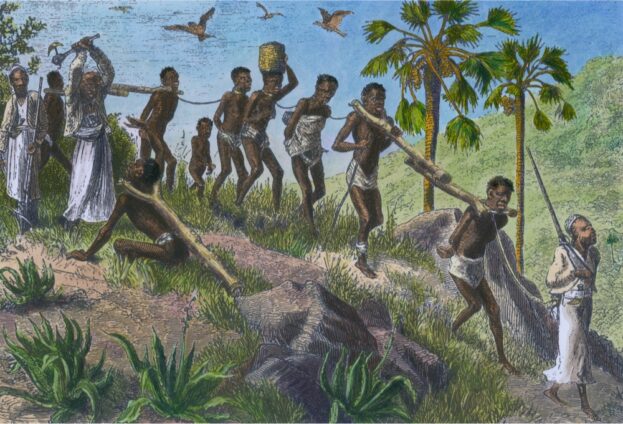
Domestic slavery thrived in west Africa even after abolition. Wikimedia Commons/Flickr

BY MICHAEL E. ODIJIE
ASSOCIATE PROFESSOR OF AFRICAN
STUDIES AND AFRICAN HISTORY,
UNIVERSITY OF OXFORD

When historians and the public think about the end of domestic slavery in west Africa, they often imagine colonial governors issuing decrees and missionaries working to end local traffic in enslaved people.

Two of my recent publications tell another part of the story. I am a historian of west Africa, and over the past five years, I have been researching anti-slavery ideas and networks in the region as part of a wider research project.

My research reveals that colonial administrations continued to allow domestic slavery in practice and that African activists fought this.

In one study I focused on Francis P. Fearon, a trader based in Accra, the Ghanaian capital. He exposed pro-slavery within the colonial government through numerous letters written in the 1890s (when the colony was known as the Gold Coast).

In another study I examined the Lagos Auxiliary, a coalition of lawyers, journalists and clergy in Nigeria. Their campaigning secured the repeal of Nigeria’s notorious Native House Rule Ordinance in 1914. That ordinance had been enacted by the colonial government to maintain local slavery in the Niger Delta region.

Considered together, the two studies demonstrate how local campaigners used letters, print culture, imperial pressure points and personal networks to oppose practices that had kept thousands of Africans in bondage.

The methods Fearon and the Lagos Auxiliary pioneered still matter because they show how marginalised communities can compel power‑holders to close the gap between laws and lived reality. They remind us that well‑documented local testimony, amplified trans-nationally, can still overturn official narratives, compel policy change, and keep institutions honest.

Colonial ‘abolition’ that wasn’t

West Africa was a major source of enslaved people during the transatlantic slave trade. The transatlantic trade was suppressed in the early 19th century, but this did not bring an end to domestic slavery.

One of the principal rationales for colonisation in west Africa was the eradication of domestic slavery.

Accordingly, when the Gold Coast was formally annexed as a British colony in 1874, the imperial government declared slave dealing illegal. And slave-dealing was criminalised across southern Nigeria in 1901. On paper these measures promised freedom, but in practice loopholes empowered slave-holders, chiefs and colonial officials who continued to demand coerced labour.

On the Gold Coast, the 1874 abolition law was never enforced. The British governor informed slave-owners that they might retain enslaved persons provided those individuals did not complain. By 1890, child slavery had become widespread in towns such as Accra. According to the local campaigners, it was even sanctioned by the colonial governor. This led to some Africans uniting to establish a network to oppose it.

The Niger Delta region of Nigeria had a similar experience. The colonial administration enacted the Native House Rule Ordinance to counteract the effects of the Slave-Dealing Proclamation of 1901 which criminalised slave dealing with a penalty of seven years’ imprisonment for offenders. The Native House Rule Ordinance required every African to belong to a “House” under a designated head. It went on to criminalise any person who attempted to leave their “House”. In the Niger Delta kingdoms such as Bonny, Kalabari and Okrika, the word “House” never referred to a single dwelling. Rather, it denoted a self-perpetuating, named corporation of relatives, dependants and slaves under a chief, which owned property and spoke with one voice. By the 1900s, “Houses” had become the primary units through which slave ownership was organised.

Therefore, the Native House Rule Ordinance compelled enslaved people in Houses to remain with their masters. The masters were empowered to use colonial authority to discipline them. District commissioners executed arrest warrants against runaways. In exchange, the House heads and local chiefs supplied the colonial administration with unpaid labour for public works.

African campaigners in Accra and Lagos organised to challenge what they perceived as the British colonial state’s support for slavery.

Fearon: an undercover abolitionist in Accra

Francis Fearon was an educated African, active in the Accra scene during the second half of the 19th century. He was highly literate and part of elite circles. He was closely associated with the journalist Edmund Bannerman. He regularly wrote to local newspapers, often expressing concerns about racism against Black people and moral decay.

On 24 June 1890, Fearon sent a 63-page letter, with ten appendices, to the Aborigines’ Protection Society in London. That dossier would form the basis of several further communications. He alleged that child trafficking continued.

As evidence, he transcribed the confidential court register of Accra and claimed that Governor W. B. Griffith had instructed convicted slave-owners to recover their “property”.

Fearon’s tactics were audacious. He remained anonymous, relied on court clerks for documents, and supplied the Aborigines’ Protection Society with evidence. He pleaded with the society to investigate the colonial administration in the Gold Coast.

Although the society publicised the scandal, subsequent narratives quietly effaced the African source.

Lagos elites organise – and name the problem

Like Fearon, Nigerian campaigners also wrote to the Anti-Slavery and Aborigines’ Protection Society. They denounced the colonial government in Nigeria for promoting slavery, but they did not remain anonymous.

By this time, the Native House Rule Ordinance had prompted some enslaved people to flee the districts in which it was enforced. They sought refuge in Lagos. Through these arrivals, Lagosian elites learned of the ordinance. They unleashed a vigorous campaign against the colonial state.

The principal figures in this movement included Christopher Sapara Williams, a barrister, and James Bright Davies, editor of The Nigerian Times. Others included politician Herbert Macaulay, Herbert Pearse, a prominent merchant, Bishop James Johnson and the Reverend Mojola Agbebi. Unlike Fearon’s lone-wolf strategy, they mounted a coordinated assault on the colonial administration. They drafted petitions, briefed sympathetic European organisations, and inundated local newspapers with commentary.

Their arguments blended humanitarian indignation with constitutional acumen. They insisted that the ordinance contravened both British liberal ideals and African custom.

After years of pressure the law was amended and then quietly repealed in 1914.

Why these stories matter now

Contemporary scholarship on abolition is gradually shifting from asking “what Britain did for Africa” to examining the role Africans played in ending slavery.

Many African abolitionists who fought and lost their lives in the struggle against slavery have long gone unacknowledged. This is beginning to change.

The two articles discussed here highlight the creativity of Africans who, decades before radio or civil-rights NGOs, used transatlantic information circuits. They exposed colonial governments that continued to rely on forced-labour economies long after slavery was supposed to have ended.

They remind us that grassroots documentation can overturn official narratives. Evidence-based advocacy, coalition-building, and the strategic use of global media remain potent instruments.

READ ORIGINAL STORY HERE

Sunday, January 12, 2025

I Study Modern-Day Slavery − And Here’s What I’ve Learned About How Enslavers Try To Justify Their Actions

Descendants of Sally Hemings and Thomas Jefferson held their first official family reunion at Jefferson’s home, Monticello, in Charlottesville, Va., in 2003. AFP Photo/Paul J. Richards via Getty Images

BY MONTI DATTA
ASSOCIATE PROFESSOR OF
POLITICAL SCIENCE,
UNIVERSITY OF RICHMOND

Several high-profile celebrities were slapped with human-trafficking charges in late 2024, from music mogul Sean Combs, known as P. Diddy, to Abercrombie & Fitch CEO Mike Jeffries. Neither has been tried yet, but in 2022 the R&B superstar R. Kelly was convicted of sex-trafficking crimes that dated back decades. He was sentenced to 30 years.

Sex trafficking, like forced labor, is a contemporary form of slavery. I am an academic who studies the mindset of slaveholders to understand more fully their rationale for what they do, in hopes of finding better ways to eradicate modern-day enslavement.

Early thinking on owning slaves

Historically, many revered figures have endorsed slavery.

“For that some should rule and others be ruled is a thing not only necessary, but expedient,” the ancient philosopher Aristotle reasoned in his book “Politics,” written around 350 B.C.E. “From the hour of their birth, some are marked out for subjection, others for rule.”

Aristotle argued that some people, such as those with mental impairments, were inferior to those with greater mental faculties. He believed this was part of the natural order. Enslaved persons, as Aristotle saw them, could be seen as a public good, to be used by the elite for the productivity of society.

This kind of thinking continued with America’s Founding Fathers, including Thomas Jefferson.

Jefferson condemned slavery and warned of its dangers, saying in 1820 that enslaving a human was like holding “a wolf by the ears.” Yet Jefferson maintained that Black people were inferior to white people and owned hundreds of slaves. He repeatedly raped one enslaved woman, Sally Hemings, fathering six children with her.

Jefferson’s thinking and behavior is characteristic of U.S. slaveholders prior to the Civil War. As scholars Elizabeth Fox-Genonese and Eugene D. Genonese explain, although many antebellum slaveholders were pious, they used faith to justify the American slave trade.

Mindset of the modern slaveholder

Today, upward of 50 million people are enslaved worldwide, trapped in sex trafficking, forced marriage and various kinds of involuntary labor.

Many enslaved persons live in Global South countries and work in industries ranging from electronics and seafood to agriculture. Their free labor provides cheap goods and services for rich countries. Their enslavers may be individuals, criminal rings or families, but big global companies are often complicit. Several Fortune 500 companies, including Apple, Samsung, Nestlé and Nike, have been charged with or admitted to using slave labor.

Academic research on the mindset of modern slaveholders is limited.

In perhaps the most comprehensive analysis to date, sociologist Austin Choi-Fitzpatrick focuses on India, where an estimated 11 million people are enslaved, many in debt bondage in agriculture, textiles, brick kilns and stone quarries.

Choi-Fitzpatrick finds that slaveholders in India tend to be paternalistic; they think of the enslaved as part of their extended family. Slaveholders buy into a myth that without their help the enslaved would be helpless, like children.

“Like a shepherd who knows his herd, we know the laborers,” one slaveholder says in Choi-Fitzpatrick’s 2017 book.

Part of this mindset likely stems from India’s caste system, in which members of higher castes believe they are superior to those belonging to lower castes.

Journalistic accounts have identified a similar mindset among South Korean slaveholders, too.

Novelist and broadcaster Marcel Theroux of the documentary series “Unreported World” reported in 2015 that scores of disabled people were enslaved on salt farms in South Korea.

South Korea’s social welfare system lags other major developed nations. People with disabilities can end up homeless on the streets, where they become easy prey for criminal networks that ensnare them into debt bondage, forced to work off an unpayable debt on salt farms.

Yet, South Korean slaveholders often believe they are doing the enslaved a favor, Theroux’s reporting found.

“My wife and I are just like real parents to him. In fact, people say we are closer to him than to our real sons who’ve left home,” one slaveholder said of his relationship with an enslaved laborer.

Slavery in the US

People are enslaved in the U.S., too. The National Human Trafficking Resource center, which documents cases of forced labor and sex trafficking, has identified 197,000 victims of human trafficking since 2007.

In a bombshell revelation published after his death in 2017, Pulitzer Prize-winning reporter Alex Tizon wrote about growing up in the U.S. with a domestic slave named Lola.

Tizon’s grandfather had purchased Lola in the Philippines as a present for Tizon’s mother, who then moved to the U.S. Lola stayed enslaved in Tizon’s family for 56 years until her death in 2011. Despite his misgivings about slavery, Tizon hailed Lola “a hallowed figure in (his) extended family.”

The U.S. has laws, including the Trafficking Victims Protection Act, that ban such behavior. But enslavers find ways to skirt the law. Coyotes and other middlemen who smuggle people into the country find a lucrative market for the forced labor of their victims.

Purchasing a slave is not expensive today. A domestic servant from Haiti can be bought for about US$50 with the requisite forged documents to bypass immigration. An Eastern European slave costs about $500.

This relatively cheap price stems from globalization along with the global population explosion. Human beings are, in scholar Kevin Bales’ words, disposable.

Survivors such as Rachel Lloyd and Holly Austin Gibbs have published their testimonies of being trafficked in Germany and the U.S., respectively. Their accounts offer some insight into the mindset of modern slaveholders.

In their memoirs, they write that their slaveholders thought of the people they enslaved as an economic commodity and cared little for their emotional well-being. Slaveholders, in their experience, were manipulative and violent. Their goal in trafficking teenage girls was simply to turn a profit.

This perspective recalls in some sense Aristotle’s thinking – that a slave is a tool to be used by another.

More research to be done

The field of contemporary slavery studies is relatively young. Data and research on modern slavery began to appear only about two decades ago, and that work focused on the systemic causes of enslavement – not on individual perpetrators.

Given the unique cultural underpinnings of slavery that vary around the world and over time, academia is still far from developing a general theory of what slaveholders think. There simply isn’t much research on their mindset.

Yet as the global population continues to explode, millions more people are likely to be enslaved in the coming years. Enslavement will continue to take familiar forms, from forced labor to sex trafficking, while the internet and social media provide new venues for online recruitment and cyber enslavement.

And if 2025 is anything like 2024, this year will see even more high-profile cases of celebrities accused of human trafficking.

I believe a better understanding of the mindset of slaveholders is crucial to combat contemporary slavery. Breakthroughs in understanding the thinking of other perpetrators, such as serial killers, has helped law enforcement better profile suspects, understand their thinking and develop better strategies and tool kits to apprehend them.

More fully understanding the people who dare to enslave another human being could give law enforcement worldwide a better shot at stopping this crime against humanity.

READ ORIGINAL STORY HERE

Wednesday, October 23, 2024

Many Wealthy Members Of Congress Are Descendants Of Rich Slaveholders − New Study Demonstrates The Enduring Legacy Of Slavery

Legislators in the House of Representatives debate the abolition of the 1836 gag rule, which prevented discussion of any laws concerning slavery. MPI/Getty Images

AUTHORS:

NEIL KR SEHGAL
PH.D CANDIDATE IN COMPUTER
AND INFORMATION SCIENCE
UN IVERSITY OF PENNSYLVANIA

ASHWINI SEHGAL
PROFESSOR, DEPARTMENT OF
MEDICINE, SCHOOL OF MEDICINE
CASE WESTERN RESERVE UNIVERSITY 

The legacy of slavery in America remains a divisive issue, with sharp political divides.

Some argue that slavery still contributes to modern economic inequalities. Others believe its effects have largely faded.

One way to measure the legacy of slavery is to determine whether the disproportionate riches of slaveholders have been passed down to their present-day descendants.

Connecting the wealth of a slaveholder in the 1860s to today’s economic conditions is not easy. Doing so requires unearthing data for a large number of people on slaveholder ancestry, current wealth and other factors such as age and education.

But in a new study, we tackled this challenge by focusing on one of the few groups of Americans for whom such information exists: members of Congress. We found that legislators who are descendants of slaveholders are significantly wealthier than members of Congress without slaveholder ancestry.

How slavery made the South rich

In 1860, one year before the Civil War, the market value of U.S. slaves was larger than that of all American railroads and factories.

At the time of emancipation in 1863, the estimated value of all enslaved people was roughly US$13 trillion in today’s dollars. The lower Mississippi Valley had more millionaires, all of them slaveholders, than anywhere else in the country.

Some post-Civil War historians have argued that emancipation permanently devastated slave-owning families.

More recently, however, historians discovered that, while the South fell behind the North economically immediately following emancipation, many elite slaveholders recovered financially within one or two generations.

They accomplished this by replacing slavery with sharecropping – a kind of indentured servitude that trapped Black farm workers in debt to white landowners – and enacting discriminatory Jim Crow laws that enforced racial segregation.

100 descendants of slaveholders

Using genealogist-verified historical data and financial data from annual congressional disclosures, we examined members of the 117th Congress, which was in session from January 2021 to January 2023.

Of its 535 members, 100 were descendants of slaveholders, including Democratic Sen. Elizabeth Warren and Republican Sen. Mitch McConnell.

Legislators whose ancestors were large slaveholders – defined in our study as owning 16 or more slaves– have a current median net worth five times larger than their peers whose ancestors were not slaveholders: $5.6 million vs. $1.1 million. These results remained largely the same after accounting for age, race and education.

Wealth creates many privileges – the means to start a business or pursue higher education. And intergenerational wealth transfers can allow these advantages to persist across generations.

Because members of Congress are a highly select group, our results may not apply to all Americans. However, the findings align with other studies on the transfers of wealth and privilege across generations in the U.S. and Europe.

Wealth, these studies find, often stays within rich families across multiple generations. Mechanisms for holding onto wealth include low estate taxes and access to elite social networks and schools. Easy entry into powerful jobs and political influence also play a part.

Privilege with power

But members of Congress do not just inherit wealth and advantages.

They shape the lives of all Americans. They decide how to allocate federal funds, set tax rates and create regulations.

This power is significant. And for those whose families benefited from slavery, it can perpetuate economic policies that maintain wealth inequality.

Beyond inherited wealth, the legacy of slavery endures in policies enacted by those in power – by legislators who may be less likely to prioritize reforms that challenge the status quo.

COVID-19 relief legislation, for example, helped reduce child poverty by more than 70% while bringing racial inequalities in child poverty to historic lows. Congress failed to renew the program in 2022, plunging 5 million more children into poverty, most of them Black and Latino.

The economic deprivation still experienced by Black Americans is the flip side of the privilege enjoyed by slaveowners’ descendants. The median household wealth of white Americans today is six times higher than that of Black Americans – $285,000 versus $45,000.

Meanwhile, federal agencies that enforce antidiscrimination laws remain underfunded. This limits their ability to address racial disparities.

The path forward

As the enduring economic disparities rooted in slavery become clearer, a growing number of states and municipalities are weighing some form of practical and financial compensation for the descendants of enslaved people.

Yet surveys show that most Americans oppose such reparations for slavery. Similarly, Congress has debated slavery reparations many times but never passed a bill.

There are, however, other ways to improve opportunities for historically disadvantaged populations that could gain bipartisan backing.

A majority of Americans, both conservatives and liberal, support increased funding for environmental hazard screening, which assesses the potential impact of a proposed project. They also favor limits on rent increases, better public school funding and raising taxes on the wealthy.

These measures would help dismantle the structural barriers that perpetuate economic disparities. And the role of Congress here is central.

Members of Congress do not bear personal responsibility for their ancestors’ actions. But they have an opportunity to address both the legacies of past injustices and today’s inequalities.

By doing so, they can help create a future where ancestral history does not determine economic destiny.

READ ORIGINAL STORY HERE

Wednesday, November 15, 2023

China Leads List Of Labor Abusers, Sometimes Akin To Slavery, Detected On Fishing Vessels Worldwide

FILE - In this July 2021 photo provided by Sea Shepherd, the Chang Tai 802, a Chinese-flagged ship, fishes for squid at night on the high seas off the west coast of South America. Hazardous work conditions sometimes akin to slavery have been detected on nearly 500 industrial fishing vessels around the world, including this one, but identifying those responsible for abuses at sea is hampered by a lack of transparency and regulatory oversight, according to research by the Financial Transparency Coalition released on Wednesday, Nov. 15, 2023. (Isaac Haslam/Sea Shepherd via AP, File)

BY JOSHUA GOODMAN

MIAMI (AP)
— Hazardous, forced work conditions sometimes akin to slavery have been detected on nearly 500 industrial fishing vessels around the world, but identifying those responsible for abuses at sea is hampered by a lack of transparency and regulatory oversight, a new report concluded.

The research by the Financial Transparency Coalition, a Washington, D.C.-based nonprofit organization that tracks illicit money flows, is the most comprehensive attempt to date to identify the companies operating vessels where tens of thousands of workers every year are estimated to be trapped in unsafe conditions.

The report, published Wednesday, found that a quarter of vessels suspected of abusing workers are flagged to China, whose distant water fleet dominates fishing on the high seas, traditionally lawless areas beyond the jurisdiction of any single country. Vessels from Russia, Spain, Thailand, Taiwan and South Korea were also accused of mistreatment of fishers.

This story was supported by funding from the Walton Family Foundation. The AP is solely responsible for all content.

Forced labor in the seafood industry is a rarely seen but common phenomenon, one increasingly recognized as a “widespread human rights crisis,” according to the report’s authors. The Associated Press in 2015 uncovered the plight of thousands of migrant workers from Myanmar, Cambodia and Laos who were abused while employed on Thai vessels whose catch often ended up in the United States.

Globally, as many as 128,000 fishers face threats of violence, debt bondage, excessive overtime and other conditions indicative of forced labor, according to the U.N.'s International Labor Organization.

U.S. and European companies are under increasing pressure to clean up supply chains in labor-intensive industries where worker abuse is widespread. The Financial Action Task Force set up by the Group of Seven wealthiest democracies has identified illegal logging and mining as a key driver of money laundering and encouraged its members to set up publicly available databases to raise awareness about the financial flows that fuel environmental crimes.

However, the seafood industry has so far escaped the same scrutiny, in part because governments often lack the tools to regulate what takes place hundreds of miles from land. This week, President Joe Biden’s administration decided to abandon a planned expansion of the flagship Seafood Import Monitoring Program used to prevent illegal fishing and forced labor on foreign vessels, which supply about 80% of the seafood Americans eat.

“We are once again seeing the heartbreaking reality of what is happening on some commercial fishing vessels out at sea and it’s completely unacceptable,” Beth Lowell, vice president in the U.S. for the conservation group Oceana, said about the report, which she had no role in. “Forced labor and other human rights abuses should not be the cost for a seafood dinner.”

The National Oceanic and Atmospheric Administration said Tuesday that it decided to shelve the planned expansion after receiving public feedback on the proposed rule changes and would instead focus its attention on improving the impact of the current import monitoring program, which covers around 1,100 species.

Another obstacle to transparency: offenders are frequently licensed by governments like Panama and Belize with reputations for financial secrecy and minimal oversight of their fleets. Of the vessels suspected of abuse and whose ownership could be identified by the Financial Transparency Coalition, 18% flew so-called flags of convenience companies use to avoid careful examination and hide their shareholder structure.

The report identified two Chinese companies — ZheJiang Hairong Ocean Fisheries Co. and Pingtan Marine Enterprises — as the worst offenders, with 10 and seven vessels, respectively, accused of human rights violations. A third company, state-owned China National Fisheries Corp., had five.

None of the companies responded to AP’s request for comment. But ZheJiang Hairong in a statement last year to the state-owned Fujian Daily claimed ownership of only five of the 10 vessels that would later appear on the Financial Transparency Coalition’s list. Pingtan last year was sanctioned by the Biden administration over allegations of illegal fishing and labor abuse. and later saw its shares delisted from the New York Stock Exchange.

The Financial Transparency Coalition scoured government reports, media accounts and complaints by advocacy groups to come up with a list of 475 individual vessels suspected of forced labor since 2010. Of that amount, flag information was available for only about half of the total — another indication of the need for greater ownership transparency, the group says.

AP Reporter Fu Ting in Washington, D.C., and AP researcher Wanqing Chen in Beijing contributed.

Contact AP’s global investigative team at Investigative@ap.org or https://www.ap.org/tips/

Wednesday, August 09, 2023

Righting Imperialism’s Wrongs, Past And Present


BY NANI JANSEN REVENTLOW

A t long last, European countries have begun to grapple with their colonial legacies. In the Netherlands, the government has issued an apology for the country’s role in the global slave trade, and the king has ‘asked for forgiveness.’ The United Nations Special Rapporteur on the Rights of Indigenous Peoples has urged Denmark to ‘address the negative impacts’ of its colonisation of Greenland. And in the United Kingdom, media outlets, the Church of England, and cities like Manchester have acknowledged the hard truth: their wealth and power were built on the backs of enslaved people.

While these efforts are rightly recognised as historic, they have also been criticised for a lack of consultation with affected communities and an apparent reluctance to provide meaningful reparations. In fact, these statements and apologies often sidestep the question of what reparations should entail, rendering them toothless gestures of pseudo-accountability.

To be sure, the discussions such public apologies spark help raise the public’s awareness about the horrors of colonialism. The conversations they nurture are crucial, and the fact that they are occurring in Europe’s most venerable institutions – royal palaces, museums, centuries-old foundations, businesses, and media conglomerates – is a testament to the relentless efforts of organisers and communities to keep history from being swept under the proverbial rug.

But we must be wary of what Georgetown University’s Olúfẹ́mi O. Táíwò calls ‘elite capture,’ whereby potentially transformative and liberating concepts are stripped of their radical content and appropriated by the political, social and economic forces they target. In many ways, the reparations discourse is already being co-opted in this way.

Buying their way out

While important, none of the recent acknowledgments and apologies seeks to tackle the living legacy of slavery, colonialism, imperialism and the extractive capitalism that they underpinned. Official apologies can serve as a good starting point, but those in positions of power must not be permitted to use the process of reckoning with the atrocities of colonial plunder to evade real accountability.

Focusing solely on memorialising and apologising for historical injustices without acknowledging their enduring effects risks perpetuating structural inequalities. Colonialism undergirded the international economic order. The over-policing of black youth, disproportionately high mortality rates among non-white mothers, workplace discrimination, migrants’ limited access to social services, and the necropolitics of ‘Fortress Europe’ are all part of the legacy of the racist imperialism upon which Europe’s wealth was built.

To address these systemic injustices, we must recognise that the emphasis on financial restitution in current debates about reparations is a problem. If we are not careful, governments and institutions could use this money-centric definition of reparations as a cop-out. As we know from international law, countries often prefer to pay damages for their human-rights violations rather than take meaningful steps such as revising laws, policies and practices.

This is not to downplay the vital role of wealth redistribution in building a just world. But financial settlements that seek merely to placate those who call for justice are not the same as redistributive policies that target systemic inequality. So far, European governments and institutions have been more than eager to blur the distinction between the two.

As Esther Stanford-Xosei and the Pan-Afrikan Reparations Coalition in Europe have argued, the financial aspect of reparations ‘will be meaningful only if it serves the holistic purpose and strengthens the integral whole of our self-repair process.’ In other words, any form of reparations must enable communities to reclaim power, dignity, and stewardship over their shared wealth and resources. If reparations are solely focused on the past, we risk neglecting the present and weakening their emancipatory potential. A more historically informed approach would view reparations as part of a larger project.

Much like the broader struggle for racial, social, economic, and climate justice, the purpose of reparations is to help build a more equitable world. The transition to such a world will not be costless and will undoubtedly require sacrifices. Reparations should ensure that these costs are distributed fairly rather than provide a monetary band-aid.

To bring about a more just future, we must first meet the most urgent needs of communities grappling with the lasting legacies of colonialism. This means dismantling the unequal power structures in our legal, education, health-care, and political systems, as well as our workplaces and public services.

By adopting a community-oriented approach to addressing structures of oppression, we can ensure that marginalised groups have equal access to essential public goods. But we must also be willing to challenge the inherently harmful and extractive systems that we often take for granted.

Simply put, we can no longer accept that any framework, institution, or process that affects marginalised communities is established or operated without their meaningful participation. Rectifying historical injustices is not just about righting past wrongs. To create a more equitable society, we must also address colonialism’s ongoing effects.

READ ORIGINAL STORY HERE

Tuesday, May 23, 2023

'Modern Slavery' Most Common In North Korea And Eritrea: Study

Image via Asmarino

LONDON (AFP)--North Korea, Eritrea and Mauritania have the highest prevalence of modern slavery in the world, according to the 2023 Global Slavery Index published Wednesday, which noted a "worsening" situation globally since its last survey five years earlier.

The report said an estimated 50 million people were "living in situations of modern slavery" in 2021, an increase of 10 million over 2016, when the problem was last measured.

The figure includes some 28 million people in forced labour and 22 million living in a forced marriage.

The situation is worsening "against a backdrop of increasing and more complex armed conflicts, widespread environmental degradation" and impacts from the coronavirus pandemic, among other factors, the investigation said.

Compiled by the human rights charity Walk Free, the report defines modern slavery as encompassing "forced labour, forced or servile marriage, debt bondage, forced commercial sexual exploitation, human trafficking, slavery-like practices, and the sale and exploitation of children."

Slavery's core principle entails "the systematic removal of a person’s freedom" -- from the right to accept or refuse labour to the liberty to determine if, when and whom to marry.

By this benchmark, reclusive and authoritarian North Korea has the highest prevalence of modern slavery (104.6 per 1,000 population), according to the report.

It is followed by Eritrea (90.3) and Mauritania (32), which in 1981 became the last country in the world to make hereditary slavery illegal.

The 10 countries with the highest prevalence of modern slavery have some common characteristics, including "limited protections for civil liberties and human rights".

Many of the countries are in "volatile" regions experiencing conflict or political instability, or home to a large populaton of "vulnerable people" such as refugees or migrant workers.
'Mirror held to power'

Also in the top 10 globally were Saudi Arabia, the United Arab Emirates and Kuwait, where migrant workers' labour rights are restricted by the "kafala" sponsorship system.

Other countries in the top 10 are Turkey, "which hosts million of refugees from Syria", Tajikistan, Russia and Afghanistan.

While forced labour is more common in low-income countries it is "deeply" connected to demand from higher-income countries, the report said, noting that two-thirds of all forced labour cases are linked to global supply chains.

The report said G20 countries -- made up of the EU and the world's 19 top economies -- are currently importing $468 billion worth of goods that are at risk of being produced with forced labour, up from $354 billion in the previous report.

Electronics remain the highest value at-risk product, followed by garments, palm oil and solar panels, in a sign of high demand for renewable energy products.

"Modern slavery permeates every aspect of our society. It is woven through our clothes, lights up our electronics, and seasons our food," the group's founding director Grace Forrest said.

"At its core, modern slavery is a manifestation of extreme inequality. It is a mirror held to power, reflecting who in any given society has it and who does not," she added.

© 2023 AFP

Tuesday, May 09, 2023

West African Slave Trade: Buyers And Sellers


BY ROBERT L. MARONIC

Last week I read an article in The Washington Post published on March 28 entitled “Harris Touches on Africa’s Painful Past – and Youthful Future” by Cleve R. Wootson Jr. The article’s subtitle was “The Vice President Visits Cape Coast Castle, Once a Clearinghouse for Enslaved People.”

I found the article overall interesting not so much for what was reported, but for what was not reported.

At the top of the article was an oversized picture of Vice President Kamala Harris standing to the left of her husband Second Gentleman Doug Emhoff understandably wiping a tear from his right eye with his left thumb “during a tour of Cape Coast Castle in Ghana.”

If I were taking a tour of this slave fortress, I also would be shedding a few tears in this sad depressing museum, which is the polar opposite of Ellis Island and Castle Garden (Castle Clinton) in New York Harbor. That is because this slave fortress from 1653 to 1807 was much more similar to the outer ring of the seventh circle of Hell in Dante’s Inferno than any immigration port of entry in the United States.

The article mentioned “Ghana’s unique and dark connection to the African diaspora – and to [Harris] herself.” It mentioned how “75 percent” of the transatlantic slave forts were built on land, which would later be located in modern Ghana (map).

As Harris toured the subterranean dungeons and the mournful “door of no return,” she accurately observed that the African slaves “were kidnapped from their homes,” and “transported hundreds of miles from their home [sic]” to face the brutalities of slavery at the coastal slave fortress and eventual enslavement in the Americas.

However, neither the vice president nor The Washington Post reporter explained who exactly did the kidnapping, and hence who was ultimately responsible for this west “African diaspora?”

I suppose such an explanation would be both politically incorrect and detrimental to Ghanaian-American relations. God forbid.

Harris later stated in a speech at the same museum without specifically naming any esteemed politicians that “some Republican governors have argued that lessons on Black history are ideological or “woke,” and should be kept out of public schools.” In my opinion, African-American history needs to be taught accurately in all private and public schools either as a one or two semester elective or integrated within the U.S. history curriculum and not just in February.

That should also include the teaching of native American (e.g. Pequot), feminist, Hispanic and other “spokes” on the wheel of American history, but I digress.

In 2003 I once worked with a high school history teacher originally from Togo (map), which borders Ghana to the east, who was generally appalled at the poor behavior of both many white and black students in Roanoke City Public Schools. Like all immigrants he was in search of the American dream. However, he once told me privately how “there was a deep sense of shame in west Africa how Africans treated their fellow Africans by selling them into slavery.”

According to Henry Louis Gates Jr., the teacher’s words were highly reminiscent of when President Mathieu Kérékou of Benin (map) “made a pilgrimage to the Church of the Great Commission in Baltimore in February 1999 in order to apologize on his knees to African-Americans for the African role in the slave trade.”

My Togolese colleague told me that most European slave buyers timidly stayed on their clipper ships, offshore islands (e.g. Gorée and Bunce Islands) or inside their scores of coastal slave forts (e.g. Elmina Castle) because the multitude of west African “nations” or tribes were sovereign states, and had all forbidden any unauthorized excursions or slave-hunting expeditions inside their territory. To do so would have been regarded as an act of war.

The history teacher also told me that the Europeans had a big “health incentive” not to travel beyond the coastline because they had no natural immunity against such deadly African diseases as malaria and dengue fever similar to how native North Americans had no natural immunity against such fatal European diseases as measles and smallpox.

My west African friend clearly told me that it was Africans, who kidnapped other African men, women and children, and sold them into slavery along with criminals, prisoners of war and debtors. In plain words, the west Africans were the sellers and the Europeans were the buyers.

He called the jungle scene in the 1977 television miniseries “Roots” by Alex Haley when Kinta Kunte frightfully witnessed his fellow Africans being bound and marched single file into bondage guarded by their white captors while he was trying to capture a bird in a rite of manhood as “pure fiction” and a “whitewash.”

He also referred to the slave trade as the “African exchange” similar to the New World’s “Columbian exchange” except that “Africa ultimately came out on the losing end of the stick.” The African exchange basically involved the trading of west African slaves for “metals, cloth, beads, guns, and ammunition” along with many other manufactured goods, rum, tobacco and such foods as corn and cassava.

Regardless of who were the sellers and buyers of slaves in west Africa, in my opinion American slaves and their descendants in both the North and South should have received some form of reparation between 1865 and 1880. The problem in 2023 is that all the slaves from the Reconstruction era are no longer alive to receive any just compensation whether in the form of land, animals, money or a triple combination.

Verifying today which African-Americans are directly descended from antebellum slaves would be extremely difficult since the Immigration and Nationality Act of 1965, which has allowed millions of people from both the Caribbean and Africa to emigrate to the U.S., along with much higher rates of racial intermarriage since 1967.

If there are ever going to be any reparations for slavery in the United States, it would first have to start with such west African countries as Senegal, Sierra Leone, Ghana, Ivory Coast, Togo, Benin, Nigeria, and other modern successor states to such precolonial slave kingdoms as the Dahomey (southern Benin), Ojo, Yoruba (southwestern Nigeria), Asante (southern Ghana), and other kingdoms.

Then since the United States was a British colony from 1607 to 1783, London would be next in line for paying reparations along with other nations such as France or Spain which were responsible for the slaves’ transport to the U.S. via the brutal and tortuous Middle Passage.

And finally, who would decide if a person is sufficiently black or African-American? For example, would a Caucasian, who is either less than 1% or 10% Senegalese, qualify for full or partial reparations? Perhaps this person would qualify for no reparations? Then what happens to a person who cannot trace his DNA to west Africa like Barack Obama, who had a Kenyan father?

These are all questions for another column.

READ ORIGINAL STORY HERE

Saturday, January 21, 2023

Door Of No Return: Yellen Visits Onetime Slave-Trading Post

U.S. Treasury Secretary Janet Yellen stands in the "Door Of No Return" on Goree Island, Senegal, Saturday Jan. 21, 2023. Yellen has paid a solemn visit to an island off Senegal that is one of the most recognized symbols of the horrors of the Atlantic slave trade that trapped tens of millions of Africans in bondage. She is in Senegal as part of a 10-day trip aimed at rebuilding economic relationships between the U.S. and Africa. (AP Photo/Stefan Kleinowitz)

BY FATIMA HUSSEIN

GOREE ISLAND, SENEGAL (AP
) — U.S. Treasury Secretary Janet Yellen paid a solemn visit Saturday to the salmon-colored house on an island off Senegal that is one of the most recognized symbols of the horrors of the Atlantic slave trade that trapped tens of millions of Africans in bondage for generations.

Yellen, in Senegal as part of a 10-day trip aimed at rebuilding economic relationships between the U.S. and Africa, stood in the Gorée Island building known as the House of Slaves and peered out of the Door of No Return, from which enslaved people were shipped across the Atlantic.

“Gorée and the trans-Atlantic slave trade are not just a part of African history. They are a part of American history as well,” Yellen said in brief remarks during her visit.

“We know that the tragedy did not stop with the generation of humans taken from here. Even after slavery was abolished, Black Americans — many of whom can trace their descendance through ports like this across Africa — were denied the rights and freedoms promised to them under our Constitution.”

The economic benefits that major slave-trading nations, including the United States, reaped for hundreds of years on the backs of unpaid labor could amount to tens of trillions of dollars, according to research on the commerce.

And in the U.S., African slaves and their children contributed to the building of the nation’s most storied institutions, including the White House and Capitol, according to the White House Historical Association.


Yellen acknowledged the ongoing ramifications of that brutal past.

“In both Africa and the United States, even as we have made tremendous strides, we are still living with the brutal consequences of the trans-Atlantic slave trade,” she said.

“What I take from this place is the importance of redoubling our commitment to fight for our shared values and principles wherever they are threatened — in the United States, in Africa, and around the world,” she said. ”We have more work to do.”

Yellen’s trip to the island is one that many dignitaries have made, including former U.S. presidents Barack Obama and Bill Clinton and South Africa’s Nelson Mandela. Today, Gorée Island is designated as a UNESCO World Heritage Site.

Yellen’s stop there during a trip meant to revitalize U.S.-African economic relations is one that evoked the massive costs of the slave trade. There has been a resurgence in interest in determining the true cost of slavery on the generations impacted.

The House Financial Services Committee in recent years has studied how U.S. banks and insurance companies profited from the practice of slavery before it was outlawed in 1865. There have also been hearings on the study and development of reparations proposals in the U.S.

Thursday, November 17, 2022

How The World Turns A Blind Eye To African Slavery


BY PAUL RAFFAELE

Since I was old enough to read about Africa, I have been fascinated by the Tuareg. For more than a thousand years they were the fierce, veiled, camel-riding, sword-wielding warlords of the Sahara until they were ruthlessly conquered in the late nineteenth century by the French Foreign Legion. But when I told my family I longed to journey to the Tuaregs’ Saharan heartland, they would tap their heads signalling that I was crazy.

That chance came after I read that ruthless, nomadic, Tuareg tribes in the small Saharan nation, Niger, ignored world-wide condemnation of their practice of keeping more than 40,000 slaves — women, children, and men — in lifelong bondage. It was known as inherited slavery.

These tragic people were born as slaves, possessions of their masters from the moment they first drew breath until they died. Their owners could do with them what they wanted, even castrate rebellious adult male slaves, and sell them or give them away. They gave slave babies to relatives and friends as gifts.

How was it possible such a slave-owning nation still existed? Why wasn’t the United Nations demanding that Niger stamp out the evil practice? Why did the many nations that honourably brought down the evil apartheid system in South Africa, avert their eyes from a system far worse?

Ten years ago a news story mentioned that the crown prince of a Tuareg kingdom in Niger was bravely fighting to abolish his people’s ancient slave-owning tradition. He was a person I wanted very much to meet.

But first, for a book I was researching, Among the Great Apes, I journeyed to Cameroon. There, I found evidence of the essential connivance of historical African slave traders who sold slaves to white slave traders.

At Bimbia village, its chieftain, Alfred Ejong, confirmed that his ancestors were deeply involved in the slave trade. “Buying slaves and selling them to the white people was good business for our people,” he told me. “In the interior, there were always wars, and victorious kings and chieftains enslaved their captured enemies — men, women, and children. My ancestors went to the rulers to buy slaves and marched them back to Bimbia to sell to whites who came in big ships from across the sea.”

Alfred showed me rusted leg irons and a cutlass, its curved blade flecked with rust: “Our ancestors locked the slaves into chains and marched them here to the coast.” With a grim smile, he brandished the weapon. “Nafonde, a slave master from our village, got this from a white sailor and used it to behead any slave causing trouble. He licked the blood in front of the other slaves to frighten them so none would try to escape. Slave masters who came after Nafonde used the sword the same way.”

A dirt track led down a hill to the Atlantic Ocean. A hundred yards across the dark water was a small, uninhabited island called Niko. “Once the slaves arrived here, our ancestors took them by pirogue out onto the island. The ocean terrified the inland people, and no one dared try to escape. Our ancestors kept them there until the next slave ship arrived from America or Europe.”

Half-way down the slope was a large ship’s cannon partially buried in the damp earth. “An American slave ship captain gave this to my ancestor, the village chief, to use against pirates attacking us, attempting to seize the slaves on the island.”

Was he ashamed of his ancestors’ actions? “We didn’t force people into slavery. My ancestors were the middlemen. The trade existed and if they didn’t do it, others would.”

Slaves being the losers in tribal battles, and their wives and children, was a narrative I heard in Mali and Niger. Inherited slavery was still visibly evident there, as well as in Mauritania, which had an estimated 100,000 inherited slaves, each born to a slave woman. They became the “property” of the slave master at birth and died a slave without even a minute of their lives as a free person.

The flight from Paris to Niamey, Niger’s capital, took five hours. After flying high above the Sahara’s dun-hued sweep, we landed at dawn in a sandstorm. When the jet’s door opened, the 115 °F heat hit me like a furnace’s fiery blast.

Niamey was a sprawl of mud huts pockmarked by a few motley skyscrapers. The narrow streets were carpeted with sand swept in by the wind from the desert that fringed the city. The potholed streets swarmed with people, camels, goats, donkeys, and a few cars. I passed by hundreds of Nigeriens and not one looked overweight. The extreme heat and poverty seemed to pare humans of all fat and any excess flesh.

The Nigeriens moved along the streets with the graceful lope of desert dwellers. The streets reflected the country: a jumble of races, with tall, slim Tuareg men concealing all but their hands, feet, and dark eyes in a swathe of cotton robes and veils. Some flaunted swords buckled to their waists. Fulanis in conical hats and long robes herded donkeys, while the majority Hausa resembled their stocky tribal cousins across the border in Nigeria.

Apart from the occasional Mercedes-Benz, there was little sign of any wealth, reflecting the godforsaken nature of arid Niger. Two-thirds of the country is desert, and its people’s longevity, education and income rank 189th of the 189 countries on the UN’s human development index. More than 60 per cent of its 24 million people lived on less than $1 a day, and most others received not much more.

Idy Baroud, formerly the BBC Niger correspondent, my translator and valued companion on the journey, took me to meet a runaway slave who had bravely escaped life-long captivity. While the country’s leaders played blind to the malady, some slaves, risking a terrible beating, whipping and even castration as punishment, had escaped.

Idy said the police searched for escaped slaves and often dragged them back at gunpoint to their owners. But escapees hid in towns, especially Niamey with its population of 740,000, where they disappeared into its crowded streets and alleyways.

On Niamey’s outskirts, we entered a maze of huts whose mud walls, baked hard as concrete by the fierce sun, led us deep into a settlement that wouldn’t look out of place in the Bible. It housed several thousand people clad in robes, sandals, turbans, and veils. Children garbed in ragged clothing stared wild-eyed at me, while their parents threw me hard glances. Some were escaped slaves and Idy warned that our arrival as strangers could mean trouble.

Timizgida emerged from a mud house carrying an infant and with a four-year-old girl trailing her. She claimed to be about thirty, looked forty, and had a smile that seemed as fresh as her recent good fortune. Like all slaves, she was dark-skinned and said her parents were the slaves of fairer-skinned Tuareg nomads. Sold to her owner, a civil servant, as a baby, she never knew her parents, never even knew their names.

“My master, Abdullah had one wife and four children. I played with his children until I was eight,” she told me in a quiet voice. Then, she was suddenly yanked into the stark reality of captivity. Her fate, from then on, was the same as tens of thousands of other Saharan inherited slaves. She rose before dawn and trudged through the desert to fetch water from the distant well for her owner’s family and his thirsty herds of sheep, camels, and goats. She then toiled all day and late into the night cooking, doing chores and was fed just scraps.

“I was only allowed to rest for two or three days each year, during religious festivals like Eid, and I was never paid. My master didn’t pay his camels and so, he said, why should he pay me and his eight other slaves.” The feisty sparkle in her eyes signalled a rebellious nature, and her owner and family tried to beat it out of her many times with sticks and whips. “Sometimes they thrashed me so hard they drew blood, and the pain lingered for months.”

She was spared one indignity. “My master never had sex with me because he believed it shameful to sleep with slaves like the other masters. I had sex for the first time with a slave boy. My master encouraged me because all my children at the moment of their birth would become his slaves.”

Then, six months earlier, after a severe beating, she escaped, helped by a soldier who pitied her and paid for Timizgida and her two daughters’ bus fares to Niamey. “I shook with fear all the way to Niamey, but every time I looked at my daughters, I knew I must stay strong and never return.”

She smiled as she told me: “I’m still learning what it feels like to be free. Sometimes I wake up and feel very frightened because I think I’m back with my owner but realise I’m now in control of my own destiny.”

Her smile grew wider as she pointed to her daughters, the four-year-old and the infant. “Abdullah will never find me here. My children were also my master’s slaves, but now they’re also free, as will be their children. With freedom I became a human being. It’s the sweetest of feelings.”

History resonates with tales of humans buying and selling each other. In the Bible are many references to slaves, everyday life at that time. The Sahara’s earliest written records of slavery go back to the seventh century, but it existed long before then and sprang largely from warfare with victors enslaving the vanquished. The winners kept slaves to serve their households, work their fields, and to sell them.

In Niger, millions of unfortunates were for centuries yoked together and dragged to North African ports for sale to Europe and Arabia. Millions more in the Niger Basin were taken to West African ports and shipped to the Americas.

Niger was hot as hell during the day. But once the sun set, the temperature plunged so steeply that I breathed easily as I walked to a café near my hotel to meet Moustapha Kadi Oumani, the crown prince of a small, slave-owning kingdom. “Moustapha is fighting to end slavery in Niger,” Idi told me.

He was slim, good-looking, in his late thirties, and clad in a mauve cotton robe and sandals, but no headdress, signalling that he was a modern Tuareg.

Tuareg was an Arab word meaning “abandoned by God”, but Moustapha seemed most assuredly blessed. He was a scion of an ancient tribe that evolved from the Berbers in southern Algeria. The Greek historian Herodotus wrote about the Tuareg in the fifth century BC, noting that they controlled the trans-Saharan trade routes. Their name for themselves was Imazgan, meaning “the free people”.

The café’s open-air tables sheltered under leafy trees, the delight of desert dwellers. There were no women there. Unlike his polygamous father, the king, Moustapha had just one wife. He graduated from universities in Switzerland and Italy, and had returned to his ancient kingdom, more as a twenty-first-century man than as a medieval ruler-in-waiting. He was no wild-eyed rebel, but spoke in a calm, quiet voice that intensified the power of his thoughts on slavery which were regarded as radical, even dangerous, by many in Niger.

“In 1678, my ancestor, Agaba, fought a battle with the enemy – animists – and defeated them. He seized their kingdom, lllela, and enslaved the warriors who fought us, and their families. That meant thousands of people. Their families have been our slaves ever since. Niger’s royal families and nobles have thousands of slaves whom they treat like their camels and goats: no better, no worse. They feed them well, much as they do their livestock. But they keep them in the most degrading condition of life-long slavery.

“The owners can sell their slaves, give them away as gifts, rape the girls, and mistreat them if they are insubordinate. Some have even castrated slaves who refused to obey orders, just as you’d castrate a headstrong stallion.”

“How can slave owners mete out such cruelty,” I asked? “Surely they’re serious breaches of Niger’s legal system?”

“Yes, but my people live far from Niamey in the desert and there is very little law and order there. People do much as they like. They justify slavery as being practised by our people for thousands of years and ask why it should stop now. They say it’s Allah’s will for some to be slave owners and others to be born as their slaves.”

Moustapha’s mother, the queen, before she died, willed her many personal slaves to Moustapha. In a public ceremony in Tahoua, the town nearest his father’s kingdom, Moustapha formally freed them. “Come to Illela with me to meet my father, and slaves and their owners?” he offered. As Idy and I walked back to the hotel, he expressed surprise that Moustapha wanted to take me to his father’s kingdom. “He’s never before escorted any foreigner to Illela.”

when we left next morning, our driver’s face was covered by a white veil, hiding all but his eyes. Moustapha greeted him in Tamashek, their tribe’s ancient language. The driver bowed as he answered.

We faced a journey of 350 miles that would take seven hours. Halfway there, we turned off the road and drove across the desert, a flat, barren plain. We passed a handful of small mud-hut villages. There were no women in sight, but the men, Tuareg, were clad in robes and face veils.

In Niamey they seemed a badge of the man’s ethnic status, but in the desert, they were eminently practical as protection from the wind-blown sand blasting against your face all day.

“All the slaves should be freed immediately,” Moustapha said. “Human beings are resilient, and once they understand they are free, they’ll find their own way. The slaves I freed slipped into normal society without disruption.”

At Tajaye, a small village, we sat outside the mud house of Musa, a veiled Tuareg elder. We sipped syrupy tea served by a wizened, 80-year-old slave woman, Takany, who knelt in front of us. By her side stood her 4-year-old great-grandson, also Musa’s slave.

The child had a frown already etched on his features, his eyes brimmed with sadness, and he was naked, in contrast to several boys and girls his age from Musa’s extended family playing chase around the compound. They were clad in robes, sandals and even jeans, and bubbled with laughter.

During my journey through much of Niger, almost all the little slave children I saw were naked. Like Takany’s great-grandson, they stayed close to their slave relatives, as if for protection, and their features were grim, eyes wary, their step cautious. I never saw any of them smile.

“Slave children in Niger are forced by their owners to go naked at all times until they are five or six years old,” Moustapha explained. “It’s to humiliate them, make them accept they are subhuman. Their masters tell them they’ll be beasts of burden all their life, just like their donkeys, camels, and goats.”

Musa felt no shame in forcing this separation of children into clothed free-born and naked slave. “That’s his destiny,” Musa told me, echoing other slave masters I met. “He was born a bellah (slave) and will die a bellah.”

At mid-afternoon we reached Illela, the capital of Moustapha’s father’s sprawling desert domain. We drove along sandy streets lined with mud-house compounds. About 12,000 people lived there, ruled by his father, Kadi Oumani, the hereditary king. Scores of village chieftains offered him fealty. A quarter of a million people in surrounding villages gave obeisance to Kadi. Moustapha’s survey of Tuareg royalty in Niger found they alone had more than 8,000 inherited slaves. “When a princess marries, she brings slaves as part of her dowry.”

We pulled up outside a mud-wall open-air compound. Inside Kadi Oumani sat on a simple chair, as if it was a throne, with a dozen nobles, all slave-owners, seated cross-legged on the dusty ground around him. Two dozen long-horned cattle, sheep and goats noisily milled about, a deliberate reminder to the Tuareg aristocrats of their nomadic origin.

Kadi was 74 years old and, like his courtiers, wore a robe and a veil left open, revealing his bluff face. Moustapha greeted him and then the crown prince and I walked across the street to an open compound set aside for us.

Wildly pulsating music from a band of drums, horns, and cymbals signalled a ceremony that Tuareg royal protocol demanded. Moustapha motioned for me to sit beside him at the compound’s far end. Then, for the next hour, he greeted powerful nobles who came to pay homage to their king’s first-born son.

It resembled a medieval parade at court to honour the Dauphin’s arrival. Sharp-minded and elegant, Moustapha displayed to the nobles his born-to-be-king nature; his effortless, gracious command of others that came from his family’s generations of unchallenged authority. Each noble, clad in his most splendid robe and turban, entered through a door in the mud front wall. One by one, each strode grandly across the compound and bowed to Moustapha. He remained seated as tradition demanded. He chatted with each for a few minutes, and then the grand departure by one noble was followed by a grand entrance by another lavishly-clad nobleman.

Dinner was lamb grilled over a charcoal fire as a courtier sang for us an ancient, achingly sad, desert tune about love desired, love gained, love lost, and love abandoned. It mingled eerily with the whine of a freshening wind. Above, stars, glinted across the dark sky, attesting to the clean desert air.

Moustapha’s cousin, Oumarou Marafa, a burly, middle-aged nobleman who worked as a secondary school teacher, arrived after we finished the meal. “He’s a slave owner, and not ashamed of it,” Moustapha confided.

Oumarou promptly defended inherited slavery and the practice of taking young slave girls as concubines. “When I was younger, I desired one of my mother’s slaves, a beautiful 12-year-old, and mother gave her to me as a fifth wife,” he told me. “There was no marriage ceremony, she was mine to do with her as I wished.” Islam allowed a maximum of four wives and so the term “fifth wife” was a euphemism for a concubine.

“Did that mean you having sexual intercourse with the girl at that young age?” “Of course. She was ripe for lovemaking.”

A few years later, he tired of her. With Oumarou‘s permission, she went to live with a free man. But Oumarou still considered her his possession. “When I want to sleep with her, she must come to my bed, and she does. Her husband can’t object because he knows I still own her.”

Moustapha confirmed it. “It’s Tuareg custom, and her husband is too scared to object. Oumarou, as a noble, has much power. I want to ban this practice and free all the slaves. My father knows this, but never talks to me about it.”

Oumarou was dismissive of his cousin’s views. “There are many men in Illela with fifth wives,” he said, even though the cost was the equivalent of U.S.$1,000 — three years pay for a labourer. “If you want a fifth wife and have the money, slave owners have young girls for sale here in Illela.”

“Even a twelve-year-old girl?” I asked. “Yes. As young as ten. She’ll be your slave until she dies, and you’ll own any children she has.”

“But you’re a schoolteacher. Surely you wouldn’t sleep with any of your 12-year-old pupils.”

Oumarou clenched his fists and his eyes tightened. “That’s an absurd comparison. They’re children, but the fifth wives are slaves. The bellah don’t think like us, they have no moral sense like us.

“My 12-year-old fifth wife enjoyed sleeping with me. Once I showed her how, she wanted me to make love to her many times every night. I had sexual obligations to my true wives and the slave girl tired me out. That’s why I eventually sent her away.”

Until late into the night, Moustapha and I attempted to convince Oumarou of slavery’s evil nature, trying to change his belief that slaves are a lower sub-species of humans.

“Try and understand the enormous mental pain of a slave seeing their child given away as a present to another slave-owning family,” I asked. “How would you feel if your daughter was given to another family, never to see her again and knowing she was being treated no better than her owner’s camel?”

“You Westerners only understand your way of life and think the rest of the world should follow you.” With that snort he rose, said goodnight to Moustapha and Idy, but ignored me.

Next morning, Moustapha took me to the immense, 300-year-old mud palace where his father was meeting chieftains who had come to honour him or have him adjudicate disputes. Kadi sat on a modest throne from where he daily delivered judgment.

“There are no slaves in Niger,” he told me.

“But I’ve met slaves in your kingdom.”

“You mean the bellah. They’re one of the traditional Tuareg castes. We have royalty, nobles, common people, and bellah.”

“But they’re not free, they’re the possessions of their owners.”

“They are bellah and that is their fate.”

The following day Idy and I drove north to Tahoua. We spent the night in a minus-three-star Hotel Malaria, the prey of giant, buzzing mosquitoes, and departed at 7am. An hour later, turning off the road, we headed into the desert.

There was no one at the first two wells we encountered in that land of meagre rainfall. “The slaves have already watered the herds and gone,” said Fungutan, our Tuareg guide. At the third well, six small slave children were unloading empty goatskin water containers strapped to donkeys. The four younger ones were naked, while the older ones wore ragged robes. When the children saw me arrive, they screamed in terror and buried their heads into the donkeys’ flanks. Trembling in fear, they refused to lift their heads to look at me.

“They’ve never seen a white person before and they’re crying that you’re one of Satan’s demons come from hell,” Fungutan explained. Three women arrived balancing plastic water containers on their heads, having walked barefoot across the burning sand five miles from the tents of their Tuareg owner, Halilou. They covered their faces with cloth and refused to speak to us.

A middle-aged man, also barefoot and clad in a tattered blue robe, appeared walking across the sand. His face clouded when he saw us. “My master said he’ll beat me if I talk to strangers,” he said to Fungutan. He warned the others not to tell their owner about us.

He said they were all slaves of Halilou and his family, living in the Tuaregs’ encampment. Born to one of the family’s slaves, he had toiled for Halilou’s family since he was a little child. He had never received any money, just threadbare clothing, food, and water. Halilou had beaten him many times, but he had never thought of escaping because he wouldn’t know where to go or what to do. “I’ve seen the police catch runaways and bring them back to their masters who then savagely beat them as a warning to the rest of us.”

“Let’s go to Tafan’s tent,” I suggested to Fungutan. Tafan was Halilou’s brother and, Fungutan had told me, one of his slaves, a woman called Asibit, had escaped from him not long before. Fungutan looked worried. “He’s a very violent man. He doesn’t like strangers. He recently cut off the hand of a rival Tuareg.”

Idy persuaded him we should chance it, and for ten minutes the SUV headed across the sand. In the distance I spotted five dark goatskin tents. No one was in sight. All the slaves had gone to work and Tafan’s family were resting in the tents.

A tall, thin man in a robe and Tuareg veil came out to see who was approaching. He went back into the tent and re-emerged gripping a sheathed sword. We stopped the vehicle a few paces from him and got out. “Who are you?” Tafan demanded, glaring at me. “You don’t belong here.” His anger surprised me. In the Arabian desert, the Muslim Bedouin with whom I once spent several weeks welcomed even their worst enemies to their tents in their centuries-old tradition of hospitality. They slaughtered them without mercy in battle, but at their tents offered food and drink to all journeyers in the desert. Fungutan told Tafan I was a writer from a far-off land and was interested in finding out about the bellah.

“My family have owned bellah for generations,” Tafan said. “No one can take them away from us. City people came here and demanded I free them, but I chased them away with my sword. I don’t go to their places and demand they free their goats and donkeys.”

“What about Asibit?” I asked. “What did you say?” he roared.

“Asibit, your slave who escaped.” Tafan yanked out his sword and cut the air. “My sword will tell you all about Asibit,” he snarled. “Get out of here or I’ll cut off your head.”

Fungutan grabbed my shoulder and pushed me back to the vehicle. “He’s a Tuareg like me, and when a Tuareg pulls out his sword, his emotions can overwhelm his common sense, and he can’t control himself. Let’s get out of here.”

Tafan strode towards me looking eager to carry out his threat. I jumped into the SUV and slammed shut the door just before he reached me. His face twisted in anger, he banged the sword’s hilt against the door as we roared away.

Asibit now lived in a town 20 miles across the desert. There, she told me that Tafan’s family had treated her not as a human, but as chattel and a beast of burden. Her eldest daughter, Asibit said, was born after Tafan raped her. When the child turned six, he gave her as a present to his brother, Halilou, a common practice among Niger’s slave owners. Asibit, fearful of a whipping, watched in silence as Halilou took her daughter away.

“From childhood, I toiled from early morning until late at night,” she recalled matter-of-factly. She pounded millet, prepared breakfast for Tafan and his family, and ate the leftovers with the other slaves. While her husband and children herded Tafan’s livestock to the well, she did his household chores and milked his camels.

She had to move his large tent — open-fronted to catch any breeze — four times a day so his family would always be in shade. Now 51, she seemed to bear an extra two decades in her lined and leathery face. “I never received a single coin during the 50 years,” she said. She bore these indignities without complaint, but on a stormy night, she said, she seized the chance to flee, making a dash to the nearest town.

But freedom brought her new difficulties. “Former slaves suffer extreme discrimination in getting a job, government services, or finding marriage partners for their children,” Fungutan told me.

Asibit cannot hope for help from her own government. Lacking the power to confront the chieftains, lacking the space and services in the cities to accommodate a mass release of tens of thousands of slaves, lacking the funds to ease their path back into society, and fearing condemnation by the outside world by that admission of slavery, the government believed it had no choice but to continue to mask the truth and deny that slavery existed in Niger.

Back in Niamey, on my final night in Niger, we talked about how slavery could be eradicated in the country. Idy was pessimistic, believing the chieftains’ power was too strong. But Moustapha vowed to fight on. “We can’t encourage foreign nations to force us into compliance by placing trade sanctions until slavery is ended. We are one of the earth’s poorest nations and that would only impoverish us more and hurt most of all our poor people. That’s half the country.”

“What to do then?” I asked. “Slave owners are not going to free what they regard as their property,” he reasoned, “and while they wield political power, the government will not move against them to end slavery. Pressure must come from outside, especially from the US, France and the UN. Not by sanctions but by political pressure, threatening to turn us into a pariah nation. If these great powers do nothing, then slavery in Niger will never end.”

On the jet back to Paris, I pondered Moustapha’s words. In 1807, Britain banned the slave trade throughout its vast empire, and in 1865 the United States abolished slavery and freed all slaves under the Thirteenth Amendment. But more than 100,000 inherited slaves in Niger, Mauritania, and other Saharan countries suffer as the chattels of their often brutal masters.

“How much longer will the outside world ignore their cruel fate?” Moustapha had said back at Illela. “How much longer must they wait to be free?”

Postscript

Extracts from the U.S. State Department webpage: “2022 Trafficking in Persons Report: Niger”

In the Tahoua region, influential chiefs facilitate the transfer of girls from impoverished families to men as “fifth wives” for financial or political gain. This practice — known as wahaya — results in some community members exploiting girls as young as nine in forced labor and sexual servitude; wahaya children are then born into slave castes, perpetuating the cycle of slavery.

The government reported minimal law enforcement action to address hereditary slavery practices, including the enslavement of children. [It] did not report law enforcement statistics on investigations, prosecutions, or convictions of traffickers exploiting victims in hereditary slavery, [or] traditional chiefs who perpetuated hereditary slavery practices.

Hereditary and caste-based slavery practices perpetuated by politically influential tribal leaders continued in 2020. Some Arab, Zjerma, and Tuareg ethnic groups propagate traditional forms of caste-based servitude in the Tillaberi and Tahoua regions, as well as along the border with Nigeria.

READ ORIGINAL ARTICLE HERE

KNOCK, KNOCK

By issuing subpoenas to five Times journalists, the Trump administration reveals its first response to unwanted national security coverage: ...