Showing posts with label VOA. Show all posts

Tuesday, December 03, 2024

Regional Analysts Suggest Caution As Nigeria Signs New Deals With France


BY TIMOTHY OBIEZU

ABUJA, NIGERIA (VOA)
— Political analysts in Nigeria say the country needs to be careful after signing a series of agreements with France during President Bola Tinubu’s three-day visit to the European country last week.

Tinubu’s three-day visit to France was the first official state visit to Paris by a Nigerian leader in more than two decades.

During the visit, Nigeria and France signed two major deals, including a $300 million pact to develop critical infrastructure, renewable energy, transportation, agriculture and health care in Nigeria.

Both nations also signed an agreement to increase food security and develop Nigeria's solid minerals sector.

Tinubu has been trying to attract investments to boost Nigeria's ailing economy. While many praise his latest deals with France, some critics are urging caution.

The deals come as France looks for friends in West Africa following a series of military coups in countries where it formerly had strong ties — Burkina Faso, Mali and Niger.

Ahmed Buhari, a political affairs analyst, criticized the partnership.

"Everybody is trying to look for a new development partner that would seemingly be working in their own interest, but obviously we don't seem to be on the same page,” Buhari said. “We're partnering with France, who [has] been responsible for countries like Chad, Niger, Mali, Burkina Faso and the likes, and we haven't seen significant developments in those places in the last 100 years."

Abuja-based political analyst Chris Kwaja said France's strained relationships with the Sahelian states do not affect Nigeria.

"That the countries of the Sahel have a fractured relationship with France does not in any way define the future of the Nigeria-France relationship,” Kwaja said. “No country wants to operate as an island. Every country is looking at strategic partnerships and relationships.”

France has a long history of involvement in the Sahel region, including military intervention, economic cooperation and development aid. Critics say the countries associated with France have been grappling with poverty and insecurity.

Eze Onyekpere, economist and founder of the Center for Social Justice, said Nigeria must be wary of any deal before signing.

"It is a little bit disappointing considering the reputation of France in the way they've been exploiting minerals across the Sahel,’ Onyekpere said. “They've been undertaking exploitation in a way and manner that's not in the best interest of those countries. I hope we have good enough checks to make sure that the agreements signed will generally be in the interest of both countries and not a one-sided agreement."

Nigeria is France’s top trading partner in sub-Saharan Africa.

During the president's visit, two Nigerian banks — Zenith and United Bank for Africa — also signed agreements to expand their operations into France.

Tuesday, June 20, 2023

New Orleans' Juneteenth Feast Shows Off the City's African, Caribbean Influences

Chef Serigne Mbaye speaks to the crowd at the Afro Freedom/Afro Feast Juneteenth celebration at Grow Dat Youth Farm in New Orleans on June 19, 2023. Mbaye works to spotlight African-influenced cuisine at his New Orleans restaurant Dakar NOLA.

BY MATT HAINES

NEW ORLEANS (VOA)
— Senegalese-born chef Serigne Mbaye knows the U.S. holiday Juneteenth honors the day when the last African American slaves were freed in 1865.

“But,” he said, “to me, the most important thing about Juneteenth is community.”

So Mbaye’s New Orleans restaurant Dakar NOLA organized the Afro Freedom/Afro Feast community celebration featuring food by more than a half-dozen of New Orleans’ most prominent Black chefs, music by a West African DJ and by premier African American jazz musicians and drinks from a local nonprofit that connects rising Black and other non-white hospitality workers to job opportunities.

“To have all of these Black and brown brothers and sisters celebrating our freedom and sharing their talents with this city — it’s very special,” Mbaye told VOA. “But it’s also a way to have a conversation that needs to be had. It’s a difficult conversation, but doing it over food, drink and music helps make people more open.”

Story through food

Mbaye was an emerging finalist for this year’s James Beard Awards honoring the top U.S. chefs, restaurateurs and food writers. He is using that notoriety to address issues of concern in the New Orleans food industry. Among the discussions at this year’s Juneteenth event was how, in a city renowned for its food, African contributions to that cuisine are too often overlooked.

“French food is held up as the sole standard, but I don’t really get that,” said Martha Wiggins, executive chef at Café Reconcile, a nonprofit restaurant in New Orleans providing food industry job training to at-risk youth.

“African influence can be found throughout New Orleans’ food and throughout America’s food,” she told VOA, “and I think this country should give more credit to — and take more time to celebrate — this excellent, masterful and ingenious cuisine.”

At Dakar NOLA, Mbaye helps guests make that connection by highlighting the West African influence on many of New Orleans’ signature dishes.

“Gumbo is so important to New Orleans, but you’ll find that same characteristic okra and seafood stew over rice in African soupou kandja,” he explained. “And it doesn’t end there. Louisiana’s tomato-based etouffee and doughy beignets also have origins in Africa. But those stories are often forgotten here.”

When Haitian chef Charly Pierre moved to New Orleans, he worked at several high-profile restaurants before opening his own Haitian restaurant, something he was surprised to find lacking in the city.

“After the Haitian revolution in the early 19th century, Haitian refugees doubled New Orleans’ population,” Pierre told VOA. “The effect was huge. So why isn’t Haitian culture celebrated the same way French, Spanish and Italian contributions to this city are?”

Celebration, but work to do

While the chefs at the Juneteenth event agreed African American influence on the city’s culture should be more widely learned and celebrated, Pierre believes those traditions are even more notable given the circumstances through which they have endured.

“Red beans and rice, root vegetables, chitlins, gumbo and so many other dishes survived hundreds of years of our people being enslaved,” he said. “That these dishes were able to survive from our forefathers centuries ago in Africa, and that they remain close to our hearts today after everything we’ve been through, it’s really amazing.

“And it’s a testament to how good this food is,” Pierre continued. “It’s like natural selection. How did it survive all this? Well, when you have your first bite of red beans, you get it. Of course, this food survived. It’s that good.”

More than 100 Afro Freedom/Afro Feast guests gathered at an urban farm just outside downtown New Orleans, dancing to music by the Preservation Hall Jazz Band and loading up their plates with meats and vegetables cooked over an open flame by some of New Orleans’ brightest culinary stars.

It was a spirited Juneteenth celebration that participating chefs see as more of a beginning than an end.

“When I first heard last year that Juneteenth was becoming a national holiday, I was kind of cynical and rolled my eyes,” Wiggins of Café Reconcile said. “Is this just going to be some performative way for Americans to say they support Black and brown people without really doing anything?

“But after the event, I don’t feel so cynical,” she admitted. “It’s a celebration of community. I brought some of the students I’m mentoring from Café Reconcile, and for them to see all of these Black chefs being elevated, and to see this traditional food being celebrated, I think it’s important for the next generation to understand how they fit in.”

Mbaye hopes to see continued attention for Black chefs and African-influenced dishes in New Orleans.

“There are so many extraordinary Black chefs in this city and their work should be acknowledged and their food should be tried,” Mbaye said. “I think we were able to do some of that this week, but this isn’t only for Juneteenth. Africa’s influence on American culture is something we should be talking about every single day.”

Thursday, March 30, 2023

Nigeria's Secret Police Say It Is Monitoring Possible Threat To Democratic Rule


BY TIMOTHY OBIEZU

ABUJA, NIGERIA (VOA)
—Supporters of Nigeria's ruling party are calling on the Department of State Services, often referred to as Nigeria’s secret police, to name the politicians the agency says are plotting to set up an interim government to prevent the handover of power to president-elect Bola Tinubu.

Opposition parties continue to reject the outcome of the February presidential election in which Bola Ahmed Tinubu was declared the winner.

Felix Muoka, national publicity secretary of the ruling All Progressives Congress, told VOA Thursday that the APC has yet to officially react to reports of a threat to the nation’s democracy.

The secret police, in a statement late Wednesday, said some Nigerian politicians were plotting to institute an interim government ahead of May 29 when President Muhammadu Buhari is due to hand over power to president-elect Bola Ahmed Tinubu.

The Department of State Services said the politicians are trying to "sponsor endless violent mass protests in major cities to warrant a declaration of State of Emergency and obtain frivolous court injunctions to forestall the inauguration of new executive administrations."

The DSS did not name politicians involved in the interim government plot but pledged to take legal measures against them.

The declaration of Tinubu as president-elect last month was rejected by the opposition People's Democratic Party and Labour Party.

Both parties have challenged the outcome in court and have been speaking to local television stations, calling Tinubu's election illegal.

Muoka voiced support for the DSS.

"There's been quite a lot of incendiary statements made by leaders of the opposition, in particular, leaders of the Labour Party,” Muoka said. “I think it is absolutely wrong and unpatriotic and in fact almost teetering on the edge of treasonable felony to instigate civil disobedience that may bring the country into severe crisis.”

Muoka added that the DSS is within its statutory authority to make arrests if it decides threats are sufficient.

“I am certain that the DSS will do everything within its authority to keep the peace in Nigeria,” he said.

Observers say the February elections lacked transparency. There were numerous reports of violence, voter intimidation and technical problems that caused delays.

But the DSS said in its statement the election was peaceful and that it is the alleged plot by politicians that could plunge Nigeria into crisis.

A civil society group, the Free Nigeria Movement, has been holding daily demonstrations in the capital to pressure the Independent National Electoral Commission, or INEC, and Nigerian authorities to review the February and March elections.

Tochukwu Ezeoke is a Labour Party presidential campaign member who took part in the protest. He said the protests are not politically motivated and that the DSS is applying a double standard.

"We're a group of Nigerians who have come together and are demanding that the right things be done,” Ezeoke said. “To be honest with you I'd say it smacks of hypocrisy that when something is coming from the ruling party they all feign ignorance. But on the other side when the citizens march the streets, then we get strokes. We are law-abiding citizens, if they want to arrest us, so be it."

Paul James, elections program officer at YIAGA Africa, a nonprofit promoting democracy, said the timing of the DSS statement is suspicious. He said people are demanding what they said didn’t represent their wishes and aspirations and is worried about the timing of the DSS statement.

“To the best that I know they have not constituted any nuisance,” he said about protesters.

Last week, the ruling party's presidential campaign spokesman and labor minister Festus Keyamo filed a complaint with the DSS about the opposition party's commentaries on local television stations.

The petition came after the Labour Party's vice presidential candidate, Yusuf Datti-Ahmed, told a station that Tinubu's election was a sham and said he must not be sworn in.

Saturday, August 20, 2022

Nigeria To Revoke Licenses Of 52 Media Outlets


BY MEDINA DAUDA

ABUJA, NIGERIA (VOA)
-- Nigeria’s broadcasting regulator on Friday announced it will revoke the licenses of 52 media organizations over unpaid fees, in a move the country’s journalist union says is “ill advised.”

The head of the National Broadcasting Commission (NBC), Mallam Balarabe Illelah, announced the decision Friday at a news conference in Nigeria’s capital, Abuja, Friday.

The affected stations owe the commission a combined $6.2 million (2.66 billion naira), the commission said.

In a press release, the NBC said it published a list of media companies owing license fees in May and gave the organizations a grace period to pay the debt and avoid having licenses revoked.

Those who had still not paid were ordered to shut down operations in the next 24 hours.

Included on the list are about 20 state government media outlets, including some belonging to the ruling All Progressives Congress, or APC party.

Nigeria’s Union of Journalists described the move as “hasty” and “ill advised.”

In a statement, the union president, Chris Isiguzo said the broadcasting commission had failed to take account of the economic reality in Nigeria and noted that some unpaid fees dated back to 2015.

Isiguzo said that the union “regret[s] the inability” of broadcasters to pay their fees and cited “dwindling resources.”

But, he said, “We caution against such large-scale clampdown of broadcast stations in disregard to security issues and the attendant consequence. We cannot afford the unpleasant outcome of such media blackout at this time.

The heads of some of the affected stations requested more time to pay their dues, citing a tough economic climate.

The head of Jos-based Unity Radio and Television Stations, Ibrahim Dasuki Nakande, said that although the broadcasting commission has financial reasons for taking such measures, he believes the action is too punitive during an economic downturn.

Shu’aibu Kere Ahmed, director of Zuma FM Radio, said the station was aware of the impending revocation and pleaded with the commission for more time, noting the high costs involved in running a media organization.

The broadcasting commission announcement comes a few weeks after the regulator fined four Nigerian stations in connection with their coverage of insecurity.

The commission fined Trust TV $11,726 (5 million naira) over a documentary on terrorism, which it said was provocative and contained misinformation.

The other outlets were fined the same amount after they aired a BBC documentary, Bandit Warlords of Zamfara.

In a press release shared on social media, the commission said the documentary “glorified” banditry and “undermines national security.”

The commission director, Illelah, on Friday said the demand that media organizations pay their debts is neither retaliatory nor political.

Failure to renew broadcast licenses violates Nigerian law, he said.

Nigeria ranks 129 out of 180 countries and regions on the World Press Freedom Index, where 1 has the best media conditions.

Reporters Without Borders, which compiles the list, notes that the country has a large number of media outlets but “very few are in good economic health.”

This article originated in VOA’s Africa division.

Tuesday, June 14, 2022

China Wins Battle of Perception Among Young Africans

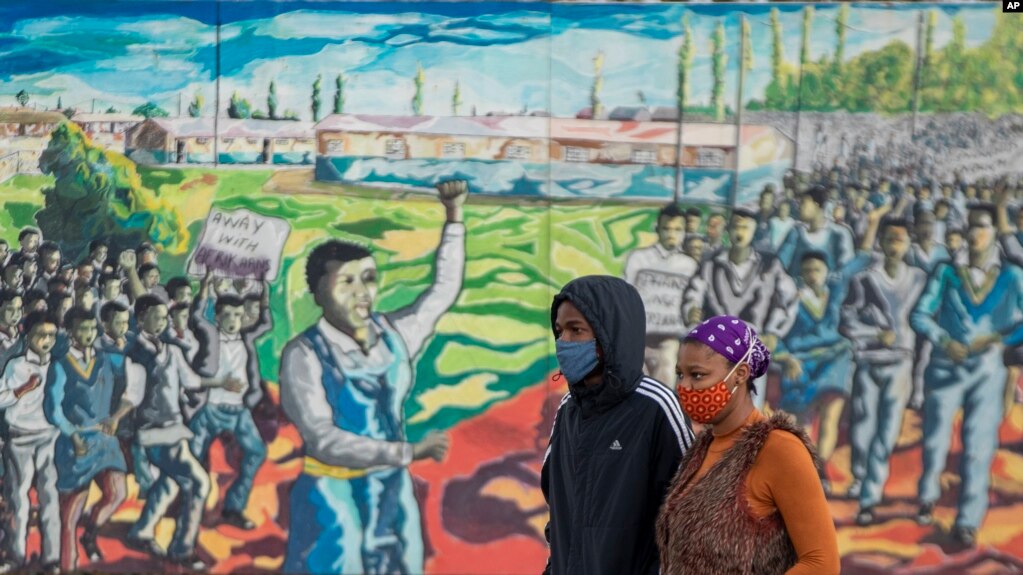
FILE - A couple wearing face masks walk past a painting to mark the country's Youth Day holiday in Soweto, South Africa, June 16, 2020. Image: AP

BY KATE BARTLETT

JOHANNESBURG, SOUTH AFRICA (VOA)
— If it’s a battle for hearts, minds – and wallets – then according to young Africans, China is outperforming the U.S. these days.

A new survey by Johannesburg-based think tank The Ichikowitz Family Foundation, found this week that the vast majority of African youth see China as the most influential foreign player on the continent.

By contrast, U.S. influence has dropped by 12% since 2020, according to the survey of more than 4,500 Africans 18 to 24 years old and living in 15 countries across Africa.

Seventy-seven percent of young Africans said China was the “foreign actor” with the greatest impact on the continent, while giving the U.S. an influence rating of just 67%. In a follow-up question on whether that influence was positive or negative, 76% said China’s was positive, while 72% said the same of the U.S.

The top reasons those surveyed say China’s influence is positive: affordable Chinese products, Beijing’s investments in infrastructure development on the continent and China’s creation of job opportunities in African countries.

“In the first edition of the pan-African youth survey we asked young Africans which country they believed had the biggest influence on the continent and at that point it was without any doubt the United States,” said Ivor Ichikowitz, who heads the foundation that carried out the research.

“This year, two years later, post-COVID, the picture is completely different ... the most influential country in Africa at the moment is China.”

Ichikowitz told VOA there are a few reasons for this change.

“(Former President) Donald Trump resonated with African youth. He was seen as a powerful, charismatic leader … and as a consequence the United States topped the list of most influential countries in Africa,” he explained.

But mostly, he said, it’s down to investment.

“Young Africans are telling us that they are seeing tangible, visible and very impactful signs of the role that China has played in the development of Africa,” Ichikowitz said.

“Albeit that there is significant criticism of Chinese investment in Africa, it’s very difficult for African governments not to value China because China is providing capital, providing expertise, providing markets at a time when Europe and the United States are not,” he added.

The African Union Commission reported more than 40% of the world’s youth is expected to reside in Africa in the next decade. The fact that China is helping to create a middle class on the continent means they will also help create one of the biggest consumer populations in the world, Ichikowtiz said.

However, the study also found some young Africans concerned over whether they are reaping enough of the benefits from China’s exploitation of their mineral wealth and natural resources.

Twenty-four percent of those interviewed said Chinese investments in their countries were a form of “economic colonialism,” with 36% of those surveyed saying the Chinese are exporting African resources without fair compensation. Yet other interviewees — 21% — said the Chinese showed a lack of respect for African values and traditions.

Among the countries surveyed was South Africa.

Woniso, a 23-year-old medical student at a busy sidewalk café in Johannesburg, told VOA she understood why China had come out on top. Chinese investment in Africa was significant, she noted.

However, she had some concerns about Chinese human rights abuses in Xinjiang and said she preferred Western-style democracy.

“Socially I’d probably put them (China) last because of like all the social injustices happening against the Muslim community,” said the student, who didn’t wish to give her last name.

Young South Africans, she said, are also “a very liberal sort of generation” and liked “the U.S. in terms of their liberal nature of doing things.”

However, when it comes to a Western style democracy, only 39% of the youth surveyed said it should be emulated. While the survey found African youth favoring democracy, more than half of those interviewed said a Western type of democracy “is not suitable” and African countries need a style of governance that fits them.

Chatting to a friend outside a mall a short distance away, Thandazani Nyathi, a businessman in his 30s, said he didn’t have a preference between the U.S. and China.

“They’re both looking to profit. I guess I would lean towards the country that wants to profit but on the most equitable terms,” he said.

“Which one am I particularly in favor of? The one that doesn’t come screw us,” he added, roaring with laughter.

Saturday, February 05, 2022

Florida Universities Aim For Academics After Years Of Sports Fame

VOA
The Florida State quarterback is chased by players from Florida in the last game of the regular season for each team. Neither team won more games than it lost last year. (AP Photo/John Raoux)

In January, the University of Georgia defeated the University of Alabama to win the college football championship in the United States.

It was not a surprise to see the two schools in the final game because they were among the best in the nation. What is surprising, however, is that two other famous football teams from the neighboring state of Florida were so far from the best.

The University of Florida is in the city of Gainesville and Florida State University is in Tallahassee. Both are in the northern part of the state, close to Georgia and Alabama.

The teams lost more times than they won. That is different from the recent past, when they were among the best in the nation. The last year both schools had a good year was 2016. That is about the same time Florida and Florida State started getting national attention for their academic programs.

Top choices for strong students

The two schools are now seen as top choices for students in the southeastern United States.

U.S. News and World Report recently rated Florida fifth and Florida State 19th among public universities. In the 1990s and early 2000s, Florida, also known as UF, was rated about 50th among all U.S. universities. The school is now listed at 28th.

Other publications, including Forbes and the Wall Street Journal, also gave the schools high ratings on their lists.

How did the schools raise the academic bar?

Chris Chouinard is one person who knows about the academic programs at the University of Florida. He completed his advanced degree in chemistry there in 2016. He is now a professor at Florida Institute of Technology.

Chouinard said when he was younger, he had a different idea about the big Florida schools.

“I grew up thinking of a place like the University of Florida as a school that's really good at football and probably really good at partying but not necessarily the best in terms of academics. Well, come to find out that that's not the truth.”

Chouinard said the rise of the academic programs at the University of Florida has been “meteoric.” He credited President Kent Fuchs with pushing the school to think of itself as one of the best public universities in the nation, alongside the University of California – Berkeley, the University of California – Los Angeles, and the University of Michigan.

Before coming to Florida, Fuchs was the top academic officer at Cornell University, an Ivy League university. Fuchs helped Florida raise money, add more professors, and increase attendance.

In 2020, the university announced a partnership with technology company NVIDIA to create an artificial intelligence and machine learning center. One of the founders of NVIDIA is Chris Malachowsky, a graduate of the University of Florida.

Chouinard said the university’s push to be a leader in machine learning will put it in a leadership position for science and technology education.

Gaining an international reputation

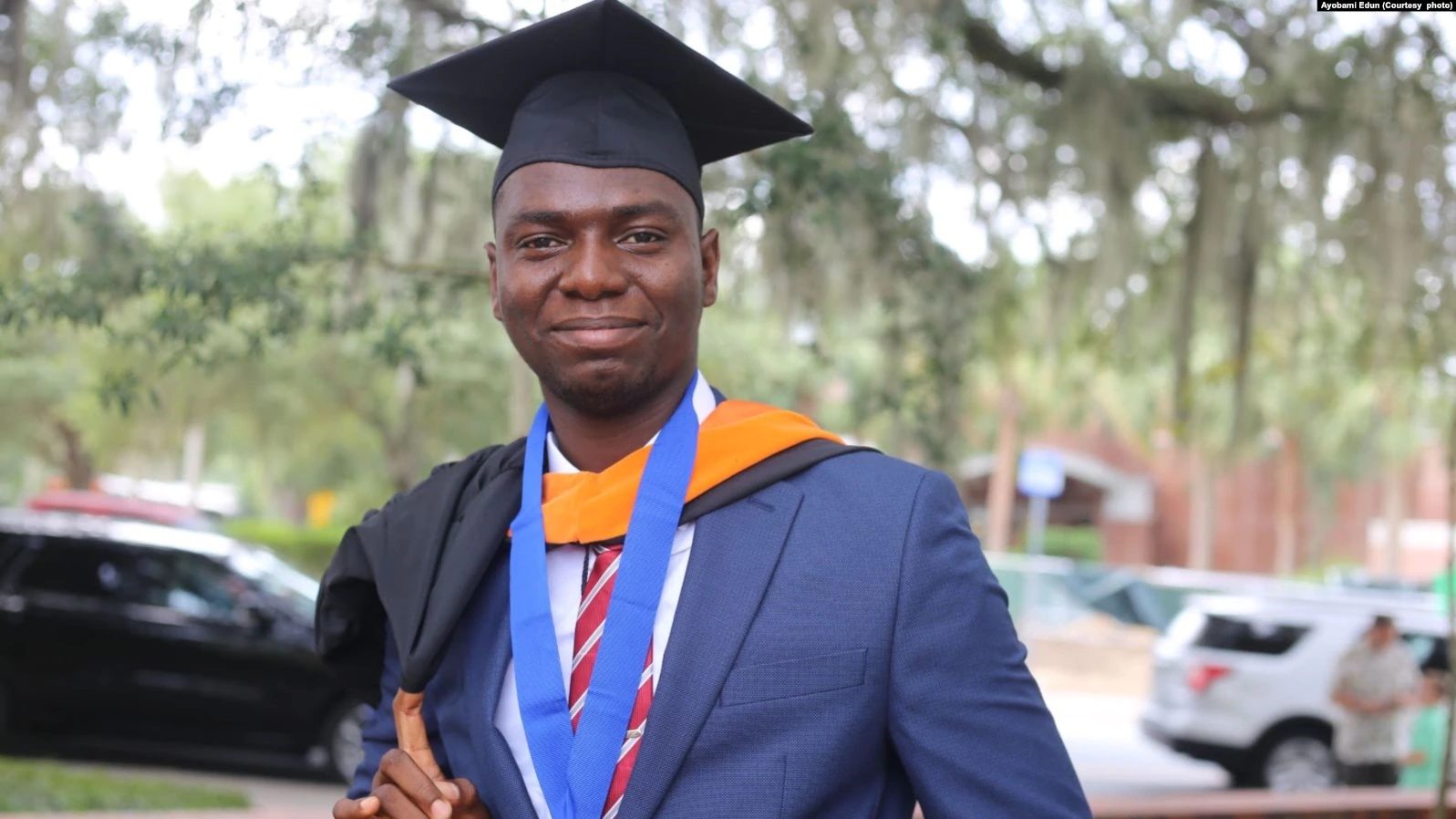
Ayobami Edun of Nigeria came to the University of Florida to study engineering.

Ayobami Edun, a Nigerian, is working on an advanced degree in electrical engineering at the University of Florida.

He said he heard about the schools in Florida because his Nigerian university had a relationship with Florida A&M University, another college in Tallahassee. Edun said he chose Florida because “I found out UF was the best in Florida.”

“There’s a very intense level of research at UF,” he said. “And whether you’re going to go into academia or industry, the classes prepare you.”

The Florida State story

At Florida State, former President John Thrasher started an effort to raise $1 billion for the university when he took the job in 2015. Part of the money went toward hiring more professors and helping students pay for college costs.

The new president, Richard McCullough, came from Harvard and Carnegie Mellon University in Pittsburgh where he led programs in information science and biology. His arrival shows the university will continue to support strong academic programs.

The school also centers its effort on keeping students and helping them graduate. Stephen McDowell is a leader in the university’s college of communications. He said, “FSU has gotten recognition for the four-year graduation rate. That’s good for the students (who start their careers sooner) and it also gets attention in the national rankings.”

Why have the football teams struggled?

Between 1993 and 2013, Florida and Florida State combined to have the best college football team six times. But now, the schools are struggling in football, the most popular college sport in the U.S.

David Hale writes about college football for the sports publication ESPN. He said when a school can select more top students, it makes it harder for people who are great athletes but not strong students to get into the school. Hale said university leaders have a difficult choice.

“Are they more concerned with investing in academics and getting your U.S. News and World Report rankings higher or are they more invested in making sure athletics is successful and you’re packing an 80,000-person stadium every Saturday and you’re winning championships?”

Hale said when investment in academics produces better results than money spent on football, it becomes easier to invest in school programs than new sports buildings or a costly new coach.

Hale put it this way:

“You have more investment in your state. And you have higher-achieving workers... And you can attract bigger companies to come there and set up headquarters to create jobs because you have that skilled labor. And all of that stuff has very real, significant, long-term effects that are much more positive than a winning football season is.”

I’m Dan Friedell. And I’m Jill Robbins.

Dan Friedell wrote this story for Learning English.

Monday, December 30, 2019

South Africa Traditional Circumcision Deaths Prompt Bans, Debate

Youths walk in a field outside an initiation school in the Eastern Cape, South Africa, July 10, 2006. Image via VOA


BY ANITA POWELL

JOHANNESBURG (VOA)
- For hundreds of years, teenage boys and young men from South Africa’s Xhosa and Ndebele groups have followed a sacred, secret coming-of-age ritual that culminates in ritual circumcision by a traditional surgeon. Initiation, as the practice is called, is part of the rich fabric of South African society.

But in recent years, as dozens of young men have died during the process each year -- most from exhaustion and dehydration, but some from botched surgeries -- it has also become a legal and cultural minefield.

Both the practice’s traditional defenders and those agitating for reform agree on one thing: No more boys should die. But how exactly they will get there is a question no one can answer.

This year, amid reports of more than 25 deaths during the recent initiation season, South Africa’s Commission for the Promotion and Protection of Cultural, Religious and Linguistic Communities called for the immediate suspension of initiation schools in the Eastern Cape province, where most of the deaths occurred.

That call has earned the ire of the gatekeeper of this tradition, the Congress of Traditional Leaders of South Africa. The group’s president, Kgosi Mathupa Mokoena, said he agrees that schools that have seen deaths should be investigated, but that a ban is not just foolhardy, but futile.

"We totally disagree with the call from the CRL, because unfortunately, we were never consulted when they made this call," he said from South Africa’s eastern Mpumalanga province. "Unfortunately for them, even if they had made a call or even forced parliament to legislate to do away or ban the running of initiation schools, unfortunately it is not enforceable. Therefore we’ll just advise them, nicely, to say, ‘come, let’s sit down and talk about this.’ Because If you legislate on something you cannot then enforce, it is as good as wasting public funds."

‘Life is more important’
While the independent, government-funded group has called for suspensions in previous years, this year their call was backed by a powerful men’s group. Ntando Yola is Chairman of the South African National AIDS Council’s Men’s Sector. The organization supports the suspension, and is pushing for an open conversation about the practice.

But, he stresses, he isn’t against the ritual itself.

"It’s a practice that is held in high regard, that a boy grows up looking forward to doing that," he told VOA from Johannesburg. "And I think that is fine. I have gone through that myself and I went through it willingly. However, we have got to put measures to make sure that it does not cost life. Life is more important — is equally important as the ritual."

The fine line between tradition and change
Civil society groups have proposed several changes, such as tightening regulations on the schools, which can cost between $35 and $70 -- a large amount in a nation where a minimum wage worker can make as little as $250 a month.

They’ve also called for more medical supervision over the two- to four-week retreats. In recent years, Zimbabwe has integrated medical circumcision into its initiation schools, leading to a drastic reduction in deaths. Mokoena said that is not an option for South Africa, though traditional leaders allow doctors to intervene if initiation leaders call on them.

"How they do it in Zimbabwe, it’s foreign, we don’t even know why, don’t understand why, they do it that way," he said. "It’s still allowed for that medical doctor to go to the mountain and assist. But unfortunately, you cannot do it in the mountain and again in hospital. It’s never done that way. That is no more an initiation school; it’s something else.”"

But maybe it’s time for change, Yola said. His group is also floating the idea of giving women a voice in the process. When it comes to initiation, the women in these boys’ lives are forbidden from having any oversight or authority. And while the group isn’t suggesting anything as radical as letting women witness or learn more about the process, he says the fact that they are left completely in the dark seems unfair.

"One of the things that happens with the secrecy that is happening around the practice is the fact that women who are mothers or who are carers to these young men have to just sit and wait until the son comes back from there and they have no role or no part in it," he said. "And women, sometimes they're able to call out, to cry out around this and say ‘this is unacceptable that I raised a child, and oftentimes as a single mother, and then there's just this period in the life of my child where I have to not be involved in any way, and just wait and hope that my son comes alive.’ So it's really a range of all of these issues that we're really calling out against."

Thursday, March 07, 2019

Will US Military Complete Planned Troop Cuts In Africa?

Gen. Thomas D. Waldhauser, left, commander of U.S. Africa Command, is joined by U.S. Ambassador to Senegal Tulinabo S. Mushingi, right, after a tour of Camp Cisse where the U.S. maintains a small site in Dakar, Senegal, July 30, 2018.

BY CARLA BABB

WASHINGTON (VOA) 
— The commander of U.S. forces in Africa has cast doubt on whether the Pentagon will complete plans to cut forces in Africa by 10 percent as the Department of Defense announced late last year.

In November, Pentagon officials said they would cut roughly 700 of the 7,200 U.S. troops on the African continent by June 2020. The reductions, officials said, were to "optimize" special operations forces that would be needed in a potential future fight against near-peer competitors like Russia or China.

Marine Gen. Thomas Waldhauser, who heads U.S. Africa Command (AFRICOM), told lawmakers Thursday he already has reduced force numbers in Africa by about 300. But commanders appear to be rethinking plans to cut an additional 400 troops from the continent.

"Whether we'll ever be directed to execute the second half [of cuts] is to be determined," Waldhauser said.

Threats growing

The troop reductions were planned even though many West African nations are fighting insurgencies by al-Qaida-linked groups.

Niger and Mali are battling al-Qaida-linked militants, and Chad is combating a militant push from the expansion of Islamic State and Boko Haram in neighboring Nigeria.

Burkina Faso, host to a U.S.-led counterterrorism exercise last week, is facing "an unprecedented humanitarian emergency" due to surging terrorist attacks and intercommunal violence, the United Nations warned Tuesday.

"The threat is growing," U.S. Ambassador to Burkina Faso, Andrew Young, told VOA in an interview. "We're in a tough fight, and the fight is getting harder."

Waldhauser said he had advised the secretary of defense that AFRICOM was prepared to "push back" on the planned cuts if they are not in "our best interest."

"Especially in Western Africa ... we are concerned. So far, there has been minimal impact," Waldhauser said. "If the groups grow, we may have to revisit these decisions."

'Small niche'

The general explained that the "optimization" cuts on the African continent were focused solely on the counterterrorism strategy.

"It's a very small niche," he said.

But this "small niche" of special operations forces and their enablers is a very important one. Local partners at the counterterrorism exercise in Burkina Faso told VOA their troops rely on these forces for help with everything from logistics to intelligence-gathering against militant threats.

U.S. Air Force Maj. Gen. Marcus Hicks, head of U.S. Special Operations Command Africa, has cautioned that the United States and others interested in a secure and prosperous Africa should watch the Sahel "very closely" and "continually reassess whether or not there are enough resources applied."

"I wouldn't recommend we decrease forces at this point. I think we have a good approach in this region, and we are stable with our force structure here," Hicks said in an exclusive VOA interview last week.

Waldhauser explained Thursday that the cuts to U.S. forces in Africa have fallen mostly on places where U.S. troops had been training partner forces "for quite some time," and those partner units were now working on their own.

But when asked by a congresswoman whether he feels "angst" due to withdrawing forces from areas in West Africa where there are still problems with violent extremist organizations, Waldhauser responded, "The short answer to your question is yes."

Tuesday, January 29, 2019

America's First Muslims Were Slaves

VOA, JAN. 29, 2018

Muslim Yarrow Mamout (Muhammad Yaro) managed to buy his freedom after 44 years of enslavement. As an entrepreneur and homeowner, he continued to practice his faith. (1819 portrait Philadelphia Museum of Art) via VOA

In 1807, a wealthy 37-year-old scholar was captured in West Africa, in what is now Senegal, and transported to the United States to be sold into slavery.

That man, Omar Ibn Said, lived the remainder of his life enslaved in the American South, and his story might have been forgotten if not for the handwritten autobiography he left behind.

Written in Arabic and recently acquired by the Library of Congress, "The Life of Omar Ibn Said” is not only a rare handwritten personal story of an American slave, but it's also one of the first intimate accounts of the early history of Muslims in the United States.

Ibn Said was among the approximately one-third of American slaves who were Muslim. While the exact number of enslaved Muslims is unknown, up to 40 percent of those who were captured and enslaved came from predominantly Muslim parts of West Africa.

“It challenges this notion of this being a Christian nation," says Zaheer Ali, an oral historian at the Brooklyn Historical Society and project director of the Muslims in Brooklyn project. "It opens us up to understanding that there were non-Christians present at the founding of this nation, and not only at the founding of this nation, but that helped build this nation...It challenges the idea that this was a quote ‘Christian nation’ from the beginning.”

America's first Muslims were slaves
The subsequent erasure of the black Muslim identity among the enslaved people in the United States was part of a strategy to strip enslaved Africans of their individual identities and reduce them to chattel both legally and in the public imagination.

"The black classification was devised to mark enslaved Africans as property. So, if you were black, you were no longer a human being," says Khaled Beydoun, an author and law professor at the University of Arkansas. "If you acknowledge some of these religious identities, then you're in turn acknowledging their humanity."

During the antebellum period in the South, the Muslim identity took on very different identity from the stereotype of an African slave.

"When people thought of a Muslim at that time, they thought Arab, they thought Ottoman, they thought Middle Eastern," Beydoun says. "Enslaved Africans did not fit within that racial ethnic caricature or form."

This narrow understanding of both Muslims and Africans led to the widespread belief that the two identities could not overlap and helped hasten the erasure of Muslim African slaves from the historical record. In addition, the names of enslaved Muslims were often anglicized, which further obscured them from the history.

Writing themselves into history

Enslaved Muslims who left behind a written record challenged the idea that enslaved men and women were a brute workforce solely capable of physical labor because they lacked the intellectual capacity that would make them deserving of independence and freedom.

“These were people who were essentially writing themselves into existence both in terms of leaving a record of their life but also in terms of challenging the racist assumptions about people of African descent," Ali says.

What we know about the masses of African Muslim slaves who left no written record can be garnered from the remembrances of their descendants and their names on bills of sale or runaway notices.

How long they adhered to Islam is unknown. Some converted to Christianity while others pretended to convert in order to satisfy their captors. But there are signs that some enslaved Muslims held onto the religion of their homelands.

Ali points to burial grounds on islands off the southern state of Georgia, where slave tombstones bear Islamic markings, and churches that were built facing the east, the direction Muslims face while praying. And there are descendants who recall seeing their elders using prayer rugs and Islamic prayer beads.

These recollections suggest that despite any coercion, some enslaved Muslims held onto their religious practices for life.

Leaving their mark
While the existence of a sizable number of African Muslim slaves might not be well known to most Americans, they are believed to have left their mark on American culture.

Author and scholar Sylviane Diouf has suggested that slave work songs are related to the vocal pattern of Koranic recitation and the call to prayer. Those work songs — such as "Levee Camp Holler" a century-old song that originated in Mississippi — eventually gave birth to the blues.

And Ali says it's possible that the banjo and guitar came from a traditional West African instrument.

Perhaps the most lasting legacy of Muslim slaves is the modern movement among some African Americans to embrace what they believe to be the original religion of their people.

“The movement towards Islam in the African American community in the 20th century was in part understood by its adherents as a reclaiming of a lost heritage, that this was not a new religion," Ali says. "Islam is not new to the United States; it was here before the country was founded; it was present among the people who helped build this country; and it has very much been a part of the thread of America’s story.”

Beginning with the period of American slavery until today, black Muslims continue to comprise the largest segment of the Muslim community in the United States.

Sunday, August 12, 2018

South Africans See Rise Of Anti-Immigrant Policies

FILE - People rally during a march against xenophobia, in downtown Johannesburg, South Africa, 2015. Anti-foreigner sentiments have been on the rise in the country which, according to most recent data, is home to some two million foreign nationals. (AP Photo/Jerome Delay)


SOUTH AFRICA (VOA)--A new political party in South Africa wants the government to expel all foreigners.

The African Basic Movement party claims that foreigners bring crime into the country. It also says they are responsible for high unemployment.

Political observers say the party is unlikely to win many seats in the South African general elections next year. But they say its appearance shows that the wave of nationalist, populist politics in other countries has come to South Africa.

Thembelani Ngubane is the head of the African Basic Movement, which he started last year. Ngubane says his group already has tens of thousands of members and signatures that support a plan to expel all foreigners by the end of the year. Those numbers could not be independently confirmed.

The party recently registered to compete in the 2019 elections. But critics question whether its goals follows South Africa's progressive, inclusive constitution. They also wonder whether the party's positions are dangerously close to hate speech, which is illegal in South Africa.

"We should get rid of all foreigners who are here, they are taking South Africa's jobs," Ngubane told VOA.

"They sleep with our sisters. They give them children. They get married to them, so that they get South African citizenship. When they get them, they abandon them ... So South Africa is like chaos. And they are criminals. We can't catch them. They have no fingerprints because they are from other countries."

Dangerous direction

About two million foreign nationals live in South Africa. The latest population count shows that most come from neighboring countries, such as Zimbabwe. However, the actual number is thought to be higher.

The rise in xenophobic politics is extremely worrying, says Sharon Ekambaram of the rights group Lawyers for Human Rights. She warns it could lead to xenophobic violence because South Africa sometimes experiences violent clashes between unsatisfied citizens and foreign nationals.

"I can't even articulate how dangerous this is for our democracy," Ekambaram said, talking about the rise of Ngubane's party.

"This is clearly a group that is racist. They're xenophobic … and I don't think there's a place for those kinds of people in our country.”

She also said that, if the group has registered as a party, election officials should then investigate whether that is constitutional.

Ekambaram added that the party's ideas are weak. She said researchers have found that foreign nationals are often job creators, and do not cause more violent crime than South African citizens.

ANC opens the door

Another observer, Ralph Mathekga, says he is concerned, but not that the African Basic Movement will beat the ruling African National Congress or ANC in the elections. What worries him, he says, is that the movement’s extreme ideas will enable other nationalist beliefs to gain standing.

Mathekga believes the many corruption cases involving the ANC and its inability to reduce unemployment and poverty make it easier for other parties to compete.

"I'm not surprised," he told VOA about the rise of the African Basic Movement.

"South Africa's politics is going in that direction, of populism. You have always had that level of leftist populism that has been there within South African politics. But the thing that is very, very different is the emergence of nationalist populism.”

Pointing to the United States, Ngubane praises President Donald Trump's policies against illegal immigration. He shares the U.S. leader's beliefs.

"Donald Trump is putting Americans first. Here, we are putting South Africans first. You see, you cannot let your child sleep on [an] empty stomach and feed your neighbor's child. That is the problem. Here in South Africa, our children sleeps on empty stomach. Our neighbors like Pakistan, Chinese, they sleep on full stomach. We don't want that."

I’m Phil Dierking.


Anita Powell reported this story for VOANews.com. Phil Dierking adapted her report for Learning English. George Grow was the editor.

Thursday, June 14, 2018

VOA INTERVIEW: Mother Of Boko Haram Leader Speaks Out

Falmata Abubakar is the mother Abubakar Shekau, the leader of the terrorist organization, Boko Haram. She granted her first media interview to VOA, saying she has not seen her son in 15 years. Image via VOA


BY CHIKA ODUAH


SHEKAU, NIGERIA (VOICE OF AMERICA)— Driving west from the city of Maiduguri, Nigeria, the roads get narrower as the towns get smaller. Along the road lie bullet-ridden buildings and security check points as vigilante members patrol gates, all signs of a region where people are trying their best to protect themselves.

After three hours VOA ends up in Yobe state, at a village called Shekau. Here, elders and community leaders take VOA to meet Falmata Abubakar, who they say is the mother of Boko Haram leader Abubakar Shekau.

His father was a local district imam before passing away a few years ago.

Falmata said she had never spoken to journalists before VOA approached her, and she does not know where her son is hiding.

“I don’t now if he’s alive or dead. I don’t know. It’s only God who knows. For 15 years I haven’t seen him,” she said.

Concealing their hometown

People here say they often hide the fact that they are from Abubakar Shekau’s hometown because others may fear they have Boko Haram connections.

Falmata says her son left Shekau as a boy to continue his Islamic education in Maiduguri, a center of religious studies for hundreds of years.

Shekau was an almajiri. In the generations-old tradition, almajirai are sent off by their parents to study the Quran in schools locally known as a tsangaya, where a teacher coaches the dozens, sometimes hundreds of male students, to memorize the entire Quran.

Almajirai beg on the streets for food, and it is believed that Shekau did the same. At some point in his studies, Shekau, according to his mother, met Mohammed Yusuf, the founder of Boko Haram, who condemned Western education as sinful. Falmata says her son was brainwashed.

'Different characters'

“Since Shekau met with Mohammed Yusuf, I didn’t see him again,” she told VOA.

“Yes, he’s my son and every mother loves her son, but we have different characters,” she said. “He brought a lot of problem to many people. Where can I meet him to tell him that these things he is doing is very bad? He brought many problems to many people, but I am praying for God to show him the good way.”

Mohammed Yusuf was killed by Nigerian security agents in 2009, and Abubakar Shekau then took over as the leader.

Shekau is accused of leading an insurgency that has killed more than 30,000 people in northeastern Nigeria and the Lake Chad region.


Destroying schools is at the heart of Boko Haram’s manifesto, and the group has attacked more than 1,400 schools, according to the United Nations Children’s Fund.

Members of the group invaded the first primary school in northeastern Nigeria in 2010 and 2013. They killed the principal and secretary.

In 2014, Boko Haram killed 59 students at a federal school in Buni Yadi, Yobe State. The school is being rebuilt but the expansive campus is barren, a reminder of one of the bloodiest school attacks in Nigeria’s history.

In February of this year, the sect kidnapped more than 100 students from the girls’ secondary school in the town of Dapchi.

The insurgents returned the students a month later, but held onto Leah Sharibu, reportedly because she refused to convert to Islam in exchange for her freedom. Her mother Rebecca and her brother say they feel in their hearts that Leah is still alive.

It’s the 2014 abduction of the Chibok Girls from their school that brought Boko Haram into the international spotlight for unprecedented condemnation. The Bring Back Our Girls activists are still demanding the freedom of at least 100 Chibok Girls, including Dorcas Yakubu who turned 20 years old this week, marking her birthday while in Boko Haram captivity. In 2016, Dorcas appeared in a proof of life video released by the terrorists.

Falmata says she can never curse her son, but he has become someone who she doesn’t recognize anymore.

“He just took his own character and went away,” she said. “This is not the character I gave him. I don’t know what this type of behavior is. It’s only God who knows.”

Wednesday, March 21, 2018

Cambridge Analytica Played Roles In Multiple African Elections


People walk past the building housing the offices of Cambridge Analytica in central London, March 20, 2018.


WASHINGTON (VOA) — Long before its controversial roles in the 2016 Brexit vote and the U.S. presidential election, Cambridge Analytica influenced elections in Africa.

The data mining company, under fire for its alleged use of 50 million Facebook accounts to shape campaign messages for then-candidate Donald Trump, also played a role in elections in Kenya and Nigeria, according to new reports.

The company’s first involvement in Africa dates to the general election in South Africa in 1994. That election marked the end of the apartheid era and the assent of Nelson Mandela to the presidency.

Widespread violence and deep-seated societal fractures had put the elections in jeopardy, Martin Plaut, a journalist and senior research fellow at the University of London's Institute of Commonwealth Studies, told VOA.

“The 1994 election in South Africa was on an absolute knife’s edge. There was no reason to believe that it would go ahead without severe loss of life,” Plaut said.

The Inkatha Freedom Party, which represented the Zulu population — South Africa’s largest ethnic group — had not reconciled with the African National Congress (ANC). Amid divisions that were stoked, in part, by the old apartheid regime, hundreds died ahead of the election, Plaut said.

A political party — unnamed, but most likely the ANC — hired Cambridge Analytica to mitigate election violence, according to the company's website. Their exact role in the election hasn’t been independently verified, but the violence subsided during and after the historic vote for Mandela and the ANC.

Involvement in Kenya, Nigeria

More recently, Cambridge Analytica worked with Kenya's ruling Jubilee Party ​— not to build consensus, but rather to exploit divisions to re-elect President Uhuru Kenyatta.

The firm designed a campaign strategy based on interviews with nearly 50,000 potential voters gathered over three months. Their work with the Jubilee Party had been widely suspected but unconfirmed.

But in an undercover video broadcast this week on Britain’s Channel 4 News, Cambridge Analytica executive Mark Turnbull boasted that the company and its parent, SCL Group, ran the Kenyatta campaign.

“We have rebranded the entire party twice, written the manifesto, done huge amounts of research, analysis, messaging. Then we’d write all the speeches and stage the whole thing. So, just about every element of his campaign,” Turnbull said.

Those elements included social media videos that played to the fears of the electorate, warning that a victory by opposition leader Raila Odinga would lead to disease, famine and terrorism.

Cambridge Analytica denied any involvement with the videos or negative campaigning in Kenya.

VOA reached out to both Cambridge Analytica in Washington and the SCL Group, but they did not respond to requests.

Similar allegations of malfeasance have emerged in Nigeria. The Guardianreported Wednesday that Israeli hackers provided Cambridge Analytica with President Muhammadu Buhari's personal emails.

Buhari was running against incumbent Goodluck Jonathan, and a Nigerian billionaire paid Cambridge Analytica $2.8 million to dig up damaging information about Buhari as part of an attack campaign, The Guardian reported. The emails included information about Buhari’s health and medical records, a source told The Guardian.

Since assuming office, Buhari has taken extended medical leaves in London, because of an undisclosed illness.

Precise analysis

Data analysis companies such as Cambridge Analytica provide information to governments and political parties, Plaut said, to influence “people in the middle” — those with moderate views who can be persuaded to join a side through emotional appeals.

These companies analyze precisely who to target and craft messages that play on hopes and fears, not facts, according to Plaut.

Social media platforms such as Facebook and WhatsApp, which Facebook bought in 2014, provide an in-depth view into people's likes and dislikes —from which psychological profiles can be built and exploited to changing behavior through tailored messaging.

Julie Owono, executive director of Internet Without Borders, a group that advocates for online freedom and privacy, told VOA's French to Africa service that her organization has been warning about the dangers of letting companies like Facebook collect the personal data of billions of people around the world.

“Since 2010, we've been saying that countries with low-to-nil data protection are testing ground for worst practices by companies and governments,” Owono tweeted.

The ANC, South Africa’s ruling political party since the end of apartheid, has used similar techniques through its own data mining, according to Plaut. Through billboards along the highways of Johannesburg and fake social media posts, they have invested millions of dollars in messages that advance their agenda, regardless of truth.

‘Open to manipulation’

African voters, Plaut said, “are as open to manipulation as any voter in the world.” They’re a sophisticated electorate, Plaut said, that knows politicians craft and distort messages to suit their needs. But knowledge doesn’t inoculate people against the effects of disinformation.

“Everybody is open to manipulation,” Plaut said.

In Kenya, political advertisements played to fears surrounding terrorist group Al-Shabab and disease outbreaks. Persuasive messages about safety and health influenced an unknown number of voters, but enough to make an impact, Plaut acknowledged.

African ties

The role of data mining in Africa hasn’t been confined to elections.

The SCL Group has extensive ties across Africa, with past projects spanning from Libya to Rwanda, and from South Sudan and Somalia all the way to Ghana, according to their website.

SCL says its mission is to be “the premier provider of data analytics and strategy for behavior change.” The kinds of behaviors they seek to influence shift, depending on their clients and partners — of whom there are many.

In Rwanda, SCL partnered with World Vision, a global Christian aid organization, to conduct research on community attitudes about nutrition and sanitation. In South Sudan, SCL worked with the United Nations Development Group to conduct a survey on the Disarmament, Demobilization and Reintegration Program.

SCL partnered with the Ghanaian Ministry of Health, along with a major British construction company, to research the country's attitudes toward the health care system.

In Somalia, SCL researched the tenability of the nationwide Somtelcom telephone network. The group also interviewed nearly 3,000 Libyans to develop policy recommendations to help the government address instability countrywide.

VOA reached out to John Apea, who is listed on SCL’s website as its special adviser for SCL Ghana. Apea said he no longer works with SCL and would not provide additional information about the office’s operations in the country.

Safeguarding democracy

The growth of digital media across Africa will present new opportunities to engage in sophisticated campaigns to influence not just voters but also policymakers and governments.

The solution, according to Plaut, is international oversight.

“The African Union should be much more robust in insisting on its observers going to see elections and spending a good deal of time there, not just five minutes before the vote takes place,” Plaut said.

In-depth reports filed months in advance of elections will give the public the tools they need to combat propaganda with a transparent account of their governments’ efforts to ensure a free and fair process.

Plaut anticipates closer scrutiny of the democratic process will lead to pushback and complaints of interference. Nonetheless, the efforts are worth it, he said.

“The African Union, as the guardian of democracy in the continent, has a duty to go out there and really push for democracy throughout the continent,” Plaut said.

Tuesday, May 31, 2016

Nigerian Oil Production Falls As Militant Attacks Take Toll

VOA, MAY 31, 2016


LAGOS—Nigeria is Africa's oil king no more.

Months of militant attacks on pipelines and oil infrastructure in the southern Niger Delta region have crippled production in Africa's largest producer of crude.

The militant group behind the attacks, the Niger Delta Avengers, vowed in an early communiqué to reduce Nigeria's economy to "zero." They appear to be getting their wish.

Exports have fallen from about 2.2 million barrels per day to as low as 990,000 barrels per day, analysts say, making Angola Africa's largest producer of oil, at least for now.

The drop in production and the low price of oil globally are major reasons why Nigeria is expected to enter a recession in coming months.

Gail Anderson, research director at energy research and consultancy group Wood Mackenzie, says the militants have been careful in their sabotage.

"The attacks themselves have been well-targeted and they've been designed to cause maximum damage, and I think they've been quite successful in that respect," Anderson said.

Attacks hit hard

The NDA emerged earlier this year with a blog that took credit for a number of attacks on pipelines in the delta. It also listed demands, including apologies from politicians, the release of an imprisoned separatist leader and a redistribution of ownership of oil blocks.

After months of sabotage, Anderson estimates production has fallen by about 560,000 barrels per day.

Dolapo Oni, head of energy research at Ecobank, gave a more drastic estimate. Between pipeline repairs and militant attacks, Nigeria is probably producing no more than 990,000 barrels of oil every day, he said.

Crude has long been Nigeria's top export. Though President Muhammadu Buhari wants to wean the country off its dependence on oil, it remains the major source of revenue for the country's recently enacted $30.4 billion budget.

"We're not producing up to the level we need to produce, the government won't generate the amount of revenue it needs to generate from oil," Oni said.

Low oil prices and shortages of fuel and foreign exchange led Nigeria's economy to contract last quarter. It's expected to do the same this quarter, putting the country into a recession.

Repairs on the attacked pipelines will likely take weeks, Oni said, and that might not deter the militants. The militants blew up one pipeline in Bayelsa State twice, and warned its owners against repairing it, he said.

Past problems

Militancy in the Niger Delta is nothing new. The delta was the site of a years-long insurgency that only ended in 2009 when the government started paying off militants and offering them job training as part of an amnesty program.

That effort was criticized for not addressing the underlying issues fueling the militancy, namely the joblessness, poverty and pollution in many communities where people live next to oil production sites.

The government is winding down the amnesty program, but the NDA says it wants the program to continue. Oni said its unknown if any participants in the program are part of the new group, but the sophistication of their attacks suggests a high level of familiarity with oil infrastructure.

"They carry out attacks at specific times of the day, when they know they're able to strike without specific reprisal from the enemy," Oni said.

Buhari is headed to the delta this week to kick off the cleanup of Ogoniland, a region of Rivers State that has been extensively polluted by oil spills over the years.

Rehabilitating Ogoniland is one of the NDA's demands.

Saturday, May 14, 2016

Equatorial Guinea, Gabon Expelling Central African Migrants

VOA NEWS, MAY 14, 2016


KIOSSI, CAMEROON—Several hundred people from Central African nations are stranded in southern Cameroon after being expelled from neighboring Equatorial Guinea and Gabon this month.

Equatorial Guinea and Gabon say they are expelling foreigners who do not have proper identification papers.

The majority of those being expelled are economic migrants from around Central Africa. They complain that authorities in those two countries ransacked their homes, seized their money and deposited them on the border at Kiossi.

Some had only just arrived in those countries while others had been living there for years.

Bakari Zhouli, a 45-year old engineer from Chad, says his documents were taken and he is stuck.

He says he is surprised that the government of Equatorial Guinea is chasing out the people who helped to transform many parts of their country from mere foot paths, forests and abandoned cocoa plantations into a developing country. He says he helped transform the capital, Bata, in the 15 years he was there.

Gabon and Equatorial Guinea say they are expelling foreigners who do not have proper identification papers for security reasons, saying some migrants are engaged in illegal mining and criminal activities.

Felix Nguele Nguele, governor of Cameroon's southern region, says the government is investigating.

"We insisted that forces of law and order should have information on who was expelled and why he was expelled. We took an assessment of all the control posts on the borders and equally sent a team to the field to try to sensitize all stakeholders," said Nguele.

Most of the people now stranded in Cameroon said they went to Gabon and Equatorial Guinea looking for work. The oil-producing nations have long been destinations for economic migrants.

Nchama Theodoro is senior adviser to the governor of Woleu-Ntem, one of Equatorial Guinea's nine administrative provinces. He says the global drop in price of oil and other commodities is taking a toll and many companies are having to lay off workers.

He says central African states should be able to provide opportunities for their young people who instead see Equatorial Guinea as the solution to their problems. He says Equatorial Guinea is helping to build Africa’s workforce by allowing people to come and work freely, but that cannot be the only solution to unemployment.

The International Monetary Fund said earlier this month that the rate of economic growth in sub-Saharan Africa is expected to slow to a 16-year low. Central Africa is feeling the slump with countries reporting record increases in debt.

Hundreds of Cameroonians have returned home after being expelled from Gabon.

Sunday, October 06, 2013

Nigeria Leader To Inaugurate Dialogue Committee


Nigeria's president Goodluck Jonathan speaks during an interview with Reuters in New York, September 26, 2012

By Peter Clottey, VOA, Sunday, October 6, 2013

Nigeria’s President Goodluck Jonathan intends to inaugurate an advisory committee on Monday to develop a plan to begin a national dialogue to help resolve the country’s challenges, says Rueben Abati, Special Adviser on Media and Publicity to Mr. Jonathan.

“It has the mandate to work out the modalities, the form the structure the nomenclature, the agenda for the dialogue or conference,” said Abati.  “Part of the function is also advising government on the legal proceeding that may be necessary, the constitutional action that may follow the outcome of the dialogue.”

The 13-member committee is expected to comprise a chairman, a secretary, and 11 other members who are drawn from different segments of the Nigeria society, including the civil society, the academia and professional groups, says Abati.

The committee is expected to submit its report in four weeks after its inauguration.

“The purpose of this whole exercise is to address those issues that continue to cause friction within the Nigerian society.  Issues that were left unresolved by previous conferences of this nature,” said Abati. “

Observers have questioned the creation of the advisory committee, saying previous administrations failed in 1994 and 2005 with similar efforts.  But Abati says unlike in the previous governments, Mr. Jonathan has pledged to resolve the country’s problems.

“What is different is the commitment of the government of the day, the political will to make a difference and this administration is not going to define no-go areas for the conference,” said Abati.  “This is a problem solving unity forging exercises, and it is not surprising that the proposal has received the support of Nigerians across the various ethnic nationalities, and across social political organizations, who have said that indeed a dialogue is necessary.”

Some opposition groups have rejected the formation of the committee saying it's yet another effort of the Jonathan administration to distract Nigerians from the government’s failures.  But Abati disagreed with the criticisms.

“The naysayers are just individual trouble makers who are opposing it for selfish political reasons.  Because these same isolated individuals are persons who in the past have demanded an exercise of this nature, who have said this is important for Nigeria to move forward,” said Abati.

“But now that they have been confronted with, and they have seen the administration is committed to really having that dialogue and given them the opportunity to ventilate their own opinion, they are now trying to play politics just to be seen to be contrarian as a habit.”

Abati says the advisory committee forms part of President Jonathan’s effort to ensure the country’s unity as enshrined in the constitution.

Wednesday, September 25, 2013

Tensions Rise Over Divisions in Nigeria’s Ruling Party


Friday, September 20, 2013

Nigeria Says 9 Killed in Clash Between Security, Boko Haram

VOA
Friday, September 20, 2013

Nigerian officials say nine suspected members of militant group Boko Haram were killed Friday in a gunbattle with security agents.

The state security force says several other people were wounded in the early morning clash, which happened in the capital, Abuja, at an unfinished home in a community for Nigerian lawmakers.

Spokeswoman Marilyn Ogar says two captured Boko Haram members had told agents about a buried stash of weapons at the site.

"And so a joint security team had to proceed to recover the arms. So when they got here, they came under attack, and of course they had to respond back."

Ogar told reporters that 12 Boko Haram suspects were arrested.

Two self-professed Boko Haram members were brought in front of reporters and admitted to belonging to the group.

Residents of the community told VOA they doubted the young men were Boko Haram members, saying they were paying rent to stay in the house.

The violence followed a major attack in Nigeria's Borno state blamed on the Islamist militant group.

Nigerian officials say the militants killed at least 87 people in and around the town of Benisheik, and that scores of homes and buildings were burned.

Local witnesses told VOA that the Boko Haram fighters were better armed than soldiers who tried to fight them, and that the militants looted the town, taking away food and numerous vehicles.

The group says it is fighting to impose a strict form of Islamic law on Nigeria's Muslim-majority north. The militants have been blamed for thousands of deaths since launching an insurgency against the government in 2009.

Borno is one of three northeastern states where President Goodluck Jonathan declared a state of emergency and deployed additional troops in May to fight Boko Haram. Rights groups have criticized the military for heavy-handed operations they say have led to hundreds more deaths.

Wednesday, September 18, 2013

Nigeria Ruling Party ‘Resolving’ Internal Rift

By Peter Clotey
VOA, Monday, September 18, 2013

A spokesman for Nigeria’s ruling People’s Democratic Party (PDP) says senior officials of the group are trying to resolve internal wrangling that threatens to break the party apart in the run-up to the 2015 general election.

“Since this happened, the president became restless because he is a peaceful person. He will make sure that there would be no crack in PDP during his lifetime,” said PDP spokesman Mohammed Jalo. “So there is a reconciliation going on from a committee of elders headed by former president, Chief Olusegun Obasanjo, and former military heads of state, [Ibrahim] Babangida trying to resolve this little problem within the PDP.”

Jalo says President Goodluck Jonathan is displeased with recent developments within the ruling PDP after former vice president Atiku Abubakar and some governors formed a splinter group. The new group, named the New PDP, is opposed to Mr. Jonathan’s possible re-election bid. The splinter group also demands the resignation of PDP chairman Alhaji Bamanga Tukur after blaming him for the fissures within the party. Jalo disagrees with the accusations.

“The people are myopic and naïve. Whether Bamanga Tukur is there or not, this party is for Nigerians. The party is not a one man’s affair. It is a conglomeration of so many people so it is not Bamanga Tukur working for the party. So whether Bamanga Tukur is there or not this party will exist,” said Jalo.

The militant group, Boko Haram, based in Nigeria’s north, has been accused of carrying out violent attacks in an attempt to force the country to adopt strict Islamic law.

Human Rights Watch says Boko Haram-related violence has killed an estimated 3,000 people since 2009, a toll that includes killings by security forces.

Some Nigerian says Mr. Jonathan and the ruling PDP are responsible for the violence because they have not been able to deal with the security challenges facing the country.

But Jalo rejected criticisms that President Jonathan and his PDP have failed to deal with the security issues.

“The insurgency in Maiduguri, which is the stronghold of Boko Haram, is now peaceful,” said Jalo. “As at right now, kudos should be given to President Jonathan [because] for the past six months or so there was no bomb blast in the entire North-East, whether it is Maiduguri, Yobe, [or] Adamawa. There was no gunshots, no bomb blast, nothing. We should appreciate the effort of Mr. President.”

Monday, July 22, 2013

Residents in Northern Nigeria Rebuild Lives, Despite Fears

By Heather Murdock
VOA, Monday, July 22, 2013

A call center is shown that had been shut down along a road in Damaturu in the northeastern state of Yobe, Nigeria, July 16, 2013.

ABUJA, NIGERIA — Residents of Yobe State in northern Nigeria are rebuilding their lives after what they say have been years of violence, and months cut off from the rest of the country by the military. But while military officials say Yobe state is stable, schools remain closed after gunmen slaughtered nearly 30 children at a secondary school.

Malam Abubakar was a teacher at Mamudo Secondary school when gunmen threw explosives and opened fire on students in the middle of the night early this month. The school, like all the rest in Yobe state, was closed immediately, but Abubakar still comes to work because every now and then frightened children return to the boarding school to gather their things.

In a nearby mud home, partially collapsed due to rain, 14-year-old Isa Saleh Dasheri said he ran from the school when he heard the gunshots, jumping over dead bodies into the bush. But if the now-burned school is repaired and re-opened, he said, unlike some students, he will go back to school.

But his mother said that he, like all the other children, will be scared.

Phone lines were cut off

Other locals blame the school attack, in part, on the fact that phone lines were cut for two months by the military, after a state of emergency was declared in three northeastern states in mid-May.

President Goodluck Jonathan said at the time the Islamist militant group Boko Haram had overrun parts of the north, and he sent thousands of troops to the battle.

Farmer Adamu Nguru said if they had mobile phones, locals could have warned security forces the militants were about to attack the school.

But the spokesman for Yobe state security forces, Lieutenant Eli Lazarus, said phone service has been restored and life is starting to get back to normal. He said the restoration of the phones may help security forces conquer Boko Haram for good, because they rely heavily on local informants.

“Somewhere along the line with the outage of the telecommunication service people who were intent to give us information were unable to do so and that has impacted our operation in so many ways,” said Lazarus.

Defeating Boko Haram

Critics say if the Nigerian military can successfully beat Boko Haram, a fractured group of shadowy militants that has been blamed for thousands of deaths since 2009, the victory will not last. In the past, Boko Haram has melted away only to resurface later, stronger and better armed.

Lazarus said actually putting an end to attacks could take a long time.

“Insurgency is something that takes time to fizzle out, to overcome completely. You keep on seeing one or two hits around. Probably because these people are disguised as civilians and they carry themselves as innocent citizens only for them to wreck havoc somewhere. You still have pockets of them,” said Lazarus.

Farmer Ahmed Dori said it will take even longer for the region to recover economically, after two months of living “at a standstill.”

Farmers say that in the past year they have not been allowed to grow some of their regular staple crops because high plants can provide cover for insurgents.

Parents say although they are afraid to send their children back to school next month, after Ramadan ends, they are even more afraid of what will happen to their children if the schools do not open again. 

Ardo Hazzad contributed to this report form Yobe State.

KNOCK, KNOCK

By issuing subpoenas to five Times journalists, the Trump administration reveals its first response to unwanted national security coverage: ...