Showing posts with label Igbo Politics. Show all posts

Monday, January 09, 2023

5 elections To Watch In 2023 – What’s At Stake As Millions Head To The Ballot Box Around The Globe

Nigeria Labor Party Presidential Candidate Peter Obi

Predicting the outcome of national elections can be a mug’s game. Polls are often wrong, and second-guessing how people will vote months down the line can leave even the most savvy election specialist with egg on their face.

In short, there are too many unknowns – the state of the economy, late political shocks and even the weather on election day. What is known is that 2023 has its fair share on consequential races. Democracy is on the ballot in a number of nations, while common themes – such as the handling of inflation and corruption – may determine how incumbent governments and presidents fare as the ballot box. The Conversation asked five experts to provide the lowdown on what is at stake in key national votes in 2023.

Here are their psephological pearls of wisdom:

Nigeria (Feb. 25)

Carl LeVan, professor of comparative and regional studies at American University

Some of the campaign dynamics heading into the Nigerian presidential election will seem familiar to those who follow the country, with politics still deeply entwined with the country’s geographic-religious divide between a predominantly Muslim north and its Christian south. And after eight years of a northerner – Muhammadu Buhari – holding the presidency, debate revolves around whether power should “shift” to the south.

Buhari, in line with the constitution, is stepping down after serving two four-year terms – and that changes the electoral landscape. For only the second time since the transition to civilian rule in 1999, there’s no incumbent presidential candidate.

Having no incumbent seeking reelection has historically increased the chances of opposition party victory in Africa. Arguably for the first time since the 1980s, each of the three major ethnic groups in Nigeria has produced a serious presidential contender: Atiku Abubakar who is of Hausa-Fulani descent, the Yoruba former Lagos governor Bola Tinubu and former Anambra governor Peter Obi, a member of the Igbo.

While this might seem like progress – and has advanced inter-ethnic cooperation in the presidential campaign – it also dramatically increases the risk of no clear winner under the constitution’s formula that requires both a plurality of votes and a geographical distribution of support. A runoff has never before taken place, and the electoral commission would have only a week to organize it.

Security and poverty are key electoral themes. Buhari won in 2015 by prioritizing economic growth, anti-corruption and the defeat of the world’s deadliest insurgency, Boko Haram. Yet today, more than 80 million Nigerians remain in poverty, while insecurity ravages the country. The scale of violence plaguing Nigeria has not been seen since the civil war ended in 1970, while the geographical scope is unprecedented. Meanwhile, only 15% of Nigerians feel more loyalty to their nation than to their ethnic group.

This raises the specter of electoral violence and voter intimidation in the run-up to the Feb. 23 vote. Political violence, both between and within political parties, increased in 2022. Despite this, candidates have been largely running on hopeful messages about economic diversification, anti-corruption and opportunities for Nigeria’s youth.

Turkey (June 18)

Ahmet Kuru, professor of political science at San Diego State University


People in Turkey tend to call every presidential election historic – but the June 2023 election will truly be historic. It will determine whether the increasingly autocratic rule of President Recep Tayyip Erdogan will continue to dominate the country’s politics or not. What’s at stake is not simply “politics” in the narrow sense of the term, but also the direction in economic policy, religion, education and many other fields.

If Erdogan wins, it could portend a further erosion of the remaining opposition in Turkish public life, especially given his past record of authoritarianism and vengefulness. Indeed, there is already a suspicion that potential presidential candidates are being targeted, with the popular mayor of Istanbul being sentenced to prison in December – a conviction that if held up on appeal would bar him from running for any political office.

The danger is the Turkish opposition will lose hope for the future. It could also exacerbate the country’s “brain drain” problem – as well-educated people, including medical doctors, academics, and businesspeople, migrate to Western countries, weakening the opposition at home.

An Erdogan loss would be hugely consequential. Those who have been silenced under his rule will be able to speak up again. Over a hundred thousand people have been jailed as part of Erdogan’s political purge. It would not surprise me that in the event of an Erdogan loss, legal action is taken against him and his civil servants over alleged abuses and against his crony-capitalists over alleged corruption.

The outcome of the election will also determine the future of religion-state relations. Turkey’s Directorate of Religious Affairs, which controls 80,000 mosques, is a major ally of Erdogan. Any change in the administration is likely to result in curtailing of the directorate’s powers.

The 2023 presidential election will be fought over politics, economics and religion. If Erdogan wins, he will frame himself as the second founder of Turkey, after Mustafa Kemal Ataturk. If he loses, his political, business, and religious allies will face the risk of being expunged.

Zimbabwe (likely July-August)

Miles Tendi, associate professor of politics at the University of Oxford


The 2023 election in Zimbabwe will be the second national vote to take place after the downfall of the country’s former leader Robert Mugabe.

The country’s last election, in 2018, occurred a year after a military coup ended Robert Mugabe’s oppresive 37-year-long leadership. But contrary to the hopes of many Zimbabweans and foreign governments, that ballot did not prove to be a momentous break from the country’s extensive history of disputed and violent elections – underlining that powerful systemic problems, such as the conflation of the ruling ZANU PF party and the state, generate flawed elections in Zimbabwe.

Whether Zimbabwe can finally stage an election that is universally accepted as credible is one of the key issues in 2023. A credible election in itself will not bring about consequential political, economic and social reforms. But Western states and international donors such as the International Monetary Fund will be looking for an unblemished national vote as a prerequisite to earnest economic and diplomatic re-engagement with Zimbabwe after years of strained relations.

Observers will also be hoping for improvements on women’s political rights. The gendered nature of political leadership, violence, election campaigns and voting behavior have precluded equal representation for women in Zimbabwean politics. Only 26 of the 210 constituencies in the 2018 parliamentary election were won by women candidates. Although four women ran for president in 2018, none managed more than 4% of the vote share.

The future of opposition politics is also on the ballot. Since 2018, the main opposition movement has had to contend with state repression, internal splits and underfunding. In the intervening years it has failed to get large numbers of new voters onto the electoral register.

If the ruling ZANU PF party pulls off the overwhelming election victory it is working towards, it is likely that the opposition will be further saddled with division and disillusionment, posing an existential threat to the kind of vibrant opposition politics led by the Movement for Democratic Change in the past two decades. And with no strong opposition to challenge and keep a check on ZANU PF, the danger is authoritarian rule will be solidified.

Argentina (October 29)

Eduardo Gamarra, professor of politics and international relations at Florida International University


Even with a World Cup to savor, many Argentinians are pretty gloomy going into the 2023 election year – for good reason. The nation’s economy has been on the skids for a long time and it has one of the highest per capita debts in Latin America. On top of this there are sky-high inflation, low wages and poor growth – all worsened by the government’s handling of the COVID-19 pandemic.

Not all of these problems are the sole making of President Alberto Fernández and his powerful vice president, Cristina Fernández de Kirchner – both from the center-left Peronist faction. In fact, former President Mauricio Macri racked up massive levels of debt to the IMF before being voted out in 2019. But it is fair to say that Fernández and Fernández de Kirchner have been unable to solve the country’s economic problems.

Moreover, the pair have been plagued by other problems, notably corruption – both old-style political patronage and modern corruption based in drug trafficking throughout the country.

Indeed on Dec. 6, 2022, Fernández de Kirchner was sentenced to six years in jail in a scandal over a kickback scheme that saw public contracts go to a friend in return for bribes.

Some are even predicting that the combination of mishandling the economy and the corruption scandal could bring an end to Peronism, the political philosophy that has governed Argentina for much of last 70 years. Indeed the Peronists appear to be struggling with unifying around a candidate to contest the election.

Meanwhile, the party of Mauricio Macri is similarly split, with the former president facing strong challenges from within his own party.

These political and economic circumstances may favor a third contended: Javier Milei, a populist libertarian who has been rising in the polls and whose brusque style has drawn comparisons with Donald Trump.

Pakistan (by end of 2023)

Ayesha Jalal, professor of history at Tufts University


Pakistani elections are all about power. In particular, this one will be all about whether ousted Prime Minister Imran Khan can get the two-third majority he says he wants to govern Pakistan. Anything less will not satisfy the former national cricket star.

A big question is when the elections will take place. In Pakistan, general elections are not held under an incumbent government. Instead, an interim government – typically made up of technocrats – takes over with an election having to take place within 90 days.

But with the ruling coalition seemingly intent on holding on to power for as long as possible while the country faces an economic crisis, environmental disaster and a credibility crisis it is unclear when the national assembly will dissolve and an interim government take over. And that could mean pushing the election toward the end of the year.

Either way, it will be a consequential election. It remains to be seen if the current coalition government – which ousted Khan’s Tehreek-e-Insaf party last year – will hold together, as it consists of a number of parties.

Khan has said he wants a two-third majority to bring about the constitutional changes he would like. So if he fails to get that, will he still be satisfied?

Either way, the 2023 election is unlikely to be the answer to Pakistan’s woes. Whoever is in charge after will need to paper over the economic cracks with the help of the International Monetary Fund; without a further bailout, Pakistan won’t have the liquidity it needs to function.

You can never rule out electoral violence. Pakistan is awash with guns and is very polarized. Violence marred the election in 2013 and there has been recent violence in northern Pakistan as well as the shooting of Khan at a rally.

That said, the hope is the nation’s security forces can keep a lid on violence during the election.

Wednesday, December 14, 2022

Is Prof. Soludo Really PDP’s Anambra Solution

Charles Chukwuma Soludo

BY CHUWUDI NWOKOYE

Then on the issue of drafting Professor Soludo as their joker or game-changer, the party is still doing the same thing they did back in 2003 and even in 2007. If they would tell themselves the truth, there is no way you can tell the state that PDP intended to hold governorship primaries in the state. They had it in mind that Soludo would be the solution to their political imbroglio in the state. No disrespect to our erudite professor, but Anambra is not a bank! Anambra is not a state lacking in people with educational qualifications or connections at Abuja. He is not going to be the last with a president’s ear. I bet that in the whole Isuofia or even in Soludo’s Isuanioma, there are other professors and men that have made their mark in education and came out with distinction, how much more the whole of Anambra state. So the state is endowed with all kinds of high performers that just one person that has a retinue of academic record does not scare us.

The problems with PDP and all the Abuja politicians are that they think that the mere fact that they live in Abuja and make some money while boot-licking; and have access to the corridors of power; that they can just breeze in from Abuja to Anambra, "flash their badges and make us nervous" (apologies Jack Nicholson in the movie ‘A Few Good Men’). That is where they got it all wrong. Anambra has produced all kinds of high achievers that educational milestones are nothing new in the state.

Soludo is a good person despite the problems with Central Bank under his charge. I do not intend to go into some charges levelled against him about cooking the book which has not been proven nor has he been indicted. I think it is unfair to judge him without any formal indictment. Even though he refused to give a specific answer to questions about his stewardship at the bank that failed to regulate the banks under CBN I do not intend to discuss his capability to administer the state. He performed admirably as the Governor of the apex bank of which Nigeria is grateful. He is a saleable candidate, but he has to sell himself and find a way to resonate with the people.

In fact, almost all the aspirants have the paper qualification to govern the state. However, my main point is that the method that the party adopted to field him as their candidate is flawed and he should know that he is sitting at the keg of gun-powder. The system of imposing a candidate would not work in the state as far as the governorship is concerned.

Prof. Soludo fell into the same flawed method that Andy Uba explored to win the party’s nomination. Both Uba and Soludo basically ran against themselves during the so-called primaries. But if well prepared for the post of governor, I have no doubt that he has all it takes to govern the state. Again, like I said, most Abuja politicians do not know the act of electioneering or even how to play politics even when they are quick to adopt that appellation "politician".

The same mistake that Andy Uba made when he was wielding the big stick and has the Anambra PDP at his beck and call; is the same mistake that Soludo made prior to being drafted or coerced or talked into being the party’s nominee. Soludo did not use his leverage at Abuja to help the state he intends to govern. What would have happened if he has effectively used his contact? If Soludo has used his immense contacts with the corridor of power to better the lot of Anambra people in terms of things I mentioned above like influencing the building of second Niger bridge, repairing the federal roads in the south-east, dredging the River Niger and constructing a state of the art sea port at Onitsha, helping to bring Enugu Airport to international standard, and probably coming to the universities in the state once in a while to deliver lectures to the youths, by now he would have been like a super humanbeing. The governorship would be his for the asking. He would have been a household name in the state and he would basically run unopposed both in the primaries and in the 2010 election.

Most politicians do not know how to use their influence to win people over. Senator Ifeanyi Okonkwo used his money and influence to give scholarships to many indigent students in his local government and some other good things he did and was coasting to victory before PDP’s beloved Soludo was anointed. Even other candidates like Iyom Chinwe Ekwunife of Peoples Progressive Alliance (PPA) and even Hon. Nicholas Ukachukwu were using their connections and resources to establish scholarship and other poverty alleviation programs. The people they helped wanted to pay them back with their votes; but not so with Soludo and even Andy Uba.

The main problem is that most politicians from Abuja are very selfish. They never look at the big picture, in their little mind, they think that this concept of "igbo enwe eze" (igbos have no kings) is a mere slogan. Inspite of the mistaken opinion that Anambra people love money, therefore if you come around and do some ‘naira rain’ people would be falling over each other to file behind your column is flawed and they cannot follow the trend. That may work during the military regime, but the people have tasted democracy’s forbidden fruit and there is no going back. Also the party thinks that those that have been toiling for the party with the hope of winning the nomination would just roll over and surrender for him!

Also Anambra state would not and will never in the future be anyone’s retirement benefit, severance pay or package. During former President Olusegun Obasanjo’s regime, Andy Uba was said to have served the former president well that OBJ wanted to settle Andy Uba for a job well done with Anambra governorship. That didn’t work out well. It might be the same thing that the current President Umaru Yar’adua is trying to do.

It is not going to work out for him. It did not work out for Andy under OBJ. In my place we would say "the deer we sent to the stream did not return and we are trying to send the antelope to the same stream; how do you think that the antelope would return?" It is the same old trick that never worked. I pity Prof Soludo because he fell into the same PDP Modus Operandi and he would come out frustrated. If he had started earlier to water the ground, do lots of heavy-lifting in terms of making people believe that he is not just a name in the Nigerian currency, but a real person with human flesh and not a fiction at Abuja, it could be different. Market women, Okada riders and peasants that struggle everyday to put food on the table for their families do not mainly understand what success at Central Bank has to do with them and their situation. Local people who are the main chunk of the electorate do not give a damn about a Central Bank Governor since it meant nothing to them. Some of them haven’t even heard about him before and PDP would find it difficult to convince them that he is the real deal.

Most Anambrarians are mostly concerned about some achievements they can relate to like "this road was constructed by Ngige" or "that school was built by Peter Obi" or "that hospital if not for Chief (Mrs) Ekwunife, we would not have it". That’s what normally resonates with local people. Majority of the electorates do not live in the cities, they live in the villages and the things that would normally get their attention are roads, schools, hospitals, water, electricity, bridges and other social amenities that would make their life better. If a road is inaccessible for ages and somehow someone in government builds it for them, his name is forever on that road.

Like in my hometown, some ‘nwadiana’ (our daughter’s son) from Onitsha that was in the eastern region government at the time built the road for the people. Many people do not even know the man, but up till today, when the story of the road is told, people do not fail to praise the man that built the road even though the man has long passed away. Dr Ngige understands the politics of roads and obviously Peter Obi understands how providing the infrastructure in the state write a governor’s name forever in the hearts of the people. A situation where the people actually kneel down and pray for their governor and ask God to preserve him, and PDP thinks that they can just pick a candidate and phew, magic happens and he breezes into the Government House,may be difficult to reverse. But PDP does not understand that simple fact of winning hearts and mind of people. Prof Soludo does not get it. It is either that he is not as smart as we make him out to be or he believes just as PDP that there would not be an election come February 6, 2010, but a selection or coronation of Soludo. Either way it does not say well of him and both he and the party should get ready for the greatest shock of their lives.

Chukwudi Nwokoye writes from Maryland, USA nwokoyeac@hotmail.com

Article published October 7, 2009 on OHUZO via Triumph Newspapers

Friday, September 30, 2022

INTERVIEW: 2015 Presidency: 'I Weep For The Southeast People'


BY SAMSON EZEA AND NKECHI ONYEDI

PROF. A.B.C Nwosu, former Minister of Health and chieftain of the Peoples Democratic Party (PDP), speaks on the state of insecurity in the country, Igbo Presidency in 2015, corruption and other issues.

The Igbo are clamouring for the Presidency in 2015, do you think it would be possible?

People get the leadership that they deserve, but the Bible also says that where there is no vision, the people perish, I weep for the Southeast and beyond, I won’t say more. There are people who promised the Ohanaeze leadership that power will go to Southeast in unbroken succession in 2015 from the Southsouth, that was their solemn word and that was what the Ohanaeze leadership told Ndigbo last year. So, we must hold them to their words if not, and the people should disgrace them thoroughly, because if we don’t disgrace them, another set will come up again. When a leadership says this is what they will deliver and they don’t deliver it, the followership should sanction them.

What were the factors that hindered previous moves by the Southeast to clinch power in the country?

The Igbo got the first Presidency of Nigeria, but it was a ceremonial president during the time of Dr. Nnamdi Azikiwe. It has not always been like this with the Igbo. After independence, it was Azikiwe until 1966. The situation changed when we had the executive president in 1979, after the civil war had intervened. There is a school of thought that believes that the Igbo, having fought the civil war, should never be allowed to be President again until centuries have passed. There is also another school of thought that says ‘no, the Igbo have paid their dues and are entitled to the exercise of their full citizenship rights, including the Presidency’. The Igbo believed they must produce the President and in 1979, they came near it with Chief Alex Ekwueme as Vice President. Perhaps, if the military hadn’t intervened in 1983, Ekwueme might have become the President at the end of Shagari’s second term, but the military intervened and later there was June 12 presidential election, which was won by the late Chief MKO Abiola. Because of that, in 1999, it had to be exclusively Southwest issue.

Now, the Igbo are saying that they also need to become part of the equation and they reached an agreement with the Southwest, South-south in 2007 that the we didn’t mind if a Southsouth was, that was why some of us gave Dr. Peter Odili our best support in his presidential quest in 2007. Now that the Southsouth has produced the President, the only people who have not produced president is Southeast and we are saying we should produce. We are not anti-anybody, we are just pro-Igbo.

I respect the Yoruba the way they canvassed, pushed and held on to June 12. They are a people, they didn’t have to agree, but they made June 12 an issue and Nigeria recognised that June 12 was an issue. They presented a credible threat and were recognized.

I salute people like Chief Edwin Clark, though I will not go with him, but I salute him for his spirited defence of his people. He is a soldier of his people and a defender of Ijaw rights and I respect his tenacity. Because of that and the resource control issue, they also presented a credible threat and have become a force in Nigeria and Nigeria has recognised them.

But my heart bleeds when it comes to the Igbo, and then I weep again for the late Ikemba Odimegwu Ojukwu. And I ask, when will some leaders emerge from Igbo and say, ‘this is us, we mean no harm, but we are citizens of Nigeria and are entitled to full citizenship as a right’.

Not for people to be looking for where they are sharing porridge and running into the place, collect plates of porridge and vanish. It has always been an issue and each Igbo man must choose what he wants.

What is your view on the proposals submitted by Ohanaeze leadership on the amendment of the country’s constitution?

I needed a tranquilizer when I saw the president general of Ohanaeze Ndigbo presenting a proposal to the Deputy Speaker of the House of Representatives.

I have four issues with that; if you are presenting a proposal on my behalf, at least, I ought to know what it is, it was in the pages of the newspapers that I heard that it was a six-year single term and I know it flies in the face of what Ndigbo has been asking for. My first quarrel was: why don’t they let our people see what they are submitting their behalf? How did they arrive at the decision? They can’t just wake up and begin to act as if nothing else occurred before now? I saw the one submitted by Delta State which was published in the newspaper. It was specific that Federal powers must be devolved to the states and it quoted specific sections of the constitution that they want to be amended.

I am not saying that they shouldn’t do it, but it will be easier if they carry everybody along and publish the proposal on the pages of the newspaper. Nothing will be lost because this thing is not a secret document. The Igbo people are not seeking something that is anti-Nigeria.

Many believe that corruption has worsened in the country since 1999 and the government is not doing enough to curb, do you agree?

I was shocked on May 29, 1999 when President Olusegun Obasanjo appointed me as Political Adviser and brought me into his government without knowing me.

We had never met as at that time, he had never seen me and I remembered that we went into the small room in the Villa after we congratulated him. I told him that I am Prof A.B.C Nwosu, he held me and took me into the small room and said, he wanted me to work with him and he had two bills with him that day he was sworn in. The Bill on Niger Delta Development (NDDC Bill). I will always say the truth, if anybody says it is an afterthought from Obasanjo, it is not true. He came to the Presidency determined to set up the NDDC to redress the injustice meted to the Niger Delta. How he ended up, he will be in the best position to tell us, but I know he showed me the Bill.

The second bill he showed me was the Anti-Corruption Bill, and he wanted me to do a research on how countries of the world had dealt with corruption and set up their anti-corruption agencies and the kind of powers they have.

The most charitable thing I can say is that corruption is still with us, and it illustrated what the Igbo man wrote on his motor that ‘to be a man is not a day’s job’. To fight corruption in Nigeria is not a day job, because corruption will fight back. So we have to fight it, if we don’t fight it, it will undo us as a nation. It diminishes our sovereignty and ability to fulfill our destiny in the world, so we must fight it.

Let’s forget yesterday, let’s start from today. This current Senate has identified wrongdoings in the privatization; we can fight it by doing something about that. We can look at the report, it is a report from our Senate, we can deal with it, we can deal with the corruption witnessed in the pension probe, it is mind-boggling. That brings us to the subsidy scam. What can stop corruption is that anybody who is caught in corruption is arraigned and jailed in accordance with the law. That is why you see people looking for General Muhammed Buhari; he sentenced people to unbelievable jail terms which they served some. If you catch a person, you send him to jail and make him forfeit some of those property and people see it.

What is your reaction to the state of insecurity across the country today with the killings in Jos and Boko Haram?

Everybody is worried, including the security agencies. My problem is that worrying about this cannot give us security. It is doing something about it that will give us security and I want to suggest that we can do something about it by engaging traditional rulers. Not just in places where we have security problems, but also all over the country.

I am convinced that we all have a firm resolve that the security problem cannot go on anymore, because I don’t think there is anybody who is benefitting from it. The problem is diminishing Nigeria’s sovereignty.

For somebody who witnessed the civil war, it is frightening. The thing has gotten out of hand and out of control and the only way to control it is to engage the traditional rulers and the various stakeholders. It is not of religion, and it is a matter of sovereignty, nationhood and citizenship.

We need to be firm about how the coercive agencies of the state are handling this matter. Murder and arson are criminal offences of the worst order. We have a proverb that says, “ If a small child craws and bites an old man without respecting the grey hair, the old man should craw back and bite the child on the buttock without respecting whatever he sees there.”

So if these people kill and maim people, the coercive agencies should use maximum force to establish the sovereignty of Nigeria. This insecurity issue has gone so far that it has to be dealt with decisively now.

Is the high rate of unemployment in the country a contributory factor to the problem?

Unemployment is a major factor because an idle mind is the devils workshop. The level of unemployment is intolerable and nobody is happy with it, but there are people who are paid by government to think out programmes that will keep people employed in a sustainable manner.

We cannot import tricycles popularly Keke NAPEP from India and tell a graduate of Chemistry to be driving and say it’s employment. What we are facing in the world is not new, America and Britain have gone through depression and a major way of creating employment in a sustainable manner is through massive investment in public works.

If government decides now to build one million housing units in Nigeria today, do you know the number of people who will be employed? Not Keke NAPEP for God’s sake. Or this thing they are doing, call young boys and give them lectures, after the lectures, they give them N5 million and ask them to go and be entrepreneurs and employers of labour. That again to me is again laughable. We should have a way of encouraging small and medium scale industries in a measurable way.

The Nigerian market is huge, we don’t have to export, we have over 160 million people. If we make enough quality goods and people buy into it, it is enough to create employment. The one that my heart bleeds as I drive to Enugu is the Ajaokuta steel. There are so many buildings that have passed lintel level, they have been wasting away for over 20 years. Ajaokuta is not only a steel factory, it is steel city. That is why you have hospitals, residential quarters and others there.

Ajaokuta Steel can conveniently absorb thousands of unemployed youths. Why should we leave the fate of people like that to some nonsensical privatization which every probe has found wanting.

I was one of the authors of the PDP manifesto, we believed in private sector-led economy, but we did not say that we would auction off the entire economy to whatever private sector. We have no national carrier, how many countries do you know that don’t have national carriers? Because of private sector, they go and bring 30-year-old aircrafts into Nigeria airspace. That is a shame.

This is 13 years of Democracy in Nigeria, do you think we have done well?

I laugh whenever I hear that US spent 200 years before they got to where they are today. The issue is that people learn from people’s experiences, so that you don’t have to go through the same thing. We have more than enough time. What are we learning that nobody should rule another person without the persons’ consent? When you rig the election, you are ruling without the consent of the people, is that what you need 500 years to learn? Do we need 500 years to draw up people’s constitution?

GUARDIAN NIGERIA INTERVIEW AUGUST 4, 2012

Tuesday, March 22, 2022

Southern Nigeria Presidency: A Case For The South-East Geopolitical Zone


BY HAKEEM FAWEHINMI

WITH less than a year to the 2023 general elections, the race for the presidential ticket of political parties is getting more intense. As political parties strategise towards holding their party primaries, the issue of which of the six geopolitical zones in Nigeria their presidential candidate will emerge from has been a subject of national discourse.

Equitable zoning of the presidency in the 2023 general elections by the two major political parties, the All Progressives Congress, APC, and the Peoples Democratic Party, PDP, is currently one of the most contentious issues in Nigeria today.

Although the concept of zoning electoral positions by political parties is not expressly captured in the 1999 Constitution of the Federal Republic of Nigeria (as Amended), it is in tandem with the Federal Character Principle as enshrined in its Third Schedule, as a way of promoting equity, justice and fair play and giving every constituent of the Nigerian society a sense of belonging. Zoning or power shift is a veritable instrument for protecting the equality of citizens’ rights and guarding against the marginalisation of the ethnic minorities.

It ensures societal harmony through the equitable devolution of power and allocation of resources. Power shift or rotational presidency has been a major cause of feud in the Nigerian polity since independence in 1960. It carries with it a strong moral force that can threaten the existence of Nigeria as a sovereign entity.

Rotational presidency is a pragmatic means of stabilising the Nigerian democracy and has been an ideological norm formally adopted by many political parties prior to Nigeria’s independence. Problems of cleavage along ethno-religious lines can only be addressed by this power sharing arrangement which although unlegislated upon, has been in prolonged usage and widely accepted by the people and commands the conscious obeisance by the majority of its citizens.

Of the 62 years post-independence Nigeria, the North has ruled for 37 years, mostly as military heads of state, and some political analysts believe this would have conferred some advantage on the region: as in the absence of parliamentary scrutiny, many critical national assets, establishments and appointments can be inequitably sited in this part of the country by military fiat.

In the current democratic dispensation, the North-West has produced two presidents from the same state, and aside from the Middle-Belt, the core North is homogenous for language and religion and can conveniently cohabit as single ethnic entity.

Southern Nigeria on the other hand, has two major ethnic groups: the Yoruba and Igbo that are clearly identifiable with little cultural inclinations. Since the advent of the Fourth Republic, apart from the South-East and North-Central, the other geopolitical zones of Nigeria have had a shot at the presidency.

The two major political parties, the APC and PDP have already zoned their party’s national chairmanship position to the North-Central and barring any ‘extenuating circumstance’ and from antecedents and ‘their body language’, would choose their presidential flag bearer from the South and the vice-president from the North-East.

Going against this arrangement no matter what expediency and zoning the office of the president to the North or micro-zoning it to a geopolitical bloc in the South that had already had a shot at it in the current republic, will make nonsense of the zoning principle and defeat the spirit of its intendment with dire consequences on the stability of the country.

Thus, contrary to arguments that there was no order of zoning, Nigeria has religiously adhered to this bipodal sharing of critical political offices as evidenced by the major political parties restricting their presidential tickets to a presidential candidate who is a Christian from the South with a Northern Muslim vice-presidential running mate in the 1999 election or vice versa since then, and mandatorily fielding gubernatorial candidates paired with a deputy from a different senatorial zone.

Proponents of the anti-zoning mantra argue that zoning has outlived its usefulness and has no place in the Nigerian Constitution. They hide under their perceived regional numerical dominance to posit that the president should be picked from any part of the country based on competence or merit.

This call by critics of rotational presidency is unpatriotic, sounds politically arrogant and devoid of statesmanship as no segment of Nigeria has a monopoly of talents and will breed regionalism and ‘ethnic hegemony’ since the section with the highest voter population will always produce ‘the best man for the job’.

Equity and fair play demands the status quo be maintained until the position of president alternates or rotates between all six geopolitical zones in Nigeria in full circle, before such proclamation can be made. Jettisoning zoning in the 2023 elections is tantamount to ‘changing the rules in the middle of a game’, and akin to the proverbial ‘elephant that breaks the pot after its turn to drink’.

Besides, events in the Nigeria’s political space have shown that no geopolitical zone despite its voting strength, can on its own meet the conditions precedent in the 2022 Electoral Act (as Amended) and score not less than 25 per cent of votes cast in at least two-thirds of states in the federation to win the presidential election, especially with a stiff opposition from three or more geopolitical zones.

Naysayers also argue that since the return to democracy in May 1999, by the end of the current regime, a Northerner would have occupied the office of the president for only 10 out of the 24 years, and that the North would have held power under the PDP government for just two and half years.

Therefore, to strike a balance, there is the need for the office of the president to remain in the North for additional four years, making 12 years back-to-back. This view is jaundiced, bereft of logical reasoning and has no historical basis.

The unfortunate demise of President Umaru Yar’Ardua in 2010 was an act of providence and Nigeria as an independent nation has been in existence for 38 years before 1999. Therefore, for the sake of the country’s current fragile democratic governance and in the interest of natural justice, there is the need to run a politics of inclusion and all political parties should as a matter of exigency zone their presidential ticket come 2023 to the South.

This resolution of the Southern Governors Forum has been re-echoed by some prominent Northern political leaders such as Governors Babagana Zulum and Nasir El-Rufai of Borno and Kaduna States respectively and some regional socio-political groups. The pros of zoning clearly outweigh its cons and, therefore, jettisoning it will be a dangerous precedent for the country’s nascent democracy and an affront on the collective will and peaceful coexistence of the people.

With the expected power shift to the South at the end of President Buhari’s statutory eight-year tenure, equity and national cohesion demands that the office of the president of Nigeria be ceded to the South-East. This is because, the South-East is the only geopolitical zone in the South that is yet to produce a president or vice-president since the return to civilian rule in 1999 and remains the most deprived of the presidency.

Therefore, in the eyes of equity it is imperative that all political parties rise above partisanship and regional sentiments and field presidential candidates from the South-East in the forthcoming election. This is within the tenets of democratic norms and ideals especially in a pluralistic society like ours. Egalitarianism cannot be fostered when a major component of society is nursing a feeling of discontentment.

Hence, the collective interest and sanctity of the Federal Republic should be of paramount concern over the political interest of a few individuals, groups or political party. A political arrangement like zoning must accommodate the emotions and sentiments of those it is intended to serve for if not to out leave its usefulness.

The clamour for a president of Nigeria of Igbo extraction has continued to attract the attention of political actors in the build-up to the elections. This has received measurable support from the apex Igbo socio-cultural group the Ohanaeze Ndigbo and other regional bodies such as the Arewa Consultative Forum, Southern and Middle Belt Leaders Forum, Afenifere and the Pan Niger Delta Forum, PANDEF.

The Igbo are indigenous to South-East Nigeria and aside the Hausa/Fulani and Yoruba are the third largest ethnic group, accounting for about 19 per cent of its population. An Igbo president will assuage the feeling of real or perceived marginalization among them, guarantee their full re-integration into the post-civil war Nigerian state and end their agitation for socio-economic and political emancipation, as happened to the militancy struggle in the South-South with the election of Dr Goodluck Jonathan as President in 2011. It will give the civil war veterans including former heads of state a sense of fulfilment, seeing their dream of a truly unified Nigeria which they have fought for, materialise in their lifetime.

Ndigbo have been blamed for being their own detractors and architect of their misfortune. Igbo political leaders including the South-East Governors have been accused of not showing enough commitment towards the actualisation of this regional agenda because of personal political interest and considerations.

This was exemplified in their irregular attendance to crucial meetings of the Southern Governors Forum where issues critical to Igbo survival and advancement such as Zoning of the 2023 Presidency, Anti-Open Grazing Law and Regional Security Outfits, were discussed, even when the meeting was hosted at their doorstep in Enugu.

The vacuum created by this lack of directional leadership is affecting the Igbo political struggle for self-determination and expressed in their “taking their destinies into their hands” in form of agitations for restructuring and struggles for outright secession.

Pundits have also argued that the South-East lack the voting strength to swing the pendulum in any direction in the political dynamic. This pessimistic view has made Ndigbo resign to second fiddle by playing the ‘spoiler role’ for political parties. They have been admonished for not being united, forming a common front and speaking with one voice.

Power they say, is not given but taken’ and in a multi-ethnic democracy like ours, the only way to win political power through the ballot is for the Ndigbo to close ranks, form an alliance and embark on constructive engagements with counterpart regional bodies through negotiations and persuasion in order to gain their confidence. They should remain politically active and consciously mobilize their electorate in order to boost their power of negotiation.

As political activities and permutations gather momentum ahead of 2023 election, most presidential hopefuls have commenced behind the scene consultations across the country. Others have deployed proxy groups and cronies to begin grassroot mobilisation, while others have openly declared their intentions to contest the highest office in the land.

Yet, their performance as politicians over the years and how they have fared in their respective parties is another issue to be considered in the zoning discourse. While we expect the Independent National Electoral Commission, INEC, to conduct a free, fair and credible election that will respect the aspiration of the Nigerian masses, there have been debates on key attributes the presidential candidates are expected to possess to make them suitably qualified to occupy the coveted office.

Nigeria at this precarious time needs a detribalised leader that will foster unity, put the interest of all Nigerians above sectional interest, fight endemic corruption frontally, tackle widespread insecurity pervading the land headlong and prosper the lives of its citizenry through economic emancipation and job creation.

A formidable contender from the South-East is the current Honourable Minister of Science, Technology and Innovation, Dr OgbonnayaOnu, who has been an indigene of 3 South-Eastern States (Imo, Abia and Ebonyi) at different times.

Dr Ogbonnaya Onu’s political career, like that of former Vice-President Atiku Abubakar spans over 3 decades, and he is the most senior political office holder amongst all the aspirants currently jostling for the Office of President. He was elected the first civilian Governor of the old Abia State in 1991 and became the first Chairman, Conference of Nigerian Elected Governors.

He is 70years old, sound in mind and body and is one of the most educated aspirants. Dr Ogbonnaya Onu is a First Class honours graduate of Chemical Engineering from the University of Lagos, with a PhD from the reputable University of California, Berkeley, USA. He was the pioneer Head of Department of Chemical Engineering and Member of Senate and Governing Council of the University of Port Harcourt before his foray into politics.

Dr Ogbonnaya Onu is a foundation member of the All People’s Party (APP) that metamorphosed into the All Nigeria People’s Party (ANPP) for which as National Chairman in 2013 he carried the ANPP flag to the union with the Action Congress of Nigeria (ACN) and the Congress for Progressive Change (CPC) to form the APC.

Dr Ogbonnaya Onu was the presidential flag bearer of the APP in 1999 but forfeited his presidential ticket to Chief OluFalae who contested under the AD/APP joint platform. This move was to assuage the feelings of the Yoruba in their yearning for the presidency due to the annulment of the June 12, 1993 presidential election convincingly won by Chief MKOAbiola.

As National Chairman, most of ANPP’s presidential candidates were Northerners, and Dr OgbonnayaOnu stands out as one of the very few politicians pre-2015 that remained in the opposition despite its deprivations, because of his diligent and consistent nature. It is noteworthy that of the three major political parties that merged to form the APC, the ANPP stock appears to have been most short changed in the tripartite power sharing equation.

A multicultural society like Nigeria requires a nationalistic leader like Dr OgbonnayaOnu that can be entrusted with its unity and treasury and can provide a transformational leadership devoid of sentiments and rancour.

He has never had any brawl with the anti-corruption and security agencies, and this gives him the moral justification to fight corruption. Dr OgbonnayaOnu prefers meritocracy to nepotism as a way of earning the confidence of the people. He has demonstrable capacity to work with every Nigerian irrespective of religious or tribal persuasion and his political sagacity, requisite experience, managerial acumen and comportment will earn him the respect of the government and people.

The APCshould therefore put its best foot forward and adopt Dr OgbonnayaOnu as its consensus presidential standard bearer in its legitimate quest to retain power at the centre post-2023, as he is not only acceptable to the Ndigboand APC, but to all Nigerians due to his broad appeal for which the majority of voters will coalesce.

Those in support of a President of Nigeria from the South-East have harped on the need for Igbo Elders, the OhanaezeNdigbo and other Igbo socio-political groups and Opinion Leaders to make a clarion call to all Igbo political leaders, especially present and former Governors, Federal Ministers and Legislators, to synergize, pull resources together, build bridges across party lines and rally support from the various regional interest groups for Dr OgbonnayaOnu.

He has been projected as the ideal President for Nigeria come 2023 as he belongs to an endangered species of statesmen who can galvanize all facets of this country and provide the much needed modern day progressive leadership.

The election of Dr OgbonnayaOnu as President will pull Nigeria back from the brink and sustain its existence as an indivisible entity. This worthy course if left to slide can only be realised in the next 16 years with the sustenance of the current democracy. I rest my case!

Prof. Fawehinmi, is former Deputy Vice-Chancellor (Academic), University of Port Harcourt.

Sunday, January 23, 2022

Igbos, PDP And The Presidency

BY FREDRICK NWABUFO


When preparation unites with expectations and opportunity – results happen. For every feat, there must be diligent preparation and effort. Nothing takes shape in disarray, grumbling and victim complex. We, the Igbo, cannot sit by the Rivers of Babylon and lament our way to the presidency. We cannot have what we are not ready or prepared for.

If work had been put in by Igbo political leaders in the past six years — forging alliances and mobilising consciences — the right atmosphere would have been created for the zoning of the presidency to the south-east by the foremost political parties in 2023. The mood today says otherwise. The Igbo are not prepared for the presidency — even though deserving of it.

I met with some of these leaders years ago. I shared my concerns about the self-relegation of the Igbo in national politics and suggested ways of generating a high-voltage flow for the realisation of the ever-elusive aspiration of presidency by the Igbo. I was discouraged by them.

Well, I later found out their reason. Their interest was survivalist, and not about the Igbo.
These same people cry ‘’the Igbo are marginalised and Buhari is Fulanising Nigeria’’, but will work hysterically for another Fulani in the Peoples Democratic Party (PDP) to emerge as president. The fact is if any of the political parties happens to cede the presidential ticket to the south-east, these Igbo political elite will still tarry with the same presidential aspirant from the north-east. That is, survivalist politics — which negates the interest of the whole for that of the individual.

This brings me to the question. What did the PDP do to deserve the loyalty of the Igbo? What did the PDP do for the Igbo in 16 years when the party was in power? The Igbo have trudged with the PDP through thorns and thistles, yet have nothing to show for their years of blind loyalty.

Absolutely nothing! I challenge anyone to list the infrastructural achievements of the PDP federal government in the south-east in 16 years.

I have searched frantically, but found nothing. The much-vaunted upgrading of Enugu airport to international standards under the PDP government was a hoax. The airport was only converted from a motor park to an aviation igloo. The Buhari administration later had to shut down the airport for repairs owing to the treacherous runway. The second Niger Bridge was only in the works on paper. But today, the bridge is nearing completion under an APC government that the Igbo do not fancy. Onitsha-Enugu expressway is also nearing completion as well as other projects by the federal government in the south-east.

What did the PDP do to deserve the loyalty of the Igbo? It is really mindboggling trying to situate the reason for the Igbo’s love affair with the PDP. Some Igbo politicians today are racketing for inland ports in the south-east. They went on the accustomed refrain of nepotism when a dry port was established in Kaduna by the Buhari administration. But these people were in government years ago – for 16 years — what did they do for the south-east? Nothing!

The Igbo keep tailing the PDP through its floundering and wobbles. Even within the party, the south-east is henpecked. Yet, the Igbo sustain the romance.

As I said in the column: ‘In 2003, south-east voted for Obasanjo against Ojukwu – why’, the Igbo’s love for the PDP even conquered Odumegwu Ojukwu. In the 2003 presidential election in which Ojukwu, the famed Igbo leader, vied, the south-east voted tremendously for his rival – Olusegun Obasanjo of the PDP. In fact, Ojukwu’s ‘’Igbo party’’, the All Progressives Grand Alliance (APGA) could not even win governorship elections in the south-east except in Anambra — the late politician’s native home.

In Anambra, Obasanjo had 466,866 votes which represent 54 percent of the entire count while Ojukwu had 279,378 – 34 percent of the total tally. In Abia, Obasanjo had 386,748 votes (51.7 percent) while Ojukwu had 260,899 votes (34.9 percent). In Ebonyi, Obasanjo had 752,823 votes (94.5 percent) but Ojukwu polled only 20,525 votes (02.6 percent) within the same range as Muhammadu Buhari who had 16,308 votes in the state.

In Enugu, Obasanjo had 897,721 votes (79.7 percent) while Ojukwu had 177,050 votes (15.7 percent). And in Imo, Obasanjo polled 656,861 votes (64.6 percent), but Ojukwu had 281,114 votes (27.7 percent). The late Igbo leader’s second attempt in 2007 was also unsuccessful.
Obasanjo trounced Ojukwu on his own turf. How intriguing? Today and like in the past, the Igbo elite consort with the PDP for their own survival – and not for the advancement of the Igbo. The beneficiaries of the PDP years were the elite who had sizeable representations in government. The south-east’s liaison with the PDP subsists, yet no commensurate dividends in terms of economic and infrastructural development for the region.

The south-east regaining its place means it must look beyond a solitary party. It must put itself in the thick of things. And to sit at the table, it must wrest itself from the enchantment of the PDP. It must forge new alliances – a new political and social concordat.

I ask again, what did the PDP do to deserve the loyalty of the Igbo?

---------------THIS DAY

Tuesday, January 04, 2022

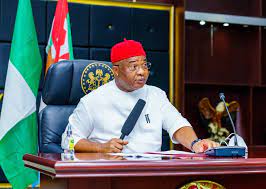
In 2024, Governor Hope Uzodimma Will Be Re-Elected

BY KENNETH UWADI

Hope Uzodinma. Image: Facebook


I read a story on Sahara Reporters of 1st January, 2022 titled, don’t seek re-election for second term, Nigerian Cleric, Primate Ayodele, warns Imo Governor. As the Igbo saying goes, when you see a frog in the day, there must be something after his life. When I read the Ayodele story, I got the picture. The hawks who want to take over Imo by fire by force are at it again. Their first strategy was sponsoring fake newspaper stories, and then they turned to sponsoring killings in the state. Their latest style is sponsoring and promoting fake prophecies. In actions and deeds, these hawks have been making silly and unpardonable mistakes. They have added thousands of votes to Governor Hope Uzodimma in 2004 without knowing it. Hours on end, they continue to add value to Uzodimma’s reelection by jumping from one mistake to another. In their futile bids to paint the governor black they have angered Ndi-Imo who now feel that the governor is being witch hunted for nothing. Men who want to rule the state are going about killing people, killing police, killing soldiers, killing traditional rulers, sponsoring fake prophecies and fake media stories about Imo.

Primate Ayodele only tickled himself and we all know that such a practice is an exercise in self deceit. His message reminds me of some so-called men and women of God, who predicted doomsday and Armageddon. Frightened Nigerians scampered abroad and to their states of origin in droves, some sold their properties at give away prices, awaiting the doomsday. Many died in the process. The disintegration never came. Like the Doomsday and Armageddon prophets, Ayodele’s message about Imo will not come to pass . Emerson once said in The Over Soul ‘’the soul is the perceiver and revealer of truth. We know the truth when we see it; let the skeptics and scoffers say what they choose’’. It is very saddening today to see that false pastors and prophets have dominated the airspace, news media and TV in the land. Today, false prophets prophesy all kinds of lies to enrich their never-satisfying stomachs, selfish and satanic desires. Jeremiah 5:31 informs us that: “The prophets prophesy falsely, and the priests rule by their own power.

The presence of the unknown servants of God in Imo will keep the state away from doom. Imo is in the hands of God. The State will not enter into the hands of killers. Those who pride themselves on their weakness and incompetence, those who kill our people just because they want to rule the state , those whose love of false prophets and strange women know no bounds and have no end will not rule Imo. We know them. When they were governors what did they do? When they were governors they abdicated their responsibilities, destroyed their own political parties, divided their own people, brought ridicule to their own faith, looted Imo funds to high heavens, scorn Ndi-Imo. They are self-evident leaking ships. They will not rule. In 2024, Governor Hope Uzodimma will be re-elected.

When Hezekiah heard he was going to die, he prayed to God. He asked God to intervene. The very fact that he prayed is a remarkable sign of his faithfulness. Think how desperate his situation was. He was sick to death. He has had the prophetic word that he was going to die. The Lord showed his blessing upon him by healing him, by raising him up, by uniting him in the fellowship of worship in his temple and by granting him 15 more years of life and by giving him a son, delivering Jerusalem from the hand of the Assyrians. The Lord surely did glorify himself in answering the prayers of Hezekiah . God that did it for Hezekiah will do it for Imo. Message of Doom will not work in the state.

Balack told Balaam ‘’Now come and put a curse on these people, because they are too powerful for me. Perhaps then I will be able to defeat them and drive them out of the country. But God said to Balaam, “You must not put a curse on those people, because they are blessed.” The Almighty’s warning – thou shall not curse a man God has blessed. The guardian of Israel neither slumbers nor sleeps. It is God that brought in Uzodimma and in 2024 he will become Governor for a second time. Surely there is no enchantment against Jacob, neither is there any divination against Israel: according to this time it shall be said of Jacob and of Israel, What hath God wrought! There will be a gang up but who can battle with the lord. Nobody! Behold, they shall surely gather together, but not by me: whosoever shall gather together against thee shall fall for thy sake. Behold, I have created the smith that bloweth the coals in the fire, and that bringeth forth an instrument for his work; and I have created the waster to destroy. No weapon that is formed against thee shall prosper; and every tongue that shall rise against thee in judgment thou shalt condemn. This is the heritage of the servants of the Lord, and their righteousness is of me, saith the Lord. And so shall it be. It is done.

Thursday, November 21, 2019

Igbo Presidency: Unwelcome Mandate

Igbo Union Pioneers: M.I. Okpara (L) and Nnamdi Azikiwe (C) at a political rally, 1959. Michael Iheonukara Okpara was born in Umuahia, a political leader and Premier of Eastern Nigeria during the First Republic from 1959 to 1966. Okpara attended the Uzuakoli Methodist College, where he won a scholarship to study medicine at Yaba Higher College, Lagos. Completing his medical studies at the Nigerian School of Medicine, he worked briefly as a government medical officer in Lagos before returning to Umuahia to set up a private practice. After the Pogrom and Biafra War, Okpara lived in Ireland, on exile, until his return in 1979. He died December 17, 1984. Nnamdi Azikiwe was born in Zungeru, a political leader and was Nigeria's last Governor-General from 1960 to 1963 and the first president from 1963 to 1966. He was the father of modern Nigeria nationalism. Zik attended Hope Wadell Training Institute, Calabar, and Methodist Boys' High School Lagos, then to the United States securing admission at Howard University in Washington, D.C. He would enroll at Lincoln University, Pennsylvania obtaining degrees in Religion and Anthropology. He worked as an instructor at Lincoln before returning to Nigeria. Upon returning to Nigeria, he founded the West African Pilot, in 1934, using it as an effective tool to fight the British Colonial administrators in the region. He died May 11, 1996 at the University of Nigeria Teaching Hospital, Enugu. Image Courtesy of the Nigeria Nostalgia Project.


There is no single day that passes by Igbo presidency, and its timing, and rightfully placed spot, of electing an Igbo president is not mentioned in the nation's tabloid journalism, in essays, commentaries on a variety of airwaves, beer parlors' usual crackpot intoxicating effects, social gatherings, informal debates, Igbo related forums, local political membership clubs, and any forum identified with the Igbo, and how the danger poses a wide range of problems resulting from the Igbo still not aware of the political play attracting such conventions, while the power brokers and ruling elites of the Fulani Caliphate oligarchical class watch gleefully how it should be unfolding, and how the shots would be called, and its design, and the players, regardless of background, and eventually, when stamped as done deal on its final call by the caliphates, knowing an Igbo president is still a mirage, and would continue to be a mirage until the caliphate oligarchical class gets saturated with the Nigerian enterprise. Igbo president of an entrapped nation state doesn't exist. It just won't happen.

And we are not too far from memory in our experiences of how we've been thrown around in what happened to have originated by the pragmatic Igbo and his men of industry, I have mentioned times without number; and another familiar case of Goodluck Jonathan I had made clear his presidency represented the Igbo spot, and was an "Army Arrangement" plot, organized by the Fulani Caliphates and their collaborators.

The caliphate has never encountered any problem in its platform to determine who should be assigned a slot and what circumstances calls for it's implementation, and at what given time, whenever the quest for the presidency becomes a hot topic on what particular tribe gets the merit, from its political standings and waiting time, especially the Igbo, in her elusive game, from the moment a nation was fabricated, even when a political party is not sure of its slot and how the propaganda works in a crumbling, dictatorial, democracy like Nigeria.

The Igbo extraction of the entrapment is subjected to present not only who had been passive in mind, and actions, but a representative of the status quo, to feed from the crumbs of the caliphate and run out to the public square and applaud their captors on becoming conducts and get more access to the leftovers that had given them life, which has been the situation of alleged Igbo presidency, since the military juntas left, and after the junta, Abdulsalami Abubakar's indoctrination to guide the 4th Republic, was used, which remains valid on the floor of an inconsequential, inept and corrupt National Assembly. A National Assembly without clue what democracy stood for and the foundations that kept it intact and viable. A lawless place, legislated by imbeciles and corrupt and criminal masterminds.

The irony of all the events surrounding Nigeria's political plays following the apparent bad regimes in a civilian order, kidnappings begun anew, frequent assassinations, religious leaders partake and influence in government, press censorship and imprisonment of journalists, military institutions still enforcing decrees on roadblocks, series of Human Rights violations, police forces forced to abandon the implementation of the rules to set up criminal enterprises, in a society that dramatically welcomes a state of empire and anarchy, while the United States and the West, looks the other way round. Proper governance and democracy itself has been jeopardized. This is the present situation Nigeria finds itself, and comfortable enough, the population seems to be fine with it.

In as much as the interest sounds very much political and affiliation with the ruling elite, and a scramble to favor the caliphate oligarchical class, and the directives that sees the control of power, having nothing to do with its democratic proceedings and standard of a democratic fabric, by way of its constitution determining the outcome, and not by political party principles, then they can be assured the playing field has never been leveled in their favor, but on the benefit of the caliphate even when they are not running the affairs of state, giving the agitators reason to put their demand into perspective, and on their own very interest and, heavily relying on "nku ukwa igba n'Abuja," ballooning like fat cats, often a trend and remark for social economic status, used as machinery to intimidate others.

And we must not forget to bear in mind that before anything political of a nation-state ever surfaced, Igbo had kept its republican ideals applicable and complete, upholding its rule of customary laws through organized representation and rules that governs it. And upon creation of the Igbo Union, all had been concretely sustained following profound leadership with no social contract. But that order would be hijacked not because a better and more progressive options had been obtained, but a people so unique in its tradition and cultural heritage would fall apart, entirely from its standard; for instance, the jumbled and bellicose World Igbo Congress, the WIC, acclaimed Igbo umbrella, the elitist Ohanaeze Nd'Igbo, the ego-tripping Igbo Cultural Association of Nigeria-Dallas/Forth Worth, the do-nothing Igbo Cultural Association of Southern California, Owerri Progressive Union, Owerri Peoples Union, Anambra State Association, Imo State Congress, Old Orlu Province Association, Igbo Mandate Union and the list goes on, and on, of organizations without effective tools and couldn't come up with anything substantial and credible in time of its challenges.

And, on the social landscape toward organizational effectiveness: the women social club and its watch on preserving Omenala Igbo, rules of engagement and Igbo cultural heritage, Anaedo Social Club, Peoples Club of Nigeria, etc, with a barrage of confusion showing nothing else but flamboyance of its outfits, swaggering around at any picnic, a commonplace thing right now, when these organizations should be engaging in serious stuff, keeping the fundamentals of its forebears whole.

From how it was said to have begun in what had been new era of a peoples' fate, almost forgotten until the ideal of an indivisible, national states, emerges, recognizing the values of freedom in every of its discipline, and justice to keep an upcoming republic intact and viable; after the military juntas had ruined the state in its entirety, raping the treasury empty and topping it off by destroying all aspects of civil liberties, for a very long time in their stay with absolute power, which left the civilian population permanently disfigured.

Upon all that, there was high expectations that the coming republic would learn a lot of lessons from its past, deriving nothing in what had gone wrong over the years from a bunch of power holding juntas, that came out of the military barracks with their guns, when what had generated political discourses and formation of political parties to engage in political maneuvers, in another experiment seeking what would be a more credible, elected president than previously held, looked very much like a fix by the juntas who had disguised its order, joined and headed the civilian structure.

It was not to be; the handlers who were still fragments of the same juntas that used their impunity, the barrels of the gun, to decide how the country should be ruled, drawing their map and positioning their pick at the nation's critical time and the dire need for good governance, still called all the shots until it was all over, with a stamp, in continuity; as they sneaked in their own, the election of Olusegun Obasanjo, to begin the 4th Republic after almost every option had been exhausted, and, after the civilian population was yet to recover from its state of comatose, from the brutal beatings by the military juntas. The civilian structure never recovered.

And with all that badly beat up vulnerable Igbo elite and political junkies, permanently battered, and not much that they could do but go with the "flow" on the juntas' terms and agree on whatever that had been made available as the case had been; even though they could have done much, much better to reject what the juntas had doctored as available document, representing the peoples constitution.

But then, and again, to be sure, on who would be elected president of another experiment of a republic supervised by the juntas who had added clauses in their favor, leaving a population without choices, to have the ultimate right in rejecting such fabricated constitution for an 'authentic' one, a written document prepared on the consent of the people and endorsed on its behalf by the delegates representing their districts, their wards, their zones, etc. and as the case may be, to put in place a constitution that is totally endorsed by the people, of their consent. It's just as simple as that, and that's how a normal democracy functions. But the Nigerian national state had been dogged by the juntas which still plays till today as the constitution they fabricated is the one still used in the National Assembly.

It never went that way, to follow the guidelines of democratic principles, respecting the rule of law and upholding its democratic constitution written from a perspective of the peoples mandate. What the juntas had done was, in observing how critical, how gullible and how vulnerable a battered population had been subjected to, having not much of a choice at the time of said transition a convicted erstwhile military junta who had come close to death out of nowhere within the nations political arena, was revived and in a 180 degrees turn, became the party's flag bearer, pushing aside one that had founded the committee of friends and its political action committee, and groups to initiate throughout its explorations what would be the Peoples Democratic Party, the PDP and its blueprint to guide its political process.

What had not been considered by the people was their political stupidity and the inability not to have resented and declined to any form of platform in transition as prescribed by the band of military juntas who are still in their presence today, challenging them with the "in-your-face" attitude that we own the power, and would always, since you couldn't get your acts together, with more factual instances of a sitting president, who hates free speech and was once a dictator and a murderous lot, and his colleague who begun the 4th Republic under the auspices of their arrangements in a following order, succinctly described by the Chief Priest Fela Kuti, in one of his protest songs, "Army Arrangement."

What is more ironic is a civilian population that had been permanently subdued and lost every sense of purpose and belonging to situate itself, and be able to call the shots on behalf of the people. That challenge surfaced when former military junta, Obasanjo, had mistakenly assumed he had a puppet he'd rubber stamped to follow his orders. It backfired and an alternative was desperately needed to quiet a standby "barrels of the gun," as former junta, Muhammadu Buhari, was suggested to end a nightmare and deprivation to the bunch of military juntas who just couldn't take it anymore in order to restore its cultural norm.

And while the entire mess was allowed to go on and unchecked, a set of people, an ethnic group of the nation's major stock were caught in between making up their mind, knowing exactly what it demands on grounds of national leadership and the current trend it should follow, and having what it took to pursue its cause, and its rightful place on national standing which had long been dragged from colonial times until this present day, the possibilities now bears the same resemblance of the Biblical camel passing through the eye of a needle than a sinner to be admitted into God's Kingdom.

The 4th republic had made nonsense of democracy to which the civilian population should have adhered to, the power belonging to the people on the grounds and the ideal that the military institutions were meant to defend the nation's territories on the orders of the commander-in-chief, who by all accounts is the nation's chief executive to decide when it's appropriate and adequate to declare war against enemies of the state.

But as we tend to soon forget, the origins of a fabricated national state on which the colonists established nations that had nothing in common, as they did in the Balkans, the Ottoman Empire and elsewhere, directing its leadership and the nationals in question left without much choices as the quest and the need to be free became what was vital to survival and the escape from bondage, using the tribal leaders in its experiment which had suggested its genuine mandate while they, the colonists, gave all the directives, dictating how a freed nation should run its affairs of state. As it had also happened, prior before its freedom, its tribal leaders had never gotten along, an apparent indication it had not meant to be, and what was bound to take effect was mistakenly agreed upon, perhaps on the probabilities a sense of place and oneness would be understood to situate the nations accordingly.

In what had occurred during the constitutional conferences, the tribal leaders from a colonial observation had been carved out from three ethnic groups as key-point to sustaining what would be its democracy, while the ethnic minorities, not given a shot and recognized, were trapped in the midst of the three major ethnic groups--Igbo, Yoruba and Hausa--and couldn't play any significant role in the formation of the republic as independently engaged, but on the sidelines which erupted the agitation for self reliance. It was not until some of the ethnic minorities had begun to make their presence known, through series of its agitations, and the need for them to go their separate ways, that the colonial administrators gave it a thought, starting with the Willink Commission and the grievances of the ethnic minorities in their requests for plebiscites, with concerns on the Ibibio, Annangs, Ijaw, Ogoni and the rest of the tribal creeks and inhabitants in the woods of the Niger-Delta, even though tribal politics and ethnic interests had already emerged.

The Midwest, however, was carved out, eventually, with a widespread Igbo speaking population, including the Isokos, Urhobos, Ijaws, Itsekiris and others from what was originally Western Region, sustaining its reliance of state and share of the nation's revenue formula derived mainly from oil production. At the time of these political and power plays, the House of the Caliphate, up north in the nation's landscape, ran the affairs of state on the basis of higher figures, on democratic terms, while the southern leaders squabbled over political supremacy, as the confusion was established and never stopped, and no longer hidden that the nation was wrongly carved--a contraption.

The three ethnic leaders in what had become a tradition in the nation's political landscape, and the Igbo being the front runner toward the initiative from establishing the Igbo Union in respect to its republican ideals which propped up free thinking individuals while the colonial administrators decided what should matter and the obligations of controlling the state, empowering the northern elites to dog an entire nation in all cases that may arise, sharing currency with monarchy and where power should belong while the Zikist and Awoist movements looked and picked up quarrels among each other, creating the divide and hatred that stands till today in Southern Nigeria.

The ethnic rivalries--Nnamdi Azikiwe and Obafemi Awolowo--of the Igbo and Yoruba stock, had better ideas but were not tactical and had lacked the vision to have rejected any referendum in the fabrication of a nation state that would be Nigeria, knowing too well from their experiences the implications of agreeing on the terms of the colonial administrators to form a union while both had accused each other of tribalism and "master-racing," which Awolowo had earlier accused the Zikist Movement, feeling the threats of Igbo supremacy.

But a look at how it all began. Igbo had no parallel upon the race, when the colonial administrators saw a band of multiple contestants gearing for a fabricated national leadership as the colonists wanted it, to keep what had been intentionally deceitful, together and "progressive", to their own advantage. Nevertheless, the Igbo had worked so hard, and had been diligent to produce the fronntiersmen, leaders who had committed themselves to sustain a profound Igbo nationhood. The task was arduous. The commitment was honest. The roles were significant and expectations, very high. There were political disagreements but the notion was a mark of collectivity, which ultimately leads to utopia. There were factions and cultural deviations relating to its conduct. The ideal was phenomenal and the purpose, becoming and, for Igbo common good, which was achieved before the colonial administrators hijacked the moments.

The best Igbo minds had assembled on a variety of discipline in meetings, and in different locations, and no substitute could be compared to their hard work: Nnamdi Azikiwe, Kingsley Mbadiwe, Mbonu Ojike, M. I. Okpara, Nwafor Orizu, Louis Mbanefo, Francis Akanu Ibiam, Gogo Chu Nzeribe, Dennis Osadebay, Okeke Ojiudu, Francis Akanu Ibiam, Jaja Wachukwu, Josiah Okezie, Louis N. Obioha, Louis Ojukwu, Alvan Ikoku, Okechukwu Ikejiani, the thoughtful laymen and as the list goes on and on, not to mention the haul of scholars--Chinua Achebe, John Munonye, Kenneth Dike, and others, and the ideal these Igbo pioneers had left as legacy was easily wiped out from the political stupidity of those the mantle had been enthroned while confronted by a machinery that wants the Igbo indefinitely lowered in status. And of course, that machinery succeeded, in every of its applications to permanently paralyze the Igbo for good.

What erupted then after, regarding effective and sound following, was tragic with a trace to what had ended the Pogrom and the Biafran War. The dramatic changes of the foundations showed no sympathy. It was total with ominous consequences and, the Igbo would be victim of an experiment begun by the colonial administrators. And henceforth, a population that had been meant to continue and move on with an overwhelming national wealth derived from oil production and a buoyant human capital, and a 'Reconstruction' tailored to heal the battle wounds, would make a sudden 90 degrees turn, while comfortable with its operations--giving the military juntas and vandals every permission to do whatever they liked from credits of plundering and demolishing Biafra.

The military would take it and promulgate decrees to quiet a politically impotent civil society, censoring its vibrant press while they kept funny books, giving no accounts of its regime and exercising power on a turn-by-turn basis, one junta after another, raping the nation's treasury without questions asked, slamming the civilians too vocal by challenging their authority; and by the time they were saturated and done, the civilian population and its structure had been disfigured perpetually. Such is the case today as the juntas and its 'northern ruling elites' maintain the status quo.

Did I not say it, that Igbo will not be president of Nigeria because they have never been prepared when the testings takes real form and that, the usual nasty political play would hinder it? And the simple truth, that the Igbo lost every sense of belonging and purpose, to establish a profound leadership?

Have I not been writing over the years about the confused bunch of Igbos who walk our political corridors as leaders? Have I not said it over and over again that Nd'Igbo are misguided on the grounds of lacking a true, authentic leadership?

Didn't I point it out in their face, on many occasions, at community meetings, conventions and related events, that save for the usual picnic, which they should be given credit, that nothing could be said of its accomplishments since Yakubu Gowon's-led genocidal campaign against the Igbo nation, from around which they adopted the platforms and outfits of their haters, the bigots who had wanted them wiped out from the face of this planet?

When I had told the confused and oftentimes infallible Igbo bunch that they need to rethink their strategies toward effecting change in Ala-Igbo, did they not haggle rather than tackle and seek resolve on a heap of problems like in Ode Mkpishi Chinua Achebe's story line of a man who had abandoned his burning house to chase the rat fleeing from the flames?

On its national programs to create and develop a chain of related media in terms of an engaging propaganda tool, and in tune with Igbo political and, cultural ideals, thus a standard newspaper, journal, newsletters, consistent editorials and things like that, in order to stay in business and face the challenges of feasible communication and effective press, and that, nothing really would matter if Igbo stubbornly and deliberately fails to stand out with its own independent newspaper covered by its own variety of editors, staff and writers which would put meaning into the Igbo subject.

Did I not mention that in numerous occasions and entirely worn out, that the celebrated Igbo writers were a bunch pursuing their own personal interest and reason why they had sealed their lips so as not to jeopardize their chances while they play to the gallery alongside their enemies who would attack and destroy them, and nothing would happen other than a people whose history had been of administrative and political impotence to take the choice of being pacific?

When I had written the series of pieces about the Igbo presidency and debates that had followed over the years including related symposiums once conducted at Igbo Forum, was I not said to be writing to put a monkey wrench into Igbo matters and the presidency I had no "authority" on?

And following that, and putting every other thing into outlook of things, did I not with distress, when militants of other ethnic backgrounds were gunning down their targets, causing all kinds of havoc, threatening the security of the state and yet allowed to go scot-free, while MASSOB leader Ralph Uwazuruike was locked up and never given a chance to be released, and why "Igbo leaders" sat idly and watched Ganiyu Adams, Frederick Fasheun and Asari Dokubo make deals with the federal biased authority; and would be let go unconditionally while Uwazuruike was permanently shut and isolated in the gulag, question a do-nothing Igbo leadership on what explains their keeping a tight lip?

When Igbo leaders of thought, wherever they were, upon reaching decisions for a permanent burial ground for the Biafran heroes and nobody had wanted to be seen as leading the cause, Orji Uzor Kalu, then governor of Abia State, who took the challenge and allowed Umuahia as the last resort when a designated Uli was declined by Chinwoke Clement Mbadinuju because of threats he received from "I dey Kampe" Obasanjo, did I not applaud Kalu and praised his doctrine?: "Orji Kalu, Leadership And Igbos Political Future," even though said piece was widely distributed on the web, did Igbo not accuse me of writing for foreign news organizations and later brought forth by Kevin Ani, that I should be engineering Igbo paper?

Upon Muhammadu Buhari's series of attempts at the presidency, the Igbo were still stuck with their right of place to the presidency and a raging debate with all the viewpoints basically the same, saturating the papers with boredom as the substance of the debates about Igbo and the presidency waned. A "right of place", if Igbo had been strategically consistent in its persuasion as one entity and not the political plays that divided its motive, they would by now reached a point where they'd had no need for the presidency as they'd be controlling every aspect of the economy with its manpower, intellectual power house and political clout.

But on a case of sad reality, here we are again, on a presidential election Igbo played no major role in determining who should be elected while the otimkpus, the alarmists, on the beat and how they understood the Igbo situation and politics in Nigeria never stopped making noise in their engagements to seek relevance.

Igbo has more to worry about in its quest for the common good on what surrounds them than agitation for a presidency slot that would continue to keep them divided without one voice.


A scene outside the Eastern Region House of Assembly at Enugu with crowds watching an investiture ceremony when regional states influenced its independent powers and made decisions without federal character. Circa 1960

KNOCK, KNOCK

By issuing subpoenas to five Times journalists, the Trump administration reveals its first response to unwanted national security coverage: ...