Showing posts with label Nelson Mandela. Show all posts

Tuesday, January 30, 2024

An Auction Of Nelson Mandela’s Possessions Is Suspended As South Africa Fights To Keep Them

Former South African President Nelson Mandela, center, wears a printed shirt in Johannesburg, on July 13, 2003 as part of his 85th birthday celebrations. (AP Photo/Themba Hadebe, File)

BY MOGOMOTSI MAGOME

JOHANNESBURG (AP)
— The planned auction of dozens of artifacts belonging to Nelson Mandela has been suspended pending a court application to completely halt it, the body that protects South Africa’s cultural heritage said Tuesday.

The online auction had been scheduled by New York-based Guernsey’s auction house on Feb. 24, in conjunction with Dr Makaziwe Mandela, the eldest daughter of the anti-apartheid icon and South Africa’s first democratically elected president who died in 2013.

It had received widespread criticism from the public and the South African government, which is supporting a court application by the South African Heritage Resources Agency, or SAHRA, to appeal an earlier court judgment that gave the auction the go-ahead.

Items listed for the auction include Mandela’s iconic Ray-Ban sunglasses and “Madiba” shirts, personal letters he wrote from prison, as well as a blanket gifted to him by former U.S. President Barack Obama and his wife Michelle.

A champagne cooler that was a present from former U.S. President Bill Clinton was also on the list, with bidding for it starting at $24,000. Also among the items is Mandela’s “book” — his identification document following his 1993 release from prison.

On its website, Guernsey’s described the planned auction as “nothing short of remarkable,” and said that proceeds would be used for the building of the Mandela Memorial Garden in Qunu, the village where he is buried.

A note on the auctioneers’ website on Tuesday indicated that the auction had been suspended without providing any further details.

SAHRA said in statement that the suspension is a result of its engagement with Dr. Mandela and the auction house.

“SAHRA welcomes the decision by Guernsey’s Auction House to suspend the auction,” the agency said.

The agency is awaiting the outcome of an application for leave to appeal the decision by the North Gauteng High Court in Pretoria to let the auction go ahead, dismissing an interdict by the agency in December last year.

The agency argues that the items to be auctioned are the country’s cultural heritage artifacts and should be preserved for future generations instead of being sold to the highest bidder.

Follow AP’s Africa coverage at https://apnews.com/hub/africa

Saturday, January 13, 2024

South Africa Has Regained Some Of Its Lost Moral Authority With ICJ Genocide Case Against Israel - Prof Saths Cooper


BY PROFESSOR SATHS COOPER

On Thursday, I joined many of you in watching the tour de force by the outstanding legal team representing South Africa’s case at the International Court of Justice (ICJ) in The Hague to stop the genocide in Gaza.

The clearly evidenced manner in which respected lawyers – Dr Adila Hassim SC, Tembeka Ngcukaitobi SC, Prof John Dugard SC, Prof Max Du Plessis SC, Ms Blinne Ní Ghrálaigh KC, and Prof Vaughan Lowe KC – presented the case to protect life and prevent further genocide, was compelling.

Similar to our rugby World Cup win in October last year, Thursday’s ICJ hearing truly made us proud to be South African, as we start a year that can be fraught with more decline and decay, or be alive with the enormous possibilities that a country standing together, finding one another across artificial barriers imposed by our imprisoned history, engaging vigorously on issues that impact us to find viable ways forward, ignoring the bleating of inane self-serving, inward-vested, self-important persons from scores of political parties and millionaires who wield extraordinary power; all promising us heaven, knowing that they will deliver us unto hell if we allow them to; can offer.

Most of us know that terrible geopolitics and tiresome and failing narratives – where oppression and dehumanisation assume a mindless, alluringly misguided and abnormal value – can once again so easily prevail post-the ICJ case.

This will allow the perpetuation of crimes against humanity, and demonstrate that international forums work for the entitled and privileged few, against the rest of us.

A negative outcome at the ICJ will likely accelerate the need for the outdated and incapacitated United Nations, which comprises 193 sovereign states, being held hostage by the ineffective Security Council – a product of World War II that ended on September 2, 1945 – to be reformed.

The five states (the US, UK, Russia, France, and China), who hold arrogated permanent veto status in the UN Security Council, manufacture, disseminate and glorify weapons and other products of mass and individual destruction, increase their numerous war bases across the globe, and control ill-gotten wealth from the time of slavery, colonisation and their sequelae.

They are largely responsible for creating more poverty, marginalisation, illness and death of the majority on our fragile planet, made unsafe and steadily degraded by their actions.

They wield enormous and undue influence over those who appear to be in power in the rest of our fragile planet.

Whatever the outcome at the ICJ, South Africa regained some of its lost moral authority after the demise – at least on paper – of apartheid that followed Nazism as a crime against humanity.

Open-minded people everywhere, who abhor war and its devastations, will ensure that our vulnerable and threatened world cannot continue in the third decade of the 21st century to remain apathetic, and so closely controlled, while giving the appearance of being liberating.

Continuing to find refuge in the marks of our origin, our limited socialisation and reliance on blatant peddlers of untruths who proliferate on social and mainstream media will further limit our ability to effectively mediate our complex world.

This will only crush us further, and reduce our agency, which we cannot afford to delegate to anybody else.

We are who we make ourselves to be, despite our origins and circumstances, refusing to be restricted to anybody else’s biased image. We were born and should always be free, in mind, body and spirit, and should constantly strive for inner and outer peace.

Anything else will render us ineffectual and powerless, causing us to lose hope in our innate ability to strive against adversity and be part of transforming our world into a peaceful and thriving one that we so desperately desire.

We have that power. Let’s not lose it as we celebrate the 30th anniversary of our hard-won democracy.

READ ORIGINAL STORY HERE

Friday, January 12, 2024

Nelson Mandela’s Support For Palestinians Endures With South Africa’s Genocide Case Against Israel

Late Palestinian leader Yasser Arafat, left, embraces the late former South Africa President Nelson Mandela, right, at a meeting in Johannesburg Thursday May 3, 2001. (AP Photo/Denis Farrell, File)

BY GERALD IMRAY

CAPE TOWN, SOUTH AFRICA (AP)
— Barely two weeks after he was released from prison in 1990, Nelson Mandela flew to Zambia to meet with African leaders who had supported his fight against South Africa’s apartheid system of forced racial segregation.

One figure stood out among the men in dark suits eagerly waiting to greet Mandela on the airport tarmac: Palestinian leader Yasser Arafat, wearing his black and white checkered keffiyeh headdress, had traveled to see the newly freed Mandela.

He grabbed Mandela in a bear hug and kissed him on each cheek. Mandela smiled broadly. It was confirmation of the solidarity between two men who considered their peoples’ struggles for freedom to be the same.

South Africans continue to support the Palestinian cause, and the country has taken the rare step of bringing a genocide case against Israel at the International Court of Justice because of its war in Gaza.


South Africa is not a diplomatic heavyweight and is geographically far from the conflict. But its ruling African National Congress, which Mandela led from an anti-apartheid liberation movement to a political party in government, has retained its strong pro-Palestinian stance even after Mandela died in 2013.


“We have stood with the Palestinians and we will continue to stand with our Palestinian brothers and sisters,” Mandela’s grandson, Mandla Mandela, said at a pro-Palestinian rally in Cape Town in October, days after the Hamas attack in southern Israel spurred the war on Gaza. Mandla Mandela, an ANC lawmaker, wore a black and white Palestinian keffiyeh around his neck as he spoke to a large crowd.
A SHARED STRUGGLE

Nelson Mandela regularly raised the plight of the Palestinians. Three years after apartheid and white minority rule was dismantled in South Africa and Mandela was elected president in historic all-race elections in 1994, he thanked the international community for its help. He added: “But we know too well that our freedom is incomplete without the freedom of the Palestinians.”

Mandela and South African leaders after him compared the restrictions Israel placed on Palestinians in Gaza and the West Bank with the treatment of Black South Africans during apartheid, framing the two issues as fundamentally about people oppressed in their homeland. Israel provided weapons systems to South Africa’s apartheid government and maintained secret military ties with it up until the mid-1980s, even after publicly denouncing apartheid.

The ANC has consistently criticized Israel as an “apartheid state,” even before the current war. International rights groups have also accused Israel of the crime of apartheid against Palestinians and that “resonates strongly with South Africa,” said Thamsanqa Malusi, a South African human rights lawyer.

Israel adamantly rejects that characterization, saying its Arab minority enjoys full civil rights. It views Gaza, from which it withdrew soldiers and settlers in 2005, as a hostile entity ruled by the Islamic militant group Hamas, and it considers the West Bank to be disputed territory subject to peace negotiations — which collapsed more than a decade ago.

Malusi said many in the South African government experienced the oppression of apartheid and that could help explain its decision to lodge the case against Israel at the U.N.'s top court.

While Mandela, the Nobel Peace Prize-winning statesman, also reached out to Israel in an attempt to foster a peaceful solution, anti-Israeli rhetoric in South Africa has strengthened over the years, sometimes seeping into everyday life. For example, the ANC’s youth wing pressured South African grocery store chains to drop Israeli products and threatened to forcibly shut them down if they didn’t.
RESPONSE TO THE WAR


Israel’s assault on Gaza sparked renewed solidarity with the Palestinian cause in South Africa. Thousands have marched in support of Gaza in Cape Town and Johannesburg, and buildings in the Cape Town neighborhood of Bo Kaap were adorned with pro-Palestinian graffiti in the weeks after the war broke out.

South African President Cyril Ramaphosa — the current leader of the ANC — has criticized both Israel and Hamas for what he calls atrocities committed by both sides in the conflict. But he also appeared in public wearing a keffiyeh and holding a Palestinian flag, even as he offered condolences to Israel over the Oct. 7 Hamas attacks, leaving little doubt where South Africa’s sympathies lie.
HAMAS CONNECTIONS


ANC officials, including Mandla Mandela, hosted three Hamas officials in South Africa last month, including the group’s top representative in Iran. They attended a ceremony marking the 10th anniversary of Nelson Mandela’s death before a statue of the former South African President at the seat of government in a nod to his historic connection with the Palestinian cause.

On Wednesday, the eve of the court proceedings, Palestinians in the West Bank city of Ramallah crowded around another statue of Mandela, waving Palestinian and South African flags and holding signs that read: “Thank You South Africa.”

The Hamas visit to South Africa was not welcomed by all, though.

South Africa’s main opposition party has said it considers Hamas a terrorist organization, as do the United States and European Union, and support for Palestinians in South Africa has complicated racial connotations. Black and mixed-race South Africans, brutally oppressed under apartheid, have been at the forefront of the support for Palestinians. Support is not as pronounced among South Africa’s white minority.
ACCUSATIONS OF HYPOCRISY

South Africa’s ANC-led government says it is taking a moral stance in its genocide case against Israel, first seeking an order for Israel to stop the assaults in Gaza that have killed more than 23,300 Palestinians, two-thirds of them women and children, according to the Gaza Health Ministry.

But the case has given rise to accusations of hypocrisy: The ANC has itself ignored international court orders.

The ANC government refused to arrest then-Sudanese President Omar al-Bashir when he visited South Africa in 2015 while the subject of a warrant on allegations of genocide by the separate International Criminal Court. South Africa has also retained strong ties with Russia and President Vladimir Putin since the invasion of Ukraine, overlooking an ICC indictment against Putin for alleged war crimes in relation to the abduction of children from Ukraine.

Israel vehemently disputes the genocide claims, saying it is fighting a war of self-defense after Hamas militants launched its Oct. 7 attack on southern Israel, killing about 1,200 people, mostly civilians, and taking roughly 250 hostage. Israel says its actions comply with international law and that it does its best to prevent harm to civilians, blaming Hamas for embedding in residential areas.
___

AP Africa news: https://apnews.com/hub/africa

Tuesday, September 26, 2023

Mandela’s Granddaughter Zoleka Dies At 43. Her Life Was Full Of Tragedy But She Embraced His Legacy

Author Zoleka Mandela, right, granddaughter of former president Nelson Mandela and Winnie Madi kizela-Mandela, left, attent the launch of Zoleka's book "When Hope Whispers," in Johannesburg Tuesday, November 12, 2013. (AP Photo/Denis Farrell, File)

BY GERALD IMRAY

CAPE TOWN, SOUTH AFRICA (AP)
— Zoleka Mandela, a granddaughter of Nelson Mandela whose life was tangled up in addiction, a suicide attempt, a battle with cancer and the tragedy of losing two young children before she came back from the shadows to embrace his legacy, has died. She was 43.

Her death on Monday was announced by the Mandela family in a statement on Tuesday. The breast cancer she had fought for years had been in remission. But she was later diagnosed with cancer in her liver and lungs and it had metastasized and spread, her family said.

The Nelson Mandela Foundation, which promotes the legacy of the South African statesman who died in 2013, said it mourned Zoleka Mandela’s death and offered its condolences to her family. It said she was a “beloved grandchild” to Nelson Mandela and praised her work raising awareness of cancer and her role as an inspiration to those affected by the disease and to those who had lost children.

She set up foundations to help people in both spheres.

Mandela’s early story was a series of struggles and tragedies that were almost too much for one person. They were set against her self-confessed attempt and initial failure to live up to the example of her grandfather, a Nobel Peace Prize winner, the leader of the anti-apartheid movement, the first Black president of South Africa and a powerful force for good recognized and admired across the globe.


Mandela suffered sexual abuse as a child and battled drug and alcohol addiction from her teenage years. Her 13-year-old daughter, Zenani, was killed in a car crash in 2010 on the way back from a concert that marked the opening of the soccer World Cup in South Africa. It was caused by a drunk driver and came when Zoleka, herself, was deep in her drug and alcohol addiction and in a hospital having attempted suicide.

“I hadn’t seen my daughter for 10 days before her passing, and I hadn’t because I chose to use drugs,” Mandela said in an interview with The Associated Press in 2013. “That’s obviously a reminder that I chose my addiction over my kids and I have to live with that for the rest of my life.”

The horror and guilt jarred her into seeking help and going into rehab for the good of her other child at the time, son Zwelami, and the memory of her daughter Zenani, she said. Zenani’s death brought a frail-looking Nelson Mandela out to a church for his great-granddaughter’s funeral and one of his last public appearances.

Mandela was diagnosed with breast cancer barely a year after her daughter’s death, leading to a double mastectomy and grueling chemotherapy. Her second son was born prematurely in 2011 while she was being treated for cancer and died days later. She had four surviving children at the time of her death.

She released an autobiography titled “When Hope Whispers” in 2013. It delved into what she called some of the “unbearable circumstances” of her life and how an abnormal childhood played its part. In the book, she recounted the realities of being a Mandela when South Africa was in some of its most violent throes under the apartheid system of racial segregation in the 1980s and her grandfather was in jail for leading the anti-apartheid movement.

Mandela was smuggled into a high-security prison on an island off Cape Town at the age of 1 so her grandfather could meet her for the first time, she said in her book. As a child, she hid a grenade in her schoolbag so her grandmother, who was part of the armed resistance to apartheid, wouldn’t be arrested by the regime.

The opening line of her autobiography set the stage for her early childhood: “By the time I was born ... my mother knew how to strip and assemble an AK-47 in exactly thirty-eight seconds,” she wrote.

She was abusing alcohol by the time she was 9, and later doing lines of cocaine daily, the start of an addiction that led her, years later, away from her own children and toward the greatest of her regrets when she was an absent parent at the time her daughter was killed.

But her life changed and her story ultimately closed with a different chapter. She became a renowned campaigner, both for cancer awareness and also for road safety, winning praise and admiration for her work in both fields, and for her courage in the latter stages of her terminal cancer.

The foundation that bears her grandfather’s name recognized her as a “tireless activist,” possibly the most fitting tribute given that as daunted as she was by the legacy of Nelson Mandela, she was ultimately inspired by it, and by him. She once said that, above all, she hoped he approved.

“I just hope where he is with my daughter he is looking down and thinking she has gotten it right, finally,” she told the BBC in 2016.
___

Carley Petesch, a former AP correspondent in South Africa, contributed to this story from Chicago.
___

AP Africa news: https://apnews.com/hub/africa

Monday, July 24, 2023

Sri Lankans Can Learn From Mandela’s Visionary Thinking


Excerpts Of The Nelson Mandela
Memorial Lecture Delivered By

Premakumara de Silva,
Chair Professor Of Sociology, 
University Of Colombo

On 18 July 2023 at the Tharangani Hall, Sri Lanka Film Co-operation, Colombo. The lecture was organised by The Ministry of Higher Education and High Commission of South Africa, in Colombo.

As we all know, Mr. Nelson Mandela was an antiapartheid activist, politician and philanthropist who became South Africa’s first black President from 1994-1999. He was born in Cape Province, South Africa, on 18th July 1918, day like this. He died at age of 95 on 5th December 2013 in Johannesburg. Nelson Mandela was an extraordinary leader, who fought for the citizen’s rights and was the main influence in removing apartheid, which was practiced as the law of the land in South Africa since 1948. This law not only created a social gap between the Whites and the Blacks in the country but also fuelled the discrimination against the black population.

The policies during his leadership (1994-1999) were mainly aimed at improving the economy while reducing the social inequalities. One such policy is the Reconstruction and Development Programme (RPD). The purpose of this RPD is to overcome the social and economic problems faced by South Africans, such as violence, lack of jobs, of housing, equal access to adequate education, and healthcare. At the time of Apartheid, there was a division of cities where White people were placed in developing cities while Black people were placed in cities that were marginalized and neglected, even their housing was in the form of huts. So South Africa was a structurally unequal society where Black people were visibly marginalized and discriminated on the basis of colour of their skin.

Nelson Mandela joined the African National Congress (ANC), in 1942, the organization that was aiming for the independence of the South African people from apartheid and bringing equal rights for all groups. Mandela was one of the important figures in this movement and played a major role. He has directed peaceful campaigns, challenging violence against the government of South Africa and its racial policies for over 20 years. Nelson Mandela presented several important strategies related to his struggle against apartheid through the ANC under pressure from the South African government at the time. He launched the M-Plan (Plan Mandela). He was also a member of the People’s Charter for Congress and Freedom. The Pan African Congress, PAC, was formed under Robert Sobukwe’s leadership in 1959. The ANC and PAC responded by setting up a military wing in 1961. Nelson Mandela was instrumental in creating the ANC group in what was a radical departure from the ANC policy.

On 30th July 1952, under the Law on the Eradication of Communism, Mandela was arrested and tried in Johannesburg as part of 21 defendants. Convicted of violating this law, their forced labour sentence of nine months was extended to two years. Mandela was banned for a period of six months in December from attending meetings or talking to more than one person. On July 11, 1963, he was arrested again with other leaders. In the trial, Nelson Mandela was charged with more than 200 charges of “sabotage, preparing for guerrilla warfare in SA, and preparing for SA’s armed invasion.” Mandela was one of five (out of 10 defendants) to be sentenced to a life sentence and was sent to Robben Island.

Strong protests against Mandela’s arrest were increasingly voiced to the government through the ANC’s continuing movements. The world also supported the liberation movement of Mandela, including the UN. The UN obviously set out to fight Apartheid on 1 January 1976. Resolution 554 (UN 2014) was also issued on 17 August 1984. At that time, various violent protests were directed at the government of South Africa. Nelson Mandela’s 70th Birthday Tribute at Wembley Stadium was made on June 11, 1988. The concert, broadcast to 67 countries with over 600 million audiences, was one of the protests against Nelson Mandela’s imprisonment by the South African government.

Nelson Mandela was finally released from Victor Verster Prison on 11th February 1990. ANC and Nelson Mandela’s struggle was not in vain. South Africa finally succeeded in holding a democratic presidential election on October 3rd, 1994, without any racial differentiation of rights. Nelson Mandela’s inauguration as the first black President of the country on May 10th, 1994, at the age of 77, with Willem de Klerk being the first Deputy, was one of the ANC’s goals in carrying out resistance to Apartheid politics. Mandela worked to bring the transition from minority rule and most Black Apartheid rules, from 1994 to June 1999.

During the Mandela era, ANC’s strength was its ability to portray itself as a more racially inclusive alternative to South Africa’s racially segregated colonial and Apartheid ruling parties. Mandela did not respond to narrow African nationalism. His outlook for African nationalism was far more inclusive than those of many leaders in today’s Africa.

South African National Reconciliation

Let me say something about his national reconciliation project. As Sri Lankans we certainly can learn a lesson from his visionary thinking. On many occasions after being elected President, Mandela made more speeches about the beginning of the struggle to make improvements in various fields of life in South Africa based on democracy and respect for equal rights between Whites and Blacks, and other racial groups in South Africa. New challenges for South Africa can be described as “Crafting representative social institutions of deep-seated ethnic rivalries and economic inequalities.” Establishment of institutions representing various parties and obtaining public trust in societies divided by economic, ethnic and social rivalries that ran very deep was a very heavy homework for transitional government. It shows how complex the problems faced by the new South African regime. Mandela’s main concern after being elected President was to create a new pattern of relations that was more harmonious among various different races and ethnicities in South Africa. In the transition period 1990-1994, Mandela and de Klerk played an important role in preventing the occurrence of wider conflicts and violence. It was described that Mandela and de Klerk shared the same essential character of leadership, namely the willingness to change South African political legitimacy based on Proportional Representation, one thing that had never existed in previous South African political history. De Klerk and Mandela began the process of negotiation and power sharing which made the process of political transition in South Africa peaceful and a model that should be learned by other countries particularly by a country like ours.

Efforts to create a more harmonious and conducive relationship for the development of South Africa in the future began with reconciliation of various cases of State violence that occurred during South Africa still shackled in Apartheid politics. The term “reconciliation” itself became very popular in discussing conflict studies precisely because of what various parties and actors in South Africa had tried. The South African phenomenon seems to be a kind of textbook for the development of the concept of post conflict reconciliation because it is considered successful in developing methods to build more stable relationships between previously conflicting actors, more durable peace and strong legitimacy for post-conflict policies. But efforts to see the phenomenon of reconciliation in South Africa are not based solely on optimistic voices.

Concerns also emerged regarding efforts to eliminate Apartheid in South Africa. Apartheid as a systematic state policy based on the differentiation of treatment of the State based on race or skin colour may be easier to erase or replace, but as an ideology that has been practiced for years and based on patterns of racial relations that have been built for centuries, it was not an easy task. Apartheid is a complex problem. So those who tend to be pessimistic are not arguing about the problem of the possibility of the elimination of Apartheid but more of the continuous processes needed to carry out the overall elimination of the existence of Apartheid at the State level as a policy, or at the social level as values that shape individual behaviour in context of social interaction.

The initial stage of the South African reconciliation process began with the establishment of the Truth and Reconciliation Commission (TRC). This institution was formed after Mandela received and listened to proposals from various groups, especially civil society organizations in South Africa. Through the public selection process, commissioners were chosen to lead the institution. The commission was led by the South African archbishop, Rev. Desmond Tutu, a respected black Christian figure. TRC is based on several thoughts as follows:

A non-Racial Ideology of Reconciliation:

The view that South African reconciliation was based on efforts to abolish the racial identity created by Apartheid

An Inter-communal Ideology of Reconciliation:

Reconciliation is seen as an attempt to bridge community groups divided by Apartheid by creating a shared understanding of democratic values on both sides of the community or society.

A Religious and Human Rights Ideology of Reconciliation

: Reconciliation is a strengthening of religious and humanitarian values to apologize and use Apartheid’s past as an important lesson so that it does not happen again in the future.

These ideal rationale shows that the important orientation of the reconciliation effort to be carried out by TRC is emphasized on creating harmony for the lives of the people of South Africa to build in the future, not only focusing on the issue of disclosing violence and achieving justice for victims. The view of justice in the context of reconciliation will threaten the perpetrators of violence in the past in the present context. The view that they are guilty parties, solely, will actually hinder the participation of perpetrators of violence in the process of reconciliation, to those who are disadvantaged (Blacks) but also relates to those who benefit from the Apartheid system. This goal is far broader than just dealing with the problems of violence that occur, but also related to efforts to form new foundations for the people of South Africa.

Let me wind up my brief intervention here by saying something that relates to our country. Nelson Mandela is no more, but his legacy would hopefully inspire people, particularly the young, for some generations to come all over the world, including Sri Lanka. His book “A Long March to Freedom” must be a text book for every Sri Lankan. The story of his life, his determination to struggle for justice, his vision for a reconciled society or nation, and, most importantly, his exceptional human quality to see the others to be worthy of forgiveness are crucially important historical lessons for all communities in Sri Lanka in achieving a better future for their apprehension.

In a sense, South Africa’s conflict was much more complicated than Sri Lanka’s one. It was mainly a racial conflict between the indigenous ‘Blacks’ and the migrant ‘Whites,’ underpinned by vast economic and class differences. Racial prejudices are naturally much deeper and difficult to reconcile, although equally superficial. There are no racial differences between the Sinhalese, the Tamils and the Muslims. They all come, more or less, from the same ‘racial’ stock, if you want to claim so. The economic differences are much less, except in the case of the plantation Tamils.

This is not to undermine the feelings of discrimination by minorities in Sri Lanka often equated to ‘Apartheid,’ but to get a correct comparative picture of the two situations. Perhaps Sri Lanka is much more complicated at least in one major aspect with majority sanctions for discrimination, naturally difficult to unravel. Mandela said “people are undoubtedly at fault, but the systems are more at fault than the people. We all are victims of systems.” He appreciated Willem de Klerk’s goodwill, and if not for that goodwill or pragmatism he wouldn’t have been able to achieve what he expected. Mandela realized that freedom in South Africa could have been long delayed perhaps even after his death. Mandela had a deep sense of justice not as ‘revenge’ but as ‘correcting the wrong’ and ‘empowering the victims’ through truth and appropriate compensation.

The South African transition or reconciliation was primarily an internal process and as a result it was healthy and sustainable. This is the primary lesson that Sri Lanka should learn. It was a learning process to the people to do away with prejudices, animosity and hatred. There are five summary lessons that perhaps Sri Lanka should try to emulate.

After a transition, and in this case, the end of the war in Sri Lanka, reconciliation should take priority. Economy is undoubtedly a supportive factor for reconciliation but not a primary mover.

Reconciliation is foremost a political matter for the leaders to resolve and for the people to support. It is best that the leaders of all sides should take the lead without waiting for another disaster of the kind. The primary responsibility, however, being on the part of the leaders of the majority community, as Nelson Mandela himself embodied.

Talk directly, as Nelson Mandela did with Willem de Klerk without neglecting all the stakeholders or their leaders. Justice is primary. Justice, however, does not mean revenge, but correcting the wrongs and empowering all the victims through truth and appropriate compensation.

Never resort to violence or intimidation, never again. This is the primary lesson of Mr. Nelson Mandela.

READ ORIGINAL STORY HERE

Tuesday, July 18, 2023

Nelson Mandela’s Legacy: Striving For A Liberated Society

SOUTH AFRICA - FEBRUARY 15: Nelson Mandela at home in Soweto, South Africa on February 15, 1990. (Photo by Pool BOUVET/DE KEERLE/Gamma-Rapho via Getty Images)

BY SUMAYA HENDRICKS

As we mark a decade since Madiba’s death, South Africa is riddled with what feels like intractable challenges.

This can be overwhelming and confusing, leading to uncertainty regarding the actions different societal actors should take – particularly civil society. Against this backdrop, the Nelson Mandela Foundation hosted a dialogue titled “What does this moment call for?” in recognition that, like many other people and organisations, we were asking ourselves this question.

The dialogue, which was held on 28 March, commenced with opening remarks by former president Kgalema Motlanthe.

The panel discussion that followed featured notable voices, including Wits University’s Professor Tshepo Madlingozi, Nontando Ngamlana, an experienced NGO leader, along with political commentator Aubrey Matshiqi and academic Sithembile Mbete.

When asked about the changes that panellists believed should be realised, Madlingozi called on us to interrogate our motivations. More specifically, why did we want to “save” democratic South Africa and for whom, when injustice prevails for the majority. Is the project of saving South Africa merely for the benefit of middle-class South Africans, to protect our privilege?

To take seriously the questions he posed requires personal reflection and here drawing on another language is useful. In Arabic, “adl” and “qist” are often translated as “justice” but these two words carry nuances absent in English.

The former can be used to describe justice in relation to the self, while the latter in relation to society. Through this lens, there is a differentiation between inward and outward justice. In short, outward manifestations of justice do not equate to a person being inwardly just, as their intention could arise from other imperatives, such as political expediency.

For instance, if we are truly just, we should be prepared to “share” even in the absence of a legal mandate to do so. Put differently, and in response to the challenge posed by Madlingozi, we must reflect on whether our change-making is an outward manifestation of our desire for societal justice or a tactic to preserve our privilege.

While we must address day-to-day issues, including potholes and electricity outages, this must not be to the expense of deep-rooted, systemic issues such as racism and economic inequality. Matshiqi’s characterisation of our society as “anti-black, anti-poor and anti-women” is insightful, as the antithesis of this would represent a liberated society and should be the primary focus of our endeavours.

A liberated society, as the ultimate objective, involves transcending emancipation as the final goal. While emancipation is about the formal process of removing legal constraints and the granting of rights to people who previously did not have them, liberation is something more. It is about freeing people from oppression and domination. It acknowledges the need for repairing and restoring through the mediums of redress and redistribution. This distinction can be articulated in different ways.

For instance, Thomas Piketty at the 2015 Nelson Mandela Annual lecture asserted that “equality in formal rights is not sufficient to reach real equality”. He gave the example of someone having the right to live anywhere but who lacked the financial means to realise this right. Motlanthe, in his opening remarks, also emphasised that despite possessing rights, many people are unable to access them under the current system. He portrayed democracy as a destination we must journey towards and that we needed to fight for the kind of democracy we desire.

This is not to dismiss the emancipation that was achieved in 1994 which was necessary, as highlighted by Ngamlana. However, we failed to enter that era with the understanding that a collective vision of transformation still needed to be developed and pursued. As she noted, we made numerous false assumptions and believed that someone with our best interests at heart would create and maintain that vision for us, which has not been the case.

If we are to understand the 1994 moment as being that which facilitated emancipation as opposed to liberation, this helps to set an agenda for change. Moreover, it means recognising that individual emancipation does not necessarily translate and aggregate into a liberated society.

This necessitates a different set of questions, which puts our collective condition at the heart of any change-making. This is because liberation is more about the collective in contrast to emancipation which is more individually focused. Regarding the collective, in line with Mbete’s remarks made during the panel discussion, the “pie” is only so big which therefore necessitates sharing. In apartheid, white people thrived at the expense of everyone else and, as such, if we want to all thrive now, this requires a greater degree of sharing.

Implementing an agenda for change demands orchestration. It often seems as if we expect the efforts of people and organisations in various spaces to organically culminate in the desired change, rather than intentionally orchestrating it. With that said, working together also does not guarantee effectiveness if the approach is wanting. Consequently, we must reflect on whether our existing organisational structures are sufficient to reach our intended destination. Repurposing existing organisations and creating new ones might be necessary.

Taking the question of “what this moment calls for” requires pushing ourselves to envision and work towards a liberated society where individual well-being is measured by collective prosperity. Madiba knew that his hopes and dreams might not be realised in his lifetime; this lament need not be ours. A liberated society is within our reach if we are prepared to engage in critical conversations and commit to the hard work of bringing it to fruition.

Tuesday, May 31, 2022

My Grandfather Nelson Mandela Used Moral Leadership To End Apartheid. Can It End The War In Ukraine?

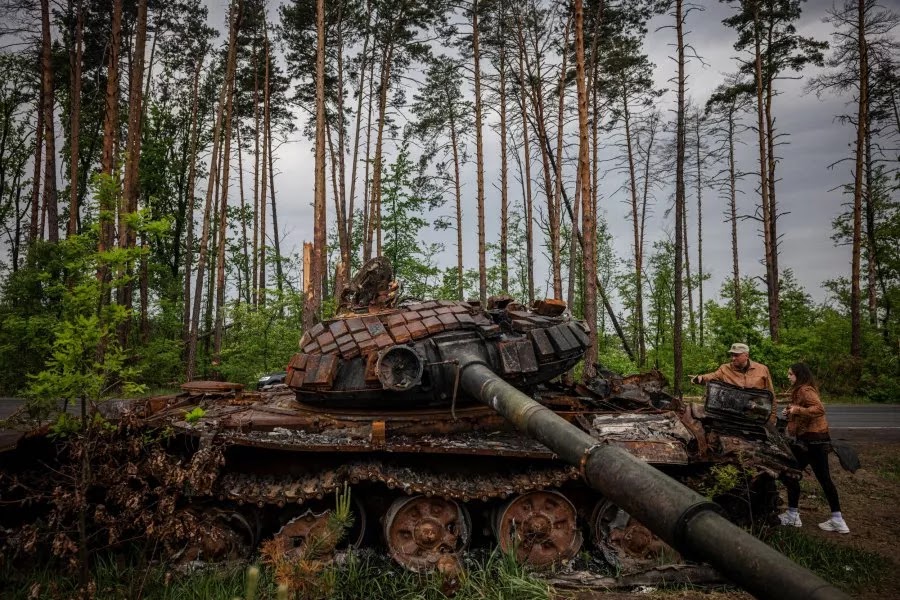
Local residents examine a destroyed Russian tank outside Kyiv on May 31, 2022.DIMITAR DILKOFF/AFP VIA GETTY IMAGES

BY NDILEKA MANDELA

President Volodymyr Zelensky recently made headlines by stating the Russia-Ukraine war must end with negotiations and diplomacy. My grandfather—Nelson Mandela—would have agreed. After all, he knew that dialogue and moral leadership are essential to securing sustainable peace. See, the anti-apartheid struggle was fought on many fronts. But the most important was the moral one.

Prior to Mandela, white South Africans generally did not see apartheid as evil. But under my grandfather's leadership and strong moral guidance, their views drastically changed and the battle against apartheid became a unifying national struggle. The key to such success? Unwavering moral leadership.

Nelson Mandela, Desmond Tutu and other leaders of the movement won the battle for hearts and minds—uniting what had been a deeply fractured state. It is this rare form of political leadership—one grounded in morality—that the rest of the world can—and must—learn from. And for Russia and Ukraine, it could make all the difference in what looks increasingly like a long-drawn-out conflict.

Zelensky has been widely upheld as a paragon of moral leadership by the West—even being vaunted as a potential Nobel Peace Prize winner. But for such moral authority to have a truly demonstrable impact, it must resonate with not only the West, but the very constituencies that stand across from him in this conflict—the Russian public. And that can only happen by expressing a narrative focused on a shared, common humanity—just like anti-apartheid leaders did.

Such sentiments may, at first, seem counterintuitive. After all, it was Russia that invaded Ukraine—who have had to defend their nation. But the longer this conflict drags on, the greater the influence of public opinion in both camps will be—either to pressure their leaders to pursue peace or—conversely—to harden their resolve in continuing to fight.

Of course, changing public opinion would necessitate moral coalitions: Coalitions of civil society organizations, religious leaders, literary voices—figures that people on each side resonate with, relate to and look up to.

In South Africa, it was a coalition of peacebuilders and moral leaders that gave life to the anti-apartheid message. So powerful did it become that ordinary white South Africans could not help but at first acknowledge it, then respect it and eventually embrace it. However, building such coalitions during periods of deep division, tribalism and animosity is not easy.

That's where the role of the international community comes into play. Moral coalitions during times of conflict are not always developed from within. They must be encouraged from outside, too.

The role of global civil society was prominent during apartheid. Religious leaders outside of South Africa engaged, encouraged and supported their counterparts within the country—both Black and white, to take the right steps. As did political, civil society and countless other prominent figures and organizations.

Similarly, global civil society must engage their counterparts in conflict zones like Russia-Ukraine to encourage narratives of peacebuilding to gain momentum. When the Pope stated he wished to meet President Vladimir Putin to help end the war, it was a small step in the right direction.

In fact, religious leadership within Ukraine and Russia is an interesting case in point. Orthodox Christian institutions in both countries have been heavily politicized during the conflict. That's because they wield tremendous moral authority and respect from ordinary Russians and Ukrainians.

Both the head of the Ukrainian Orthodox Church and a senior representative of the Russian Orthodox patriarch sat around the same table recently. At Saudi Arabia's first ever interfaith gathering organized by Muhammad bin Abdul Karim Issa, secretary general of the the Muslim World League, they and 100 other religious leaders including Vatican representatives, evangelicals, rabbis and Hindu and Buddhist priests, agreed to collaborate around peacebuilding and the exploration of common ground. This is precisely what global forums and partnerships can achieve—inching powerful civil society voices together in the pursuit of common ground.

That is, after all, how Track 2 diplomacy works; by pursuing enough in the way of common values and common ground between non-governmental voices of influence on both sides of a conflict to develop a common vision for peace—one that can be presented to each side's political leadership.

Moral leadership from figures like Zelensky is crucial to making these kinds of openings possible. However, the important persona of moral authority associated with Zelensky also risks being punctured if we are not careful. Let's not forget that early in the conflict, reports about the treatment of some minorities in Ukraine revealed worrying prejudices based on racial grounds.

Thousands of students of color were deprioritized and trapped in Ukraine. And though the Ukrainian government addressed the horrific treatment of minorities at the border, the war revealed that refugees of color are, unfortunately, treated differently than those of Caucasian heritage.

Moral authority does not work selectively. And such double standards risk undermining the creation of global moral coalitions so crucial for peace in Ukraine, before they even begin.

Mandela—for one—realized that a prosperous and democratic South Africa was in the interest of all. And for the Ukraine-Russian war to resolve, Zelensky must realize that moral leadership during times of conflict is not just about one goal, or one person, but for all of shared humanity.

Ndileka Mandela is a writer, social activist and the head of one of South Africa's most prominent rural upliftment organizations, the Thembekile Mandela Foundation, which works around education, health, youth and women's development in rural villages. She is one of South Africa's best-known feminists and the eldest grandchild of Nelson Mandela. She is on the board of several NGOs and philanthropic organizations and is an outspoken supporter of the #MeToo movement, using her platform to combat stigma surrounding sexual violence.

READ ORIGINAL ARTICLE HERE

Tuesday, February 11, 2020

Mandela's Release 30 Years Ago Birthed A New South Africa

Wreaths are laid at a statue of former President Nelson Mandela at the entrance to the Victor Verster prison in Paarl, South Africa, Tuesday, Feb. 11, 2020. Thirty years ago, Nelson Mandela was released from 27 years of imprisonment at Victor Verster prison by South Africa's apartheid regime and instantly galvanized the country, and the world, to dismantle the brutal system of racial oppression. (AP Photo/Nasief Manie)

BY ANDREW MELDRUM, NQOBILE NTSHANGASE

CAPE TOWN, SOUTH AFRICA (AP)
— Thirty years ago, Nelson Mandela was released from 27 years of imprisonment by South Africa’s apartheid regime and instantly galvanized the country, and the world, to dismantle the brutal system of racial oppression.

Raising a clenched-fist salute and striding purposefully from the gates of Victor Verster prison, Mandela, then 71, made it clear he was committed to ending apartheid and establishing majority rule and rights for all in South Africa.

His release gave many South Africans their first view of Mandela because during his imprisonment the regime banned the publication of images of him and his speeches. And then, suddenly, he was on national television, urging massive changes.

“Comrades and fellow South Africans, I greet you all in the name of peace, democracy and freedom for all,” Mandela said hours after his release, speaking to throngs of supporters at Cape Town’s City Hall.

On Tuesday, current President Cyril Ramaphosa, who held the microphone during Mandela’s address, dramatically returned to the City Hall to address the nation, saying Mandela’s stirring address was a “speech that birthed a nation.”

Just over four years after his release, Mandela was elected president in the country’s first all-race elections, leading South Africa out of decades of violently imposed discrimination. Under his leadership, South Africa drafted and passed a constitution widely praised for upholding the rights of all, becoming one of the first to explicitly endorse gay rights.

A Truth and Reconciliation Commission took South Africa on a compelling, painful path to air the injustices perpetrated during the more than 40 years of apartheid rule.

Mandela, and then South African President F.W. de Klerk, who freed him, won the Nobel Peace Prize in 1993 “for their work to peacefully end apartheid and for laying the foundation for a new democratic South Africa.”

Anglican archbishop Desmond Tutu, himself a Nobel Peace Prize laureate, marked the 30th anniversary of Mandela’s release.

“Nelson Mandela emerged from prison to dazzle South Africa and the world with his warmth and human values,” wrote Tutu and his wife, Leah, in a short statement. “Circumstances and priorities change over time, but good values don’t go out of fashion. We miss him. Love and blessings.”

Magnanimous, charismatic and inclusive during his one term as president which ended in 1999, Mandela led South Africa to a new era of democracy. In retirement he remained active in encouraging rights for all.

Today’s South Africa is dogged by serious problems of inequality, poverty and violence, largely a result of the stubborn legacy of apartheid. Some South Africans have criticized Mandela for making too many compromises, especially to the white minority, which continues to enjoy prosperity.

Standing beside a statue of Mandela at Cape Town City Hall Tuesday, Ramaphosa said the country still struggles with racial divisions and inequality and strives to live up to Mandela’s legacy.

“Millions of our people continue to live in poverty ... the divide between haves and have-nots continues to widen,” said Ramaphosa.

Ramaphosa said Mandela’s release “was a defining moment in our onward march toward democracy” in a statement to mark the anniversary.

But “inequality, especially as defined by race and gender, remains among the highest in the world. Unemployment is deepening and poverty is widespread. Violence, including the violence that men perpetrate against women, continues to ravage our communities,” Ramaphosa said.

He urged all South Africans to take inspiration from Mandela’s legacy to work together to help solve these problems.

Former president de Klerk also emphasized the challenges that South Africa faces, including “inadequate education, health and municipal services,” and “unacceptable levels of inequality, poverty and unemployment.”

The last president of apartheid said that “South Africa in 2020 is emphatically on the wrong road: it is headed not toward a ‘New Dawn’ but toward very dark and threatening storm clouds.” He urged South Africa to follow Mandela’s example and ”return to the road of freedom, toleration and non-racialism.”

___

Meldrum reported from Johannesburg.

Monday, February 10, 2020

AP Was There: Nelson Mandela Released From Jail 30 Years A

In this Feb. 11, 1990 file photo, Nelson Mandela and his wife, Winnie Madikizela-Mandela, gesture as Mandela walks free from the Victor Verster Prison in Paarl, Cape Town, South Africa after serving 27 years in prison. Tuesday, Feb. 11, 2020 marks the 30 year anniversary of the release of the former South African president. (AP Photo/Greg English, File)


BY GREG MYRE

JOHANNESBURG (AP) — EDITOR’S NOTE:
To mark the 30th anniversary of Nelson Mandela’s release from prison, a key event in ending South Africa’s brutal apartheid system of racial oppression, AP is republishing its coverage of Feb. 11, 1990.

Nelson Mandela walked through a prison gate to freedom Sunday, setting set off joyous celebrations and violent clashes as blacks nationwide welcomed their leader back from 27 years in jail.

“Comrades and fellow South Africans, I greet you all in the name of peace, democracy and freedom for all,” Mandela told tens of thousands of cheering supporters who thronged outside City Hall at twilight, many getting their first look at the African National Congress leader.


In this Feb. 13, 1990 file photo, Nelson Mandela and his wife, Winnie Madikizela-Mandela, gesture as they arrive at Soccer City Stadium in Soweto, South Africa two days after after being released after serving 27 years in prison. Mandela's release set off joyous celebrations and violent clashes as supporters welcomed Mandela back from years in jail. (AP Photo/Udo Weitz, File)


But he emphatically reaffirmed his commitment to the ANC’s guerrilla campaign and called for increased pressure to end white-minority domination - the same cause that resulted in his life sentence on charges of plotting against the government. He also reiterated that talks with the government cannot begin until it lifts the state of emergency.

“I stand here before you not as a prophet, but as a humble servant of you the people,” said the white-haired Mandela, who looked much more an elder statesman in his suit and tie than a guerrilla leader.

“Today, the majority of South Africans, black and white, recognize that apartheid has no future. It has to be ended by our decisive mass action,” he said in a rousing half-hour speech frequently interrupted by roars of “Viva!”

“We have waited too long for our freedom.”

Violence broke out about the same time Mandela’s motorcade arrived in Cape Town from Victor Verster prison and delayed his speech. Police said a black looter was shot to death by officers, and first aid workers said more than 100 people were injured when riot police fired shotguns after groups of black youths smashed shop windows in the city center.

Some youths retaliated by hurling bottles at the officers. Hundreds of terrified people waiting to hear Mandela ran for cover as police fired blasts of shotgun pellets.

Clashes between police and celebrating blacks were reported in at least two other areas, including the tribal homeland of Ciskei, where hospital officials said police shot three people to death and wounded 20.

In Natal Province, where ANC supporters have been feuding with a more conservative black group, police said 12 blacks were killed in factional fighting Sunday. It was a harsh reminder of the bitter feuds involving black factions who disagree on the best way to fight for equality.

Elsewhere, hundreds of thousands of blacks danced and jogged through the streets of big cities and impoverished townships, rejoicing at Mandela’s freedom.

“Very good news, very good news,” President Bush said after Mandela’s release. Bush said he telephoned Mandela, told him all Americans “were rejoicing at his release” and invited him to the White House.

The Rev. Jesse Jackson, speaking at a church service outside Cape Town shortly before Mandela was released, commended the South African government for making a “courageous step” but said “the pillars of apartheid remain in place.”

A thunderous cheer went up as the man who was the world’s most famous prisoner walked hand-in-hand with his wife, Winnie, through the gate of Victor Verster prison in Paarl, 35 miles from Cape Town.

Under a brilliant blue sky, the Mandelas gave clenched-fist salutes to the hundreds of supporters who had waited for hours outside, many of them waving green, gold and black ANC flags and wearing T-shirts emblazoned with a youthful image of Mandela.

Mandela appeared solemn and dignified as he and Winnie walked to a white BMW sedan and climbed in. He broke into a broad smile as the car set off slowly in a police-escorted motorcade.

The decision to free Mandela, after a prolonged international campaign on his behalf, was announced Saturday by President F.W. de Klerk. Eight days earlier, de Klerk stunned the nation by lifting a 30-year ban on the ANC and announcing other reforms aimed at clearing the way for black-white negotiations.

De Klerk, who spoke at length Saturday on Mandela’s release, stayed out of the public eye Sunday. Anton Pretorius, a de Klerk spokesman, said the president planned to comment on Mandela’s release later in the week.

Government television, however, broadcast live Mandela’s exit from prison and later showed most of the ANC leader’s speech.

His elderly appearance probably shocked many South Africans, the majority of whom were born after Mandela was last seen publicly in 1964.

Mandela has clearly lost weight since the 1960s; both his face and his body are leaner than when he was a sturdily built boxer decades ago. At 71, his face is creased with two thick lines that frame his strong, confident smile.

Mandela in his speech called de Klerk “a man of integrity” who had gone further than any previous National Party leader in accommodating black political aspirations.

But he said further steps - including the lifting of the state of emergency and release of all political prisoners - must be taken before talks can begin. The ANC shares these demands.

Mandela was the last well-known political prisoner in South Africa. Six of his ANC colleagues who had been imprisoned for more than 25 years, including Walter Sisulu, were released in October.

In the mid-1980s, Mandela rejected offers to go free in exchange for a renunciation of violence. De Klerk abandoned this condition, although he said after meeting Mandela on Friday night that he believed the black leader was “committed to peaceful solutions.”

Zambian President Kenneth Kaunda, one of the South African government’s harshest critics, urged the ANC to suspend guerrilla actions in the wake of Mandela’s release.

But Mandela told the Cape Town crowd the ANC resorted to violence in 1961 as a “defensive action against the violence of apartheid,” and added, “The factors which necessitated the armed struggle still exist today.”

“We have no options but to continue,” he said.

He urged whites to “join us in the safety of a new South Africa. The freedom movement is a political home for you, too.”

Mandela, whose imprisonment included years of hard labor on windswept Robben Island in Cape Town’s harbor, told his family: “Your pain and suffering was far greater than my own.”

This story from 1990 was written by Greg Myre, who at that time was an AP correspondent in South Africa.

Friday, June 07, 2019

Undercover With Mandela’s Spies: The Living And The Dead Still Bound By Apartheid’s Devastation


Bradley Steyn and Nelson Mandela. Image via Hawkstein


Bradley Steyn’s book Undercover with Mandela’s Spies is not just a rollicking read full of testosterone-driven skop, skiet and donner, treachery and treason, it is also about a young white man’s gradual attainment of wisdom, of understanding how psychologically, emotionally and spiritually corrosive the idea of unreconstructed whiteness is.

While a packed audience attended the Cape Town launch of Bradley Steyn’s recently published biography, Undercover with Mandela’s Spies – The Story of the Boy Who Crossed the Square, an account of how he went from apartheid Security Branch operative to spying for the ANC, the ghosts of those who suffered and died in apartheid violence moved among us.

Steyn was a 17-year-old schoolboy when he strolled across Strijdom Square towards the State Theatre in Pretoria one hot afternoon in November 1988. Fresh from rugby practice, the schoolboy carried a set of clean clothes in a tog bag for that night’s performance of the ballet Giselle,to be performed at the State Theatre, where his mother, Daphne, worked.

That year, 1988, was a torrid one of assassinations, murders, constant violence and bomb and limpet mine explosions in Kokstad, in a disco in Hillbrow, in central Johannesburg, in Cape Town in an office block only 100m from parliament, outside the Sterland cinema in Pretoria, to name only a few.

While the National Party was talking to ANC leaders both in exile and imprisoned in South Africa, behind the scenes, the war between the state and ANC Umkhonto weSizwe (MK) operatives escalated. Cross-border raids by apartheid forces in Zimbabwe and Botswana, targeted the ANC and its allies.

It was the year Trevor Manuel was detained for the third time while Nelson Mandela was moved from Pollsmoor Prison in Cape Town to Victor Verster Prison in Paarl. It was from here that he would in 1990 step through the gates, a free man.

But on 15 November, white supremacist Wit Wolf, Barend Strydom, then 23 years old and dressed in camouflage, chose to drive to Pretoria’s CBD, armed with a 9mm pistol with extra ammunition bulging in his pockets.

His mission was to kill any and every black person he encountered on the capital’s streets in the name of white and specifically Afrikaner supremacy. At the end of Strydom’s random shooting spree, eight victims lay dead, one of them cradled in Steyn’s arms, while 16 others were injured.

It is unfortunate that a superb foreword by veteran journalist Janet Smith and which formed part of an earlier draft of Steyn’s manuscript (co-written with author Mark Fine) did not make it to the final print.

Smith’s thoughts would have offered a crucial entry point into this complex, painful and layered story about the corrosive psychological and emotional impact of white supremacy and particularly toxic patriarchy in shaping events and history.

These not only led to the bloody massacre on Strijdom Square but deeply affected and shaped the lives of South Africans who lived under the apartheid regime.

Smith wrote: “If I was wary of supremacists – who didn’t hesitate to DM me with threats of slitting me open from top to bottom and rejoicing if I was gang-raped – I was cautious of Bradley at the get-go. I was affected by his experience as the boy who crossed the square, but I was immediately suspicious of everything else, especially the depth of his relationship with the ANC.”

She said that while she was “moved by his [Steyn] having witnessed Strydom’s massacre, I felt he had to be that white male stereotype of a special kind that my generation of South Africans knows only too well. He would want to be ‘protected’ and treated as special in some way because he had always been told he was.”

Smith’s sentiments echoed my own when I first picked up this remarkable book. Do we really need another damaged white person who finds redemption through black suffering and pain?

Smith wrote: “Our history has been related by white men, through white men and with white men’s often-covert comfort in a shared white maleness. My experience and that of many other women has been that Bradley and millions of other white South African men like him were damaged, unable to recognise or – for some – atone for their violence. So, without the outlet of overt racism, they harmed women in frightening, private ways, privileged and sheltered by their masculine pain, and that was just what it was.”

Encountering Steyn at the Cape Town book launch in person it is evident he has, ever since that day in 1988, grappled with the demons that came to haunt him and which altered the course not only of his life, but his sense of self.

What Smith had also set out in her omitted foreword were the violent currents that shaped the shooter Barend Strydom’s life and worldview, his unconstrained psychopathic rage as a result of early childhood trauma and which found horrific expression in the murder of those he considered “not human”.

The ideology of apartheid cultivated and groomed feelings of superiority, hate, suspicion and fear. Strydom was not born a racist mass murderer. So, what was it that shaped his rage and his hatred beyond a political system nourished by these selfsame atavistic impulses?

“When Barend Strydom was 18 months old, his unhappy young mother died of a bullet wound. They were alone at home when it happened. She was 21, and court papers recorded with cold economy that she was ‘suicidal’ and in an ‘unstable marriage’ to Nicolaas (Nic) Strydom, a 22-year-old policeman. Barend – who later preferred ‘Hendri’, from his second name, Hendrik – was their only child.”

What the court documents also revealed was that “Hendri had survived a near-death incident a year earlier when he was six months old, ‘falling unconscious for a couple of hours’ after being smothered. And it is only the young woman who put a gun to her own head who knows why her small son had ‘blue strangulation marks’ on his neck the day she pulled the trigger. The child – who’d spent a fortnight in hospital under observation after being choked as a baby – had previously been admitted to the paediatric ward after surgery for a cleft lip and palate. If Hendri witnessed his mother unravelling before she raised the gun to her head, he was deemed oblivious to it.”

It has taken Bradley Steyn 30 long and difficult years to internalise the effects of what he witnessed that day in November.

Steyn now lives in the US, having fled South Africa. His life was under threat after he was exposed as an undercover operative for the ANC’s security wing (DIS). In the Western Cape, Andre Lincoln and Jeremy Vearey (both later to become generals in the SAPS) played a significant role – it was these two men who “turned” Steyn – as well as his original Special Branch recruiter, Neil De Beer.

Steyn’s book is an insider account of the depraved dirty tricks campaign of the ruthless Special Branch, under the cover of “legitimate” business, The Project Group, and ultimately aimed at destablising South Africa’s slow rise from white minority rule to democracy.

On the surface, the Project Group appeared to be a “legitimate” business offering security at clubs and restaurants in Cape Town. In reality, the outfit was a Special Branch project.

The blueprint for what has morphed today into a continued violent turf war around protection rackets in the city was set then. Today Vearey is one of those SAPS senior officers still trying to undo the grip of the criminal underworld on Cape Town’s nighttime economy.

If you want a history of where it all began, this is it.

But Steyn’s book is not just a rollicking read full of testosterone-driven skop, skiet and donner, treachery and treason, it is also about a young white man’s gradual attainment of wisdom, of understanding how psychologically, emotionally and spiritually corrosive the idea of unreconstructed whiteness is.

Steyn delicately highlights a matter that seldom receives attention in South Africa. And that is of the many bitter and broken white men who emerged from that long dark night – fighting the apartheid government’s war, while being left to lick their own wounds, forgotten and abandoned in its aftermath.

The white boy who saw the massacre on Strijdom Square, who found his “True North” as an ANC spy, has come a long way, but is aware there is still some distance to cross in order to heal the rift between white and black South Africans.

Sitting in the audience of the Cape Town launch on 4 June, was Selina Williams, sister of ANC activist and MK operative Coline, who along with Robbie Waterwitch was killed in 1989 when a defective landmine the duo was due to place at the Athlone Magistrate’s Court exploded. Coline was 22 and Robbie 20 when they died.

While their deaths happened only one year after the Strijdom Square massacre there is no doubt that the defective mine was handed to the cadres by someone who had infiltrated the then still underground movement.

Bradley Steyn’s book is yet another vital missing piece in the reconstruction and remembrance of South Africa’s past. His intention is to memorialise those South Africans who were killed and injured that day, all of them named in the book.

And while it is written as a thriller of sorts, it has depth and layering that render it so much more than that. DM

‘Undercover with Mandela’s Spies – The Story of the Boy Who Crossed the Square’ is published by Jacana.


SOURCE: DAILY MAVERICK. READ FULL ARTICLE HERE.

Saturday, May 11, 2019

South Africa's Ramaphosa Targets Reforms After Election Win

South African President Cyril Ramaphosa

BY ALEXANDER WINNING

JOHANNESBURG, May 11 (REUTERS)
- South African President Cyril Ramaphosa led the African National Congress (ANC) to victory in Wednesday's election, but a drop in its share of the vote underlines the challenge he faces restoring confidence in his party.

With opponents in the ANC and an emboldened far-left opposition party, the former union leader turned business tycoon may struggle to deliver on his promises to push through tough reforms.

Africa's oldest liberation movement won 55.5% of the parliamentary vote, according to provisional results from 99.9% of polling districts. That was its worst parliamentary result since it swept to power at the end of white minority rule but an improvement on its showing in 2016 local elections.

Ramaphosa worked closely with South Africa's first black president Nelson Mandela to end white minority rule in 1994. He replaced scandal-plagued Jacob Zuma as head of state in February 2018 after winning a bitter contest to become ANC leader and convincing top party officials to instruct Zuma to resign.

Ramaphosa's first full presidential term should start later this month, after nomination by his party's parliamentary caucus and an inauguration ceremony.

"We've made mistakes, but we are sorry about those mistakes, and we are saying our people should reinvest their confidence in us," Ramaphosa said on Wednesday after casting his ballot in the Soweto township where he grew up.

During the campaign he had crisscrossed the country, trying to convince disillusioned voters to give the ANC another chance. Many are frustrated that huge racial disparities in income and wealth persist 25 years after the end of apartheid.

During Zuma's nine years as president, support for the ANC dropped as economic growth faltered and the party's reputation was tarnished by corruption scandals.

Ramaphosa's allies say his efforts to clean up the ANC's image are starting to bear fruit.

"Ramaphosa was a game-changer for the ANC in this campaign. Voters trust that he can do things right," said ANC executive member Fikile Mbalula.

Some analysts say the election result means Ramaphosa will be able to fend off a potential leadership challenge from party enemies aligned with his predecessor.

REFORM DRIVE

In his first 15 months in charge, Ramaphosa has tried to tackle entrenched corruption and improve governance at struggling state-owned firms like power utility Eskom. But he has found it difficult to meaningfully lift the economic growth rate and has been forced into some uneasy compromises in key policy areas like land reform.

At a campaign event in Johannesburg, Ramaphosa promised a "step-change" in the pace of reform after the election.

But analysts and some ANC party sources are sceptical. "There will still be a significant fightback from the Zuma faction which will restrain Ramaphosa," said Darias Jonker, director for Africa at Eurasia Group, a New York-based political risk consultancy.

The scale of the challenges Ramaphosa faces are immense. Unemployment stands at around 27 percent, and nearly twice that for young people, while investment by local and international firms is weak after years of policy missteps and regulatory upheaval.

Support is growing for the far-left Economic Freedom Fighters (EFF) party, which saw the biggest gains at the election and could try to force Ramaphosa into pursuing more radical policies in the next parliament.

The first barometer of Ramaphosa's reformist credentials will be whether he trims a bloated cabinet. ANC party sources say Ramaphosa wants to merge several ministries to cut wasteful expenditure.

SKILLED NEGOTIATOR

The 66-year-old son of a retired policeman, Ramaphosa rose to prominence as a labour activist defending the rights of black miners as leader of the National Union of Mineworkers.

A massive strike led by Ramaphosa's union in 1987 taught business that "Cyril was a force to be reckoned with," said Michael Spicer, a former executive at Anglo American. "He had a shrewd understanding of men and power and knew how to get what he wanted from a situation," Spicer said.

When Mandela was released from prison in 1990, Ramaphosa held the microphone as he delivered his first public speech after nearly three decades of incarceration.

The successful conclusion of talks to end apartheid, where Ramaphosa negotiated on behalf of the ANC, paved the way for the party to win South Africa's first democratic elections.

During the drafting of a new constitution, the country's last white president, F.W. de Klerk, said Ramaphosa's "silver tongue and honeyed phrases lulled potential victims while his arguments relentlessly tightened around them".

Some historians say Mandela wanted Ramaphosa to be his heir but was pressured into picking Thabo Mbeki by a group of ANC leaders who had fought apartheid from exile.

BUSINESS SUCCESS

After missing out on becoming Mandela's successor, Ramaphosa withdrew from active political life in 1997.

He set up an investment vehicle, Shanduka, which grew rapidly and acquired stakes in firms including miners and the South African McDonald's franchise.

By the time Ramaphosa sold out of Shanduka in 2015, it was worth hundreds of millions of dollars, making him one of the country's richest black businessmen.

For some, his career in business was tarnished by a tragic episode in 2012, when negotiations to halt a violent strike at Lonmin's Marikana platinum mine ended in police shooting 34 strikers dead.

Ramaphosa was a non-executive director at Lonmin at the time, and some families of the victims blamed him for urging the authorities to intervene, even though an inquiry absolved him of responsibility.

"My conscience is that I participated in trying to stop further deaths from happening," Ramaphosa said of the incident.

Ramaphosa's supporters say his understanding of the business world gives him the wherewithal to revive the economy and preserve South Africa's last investment-grade credit rating, seen as key to retaining billions of dollars in investments.

They say he is playing a long game and that corruption inquiries he has set up will take out his enemies in the ANC.

"Ramaphosa is the right man for the moment," said Colin Coleman, head of sub-Saharan Africa for Goldman Sachs. "He is a modern thinker who is sensitive to all the constituencies: business, labour and government." (Editing by James Macharia, Anna Willard and Catherine Evans)

Our Standards: The Thomson Reuters Trust Principles.

Sunday, April 14, 2019

South Africa Faces Anarchy Unless A New Cohort Of Politicians Takes Over And Imposes Rules For Accountability And Progress

Former South African president Nelson Mandela at a World AIDS Day function in Bloemfontein, South Africa, in December, 2002. George McNally writes: "I witnessed the excesses of Apartheid in South Africa and followed the long struggle for political freedom as exemplified by Nelson Mandela's life." (AP Photo/Benny Gool)

NEWSLETTER

Ian Rainey’s article (South Africa — why it’s a great country that has been ruined, News Letter, April 9) is a most perceptive, insightful piece based on personal experience of socio/economics on the African continent.

I witnessed the excesses of Apartheid (1965) in South Africa and followed the long struggle for political freedom as exemplified by Nelson Mandela’s life (pictured).

The ANC became the leading party of eventual self-government. The ideology of democracy is essentially an evolutionary concept of European states. When transposed to new African states well-meaning outsiders did not understand the peculiar styles of indigenous governance through ‘Kings, chiefs and Indunas in a setting of unwritten rules’.

European colonialists ruled by a mixture of direct and indirect rule. Local chiefs were exploited and they exerted their power through ownership of land and the movement of people. Payment for forced labour was determined by chiefs.

In some West African colonies British authorities actually created chiefs where they did not exist (Northern Ghana and Eastern Nigeria).

The new African nations having achieved independence soon became one party kleptocracies largely because of an inability to dump tribal patterns of governance.

Attempts were made by President Kaunda of Zambia in 1964 and the political rallying cry for his United National Independence Party was : ‘One Zambia, one nation, one party, one leader’.

Marxist Samora Machel, the first president of Mozambique stated constantly : ‘For the nation to live, the tribe must die.’

However, in practice tribal leaders became cadres of the ruling party and carried on as they had done for centuries.

Economic prospects for any new African state are bleak. Income per head in the richer countries of the world grows at about 2% per annum.

It would take most poor African states 60 years of annual GDP growth of more than 6% to catch up with richer nations. Only two African States, Botswana (diamonds) and Equitorial Guinea (oil) have achieved growth more than 6%.

The Republic of South Africa could descend rapidly into anarchy unless a new cohort of politicians takes over and imposes strict rules for accountability and economic progress.

Monday, September 24, 2018

Mandela’s Widow Urges World: Put Egos Aside And End Violence

South Africa President Cyril Ramaphosa, left, United Nations General Assembly President Maria Fernanda Espinosa, center, and United Nations Secretary General Antonio Guterres attend the unveiling ceremony of the Nelson Mandela Statue which was presented as a gift from the Republic of South Africa, Monday, Sept. 24, 2018, at United Nations headquarters. (Angela Weiss/Pool Photo via AP)


BY EDITH M. LEDERER & JENNIFER PELTZ

UNITED NATIONS (AP)
— Nelson Mandela’s widow challenged world leaders celebrating his life on Monday to put their egos and partisan politics aside and honor his legacy by ending the “senseless violence” plaguing too much of the world.

“History will judge you should you stagnate too long in inaction,” Graca Machel told a U.N. “peace summit” commemorating the 100th anniversary of Mandela’s birth. “Humankind will hold you accountable should you allow suffering to continue on your watch.”

With peace a scarce commodity, Machel’s challenge was echoed by U.N. Secretary-General Antonio Guterres and other leaders who acknowledged the world is far from achieving Mandela’s ideals which also include human rights and global cooperation.

“Today, with human rights under growing pressure around the world, we would be well served by reflecting on the example of this outstanding man,” Guterres said. “We need to face the forces that threaten us with the wisdom, courage and fortitude that Nelson Mandela embodied.”

The tributes to Mandela began with a rare U.N. honor — the unveiling of a $1.8 million statue of the South African anti-apartheid campaigner who became the world’s most famous political prisoner, played a key role in ending white-minority rule, and became president in the country’s first democratic election. The statue is a gift to the United Nations from South Africa.

His arms are outstretched in the statue, as if to embrace people everywhere. But after the cover was pulled off, South African President Cyril Ramaphosa, with help from Guterres, placed a small South African flag in his lapel.

The day-long summit, with nearly 160 scheduled speakers, set the stage for Tuesday’s opening of the General Assembly’s annual meeting of world leaders, where conflicts from Syria to South Sudan, rising unilateralism, and tackling a warming planet and growing inequality are among issues expected to be in the spotlight.

With a bang of the gavel by General Assembly President Maria Fernanda Espinosa Garces, the leaders on Monday adopted a political declaration resolving “to move beyond words” to promote peace and prevent, contain and end conflicts. “Dialogue is key, and courage is needed to take the first steps to build trust and gain momentum,” it said.

Garces said Mandela “represents a light of hope for a world still torn apart by conflicts and suffering.”

Like others, she warned of the rise of populism and unilateralism and its threat to the 193-member United Nations.

“Drifting away from multilateralism means jeopardizing the future of our species and our planet,” Garces said. “The world needs a social contract based on shared responsibility, and the only forum that we have to achieve this global compact is the United Nations.”

The appeal for collective action to tackle the world’s many conflicts, hotspots and challenges is being tested by the “America First” agenda of U.S. President Donald Trump and populist governments in Italy, Hungary, Austria and elsewhere as well as Britain’s impending divorce from the European Union.

Addressing the Mandela event, Iran’s President Hassan Rouhani never mentioned the United States — which has accused Tehran of promoting international terrorism, a charge it vehemently denies.

But Rouhani appeared to be taking aim at Trump and his pledge to build a wall on the U.S.-Mexican border when he said Mandela was a model for the “historical reality that great statesmen tend to build bridges instead of walls.”

Alluding to the Trump administration, Cuba’s President Miguel Diaz-Canel Bermudez said recent announcements about military expenditures are “alarming” and are pushing the world into a new arms race “to the detriment of the enormous resources that are needed to build a world of peace.”

South Africa’s Ramaphosa said his country’s “deepest hope” is that the summit, “in the name of one of our greatest exemplars of humanity, serves as a new dawn for the United Nations.”

“We hope we will rediscover the strength of will to save successive generations from war, and to overcome the hatred of our past and the narrow interests that blind us to the vision of a common future that is peaceful and prosperous,” he said. “We hope we will prove ourselves worthy as the bearers of the legacy of Nelson Mandela.”

KNOCK, KNOCK

By issuing subpoenas to five Times journalists, the Trump administration reveals its first response to unwanted national security coverage: ...