Showing posts with label Oprah Winfrey. Show all posts

Tuesday, September 16, 2025

BOOK REVIEW: How To Do A Midlife Self Review That Actually Works


In Live to 100 and Love It!: An Easy Road Map to Longevity Stacey Colino and the editors of Prevention share a science-backed, six-step routine for redefining your identity after 60.

BY STACEY COLINO

W hen you live for several decades viewing yourself a certain way—as a colleague, as a parent, as a certain type of person—it’s understandable that self-perceptions become solidified. Consciously or not, we all have beliefs about who we are that are based on our behaviors, abilities, feelings, and personality characteristics as well as how others see us and how they respond to us. This is what psychologists call “self-concept”—a reflection of how you see yourself as a person— and it has a powerful effect on the way you act, the choices you make, the attitudes you have, and how you move through life. If you’ve always been known as a go-getter or, conversely, a low-key person, you probably assume you’ll always be that way.

And then you hit middle age, and maybe you start to feel not quite like yourself. One reason may be that your reactions, preferences, needs, values, and expectations have shifted over time, but your self-concept hasn’t kept up. “We tend to think of ourselves as static, but we do change,” says Mark Leary, Ph.D., professor emeritus in the department of psychology and neuroscience at Duke University and author of The Curse of the Self.

Update Your Self Concept

Thinking of ourselves as being one way when we have in fact changed can leave us feeling confused, out of sorts, stuck, or full of self-doubt, says Leary. Research has found that this is a common phenomenon at a certain point in life: Self-concept clarity—the extent to which someone has a clear understanding of their self and identity—increases each decade until the 60s, then begins to decline; after that, “people become less sure of their identity,” the study authors noted, perhaps partly because of shifts in their work, family, and community roles at this life stage. Rediscovering a sense of self has been rated as one of the most challenging aspects of midlife for women, according to a study involving 81 women over 23 years.

Unfortunately, harboring outdated ideas about yourself can end up holding you back from taking smart risks and embracing new challenges when doing so might lead you to feel more fulfilled. “If we’re looking at ourselves through an old lens of who we are, we take those outdated views into our future and make decisions based on that,” says Michele Patterson Ford, Ph.D., a psychologist in private practice and a senior lecturer at Dickinson College in Pennsylvania. On the other hand, updating your self-concept to reflect who and how you are now can help you pursue experiences and activities that feel satisfying and meaningful and skip or minimize those that may not suit you anymore. After doing some self-reflection, you might realize that you’ve outgrown the intense fear of public speaking you used to have and might actually enjoy giving the professional talks you’ve been invited to present. Or maybe you’ll realize that you’ve had enough of the corporate grind and what you really want to do is pursue your artistic talent. And when you have a stronger, clearer sense of who you are now, you’re likely to feel more comfortable in your own skin, maybe even happier, which is valuable in its own right. Ultimately, the goal is to make choices and changes that are in your current best interest, rather than in the best interest of you 10 or 20 years ago. So how can you figure out if you’re working with a self-concept that reflects who you are now? You dig in and do an inventory.

6-Step Self Review

Step 1: Sit down and, in writing, take stock of your current strengths, weaknesses, values, and preferences, suggests Susan Krauss Whitbourne, Ph.D., professor emerita of psychological and brain sciences at the University of Massachusetts, Amherst. Ask yourself questions like these:What are 5–10 things I am good at? These could be anything from talents to work skills to hobbies to interpersonal qualities, etc.

What are 5–10 things I struggle with? These could be daily challenges you have, things you avoid, or where you have trouble with motivation, etc.

What are 5–10 values I closely hold?These might be hard work or kindness.

What are 5–10 things I love? These can be as wide-ranging as hanging out with your dog to working in your business.

Step 2 Ask people who know you well if you’ve got the right idea. Do they think you embody these talents, values, and passions (and struggles) as much as you believe you do?

Step 3 Reflect on their answers. If everything is aligned, move on to step 4. If the answer is no, take a look at how you spend your time so you can make a concerted effort to engage in more activities that reflect the qualities and things you value. Living in a way that aligns with what you value about yourself can help solidify your self-concept, says Ford.

Step 4 Think about what was important to you 10, 20, or 30 years ago and write a letter to your younger self sharing what you’ve learned about yourself over time, how you’ve changed, and what really matters to you now.

Step 5 Stay open-minded. You might have lost some qualities you care about over time. Updating your self-concept is as much about consciously letting go of notions that no longer suit you as it is reclaiming aspects of yourself that you value.

Step 6 Rethink the terms you use or yourself. Tune in to the ways you label or describe yourself— like calling yourself an introvert or an extrovert or seeing yourself as uncreative—and assess whether these terms accurately describe your current behaviors.

Now that you have a better understanding of who you are today, ask yourself the following questions to create a path to the future:What kinds of activities make you feel fulfilled? What do you truly enjoy doing?

What have you always wanted to do or try but haven’t? Can you do it now?

Is your social circle supportive and gratifying? If not, how can you expand it?

When you imagine the future, what do you want your life to look like in five years? Ten years? Fifteen years?

What do you value most in life, and are you living in a way that’s true to those values? If not, what can you do to change that?

What nonmaterial things would you like to have more of in your life?

How would you like people to remember you when you’re gone?

If today were your last day on earth, how would you spend it?

Now think about how you can set yourself up to bring more of these valuable experiences into your life. Assess this on a practical level, as well as on financial, psychological, and emotional levels. Also, think of older people you know who have these elements in their lives. Consider seeking their advice for steps you could take to cultivate them in yours.

READ ORIGINAL STORY HERE

Tuesday, December 19, 2023

The Color Purple: It’s A New Movie And An Old Hue That’s Rich In Meaning And History

Phylicia Pearl Mpasi, a cast member in "The Color Purple" poses at the premier of the film at the Academy Museum of Motion Pictures, Wednesday, Dec. 6, 2023, in Los Angeles. (AP Photo/Chris Pizzello)

BY LEANNE ITALIE

NEW YORK (AP)
— “I think it pisses God off if you walk by the color purple in a field somewhere and don’t notice it,” Shug tells Celie in Alice Walker’s “The Color Purple.”

In nature, among the priestly and royal, as a symbol of independence, pride and magic, purple is weighty in history and culture. Now, with the Christmas Day opening of the second film based on Walker’s 1982 book, purple takes a seat at the box office after the historic popularity of “Barbie” and all things pink.

Consider it a many-layered cultural counterpart to its frothier cousin.

Power, ambition, luxury. Purple reflects them all. It also expresses creativity, independence, pride, peace, mystery and magic.

In contemporary history and fiction, it often represents something sought dearly. In the early 20th century, purple attire and signage signified loyalty and dignity among the suffragists. In Walker’s novel, Celie, the main character, wants a pair of purple shoes but can’t afford them, so she settles on blue.

Oprah Winfrey, who played Sofia in the 1985 film version of “The Color Purple,” has donned purple frequently to promote the new musical she helped produce. And she wore a purple taffeta gown by Christian Siriano in her recently unveiled portrait for the National Portrait Gallery.

To Oprah, purple is “seminal.” To others, it’s a shapeshifter, said Laurie Pressman, vice president of the Pantone Color Institute, which analyzes and consults on color, including for the folks who made this year’s “The Color Purple.”

“It can take on so many contexts,” Pressman said. “It’s a color that stands out, that makes a statement, that has a singular presence in the world.”

Some ways to think about purple, the hues nestled between blue and red:

PURPLE, THE DYE

The Romans conquered the Greeks in the second century B.C. and returned home with lots of pigments and dyes, writes Victoria Finlay in “The Brilliant History of Color in Art.” The most celebrated was “purpura,” which turned into a fashion phenom made with secretions of certain mollusks. The liquid transformed into purple when left out in the sun.

When Julius Caesar traveled to Egypt in 48 B.C. and met Queen Cleopatra, he noted her love of purple and embraced it himself. It’s a love later taken up by Byzantine emperors. But before them, Caesar decreed that only Caesars could wear togas dyed completely purple.

Many, MANY mollusks were required to make purpura, which sometimes wasn’t the color we know today. Finlay wrote that at least 250,000 were needed for half an ounce of dye. Ancient Tyrian purple, named for the town of Tyre in what is now southern Lebanon, was also rose, bluish red or velvety black, she writes.

Purple was reserved for royalty, priests and nobles at various times in history and in various places.

By the 14th century, the secrets of Tyrian purple were lost, according to the University of Chicago Library’s 2007 exhibition “The Origins of Color.” But all hail Tyrian purple! In 2001, through trial and error, the technique for making it resurfaced. Well before then, synthetic dyes, including purple, were available.

PURPLE, IN SONG

Prince’s “Purple Rain.” Jimi Hendrix’s “Purple Haze.” Juice WRLD’s “Purple Devil.” The rockers Deep Purple. The Grammy-winning song “Deep Purple,” a No. 1 Billboard single for April Stevens and her brother, Nino Tempo, in 1963.

Purple has been peppering songs for decades, but no musical artist has been more closely aligned with the color than Prince. He became The Purple One after he and his band, the Revolution, put out “Purple Rain” in 1984 and a won a Grammy for it, along with an Oscar for the score to the companion film.

Though the song peaked at No. 2 on Billboard’s Hot 100 in 1984, it forever connected Prince with the color. And he leaned in with his purple attire, purple guitar and purple piano. After his 2016 death, his estate worked with Pantone to come up with an official Prince purple, dubbed “Love Symbol #2.”

Of the song’s meaning and title, Prince once explained: “When there’s blood in the sky … red and blue equals purple. Purple rain pertains to the end of the world and being with the one you love and letting your faith/God guide you through the purple rain.”

Prince’s Paisley Park estate outside Minneapolis remains bathed in purple at night.

In creating a world in sound, “purple doesn’t have as clear a set of connotations” as some other colors, like the sadness of blue or the rage of red, said Nate Sloane, who specializes in the history of popular music and jazz at the University of Southern California’s Thornton School of Music.

For musical artists, he said, that’s freedom.

“Its ambiguity means you can explore more emotions and concepts that are less clear and established,” Sloane said.

PURPLE, THE PROSE

The term “purple prose” stretches back to circa 18 B.C. and the “Ars Poetica” of Horace, according to Charles Harrington Elster in his 2005 book, “What in the Word?”

A phrase Horace used, the Latin “purpureus pannus,” denoted an irrelevant and excessively ornate passage. Literally, it’s a purple garment or raiment (think fancy). Horace’s 476-line poem, a manual of sorts on how to write poetry, warns against “mediocrity in poets no man, god or bookseller will accept.”

Generally speaking, purple prose came to mean writing that is laden with flowery descriptors and/or an oppressive structure with no real payoff to a reader. Consider this: Many writers of the 19th century were paid by the number of words they used or pages they produced.

“Purple prose doesn’t seem to have become wholly pejorative until the 20th century when steep declines in the vocabulary and reading comprehension of college-educated Americans caused a panic in the education establishment and the newspaper industry,” Elster wrote.

A blog post from the publishing site Reedsy offers this made-up example: “The mahogany-haired adolescent girl glanced fleetingly at her rugged paramour, a crystalline sparkle in her eyes as she gazed, enraptured, upon his countenance.”

PURPLE, ON CANVAS

Monet, Chagall, Derain, Rothko, Matisse, Klimt. All were admirers of purple.

The color is said to have first surfaced in art during the Neolithic era, writes Hannah Foskett at the site Arts & Collections. The pre-Raphaelites in Britain especially loved purple.

Monet stands out for his use of violet in his Lily, Haystack, Snow and Rouen Cathedral series of paintings.

Another interpretation of purple, Foskett writes, is that it tires the eyes, “often symbolizing lust or sorrow in major artworks.”

Color, in visual art, was helped along by the American portrait painter John Goffe Rand. In the 1840s, he invented a collapsible tube of tin in which to put his paint, rather than the pig bladders he and his counterparts had been struggling with for years, according to Finlay. With the invention of paint tubes, there were suddenly dozens of new pigments, including manganese violet.

“It was the first opaque, pure, affordable, mauve-colored pigment,” wrote Finlay, “and it was seen as a wonder.”

Saturday, January 22, 2022

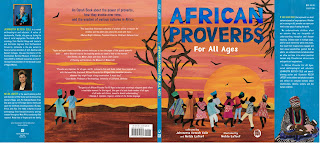
INTERVIEW: African Proverbs For All Ages Offers Wisdom For Everyone

Image via Nelda LaTeef

Let these inspiring words stir the imagination and feed the soul.

BY WADZANAI MHUTE

The Ghanaian proverb “Wisdom is like a baobab tree: No one individual can embrace it” is a fitting description for Johnnetta Betsch Cole and Nelda LaTeef’s new book African Proverbs for All Ages, which was written to be shared and discussed. In her introduction, Cole says adults assume the young are not capable of interpreting metaphors, and adults shortchange themselves when they focus solely on practical matters. As the title proclaims, all age groups will benefit from these inspirational aphorisms—centered on community, animals, and the earth—that offer life lessons gathered over centuries and passed down through oral tradition. LaTeef’s vibrant illustrations pair beautifully with the universal and often poetic sayings.

Cole is an anthropologist who became the first female African American president of Spelman College and later was president of Bennett College, both historically Black colleges for women. From 2009 to 2017, she was the director of the Smithsonian National Museum of African Art. Nelda LaTeef is an award-winning author and illustrator of several books, including The Talking Baobab Tree and Animal Village. For years, the two authors collected proverbs from the African countries in which they lived at different times. In writing African Proverbs for All Ages, published by Roaring Brook Press and an Oprah Book imprint, they are sharing decades-long accumulated knowledge.

We spoke with the authors recently about their hopes for the book. As the Sudanese proverb says, “We wish two things for our children: the first is roots; the second is wings.” These proverbs are rooted in Africa, but the authors say they should be distributed widely and beyond the continent’s borders so that people of all cultures can apply them to matters significant or mundane. Read on to hear (mostly in their own words) how they first fell in love with proverbs and why they believe you will too.

Oprah Daily: How did this book come into being?

Nelda LaTeef: It came about as a result of a children’s picture book I had written and illustrated that was inspired by the West African oral tradition. At the time Dr. Cole was the Director of the Smithsonian National Museum of African Art. I sent her the manuscript and the illustrations to the story, and she very graciously agreed to write an endorsement to the book jacket. When my book Animal Village was published, I was very excited to meet Dr. Cole in person and to present her an autographed copy of the book. During our visit, we discovered that we shared a mutual admiration for African proverbs from the many years each of us had spent living in different countries, at different time periods in Africa.

In my children’s stories, I like to try to include African proverbs in the dialogue, and if I am writing a story based on a Wolof tale, I will include Wolof proverbs, and so on. No one uses African proverbs like Dr. Cole so effectively to get her message across. So, on the spot, we agreed to collaborate on a children’s book, and we have never looked back. We decided that we would pull together our favorite proverbs, Dr. Cole would write the book’s prologue, and I would do the illustrations, so it was this wonderful teamwork and the friendship that grew between us that really propelled the project forward.

When and why did you start collecting African proverbs?

Johnnetta B. Cole: For me, it’s so easily connected to my being a young anthropologist. Growing up in the South in an African American community, I grew up with proverbs.

Then I went to Liberia in 1960 and spent two years doing fieldwork to earn my PhD. I have been privileged to visit, to do work in, and to attend conferences in 17 of the 54 countries on the African continent. You cannot go on that continent and spend much time without hearing a proverb.

NL: Well, there is a common thread running through this project, and it is the massive continent of Africa—there are 54 countries encompassing it. When I was overseas, I lived in the West African countries of Niger, Nigeria, and Senegal, where I would collect proverbs as I was writing my books. A particular proverb that resonates with me is “Traveling leaves you speechless, then turns you into a storyteller.” Traveling, personally, gave me a broad form of reference and influenced me to become a children’s author and illustrator.

When I was growing up, my parents were in the U.S. foreign service, so we did a lot of traveling. I believe that, just like reading, traveling opens your mind to so many different worlds; it gives you an appreciation for different cultures, languages, customs, food, and art forms. It makes you realize that there are so many different worlds out there. When I was in Niger, for example, I would drive into the bush with my friends, just 45 minutes outside the capital, Niamey, to see my favorite animals, giraffes, grazing in the wild. On the return drive, we would stop to visit a Zarma village where one of my friend’s grandfathers lived. There was a woman with snow-white hair who was often seated on a straw mat under the shade of a large acacia tree. As it turned out, she was the village griot, which in West African culture is a keeper of traditional knowledge. In fact, it is said that when a griot dies, it is as though a library has been burned to the ground. She would tell stories to children, and some adults gathered around her. On our way back to Niamey, some of my friends would translate to French the stories we had just heard, and I would jot them down, and it was from those stories that I became a writer and illustrator.

What has the reception to African Proverbs for All Ages been?

JBC: Nelda and I have had this wonderful experience of introducing our book to very young people, second graders. One of the points that we continue to share with these young learners and with anyone who picks up this book is that there is no wrong answer in choosing his or her idea of the best proverb in terms of connecting with the illustration. The response of children has just been exhilarating.

NL: When they pick a proverb that I did not illustrate, their explanation is so valid that it’s mind-boggling that they think so deeply.

What impact do you hope for for this book?

JBC
: Before I say what my hope is, I really must do something; I will lift up a proverb, “It does no harm to be grateful.” I simply can’t go another minute without saying how profoundly grateful Nelda and I are to Miss Oprah Winfrey. To receive the honor, the privilege of having one’s book designated a book under Oprah's imprint—it’s hard to describe that. This is the first children’s book that has received Miss Winfrey’s endorsement, and we wish that many, many children and adults will pick it up.

We hope, first of all, that it will make clear to the reader that Africa is not a country; it is a continent, a massive, incredibly diverse continent. Maybe they will even discover that Africa is where all of humanity originated. We also want readers to be engaged by what a proverb is, and connect to sayings that he or she has heard in their own culture, and that in reading this book, some messages that Nelda and I share will come forward. For example, no matter how diverse we are across our world, there is so much that we as people share, and there is so much to be learned throughout the extent of one’s life. And finally, I am going to say I hope this book brings the reader joy. I had the privilege of knowing Dr. Maya Angelou fairly well, and I often think about the fact that whenever she autographed a book, she only used one word when signing her name, joy. I hope this book brings joy to the reader.

NL: We hope these proverbs evoke a sense of curiosity and a desire to learn more about Africa. We want readers to be inspired to use proverbs in their daily practice and interactions. For example, when someone is impatient, you can remind them, “Patience is bitter, but it bears sweet fruit.” Or if someone is uncooperative, “Many hands make light work.” A proverb I particularly find powerful in its simplicity is “The one who forgives ends the argument”; I love that one. I remind myself of that often. There is so much good counsel and caution in these proverbs.

SOURCE: OPRAH DAILY

Tuesday, June 05, 2018

Oprah Winfrey Picks Prison Memoir For Her Book Club

Oprah Winfrey arrives for the David Foster Foundation 30th Anniversary Miracle Gala and Concert, in Vancouver, British Columbia. Winfrey's next book club pick is,,"The Sun Does Shine: How I Found Life and Freedom on Death Row," a memoir about a wrongful murder conviction and the long fight to win acquittal. (Darryl Dyck/The Canadian Press via AP, File)


NEW YORK (AP) — Anthony Ray Hinton, wrongly imprisoned for nearly 30 years, can hardly believe how his luck has changed. Hinton's memoir, "The Sun Does Shine: How I Found Life and Freedom on Death Row," is Oprah Winfrey's latest book club pick, a dream for virtually any writer and beyond the imagination for a man who was once confined to a 5-by-7-foot cell. Tuesday's announcement comes three years after Hinton's release from Jefferson County Jail in Birmingham, Alabama. He had been convicted for two 1985 murders in Birmingham, where he still lives.

Hinton, during a recent telephone interview with The Associated Press, called Winfrey's endorsement "the second biggest surprise" of his life. "The biggest surprise was being charged with a crime I didn't commit."

Published in March, Hinton's book tells of his conviction for killing two fast-food restaurant workers during separate robberies, and his decades spent on death row. His efforts to overturn the conviction reached the U.S. Supreme Court, which in 2014 unanimously ruled he had been denied a fair trial. Hinton was freed after new ballistics tests contradicted the only evidence — an analysis of crime-scene bullets — that connected Hinton to the slayings. When he finally got out, the words he spoke to loved ones greeting him — "The sun does shine" — became his memoir's title.

Winfrey's book club has created dozens of best-sellers and within hours of Tuesday's announcement "The Sun Does Shine" was No. 1 on Amazon.com, displacing the Bill Clinton-James Patterson thriller "The President is Missing." On Monday night, it was No. 6,861.

Hinton, 61, likened himself to Job as a man who lost everything, but eventually saw his life restored. Speaking of his time in jail, he said, "Every day was hell, every night was hell, every waking moment was hell." But upon leaving, "The sun was shining brighter than I could ever remember it shining."

Hinton's legal case was taken on by the Alabama-based Equal Justice Initiative and its director, Bryan Stevenson, whose 2014 book "Just Mercy" is considered essential reading about the criminal justice system. Stevenson provided the foreword to "The Sun Does Shine," which Hinton wrote with Lara Love Hardin. Her other credits include co-writing "The Book of Forgiving" with Archbishop Desmond Tutu and Mpho Tutu.

In a promotional video released Tuesday, Winfrey noted that most of her picks over the past 20 years have been works of fiction. But she said "The Sun Does Shine" was a worthy exception. "This story reads like an epic novel and it is all true," Winfrey said. "You will, throughout the book, try to imagine yourself — falsely accused, and in a 5-by-7 cell for 30 years. He is a remarkable storyteller and when you read it you'll be swept away."

Winfrey's interview with Hinton will air Sunday on her OWN network. Her "O'' magazine will highlight "The Sun Does Shine" in its July issue. In February, Winfrey chose a novel that also focuses on a man jailed for a crime he didn't commit, Tayari Jones' "An American Marriage."

Online:

http://www.oprah.com/app/own-tv.html

http://www.oprah.com/app/o-magazine.html

Tuesday, September 30, 2014

Oprah Winfrey, Harry Belafonte Honored By Harvard

Actor, talk show host and philanthropist Oprah Winfrey, center left, and television producer and writer Shonda Rhimes, right, embrace on stage during the W.E.B. Du Bois medal award ceremonies, Tuesday, Sept. 30, 2014, on the campus of Harvard University, in Cambridge, Mass.


CAMBRIDGE, MASS. (AP) — Oprah Winfrey and performer-activist Harry Belafonte were among those honored at Harvard University on Tuesday at its annual celebration of African American culture.
The university's Hutchins Center for African and African American Research presented its annual W.E.B. Du Bois Medals to eight people at the ceremony, also including British architect David Adjaye, civil rights hero U.S. Rep John Lewis, D-Ga.; "12 Years a Slave" director Steve McQueen, "Grey's Anatomy" and "Scandal" creator Shonda Rhimes and movie producer Harvey Weinstein.
he medal has been awarded since 2000 and is Harvard's highest honor in the field of African and African American Studies. Winfrey also accepted a posthumous award for author and poet Maya Angelou, who she has called a mentor. The billionaire television host, producer and philanthropist said one of her fondest memories of Angelou, who died earlier this year, was sitting at her table and eating biscuits.
Rhimes, creator of hit shows with black female protagonists, said it shouldn't be so unusual, in this day, to expect characters on television shows to "look like the rest of the world." In a recent Associated Press interview about her new ABC show, "How To Get Away With Murder," starring Viola Davis as a criminal lawyer and law professor, Rhimes said "Why did it take somebody black to talk about being black?"
Belafonte recalled his days in the civil rights movement with figures such as Martin Luther King Jr. and actor Paul Robeson. Lewis, who was presented a Presidential Medal of Freedom in 2010 by President Barack Obama, was introduced Tuesday by Massachusetts Gov. Deval Patrick.
Introducing the other honorees were novelist Jamaica Kincaid, Harvard sociologist William Julius Wilson, Harvard President Drew Gilpin Faust, Harvard Graduate School of Design Dean Mohsen Mostafavi, and American Repertory Theater's artistic director Diane Paulus.
Du Bois, a scholar who founded the National Association for the Advancement of Colored People, was born in Great Barrington, Massachusetts, and graduated from Harvard. Selections from his writings were read at the ceremony.
Artist and activist Harry Belafonte addresses an audience after accepting the W.E.B. Du Bois medal during ceremonies, Tuesday, Sept. 30, 2014, on the campus of Harvard University, in Cambridge, Mass.

Wednesday, November 20, 2013

Obama Awards Oprah Presidential Medal Of Freedom

President Barack Obama awards Oprah Winfrey the Presidential Medal of Freedom, Wednesday, Nov. 20, 2013, in the East Room of the White House in Washington. Image: Associated Press

Thursday, August 08, 2013

Oprah Winfrey To Receive America's Highest Civilian Honor

Talk show host Oprah Winfrey arrives at the Vanity Fair dinner and post-party celebrating the seventy-fourth Academy Awards, 24 March 2002, at Mortons in West Hollywood. The White House Thursday, August 8, 2013 announced that media icon Winfrey will be given America's highest civilian honor, Presidential Medal of Freedom. You go, Oprah! Image: Rich Schmitt/AFP/Getty

Tuesday, January 08, 2013

Oprah Winfrey to interview Lance Armstrong


LOS ANGELES — Lance Armstrong has agreed to a tell-all interview with Oprah Winfrey where he will address allegations that he used performance-enhancing drugs during his cycling career.
According to a release posted on Oprah's website on Tuesday, it's the first interview with Armstrong since his athletic career crumbled under the weight of a massive report by USADA detailing allegations of drug use by the famous cyclist and teammates on his U.S. Postal Service teams.
It's unclear if the interview at Armstrong's home in Austin, Texas, has already been taped. Nicole Nichols, a spokeswoman for Oprah Winfrey Network & Harpo Studios, declined comment.
The show will air at 9 p.m. EST on Jan. 17 on OWN and Oprah.com.
Armstrong has strongly denied the doping charges that led to him being stripped of his seven Tour de France titles, but The New York Times reported Friday he has told associates he is considering admitting the use of PEDS.
The newspaper report cited anonymous sources, and Armstrong attorney Tim Herman told The Associated Press that night that he had no knowledge of Armstrong considering a confession.
Earlier Tuesday, "60 Minutes Sports" reported the head of the U.S. Anti-Doping Agency told the show a representative for Armstrong offered the agency a "donation" in excess of $150,000 several years before an investigation by the organization led to the loss of Armstrong's Tour de France titles.
In an interview for the premiere airing on Showtime on Wednesday night, USADA CEO Travis Tygart said he was "stunned" when he received the offer in 2004.
"It was a clear conflict of interest for USADA," Tygart said. "We had no hesitation in rejecting that offer."
Herman denied such an offer was made.
"No truth to that story," Herman wrote Tuesday in an email to the AP. "First Lance heard of it was today. He never made any such contribution or suggestion."
Tygart was traveling and did not respond to requests from the AP for comment. USADA spokeswoman Annie Skinner said Tygart's comments from the interview were accurate. 
In it, he reiterates what he told the AP last fall: That he was surprised when federal investigators abruptly shut down their two-year probe into Armstrong and his business dealings, then refused to share any of the evidence they had gathered.
"You'll have to ask the feds why they shut down," Tygart told the AP. "They enforce federal criminal laws. We enforce sports anti-doping violations. They're totally separate. We've done our job."
......ASSOCIATED PRESS

Wednesday, June 27, 2012

Oprah Winfrey To Appear In "Keeping Up With The Kardashians"


With all that media frenzy and speculations, it has now been confirmed that Oprah Winfrey will be appearing in an upcoming episode of Keeping Up With The Kardashians. Talks are that after Oprahs heated confrontation with Khloe Kardashianin the talk show host interview, the talk show mogul agreed to appear on the Kardashians show.

Friday, April 30, 2010

2010 Time's 100 Most Influential People

It's no surprise that the leader of the free world, my man, President Barack Obama was the opening shot of Time's 2010 100 most influential people in what dramatically is changing the world and how close, as the world becomes smaller and smaller with a fast-paced technology. Clearly, David Remnick, editor of the New Yorker and author of The Bridge: The Life and Rise of Barack Obama points it out simply about the man who made history and have influenced us that "we can" under any circumstances. Remnick writes;

"When Barack Obama was still in his 20s and ran for the presidency of the Harvard Law Review, he won not least because he was able to attract conservatives as well as liberals. His capacity to project a receptive political personality attracted students who, although they saw themselves as ideological opponents, thought they could get a fair hearing from him. That habit of mind, which Obama made so conspicuous in the 2008 campaign, came up hard against the realities of U.S. politics as they are lived in the furious here and the partisan now."

Time's 100 list in "the people who most affect our world" has people from all walks of life which is quite fascinating. The list includes "Bad Boy" Bill Clinton, J.T. Wang, Don Bloom, Didier Drogba, my girl Liya Kebede, Prince, Lady Gaga, Oprah Winfrey, Lea Michele, Elton John, David Chang, James Cameron, Zaha Hadid, Atul Gamande, Victor Pinchuk, Lee Kuan Yew, Deborah Gist, Lisa Jackson, Sonia Sotomayor; among others. Interestingly, social networking made the list which brings to the fore the powerful effect of Facebook, Twitter, Yahoo and all the numerous networking families.


David Remnick on President Barack Obama


Humanitarian and Rock icon Bono on Bad Boy Bill


Tom Ford on My girl, Liya Kebede


Phil Donahue on Oprah Winfrey


Ebel Harrell on soccer maestro Didier Drogba


Jeff Koons on Steve Jobs


Nate Silver on "Social Networking Influence Index"


Billie Jean King on Serena Williams


Robert De Niro on Ben Stiller's amazing charity work in Haiti


Tom Dascchle on Atul Gawande

KNOCK, KNOCK

By issuing subpoenas to five Times journalists, the Trump administration reveals its first response to unwanted national security coverage: ...