Showing posts with label Abuja. Show all posts

Friday, August 02, 2024

Rights Group Says Security Forces Have Killed 9 During Protests Over Nigeria’s Economic Crisis

Police fire tear gas during a protest in Abuja, Nigeria, Thursday, August 1, 2024...(AP Photo/Olamikan Gbemiga)

BY CHINEDU ASADU

ABUJA, NIGERIA (AP)
— At least nine people were killed by security forces as protesters clashed with police during mass demonstrations over the country’s economic crisis, a rights group said Friday, while authorities said a police officer was killed and several others injured.

Authorities said another four protesters were killed and 34 injured by a bomb in the northeastern state of Borno, where the world’s longest war on militancy has left millions displaced and hungry.

More than 300 protesters were arrested and curfews were imposed in four northern states after the looting of government and public properties, Nigerian police said.

National police chief Kayode Egbetokun said Thursday night that the police are on red alert and may seek the help of the military.

Amnesty International’s Nigeria director Isa Sanusi said in an interview that the group independently verified deaths that were reported by witnesses, families of the victims, and lawyers.

The protests were mainly over food shortages and accusations of misgovernment and corruption in Africa’s most populous country. Nigeria’s public officials are among the best paid in Africa, a stark contrast in a country that has some of the world’s poorest and hungriest people despite being one of the continent’s top oil producers.

Carrying placards, bells and Nigeria’s green-and-white flag, the mostly young protesters chanted songs as they listed their demands, including the reinstatement of gas and electricity subsidies that were canceled as part of an economic reform effort.

Violence and looting were concentrated in Nigeria’s northern states, which are among the hardest hit by hunger and insecurity. Dozens of protesters were seen running with looted goods including furniture and gallons of cooking oil.

Egbetokun, the police chief, said officers “aimed at ensuring peaceful conduct.” But, he added “regrettably, events in some major cities today showed that what was being instigated was mass uprising and looting, not protest.”

The police chief’s claim was disputed by rights groups and activists.

“Our findings so far show that security personnel at the locations where lives were lost deliberately used tactics designed to kill,” Sanusi said.

Authorities feared the protests, which have been gathering momentum on social media, could be a replay of the deadly 2020 demonstrations against police brutality in this West African nation, or as a wave of violence similar to last month’s chaotic tax hike protests in Kenya.

However, the threats that emerged as the protests turned violent in some places did “not require that level of response” from police officers, said Anietie Ewang, a Nigerian researcher with Human Rights Watch.

Friday, June 23, 2023

They Fled The War In Nigeria’s Northeast. Then Bulldozers Levelled Their Homes At A Camp In Abuja

Rifkatu Andruwus, 66, sits with family members, in front of her makeshift home at the Durami camp for the displaced, in Abuja , Nigeria, Friday, June 9, 2023. Hundreds remain homeless in Nigeria's capital of Abuja after losing their shanties to government bulldozers. Authorities say the demolitions seek to rid the city of crime and restore Abuja's master plan, a conceptual layout meant to promote growth of this oil-rich Western African nation. (AP Photo/Chinedu Asadu)

BY CHINEDU ASADU

ABUJA, NIGERIA (AP)
— On a breezy morning at the height of the dry season six months ago, Rifkatu Andruwus and her children were chatting in front of their house in a displacement camp in the heart of Nigeria’s capital. Suddenly, security forces stormed into the camp, followed closely by bulldozers.

The family of seven had just about half an hour to pack their belongings and leave before their shanty house and about 200 others were reduced to rubble.

“They sent people to come and tell us to pack,” said 66-year-old Andruwus. “Then they started demolishing.”

The Durumi camp for the displaced in Abuja, Nigeria’s capital, had been home for Andruwus since her family fled the fighting 10 years ago between Nigerian security forces and Islamic extremists in the country’s northeast.

She arrived here after narrowly escaping death herself, but one of her sons and a grandson were killed in an attack by the extremists in the town of Gwoza in the northeastern Borno state.

Islamic extremist rebels launched an insurgency there in 2009 to fight against Western education and to establish Islamic law, or Sharia, in the region. At least 35,000 people have been killed and more than 2 million displaced due to the violence by the militant Boko Haram group and a breakaway faction backed by the Islamic State group, according to U.N. agencies.

Since the demolition of Durumi in December, Andruwus and hundreds of others who had lived in the camp, have been forced to spend their nights out in the open and under the rain — with no compensation or alternative shelter provided by authorities.

Slums and shantytowns are often targeted in rampant demolitions across Africa’s most populous country, and especially in Abuja. The government has defended the actions as a sustained effort to restore the city’s master plan — a conceptual layout meant to promote growth in this oil-rich Western African nation.

But the latest demolitions have evicted some of the most vulnerable people in the city, further worsening a housing crisis caused by high rents and growing demand, activists say.

The situation has led activists to mount a pressure campaign on authorities to provide alternative shelter or at least compensate the homeless, many of whom are among the poorest in the country.

Almost two-thirds of Nigerians live in poverty and the country also struggles with record unemployment. The World Bank says as many as 46% of the nation’s more than 200 million people do not have access to electricity.

So far, the activists’ efforts have had little success, and even then, mainly thanks to help from philanthropists. Authorities in Abuja have insisted the demolition of the Durumi camp was legal and carried out for safety reasons.

Amnesty International says the forced evictions in the city are illegal — often with no prior notice or alternative shelter provided for those whose houses are demolished.

“Many of the demolitions in and around Abuja are just cases of an attempt to take over land from the poor (and give it) to the rich,” said Isa Sanusi, Amnesty’s acting director for Nigeria.

He said Nigerian authorities often use the issue of illegal drugs and insecurity as an excuse for the evictions.

“That victims of the forced evictions are without a shelter just shows that no resettlement plans nor compensation have been put in place before the forced evictions,” added Sanusi.

The Durumi camp was for years a place of shelter and hope for those who fled the extremist violence and were looking to rebuild their lives in Abuja. But the authorities claimed it was a hideout for criminals.

Though it housed more than 2,000 displaced persons, the improvised camp had not received any aid from the government in recent years, surviving only on food items and medicines donated by aid groups and benefactors, according to Ibrahim Ahmadu, who acts as the camp’s chairman and now helps to mobilize resources for the homeless.

Many of the families that once lived in Durumi now roam the streets homeless while the young are further exposed to social ills such as drug abuse, violence and crime, said Gabriel Ogwuche. His group, the Society for the Youth and the Downtrodden, has been fighting the demolitions.

Like many other households, Andruwus’ family managed to survive while in the camp on what they earned from menial jobs, as farmworkers or from petty trade. But with no roof over their heads, survival has become increasingly difficult.

Many of the camp’s former occupants have found shelter under the trees in Durumi and under overpasses that crisscross Abuja’s streets. The lucky ones have mosquito nets they were given by aid groups or charitable individuals.

Some of the others have decided to return to their villages in Borno despite the ongoing fighting there.

“We lived a life more than this (but) it was Boko Haram that chased us from our homes and brought us here,” said 18-year-old Ibrahim Zakaria, whose family also lost their house in the demolition of Durumi.

“Now we seek help from the government and no help comes,” he added.

Friday, May 12, 2023

Nigerian Court Asked To Stop President-Elect’s Inauguration, Extend Incumbent’s Tenure


BY CHINEDU ASADU

ABUJA, NIGERIA (AP)
— A court in Nigeria has been asked to stop the planned inauguration of the country’s next president and to extend the incumbent’s tenure, court documents obtained Friday show.

Five Nigerians made the request to the Federal High Court in Abuja, arguing that President-elect Bola Tinubu was illegally declared the winner of the Feb. 25 presidential election and therefore should not be sworn into office on May 29.

The petition is among several challenges to the ruling party’s victory and raised concerns in the West African nation about a possible constitutional crisis should President Muhammadu Buhari remain in office until the case is decided.

Chuks Nwachuku, the plaintiffs’ lawyer, said Tinubu’s being declared president-elect was unconstitutional because he failed to win at least 25% of the votes cast in Abuja, Nigeria’s capital city.

To be elected president, the Nigerian Constitution requires a candidate to win both the highest number of votes overall and not less than one-quarter of the votes in each of at least two-thirds of the country’s 36 states and Abuja.


The interpretation of that constitutional provision has remained a subject of debate in Nigeria.

“There can be no swearing in of anyone who has not satisfied the provisions of the constitution. We are asking for a declaration that the president remains in office until the issue of succession is sorted out,” Nwachuku told The Associated Press.

Nigeria’s two main opposition parties previously contested the All Progressives Congress party’s presidential victory, alleging the election results were rigged.

While the opposition’s election challenge was not expected to stop Tinubu’s inauguration, analysts warned that extending Buhari’s tenure could create a crisis for a country with a checkered history of long military rule and electoral violence.

“The petition is a recipe for crisis. All the previous elections were disputed, but at no point in time did anybody push that the constitutional provision of inaugurating the winner should be stopped, so it is very worrying,” Idayat Hassan, who leads the Center for Democracy and Development, a research and advocacy organization based in Abuja.

Tuesday, March 07, 2023

Protests against Nigeria’s election results intensify

Atiku Abubakar of the Peoples Democratic Party and second place candidate, greets his supporters during a protest against the recent presidential election results, in Abuja , Nigeria, Monday, March 6, 2023. Thousands of opposition supporters staged a protest Monday against the country’s presidential election results, as calls for a revote intensified. (AP Photo/Gbemiga Olamikan)

BY CHINEDU ASADU

ABUJA, NIGERIA (AP)
— Thousands of Nigerian opposition supporters protested Monday against the country’s presidential election results, as calls for a revote intensified.

Dressed in black and holding signs, the protesters led by second-place candidate, Atiku Abubakar of the Peoples Democratic Party, marched to the headquarters of Nigeria’s electoral body in the capital, Abuja, and blocked the entrance as they demanded that authorities hold a new election under better conditions that would bring accurate results.

“The provisions of the current electoral law have been completely contravened,” said Abubakar. “This protest is going to continue for a very long time, either every day or every other day.”

At least five political parties are challenging last month’s vote, alleging that delays in uploading results from the country’s 177,000 polling stations to the electoral body’s portal could have allowed vote tampering. They also allege there was voter intimidation and cases where people were barred from voting at all.


Bola Tinubu of the All Progressives Congress won the election with 37% of the votes becoming Nigeria’s first presidential candidate to win with less than half of the total votes.

In Nigeria, an election can be invalidated only if it’s proven that the national electoral body largely didn’t follow the law and acted in ways that could have changed the result. None of Nigeria’s presidential election results has ever been overturned by the country’s Supreme Court.

Some observers have also criticized the conduct of the presidential election. The U.S. ambassador to Nigeria, Mary Beth Leonard, said the election process failed to meet Nigerians’ expectations after years of improvement in the quality of the elections.

“We thus reiterate our call on (the electoral commission) to address promptly the challenges that can be resolved ahead of the March 11 gubernatorial elections,” she said in a statement Sunday.

A local court on Friday granted both Atiku and third-place finisher Peter Obi permission to inspect the election materials used in the vote as part of their court challenge.

The two opposition parties will in the coming weeks gather evidence to build their cases in separate applications disputing the election results, a process that took nearly seven months in 2019 when the courts rejected a similar challenge to the results.

Saturday, January 14, 2023

Exploring The Role Of Nigeria In Interpol And The Benefits Of Membership


Nigeria is a major player in West African politics and is a member of many international organizations. One such organization is Interpol, the International Criminal Police Organization, which is dedicated to fighting crime on a global scale. Nigeria is a member of Interpol and is actively engaged in the organization’s efforts to reduce crime, strengthen international cooperation, and enhance police exchanges. This article will explore the role Nigeria plays in Interpol and how the country benefits from being a member. Additionally, it will provide an overview of the work that Interpol does, the different countries that are members, and the challenges that Nigeria faces in its efforts to combat crime.

The Nigerian Immigration Service has benefited from a new phase of assistance from the United States National Central Bureau (USNCB). As part of Project Terminus, which began in 2020, the USNCB will provide technical assistance remotely to its NIS counterparts. Project TERMINUS is part of INTERPOL’s long-term goal to improve its I-24/7 secure, global police-to-police communications system. A team of experts from Project TERMINUS provides technical assistance to countries who want to integrate INTERPOL’s stolen and lost travel documents database. Indonesia, Malaysia, Nigeria, Kyrgyzstan, and Uzbekistan are among the countries that have received assistance. The United States National Central Bureau (USNCB) is in charge of coordinating and communicating with INTERPOL partners all over the world.

The INTERPOL National Central Bureau (NCB) is based in each of our member countries. Through our secure global police communications network, known as I-24/7, our partners’ national law enforcement agencies communicate with law enforcement agencies from other countries and the General secretariat. The role of NCBs is at the heart of INTERPOL and the way we operate.

INTERPOL’s Central African chief warns of the threat of regional terrorism. INTERPOL Secretary General Jrgen Stock stated during a visit to Malabo, Equatorial Guinea, that regional law enforcement cooperation in Central Africa is influenced by efforts to address security challenges across Africa and beyond.

Where Is Interpol Located In Nigeria?

Interpol Nigeria is located in the Federal Capital Territory, Abuja. It is a branch of the International Criminal Police Organization and is responsible for the prevention and detection of international crime activities in Nigeria. It also serves as a liaison between Interpol headquarters in Lyon, France and law enforcement authorities in Nigeria. The agency is headed by a Commissioner and staffed by Nigerian police officers with expertise in international crime matters. It is tasked with the responsibility of providing coordination support to Nigerian law enforcement agencies in their efforts to combat cross-border crime.

Despite its global reach and influence, the United Kingdom has yet to recognize INTERPOL as an international organization. The UK is a significant omission because it is a major player in international law enforcement and refuses to cooperate with INTERPOL, which can hinder investigations and efforts to combat crime. Even though the UK is not legally bound to participate in INTERPOL, its cooperation and support would greatly aid in the organization’s work. The INTERPOL organization is the world’s largest and most powerful organization dedicated to fighting crime, and it is well-equipped to investigate cross-border crimes and ensure the safety and security of citizens all over the world. Despite this, the refusal of the United Kingdom to participate in INTERPOL activities has hampered the organization’s overall success. Despite the United Kingdom’s strong support for international law enforcement, the country’s lack of participation is a major obstacle to global law enforcement, and the country must step up and do something about it. As an international organization, INTERPOL would represent a significant step toward making the world a safer, more secure place for all. It is critical that the United Kingdom acknowledges its role in global law enforcement and collaborates with INTERPOL in the fight against international crime.

Which Is The Latest Country Joining The Interpol As Member?

Micronesia’s admission to the organization should be celebrated: it strengthens global police cooperation and helps to prevent crime. In any case, it’s critical to remember that this isn’t just a celebration. The admission of Micronesia to INTERPOL was formally recognized by General Assembly Resolution GA-2021-RES-01 during the UN General Assembly session in June.

INTERPOL, a global police cooperation organization, has grown to include 195 countries, making it one of the world’s most powerful police organizations. This network is possible thanks to the General secretariat and its National Central Bureau (NCB) in each country. INTERPOL’s role as the leading international police agency is to ensure that all members of its international community are properly represented. In this regard, the recent confirmation by the INTERPOL General Assembly that China is the sole representative of the Chinese people means that Taiwan is ineligible for observer status. At a press conference, the Secretary General, Jrgen Stock, announced that Taiwan is legally considered part of China, which means that it cannot be granted observer status. It’s clear that INTERPOL takes its role as a global leader in police collaboration seriously, and that it’s committed to ensuring that all countries are treated fairly and equally. As a result of this decision, INTERPOL is fulfilling its responsibilities to its members while maintaining its commitment to global collaboration and justice.

India Joins Interpol’s Fight Against Child Exploitation

India joins the 68 countries that have been designated as high-risk for child sexual exploitation as a result of Interpol’s Child Exploitation Database. It will be implemented in June 2020, marking a significant step in the country’s fight against child exploitation and abuse. An NCB is a unit in an NCB that links national police to the global network of the International Police Organization (Interpol), and there are 195 member countries, each of which hosts an NCB. Since 1949, India has been a member of Interpol, making it one of the oldest members.

The latest decision by India to join the Child Exploitation Sexual Database is an example of how Interpol serves as a vital tool for the international community in its efforts of cooperation and multilateralism. This is a sign of Interpol’s commitment to fighting child exploitation, as well as of how its member countries continue to come together to address global issues. The inclusion of India in the Child Sexual Exploitation Database will ensure that international cooperation remains an important component of the fight against child exploitation.

Head Of Interpol Nigeria

Head of Interpol Nigeria is a highly important position for the country, as it oversees the police and security forces. The Head of Interpol Nigeria is responsible for the coordination of international and regional police and security operations, and for providing technical and operational assistance to the Nigerian police. The Head of Interpol Nigeria also coordinates the exchange of criminal intelligence with other domestic and international law enforcement agencies. He/she works closely with the federal government and other security agencies to develop strategies to tackle crime and terrorism. Additionally, the Head of Interpol Nigeria also works to ensure that the laws of the country are followed and enforced, and that Nigeria remains safe and secure.

Strengthening Interpol In Nigeria: A New Leadership Trio

Garba Baba Umar, Assistant Inspector General of Police and Head of the Nigeria’s National Central Bureau (NCB), is one of Nigeria’s top law enforcement officers. The Nigerian national is in charge of leading INTERPOL, which is in charge of coordinating and investigating international police inquiries connected to Nigeria. As a result, the NCB plays a critical role in preventing the country and its surrounding region from becoming a haven for international organized crime. Uche Ifeanyi Henry is the Head of the NCB’s Abuja unit. The new AIG of Zone 7, Abuja, is currently assigned to Egbetokun, who has been with the Nigeria Police Force since March 3, 1990 as a Cadet Assistant Superintendent of Police (DCSP), level 16. INTERPOL’s Nigeria operations have remained a reliable source of support and expertise thanks to their leadership.

How To Join Interpol Nigeria

If you are interested in joining Interpol Nigeria, the first step is to contact the Nigerian Interpol branch at their headquarters in Abuja. You will need to provide evidence of your identity and demonstrate that you have the qualifications and experience necessary to join the organization. Additionally, you will need to pass an extensive security screening and background check. Once this process is complete, you will be invited to attend an interview and assessment at the Interpol Nigeria offices. Upon successful completion of the interview and assessment, you will be accepted as a member of Interpol Nigeria.

What Do I Need To Study To Become An Interpol Agent?

Nationals of all of our member countries are welcome to apply to be a part of the Organization. Most positions are filled with people with strong work language skills in Arabic, English, French, and Spanish, but they are frequently required to speak English.

Interpol Wanted List Nigeria

Nigeria is one of the countries listed on Interpol’s wanted list, with a total of 43 requests for the arrest and extradition of wanted persons. These wanted persons are suspected of a range of crimes including terrorism, organized crime, murder, money laundering and fraud. Interpol has established a “red notice” system, which is a request to law enforcement agencies to locate, identify and arrest individuals wanted by a judicial authority of another country. Additionally, Nigeria is also part of Interpol’s “Most Wanted” program, which specifically targets individuals being sought for terrorism-related activities. Through its international network, Interpol has been able to track and apprehend some of Nigeria’s most dangerous criminals, helping to ensure that justice is served and the safety of citizens is maintained.

Countries Not In Interpol

Interpol is an international organization that works to share law enforcement information and resources between countries in order to promote global security. However, not all countries are a part of Interpol. Some countries such as North Korea, Iran, Iraq, and Syria have all been excluded from membership in the organization due to their lack of commitment to international law and order. Additionally, countries such as the United States, Russia, and China, are not members of Interpol, due to their use of independent law enforcement organizations and resources. While Interpol is not an all-inclusive international organization, it is still an important part of the global law enforcement community.

A vital link between the police forces of member countries and Interpol’s global network of law enforcement agencies is established by the National Central Bureau (NCB). Police officers can access Interpol’s vast array of crime-fighting resources, which include a database of criminal records and international wanted persons, as well as its vast network of global networks. The Interpol National Crime Bureau is dedicated to ensuring that police forces in their countries are supported in their efforts to combat and investigate crime. The NCBs are currently unable to provide services and resources to a number of countries that are not members of Interpol. Bhutan, North Korea, Micronesia, Palau, Samoa, San Marino, the Solomon Islands, Taiwan, Tajikistan, Turkmenistan, Tuvalu, and the Vatican are all part of this group. However, in order to expand its global impact and make its services more widely available, Interpol will work closely with these countries. As a result of this effort, all countries will be better off because Interpol provides valuable services and resources.

China Blocks Taiwan’s Interpol Membership

The International Criminal Police Organization, or INTERPOL, is the world’s largest police organization, with 204 member countries. The organization collaborates closely with the General secretariat to exchange data pertaining to police investigations as well as to ensure a safe and secure international environment. Taiwan, on the other hand, has not been a member of the organization since 1984, when Beijing recognized Taiwan as a separate country. Taiwan has been barred from participating in the UN since that time, as a result of a resolution passed at the 53rd General Assembly. Despite Taiwan’s willingness to contribute to crime fighting, China’s obstruction has prevented Taiwan from establishing a real-time and direct information exchange link with Interpol. Because of Taiwan’s lack of membership in Interpol, it is difficult for the island to collaborate with other countries in combating crime and maintaining a safe environment around the world.

Interpol Members

Interpol is an international organization comprised of law enforcement agencies from around the world that works together to combat transnational organized crime. Membership in Interpol is voluntary, and currently, 190 countries are members. Interpol’s mission is to facilitate international police cooperation and support efforts to prevent and combat international criminal activities. As a result, Interpol helps law enforcement agencies around the world to coordinate investigations, share information, and exchange best practices. Through its various initiatives, it also strives to improve the effectiveness and efficiency of law enforcement efforts to fight crime. Interpol has been effective in combating a wide range of criminal activities including drug trafficking, terrorism, counterfeiting, and human trafficking.

Interpol Information Abuja

Interpol Information Abuja is a branch of the International Criminal Police Organization (Interpol) that is located in Abuja, Nigeria. This branch of Interpol works to prevent, combat and investigate all forms of transnational crime in the country, including terrorism, cybercrime, human trafficking, drug trafficking, and organized crime. The team consists of highly skilled and experienced law enforcement officers who utilize cutting-edge investigative techniques to identify and capture criminals. They also coordinate with national, regional and international law enforcement agencies to ensure the safety and security of citizens throughout Nigeria. Interpol Information Abuja is constantly adapting to the changing criminal landscape and is dedicated to providing the best possible service to Nigeria and its citizens.

Nigerian Immigration Service

The Nigerian Immigration Service (NIS) is responsible for the regulation and control of the movement of people into and out of Nigeria. They are responsible for the issuance of visas, passports, and permits to those travelling to and from the country. The NIS also handles the registration of foreign nationals, as well as the granting of work permits and residence permits. The Service also regulates the movement of people across the country’s borders and is responsible for the deportation of people who have entered the country illegally. The NIS is committed to providing a safe and secure environment for those travelling to and from the country, as well as those living and working in Nigeria.

The Nigeria Immigration Service has announced that it will be holding a recruitment exercise in 2022. Nigeria Immigration Service is a good federal government job in Nigeria. It is our pleasure to assist you in your application process by providing you with detailed information and guidelines. To apply, please fill out the NIS registration form 2022 and return it to the office. It is up to the Nigeria Immigration Service to fill positions for both degree holders and non-degree holders. To apply, you must have an active email account and a phone number, along with the relevant qualifications. Candidates are advised to print out and complete the referees and security clearance forms as part of the screening process.

When the Nigeria Immigration Service Recruitment 2022/2023 is set to expire, it will not be officially announced. You can be assured that updates to this website will be delivered to your inbox if you visit it on a regular basis. Please comment below if you have any questions about the National Intelligence Service recruitment 2022, and we will answer them as soon as possible.

How Can I Check My Nigerian Passport Status Online?

“We have a quick and easy way to check the status of your passport by logging into our website, www.trackimmigration.gov.ng, filling out the required information, and clicking the ‘Check Passport’ button.”

Checking Passport Application Status

If you’re still unsure when you’ll be able to receive your passport, the best way to find out is to check the status of your application. The Online Passport Status System and MyTravelGov account are two websites that you can use to track your application. However, you may not receive an update in the next two weeks. After you submit all of the necessary documents, it is estimated that you will need to wait four to six weeks for your passport to be processed. If your photo does not meet the requirements, you may be required to wait longer for the processing process. As soon as the application has been processed, an email will be sent to notify you.

West African Police Information System Cooperation Abuja

The West African Police Information System (WAPIS) Cooperation Abuja is a collaboration of West African law enforcement agencies to provide a secure and reliable information system to support police operations in the region. The goal of the cooperation is to improve the flow of information between police forces, promote police interoperability, and facilitate cross-border collaboration. WAPIS Abuja works to enhance the capacity of police forces to detect and prevent crime, as well as increasing their capability to respond quickly and effectively to security threats. Through the use of cutting-edge technology and data sharing, WAPIS Abuja is helping to strengthen the security of the West African region by providing a comprehensive, integrated police information system.

The Minister of Police Affairs, Maigari Maigari Dingyadi, commissioned the West African Information System (WAPIS), Data Collection and Recording Centre (DACORE), as well as the Data Collection and Recording System. The Minister believes that the facility will be able to provide collation and analysis of criminal information. The two sides signed a Memorandum of Understanding (MOU) on April 16, 2019. The Lagos office of the INTE RPOL Annexe has been designated as the location for a second hub as a result of an appeal made by the Minister of Interior, Idriss A. Dingyadi.

Combating Crime In West Africa: Wapis, Interpol, And Ecowas

WAPIS is an efficient and effective tool for law enforcement agencies because it allows them to share information about criminal activities more quickly and effectively. WAPIS is a comprehensive, secure, and dependable platform that allows agencies to quickly and easily exchange information while remaining compliant with federal data exchange regulations. INTERPOL plays an important role in the fight against crime around the world, providing a network of resources to facilitate international cooperation and coordination. Despite being a non-profit organization, it plays an important role in assisting countries in fighting crime. ECOWAS, which also includes the Republic of Sierra Leone, is a 15-nation economic bloc based in West Africa. Working together is a powerful force for the protection of citizens and the prevention of crime in the region, and this collective strength serves as a powerful force. The Western African Police Initiative System (WAPIS), INTERPOL, and ECOWAS’ collective strength make them an important tool for law enforcement agencies in West Africa to combat crime and protect citizens.

Wednesday, September 21, 2022

Nigeria’s Buhari Promises Fairness In Anticipated Election

President of Nigeria Muhammadu Buhari addresses the 77th session of the United Nations General Assembly, Wednesday, Sept. 21, 2022 at U.N. headquarters. (AP Photo/Mary Altaffer)

BY CHINEDU ASADU

ABUJA, NIGERIA (AP)
— Nigeria’s president said Wednesday that the 18 candidates vying to become his successor will run in a “free and fair” election next year.

Nigerian President Muhammadu Buhari told the U.N. General Assembly that his goal before leaving office is to entrench “a process of free, fair and transparent and credible elections through which Nigerians elect leaders of their choice.”

“Ours is a vast country strengthened by its diversity and its common values of hard work, enduring faith and a sense of community. We have invested heavily to strengthen our framework for free and fair elections,” Buhari said.

Only one woman is among the 18 presidential candidates listed by Nigeria’s Independent National Electoral Commission, or INEC, on Tuesday. Nigeria’s political world remains male-dominated, and women rarely make it into top positions.

Analysts had predicted the February 2023 election would be a two-man race between Bola Tinubu, 70, a former governor of Lagos from Buhari’s All Progressives Congress, and former Vice President Atiku Abubakar, 75, who placed second in the 2019 presidential election.

However, the growing popularity of Peter Obi, a former governor of southeast Nigeria’s Anambra state, has put him ahead of the other candidates, according to a recent poll.

The electoral commission projected that 95 million voters would participate in the February election. Security and economic crises have caused hardship for many of the more than 200 million citizens of Africa’s most populous country.

Despite being one of the continent’s top oil producers, Nigeria is grappling with a 33% unemployment rate and a 40% poverty rate, according to the latest government statistics. The country has also battled an insurgency by Islamic extremist rebels in the northeast, as well as armed violence now spreading across parts of the northwest and southeast regions.

Such challenges make the presidential election a “battle for the soul of the country,” Idayat Hassan, who leads the West Africa-focused Center for Democracy and Development, said.

Saturday, September 17, 2022

NIGERIA: Presidency: The Fire This Time

Image via Twitter

BY UZOR MAXIM UZOATU

The presidency of Nigeria is so highly coveted that even expired players want to grab it “by fire, by force”, as the Pentecostals would say. The presidential wannabes are all over the place with their foot soldiers, intent on commandeering all attention. The ethnic card has been furiously highlighted in the “my turn” game, and one cannot but admit that in a tribal country there must be tribalism.

When the calamitous matter of single faith domination match is thrown into the fire of ethnic monomania in a land that prides itself on diversity and plurality there is bound to be inferno in overdrive. The goings-on in Nigeria today along the ethno-religious divide call to mind the unbearable racial turmoil in the United States that made James Baldwin to write the immortal essay The Fire Next Time.

Baldwin writes these telling words in that essay: “Perhaps the whole root of our trouble, the human trouble, is that we will sacrifice all the beauty of our lives, will imprison ourselves in totems, taboos, crosses, blood sacrifices, steeples, mosques, races, armies, flags, nations, in order to deny the fact of death, which is the only fact we have.”

Death stalks the Nigerian terrain, and it is crucial to take to mind what Baldwin also writes in The Fire Next Time thusly: “The most dangerous creation of any society is the man who has nothing to lose.”

Nigerians have never had it so bad economically, educationally, politically etc., and all pointers are in one direction: The Fire This Time. The youths of Nigeria especially are full of voice all over the country, telling anybody who cares to listen that they have nothing to lose, and they are going for broke. Like James Baldwin, these irate youths are asking: “Do I really want to be integrated into a burning house?”

Most Nigerians are dying of hunger, and the politicians are apparently only interested in hiring hirelings to manufacture Fake News to further their nefarious ways. Suicide has become the national creed while the suicide note is the national anthem of hopelessness.

Beyond lonely suicide, what beckons is mass action. It is incumbent on Nigerians across board to do something fast before a boiling cauldron overwhelms all of us. The clear and present danger is that one oppressed Nigerian can copy the Tunisian who set himself on fire and thus led to the mass action that changed the history of the world.

The Tunisian, Mohammed Bouazizi, was unable to find work and had to make ends meet by selling fruits at a roadside stand. On December 17, 2010 a municipal inspector confiscated his wares, and one hour later, the anguished Tunisian doused himself with petrol and set himself on fire.

His death on January 4, 2011 brought together various groups dissatisfied with the existing system in Tunisia: the unemployed, political and human rights activists, trade unionists, students, professors, lawyers, and many others. Thus began the Tunisian uprising that led to the sacking of President Zine El Abidine Ben Ali on January 14, 2011, ending his 23 years in power.

Barely 10 days after the sacking of President Ben Ali in Tunisia, protests began in Egypt on January 25, 2011 and ran for 18 days. Beginning around midnight on 28 January, the Egyptian government attempted to eliminate the nation’s Internet access in order to inhibit the protesters’ ability to organize through social media. It was all in vain for on February 11, 2011, President Hosni Mubarak of Egypt was forced to flee from power, after being in office for about 30 years.

Then the fire spread to Libya, the land of Muammar Gaddafi, where the protests lasted till October 20, 2011 when the erstwhile strongman met with gruesome death. The uprisings that swept through the Arab world were given the name: The Arab Spring.

Nigeria had a spectre of the Arab Spring when the then President Goodluck Jonathan removed the fuel subsidy on January 1, 2012. This was done without the consent of the legislature, and there was not even enough dialogue with labour unions and civil society organizations. The very unpopular New Year “gift” sparked off spontaneous anti-government demonstrations in many Nigerian cities the very next day, that is, on January 2.

Nigerian towns such as Lagos, Kaduna, Kano, Ibadan, Awka, Ilorin, Kebbi, Gusau etc. were literally on fire as many protesters marched on the streets with placards, and made bonfires. The demonstrations brought together the unemployed, the under-employed, the employed, the poor, ill-assorted classes of people, the educated, the uneducated, the artisans, sundry workers, musicians, diverse artistes, students, all kinds of activists and, yes, tribesmen.

The name that was given to the crusade was “Occupy Nigeria”, and it had a melting pot at the Gani Fawehinmi Square in Ojota, Lagos. For a week, from sunup to sundown, the many classes of Nigerians converged at the square, and the number of protesters increased steadily. The “Occupy Nigeria” protests put panic inside the pants of the government such that Jonathan then announced that the government had reached an agreement with the labour unions to put petrol price at 97 Naira from the high of 141 Naira.

Let’s not talk of the fuel price of today or the dollar-to-naira exchange rate lest we be charged with going too far forward in sabotaging the next level acrobatics of the change regime.

Getting back on track, starting from 2017 and climaxing in 2020, there was the pan-Nigerian social movement against police brutality codenamed EndSARS which nearly brought the government of President Muhammadu Buhari on its knees.

The protests occurred in all the major Nigerian cities but an expired Nigerian journalist serving as a kept man for one of the presidential wannabes only recently brazenly wrote that it was the Indigenous Peoples of Biafra (IPOB) that undertook EndSARS to destroy Lagos! And in the warped mind of the diseased charlatan, IPOB stands for all the Igbo people of Nigeria!

It’s the height of shamelessness for the pathetic fellow suffering from senile infantilism to hide behind ethnic jingoism in the crude bid to goad the Yoruba and the Igbo people to undergo a fight-to-finish like the Hutus and Tutsis did in Rwanda. This waka-pass character shall remain nameless because he is worse than worthless. No oriki for him!

Now, let’s get serious, for as Tunisia’s Mohammed Bouazizi had shown, one small misstep can lead to national cataclysmic tragedy.

The heart of the matter is that a country cannot forever exist in suspended animation. Something has to give sooner or later; why not now? Nigeria is thus poised on historical contradictions that must be resolved one way or the other. The current leadership in Nigeria must understand that it is running against time. It is a clear case of emergency because if the issues are not addressed fast Nigeria’s many millions may end up imitating George Orwell’s animals in Animal Farm by overthrowing their oppressors. This definitely will not be a pretty sight. Already James Baldwin’s preface to The Fire Next Time rings true: “No more water, the fire next time!”

What faces Nigeria today is the eternal question posed by Chernychevsky in old Russia: “What is to be done?” Lenin took up the “What is to be done?” charge, and the Soviet Revolution happened. Then Mikhail Gorbachev who died the other day came up with his Glasnost and Perestroika that paradoxically opened up the Soviet Union for dissolution. The point really is that a leader must take charge one way or the other. It is a truism that leadership is lacking here. A true leader chosen from the forthcoming election can save Nigeria by displaying sincere personal example in dealing with the clear and present dangers in the country: true federalism, a workable constitution, devolution of powers, fiscal diversity, economic redirection etc.

Nigeria cannot afford to miss the essence of the real issues and fall for the accident of ethnic skullduggery in the coming elections. The need for free, fair and credible elections cannot be over-emphasized. The time is past when the world paid no heed to incumbent governments re-birthing themselves perpetually in Africa in so-called democratic elections. Jonathan clearly read the handwriting on the wall and thus ceded power, remarkably avoiding needless bloodshed. The eyes of the world are on Nigeria, and it is incumbent on Buhari to follow the Jonathan example by serving up elections that will win the trust of doubters. Nigeria is obviously too big to be thrown into utter confusion. The country is already too fragmented as to witness a peaceful parting of ways like the old Czechoslovakia. The fractious breakup of Yugoslavia after the death of Josip Broz Tito cannot be the prayer of any country. Even the parting of ways of the ethnic nationalities of the Soviet Union is as yet not a done deal as the tragic events between invading Russia and Ukraine manifest. Nigeria can ill-afford to set fire on her head.

The fire this time in Nigeria must perforce be squelched.

Friday, September 16, 2022

Theft Hurts Nigeria’s Oil Output But Crackdown Intensifies

                                                                                     
FILE- Arrested pirates that hijacked the Panama-flagged Maximus vessel are shown to the media in Lagos, Nigeria Monday, Feb. 22, 2016. Nigerian security forces say they are intensifying a clampdown on thieves that have stifled crude production in the West African nation after it lost its status as Africa's largest crude producer. A special military operation in the oil-rich Niger Delta region has led to the arrest of more than 100 suspected oil thieves and the seizure of 30 billion naira ($70 million) worth of oil assets since April this year, the Nigerian navy told the Associated Press on Thursday, Sept. 15, 2022. (AP Photo/Sunday Alamba, File)


BY CHINEDU ASADU

ABUJA, NIGERIA (AP)
— Nigeria is losing 470,000 barrels of crude oil per day to theft and pipeline vandalism, regulators say, and has now lost its status as Africa’s largest crude producer to Angola.

With the decline, Nigeria has dropped to fourth place among Africa’s largest crude-producing countries, according to the International Energy Agency’s latest oil market report released this week.

The problem is also making it more difficult for Nigeria to meet the 1.8 million barrels per day (bpd) production quota set by the Organisation of Petroleum Exporting Countries (OPEC). And it’s further hurting government finances amid an economic downturn in Africa’s most populous nation.

Nigerian President Muhammadu Buhari says the country’s revenue crisis “is caused mainly by the activities of unscrupulous citizens through the theft of our crude oil, a major contributor to our revenue base.”

Security forces say they are stepping up a crackdown on the thieves in Nigeria’s oil-rich Niger Delta region. Since April, more than 100 suspected oil thieves have been arrested and authorities have seized 30 billion naira ($70 million) worth of oil assets.

“The Nigerian Navy will continue to carry out operations in all our bases in the Niger Delta to ensure the operation of illegal refinery sites is no more possible,” spokesman Commodore Adedotun Ayo-Vaughan told The Associated Press on Thursday.

For many years, Nigeria’s oil sector has been crippled by theft and pipeline vandalism, defying government and security measures. Experts now fear the theft is having an unprecedented economic impact on the country’s finances and economy, which is Africa’s largest.

Government data shows the country’s crude output in August averaged 972,394 bpd, a multi-decade low.

Other factors including chronic underinvestment in the oil sector and spills from damaged pipelines have also affected Nigeria’s oil production capacity.

But more than anything else affecting Nigeria’s oil output, “what is much more difficult to manage is the issue of vandals which cut across every community,” Mele Kyari, head of the Nigerian National Petroleum Company Limited (NNPC) told reporters this month. “Wherever our product has gotten to, wherever our facilities pass, everybody has now become some form of vandal.”

Local authorities have also accused Nigeria’s security forces of working with the oil thieves, while the Nigerian Navy alleges that people with inside knowledge of the industry are involved in the theft.

“There is a lot of connivance with retired oil workers, oil workers from the Niger Delta; there is a lot of compromise by some of the people that work in the international oil companies,” said Ayo-Vaughan, the Navy spokesman.

The government’s recent launch of a mobile application to monitor oil theft is the latest action taken to address the challenge but analysts argue the government is not being sincere. Thieves and vandals have also found a way to bypass measures introduced, even adding insertions to oil pipelines so that they can divert supplies.

Crude oil has been critical in Nigeria’s infrastructural growth, accounting for 41% of the total federal government revenue in 2021, translating to 4.34 trillion naira ($10.1 billion) in earnings. But the economic impact and new style employed by oil thieves in the Niger Delta region “has not been this bad before,” said Olufola Wusu, a Lagos-based oil and gas expert.

“If we do not address the issue of oil and gas theft, it would discourage further investment,” Wusu said.

Thursday, July 07, 2022

Children Among 50 Held 100 days After Nigeria Train Attack

The Abuja-Kaduna Railway Line. Image via AFP

BY CHINEDU ASADU

ABUJA, NIGERIA (AP) — At least five children are among the 50 people still held by gunmen who attacked a passenger train near Nigeria’s capital, their families said Wednesday as they held a protest demanding more action from authorities to rescue the hostages.

As the families protested the 100 days their relatives have been held captive after the attack in the northwest Kaduna state, the Nigeria police dismissed allegations that “not enough” is being done to rescue the victims who are among the thousands either abducted or killed in the last year as the West African nation faces continued armed violence.

Gunmen in late March attacked the train with explosives and gunfire, killing seven people and abducting dozens of others.

Although no arrest has been made in connection with the attack, police are “still gathering intelligence from locals” to find and rescue the hostages, Kaduna police spokesperson Mohammed Jalige told The Associated Press on Wednesday.

No group has claimed responsibility for the attack, which authorities blamed on armed groups who have frequently targeted remote communities in northwest Nigeria with the aid of Islamic extremist rebels.

More than 100 passengers from the train were missing initially, but some were later freed by the kidnappers in conditions not made public. In June, the Nigerian presidency said the Abuja train attackers “made a demand for the release of their own children.”

As the families of the hostages protested in Kaduna, asking authorities to “work faster and do more,” AbdulFatai Jimoh, chairman of the families’ union, said they only have one key demand: “We want them (the government) to work faster on this because the longer our people stay in the bush, the more they are exposed to a lot of danger.

“We want them to hasten the process of negotiation with the abductors of our family members so they can come out in the shortest time possible,” Jimoh told The Associated Press.

He said the families are also worried about the health of the hostages believed to be kept in vast forest areas that often serve as hideouts for the armed groups, many of whom authorities have identified as formerly herdsmen caught up in Nigeria’s pastoral conflict over access to water and land.

One of the abducted passengers was shot by the kidnappers, he said, while some others are reported to have fallen sick.

Abdulaziz Atta, whose 85-year-old mother and sister are among the captives, said he cannot stop thinking about them.

“Just imagine what they have been going through in the bush and you have heavy rains everywhere,” he said. “Imagine an old woman there; at that age, you need medication, you need care, still wearing the same clothes, think about the bush, it is in the bush so they are exposed to reptiles,” he added.

Atta’s sister, Adama Lawal Aliyu, who celebrated her 52nd birthday on Tuesday, has four children at home. “I don’t want to remember the birthday; it just makes me sad,” he said.

Monday, June 27, 2022

Nigerian Governor Lets Residents Carry Guns For Self-Defense


BY CHINEDU ASADU

ABUJA, NIGERIA (AP)
— A Nigerian governor has ordered the issuing of licenses so citizens can carry guns to defend themselves against armed groups, a first among the measures drawn up to defeat gunmen blamed for the deaths of thousands in the West African country’s troubled northern region.

Zamfara state Gov. Bello Matawalle announced Sunday through the state commissioner for information that the directive to issue gun licenses follows “the recent escalating attacks, kidnapping and the criminal levies being enforced on our innocent communities.”

Armed groups known locally as bandits have targeted remote communities in Nigeria’s northwest and central regions. Kidnappings for ransom took place last year in Zamfara, one of the worst-hit states in the armed violence.

Gun permits for self-defense are very rare in Nigeria, and Zamfara could be the first state to offer mass approvals. It was not yet clear how arming citizens would help prevent the attacks; authorities have admitted that even the Nigerian police are sometimes overwhelmed during violent attacks.

Nigeria also is fighting a decade-long war against Islamist extremist rebels in the northeast region.

“This act of terrorism has been a source of worry and concern to the people and government of the state,” Ibrahim Dosara, the Zamfara information commissioner, said in a statement. He said the government has arranged for 500 licenses to be distributed to those “who qualify and are wishing to obtain such guns to defend themselves.”

Past measures, including telecommunications blackouts, blocks of millions of unregistered phone lines and a series of curfews, have not achieved the long-sought peace.

As gun permits are rolled out in Zamfara, the local information commissioner also urged residents to report informants working for the armed groups. Analysts have told The Associated Press that such informants are usually recruited by the attackers and acquiesce because of economic hardship and fear for their safety.

The state government has ordered the recruitment of 200 additional local guards in each of Zamfara’s 19 emirates “to increase manpower and strengthen its force and capacity to deal with the bandits,” Dosara, the information commissioner, said.

Markets and gas stations in some volatile areas were also closed. In addition, motorcycles were banned; groups of bandits numbering in the hundreds often attack communities while riding motorcycles.

“Government is hereby directing the military, police, civil defense and other security agencies to mobilize their operatives and take (the) fight to the enclaves of the criminals with immediate effect,” the commissioner added.

Saturday, May 28, 2022

Police: 31 Dead In Church Fair Stampede In southern Nigeria

Image: Twitter

BY CHINEDU ASADU

ABUJA, NIGERIA (AP) — A stampede Saturday at a church charity sale in southern Nigeria left 31 people dead, police told The Associated Press, a shocking development at an event that organizers said aimed to “offer hope” to the needy.

The stampede at the program organized by the Kings Assembly pentecostal church in Rivers state involved many people who were seeking assistance, according to Grace Iringe-Koko, a police spokesperson in the state.

Many of the victims came to an annual “Shop for Free” charity program organized by the church. Such events are common in Nigeria, Africa’s largest economy, where more than 80 million people live in poverty, according to government statistics.

Saturday’s charity program was supposed to begin at 9 a.m. but dozens arrived as early as 5 a.m. to secure their place in line, Iringe-Koko said. Somehow they broke open the locked gate, she said, noting that in addition to the deaths, seven other people were injured but “responding to treatment.”

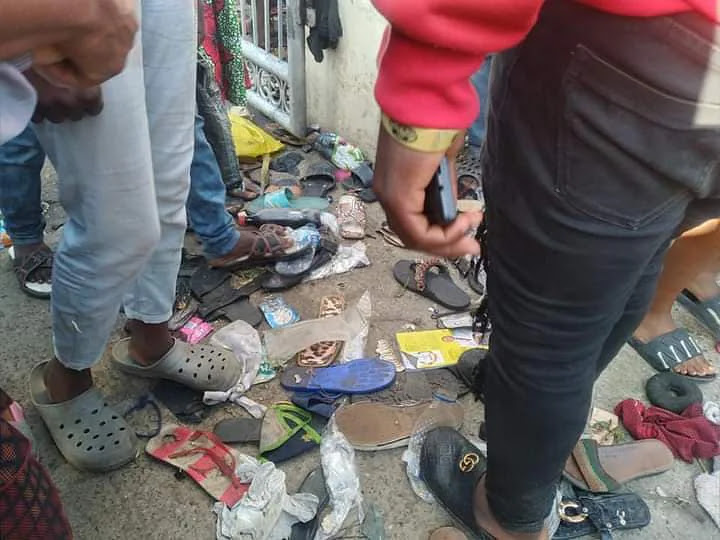
Videos from the scene showed the clothing and shoes meant for the beneficiaries. Doctors and emergency workers treated some of the injured as they lay in the open field.

The “Shop for Free” event was suspended while authorities investigated how the stampede occurred.

Friday, May 27, 2022

Nigeria's Hopeless Fight Against Corruption

Buhari swears in ministers into his cabinet in Abuja, Nigeria November 11, 2015

Seven years after President Muhammadu Buhari promised to swiftly defeat corruption, Nigerians who are now worse off than they were in 2015 doubt that the president's anti-graft war will ever succeed.

Nigeria's Muhammadu Buhari during his 2015 election campaign not only promised to swiftly defeat militant Islamist movement Boko Haram and boost the failing economy, but also take decisive actions against corruption.

A large number of the country's electorate supported his presidential bid at the ballot box, hoping for a turning point in the fight against endemic corruption. Even the media trumpeted his integrity in the run-up to the elections.

"One of the major plan on which the present government ... came on board, was to tackle corruption. But it has not been able to do so," Sheriffdeen Tella, professor of economics at Nigeria's Olabisi Onabanjo University, told DW.

"In fact, the level of corruption has increased so much that people have lost hope in his ability to do this," Tella added.

"And corruption has actually fought back. It has not only affected the education sector, it also affected the health sector and all other sectors of the economy."

It has been over seven years since Nigerians put their hope in "SaI Baba” as Buhari is popularly known.

Many Nigerians complain about how life has become worse since he came to power and express doubt over his promised anti-graft war.
Shocking theft

Lanre Arogundade, a trade unionist and former president of the National Association of Nigerian Students (NANS), told DW that Nigerians' concerns are valid.

"Nobody can blame Nigerians if at this stage they are doubting the anti-graft war or its effectiveness. And the reason for this cannot be far-fetched," he told DW.

"One can give the striking example of the allegation against the accountant general of the federation that he singlehandedly stole about 80 billion naira [around €180 million]."

Nigeria's Economic and Financial Crimes Commission (EFCC) arrested the country's accountant general, Ahmed Idris, in connection with allegations of diversion of public funds.

"This development has actually confounded many to the extent that Nigerians have been calculating how many years it would take for a single individual to spend this money," Arogundade emphasized.

Financial analysis indicated that if 1million naira was being spent every day, it would amount to 365 million naira in a year. It would therefore take 10 years to spend about 3.6 billion of the 80 billion naira. And 100 years to spend 36 billion naira.

One of the consequences of Idris' alleged theft is the closure of Nigeria's public universities. University lecturers said he is partly responsible for the ongoing strike by the Academic Staff Union of Universities (ASUU) which has put the future of Nigeria's youth on hold.
Anywhere but Nigeria

Collin Xavier, a 20-year-old first year international law student at Ukraina's Karazin Kharkiv National University, barely sleeps these days.

He is self-sponsored after training to be a stylist and designer at a Nigerian fashion school.

His hunger for success led him to Ukraine for his education. His future had looked bright, until Russia invaded Ukraine on February 24. He was lucky to escape with his life — and little else — to Berlin.

Now, squatting with two Arab families — also refugees — he stays awake every day until 3 a.m. to 4 a.m. thinking and hoping.

The night breeze helps him think straight to mull the dilemma and trauma of losing everything.

Returning to Nigeria isn't really an option for Collin. He fears the endemic corruption which has brought the country to its knees. He worries about the quality of education in Nigeria because of incessant closure of universities due to striking lecturers — caused by the corrupt actions of public office holders.
Deeper and deeper

Corruption is certainly not a new phenomenon in Nigeria. Rather, it has long been an intrinsic element of Nigerian society affecting virtually all spheres of the West African country.

In 2021, Nigeria ranked 154th out of 180 countries listed in the Transparency International's Corruption Index.

Anecdotal evidence indicates that the corruption is culturally acceptable because members of the family, tribe or ethnic group benefit from an individual's ill-gotten gains.

At the point when former Nigerian President Goodluck Jonathan relinquished his government role, the country was at the brink of ruin due to endemic corruption being recklessly displayed.

Seven years later, following a historic change of power on the grounds of defeating corruption in Nigeria, West Africa's most populous nation is said to be sinking deeper into the mire of corruption.

Nigerian security forces are battling a 12-year jihadist insurgency by Boko Haram militants in the country's northwest that has killed more than 40,000 people.

Whether in terms of the president's promise to swiftly defeat Boko Haram or fix the economy, it was clear Buhari's integrity would be tested.

Many Nigerians believed in him as they visited his past — when he was military head of state and was considered a no-nonsense person — thus invested a whole lot of hope in him. In-depth research indicated that such investment is unprecedented in the history of Nigeria.

Even after his first four years in office, many gave the Buhari-led government the benefit of the doubt that it would be difficult to fix the state of the nation, given the degree of rot they had inherited.
A salad of hope

The government started on a very good note but completely did almost a 360 degrees at the point when many of the efforts were about yielding fruits, Olanrewaju Suraju, chairman of the Human and Environmental Development Agenda (HEDA) told DW. He said that he holds Buhari's cabinet members responsible for this.

"And, a number of them — a host of many of the ministers who are true to type — the same politicians who have only just changed their political party but not their orientation, decided to take advantage of the opportunity of the anti-corruption to also be corrupt and share in some of the recovered loot," he said.

Noting that President Buhari maybe be overwhelmed, Suraju said "we want to see a situation where he is holding people to account. It is not just a few; it has to be holistic. We expect more firm action from the president and that actually is missing in some instances. So, that gives a whole lot of cause for concern."

To highlight the importance of anti-corruption for socio-economic growth — which is being raised globally — Buhari through the anti-graft agency; EFCC, has arrested, detained and even prosecuted some public office holders, the latest being the country's accountant-general for the staggeringly monumental fraud he's been perpetrating for years.

But Nigerians are saying that fighting corruption should not just be about probes, arrests and prosecutions, it should be about prevention — something the Buhari-led government lacks.

"What we have not seen under this government is the prevention of corruption such that it keeps happening again, and again, and again," Arogundade, the trade unionist told DW.
Poor preparedness and failing economy

The Buhari-led government seem incapable of coping with the level of corruption that has engulfed the economy.

Investigations reveal it has been quite hard for the government to save the fainting economy because the consequences of corruption are largely affecting the production, as well as distribution of goods.

Professor Tella told DW that the government was not prepared for the magnitude of problems it has to deal with, and it could not even begin to overcome them — not to mention providing the strong leadership necessary to grow the Nigerian economy.

Arogundade also doubts whether the government can fix the economy.

"It is clear that things are really not working. Diesel which is supposed to be deregulated, and part of the argument for deregulation was that ultimately it would bring prices down, but prices keep skyrocketing everywhere. So, there are obvious question marks over the ability of the government to actually fix the economy."
‘Interesting' days ahead

HEDA's chairman told DW that the fraudulent activities perpetrated within the last eight years would be exposed after the present government relinquishes power because the law enforcement and anti-corruption agencies are presently timid to do that now.

"We are going to see a whole lot of expose after the government leaves office. Many of the law enforcement and anti-corruption agencies are either compromised; timid, to actually reveal some of the atrocities that they know or reported to them," he said.

Suraju said Nigeria's anti-corruption agencies have not attained the level of independence that guarantee their security of tenure or independence to speak up against the corruption and atrocities being committed by political office holders.

"So, they technically would rather not jeopardize their office and just choose to wait till when it is considered expedient for them to actually spill the beans and then take appropriate action. We would see a whole lot of that happening when this government leaves office," he added.

Nigerians have taken to various social media platforms calling for the public identification of individuals and institutions being investigated for corruption by the various anti-graft agencies.

They say naming and shaming would be very helpful to the country because corruption is already killing the country and people, so should be a source of concern to everyone.
Way forward

All experts sampled for this artcle told DW that Nigeria needs a government that would from the beginning tackle corruption with its own transparency and accountability clearly seen. They all expressed worry that it is becoming increasingly difficult to believe that if Buhari could not do it, who else could?

Professor Tella said there was no way out for Nigeria in the short run. "Until after the election of next year, that is 2023, that is when we can say we are ready to improve either on the issue of corruption or the economy generally."

He said an anti-graft war requires having a plan — a national plan — something the Buhari-led government lacks. The plan should include available resources, where the country and government wants to be at any point in time, amongst others.

"What it should do first, is to have a plan. And that plan must be able to lead us to where we should be may be in the next 20, 30 years," Professor Tella told DW. "For now, there is no such plan and until we have such a thing, the government would continue to be on trial and error over time."

Lanre Arogundade doubted the possibility of an end to corruption in Nigeria. "We keep talking about the same thing: The fact that corruption is still very much there. It seems as if we are sitting on a barber's chair that keeps rotating and nothing much has actually changed."

"It would have been good for one to be able to say that there is some form of end in sight to endemic corruption in the country but definitely it is something that is just too difficult to say," he continued. "There is no way that one cannot be pessimistic when it comes to this particular issue."

Suraju said holistic change would begin with Nigerians revisiting their personal and family values because public office holders do not fall from heaven; they are from families. "It is a function of garbage in, garbage out. The moment we keep producing these level of characters, then we would still have them aspiring and becoming public office holders that would then be causing us this level of hardship."

He said imbibing the culture and orientation of not just patriotism, but also of responsibility in Nigerian children is crucial.

"We would really need to check kind of persons and characters that we are throwing up within our system and also our homes to go into the society."

--------------------DW

Wednesday, March 30, 2022

As Nigerians Await Nigeria Air


ABUJA (TRIBUNE) - Obviously, the administration of the present government is drawing gradually to its end as the atmosphere thickens with electoral campaigns that will usher in a new government at the expiration of its eight years mandate.

Whichever way one views it, the administration led by President Muhammadu Buhari and by extension, the country’s aviation sector under Senator Hadi Sirika as the minister will not be forgotten as they must have impacted the sector through the policies implemented during their time.

The Buhari administration at the twilight of its coming assured Nigerians of another national carrier after the unwise liquidation of the former Nigeria Airways. Though several attempts made to fulfil this promise ran into different murky waters with the government withholding the necessary information on how it intends to float the new carrier from stakeholders.

However, even as many believed that the dream of having the new national airline is still doubtful due to the absence of physical evidence on the ground, amidst the doubts came the information recently that may have changed all the negative notions earlier nursed about the probability of having a new national carrier under the administration.

As the intrigues over how the government plans to float a new airline continue, the news has filtered in that Captain Dapo Olumide has been named the interim managing director of the new national carrier, Nigeria Air by the federal government.

One obvious fact is that the news about the appointment of Dapo Olumide to manage the coming national airline has gone a long way in dousing the hitherto tension and intrigues surrounding the project for so many reasons.

All the promises the minister had earlier made to package a well-deserved airline for Nigeria which had been punctured by key players in view of professional lapses may not be a ruse after all following the involvement of Olumide.

In the aviation circle today, Dapo Olumide is highly rated as one of the most qualified professionals and administrators as witnessed in his days at Aero Contractors, Virgin Nigeria and subsequently Nigerian Eagle.

Dapo Olumide, who holds a Bachelor’s degree from the prestigious Embryridle Aeronautics University, Florida, USA, along with professional qualifications in airline operations was able to transform the then Virgin Nigeria Airways into Nigerian Eagle Airlines.

His performance while at the Aero Contractors still speaks for him. Unfortunately, immediately he left the airline, its story became sad.

Therefore, with the pedigree of Olumide, his appointment as the Chief Operating Officer of the airline is a square peg in a square hole. In other words, there seems to be light at the end of the tunnel.

Since he is not the kind who gets his hands soiled, for him to have accepted to work in the new airline, he might have weighed so many options.

At this juncture, while Nigerians await the final coming of the new national carrier, appointing Olumide and his team for the airline is not the end of the story as government needs to avoid unnecessary involvement.

Agreed that government cannot totally let go of the activities, but the government should allow Olumide and his team to run the airline without undue interference or imposition.

Allowing the interim management to package a standard national carrier for Nigerians this time around will go a long way in revamping the image of the country.

It will be a great relief if team Olumide is given the wherewithal and freedom needed to package the new national carrier for Nigerians and in doing this, the sector which had been thrown into instability since the exit of the defunct national carrier will witness further stability once again.

The story of the successful take-off of the new national carrier under well-packaged management consisting of core professionals will surely take away the over two decades of the hopelessness of a large country like Nigeria to float a new national airline.

While Nigerians await the coming of Nigeria Air, the Crucial Moment is welcoming onboard the Olumide team and hoping they will bring back smiles to the faces of Nigerians, particularly the travelling class.

Tuesday, March 15, 2022

NIGERIA: Falana On Umahi’s Sack: Votes Belong To Political Parties — NOT Candidates

FEMI FALANA. IMAGE: FACEBOOK
BY AYODELE OLUWAFEMI

ABUJA (THE CABLE)
-- Femi Falana, a senior advocate of Nigeria (SAN), says votes cast in any election in the country belong to the political parties, not candidates.

On March 8, Inyang Ekwo, the presiding judge at a federal high court in Abuja, sacked David Umahi, governor of Ebonyi, and Eric Igwe, his deputy, over their defection from the Peoples Democratic Party (PDP) to the All Progressives Congress (APC).

The judge held that the votes polled by Umahi in the March 2019 governorship election belonged to the PDP and cannot be transferred to the APC.

Consequently, Ekwo ordered the PDP to present another candidate or, in the alternative, the Independent National Electoral Commission (INEC) should conduct a fresh poll within 90 days.

The issue has generated concerns on a possible constitutional crisis in Ebonyi since a court has also sacked the speaker of the state house of assembly and 15 other lawmakers for defecting from the PDP.

Speaking on the development in a legal opinion article released on Tuesday, Falana said critics of Ekwo’s verdict failed to state that the majority of votes in the Ebonyi 2019 governorship poll were in favour of PDP that presented Umahi as flagbearer.

“Those who have placed uncritical reliance on Atiku’s case have failed to appreciate that the validity of the votes scored by the PDP in the presidential election did not arise for determination,” the article reads.

“To that extent, the case cannot be a justification for the subversion of the democratic rights of voters by political defectors.

“Whereas in the 2019 governorship election in Ebonyi State, the PDP garnered 393,343 votes across the 13 local governments areas of the state, its closest challenger, the APC, got 81,703 votes.

“After the PDP had emerged the winner of the election, the certificate of return was issued in the name of its flagbearer by the INEC Chairman, Professor Yakubu Mahmood, who stated that ‘I hereby certify that Nweze David Umahi of Peoples Democratic Party (PDP) has been elected to the office of Governor of Ebonyi State…’

“Even though Governor Umahi has decamped from the PDP to APC, neither the INEC nor the high court of Ebonyi state has amended the certificate of return to read ‘Nweze David Umahi of the All Progressives Congress.’

“To that extent, the case cannot be a justification for the subversion of the democratic rights of voters by political defectors.

“Whereas in the 2019 governorship election in Ebonyi State, the PDP garnered 393,343 votes across the 13 local governments areas of the state, its closest challenger, the APC, got 81,703 votes.

“After the PDP had emerged the winner of the election, the certificate of return was issued in the name of its flagbearer by the INEC Chairman, Professor Yakubu Mahmood, who stated that ‘I hereby certify that Nweze David Umahi of Peoples Democratic Party (PDP) has been elected to the office of Governor of Ebonyi State…’

“Even though Governor Umahi has decamped from the PDP to APC, neither the INEC nor the high court of Ebonyi state has amended the certificate of return to read ‘Nweze David Umahi of the All Progressives Congress.’

“It is interesting to note that some lawyers have maintained that Governor Umahi has exercised his freedom of association by decamping from PDP to APC.

“While the governor’s freedom of association is constitutionally protected, he cannot be permitted to infringe on the democratic rights of the 393,343 citizens who voted for him as the governorship candidate of the PDP.

“Or are we to believe that the votes scored by the PDP have been merged with those of the APC since the PDP candidate decamped to APC?


“Curiously, in making a mockery of the democratic rights of the people of Ebonyi State, the critics of the judgment of Justice Egwu have failed to advert their minds to the undeniable fact that the majority of the voters actually exercised their franchise in favour of the PDP. After all, the names of the candidate David Umahi and his deputy were not on the ballot papers.”

Falana also cited a reference to the case of Zamfara in which the votes of the All Progressives Congress (APC) were nullified in 2019 by the supreme court over issues arising from the party’s failure to conduct a valid primary.

“In the leading judgment of the Supreme Court in All Progressives Congress v. Marafa, LOR (24/05/2019) SC, Justice Paul Adamu Galinji declared that all the votes cast for the APC were ‘wasted votes’ on the grounds that the party failed to conduct a proper primary,” Falana said.

“The court added that all political parties with the second highest votes in the elections and the required spread, are elected to the various elections.

“In the instant case, the votes credited to the PDP in the 2019 governorship election in Ebonyi State cannot be said to have been wasted based on the decision of Governor Umahi to decamp to the ruling party.

“Since the said votes are not wasted, it is inconceivable that they have been legally transferred from the PDP to the APC. Under no law in Nigeria can the exercise of the right of Governor Umahi to defect from the PDP to APC extinguish the 4-year mandate freely given to him on the platform of the PDP during the 2019 general election.

“We wish to submit, without any fear of contradiction, that elections are won by political parties and not by candidates.

“In Amaechi v. INEC & Ors (2008) LCN/3642 (SC), the Supreme Court held that ‘The above provision (i.e. section 221) effectually removes the possibility of independent candidacy in our elections; and places emphasis and responsibility in elections on political parties. Without a political party a candidate cannot contest’.”

Thursday, March 03, 2022

NIGERIA: Much Ado About The Signing Of The Electoral Act

BY CHRIS ANYOKWU

National Assembly Abuja


We love theatre and drama in these parts, particularly political theatre. We as a people, sick to the pit of our stomach by the accretic effluvia of state actors, love to be diverted through periodic episodic displays of high-profile tomfoolery which, more often than not, masquerades as serious business of governance. Or how else does one describe the long-drawn-out shadow-boxing, the accompanying feints and the proxy “wars” engaged in by members of the Nigerian political class, notably the National Assembly? As though we did not have enough weightier matters of state, members of the political class had engaged one another in pitch battles and guerrilla warfare over what they have managed to characterise as the be-all-and-end-all of Nigeria’s political survival. Everything was subordinate to the Electoral Act, they had insisted. And, as such, the NASS had gone at it, hammer and tongs, chipping away at the nondescript block of wood otherwise referred to as the Electoral Bill Amendment Act, finessing it, adding to and subtracting from it, until they came out with the finished article. But keep in mind the fact that this same Bill upon which we are given to believe the destiny of our dear country depends; the very oxygen of the most populous Black nation on earth, statutorily went through all the parliamentary processes, such as First and Second Readings and so forth.

Public input was sought at various times. The Red and the Green chambers of the NASS separately considered and re-considered the Bill and they equally came together at plenary sessions to debate the grey areas in the momentous piece of legislation. All the who’s who in our nation pivoted in on this Bill that would either make or mar our relentless march towards democratic maturity.

After all said and done, the NASS had announced to the world that they had done their duty by Nigerians: they had delivered or birthed the single most important piece of legislation in our chequered political odyssey. The Electoral Act of 2022 was duly sent to Mr President for his assent in order for the Bill to become law. President Muhammadu Buhari had spectacularly withheld assent. He seemed to have, on his part, done his due diligence and discovered some grave defects in the document and consequently pushed it away from his presidential table in towering imperial disgust. “What is this? Why is this or that not included? And why is this offensive item included, etc.?” Sai Baba had fumed. “And you want me, General Muhammadu Buhari, to sign this fraudulent document and plunge our great nation into anarchy and bondage? Not on your lives!” he had added, his regnant military hauteur and ire reawakened. “Hankuri, hankuri, Sai Baba, we will take a second look at the Bill and bring it back for your assent, Mr President,” the NASS had mollified the piqued ruler.

Thus the NASS had returned to work on the Bill, rectifying all the offensive or/and faulty aspects accordingly. According to media reports, PMB had rejected the Electoral Bill because the NASS had approved Direct Primaries for picking candidates by political parties, a procedure considered dangerous by Mr President. PMB had pointed out, to his credit, that imposing Direct Primaries on political parties would cause disaffection and animus in the polity (Vanguard Dec. 20, 2021). People are still left scratching their heads trying to fathom the reason(s) why the sagacious gurus on the Apo Hill failed to do their due diligence, considering the momentous significance of their task. Were they putting parochial interests over and above national interest? Well, all’s well that ends well. All the cloak-and-dagger business, all the sweepstakes are well behind us now. Ah, thank goodness!

But, pray – what kind of high drama was Femi Adeshina trying in his little corner to create over the signing of the Electoral Act by Mr President? Adeshina had created a bit of hide-and-seek in the media over this. Regarding the signing event, he had put the whole nation on tenterhooks, most churlishly: Maybe in days now; maybe today before nightfall … it can happen any moment now … going … going… Ah, Femi Adeshina! You mean you couldn’t see the implied disrespect in this act to the people who, as it is, were already weary and worn at the Nigeria Golgotha? What exactly did you wish to achieve with the histrionics? Was it to make Nigerians more beholden, more indebted to your principal for assenting to the Bill? Is it to elevate and transmogrify PMB from a mere mortal to a deity, to usher him, festoons and all, into the hallowed pantheon of culture heroes and racial avatars such as Shaka the Zulu, Nelson Mandela, or such mythic idealities as Ogun, Sango and Obatala? Was it to rouse the tribe of scribes and singers of tales to begin to compose laudatory paeans and leaping panegyrics in due homage to the architect of modern Nigeria? Hagiography has its place in the royal courts of kings and potentates, but in the bloody and agonistic business of realpolitik, such puerile antics leave much to be desired.

Well, let us give thanks and praises to God as the “reworked” Act has been finally signed into law. Under the “Explanatory Memorandum”, the Electoral Act of 2022 reads: “The Electoral Act of 2022 repeals the Electoral Act No. 6, 2010”. It says, among others, “to regulate the conduct of Federal, State and Area Council elections, to make provisions for the restriction of the qualification for elective office to relevant provisions of the constitution of the Federal Republic of Nigeria 1999, use of card readers and other technological devices in elections and political party primaries, to provide a time line for the submission of the candidates, criteria for substitution of candidates, limit of campaign expenses, and address the omission of names of candidates or logo of political parties”. Top ten provisions in the Electoral Bill of 2022 include the following: (1) financial independence for INEC. In clause 3(3) funding for general elections must be released at least one year before the election. (2) Inclusion of persons with Disability. In clause 54 (2) provisions are included to make voting easy for persons with disabilities and special needs (3) Electronic Voter Accreditation. Clause 47 creates legislative backing for smart-card readers and any other voter accreditation technology. (4) Redefines over-voting with Clause 51, “Total number of accredited voters” will become a factor in determining over-voting at election tribunals. (5) If a candidate dies in an election? By clause 24, political parties can now conduct a primary election replacing a candidate who dies in an election. (6) Election results declared under duress. By clause 65, INEC can now review results declared under duress. This will discourage electoral violence and improve the safety of returning officers. (7) Early Conduct of Primaries. By Clause 29(1), parties must conduct primaries and submit their list of candidates at least 180 days before the general elections. (8) Campaigns will start early. By clause 94, campaign season now starts 150 days to election day and ends 24 hours to the elections. (9) Party Members Cannot Work At/For INEC. It is now criminal to hide your membership or affiliation to a political party in order to secure an appointment with INEC and (10) Electronic Transmission of Results. By Clause 60, INEC now has the full discretion to conduct electronic transmission of results [e-transmission considerably reduces rigging]

But the question that should still agitate our minds is: so what, now that PMB has signed the Electoral Act into law? What has really changed in every material particular? How has the Act drastically recalibrated, reconfigured or shuffled things insofar as the modus operandi of political engineering is concerned? Put differently, how has, in the immediate term, the Electoral Act turned leopards into lambs in Nigeria’s feral forest? Maybe we are getting ahead of ourselves too soon. But if history, past and recent, is any guide, under the present circumstances, Nigerian politicians are a special breed, one who takes delight in riding roughshod over rules and regulations, law and order. For them, the principle of due process and constitutionalism is dongo turenci (big grammar!). Wetin concern agbero with overload? Granted, we didn’t have this kind of well-articulated, seriously well-thought –out piece of legislation for regulating the conduct of elections in Nigeria. But one wonders aloud: what about the Independence Constitution of 1960, the Republican Constitution of 1963 and the Second Republic Constitution of 1979? Don’t we have, however imperfect, sections and sub-sections enunciating how elections should be conducted in our nation?

So far, the Electoral Act of 2022 has been hailed as PMB’s greatest legacy. The jury is still out on that, though. Also, people have called on the Independent Electoral Commission (INEC) to pick up the gauntlet, challenging it that the ball is now in its court.

Have we up until today been operating our democracy in a Hobbesian State of Nature? Truth be told, Nigeria, like most civilised nations, does have some form of Electoral Act, such as that of 2010 being amended. The fact is that, over time, it was discovered that some of the constitutional provisions were defective and inadequate, requiring amendments. Our democracy is also growing and getting increasingly complex. Thus, relying on moribund and superannuated laws would not do. That is why we have promulgated another or rather amended the old law to give birth to the new-born “bundle of joy”! Clearly, it is timely, wise and the right thing to do. It will deepen our democratic culture and create a more inclusive, fairer and egalitarian environment. It will also minimise friction, allay tension, banish mutual suspicion and acrimony and bad-blood from among our political elite. Thankfully, we now have three modes of primary election, namely; (a) Direct (b) Indirect and (c) Consensus modes. We are doing just fine, after all, even the US constitution has been amended 27 times out of hundreds of thousands of bills introduced attempting to amend it. Like the nation itself which is a daily plebiscite, the Constitution also is work-in-progress, continually admitting and reflecting the people’s remorseless walk to freedom, to jurisprudential and legislative health and to all-round prosperity, peace and progress.

So far, the Electoral Act of 2022 has been hailed as PMB’s greatest legacy. The jury is still out on that, though. Also, people have called on the Independent Electoral Commission (INEC) to pick up the gauntlet, challenging it that the ball is now in its court. But things are easier said than done, right? It is gratifying as well to know that the Act also addresses Section 227 of the 1999 Constitution (as amended): The Clause reads thus: “No association shall retain, organise, train or equip any person or group of persons for the purpose of enabling them to be employed for the use or display of physical force or coercion in promoting any political objective or interest or in such manner as to rouse reasonable apprehension that they are organised and trained or equipped for that purpose”. Hmn… this is simply revolutionary. Firstly, let us commend the framers of this document for the sheer laconicity of phraseology. Secondly, should we be able to enforce this rule in particular, Nigerian politics will change forever and we shall become the world’s poster-child of democratic Eldorado! Just imagine it! No more thugs, and goons armed to the teeth with guns, machetes and daggers, laying towns and villages waste and leaving in their wake sorrow, tears and blood. No more staccato reports of gunfire ripping apart the sacred hide of night, before, during and after elections. The Lagos Lagoon shall no longer be bloodied with dead baboons or the corpses of our compatriots from the Southeast for daring to exercise their franchise the way they deem fit. Agberos, both corporate and the real McCoy, will be out of job for our political desperadoes during elections. No more ballot-stuffing, ballot-snatching, no more militarisation of our democratic choice. Rigging shall be a thing of the past and it will be all civility, decorum and peace. We, therefore, recommend that this life-and-death Electoral Act be translated into ALL local or indigenous Nigerian languages and presented to ALL Nigerians, home and abroad. There should be massive enlightenment and sensitisation campaigns on this across Nigerian towns and villages. Agberos in particular should be warned that there is a new sheriff in town. Break the law and face the music!

But let’s tell ourselves the simple naked truth. Provision of enabling legislation has never been our problem. The political will to enforce it has always been our albatross. So, we can fete PMB for this historic legislative milestone, as much as we want. We can pop champagne and clink our glasses and toast the health of the Republic, if we so desire. Yet we must remember that we rise or fall as a nation on account of the collective conduct of our political elite. As the saying goes in Igboland, they hold the yam and the knife. But the people must remain vigilant, regardless. 2023 is upon us, the clock is ticking!

----------------------THE NEWS

War, Erasure, And The Politics Of Culture In Sudan

BY LARISSA-DIANA FUHRMANN This article examines contemporary cultural erasure in Sudan. It highlights resilient Sudanese efforts and interna...