Showing posts with label Iraq. Show all posts

Monday, July 22, 2024

The Yezidi Genocide Devastated Iraq’s Community 10 years Ago − But The Roots Of The Prejudice That Fueled It Were Much Deeper

Mourners prepare to bury the remains of Yezidi victims in a cemetery in Sinjar, Iraq, in 2021, after the bodies were exhumed from mass graves. AP Photo/Farid Abdulwahed

BY GUNES MURAT TESCUR
DIRECTOR OF THE SCHOOL OF
POLITICS AND GLOBAL STUDIES
ARIZONA STATE UNIVERSITY

On the morning of Aug. 3, 2014, the Islamic State group launched a ruthless and swift campaign in Sinjar, in northwestern Iraq. The target was Yezidis: a monotheistic religious group whose members have long been persecuted.

As forces affiliated with the regional Kurdish government fled in disarray, IS fighters captured and enslaved an estimated 6,800 Yezidis, mostly women and children. About 1,500 Yezidis were executed. A similar number lost their lives from excessive heat, thirst or starvation while stranded on Mount Sinjar, before U.S. airstrikes several days later enabled escape to the relative safety of Kurdish-controlled areas in Syria and Iraq.

The entire Yezidi population of Sinjar, about 250,000 people, lost their homes: around half of all Yezidis across the globe, by my estimate.

Ten years later, it is easy to look back on the massacres as the work of extremist militants. But IS in Iraq recruited heavily among local Sunni Muslims from northwestern Iraq. People who lived alongside Yezidis for many years became their tormentors, rapists, looters and killers.

What explains the ferocity of this genocidal campaign? As a scholar of political violence and Middle East politics, I argue that two main factors led to the anti-Yezidi atrocities.

First, Muslim authorities have historically stigmatized Yezidis and denied their existence as a faith group – one of the focuses of my 2024 book, “Liminal Minorities.” Second, transformations after the U.S. invasion of Iraq fueled resentment, which extremists channeled against this marginalized religious group.

A global pattern

The Yezidi experience reflects a global pattern: a type of marginalization and discrimination against faith groups whom I call “liminal minorities.”

Liminal minorities have two core characteristics. First, they lack theological recognition in the eyes of the area’s dominant religion. In other words, more powerful faith groups do not acknowledge the legitimacy of their religion and denigrate the minority’s beliefs and rituals.

Second, liminal minorities are subjected to widespread stigma transmitted across generations. They are often perceived as a threat to moral order and at times alleged to engage in sexually deviant practices.

These patterns of stigmatization beget discrimination.

In addition to Yezidis, liminal minorities include Alevis in Turkey, Baha’is in Iran, and Ahmadis in Indonesia and Pakistan. Religious liminality is not exclusive to the Muslim world: For example, Jehovah’s Witnesses in a variety of countries and Falun Gong in China are also liminal minorities.
Centuries of prejudice

Yezidis’ marginal status is not new. Under the Ottoman Empire, Christian and Jewish communities were offered a limited degree of protection and autonomy in return for paying a special tax – known as the millet system. These groups were recognized as “People of the Book”: monotheists whose religious faith was accepted by Muslim authorities. Yezidis, however, lacked this status.

Even today, Yezidis are often insulted as “devil worshipers.” According to the Yezidi faith, God entrusted the world to his lead angel, Tawûsî Melek, which means “Peacock Angel.” Some Muslim religious authorities, however, conflate this angel with Iblis, the personal name of the devil in Islam.

This misidentification gained widespread acceptance among Muslim clerics by the 16th century. Under Ottoman rulers and Kurdish tribal leaders, the claim was used to justify extreme forms of violence against Yezidis, including mass enslavement and killings.

Political resentment post-Saddam

The stigmatization of Yezidis remained widespread in Iraq throughout the late 20th century. There were no large-scale episodes of religiously motivated massacres targeting Yezidis under the regime of Saddam Hussein. Yet many were forced out of their mountain villages as part of his party’s Arabization campaigns: forced deportations aimed at weakening non-Arab minorities in the country’s north.

Iraq is home to people of both major schools of Islam – Sunni and Shiite – as well as minority faiths such as Yezidis, Christians and Sabaean-Mandaeans, who follow an ancient monotheistic religion. The country is also home to many different ethnic groups, with a large Arab majority and sizable minorities of Kurds, Turkmens and Assyrians.

Sunni Arabs, who make up a minority of the population, formed the backbone of the Saddam regime, while Shiite Arabs and Sunni Kurds were mostly excluded from power. After the U.S. invasion, however, the Shiite majority was able to dominate electoral politics, and many Sunni Arabs complained of being marginalized.

The Kurdish region, meanwhile, consolidated its autonomy. Yezidi votes become crucial to Kurdish claims for additional territory – spurring more Sunni resentment of the Yezidis.

Boiling point

My fieldwork, including extensive interviews between 2017 and 2019, suggests that the Islamic State’s goal of ethnic cleansing capitalized on these feelings of resentment and aimed to undermine Kurdish territorial claims.

Hundreds of Yezidis became victims of violent attacks well before 2014. As the Islamic State group gained power, it further intensified anti-Yezidi stigmas. The group instructed fighters that extreme forms of violence, including systematic rape, were justified by their faith.

The combination of historical hatreds, political resentment and denying the legitimacy of Yezidis’ faith helped spark the violence that devastated Iraq’s Yezidi community in 2014.

Quest for recognition and security

In the wake of the genocide carried out by IS, the Yezidis received unprecedented international attention as a persecuted faith group, and several countries, such as Germany, created resettlement programs for Yezidi refugees. Yezidis in the diaspora became more visible and organized, demanding justice and aiming to mobilize public attention.

Nevertheless, their conditions remain dire. Yezidis are unable to return to Sinjar, which is still an insecure zone contested among rival armed forces. Many remain in camps in Iraqi Kurdistan, facing an uncertain future.

Others have sought refuge abroad, and some benefited from specialized humanitarian asylum programs like Germany’s. The country has been home to part of the Yezidi diaspora since the early 1970s and emerged as a major destination for Yezidis fleeing Iraq after 2014. Today, about 200,000 Yezidis are estimated to live there.

Yet the rise of anti-immigration sentiments in Europe has made the Yezidis’ situation similar to that of many other migrants and refugees. As public attention to the genocide begins to fade, these newcomers face an increasingly inhospitable political climate.

Facing an existential precarity in their homeland and legal limbo in the diaspora, the Yezidi liminality persists.

READ ORIGINAL STORY HERE

Thursday, May 16, 2024

BOOK REVIEW: ‘The Achilles Trap’

Steve Coll

BY MARTIN DI CARO

In the 21 years since the U.S. invaded Iraq, the world has sought answers as to why our political and intelligence leaders blundered into strategic and moral catastrophe. In “Confronting Saddam Hussein” (2023), the eminent historian Melvyn Leffler exonerated the George W. Bush administration of deliberate deception. Rather, in Mr. Leffler’s view, the misguided war of choice stemmed from an earnest impulse to protect the country from terrorism.

The Pulitzer Prize-winning author Steve Coll renders a somewhat harsher verdict in his latest work of narrative journalism covering decades of cooperation and conflict between Washington and Baghdad. “The Achilles Trap” winds back the clock to the Ba’ath Revolution and then proceeds inside Saddam’s presidential palaces, where the dictator held sway over underlings afraid to challenge his delusional worldview.


Mr. Coll is an accomplished chronicler of American spycraft. “Ghost Wars” (2004) was a sublime account of the CIA’s involvement in the anti-Soviet jihad in Afghanistan and the pursuit of Osama bin Laden before 9/11. The follow-up volume, “Directorate S” (2018), charted the spy agency’s hunt for radical Islamists in Afghanistan and Pakistan. These books demonstrate that Mr. Coll has few equals in the quality of his sources and ability to obtain classified documents. Add his storytelling flair and a cast of characters teeming with eccentric henchmen and shameless con men, and Mr. Coll has delivered another must read book.

“The Achilles Trap” is partly based on more than 100 interviews with event participants — from clandestine operatives to Iraqi nuclear scientists. Even better, Mr. Coll obtained never-before-published audiotapes of Saddam’s internal deliberations along with loads of Iraqi government documents.

These sources make it “possible to see in new ways what drove Saddam in his struggle with Washington, and to understand how and why American thinking about him was often wrong, distorted, or incomplete,” Mr. Coll writes. They reveal a leader consumed by suspicions of foreign spies and assassination plots who failed to grasp the nature of U.S. decision-making, not least because he espoused crude conspiracy theories about all-powerful Zionists manipulating events.


This is a story of mutual misperceptions and miscalculations rarely tempered by sufficient self-reflection. But Mr. Coll argues that the “forever war” between the U.S. and Iraq was avoidable. The missed opportunities began in the aftermath of the Iran-Iraq War.

Amazing as this may seem today, Washington and Baghdad worked together from 1982. The Reagan White House authorized the CIA to share “satellite-derived intelligence about Iranian military vulnerabilities” to save Saddam from losing his war of aggression against the ayatollahs. Even after the regime’s genocidal gassing of the Kurds in 1988, President Ronald Reagan’s team “did not want to break with Saddam,” Mr. Coll writes.


The year before, an Iraqi warplane killed 37 Americans aboard the USS Stark in a mistaken attack. Reagan did not publicly criticize Saddam, who immediately apologized. “Saddam asked Reagan to ‘kindly convey to the families of the victims my personal condolences and sympathy,’” Mr. Coll writes. Partnership preserved. But the Iran-Contra scandal of 1986, which had exposed U.S. double-dealing, confirmed in Saddam’s mind that the Americans could not be trusted.

Because U.S. leaders “pulled their punches when Saddam gassed his enemies,” the dictator figured he might get away with invading Kuwait. Days before Saddam sent his tanks into his defenseless neighbor on Aug. 2, 1990, President George H.W. Bush sent a letter to “reassure” Iraq’s president that “my Administration continues to desire better relations with Iraq.”

“In the cascade of errors that led to the U.S. invasion of Iraq in 2003, the Bush administration’s failure to deter Saddam Hussein from invading Kuwait — as well as Saddam’s failure to grasp what would happen after he acted — stand out,” Mr. Coll writes. The U.S.-led campaign to liberate Kuwait in 1991 did not end the conflict. What followed was a succession of limited wars, cruel sanctions, and U.N. weapons inspections amid the alarm caused by the discovery of Iraq’s secret (and then dormant) nuclear program.

By the time a second Bush was in the White House, Saddam was convinced the all-knowing CIA had to be aware he no longer possessed weapons of mass destruction. U.N. inspectors found no weapons. Yet both the agency and neoconservative hawks, fed false reports by a parade of con men and fabulists, held a “collective presumption” that Saddam was hiding something and, therefore, was a threat to world peace.

Top Clinton administration officials believed the same, and President Bill Clinton embraced the goal of regime change without any practical idea of how to achieve it. Did President George W. Bush and his war Cabinet lie about WMD? Lie is not the word the author chooses. Rather, they “marketed through exaggerations of available evidence and unabashed fearmongering.”

Given the consequences — the hundreds of thousands dead, maimed and displaced, the shredding of U.S. prestige — Mr. Coll’s conclusion is tough to dispute. America’s most persistent enemy might have been managed rather than eliminated. More vexing is why history’s most powerful nation thought a tin-pot dictator was worthy of attention.

• Martin Di Caro hosts the “History as It Happens” podcast at The Washington Times.

READ ORIGINAL STORY HERE

Wednesday, March 22, 2023

WILL THERE EVER BE JUSTICE FOR THE IRAQ WAR?

A world without accountability paved the way for Russia’s invasion of Ukraine.


BY FARRAH HASSEN

The wars in Iraq and Ukraine may differ, but both speak to the tragic realities of war. They also make a strong case for strengthening the rule of law instead of undermining it through flimsy pretexts for endless militarism.

Like the 2003 U.S. war in Iraq, which marked its 20th anniversary this March, Russia’s year-long war on Ukraine is an act of aggression in blatant violation of international law.

On March 17, the International Criminal Court (ICC) issued an arrest warrant for Russian President Vladimir Putin. Although Russia is not a member of the ICC, human rights groups hailed the warrant as a step towards justice.

President Biden called the court’s decision “justified,” but acknowledged that the U.S. isn’t a member of the ICC either. It is important to see the U.S. support justice and accountability for Ukrainian victims. This should be extended to all victims of wars, including in Iraq.

That illegal war killed upwards of a million Iraqis, displaced over 9 million from their homes, and destroyed the country’s infrastructure. Terrorist groups, including ISIL, emerged in response to the invasion and have continued to unleash violence. Political divisions plague the country, Iraqis continue to struggle, and the U.S. has troops there even today.

The glaring lack of accountability for our government’s actions in Iraq compromises America’s authority to meaningfully promote human rights, justice, and the rule of law elsewhere — including in Ukraine.

The invasion of Iraq directly contravened the U.N. Charter’s prohibition against the use of force in international relations. The U.S. sent 130,000 troops to overthrow Iraq’s government, without U.N. authorization and under the fraudulent pretext that the country was amassing weapons of mass destruction.

Widespread human rights violations emerged from the invasion and occupation. Among them, tens of thousands of Iraqis were arrested and detained by U.S. personnel. The majority were innocent civilians and many were abused.

Photos from the Abu Ghraib prison scandal in April 2004 revealed horrifying, unlawful acts of torture. Naked men were leashed like dogs, electrocuted, and beaten. This barbarism was part of a broader post 9/11 torture network that spanned secret CIA prisons in Afghanistan and Europe to the notorious U.S. prison at Guantánamo Bay, Cuba.

Years later, WikiLeaks published classified U.S. government records that included evidence of other war crimes in Iraq. In the “Collateral Murder” video published in April 2010, shocking footage from 2007 showed U.S. helicopter gunships killing civilians and two Reuters journalists in Baghdad.

No U.S. government officials who created, implemented, or oversaw torture have been held accountable. The only ones to face charges over the WikiLeaks revelations were the people who publicized them. And no U.S. officials faced consequences for waging a war that killed nearly 4,600 U.S. soldiers and that continues to cost our government trillions.

If the U.S. is serious about enforcing international law, it must right its own wrongs in Iraq and elsewhere.

Joining the ICC would be a positive step.

On previous occasions, the U.S. has undermined the court, such as by derailing its investigation of U.S. crimes committed in Afghanistan. More recently, Pentagon officials stymied efforts to share U.S.-gathered evidence of Russian crimes with the ICC due to reported concerns that it could one day set the stage for prosecuting Americans.

This highly selective “rule of law” breeds a culture of impunity. As Russia’s actions demonstrate, these double standards weaken the rule of law and human rights around the globe.

A long overdue reckoning with Iraq is also important for Americans who were lied into this devastating war in order to ensure that nothing like this ever happens again.

In the meantime, Iraqis still wait for accountability. Like all victims of war, they deserve justice.

No one is above the law.

READ ORIGINAL STORY HERE

Sunday, March 19, 2023

20 years on, George W. Bush’s promise of democracy in Iraq and Middle East falls short


BY BRIAN URLACHER

President George W. Bush and his administration put forward a variety of reasons to justify the 2003 invasion of Iraq.

In the months before the U.S. invasion, Bush said the looming conflict was about eradicating terrorism and seizing weapons of mass destruction – but also because of a “freedom deficit” in the Middle East, a reference to the perceived lag in participatory government in the region.

Many of these arguments would emerge as poorly grounded, given later events.

In 2004, then Secretary of State Colin Powell reflected on the weak rationale behind the main arguments for the invasion: that there were weapons of mass destruction. He acknowledged that “it turned out that the sourcing was inaccurate and wrong and in some cases deliberately misleading.”

In fact Iraq did not have a stockpile of weapons of mass destruction, as Powell and others had alleged at the time.

But the Bush administration’s rhetoric of building a more free, open and democratic Middle East persisted after the weapons of mass destruction claim had proven false, and has been harder to evaluate – at least in the short term. Bush assured the American public in 2003 that, “A new regime in Iraq would serve as a dramatic and inspiring example of freedom for other nations in the region.”

He focused on this theme during the ground invasion, in which a coalition force of nearly 100,000 American and other allied troops rapidly toppled Saddam Hussein’s regime.

“The establishment of a free Iraq at the heart of the Middle East will be a watershed event in the global democratic revolution,” Bush said in November 2003. He also said that the U.S. would be pursuing a “forward strategy of freedom in the Middle East.”

Twenty years on, it is worth considering how this “forward strategy” has played out both in Iraq and across the Middle East. In 2003, there was indeed, as Bush noted, a “freedom deficit” in the Middle East, where repressive authoritarian regimes dominated the region. Yet, in spite of tremendous upheaval in the Middle East over the past two decades, many authoritarian regimes remain deeply entrenched.

Measuring the ‘Freedom Gap’

Political science scholars like myself try to measure the democratic or authoritarian character of governments in a variety of ways.

The non-profit group Freedom House evaluates countries in terms of democratic institutions and whether they have free and fair elections, as well as people’s civil rights and liberties, such as freedom of speech, freedom of assembly and a free press. Freedom House rates each country and its level of democracy on a scale from 2 to 14, from “mostly free” to “least free.”

One way to think about the level of democracy in the region is to focus on the 23 countries and governments that form the Arab League, a regional organization that spans North Africa, the Red Sea coast and the Middle East. In 2003, the average Freedom House score for an Arab League member was 11.45 – far more authoritarian than the global average of 6.75 at the time.

Put another way, the Freedom House report in 2003 classified a little over 46% of all countries as “free,” but no country in the Arab League met that threshold.

While some Arab countries, like Saudi Arabia, were ruled by monarchies around this time, others, like Libya, were ruled by dictators.

The nearly 30-year-long regime of Hussein in Iraq fit this second pattern. Hussein was part of a 1968 coup led by the Ba'ath political party, a group that wanted all Arab countries to form one unified nation – but also became known for human rights violations. The Ba'ath Party relied upon Iraq’s oil wealth and repressive tactics against civilians to maintain power.

The fall of Hussein’s regime in April 2003 produced a nominally more democratic Iraq. But after fighting a series of sectarian insurgencies in Iraq over an eight-year period, the U.S. ultimately left behind a weak and deeply divided government.

Post-invasion Iraq

The U.S. 2003 invasion succeeded in ousting a brutal regime – but establishing a healthy and thriving new democracy proved more challenging.

Rivalry between Iraq’s three main groups – the Sunni and Shiite Muslims as well as the Kurds, the largest ethnic minority in the country – paralyzed early attempts at political reorganization.

While Iraq today has a constitution, a parliament and holds regular elections, the country struggles both with popular legitimacy and with practical aspects of governance, such as providing basic education for children.

Indeed, in 2023, Freedom House continues to score Iraq as “Not Free” in its measure of democracy.

Since the U.S. military withdrawal in 2011, Iraq has lurched from one political crisis to another. From 2014 to 2017, large portions of western Iraq were controlled by the extremist militant Islamic State group.

In 2018 and 2019, rampant government corruption led to a string of anti-government protests, which sparked a violent crackdown by the government.

The protests prompted early parliamentary elections in November 2021, but the government has not yet been able to create a coalition government representing all competing political groups.

While Iraq’s most recent crisis avoided descending into civil war, the militarized nature of Iraqi political parties poses an ongoing risk of electoral violence.

The post-invasion Middle East

While Iraq continues to face deep political challenges, it is worth considering the U.S. efforts at regional democracy promotion more fully.

In 2014, widespread protest movements associated with the Arab Spring toppled dictators in Tunisia, Egypt, Yemen and Libya. In other countries, such as Morocco and Jordan, monarchs were able to offer concessions to people and remain in control by delaying public spending cuts, for example, and replacing government ministers.

Yet sustaining stable democracies has proved challenging even where the Arab Spring seemed to succeed in changing political regimes. In Egypt, the military has reasserted itself and the country has slid steadily back to authoritarianism. In Yemen, the political vaccum created by the protests marked the start of a devastating civil war.

The average Freedom House democracy score for members of the Arab League is today 11.45 — the same as it was on the eve of the Iraq invasion.

It is hard to know if U.S. efforts at democracy promotion accelerated or delayed political change in the Middle East. It is hard to know if a different approach might have yielded better results. Yet, the data – at least as social scientists measure such things – strongly suggests that the vision of an Iraq as an inspiration for a democratic transformation of the Middle East has not come to pass.

Friday, March 17, 2023

The Lessons Not Learned From Iraq


BY MICHAEL HIRSH

“War is a stern teacher,” Thucydides wrote nearly 2,500 years ago. Since then, great nations have often sought to learn lessons from the wars they waged, especially bad or stupid wars. But the same can’t really be said of the United States, which invaded Iraq 20 years ago as of Sunday. (March 19, 2003, marked the start of the “shock and awe” air war.)

Considering its long-term effects, the Iraq invasion amounted to one the most consequential strategic misdirections in U.S. history. Yet there has been very little discussion about why that is—and why what happened two decades ago is not a history lesson at all but rather part of an ongoing class in current events.

The hubris and excess of the Iraq invasion—a later iteration of the “reckless audacity” that Thucydides, the Greek historian, ascribed to the warmongering Greeks in the Peloponnesian War—are still with us today, shaping our times. The aftereffects of Iraq dramatically reduced the position of the United States in the Middle East, most recently opening the way to China’s brokering of Iran-Saudi Arabia rapprochement. The unnecessary diversion into Iraq—and the drain on U.S. resources and attention that resulted from it—set the stage for Washington’s 20-year failure in Afghanistan, which left U.S. President Joe Biden humiliated when he precipitously withdrew all U.S. troops, declaring in August 2021 that he was putting an end to U.S. efforts “to remake other countries.”

The Afghanistan catastrophe in turn projected an image of panicky weakness from which Russian President Vladimir Putin seems to have drawn false encouragement by invading Ukraine. (In speeches, Putin has also invoked the Iraq invasion to justify his own.) The self-created disaster of Iraq exposed U.S. military weakness, teaching the rest of the world how to outmaneuver and fight what was once considered an unassailable superpower. It arguably transformed American politics by helping to discredit the political establishment in Washington and open the way for former U.S. President Donald Trump and his “America First” neo-isolationism. Another little-noted domestic effect of the twin wars in Afghanistan and Iraq was that they dramatically worsened America’s opioid crisis, as a poorly prepared Department of Veteran Affairs chronically overprescribed fentanyl and other drugs to wounded and traumatized service members.

So, did any good come out of the Iraq War—a worthwhile lesson or two? Yes, but they’re not terribly encouraging. Indeed, a U.S. Army study found that “an emboldened and expansionist Iran appears to be the only victor” in the war.

Certainly, at least, Iraq is no longer ruled by anti-American tyrant Saddam Hussein. Instead, it is loosely governed by a squabbling collection of corrupt politicians who would likely be anti-American except that if they were, they’d be overthrown (either by Iran or the Islamic State) were it not for the roughly 2,500 U.S. troops who remain there.

Some military experts also believe that the U.S. military learned valuable lessons about the serious limitations of counterinsurgency operations. Even if the original invasion was a mistake, the United States managed to defeat both the Iraqi insurgency and the Islamic State occupation that followed. Still, those were hardly models of success or future strategy, notes C. Anthony Pfaff, a retired Army colonel who teaches at the Army War College. “What I don’t see is turning those operational successes into strategic ones,” he said.

Ironically, the most important lesson to be learned from the initial success of both the Iraqi insurgency and the triumph of the Taliban is how effective insurgencies can be against invading powers, like the French and Norwegians during World War II. “But we don’t like to talk about that too much because then we would be the Nazis,” said David Kilcullen, author of the 2020 book The Dragons and the Snakes: How the Rest Learned to Fight the West.

Above all, combined with the United States’ earlier experience of losing in Vietnam, the experience of Iraq and Afghanistan proved beyond any remaining doubt that no amount of money and strength by a superpower will change the outcome on the ground without a legitimate government in place. And Washington has found itself unable to implement that in Vietnam, Afghanistan, or Iraq.

Even that lesson took a long time to learn, said Andrew Wiest, co-director of the Center for the Study of War and Society at the University of Southern Mississippi. Wiest argues that for too long, the United States repeated the same mistakes in Afghanistan—open-ended support to an unsustainable government—that it did in Vietnam. Moreover, “the diversion to Iraq greatly impacted and perhaps even doomed the war in Afghanistan,” he told me in an email. This, Wiest wrote, “has not been debated enough.”


The question is whether any of these lessons will stick since the war is rarely discussed. Even now, there is no serious public debate about what went wrong. This is hardly surprising considering that, starting with Biden, many of the same officials and pundits who supported the invasion are still running things in government and the media. (This includes not only leading Republicans and conservatives but also leading Democrats, such as John Kerry, who is now Biden’s climate envoy.)

Amazingly, even the administration of George W. Bush, which launched the Iraq War, never gave “systemic thought to the fundamental challenge” of terrorism after 9/11, University of Virginia historian Melvyn Leffler writes in a new history, Confronting Saddam Hussein: George W. Bush and the Invasion of Iraq. As then-U.S. Defense Secretary Donald Rumsfeld wrote in a memo that was leaked in October 2003, “we lack metrics to know if we are winning or losing the global war on terror.”

No reliable “metrics” were ever found in the subsequent two decades. “We had all sorts of metrics and were constantly looking for more,” said Pfaff, who served in Army intelligence during the war, but “we could never figure out how to connect those metrics to strategic results.” Neither was any reason ever given for the Iraq invasion other than the administration felt an urgent need to reassert American power after the trauma of 9/11. After it turned out that fears of Saddam’s links to al Qaeda and his supposed cache of weapons of mass destruction were unfounded, the Bush administration pursued a vague, ill-thought-out plan of asserting American power and values in the region. That backfired too; by becoming an occupying power in the heart of the Arab world—often a brutal one, as the torture at Abu Ghraib and other prisons showed—Washington only touched off new waves of terrorism.

“Bush and his advisers never quite grasped that the anti-Americanism coursing through the Islamic world was not a result of Arabs hating American values but a consequence of their resentment of American deeds—Washington’s support of repressive regimes, its embrace of Israel, its sanctions policy in Iraq, its military presences in Muslims’ Holy Land (Saudi Arabia), its quest for oil, and its hegemonic role in their neighborhood,” Leffler writes.

The Iraq invasion “certainly takes the prize for lack of preparation. Yet what preparation there was sucked the air out of the Afghan mission from its beginning,” said James Dobbins, Bush’s former Afghanistan envoy. Harold Koh, a former senior official in the Obama administration, calls this the “original sin” of the war on terrorism after 9/11. “If we hadn’t invaded Iraq—and had we used the resources elsewhere and correctly assessed the situation initially—a lot of this would not have happened,” he told me on the 15th anniversary of 9/11.

Kilcullen said another problem is that because so many senior government and military officials signed onto the invasion, there was very little or no accountability afterward. He contrasts this with how other great powers, going back to ancient Rome and the Battle of Cannae, learned from their mistakes. “But that only works if you recognize you’ve been defeated,” Kilcullen said. “One thing we don’t do is punish generals for losing wars.”


Bit by bit, some of the more fervent supporters of the war are coming forward to concede how wrong they were. Among them is Washington Post columnist Max Boot, who once fiercely criticized any dissenters from the plan to invade. “I am a neocon no more,” Boot writes this month in Foreign Affairs, saying, “I now cringe when I read some of the articles I wrote at the time. … In hindsight, that was dangerous naiveté born out of a combination of post-Cold War hubris and post-9/11 alarm.”

Boot—who, as op-ed editor for the Wall Street Journal, published a prescient article by Brent Scowcroft, former national security advisor to former U.S. President George H.W. Bush, that warned of the coming disaster in Iraq—writes that he “discounted such warnings because I was dazzled by the power of the U.S. military after its victories in the Gulf War and the invasion of Afghanistan—and dazzled also by the arguments of neoconservative scholars such as Bernard Lewis and Fouad Ajami that Iraq offered fertile soil for democracy. In hindsight, I am amazed and appalled that I fell prey to these mass delusions.” Boot also laments the fact that “many of my erstwhile ideological allies have not reached the same conclusions about the folly of regime change.”

Even so, Boot and others tend to ignore or play down the impact that Iraq had on the United States’ failed campaign in Afghanistan. Will Iraq turn out to be America’s Cannae—a folly from which it can still recover, as Rome eventually did when it destroyed Carthage? Or will the disaster of Iraq—and the so-called forever war that came out of it—turn out to be more like a modern-day equivalent of the Battle of Teutoburg Forest, where the northern expansion of the Roman Empire was stopped for good at the Rhine by Germanic tribes in 9 A.D.? In other words, the Iraq adventure could prove to mark a decisive endpoint in the expansion of American influence in the Middle East.

Perhaps the best analogy from history, if there is one, is what happened when Roman Emperor Trajan mounted a full-scale invasion in 116 A.D. against the Parthian Empire in what is now Iraq, said Edward Watts, a historian at the University of California, San Diego, and author of Mortal Republic: How Rome Fell into Tyranny. Four Roman armies managed to capture Ctesiphon (the Parthian and Persian capital on the outskirts of modern Baghdad), but faced with an insurgency, the Romans couldn’t hold the region and Trajan’s successor, Hadrian, pulled out.

“The lesson Rome learned was that it lacked the capacity to absorb the lands in Mesopotamia. That frontier remained a source of tension, with wars erupting with some regularity between Rome and the Parthians and, later, the Persian Empire for the next 500 years,” Watts said. “In a sense, Roman leaders recognized what George H.W. Bush did in 1990. It was—and is—much easier to invade Mesopotamia successfully than it is to hold it or establish a government there on your terms.”

This too has uncomfortable parallels to America’s late experiences in Vietnam and Iraq—especially in the arrogance and fecklessness of Rumsfeld, who was almost Romanesque in his hauteur. Determined to invade Iraq with a minimum number of troops because he believed the Afghan campaign against the Taliban was so easy that it hardly qualified as a war, Rumsfeld embarked on a series of reckless misuses of America’s military. Not only did he fail to follow up on the pursuit of al Qaeda leader Osama bin Laden and his lieutenants at Tora Bora, Afghanistan, which could have ended the entire war against the terrorist group quickly, but he also decided that year to minimize stability operations and confine peacekeeping to Kabul, opening the way for the return of the Taliban. At the same time—while in denial about the Taliban’s growing strength—Rumsfeld turned his attention to making war on Iraq without an occupation plan. Having gone into Iraq, he then remained in denial of the growing insurgency there, which his policies did much to incite when he disbanded the Iraqi army and then treated its castoffs and many other ordinary Iraqi insurgents as terrorists or al Qaeda sympathizers. And as the consequences of Rumsfeld’s inattention to Afghanistan began to emerge in the mid-2000s, he continued to pretend that the country was stable, giving speeches saying how well Afghanistan was doing under America’s “modest footprint.”

If there is any enduring lesson from the Iraq debacle, it may be that—as Biden indicated after pulling out of Afghanistan in 2021—the U.S. military will no longer be at the cutting edge of American influence abroad.

“As we turn the page on the foreign policy that has guided our nation the last two decades, we’ve got to learn from our mistakes,” Biden said. U.S. influence will no longer come “through endless military deployments but through diplomacy, economic tools, and rallying the rest of the world for support.”

Perhaps. But the question going forward is whether America’s national security intelligentsia will ever fully grapple with the end of the United States’ total military dominance, the so-called smart bomb era that began with swift victory in the first Gulf War—especially since the return of industrialized warfare in Ukraine means a whole new rethinking is necessary. Without fully learning the lessons of the last few decades, it is doubtful that Washington will ever understand the lessons that lie ahead.

    READ ORIGINAL ARTICLE HERE

Iraq 20 Years On: Researchers Assess How US Invasion Shapes Lives Today – Podcast


BY MEND MARIWANY AND NEHAL EL-HADY
INTERVIEWED: INNA RUDOLF AND SANA MURRANI

Initially, this was due to the U.S. invasion, then as a result of continued conflict due to the sectarian violence that followed between 2006 and 2010, and finally because of the Islamic State group’s occupation in parts of the country from 2013-17.

In this episode of The Conversation Weekly, we speak to two researchers who examine the impact the invasion and conflict have had on the lives of Iraqis.

Sana Murrani Associate Professor in Spatial Practice and Deputy Director for the Doctoral College for the Arts, Humanities and Business at the University of Plymouth, United Kingdom. Originally from Baghdad, Murrani fled Iraq shortly after the 2003 U.S.-led invasion. As part of her research, she has focused on how people cope with the traumatic effects of war.

“Iraqis wake up to a very different landscape every single day,” she points out. “And they engaged with that landscape to have to go to work, to school.”

Murrani interviewed 15 people across Iraq about their lives since the U.S. invasion. These collected narratives will be published in a forthcoming book and featured (Bloomsbury, 2024) in an upcoming exhibition. Ruptured Domesticity: A visual narrative of domestic responses to war in Iraq will be on display at the London School of Economics in the U.K.

For the exhibition, Murrani created collages and maps to visualize the stories of the people she interviewed, which will also be accessible virtually.

“I think these stories and memories and traumas that have certainly only appeared for a very brief moment under the spotlight,” Murrani explains. “And I’m thinking that this will bring back a focus on Iraq for a bit, for people to understand what has become of a country after 20 years of invasion and traumas.”

Inna Rudolf is a senior research fellow at the International Centre for the Study of Radicalisation and a postdoctoral research fellow at the Centre for the Study of Divided Societies, King’s College London in the U.K. As part of her research, Rudolf has conducted interviews with Iraqis to understand how contested narratives surrounding decades of conflict have impacted the memory of various communities and their identities.

“What we found out that in order for projects to contribute to social and psychological healing, they need to bring individuals together, and to create a context in which these individuals can perceive each other as humans again. Iraqis from different communities need to recognise that they were all affected by the violence and that each group carries its own scars, which need time and conditions to heal.”

Rudolf says that once the people recognize each other’s pain, Iraqis can begin to heal their communities and their country.

“Each community wants its own victimhood to be heard, understood and acknowledged. And the more they feel that they are pushed into one category, or that their own suffering is not being taken seriously either by their counterparts, by their co-nationals or by the Iraqi government, the more feelings of alienation are likely to prevail over feelings of belonging to the state as equal citizens.”

Many Iraqis want to be able to move on in order to contribute in meaningful ways to their society and actively shape their future, as Rudolf found out.

Listen to the full episode of The Conversation Weekly to find out more.

This episode of The Conversation Weekly was produced and written by Mend Mariwany, who is also the show’s executive producer. Sound design is by Eloise Stevens, and our theme music is by Neeta Sarl.

READ ORIGINAL STORY HERE

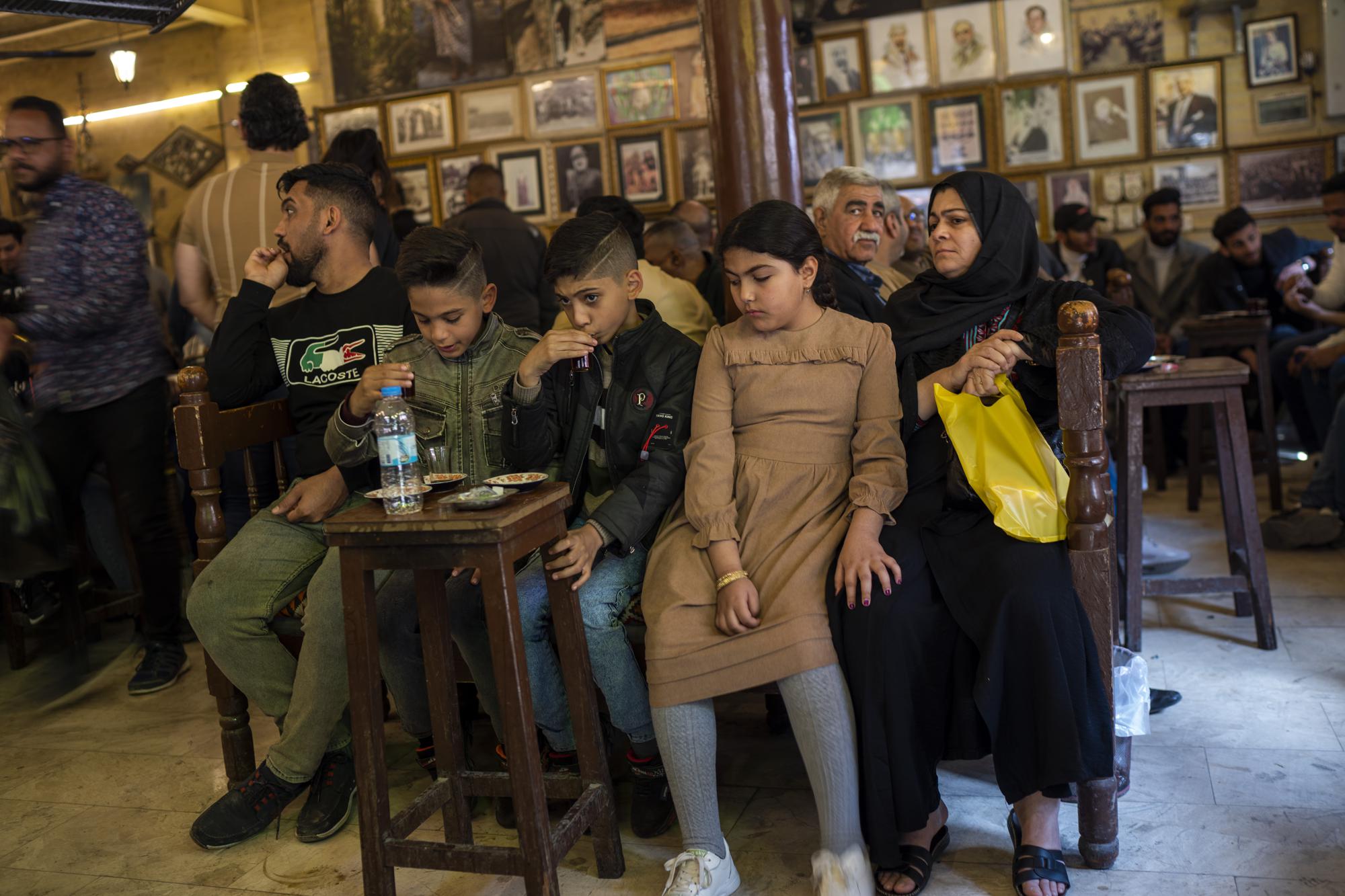
20 Years After U.S. Invasion, Young Iraqis See Signs Of Hope

A family drinks tea at the Ashabander cafe on Al-Mutanabbi Street in Baghdad, Iraq, Friday, Feb. 24, 2023. Image: Jerome Delay/AP

BY JOHN DANISZEWSKI

BAGHDAD (AP)
— On the banks of the Tigris River one recent evening, young Iraqi men and women in jeans and sneakers danced with joyous abandon to a local rap star as a vermillion sun set behind them. It’s a world away from the terror that followed the U.S. invasion 20 years ago.

Iraq ’s capital today is throbbing with life and a sense of renewal, its residents enjoying a rare, peaceful interlude in a painful modern history. The wooden stalls of the city’s open-air book market are piled skyward with dusty paperbacks and crammed with shoppers of all ages and incomes. In a suburb once a hotbed of al-Qaida, affluent young men cruise their muscle cars, while a recreational cycling club hosts weekly biking trips to former war zones. A few glitzy buildings sparkle where bombs once fell.

President George W. Bush called the U.S.-led invasion on March 20, 2003, a mission to free the Iraqi people and root out weapons of mass destruction. Saddam Hussein’s government was toppled in 26 days. Two years later, the CIA’s chief weapons inspector reported no stockpiles of nuclear, chemical or biological weapons were ever found.

The war deposed a dictator whose imprisonment, torture and execution of dissenters kept 20 million people in fear for a quarter of a century. But it also broke what had been a unified state at the heart of the Arab world, opening a power vacuum and leaving oil-rich Iraq a wounded nation in the Middle East, ripe for a power struggle among Iran, Arab Gulf states, the United States, terrorist groups and Iraq’s own rival sects and parties.

For Iraqis, the enduring trauma of the violence that followed is undeniable — an estimated 300,000 Iraqis were killed between 2003 and 2019, according to the Watson Institute for International and Public Affairs at Brown University, as were more than 8,000 U.S. military, contractors and civilians. The period was marred by unemployment, dislocation, sectarian violence and terrorism, and years without reliable electricity or other public services.

Today, half of Iraq’s population of 40 million isn’t old enough to remember life under Saddam or much about the U.S. invasion. In dozens of recent interviews from Baghdad to Fallujah, young Iraqis deplored the loss of stability that followed Saddam’s downfall — but they said the war is in the past, and many were hopeful about nascent freedoms and opportunities to pursue their dreams.

Editor’s note: John Daniszewski and Jerome Delay were in Baghdad 20 years ago when the U.S. bombing began. They chronicled the unraveling of the country that followed, in text and photos. They returned 20 years later for this special report on how the country has changed over two decades — especially for its young people.

In a marbled, chandeliered reception room in the palace where Saddam once lived, seated in an overstuffed damask chair and surrounded by paintings by modern Iraqi artists, President Abdul Latif Rashid, who assumed office in October, spoke glowingly of the country’s prospects. The world’s perception of Iraq as a war-torn country is frozen in time, he told The Associated Press in an interview.

Iraq is rich; peace has returned, he said, and there are opportunities ahead for young people in a country experiencing a population boom. “If they’re a little bit patient, I think life will improve drastically in Iraq.”

Most Iraqis aren’t nearly as bullish. Conversations begin with bitterness that the ouster of Saddam left the country broken and ripe for violence and exploitation by sectarian militias, politicians and criminals bent on self-enrichment or beholden to other nations. Yet, speaking to younger Iraqis, one senses a generation ready to turn a page.

Safaa Rashid, 26, is a ponytailed writer who talks politics with friends at a cozy coffee shop in the Karada district of the capital. With a well-stocked library nook, photos of Iraqi writers and travel posters, the café and its clientele could as easily be found in Brooklyn or London.

Rashid was a child when the Americans arrived, but rues “the loss of a state, a country that had law and establishment” that followed the invasion. The Iraqi state lay broken and vulnerable to international and domestic power struggles, he said. Today is different; he and like-minded peers can sit in a coffee shop and freely talk about solutions. “I think the young people will try to fix this situation.”

Another day, a different café. Noor Alhuda Saad, 26, a Ph.D. candidate at Mustansiriya University who describes herself as a political activist, says her generation has been leading protests decrying corruption, demanding services and seeking more inclusive elections — and won’t stop till they’ve built a better Iraq.

“After 2003, the people who came to power” — old-guard Sunni and Shiite parties and their affiliated militias and gangs — “did not understand about sharing democracy,” she said, tapping her pale green fingernails on the tabletop.

“Young people like me are born into this environment and trying to change the situation,” she added, blaming the government for failing to restore public services and establish a fully democratic state in the aftermath of occupation. “The people in power do not see these as important issues for them to solve. And that is why we are active.”

___

Signs of the invasion and insurgency have been largely erased from Baghdad. The former Palestine Hotel, Ferdous Square, the Green Zone, the airport road pockmarked by IED and machine-gun attacks have been landscaped or covered in fresh stucco and paint.

The invasion exists only in memory: bright orange flashes and concussions of American “shock-and-awe” bombs raining down in a thunderous cacophony; tanks rolling along the embankment; Iraqi forces battling across the Tigris or wading into water to avoid U.S. troops; civilian casualties and the desperate, failed effort to save a fellow journalist gravely wounded by a U.S. tank strike in the final days of the battle for Baghdad. Pillars of smoke rose over the city as Iraqi civilians began looting ministries and U.S. Marines pulled down the famous Saddam statue.

What appeared to be a swift victory for the U.S.-led forces was illusory: The greatest loss of life came in the months and years that followed. The occupation stoked a stubborn guerrilla resistance, bitter fights for control of the countryside and cities, a protracted civil war, and the rise of the Islamic State group that spread terror beyond Iraq and Syria, throughout the Middle East, Africa, Asia and Europe.

The long, staggeringly costly experience in Iraq exposed the limitations of America’s ability to export democracy and chastened Washington’s approach to foreign engagements, at least temporarily. In Iraq, its democracy is yet to be defined.

Blast walls have given way to billboards, restaurants, cafes and shopping centers — even over-the-top real estate developments. With 7 million inhabitants, Baghdad is the Middle East’s second-largest city after Cairo, and its streets teem with cars and commerce at all hours, testing the skill of traffic guards in shiny reflective caps.

Daily life here looks not so different from any other Arab metropolis. But in the distant deserts of northern and western Iraq, there are occasional clashes with remnants of the Islamic State group. The low-boil conflict involves Kurdish peshmerga fighters, Iraqi army troops and some 2,500 U.S. military advisers still in country.

It is but one of the country’s lingering problems. Another is endemic corruption; a 2022 government audit found a network of former officials and businessmen stole $2.5 billion.

Meanwhile, digital natives are testing the boundaries of identity and free speech, especially on TikTok and Instagram. They sometimes look over their shoulders, aware that shadowy militias connected to political parties may be listening, ready to squelch too much liberalism. More than a dozen social media influencers were arrested recently in a crackdown on “immoral” content, and this month authorities said they would enforce a long-dormant law banning alcohol imports.

In 2019-20, fed-up Iraqis, especially young people, protested across the country against corruption and lack of basic services. After more than 600 were killed by government forces and militias, parliament agreed to a series of election law changes designed to allow more minorities and independent groups to share power.

The sun bakes down on Fallujah, the main city in the Anbar region that was once a hotbed for al-Qaida of Iraq and, later, the Islamic State group. Beneath the iron girders of the city’s bridge across the Euphrates, three 18-year-olds are returning home from school for lunch.

In 2004, this bridge was the site of a gruesome tableau. Four Americans from military contractor Blackwater were ambushed, their bodies dragged through the streets, hacked, burned and hung as trophies by local insurgents, while some residents chanted in celebration. For the 18-year-olds, it’s a story they’ve heard from their families — distant and irrelevant to their lives.

One wants to be a pilot, two aspire to be doctors. Their focus is on getting good grades, they say.

Fallujah today is experiencing a construction renaissance under former Anbar Gov. Mohammed al-Halbousi, now speaker of Iraq’s parliament. He has helped direct millions of dollars in government funding to rebuild the city, which experienced repeated waves of fighting, including two U.S. military campaigns to rid the city of al-Qaida and the Islamic State group.

Fallujah gleams with new apartments, hospitals, amusement parks, a promenade and a renewed gate to the city. Its markets and streets are bustling. But officials were wary of letting Western reporters wander the city without an escort. The AP team’s first attempt to enter was foiled at a checkpoint.

The prime minister’s office intervened the next day, and the visit was allowed, but only with police following reporters at a distance, ostensibly for protection. The disagreement over security and press access is a sign of the uncertainty that overhangs life here.

Still, Dr. Huthifa Alissawi, 40, an imam and mosque leader, says such tensions are trifling compared with what his congregation lived through. Iraq has been engulfed in war for half of his life. When the Islamic State group overran Fallujah, his mosque was seized, and he was ordered to preach in favor of the “caliphate” or be killed. He told them he’d think about it, he said, and then fled to Baghdad. He counted 16 killings of members of his mosque.

“Iraq has had many wars. We lost a lot — whole families,” he said. These days, he said, he is enjoying the new sense of security he feels in Fallujah. “If it stays like now, it is perfect.”

Sadr City, a working-class, conservative and largely Shiite suburb in eastern Baghdad, is home to more than 1.5 million people. In a grid of thickly populated streets, women wear abayas and hijabs and tend to stay inside the house. Fiery populist religious leader Moqtada al-Sadr, 49, is still the dominant political power, though he rarely travels here from his base in Najaf, 125 miles to the south. His portraits, and those of his ayatollah father, killed by gunmen in Saddam’s time, loom large.

On a clamorous, pollution-choked avenue, two friends have side-by-side shops: Haider al-Saady, 28, fixes tires for taxis and the three-wheeled motorized “tuk-tuks” that jam potholed streets, while Ali al-Mummadwi, 22, sells lumber for construction.

Thick skeins of wires hooked up to generators form a canopy over the neighborhood. City power stays on for just two hours at a time; after that, everyone relies on generators.

They say they work 10 hours every day and scoff when told of the Iraqi president’s promises that life will be better for the young generation.

“It is all talk, not serious,” al-Saady said, shaking his head. Sadr City was a hotbed of anti-Saddam sentiment, but al-Saady — too young to remember the fallen dictator — nevertheless expressed nostalgia for that era’s stability.

His companion echoes him: “Saddam was a dictator, but the people were living better, peacefully.” Dismissing current officials as pawns of outside powers, al-Mummadwi added, “We would like a strong leader, an independent leader.”

When news spread recently that a musician born and raised in Baghdad whose songs have gotten millions of views on YouTube would headline a rap party hosted at a fancy new restaurant in western Baghdad, his fans shared their excitement via texts and Instagram.

Khalifa OG raps about the difficulties of finding work and satirizes authority, but his lyrics aren’t blatantly political. A song he performed under strobe lights on a grassy lawn next to the Tigris mocks “sheikhs” who wield power in the new Iraq through wealth or political connections.

Fan Abdullah Rubaie, 24, could barely contain his excitement. “Peace for sure makes it easier” for young people to gather like this, he said. His stepbrother Ahmed Rubaie, 30, agreed.

The Sunni-Shia sectarianism that led to a pitched civil war in Iraq from 2006 to 2007, with bodies of executed victims turning up each morning on neighborhood streets or dumped into the river, is one of the societal wounds that the rappers and their fans want to heal.

“We had a lot of pain ... it had to stop,” Ahmed Rubaie said. “It is not exactly vanished, but it’s not like before.”

Secular young people say that unlike their parents who lived under Saddam, they’re not afraid to make their voices heard. The 2019 demonstrations gave them confidence, even in the face of backlash from pro-religious parties.

“It broke a wall that was there before,” Ahmed Rubaie said.

Iraq’s prime minister, Mohammed Shia al-Sudani, took office in October. A former government minister for human rights and governor of Maysan province, southeast of Baghdad, he won support from a coalition of pro-Iranian Shiite parties after a yearlong stalemate. Unlike other Shiite politicians who fled during the Saddam era, he never left Iraq, even when his father and five brothers were executed.

Working in a former Saddam palace that U.S. and British officers and civilian experts once used as headquarters for their frenetic attempts at nation-building, al-Sudani still grapples with some of the issues that plagued the occupiers, including restoring regional relations and balancing interests among Shiites, Sunnis and Kurds. He said building trust between the people and government will be his first priority.

“We need to see tangible results — job opportunities, services, social justice,” al-Sudani said. “These are the priorities of the people.”

One of the Shiite militias that took part in that campaign against the Islamic State group is Ketaib Hezbollah, or the Hezbollah Battalions, widely viewed as a proxy for Iran and a cousin to Hezbollah in Lebanon and Syria. It also is part of the political coalition that established al-Sudani’s government.

Ketaib Hezbollah’s spokesman, Jafar al-Hussaini, met AP at an outdoor restaurant in Baghdad’s Dijlas Village, an opulent, 5-month-old complex of gardens, spas and a dancing fountain overlooking a bend in the Tigris, an idyllic Xanadu that looks like a transplant from uber-wealthy Dubai.

Al-Hussaini voiced optimism for the new Iraqi government and scorn for the United States, saying the U.S. sold Iraq a promise of democracy but failed to deliver infrastructure, electricity, housing, schools or security.

“Twenty years after the war, we look towards building a new state,” he said. “Our project is ideological, and we are against America.”

Far from such luxury, 18-year-old Mohammed Zuad Khaman, who toils in his family’s kebab café in one of Baghdad’s poorer neighborhoods, resents the militias’ hold on the country because they are an obstacle to his dreams of a sports career. Khaman is a talented footballer, but says he can’t play in Baghdad’s amateur clubs because he does not have any “in” with the militia-related gangs that control sports teams in the city.

He got an offer to train in Qatar, he said, but a broker was charging $50,000, far beyond his family’s means.

War and poverty caused him to miss several years of school, he said, and he’s trying to get a high school degree. Meanwhile, he takes home about $8-$10 a day wiping tables and serving food and tea. He is among those Iraqis who would like to leave.

“If only I could get to London, I would have a different life.”


In contrast, for Muammel Sharba, 38, who managed to get a good education despite the war, the new Iraq offers promise he did not expect.

A lecturer in mathematics and technical English at the Middle Technical University campus in Baquba, a once violence-torn city in Diyala, northeast of Baghdad, Sharba left in 2017 for Hungary, where he earned a Ph.D. on an Iraqi government scholarship.

He returned last year, planning to fulfil his contractual obligations to his university and then move to Hungary permanently. But he’s found himself impressed by the changes in his homeland and now thinks he will stay.

One reason: He discovered Baghdad’s nascent community of bicyclists who gather weekly for organized rides. They recently rode to Samarra, where one of the worst sectarian attacks of the war happened in 2006, a bombing that damaged the city’s 1,000-year-old grand mosque.

Sharba became a biking enthusiast in Hungary but never imagined pursuing it at home. He noticed other changes, too: better technology and less bureaucracy that allowed him to upload his thesis and get his foreign Ph.D. validated online. He got a driver’s license electronically in one day. With infrastructure improvements, he’s even seen some smoother roads.

Security in Diyala isn’t perfect, he said, but it’s less fraught than before. Not all his colleagues are as optimistic, but he prefers to focus on the glass half-full.

“I don’t think European countries were always as they are now. They went through a long process and lots of barriers, and then they slowly got better,” he said. “I believe that we need to go through these steps, too.”

On a recent evening, a double line of excited cyclists threaded a course through the capital’s busy streets for a night ride, Sharba among them. They raised neon-green-clad arms in a happy salute as they headed out.

As daylight ebbed into a crimson sunset, it wasn’t hard to imagine that Iraq, like them, could be on the way to a better place.

John Daniszewski is AP’s vice president for standards and editor at large. Jerome Delay is chief photographer in Johannesburg, South Africa. AP reporter Qassim Abdul-Zahra and Abby Sewell, AP’s Syria, Lebanon and Iraq news director, contributed to this report from Baghdad.

Thursday, December 22, 2022

Real coffee, but a fake ‘Starbucks’ in piracy-ridden Iraq

A woman walks by an unlicensed Starbucks cafe in Baghdad, Iraq, Wednesday, Dec. 21, 2022. Real Starbucks merchandise is imported from neighboring countries to stock the three cafes in the city, but all are unlicensed. Starbucks filed a lawsuit in an attempt to shut down the trademark violation but the case was shuttered after the owner allegedly threatened lawyers hired by the coffee house. (AP Photo/Ali Abdul Hassan)

BY SAMYA KULLAB AND QASSIM ABDUL-ZAHRA

BAGHDAD (AP)
— Everything from the signboard outside down to the napkins bears the official emblem of the top international coffee chain. But in Baghdad, looks are deceiving: The “Starbucks” in the Iraqi capital is unlicensed.

Real Starbucks merchandise is imported from neighboring countries to stock the three cafes in the city, but all are operating illegally. Starbucks filed a lawsuit in an attempt to shut down the trademark violation, but the case was halted after the owner allegedly threatened lawyers hired by the coffee house.

Be careful, he told them — and boasted of ties to militias and powerful political figures, according to U.S. officials and Iraqi legal sources.

“I am a businessman,” Amin Makhsusi, the owner of the fake branches, said in a rare interview in September. He denied making the threats. “I had this ambition to open Starbucks in Iraq.”

After his requests to obtain a license from Starbucks’ official agent in the Middle East were denied, “I decided to do it anyway, and bear the consequences.” In October, he said he sold the business; the cafes continued to operate.

Starbucks is “evaluating next steps,” a spokesman wrote Wednesday, in response to a request for comment by The Associated Press. “We have an obligation to protect our intellectual property from infringement to retain our exclusive rights to it.”

The Starbucks saga is just one example of what U.S. officials and companies believe is a growing problem. Iraq has emerged as a hub for trademark violation and piracy that cuts across sectors, from retail to broadcasting and pharmaceuticals. Regulation is weak, they say, while perpetrators of intellectual property violations can continue doing business largely because they enjoy cover by powerful groups.

Counterfeiting is compromising well-known brands, costing companies billions in lost revenue and even putting lives at risk, according to businesses affected by the violations and U.S. officials following their cases.

Qatari broadcaster beIN estimated it has lost $1.2 billion to piracy in the region, and said more than a third of all internet piracy of beIN channels originated from companies based in northern Iraq. The complaint was part of a a public submission this year to the U.S. Special 301 Report, which publicly lists countries that do not provide adequate IP rights.

Iraq is seeking foreign investment away from its oil-based economy, and intellectual property will likely take center stage in negotiations with companies. Yet working to enforce laws and clamp down on the vast web of violations has historically been derailed by more urgent developments in the crisis-hit country or thwarted by well-connected business people.

“As Iraq endeavors to diversify its economy beyond the energy sector and attract foreign investment in knowledge-based sectors, it is critical that companies know their patents and intellectual property will be respected and protected by the government,” said Steve Lutes, vice president of Middle East Affairs at the U.S. Chamber of Commerce.

Makhsusi insists he tried the legal route but was denied a license from Starbucks’ regional agent based in Kuwait. He also said he attempted to reach Starbucks through contacts in the United States, but that these were also unsuccessful.

He depicts his decision to open a branch anyway as a triumph over adversity.

Cups, stir sticks and other Starbucks merchandise are obtained in Turkey and Europe, using his contacts, he said. “The coffee, everything is authentic Starbucks,” Makhususi added.

Makhsusi said he “had a session” with a lawyer in Baghdad to come to an understanding with the coffee company, “but so far we have not reached a solution.”

The law firm recounts a different version of events.

Confidentiality agreements prevent the firm from divulging details of the case to third parties, but the AP spoke to three Iraqi legal sources close to the case. They spoke on condition of anonymity in order to provide details. They also asked the name of the firm not be mentioned for security reasons.

They said that in early 2020, the firm was hired by Starbucks and sent a cease-and-desist notice to Makhsusi. They said that the businessman then told one of the lawyers on the case that he ought to be careful, warning that he had backing from a prominent Iranian-backed armed group and support from Iraqi political parties.

“They decided it was too risky, and they stopped the case,” the Iraqi legal source said. Makhsusi denied that he threatened Starbucks’ lawyers.

Makhsusi said doing business in Iraq requires good relations with armed groups, the bulk of whom are part of the official state security apparatus.

“I have friendly relations with everyone in Iraq, including the armed factions,” he said. “I am a working man, I need these relationships to avoid problems, especially given that the situation in Iraq is not stable for business.”

He did not name particular armed groups he was in contact with. The AP contacted two groups known to have business dealings in the areas where the cafes are located, and both said they had not worked with Makhsusi.

Counterfeiters and pirates have stepped up activity in Iraq in the past five years, particularly as Gulf countries have responded to U.S. pressure and become more stringent regulators, said a U.S. official in the State Department, speaking on condition of anonymity because he was not authorized to talk about the trends.

The broadcaster beIN has sent cease-and-desist letters to Earthlink, Iraq’s largest internet service provider. Earthlink offers subscribers a free streaming service, Shabakaty, which beIN alleges is composed almost entirely of pirated content. Iraq’s Communications Ministry, which partners with Earthlink, did not respond to a request for comment.

“It’s unheard of and completely outrageous,” said Cameron Andrews, director of beIN’s anti-piracy department. “It’s a huge market, so it’s a great deal of commercial loss.”

But the larger issue for beIN is the piracy that originates inside Iraq and bleeds into the rest of the region and the world, he said. After being copied by these companies, beIN’s channels are re-streamed on pirate IPTV services, and become accessible all over the region, according to beIN. The company’s investigation found that some Iraqi operators even distribute pirated content in the U.S.

At least two U.S. pharmaceutical companies have approached the U.S. Chamber of Commerce with complaints that their trademark was being used to sell counterfeit life-saving medication by Iraqi companies.

“I worry if regulatory lapses or infringements in IP protection are allowed, then U.S. companies will be deterred from doing business in Iraq and quality of care could be dangerously jeopardized for Iraqi patients,” said Lutes.

The companies did not accept to be named in this report or detail the types of medications.

Successive Iraqi governments promised to fight graft since the 2003 U.S.-led invasion reset Iraq’s political order, but none has taken serious steps to dismantle the vast internal machinery that enables state-sanctioned corruption.

Intellectual property has also historically been a low priority for Iraq. Limited bilateral talks with the U.S. over the issue have been on and off for the past five years.

The challenge is to find a “clear leader in the Iraqi government that is interested in IP issues as a way to attract foreign investment,” said a U.S. State Department official. “Until that person exists, it is difficult for us to engage.”

Friday, January 24, 2020

Pentagon Says 34 Troops Suffered Brain Injury In Iran Strike

U.S. soldiers and journalists inspect the rubble at a site of Iranian bombing, in Ain al-Asad air base, Anbar, Iraq, Monday, Jan. 13, 2020. Ain al-Asad air base was struck by a barrage of Iranian missiles on Wednesday, in retaliation for the U.S. drone strike that killed atop Iranian commander, Gen. Qassem Soleimani, whose killing raised fears of a wider war in the Middle East. (AP Photo/Qassim Abdul-Zahra)


BY ROBERT BURNS

WASHINGTON (AP)
— The Pentagon disclosed on Friday that 34 U.S. service members suffered traumatic brain injury in Iran’s missile strike this month on an Iraqi air base, and although half have returned to work, the casualty total belies President Donald Trump’s initial claim that no Americans were harmed. He later characterized the injuries as “not very serious.”

Eight of the injured arrived in the United States on Friday from Germany, where they and nine others had been flown days after the Jan. 8 missile strike on Iraq’s Ain al-Asad air base. The nine still in Germany are receiving treatment and evaluation at Landstuhl Regional Medical Center, the largest U.S. military hospital outside the continental United States.

Jonathan Hoffman, the chief Pentagon spokesman, said the eight in the U.S. will be treated at Walter Reed National Military Medical Center at Bethesda, Maryland, or at their home bases. The exact nature of their injuries and their service and unit affiliations were not disclosed.

Trump had initially said he was told that no troops had been injured in the strike, which Iran carried out as retaliation for a U.S. drone strike in Baghdad that killed Iran’s most powerful general, Qassem Soleimani, on Jan. 3. The military said symptoms of concussion or traumatic brain injury were not immediately reported after the strike and in some cases became known days later. Many were in bunkers before nearly a dozen Iranian ballistic missiles exploded.

The question of American casualties took on added important at the time of the Iranian strike because the degree of damage was seen as influencing a U.S. decision on whether to counter-attack and risk a broader war with Iran. Trump chose not to retaliate, and the Iranians then indicated their strike was sufficient for the time being. Tensions have since eased.

After the Pentagon reported on Jan. 17 that 11 service members had been evacuated from Iraq with concussion-like symptoms, Trump said, “I heard they had headaches and a couple of other things ... and I can report it is not very serious.” He said he did not consider the injuries to be as severe as those suffered by troops who were hit by roadside bombs in Iraq.

Traumatic brain injury, or TBI, has become a bigger concern for the military in recent years as medical science improves its understanding of its causes and effects on brain function. It can involve varying degrees of impairment of thinking, memory, vision, hearing and other functions. The severity and duration of the injury can vary widely.

The Defense Department has said more than 375,000 incidents of TBI occurred in the military between the years 2000 and 2018.

Jefferson Kinney, a neuroscience researcher at the University of Nevada at Las Vegas, where he is chair of the department of brain health, said Friday that much remains to be learned about TBI, including its effects on behavior.

“It depends a lot on how severe the damage is and where the damage is,” among other factors, he said. “There is huge variability across individuals. Some people will undergo a trauma that they seem to recover from very quickly and others seem to be much more impacted by it for a longer duration.”

The Centers for Disease Control and Prevention says a severe TBI may lead to death or result in an extended period of coma or amnesia.

Hoffman’s disclosure that 34 had been diagnosed with TBI was the first official update of the number injured since the Pentagon announced the evacuation of the first 11. On Jan. 21, officials said more had been sent out of Iraq for further diagnosis and treatment, but the Pentagon declined to provide firm figures or say whether any had been returned to duty.

Hoffman said that of the 34 with TBI, 18 were evacuated from Iraq to U.S. medical facilities in Germany and Kuwait, and 16 stayed in Iraq. The one American sent to Kuwait has since returned to duty in Iraq. All 16 who stayed in Iraq have since returned to duty there, Hoffman said.

No one was killed in the attack on Ain al-Asad, even though the U.S. had no missile defense systems there to protect from potential attack. Hoffman said Friday that deploying one or more Patriot anti-missile systems to Iraq is among options now being weighed by military commanders. The U.S. had deployed numerous Patriot systems to other countries in the region as protection against Iranian missile attack, including in Saudi Arabia, but a strike on Iraq was seen as less likely.

Some members of Congress this week pressed the Pentagon for more clarity on the scope of the TBI cases resulting from the Iranian attack. Rep. Bill Pascrell, D-N.J., founder of the Congressional Brain Injury Task Force, wrote senior Pentagon officials on Thursday requesting additional details on casualties from the attack.

On Friday morning, Defense Secretary Mark Esper directed the Pentagon’s acting undersecretary of defense for personnel and readiness, Matthew Donovan, to begin working with the staff of the Joint Chiefs to review how military injuries are tracked and reported — not just TBI cases but battlefield injuries of all kinds, Hoffman told reporters.

“The goal is to be as transparent, accurate, and to provide the American people and our service members with the best information about the tremendous sacrifices our war fighters make,” Hoffman said.

Associated Press writer Lauran Neergaard contributed to this report.

Sunday, January 05, 2020

Who The Winners Are From America’s Destruction Of Iraq And War Against Iran

Qassem Soleimani

BY ERIC ZUESSE

Americans are unfortunately severely reluctant to disbelieve the lies that normally spew forth from the U.S. Government about foreign countries and especially about foreign countries that it invades or wants to invade. Consider, for examples, the lies that were told against Iraq when Saddam Hussein ruled it, or about Libya when Muammar Gaddafi ruled it, or about Iran right now. But Americans widely believe their Government’s lies, nonetheless.

On Friday, January 3rd, the Republican Fox ‘News’ channel headlined “Rose McGowan, John Cusack bash killing of Iran’s Soleimani, slam Trump”, and reported the two actors’ opposition to the Republican U.S. President Trump’s violation of Iraqi sovereignty that day, and to his assassination at the Bagdad airport of Iran’s #2 leader, General Qasem Soleman, as well as Trump’s murders there of some Iraqis, and of some other Iranians.

To judge from the “Best” (most-liked) reader-comments at that ‘news’-report, Trump will have at least that Republican audience behind him regarding this action by him, though what he did there could spark World War III, and though the beneficiaries of his Republican predecessor George W. Bush’s 20 March 2003 invasion of Iraq haven’t been ordinary people such as those thousands of Republican commenters are, but instead have been, and are, billionaires from around the world who invested in the privatization of Iraq’s oil, which resulted from that invasion. For a far-right audience such as that — people who cannot distinguish between nationalism and patriotism, and who know only nationalism — the most-liked comment was “Rose [McGowan], you do realize that in Iran, if you had worn that dress made of nothing but chains, you would have been stoned to death? Congratulations on being the new Jane Fonda.” That person, “JanWub1,” didn’t think, at all, about the U.S. Government’s lies that had persuaded the American public to boost their approval of George W. Bush from 57% immediately before the invasion to 71% immediately after his lie-based international war-crime in invading Iraq, and that person and everyone who clicked “Like” on it had obviously learned nothing from that historical example, nor did the individual commenter even so much as just mention the possibility of Trump’s having sparked WW III on that occasion, but instead “JanWub1” personalized the issue to that commenter’s contempt and hatred of an actress who had opposed that 2003 international war-crime against Iraq by the USA, and transferred that hatred against her onto the present two thespians, who oppose this President’s illegal invasion and murders.

So: how do we know who actually benefitted from that international war-crime — the invasion and military occupation of Iraq?

Back on 15 April 2013, a rare entirely honest CNN news-report about Iraq was published online, from the independent journalist Antonia Juhasz, who headlined “Why the war in Iraq was fought for Big Oil”. She wrote that:

In 2000, Big Oil, including Exxon, Chevron, BP and Shell, spent more money to get fellow oilmen Bush and Cheney into office than they had spent on any previous election. Just over a week into Bush’s first term, their efforts paid off when the National Energy Policy Development Group, chaired by Cheney, was formed, bringing the administration and the oil companies together to plot our collective energy future. In March, the task force reviewed lists and maps outlining Iraq’s entire oil productive capacity.

Planning for a military invasion was soon under way. Bush’s first Treasury secretary, Paul O’Neill, said in 2004, “Already by February (2001), the talk was mostly about logistics. Not the why (to invade Iraq), but the how and how quickly.”

In its final report in May 2001 (PDF), the task force argued that Middle Eastern countries should be urged “to open up areas of their energy sectors to foreign investment.” This is precisely what has been achieved in Iraq. …

Juhasz made clear that all of the bombs and the corpses were done for investors in large international oil companies — not only for U.S. companies, but for the benefit of mega-oil investors from all countries. Apparently, George W. Bush was a libertarian, who believed in the gospel of economic competition as being what the world needs more of — and not just more of American oil. She noted:

The new contracts lack the security a new legal structure would grant, and Iraqi lawmakers have argued that they run contrary to existing law, which requires government control, operation and ownership of Iraq’s oil sector.

But the contracts do achieve the key goal of the Cheney energy task force: all but privatizing the Iraqi oil sector and opening it to private foreign companies.

They also provide exceptionally long contract terms and high ownership stakes and eliminate requirements that Iraq’s oil stay in Iraq, that companies invest earnings in the local economy, or hire a majority of local workers.

Iraq’s oil production has increased by more than 40% in the past five years to 3 million barrels of oil a day (still below the 1979 high of 3.5 million set by Iraq’s state-owned companies), but a full 80% of this is being exported out of the country. …

The oil and gas sectors today account directly for less than 2% of total employment, as foreign companies rely instead on imported labor.

In just the last few weeks, more than 1,000 people have protested at ExxonMobil and Russia Lukoil’s super-giant West Qurna oil field, demanding jobs and payment for private land that has been lost or damaged by oil operations. The Iraqi military was called in to respond.

The Iraqi government serve as gendarmes for foreign oil companies, and for foreign oil workers. The profits, and the jobs, go abroad. The destruction of Iraq was done for those oil companies — it was done for the investors who own them.

Saddam Hussein was killed for refusing to cooperate with this type of plan for his country.

On 1 January 2020, 24 international oil giants were extracting and selling Iraq’s oil, and only ExxonMobil was American-based. Five years earlier, back on 20 March 2015, 28 were, and 6 of them were American: Chevron, ExxonMobil, Heritage, Hunt, Marathon, and Occidental. Perhaps Iraq’s Government, during the past five years, has been increasingly trying to free itself from the grip of the U.S. regime, and maybe that’s the reason why five of the six U.S. firms that were in Iraq in 2015 have left.

Also on January 1st of 2020, Abbas Kadhim, of the nonprofit NATO public relations arm the Atlantic Council, headlined “New low in US-Iraq relations: What’s next for 2020”, and he opened by saying that, “In early 2019, I predicted that US forces would remain in Iraq this past year despite calls in parliament to pass a law mandating their withdrawal. My prediction was right. My prediction for 2020 is that no US forces will remain in Iraq by the end of the year. As someone who firmly believes in the importance of robust US-Iraq ties and works hard to help both sides improve and strengthen the relationship, I am saddened at this recent deterioration and am concerned about the future.”

Donald Trump had tweeted just the day before, on December 31st, “Iran killed an American contractor, wounding many. We strongly responded, and always will. Now Iran is orchestrating an attack on the U.S. Embassy in Iraq. They will be held fully responsible. In addition, we expect Iraq to use its forces to protect the Embassy, and so notified!”

Later on, that day, he tweeted, “Iran will be held fully responsible for lives lost, or damage incurred, at any of our facilities. They will pay a very BIG PRICE! This is not a Warning, it is a Threat.”

Whether or not Iran had had anything to do with the attacks which had precipitated Trump’s “Threat” against Iran isn’t known, any more than it was known, when we invaded Iraq on 20 March 2003, whether or not there were any WMDs in Iraq after the U.N. had destroyed all of them in 1998. Everything that George W. Bush and Dick Cheney and Condoleezza Rice, etc., had said about that were lies, which the U.S. ‘news’-media refused to expose as being lies from the Government. Donald Trump is just as much a liar as they were, and as Barack Obama was; so, when Trump followed through on his “Threat” against Iran, inside Iraq, on January 3rd, one can’t reasonably assume that it would be any more justifiable than our invasion of Iraq was, or than our conquest of Ukraine by means of a bloody coup in 2014 was, or than our participation in the destruction of Libya in 2011 was, or than our destruction of Syria is, or than our assistance to the Sauds’ destruction of Yemen is, or than our destruction of Bolivia for its lithium is.

All of that has been simply fascism, American-style. America’s Republicans apparently like it, but perhaps America’s Democrats won’t like it in this instance (since its from a Republican), and maybe even the independents won’t. (However, the reader-comments at Zero Hedge, a non-mainstream, independent libertarian news-site, are unconcerned with the sheer psychopathy and enormous danger of Trump’s murders in Iraq on January 3rd, and are concerned almost only with whether or not what he did will be of benefit to Americans; so, perhaps independents will turn out to be largely favorable toward what Trump did here. Also: viewer-comments at a January 3rd youtube “Pakistan: Soleimani killing sparks outrage among Shia community” were rabidly hostile against the demonstrators, like a typical comment there, “feel American power, infidels,” is. This is today’s supremacist America. It’s not just the Republican Trump’s “Make America Great Again”; it is also the Democrat Obama’s “The United States is and remains the one indispensable nation.” Pakistan, Iran, Iraq, etc. — all other nations than the U.S. — are “dispensable,” according to Americans in both Parties. Hello, Hitler, here?)

Trump has started off the U.S. Presidential s‘election’ year of 2020 with a bang, and he’s well-supported by America’s Republican billionaires, but it’s still doubtful whether he will get anything like the 14% boost in approval-rating that Bush did by raping Iraq for global oil-investors, on 20 March 2003. Time will quickly tell. However, already on January 3rd, the leader of Democrats in the U.S. Senate, Charles Schumer, said on the Senate floor, that “No one should shed a tear over his [Soleimani’s] death.” (Schumer objected only that he had not received “any advance notification or consultation” about the assassination and murders.) Some of the Democratic Presidential candidates have refused to condemn Trump’s action. Everyone will be looking at the polling-numbers. And those will reflect the result of what America’s billionaires’ (or “the mainstream”) ‘news’-media present about this matter, to their respective publics. It is conceivable that Trump could achieve bipartisan support for entirely needlessly starting WW III. This could be the way that today’s Americans are.

Later in the day of January 3rd, Reuters headlined a news-report that, if true, is historically significant about all of this matter, “Inside the plot by Iran’s Soleimani to attack U.S. forces in Iraq”. Written by “Reuters staff,” it opened:

In mid-October, Iranian Major-General Qassem Soleimani met with his Iraqi Shi’ite militia allies at a villa on the banks of the Tigris River, looking across at the U.S. embassy complex in Baghdad.

The Revolutionary Guards commander instructed his top ally in Iraq, Abu Mahdi al-Muhandis, and other powerful militia leaders to step up attacks on U.S. targets in the country using sophisticated new weapons provided by Iran, two militia commanders and two security sources briefed on the gathering told Reuters.

The strategy session, which has not been previously reported, came as mass protests against Iran’s growing influence in Iraq were gaining momentum, putting the Islamic Republic in an unwelcome spotlight. Soleimani’s plans to attack U.S. forces aimed to provoke a military response that would redirect that rising anger toward the United States, according to the sources briefed on the gathering, Iraqi Shi’ite politicians and government officials close to Iraqi Prime Minister Adel Abdul Mahdi.

Soleimani’s efforts ended up provoking the U.S. attack on Friday that killed him and Muhandis, marking a major escalation of tensions between the United States and Iran. …

Obviously, if that report is true, then Trump had cause to do on January 3rd what he did. Even his having not given anyone in Congress advance-notice about it would have been justifiable as this action’s being an emergency opportunity and in accord with his Commander-in-Chief powers to do in order to protect the Embassy. It wouldn’t justify the psychopathically pro-U.S.-regime reader-comments earlier that day on January 3rd about what Trump had done, because all of recent American history is full of lies by the U.S. Government in order to ‘justify’ its invasions against countries that neither threatened nor perpetrated invasion of the United States. However, if that Reuters report is true, then what Trump had done on January 3rd was done as an authentic U.S. national-security matter, in response to what Soleimani and his colleagues were doing. This isn’t necessarily to say that what Soleimani and his colleagues were doing there would have been unjustified. The United States, ever since its 1953 coup against Iran, has been an oppressive foreign power — Iran’s enemy — and the U.S., since at least its 2003 invasion against Iraq, is also Iraq’s enemy. Neither Iran nor Iraq ever endangered the national security of the United States. All of the aggressions have instead been by the United States. However, if this Reuters report is true, then the appropriate response by the Governments of U.S., Iraq, and Iran, would be as follows:

Trump would announce that he is herewith cancelling sanctions against Iran and restoring U.S. participation in the Iran nuclear agreement, the Joint Comprehensive Plan of Action, which in 2015 was signed by China, France, Russia, United Kingdom, United States, Germany, and then the entire European Union. Iran would then announce that it is willing to discuss with all of the signatories to that agreement, if a majority of them wish to do so, international negotiations regarding possible changes (amendments) to be made to that agreement. The United States would then offer, separately, and on a strictly bi-lateral U.S.-Iran basis, to negotiate with Iran a settlement to all outstanding issues between the two nations, so that they may proceed forward with normal diplomatic relations, on a peaceful instead of mutually hostile, foundation.

Trump also would announce that he is seeking negotiations with Iraq about a total withdrawal from Iraq and closure of the U.S. Embassy there, to be replaced by a far smaller U.S. Embassy.

Trump would initiate this as a package-deal confidentially offered by him to Khamenei — all steps of it — in advance of any carrying-out of the steps, and initiated by him soon enough to ward off any retaliatory action by Iran, so as to avoid further escalation of the hostilities, which otherwise would likely escalate to a widespread and possibly global war. In other words, this direct communication between the two should already have been sought by Trump. (If the Reuters article is true, this should have been planned by him at the very moment he started seeking an opportunity to assassinate Soleimani.)

I do not expect Trump to do any of that, not even the first step, and not even the offer to Khamenei; and Iran is in no position to make the first step, in any case (since the U.S. had started the mutual hostilities between the two nations in 1953). However (assuming the gtruthfulness of the Reuters article), if Trump does, at least make the offer and then do the first step (ending sanctions), then I think that he will easily win re-election, regardless of whom the Democratic nominee will be. If he can re-establish friendly relations with Iran, then that will be a diplomatic achievement of historic proportions, the best and most important in decades. No one would then be able to deny it. He would, in fact, then deserve to win the Nobel Peace Prize (which Obama never deserved to win, though he did win it). But I don’t expect any of that to happen, because it would be exactly contrary to the way that any recent U.S. President has behaved, and because many in power in the United States would be furious against him if he did do it.

Furthermore, the Reuters report might be a lie, like so many other U.S.-and-allied ‘news’-reports are.

In any case, however: The answer to the headline-question “Who the Winners Are from America’s Destruction of Iraq and War Against Iran” is: the owners of U.S.-and-allied international oil and gas corporations. They were served when the U.S. regime in 1953 overthrew Iran’s democratically elected progressive Government and installed the brutal Shah to end Iran’s democracy and to control the country, and when he then privatized the National Iranian Oil company and cut American-and-allied aristocrats in on the profits from sales of Iranian oil. The founding members of that privatization in 1954 were British Petroleum (40%), Royal Dutch Shell 14% (Shell now), French Compagnie Française des Pétroles (CFP) 6% (Total now), Gulf Oil 8% (Now Chevron), and the four American partners of Aramco 32% (8% each). And they were served, yet again, when George W. Bush did the same to Iraq by means of an outright invasion (instead of like Eisenhower’s 1953 method, coup) in 2003.

America’s international oil (and other international extractions) corporations — and not only America’s ‘defense’ contractors — need to be nationalized, so that these ceaseless “regime-change wars” by the U.S. regime will be able to cease. Otherwise, the world will self-destruct by war, if not subsequently by global burnout (which is likely only over a much longer time-frame).


SOURCE: MODERN DIPLOMACY

War, Erasure, And The Politics Of Culture In Sudan

BY LARISSA-DIANA FUHRMANN This article examines contemporary cultural erasure in Sudan. It highlights resilient Sudanese efforts and interna...