Showing posts with label Angelique Kidjo. Show all posts

Monday, September 19, 2022

At UN, Leaders Confront COVID’s Impact On Global Education

THE ASSOCIATED PRESS
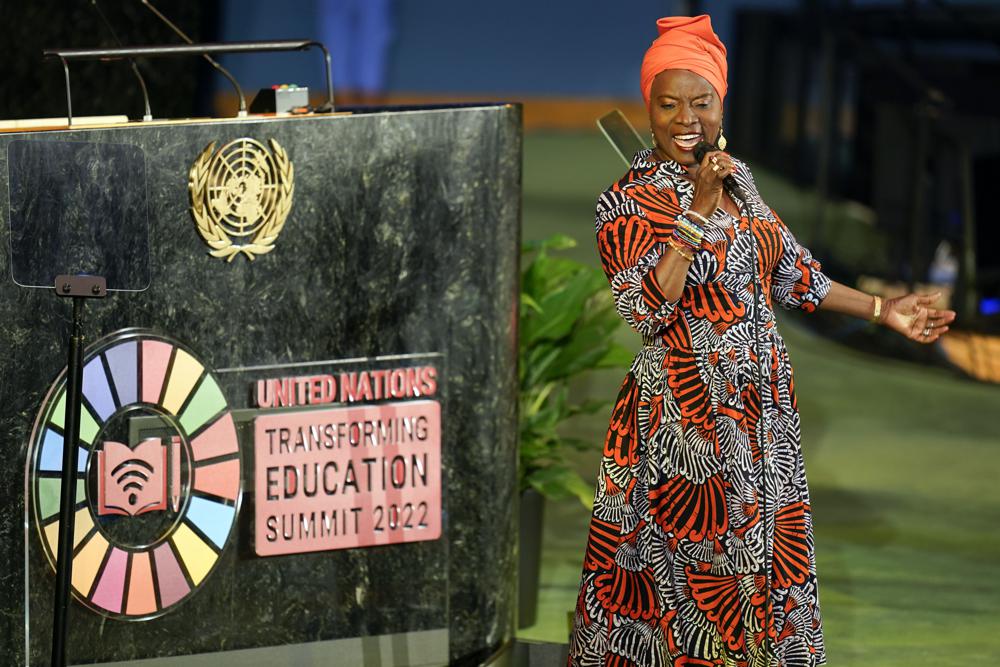
Angelique Kidjo performs during the Transforming Education Summit at United Nations headquarters, Monday, Sept. 19, 2022. (AP Photo/Seth Wenig)

BY BIANCA VÁZQUEZ TONESS AND JOCELYN GECKER

With COVID-related school disruptions setting back children around the world, activists implored world leaders Monday to prioritize school systems and restore educational budgets slashed when the pandemic hit.

The summit on transforming education, held at the U.N. General Assembly ahead of the annual leaders’ meeting, was expected to produce commitments from the world’s nations to ensure that children everywhere from sub-Saharan Africa to the United States don’t fall too far behind.

“Seven years ago, I stood on this platform hoping that the voice of a teenage girl who took a bullet in standing up for her education would be heard,” said Nobel Peace Prize Laureate Malala Yousafzai, a U.N. messenger of peace. ”On that day, countries, corporates, civil society, all of us committed to work together to see every child in schools by 2030. It is heartbreaking that halfway through that target date, we are facing an education emergency.”

Nigerian youth activist Karimot Odebode was more pointed. “We demand you take responsibility,” Odebode told the General Assembly. “We will not stop until every person in every village and every highland has access to an education.”

The percentage of 10-year-old children in poor and middle-income countries who cannot read a simple story increased to an estimated 70% — up 13 percentage points since before the pandemic shuttered classrooms, according to a report from the World Bank, UNESCO and UNICEF.

Will the world’s leaders do enough to help their youngest citizens learn to read and gain the other skills they need to thrive? It will require addressing systemic problems that existed before the pandemic, dignitaries and students say. Countries will need to increase spending, change policies to increase access for girls and disabled students, and modernize instruction to stress critical thinking rather than rote memorization.

“This is a once-in-a-generation opportunity for us to radically transform education,” U.N. Deputy Secretary-General Amina Mohammed told reporters ahead of the education summit at U.N. headquarters in New York. “We owe it to the coming generation if we don’t want to witness the emergence of a generation of misfits.”

When COVID-19 closed schools around the world in spring 2020, many children simply stopped learning — some for months, others for longer. For many, there was no such thing as remote learning. More than 800 million young people around the world lacked internet access at home, according to a study by UNICEF and the International Telecommunication Union in December 2020.

More recent studies underscore the pandemic’s lasting effects. “The learning losses from COVID were enormous,” Mohammed said.

The amount of time school buildings were closed because of COVID-19 varied widely around the world. At the extreme, schools in parts of Latin America and South Asia were closed for 75 weeks or longer, according to UNESCO. In parts of the United States, including cities such as Chicago and Los Angeles, schools operated remotely from March 2020 through most of the 2020-2021 school year.

There also were huge variations in the availability and quality of remote learning. In some countries, students stuck at home had access to paper packets, or radio and television programs, or almost nothing at all. Others had access to the internet and video conferences with teachers.

The estimated learning delays on average ranged from over 12 months of school for students in South Asia to less than four for students in Europe and Central Asia, according to an analysis by consulting firm McKinsey & Company.

Most of the world’s classrooms are now back open, but 244 million school-age children are still out of school, UNESCO Director-General Audrey Azoulay said during the summit, citing data from the U.N. education agency. Most of those children — 98 million — live in sub-Saharan Africa, followed by Central and Southern Asia, in a reminder of the deep inequalities that persist in access to education, she said.

In many places, money is the key ingredient for stemming the crisis, if not fully reaching the leaders’ lofty goal of “transforming education.” “Education financing must be a priority for governments,” U.N. Secretary-General Antonio Guterres told the General Assembly on Monday. “It is the single most important investment any country can make in its people and its future.”

On average wealthy countries invest $8,000 a year per school-aged child, compared to upper middle income countries, like some in Latin America, that invest $1,000 per year, according to a report from UNESCO and Global Education Monitoring. Lower income countries allot roughly $300 a year and some poor countries, just $50 a year per student.

Rich countries should also step up spending, said Guterres. In recent years, Germany, France and the United States have given the most international aid towards education in low-income countries, according to a 2021 Center for Global Development report. The United States invested more than $1.5 billion annually from 2017-2019, according to the report based on the most recent available data.

As top dignitaries urged individual countries to prioritize their youngest citizens, it was some of the youngest attendees at the summit who aired the most skepticism towards any prospect of change. After all, the U.N. lacks any authority to force countries to spend more on schooling.

Yousafzai urged countries to devote 20% of their budgets toward education. “Most of you know what exactly needs to be done,” she said. “You must not make small, stingy and short-term pledges.”

The Associated Press education team receives support from the Carnegie Corporation of New York. The AP is solely responsible for all content. Follow Bianca Vázquez Toness on Twitter at http://twitter.com/biancavtoness and Jocelyn Gecker at http://twitter.com/jgecker

Saturday, November 23, 2019

Singer Angelique Kidjo Hopes To Close Financing Gap For African Women

In this Sunday, Nov. 11, 2018 file photo Benin's Angelique Kidjo performs in front of heads of states and world leaders during ceremonies at the Arc de Triomphe in Paris. One of Africa's iconic artists, Kiddo, is the voice of a new project aimed at rewriting laws across the African continent that keep millions of women from becoming a more powerful economic force. (AP Photo/Francois Mori, Pool, File)


BY CARA ANNA

JOHANNESBURG (AP)
— The insect-eaten money fluttered in pieces to the floor. For global music star Angelique Kidjo, that image of her grandmother having to use a closet as a bank is driving her desire to see African women leap the many obstacles to obtaining credit — and respect.

The Benin-born singer, one of Africa’s iconic artists and a collaborator with Philip Glass and others, is the voice of a new project aimed in part at rewriting laws across the continent that prevent millions of women from becoming a more powerful economic force.

In an interview with The Associated Press, Kidjo described what she has seen over decades of travel in Africa during which women in vibrant marketplaces wished they had the means to do more.

“Why do banks give more loans to men versus women? That’s the question I have,” she said. “Millions of women entrepreneurs in Africa, they lack loans versus the men. Once again, we come back to this patriarchy. And we know men pay less back than women.”
Full Coverage: Weekend Reads

Every time credit is refused to African women, who invest some 90% of what they earn in educating their children and supporting families and communities as opposed to about 40% for men, it’s a disaster, Kidjo said. “We’re taking up reducing the poverty rate in Africa to the smallest number ever. That’s my passion. That’s why I’m here.”

She will help the African Development Bank next week launch AFAWA, or Affirmative Finance Action for Women in Africa. Already the G-7 group of the world’s major democracies has committed $250 million, and the bank is providing $1 billion for the project that will be deployed across all 54 countries.


In this Sunday Aug. 25, 2019 file photo French President Emmanuel Macron, right, African Development Bank President Akinwumi Adesina, left, and UNICEF ambassador Angelique Kidjo attend a press conference on the situation in Sahel during the G7 summit in Biarritz, southwestern France. One of Africa's iconic artists, Kiddo, is the voice of a new project aimed at rewriting laws across the African continent that keep millions of women from becoming a more powerful economic force. (Ian Langsdon Pool via AP, File)


The goal is to raise $5 billion for efforts that include helping to guarantee loans, training women on financial matters and eliminating laws and regulations that make accessing credit more difficult. African women face a $42 billion financing gap even though one in four starts or manages a business, the highest percentage in the world, the bank says.

In some African countries, women can’t open a bank account without their husband or father, or inheritance laws leave them with little or nothing. That means no collateral.

But reforms are catching on. In the World Bank’s latest Women, Business and Law report in 2018, 32% of reforms tracked in sub-Saharan African countries addressed equal treatment for women and men in accessing credit and financial services. Angola, Congo and Zambia joined others in prohibiting gender-based credit discrimination, it said.

With the new fund for financing African women “we will be able to go as low as a few hundred dollars’ loan ... for people who need it the most,” said Vanessa Moungar, the African Development Bank’s Chadian-French director of gender, women and civil society.

She was not ready to announce further pledges but said talks are continuing with potential donor countries, including African ones. With the continent’s 1.2 billion population expected to double by 2050, the pressure for growth is huge.

“Look, women are one of the most powerful forces of nature on this continent,” Moungar said. “If they can be economically empowered, transformation will be fast-tracked like we’ve never seen.”

Launching along with the new financing project is an index to assess how commercial banks are performing. “When they come to us for more (loans) we’ll say, ‘What have you done for women?’” Moungar said.

The project is also turning accountability on itself, with Kidjo and other ambassadors meant to speak up if they think the project isn’t moving quickly or effectively enough.

True, Kidjo said. “I’m not a very patient person. Those women, they don’t have time to waste. Their livelihood is in danger. I’m gonna be very strict.”

Women across Africa have told her they don’t want charity, the singer said. They know how to make money but aren’t given the chance to try.

She recalled women in Ghana who resorted to digging a hole in the ground to stash their earnings because they didn’t have bank accounts. And during a visit to Benin last month, one woman told her that to obtain a loan of 5,000 CFA ($8) she had to show a property deed and hand over 100,000 CFA as collateral.

Such experiences have helped to inspire another new program, the $100 million U.S.-run Women’s Global Development and Prosperity Initiative fund with projects in 22 countries in Africa and elsewhere. They include Morocco, where women are benefiting from new laws that allow them to own land.

The Africa-focused AFAWA, with vocal backing from French President Emmanuel Macron, will launch this month in Rwanda at the Global Gender Summit, which gathers multilateral development banks from around the world.

When that East African nation changed its laws to give women access to land, their financial inclusion jumped from 36% to 63% in just four years, Moungar said.

“Can you imagine?” she said. “I want all the women out there to know that’s what’s really driving us and our hearts. We are working for them and nothing else.

Follow Africa news at https://twitter.com/AP_Africa

Sunday, October 22, 2017

Grammy-Winning Musician And Activist Angelique Kidjo Speaks At TU

TULSA WORLD


Angelique Kidjo Image Via Bucknell University


When the band Talking Heads released “Remain in Light” in 1980, the album’s use of African rhythms and musical structures led to a spate of critical controversy about Western musicians appropriating aspects of other cultures.

Angelique Kidjo, the Grammy Award-winning singer, songwriter and activist who has been called “Africa’s premier diva,” dismisses such ideas with a laugh.

“That is a Western idea,” Kidjo said. “An Africian musician would not be thinking, ‘These people are taking our music,’ because they know what they are really doing is drawing something from our shared humanity, from our human family.

“Don’t fool yourself — we are all African,” she said. “Every single one of us can trace our ancestry back to Africa. So how can you deny someone this music, when it’s in their DNA?”

Kidjo’s own acclaimed career has been built on combining music and rhythms from multiple cultures, from the distinctive vocal techniques of her native Benin to American jazz, rock and blues, from Afrobeat dance music to collaborating with composer Philip Glass.

Her most recent project is her own version of “Remain in Light,” taking the original songs from the Talking Heads’ album and reimagining them in her own way. She is working on the recording, which is expected to be released in 2018.

She debuted the project earlier this year at a concert in New York’s Carnegie Hall, of which the New York Times wrote: “Where Talking Heads had dealt in tensions and dualities, Ms. Kidjo’s element was joyful empowerment: the joy of an all-conquering voice and a righteous, uplifting spirit. In West African tradition, her own songs are lessons from a community’s history and conscience, with music that maintains African roots while drawing on all her cosmopolitan experience.”

“I didn’t want to wait to do this show until after we had finished the recording,” Kidjo said. “It’s such an iconic album, and what I realized was that a lot of people have been interested in seeing what I would do with this music.

“It is a conversation, really,” she said. “The Talking Heads were inspired by the music of (legendary Afrobeat pioneer) Fela Kuti. So I’m just giving my answer back. That’s the whole point of music. It is limitless — no boundaries, no countries, no color. It is the universal language.”

Kidjo will come to Tulsa for the first time Tuesday as part of the University of Tulsa’s Presidential Lecture Series, presented by the Darcy O’Brien Endowed Chair.

Her presentation will draw from her 2014 memoir, “Spirit Rising: My Life, My Music.”

“Basically, I describe my journey from growing up in a very poor country to get to where I am today,” Kidjo said. “I want to give people a sense of the world of possibility and opportunity, to show that you are your own destiny.”

Kidjo was born in the West African country of Benin, where she began performing with her mother’s theater troupe when she was just 6 years old. She performed with other bands and released a solo album, “Pretty,” in 1981.

Two years later, because of the increasing oppression of Benin’s Communist government, Kidjo moved to Paris, continuing her career. Her 1991 album, “Logozo,” was her international breakthrough, reaching No. 1 on the Billboard World Music chart.

Kidjo’s subsequent albums include the Grammy-winning “Djinn Djinn,” “Eve” and “Angelique Kidjo SINGS with the Orchestre Philharmonique Du Luxembourg,” and she has collaborated with many of the world’s leading rock and jazz musicians, including Carlos Santana, Alicia Keys, Peter Gabriel, Dave Matthews, Branford Marsalis, Christian McBride and Dianne Reeves.

Kidjo is equally known for her humanitarian work. She has been a UNICEF Goodwill Ambassador since 2002 and co-founded the Batonga Foundation (named for one of her first hit singles), which provides secondary education for girls across Africa to help empower the female leaders of tomorrow.

Kidjo said she “was singing before I could talk,” and added that her sense of advocacy is about as long-lived.

“It was what I grew up with,” she said. “My father’s car was the local ambulance. Anyone who needed to be taken to the doctor or the hospital, my father would take them. Even now — I just returned from visiting my mother in Benin. She is 90, and she is taking care of a young boy. His father died, and his mother’s family doesn’t want to deal with him because he is troubled.

“And I said to my mother, ‘What are you thinking? You are 90 years old and you’re going to care for this boy?’ My mother answered, ‘What am I going to do — let him sleep in the street?’ ” Kidjo said. “And that was the end of the conversation. Because when someone needs help, you give them help. That was how I was raised, and that’s what I try to do.”

War, Erasure, And The Politics Of Culture In Sudan

BY LARISSA-DIANA FUHRMANN This article examines contemporary cultural erasure in Sudan. It highlights resilient Sudanese efforts and interna...