Showing posts with label Sweden. Show all posts

Wednesday, October 05, 2022

Steinbeck's Letter To Son On Love, 'The Best Thing,' On Sale

Nobel prize-winning author John Steinbeck, right, admires a prize-winning poster by his son, Thomas Steinbeck, in Hartford, Conn., March 22, 1963. A tender and touching letter that author John Steinbeck penned to his teenage son, offering fatherly advice after the young man confided that he was in love for the first time, is going up for auction. "If you are in love â€" that's a good thing â€" that's about the best thing that can happen to anyone. Don't let anyone make it small or light to you," the Nobel literature laureate told his son, Thomas, in 1958.


BOSTON (AP) - A tender and touching letter that author John Steinbeck penned to his teenage son, offering fatherly advice after the young man confided that he was in love for the first time, is going up for auction.

Boston-based RR Auction says the handwritten draft of a letter to his eldest son, Thomas - then 14 - shows the "Of Mice and Men" author's empathy: He refused to dismiss it as puppy love.

"While this letter offers an intimate, private glimpse into Steinbeck's family life, it also expresses his ideas about love with profundity and eloquence," said Bobby Livingston, executive vice president of the auction house.

In the two-page letter, dated Nov. 10, 1958, the Nobel Literature Prize laureate told his son: "If you are in love - that's a good thing - that's about the best thing that can happen to anyone. Don't let anyone make it small or light to you."

Steinbeck, who won a Pulitzer for "The Grapes of Wrath" in 1940 and the Nobel in 1962 for a body of acclaimed work, showed he was no stranger to matters of the heart.

"The object of love is the best, and most beautiful. Try to live up to it," he wrote. "If you love someone - there is no possible harm in saying so - only you must remember that some people are very shy and sometimes the saying must take that shyness into consideration."

"Girls have a way of knowing or feeling what you feel, but they usually like to hear it also," he said. "It sometimes happens that what you feel is not returned for one reason or another - but that does not make your feeling less valuable and good."

"If it is right, it happens - The main thing is not to hurry. Nothing good gets away," the California-born novelist wrote, signing his letter simply: "Love, Father."

John Steinbeck died in 1968, and Thomas Steinbeck died in 2016.

The text of the letter has been published for worldwide audiences, including in 1989's "Steinbeck: A Life in Letters," by Penguin Books.

Legal wrangling over his estate has dragged on for decades. In 2020, the U.S. Supreme Court let stand a decision awarding Steinbeck's stepdaughter $5 million in a family dispute over abandoned plans for movies of some of Steinbeck's best-known works.

Thomas Steinbeck, a writer in his own right, fiercely defended his father's work, adapting several of his father's books for movies and launching legal efforts to protect the copyrights of his father and others.

Tuesday, October 04, 2022

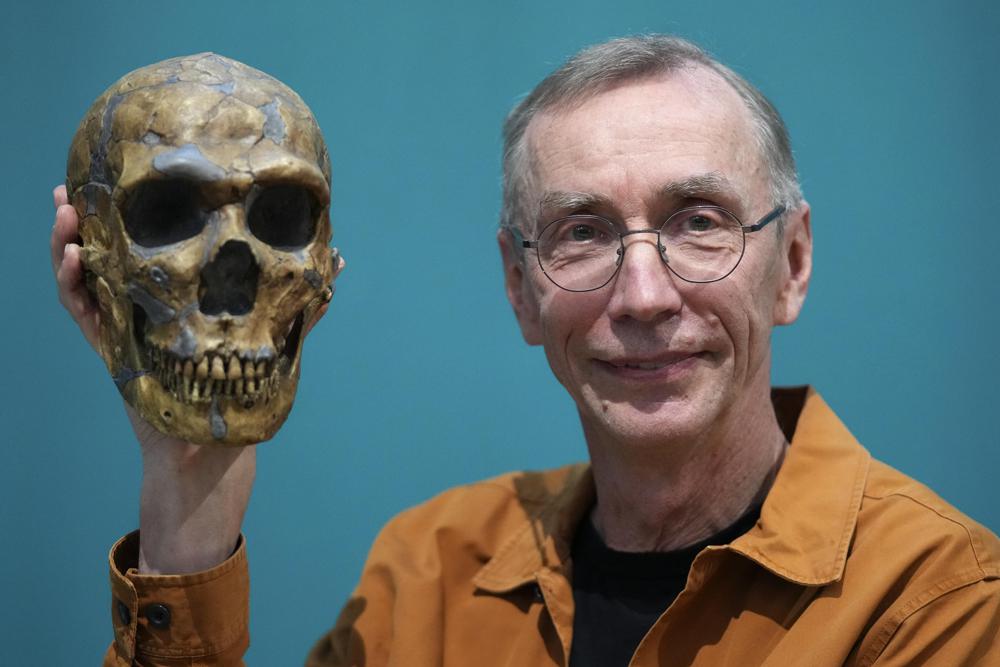
Nobel Win For Swede Who Unlocked Secrets Of Neanderthal DNA

Swedish scientist Svante Paabo poses with a replica of a Neanderthal skeleton at the Max Planck Institute for Evolutionary Anthropology in Leipzig, Germany, Monday, Oct. 3, 2022. Swedish scientist Svante Paabo was awarded the 2022 Nobel Prize in Physiology or Medicine for his discoveries on human evolution. (AP Photo/Matthias Schrader)

BY PIETRO DE CRISTOFARO AND LAURA UNGAR

LEIPZIG, GERMANY (AP)
— Swedish scientist Svante Paabo won the Nobel Prize in medicine Monday for discoveries in human evolution that unlocked secrets of Neanderthal DNA that helped us understand what makes humans unique and provided key insights into our immune system, including our vulnerability to severe COVID-19.

Techniques that Paabo spearheaded allowed researchers to compare the genome of modern humans and that of other hominins — the Denisovans as well as Neanderthals.

“Just as you do an archeological excavation to find out about the past, we sort of make excavations in the human genome,” he said at a news conference held by Max Planck Institute for Evolutionary Anthropology in Leipzig.

While Neanderthal bones were first discovered in the mid-19th century, only by understanding their DNA — often referred to as the code of life — have scientists been able to fully understand the links between species.

This included the time when modern humans and Neanderthals diverged as a species, around 800,000 years ago.

“Paabo and his team also surprisingly found that gene flow had occurred from Neanderthals to Homo sapiens, demonstrating that they had children together during periods of co-existence,” said Anna Wedell, chair of the Nobel Committee.

This transfer of genes between hominin species affects how the immune system of modern humans reacts to infections, such as the coronavirus. People outside Africa have 1-2% of Neanderthal genes. Neanderthals were never in Africa, so there’s no known direct contribution to people in sub-Saharan Africa.

Paabo and his team managed to extract DNA from a tiny finger bone found in a cave in Siberia, leading to the recognition of a new species of ancient humans they called Denisovans.

Wedell called it “a sensational discovery” that showed Neanderthals and Denisovans were sister groups that split from each other around 600,000 years ago. Denisovan genes have been found in up to 6% of modern humans in Asia and Southeast Asia, indicating interbreeding occurred there too.

“By mixing with them after migrating out of Africa, Homo sapiens picked up sequences that improved their chances to survive in their new environments,” Wedell said. For example, Tibetans share a gene with Denisovans that helps them adapt to high altitude.

Paabo said he was surprised to learn of his win, and at first thought it was an elaborate prank by colleagues or a call about his summer home in Sweden.

“So I was just gulping down the last cup of tea to go and pick up my daughter at her nanny where she has had an overnight stay, and then I got this call from Sweden,” he said in an interview on the Nobel Prizes homepage. “I thought, ‘Oh the lawn mower’s broken down or something’” at the summer home.

He also mused about what would have happened if Neanderthals had survived another 40,000 years.

“Would we see even worse racism against Neanderthals, because they were really in some sense different from us? Or would we actually see our place in the living world quite in a different way when we would have other forms of humans there that are very like us but still different,” he said.

Paabo, 67, performed his prizewinning studies at the University of Munich and at the Max Planck Institute. During the celebrations after the news conference in Leipzig, colleagues threw him into a pool of water. Paabo took it with humor, splashing his feet and laughing.

Paabo’s father, Sune Bergstrom, won the Nobel prize in medicine in 1982, the eighth time the son or daughter of a laureate also won a Nobel Prize. In his book “Neanderthal Man: In Search of Lost Genomes,” Paabo described himself as Bergstrom’s “secret extramarital son” — something he also mentioned briefly on Monday.

He father took a “big interest” in his work, he said, but it was his mother who most encouraged him.

“The biggest influence in my life was for sure my mother, with whom I grew up,” he said in the Nobel interview. “And in some sense it makes me a bit sad that she can’t experience this day. She sort of was very much into science, and very much stimulated and encouraged me through the years.”

Scientists in the field lauded the Nobel Committee’s choice.

David Reich, a geneticist at Harvard Medical School, said he was thrilled, fearing the field of ancient DNA might “fall between the cracks.”

By recognizing that DNA can be preserved for tens of thousands of years — and developing ways to extract it — Paabo and his team created a completely new way to answer questions about our past, said Reich, who is paid by the Howard Hughes Medical Institute, which also supports The Associated Press’ Health and Science Department.

Dr. Eric Green, director of the National Human Genome Research Institute at the U.S. National Institutes of Health, called it “a great day for genomics,” a relatively young field first named in 1987.

The Human Genome project, which ran from 1990-2003, “got us the first sequence of the human genome, and we’ve improved that sequence ever since,” Green said.

When you sequence DNA from an ancient fossil, you only have “vanishingly small amounts,” Green said. Among Paabo’s innovations was figuring out methods for extracting and preserving these tiny amounts. He was then able to lay pieces of the Neanderthal genome sequence against the sequencing of the Human Genome Project.

Paabo’s team published the first draft of a Neanderthal genome in 2009, and sequenced more than 60% of the full genome from a small sample of bone, after contending with decay and contamination from bacteria.

“We should always be proud of the fact that we sequenced our genome. But the idea that we can go back in time and sequence the genome that doesn’t live anymore and something that’s a direct relative of humans is truly remarkable,” Green said.

Paabo said they discovered during the pandemic that “the greatest risk factor to become severely ill and even die when you’re infected with the virus has come over to modern people from Neanderthals. So we and others are now intensely studying the Neanderthal version versus the protective modern version to try to understand what the functional difference would be.”

Nobel Prize announcements continue Tuesday with the physics prize, chemistry on Wednesday and literature on Thursday. The Nobel Peace Prize will be announced Friday and the economics award on Oct. 10.

Last year’s medicine recipients were David Julius and Ardem Patapoutian for their discoveries into how the human body perceives temperature and touch.

The prizes carry a cash award of 10 million Swedish kronor (nearly $900,000) and will be handed out on Dec. 10. The money comes from a bequest left by the prize’s creator, Swedish inventor Alfred Nobel, who died in 1895.

Ungar reported from Louisville, Kentucky. Frank Jordans contributed from Berlin; David Keyton from Stockholm, Sweden, and Maddie Burakoff from New York.

Follow all AP stories about the Nobel Prizes at
https://apnews.com/hub/nobel-prizes

The Associated Press Health and Science Department receives support from the Howard Hughes Medical Institute’s Department of Science Education. The AP is solely responsible for all content.

3 Physicists Share Nobel Prize For Work On Quantum Science

Secretary General of the Royal Swedish Academy of Sciences Hans Ellegren, centre, Eva Olsson, left and Thors Hans Hansson, members of the Nobel Committee for Physics announce the winner of the 2022 Nobel Prize in Physics, from left to right on the screen, Alain Aspect, John F. Clauser and Anton Zeilinger, during a press conference at the Royal Swedish Academy of Sciences, in Stockholm, Sweden, Tuesday, Oct. 4, 2022. (Jonas Ekstromer /TT News Agency via AP)

BY DAVID KEYTON AND FRANK JORDANS

STOCKHOLM (AP)
— Three scientists jointly won this year’s Nobel Prize in physics on Tuesday for their work on quantum information science that has significant applications, for example in the field of encryption.

Frenchman Alain Aspect, American John F. Clauser and Austrian Anton Zeilinger were cited by the Royal Swedish Academy of Sciences for discovering the way that unseen particles, such as photons or tiny bits of matter, can be linked, or “entangled,” with each other even when they are separated by large distances.

“Being a little bit entangled is sort of like being a little bit pregnant. The effect grows on you,” Clauser said in a Tuesday morning phone interview with The Associated Press.

It all goes back to a feature of the universe that even baffled Albert Einstein and connects matter and light in a tangled, chaotic way.

Clauser, 79, was awarded his prize for a 1972 experiment that helped settle a famous debate about quantum mechanics between Einstein and famed physicist Niels Bohr. Einstein described “a spooky action at a distance” that he thought would eventually be disproved.

“I was betting on Einstein,” Clauser said. “But unfortunately I was wrong and Einstein was wrong and Bohr was right.”

Clauser said his work on quantum mechanics shows that you can’t confine information to a closed volume, “like a little box that sits on your desk” — though even he can’t say why.

“Most people would assume that nature is made out of stuff distributed throughout space and time,” Clauser said. “And that appears not to be the case.”

Quantum entanglement “has to do with taking these two photons and then measuring one over here and knowing immediately something about the other one over here,” said David Haviland, chair of the Nobel Committee for Physics. “And if we have this property of entanglement between the two photons, we can establish a common information between two different observers of these quantum objects. And this allows us to do things like secret communication, in ways which weren’t possible to do before.”

That’s why quantum information is not an esoteric thought experiment, said Eva Olsson, a member of the Nobel committee. She called it a “vibrant and developing field.”

“It has broad and potential implications in areas such as secure information transfer, quantum computing and sensing technology,” Olsson said. “Its predictions have opened doors to another world, and it has also shaken the very foundations of how we interpret measurements.”

Everything in the universe could be entangled but “usually the entanglement just kind of washes off. It’s so chaotic and random that when you look at it ... we don’t see anything,” said Harvard professor Subir Sachdev, who has worked on experiments that look at quantum entangled material consisting of up to 200 atoms. But sometimes scientists can unsnarl just enough to make sense and be useful in everything from encryption to superconductors, he said.

Speaking by phone to a news conference after the announcement, Zeilinger said he was “still kind of shocked” at hearing he had received the award.

“But it’s a very positive shock,” said Zeilinger, 77, who is based at the University of Vienna.

Clauser, Aspect, and Zeilinger have figured in Nobel speculation for more than a decade. In 2010 they won the Wolf Prize in Israel, seen as a possible precursor to the Nobel.

While physicists often tackle problems that appear at first glance to be far removed from everyday concerns — tiny particles and the vast mysteries of space and time — their research provides the foundations for many practical applications of science.

The Nobel committee said Clauser developed quantum theories first put forward in the 1960s into a practical experiment. Aspect, 75, was able to close a loophole in those theories, while Zeilinger demonstrated a phenomenon called quantum teleportation that effectively allows information to be transmitted over distances.

“Using entanglement you can transfer all the information which is carried by an object over to some other place where the object is, so to speak, reconstituted,” said Zeilinger. He added that this only works for tiny particles.

“It is not like in the Star Trek films (where one is) transporting something, certainly not the person, over some distance,” he said.

When he began his research, Zeilinger said the experiments were “completely philosophical without any possible use or application.”

Since then, the laureates’ work has been used to develop the fields of quantum computers, quantum networks and secure quantum encrypted communication.

A week of Nobel Prize announcements kicked off Monday with Swedish scientist Svante Paabo receiving the award in medicine Monday for unlocking secrets of Neanderthal DNA that provided key insights into our immune system.

They continue with chemistry on Wednesday and literature on Thursday. The 2022 Nobel Peace Prize will be announced on Friday and the economics award on Oct. 10.

The prizes carry a cash award of 10 million Swedish kronor (nearly $900,000) and will be handed out on Dec. 10. The money comes from a bequest left by the prize’s creator, Swedish inventor Alfred Nobel, who died in 1895.

Jordans reported from Berlin. Seth Borenstein contributed from Kensington, Maryland, and Maddie Burakoff contributed from New York.

Follow all AP stories about the Nobel Prizes at

https://apnews.com/hub/nobel-prizes

Wednesday, April 13, 2022

Finland, Sweden Move Ahead Toward Possible NATO Membership

Swedish Prime Minister Magdalena Andersson, left, and Finnish Prime Minister Sanna Marin walk together prior to a meeting on whether to seek NATO membership, in Stockholm, Sweden, Wednesday, April 13, 2022. (Paul Wennerholm/TT via AP)

BY JARI TANNER

HELSINKI (AP)
— European Union nations Finland and Sweden reached important stages Wednesday on their way to possible NATO membership as the Finnish government issued a security report to lawmakers and Sweden’s ruling party initiated a review of security policy options.

Russia’s invasion of Ukraine on Feb. 24 triggered a surge in support for joining NATO in the two traditionally militarily non-aligned Nordic countries, with polls showing a majority of respondents willing to join the alliance in Finland and supporters of NATO in Sweden clearly outnumbering those against the idea.

Finland, a country of 5.5 million, shares the EU’s longest border with Russia, a 1,340-kilometer (833-mile) frontier. Sweden has no border with Russia.

Russia, for its part, has warned Sweden and Finland against joining NATO, with officials saying it would not contribute to stability in Europe. Officials said Russia would respond to such a move with retaliatory measures that would cause “military and political consequences” for Helsinki and Stockholm. One of Russian President Vladimir Putin’s reasons for invading Ukraine was that the country refused to promise that it would not join NATO.

Finnish Prime Minister Sanna Marin, speaking Wednesday in Stockholm in a joint news conference with her Swedish counterpart Magdalena Andersson, said Finland is ready to make a decision on NATO “within weeks” rather than months following an extensive debate in the 200-seat Eduskunta legislature.

Marin stressed that Finland and Sweden, two neighboring Nordic countries which have close economic, political and military ties, will make independent decisions regarding their security policy arrangements, including whether to join NATO.

“But we do that with a clear understanding that our choices will affect not only ourselves but our neighbors as well,” Marin said, adding that she would prefer seeing both Finland and Sweden becoming NATO members.

Andersson said Sweden and Finland would maintain “a very close dialogue and have a very straightforward and honest discussions” in the coming weeks over their countries respective choices on NATO.

The only real option to NATO membership could be an enhanced bilateral military cooperation added with the United States and Nordic NATO member Norway, Finnish experts have said.

Marin and Andersson lead the ruling Social Democratic Parties in their respective countries. The parties are expected to announce their NATO views in early and late May, respectively. Parliaments in both countries are ready to finally decide the matter — something that could happen in Finland in late May and a bit later in Sweden.

Complicating things in Sweden is the general election in September, which is likely to be dominated by the NATO issue.

In Finland, President Sauli Niinisto said he was convinced that his country’s decision on NATO will be ready well ahead of NATO’s June 29-30 summit in Madrid, Spain.

On Wednesday, the Finnish government issued a much-awaited report on changes in Finland’s security environment that lawmakers will start debating after the Easter break. The report addresses the pros and cons of Finland’s possible membership in NATO, focusing on supply threats, economic effects, cybersecurity and hydrid threats.

“The war started by Russia endangers security and stability in entire Europe,” Finnish Foreign Minister Pekka Haavisto said as he presented the report. “Russia’s attack on Ukraine will have a long-lasting impact on our own security environment. Trust in Russia has plummeted.”

Andersson said Wednesday that the Swedish government is working on a security environment analysis together with all parties in the 349-seat Riksdag legislature. She said the report is due May 31 but could be finished earlier. In addition, Andersson’s Social Democratic Party has initiated its own separate review of Sweden’s security environment.

Follow the AP’s coverage of the war at:

https://apnews.com/hub/russia-ukraine

Tuesday, December 09, 2014

Girl Power: Friends Shot With Malala Share Her Joy

Joint-Nobel Peace prize winners Malala Yousafzai, left, and Kailash Satyarthi attend a press conference in Oslo, Norway, Tuesday, Dec. 9, 2014


OSLO, NORWAY (AP) — Malala Yousafszai wasn't alone when she was shot by the Taliban for having the temerity to demand an education.
Two other girls were also attacked that day in Pakistan and Malala hasn't forgotten them. She brought her friends with her to Oslo, Norway, so they can share her joy as she receives the Nobel Peace Prize.
Shazia Ramazan, 16, and Kainat Riaz, 17, hugged their friend and posed for pictures with her Tuesday before telling reporters that all three are bound together in what they called "Mission Malala" — joining with people around the world to make sure that young girls get a chance to study.
Riaz said "when you are educated, you are able to do everything. If you are not educated, you can't do anything."

Monday, November 10, 2014

Skanska Extends Metro Line In Los Angeles...

LOS ANGELES: ÖSTERSUND, SWEDEN--()--REGULATORY NEWS

COMMUTERS BOARDING THE EXPO LINE AT THE 7TH & METRO STATION. IMAGE: EHIRIM FILES IMAGES
The Skanska joint venture with Traylor Brothers, Inc. and J.F. Shea Construction has been awarded a design-build contract by the Los Angeles County Metropolitan Transportation Authority to extend the Los Angeles Metro Purple Line. The contract is worth in total USD 1.6 billion, about SEK 11 billion, and Skanska USA Civil will include its full 50 percent share of the contract, USD 818 M, about SEK 5.5 billion, in the order bookings for the fourth quarter of 2014.
The project includes a 6.3 kilometer extension of the Purple Line, as well as train control and signals, communications, traction power supply and distribution, and fare collection systems that will connect and operate with the existing system.
The project schedule requires substantial completion in June 2023.
Skanska USA is one of the leading development and construction companies in the country, consisting of four business units: Skanska USA Building, which specializes in building construction; Skanska USA Civil, specialized in civil infrastructure; Skanska Infrastructure Development North America, which develops public-private partnerships; and Skanska USA Commercial Development, which develops commercial projects in select U.S. markets. Headquartered in New York, Skanska USA has more than 9,600 employees and its 2013 revenues were SEK 43.5 billion.
Skanska AB may be required to disclose the information provided herein pursuant to the Securities Markets Act. Skanska is one of the world’s leading project development and construction groups with expertise in construction, development of commercial and residential projects and public-private partnerships. Based on its global green experience, Skanska aims to be the clients' first choice for Green solutions. The Group currently has 57,000 employees in selected home markets in Europe, in the US and Latin America.
Headquartered in Stockholm, Sweden and listed on the Stockholm Stock Exchange, Skanska's sales in 2013 totaled SEK 136 billion.
Today, Skanska is one of the world’s leading project development and construction groups with expertise in construction, development of commercial and residential premises, and public-private partnership projects. Based on its global green experience, Skanska aims to be the client’s first choice for green solutions. The group currently has 57,000 employees in selected home markets in Europe, the US and Latin America. Skanska's sales in 2013 totalled SEK 136 billion.
This information was brought to you by Cision http://news.cision.com

Contacts

Skanska USA
Jay Weisberger, +1-206-494 -5469
Director, Communications West
or
Skanska AB
Edvard Lind, +46 (0)10-448 88 08
Head of Media Relations
or
Direct line for media: +46 (0)10 448 88 99
This and previous releases can also be found at www.skanska.com

Thursday, October 09, 2014

French Novelist Patrick Modiano Wins Nobel Prize In Literature


French novelist Patrick Modiano has been awarded the 2014 Nobel Prize in Literature "for the art of memory with which he has evoked the most ungraspable human destinies and uncovered the life-world of the occupation". Most of Modiano's work were focused on the Holocaust. The 2010 release of the German translation of La Place de l'Étoile won Modiano the German Preis der SWR-Bestenliste (Prize of the Southwest Radio Best-of List) from the Südwestrundfunk radio station, which hails the book as a major Post-Holocaust work. In 1973, Modiano co-wrote the screenplay of Lacombe Lucien, a movie directed by Louis Malle which focuses on the involvement of a boy in the "French Gestapo." Image: Nicolas Hidiroglou, Paris, 2007

Wednesday, October 08, 2014

2 Americans, 1 German Wins Nobel Prize In Chemistry

Professor William E. Moener of Stanford University, Stanford, California (Pictured), Stephen W. Hell of Max Planck Institute for Biophysical Chemistry, Göttingen, and German Cancer Research Center, Heidelberg, Germany and Eric Betzig, Janelia Farm Research Campus, Howard Hughes Medical Institute, Ashburn, VA, won the Nobel Prize in Chemistry on Wednesday, October 8, 2014 for the development of super resolved microscopy. Image courtesy of Stanford University.

 Two separate principles are rewarded. One enables the method stimulated emission depletion (STED) microscopy, developed by Stefan Hell in 2000. Two laser beams are utilized; one stimulates fluorescent molecules to glow, another cancels out all fluorescence except for that in a nanometre-sized volume. Scanning over the sample, nanometre for nanometre, yields an image with a resolution better than Abbe’s stipulated limit.


Eric Betzig and William Moerner, working separately, laid the foundation for the second method, single-molecule microscopy. The method relies upon the possibility to turn the fluorescence of individual molecules on and off. Scientists image the same area multiple times, letting just a few interspersed molecules glow each time. Superimposing these images yields a dense super-image resolved at the nanolevel. In 2006 Eric Betzig utilized this method for the first time.
Today, nanoscopy is used world-wide and new knowledge of greatest benefit to mankind is produced on a daily basis.
------------The Royal Swedish Academy of Sciences

Monday, October 06, 2014

3 Win Medicine Nobel For Discovering Brain's GPS

Images of the winners of the 2014 Nobel Prize for Medicine, U.S.-British scientist John O'Keefe and Norwegian husband and wife Edvard Moser and May-Britt Moser are projected on a screen during the announcement of the 2014 Nobel Prize in Physiology or Medicine.


STOCKHOLM (AP) — A U.S.-British scientist who grew up in the South Bronx and a husband-and-wife research team from Norway won the Nobel Prize in medicine Monday for discovering the brain's navigation system — the inner GPS that helps us find our way in the world — revelations could lead to advances in diagnosing Alzheimer's.
The research by John O'Keefe, May-Britt Moser and Edvard Moser represents a "paradigm shift" in neuroscience that could help researchers understand the sometimes severe spatial memory loss associated with Alzheimer's disease, the Nobel Assembly said.
"This year's Nobel Laureates have discovered a positioning system, an 'inner GPS' in the brain, that makes it possible to orient ourselves in space," the assembly said. O'Keefe, 74, a dual U.S. and British citizen at the University College London, discovered the first component of this system in 1971 when he found that a certain type of nerve cell was always activated when a rat was at a certain place in a room. He demonstrated that these place cells were building up a map of the environment, not just registering visual input.
Decades later, in 2005, May-Britt and Edvard Moser, married neuroscientists at the Norwegian University of Science and Technology in Trondheim, identified another type of nerve cell — the grid cell — that generates a coordinate system for precise positioning and path-finding, the assembly said.
Monday's award was the fourth time that a married couple has shared a Nobel Prize and the second time in the medicine category. "This is crazy," an excited May-Britt Moser, 51, told The Associated Press by telephone from Trondheim.
"This is such a great honor for all of us and all the people who have worked with us and supported us," she said. "We are going to continue and hopefully do even more groundbreaking work in the future."
Her 52-year-old husband didn't immediately find out about the prize because he was flying Monday to the Max Planck Institute in Munich to demonstrate their research. Edvard Moser only discovered he had won after he landed in Munich, turned on his cellphone and saw a flood of emails, text messages and missed calls.
"It's a great moment. I am grateful to everyone who has contributed to this, including everyone who is and has been in our lab," he said later Monday. "And it shows that it is possible to create good science, if you do it in the right way. I think it's a big stimulation for science both at home in Norway and throughout the world."
The Nobel Assembly said the discoveries marked a shift in scientists' understanding of how specialized cells work together to perform complex cognitive tasks. They have also opened new avenues for understanding cognitive functions such as memory, thinking and planning.
"Thanks to our grid and place cells, we don't have to walk around with a map to find our way each time we visit a city, because we have that map in our head," said Juleen Zierath, chair of the medicine prize committee. "I think, without these cells, we would have a really hard time to survive."
O'Keefe told the AP he was working at home when his office called to say "there's a gentleman from Sweden who wants to have a word with you." "Before I called him, I took a long, deep breath," O'Keefe said, speaking at his office at University College London.
O'Keefe was born in Harlem and raised in the South Bronx. "If you can survive the South Bronx, you can survive anything," he said. He moved to England for postdoctoral training and found the place cells in a part of the brain called the hippocampus. The Mosers, meanwhile, identified the grid cells in a nearby section of the brain known as the entorhinal cortex.
O'Keefe said his work could be used as a basis for investigating Alzheimer's. "So we can not only use brain imaging to see the earliest signs of the disease in this part of the brain, but we can begin to see how it is affecting their memory, particularly their spatial memory," he said.
David Foster, a neuroscientist at Johns Hopkins University in Baltimore, said O'Keefe's discovery of place cells was controversial in 1971 but became widely accepted over the next few decades. "He founded the field," Foster said.
Joshua Jacobs, who studies place and grid cells in humans at Drexel University in Philadelphia, said with further understanding of how the internal GPS system works, scientists may be able to develop drugs or devices to help people with Alzheimer's who have lost their ability to navigate.
"It's a little far off," he said. "We're not doing that yet, but that is one payoff that could come from this." All three Nobel laureates won Columbia University's Louisa Gross Horwitz Prize last year for their discoveries. They will split the Nobel prize money of 8 million Swedish kronor (about $1.1 million), with half to O'Keefe and the other half to the Mosers.
The Nobel awards in physics, chemistry, literature and peace will be announced later this week and the economics prize will be announced next Monday. Created by Swedish industrialist Alfred Nobel, the Nobel Prizes were first awarded in 1901. The winners collect their awards on Dec. 10, the anniversary of Nobel's death in 1896.
Lawless reported from London. Malin Rising in Stockholm, Mark Lewis in Stavanger, Norway, and Malcolm Ritter in New York contributed to this report.

Friday, April 06, 2012

World Cup: Brazil's Victory

Jubilant team members hug Pele (10), who scored the winning goal for Brazilians in their World Cup victory over the Swedish soccer team. Date: June 29, 1958. Location: Stockholm, Sweden

World Cup: Sweden 1958

Brazilian soccer star Pele (right), waves his arms triumphantly after scoring his country's fifth goal in the World Cup Final against Sweden. The final score was 5-2 in Brazil's favor. Date: June 29, 1958. Location: Stockholm, Sweden

KNOCK, KNOCK

By issuing subpoenas to five Times journalists, the Trump administration reveals its first response to unwanted national security coverage: ...