Showing posts with label Ketanji Brown Jackson. Show all posts

Thursday, July 09, 2026

Justice Jackson’s Birthright Citizenship Opinion Includes Black Americans In The Story Of The Nation’s Search For Equality

Ketanji Brown Jackson testifies before a Senate Judiciary Committee hearing on pending judicial nominations on April 28, 2021, in Washington. Kevin Lamarque/Pool via AP


BY AUSTIN SARAT
WILLIAM NELSON CROMWELL PROFESSOR
OF JURISPRUDENCE AND POLITICA;L
SCIENCE, AMHERST COLLEGE

In the annals of Supreme Court decisions, the public likely remembers what justices wrote for the court in famous cases, such as the Brown v. Board of Education ruling that outlawed racial segregation in public schools.

Or perhaps the public remembers great dissenting opinions that display foresight and speak across the ages. Justice John Marshall Harlan’s dissent in the 1896 Plessy v. Ferguson case, which legalized racial segregation, is a shining example.

But Supreme Court scholars and the public alike seldom pay much attention to concurring opinions, in which a justice expounds on the views of their colleagues in the majority. Some legal experts have denigrated concurring opinions as “the worst form of legal clutter… that are, usually, better left unwritten.”

On June 30, 2026, in the Trump v. Barbara ruling, Justice Ketanji Brown Jackson showed how wrong that view can be when she delivered a monumental concurring opinion in the birthright citizenship case.

Chief Justice John Roberts wrote the majority opinion, ruling that the 14th Amendment guarantees automatic citizenship to virtually everyone born on U.S. soil. The decision invalidated President Donald Trump’s executive order that sought to deny citizenship to children born to foreign parents who are unlawfully in the United States.

Jackson, however, used her concurrence to go far beyond that and offer a new understanding of the origins of the 14th Amendment’s guarantee of birthright citizenship and its promise of equal treatment. She did so while emphasizing the singular contributions of Black Americans to that endeavor.

Along the way, Jackson criticized Justice Clarence Thomas and the court’s dominant originalist jurisprudence – centered on interpreting the Constitution based on how it was understood when it was adopted – for distorting the historical record. Jackson has previously signaled that a responsible use of history requires examining all relevant sources instead of cherry-picking among them to make a particular point.

As a politics scholar who has written about history and law, I believe that years from now, when Americans look back on Trump v. Barbara, it will be Jackson, not Roberts, whom they remember.

No shrinking violet

During her brief tenure on the court, Jackson has shown herself to be no shrinking violet. From the start, she has made her voice heard during oral arguments and in her written opinions.

As political scientists Jake Truscott and Adam Feldman wrote in December 2022, after her first three months as a justice, Jackson “was by far the most active participant in oral arguments.”

Since then, nothing has changed about Jackson’s style on the bench. The Washington Examiner reports that she “took up more than 20% of the Supreme Court’s questioning last term.”

Jackson also is not shy about writing dissenting opinions, and the occasional concurrence, whether in combination with others or alone. In both her dissents and concurrences, Thomas, the court’s only other Black member and its leading proponent of originalism, has been one of her main targets.

For example, in her 2023 dissent from the court’s decision to end affirmative action in higher education, Jackson directly criticized Thomas when she wrote that “those who demand that no one think about race … refuse to see, much less solve for, the elephant in the room – the race-linked disparities that continue to impede achievement of our great Nation’s full potential.”

Originalism, Jackson-style

Jackson has also called herself an originalist. However, she departs from Thomas’ brand of originalism.

For Jackson, to understand how any provision of the Constitution was understood requires unearthing sources of constitutional meaning that have been largely ignored by others on the court.

That vision was on display in her concurring opinion in the birthright citizenship case. There, Jackson paid particular attention to what Black Americans did in inspiring and crafting the 14th Amendment.

This contrasts with the traditional originalist story that highlights white protagonists such as Pennsylvania Rep. Thaddeus Stevens, who introduced the proposal to add the 14th Amendment to the Constitution, or President Andrew Johnson, who resisted the 14h Amendment on the grounds that it infringed on states’ rights.

Justice Thomas embraced this sort of vision in Trump v. Barbara. As he tells it, the birth of the 14th Amendment can be traced to the concerns of members of the Reconstruction Congress that the 1866 Civil Rights Act, which extended certain fundamental rights to “all persons born in the United States,” would be repealed or overturned in the courts.

Black people have little or no role in Thomas’ account.

Black Americans and birthright citizenship

Jackson’s opinion registers her impatience with such an exclusion. She faults Thomas for his “narrow vision of the Fourteenth Amendment (that) bears little relationship to the history of its ratification.”

Instead, Jackson traces the 14th Amendment to work done by people “within and beyond Congress.”

Jackson follows Harvard historian Jill Lepore’s suggestion that originalist judges should always attend to “all the people who are basically knocking on the windows and banging on the doors with their ideas about what should be in the Constitution.”

As Jackson recounts, “In the decades leading up to the ratification of the 14th amendment, black Americans organized and gathered at more than 600 local and national conventions across the country. There, delegates erected the political and intellectual scaffolding of the 14th amendment and, later, for the black civil rights movement more generally.”

Contrary to Thomas, who argues that birthright citizenship applies only to former slaves and their offspring, Jackson notes that Blacks “helped galvanize the push for full equality.” When ratified, Jackson explains, “the citizenship clause thus vindicated the universalist vision of the delegates at the colored conventions and their allies in Congress.”

And in a pointed dig at her colleague, Jackson writes that the “distortion of historical facts – retellings that reimagine and repurpose past events to lend credence to misbegotten aims” – poses a grave threat to the constitutional project and America’s well-being.

Extending the work of the 1619 Project

Jackson’s concurrence in the birthright case builds on the approach to history taken by the so-called 1619 Project. That project, unveiled by The New York Times in 2019, “aimed to reframe the country’s history by placing the consequences of slavery and the contributions of black Americans at the very center of our national narrative.”

Nikole Hannah-Jones, creator of the 1619 Project, insists “the United States simply would not exist without us. The idealistic, strenuous, and patriotic efforts of black Americans have helped the country live up to its founding ideals.”

Jackson fully embraces that story and, in her concurring opinion in Trump v. Barbara, extends it to include what happened in 1866 when the U.S. restated and renewed its founding commitment to equality. She suggests that the 14th Amendment would not have come into being without similar “patriotic efforts” by Black Americans.

What makes Jackson’s concurrence extraordinary, Slate’s Robyn Nicole Sanders writes, “is that it insists on telling the 14th amendment story honestly … (and) it is at moments elegiac in its remembrance of the people whose suffering and resistance gave birth to the citizenship clause.”

That is why I believe Jackson’s concurrence will be remembered as one of the great opinions produced by a Supreme Court justice.

READ ORIGINAL STORY HERE

Saturday, September 07, 2024

In ‘Lovely One,’ Ketanji Brown Jackson Credits The Mentors Who Lifted Her Up

Justice Ketanji Brown Jackson at NBC Studios to discuss her memoirs "Lovely One" on September 3, 2024, Image: Nathan Congleton/NBC

BY ALEXANDRA JACOBS

Justice Ketanji Brown Jackson handed down many important decisions on her way to becoming the first Black woman appointed to the nation’s highest court in 2022. But perhaps the most astute was rejecting a career in the magazine industry before anyone could see it was dying.

In a packed but fast-moving new memoir, “Lovely One,” Jackson tells how 30 years before, during a brief stint as a reporter-researcher at Time, she suggested that a top editor might want to send someone to cover Hurricane Andrew. “Oh, we don’t do weather stories,” he replied dismissively of the storm that would cause $27 billion in damage, including ripping the roofs off most homes on her parents’ street in Miami.

“Win or lose a case, the law was logical and understandable,” she writes, “whereas in journalism the criteria for one story being chosen over another seemed subjective and often somewhat arbitrary.”

Subjective? Supreme Court cases? Never.

Jackson also considered becoming a Broadway actress, teaching herself to sing for a college revue about Billie Holiday, and her book could probably be optioned for a bio-musical itself. (Imagine the big “Immunity” number!) “Lovely One” is about motivation and mentors, swooshing through a résumé without apparent flaw. It’s a great glass elevator of uplift.

The title is the translation of Jackson’s given name, Ketanji Onyika, a phrase from an untraced African dialect suggested by her Aunt Carolynn, a missionary. Ketanji was born in Washington, D.C., on Sept. 14, the same date as Constance Baker Motley, the first Black female federal judge, who became her “personal heroine and forever role model.”

Her father, Johnny, was a school-board attorney; her mother, Ellery, became a principal after teaching science, and little Ketanji was “an enthusiastic pupil, a Mama-pleasing little sponge,” whose foundational texts included “Danny Dunn and the Homework Machine” and the blessedly inclusive “Schoolhouse Rock!” Her younger brother, Ketajh, was more of a risk taker; he became a drug-enforcement detective in the Baltimore unit that inspired “The Wire” and served in Operation Enduring Freedom before settling down to nice relaxing work in commercial litigation.

The family’s ancestors were enslaved on plantations across the South, and the arc from there to here is majestic. Jackson describes vividly her maternal grandfather, Horace, who got fed up with chauffeuring white customers in the Jim Crow era and started a landscaping business in Florida, and her grandmother Euzera, a housekeeper turned nurse’s aide. They moved from a community on the edge of Miami known as “Colored Town” to raise their five children in a public works project called Liberty Square, which at Christmas rang out with the sound of roller skates on asphalt.

Euzera and Ellery consistently told Ketanji that she was destined for greatness and above engaging with the prejudice that lingered after desegregation, painful and plentiful as it was. At 7 or 8, the mother of a white playmate broke up the friendship after finding her “too different.” While at Palmetto High, she was a debate star (and a few years behind Jeff Bezos) — yet followed with suspicion by a salesperson when shopping for poster materials to advertise a bake sale. At Harvard, someone hung a Confederate flag in a dorm window; Jackson took part in the subsequent protests, but also cited Toni Morrison warning against racism as a distraction. When working as an associate in corporate law — this after clerking for Justice Stephen Breyer — she was more than once mistaken for a secretary.

Since her swearing-in, Jackson has been commended for her assertiveness as a junior member of the liberal minority; in the words of one law professor, she “came to play.” But you’ll glean more about the dynamic with her fellow judges by reading Supreme Court opinions than from this book, from which Samuel A. Alito Jr. and Clarence Thomas are entirely absent and the rest of the gang mentioned only briefly.

“Lovely One” is formally written, but quite personal. The judge unwinds her fairy-tale love story with Patrick Jackson, a Boston Brahmin surgeon she met as an undergraduate, and their challenges raising two daughters, one with autism spectrum disorder, while working long hours. There are the indignities of breastfeeding and pumping, and naps stolen in a Safeway parking lot. She explains how the trademarked Sisterlocks method has made her hair routine easier, and the statement necklaces that accent her robes, like Ruth Bader Ginsburg’s collars. Readers disappointed by Breyer’s own recent, dry entry into the booming Supreme bookstakes, “Reading the Constitution,” will be gratified to see him pop up here in bicycle shorts, recommending French restaurants.

At a moment when the court is under intense scrutiny, Jackson goes heavier on work-life balance, lighter on the scales of justice — with some notable exceptions. One is the case of her Uncle Thomas, “a nonviolent bit player in a small-time drug scheme,” sentenced to life without parole — more than many murderers — when he was caught with 14 kilos of powder cocaine in his car after a few minor offenses. A friend took his case pro bono, and President Obama granted him clemency, but he died soon after being released from 28 years of imprisonment.

“There, but for the grace of God, go I,” Jackson has thought many times about him and other defendants; a phrase that seems to underline her thinking as much as the “progressive originalism” for which she’s been both lauded and attacked.

A footnote: If there’s any vestige of Jackson’s time at Time in this book, it’s a generous sprinkling of the magazine’s tradition of inverted syntax, famously parodied by the humorist Wolcott Gibbs (“Backward ran sentences until reeled the mind”). Or maybe lines like “Never again would I allow fear to shut me down when faced with the deep end of any circumstance” were the contribution of Jackson’s collaborator, Rosemarie Robotham. Either way, they add unnecessary starch to an otherwise billowingly triumphant American tale of early promise fulfilled.

READ ORIGINAL STORY HERE

Thursday, April 07, 2022

Jackson Confirmed As First Black Female High Court Justice

FILE - Supreme Court nominee Judge Ketanji Brown Jackson is sworn in for her confirmation hearing before the Senate Judiciary Committee March 21, 2022, on Capitol Hill in Washington. (AP Photo/Jacquelyn Martin, File)

BY MARY CLARE JALONICK AND MARK SHERMAN

WASHINGTON (AP)
— The Senate confirmed Ketanji Brown Jackson to the Supreme Court on Thursday, shattering a historic barrier by securing her place as the first Black female justice and giving President Joe Biden a bipartisan endorsement for his effort to diversify the high court.

Cheers rang out in the Senate chamber as Jackson, a 51 year-old appeals court judge with nine years experience on the federal bench, was confirmed 53-47, mostly along party lines but with three Republican votes. Presiding and emotionally announcing the vote was Vice President Kamala Harris, also the first Black woman to reach her high office.

“This is a wonderful day, a joyous day, an inspiring day — for the Senate, for the Supreme Court and for the United States of America,” exulted Senate Majority Leader Chuck Schumer. The Senate’s upper galleries were almost full for the first time since the beginning of the pandemic two years ago, and about a dozen House members, part of the the Congressional Black caucus, stood at the back of the chamber.

“We’re making history,” declared Rep. Marilyn Strickland of Washington state.

Harris, who paused with emotion as she read the vote, said as she left the Capitol that she was “overjoyed, deeply moved.”

Jackson will take her seat when Justice Stephen Breyer retires this summer, solidifying the liberal wing of the 6-3 conservative-dominated court. She joined Biden at the White House to watch the vote, embracing as it came in.

During the four days of Senate hearings last month, Jackson spoke of her parents’ struggles through racial segregation and said her “path was clearer” than theirs as a Black American after the enactment of civil rights laws. She attended Harvard University, served as a public defender, worked at a private law firm and was appointed as a member of the U.S. Sentencing Commission.

She told senators she would apply the law “without fear or favor,” and pushed back on Republican attempts to portray her as too lenient on criminals she had sentenced.

Jackson will be just the third Black justice, after Thurgood Marshall and Clarence Thomas, and the sixth woman. She will join three other women, Sonia Sotomayor, Elena Kagan Amy Coney Barrett – meaning that four of the nine justices will be women for the first time in history.

Her eventual elevation to the court will be a respite for Democrats who fought three bruising battles over former President Donald Trump’s nominees and watched Republicans cement a conservative majority in the final days of Trump’s term with Barrett’s confirmation. While Jackson won’t change the balance, she will secure a legacy on the court for Biden and fulfill his 2020 campaign pledge to nominate the first Black female justice.

“This is a tremendously historic day in the White House and in the country,” said White House press secretary Jen Psaki after the vote. “And this is a fulfillment of a promise the president made to the country.”

Despite the efforts to tarnish her record, Jackson eventually won three GOP votes. The final tally was far from the overwhelming bipartisan confirmations for Breyer and other justices in decades past, but it was still a significant bipartisan accomplishment for Biden in the 50-50 split Senate after GOP senators aggressively worked to paint Jackson as too liberal and soft on crime.


Statements from Sens. Susan Collins of Maine, Lisa Murkowski of Alaska and Mitt Romney of Utah all said the same thing — they might not always agree with Jackson, but they found her to be enormously well qualified for the job. Collins and Murkowski both decried increasingly partisan confirmation fights, which only worsened during the battles over Trump’s three picks. Collins said the process was “broken” and Murkowski called it “corrosive” and “more detached from reality by the year.”

Biden, a veteran of a more bipartisan Senate, said from the day of Breyer’s retirement announcement in January that he wanted support from both parties for his history-making nominee, and he invited Republicans to the White House as he made his decision. It was an attempted reset from Trump’s presidency, when Democrats vociferously opposed the three nominees, and from the end of President Barack Obama’s, when Republicans blocked nominee Merrick Garland from getting a vote.

Once sworn in, Jackson will be the second youngest member of the court after Barrett, 50. She will join a court on which no one is yet 75, the first time that has happened in nearly 30 years.

Jackson’s first term will be marked by cases involving race, both in college admissions and voting rights. She has pledged to sit out the court’s consideration of Harvard’s admissions program since she is a member of its board of overseers. But the court could split off a second case involving a challenge to the University of North Carolina’s admissions process, which might allow her to weigh in on the issue.

Judith Browne Dianis, executive director the Advancement Project, a civil rights organization, said Jackson’s confirmation will make the court more reflective of communities that are most impacted by the judiciary.

“The highest court in the land now will have a firsthand perspective of how the law impacts communities of color — via voting rights, police misconduct, abortion access, housing discrimination or the criminal legal system, among other issues,” she said. “This will ultimately benefit all Americans.”

Republicans spent the confirmation hearings strongly questioning her sentencing record, including the sentences she handed down in child pornography cases, which they argued were too light. Jackson declared that “nothing could be further from the truth” and explained her reasoning in detail. Democrats said she was in line with other judges in her decisions.

The GOP questioning in the Judiciary Committee showed the views of many Republicans, though, including Senate Majority Leader Mitch McConnell, who said in a floor speech Wednesday that Jackson “never got tough once in this area.”

Democrats criticized the Republicans’ questioning.

“You could try and create a straw man here, but it does not hold,” said New Jersey Sen. Cory Booker at the committee’s vote earlier this week. The panel deadlocked on the nomination 11-11, but the Senate voted to discharge it from committee and moved ahead with her confirmation.

In an impassioned moment during the hearings last month, Booker, who is Black, told Jackson that he felt emotional watching her testify. He said he saw “my ancestors and yours” in her image.

“But don’t worry, my sister,” Booker said. “Don’t worry. God has got you. And how do I know that? Because you’re here, and I know what it’s taken for you to sit in that seat.”

Associated Press writers Lisa Mascaro and Farnoush Amiri in Washington and Aaron Morrison in New York contributed to this report.

Follow the AP’s coverage at https://apnews.com/hub/ketanji-brown-jackson

Friday, March 25, 2022

Supreme Court Nominee’s ‘Empathy’ Is Flashpoint For Senate

FILE - Supreme Court nominee Ketanji Brown Jackson testifies during her Senate Judiciary Committee confirmation hearing on Capitol Hill in Washington, March 22, 2022. Empathy is not a quality many senators want to see in the next Supreme Court justice. The ability to empathize with another's plight has become a touchstone for Republican opposition to Judge Ketanji Brown Jackson. (AP Photo/Alex Brandon)

BY LISA MASCARO

WASHINGTON (AP)
— Empathy is not a quality many Republican senators want to see in the next Supreme Court justice.

Traditionally considered an admirable attribute, the ability to empathize with another’s plight has become a touchstone for GOP opposition to Judge Ketanji Brown Jackson.

The first Black woman nominated to become a justice, Jackson brings a lifetime of experience never seen before on the high court, which has been filled almost exclusively by white men for most of its 233-year history.

Democrats praise President Joe Biden’s choice of the Harvard-educated lawyer and appellate court judge as long overdue, making the judicial branch begin to look more like America.

Perhaps nothing more dramatically captured Jackson’s landmark moment than the image of the 51-year-old Black judge, tears streaming down her cheek

But on the other side of the Senate, Republicans lining up to oppose the historic nomination are warning that Jackson carries too much empathy to the job.

Jackson, Republicans have argued, shows compassion for criminal defendants she represented as a lawyer, and they have questioned whether that compassion extends to victims. They say she sentences criminals — in particular, child pornography defendants — too leniently as a judge, despite fact checks of her record that show she’s largely in line with protocol in most cases. They worry Jackson’s empathy will cloud her judgment on the high court.

“It seems as though you’re a very kind person, and that there’s at least a level of empathy that enters into your treatment of a defendant that some could view as maybe beyond what some of us would be comfortable with,” said Sen. Thom Tillis, R-N.C.

Sen. Tom Cotton, R-Ark., said he was looking for a justice “who will make decisions based on the law, not based on personal experiences or preferences, not on empathy.”

It’s not the first time the concept of empathy has been wielded as a disqualifying weapon against a nominee for the high court. Nor is it the only time the empathy standard was applied to the women tapped for the bench, rather than the much longer list of men.

More than a decade ago, Republicans lodged similar arguments against another trailblazing minority woman nominated by a Democrat to the Supreme Court — Sonia Sotomayor, the first Latina justice, a Puerto Rican-American who grew up in the Bronx.

Barack Obama popularized the idea of making empathy among the core criteria he was looking for when the newly elected president was seeking a nominee to replace the retiring Justice David Souter, himself among the more empathetic thinkers on the court.

At the time, Obama said he would seek “someone who understands that justice isn’t about some abstract legal theory or footnote in a case book. It is also about how our laws affect the daily realities of people’s lives.”

“I view that quality of empathy, of understanding and identifying with people’s hopes and struggles, as an essential ingredient for arriving at just decisions and outcomes,” Obama said.

It was May 2009, and Obama’s young White House was just taking shape. Soon the qualities the first Black president sought for a Supreme Court justice became what’s now referred to as the “empathy standard.”

In nominating the Yale-educated Sotomayor, Obama said her mastery of the law and ability to render impartial justice were not enough. “We need something more,” he said.

For this, Obama drew from the former Supreme Court Justice Oliver Wendell Holmes, who he quoted as saying, “The life of the law has not been logic; it has been experience.”

What started as lofty goals and a nod to history, the “empathy standard” swiftly transformed into conservative legal catchphrase for liberal judges.

Months later at Sotomayor’s confirmation hearing, the top Republican on the Senate Judiciary Committee, the conservative Sen. Jeff Sessions of Alabama, warned of the slippery slope of confirming justices based on the empathy standard.

“I am afraid our system will only be further corrupted, I have to say, as a result of President Obama’s views that, in tough cases, the critical ingredient for a judge is the ‘depth and breadth of one’s empathy,’” said Sessions, who would go on to become former President Donald Trump’s first attorney general.

“I fear that this ‘empathy standard’ is another step down the road to a liberal activist,” he said.

This past week, Jackson testified at her Senate Judiciary Committee hearing, fielding more than 20 hours of questions from senators about her views, her record and approach to the law.

The mother of two told senators she doesn’t hold to a particular judicial philosophy but rather a method for scrutinizing cases, striving to keep a neutral approach and “stay in my lane” as a judge rather than veering into policy making.

Democratic Sen. Dianne Feinstein of California said she has “a real sense of empathy.”

The American Bar Association’s standing committee on the federal judiciary gave her its highest rating, “well qualified.” The Fraternal Order of Police, the large law enforcement group, said she has “earned this.”

Since its founding in 1789, the Supreme Court has had just two Black justices — the late Thurgood Marshall, the storied civil rights leader, confirmed in 1967, and Clarence Thomas, who joined in 1991.

Inside the Senate committee room was a tense if sometimes celebratory atmosphere, with civil rights leaders in attendance marking the milestone.

At one point, after Jackson had wiped away her tears, the youngest senator, Jon Ossoff, D-Ga., told Jackson there are “millions and millions of people who are watching and cheering you on right at this very moment.”

Around the world, he said, people are “seeing what is possible in America.”

Jackson has worked in public and private practice, and has been confirmed by the Senate three times before — as a federal judge, on the U.S. sentencing commission and in her current job on the appellate court.

In the 50-50 Senate, it is no longer necessary to muster broad support for Supreme Court nominees, after a Trump-era rules change that allows for confirmation with 51 votes.

Democrats have the slim majority with Vice President Kamala Harris able to break a tie, and are on track to confirm Biden’s pick by time senators leave for a scheduled spring recess April 8, even if all Republicans are opposed.

Senate Republican leader Mitch McConnell announced after the hearings he would oppose Jackson’s nomination, setting the tone for the other GOP senators to follow.

McConnell had laid out his concerns days earlier: “If any judicial nominee really does have special empathy for some parties over others, that’s not an asset. It’s a problem.”

Associated Press writer Mary Clare Jalonick contributed to this story.

Thursday, March 24, 2022

Takeaways: Civil Rights, Trump Close Out Jackson Hearing

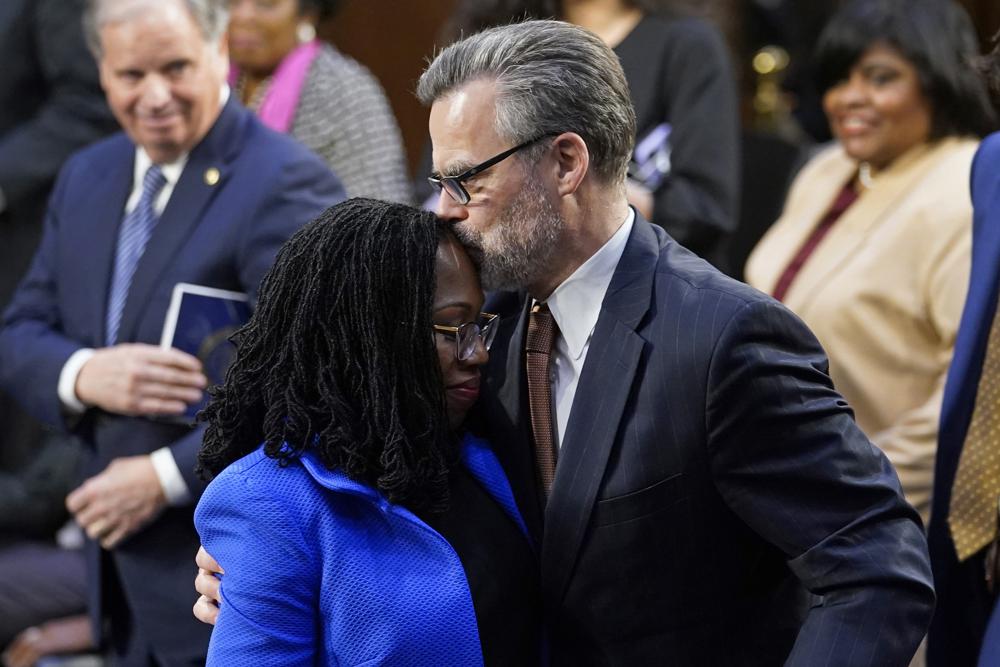
Supreme Court nominee Judge Ketanji Brown Jackson gets a kiss from her husband Dr. Patrick Jackson, at the conclusion of her confirmation hearing before the Senate Judiciary Committee on Capitol Hill in Washington, Wednesday, March 23, 2022. (AP Photo/Susan Walsh)

BY LISA MASCARO

WASHINGTON (AP)
— The historic Senate hearings for Judge Ketanji Brown Jackson, the first Black woman nominated for the Supreme Court, have been joyful, combative and clarifying, putting on display the breadth of the nation’s partisan divide and the unresolved problems of its past.

The fourth and final day of the Senate Judiciary Committee’s consideration of Jackson wrapped up Thursday with several hours of testimony from outside experts.

The American Bar Association’s standing committee on the federal judiciary has afforded its highest rating, “well qualified,” to the Harvard-educated Jackson. A junior high school friend gushed over the “supernova” debate team champion. Skeptics, including the Alabama’s attorney general, warned that her views on crime and policing are “outside the mainstream.

Yet in the 50-50 Senate, where a Trump-era rules change means it is no longer necessary to muster broad support to confirm Supreme Court nominees, the hearings have become less about the vote ahead and more about framing the politics of the eventual outcome.

Democrats are on track to confirm President Joe Biden’s pick, with a vote expected by time senators leave for a scheduled spring recess April 8.

Some takeaways from Day Four of the weeklong hearing:

REVIEWING THE RECORD

“Outstanding, excellent, superior, superb.”

The ABA committee gave Jackson the same highest rating that has been bestowed on most recent Supreme Court nominees, with the exception of Justice Amy Coney Barrett.

The committee’s chair, Ann Claire Williams, testified on the review of some 250-legal professionals on Jackson’s record. Asked how Jackson’s integrity was viewed, Williams said: “Those are the comments.”

Republican senators are focusing on a narrow slice of the judge’s work, the child pornography cases that Jackson herself has said are among “the most difficult” of her career — some of which still give her nightmares.

Much the way senators opposed to the first Black nominee to the court, Thurgood Marshall, a half-century ago portrayed the storied civil rights lawyer as soft on crime in his work defending Black people, Republicans have spotlighted Jackson’s sentencings in criminal cases, they show too much “empathy” for defendants.

A witness for the Republican side, Attorney General Steven T. Marshall of Alabama, said he believes Jackson shows more deference to criminals appearing in her courtroom than she does victims. He said her views of law enforcement reforms are “outside the mainstream.”

Republicans are trying to link Jackson to the left-leaning “defund the police” movements, but it’s unclear if the approach is working. The judge has backing from the nation’s largest law enforcement organization, the Fraternal Order of Police, and she has spoken emotionally about her brother and uncle who worked as police officers.

TRUMP’S INFLUENCE HOVERS

Donald Trump is gone from the White House, but his influence over Republicans endures.

One witness called by Republicans was Alessandra Serano, the chief legal officer of Operation Underground Railroad, a Utah based anti-trafficking nonprofit group. It is under criminal investigation in the state for exaggerating its role in law enforcement arrests involving child predators, in order to fundraise.

The organization has become popular online and found success raising money off of conspiracy theories that have are popular among suburban mothers and groups that arose out of the QAnon conspiracy theory, which casts Trump as a hero fighting a cabal of Satan-worshipping cannibals operating a child sex trafficking ring.

As Republicans focus on Jackson’s rulings in the child pornography cases, they are tapping into this strain of the GOP and its popularity among backers of the former president, drumming up voter interest before the November elections that will determine control of Congress.

From retirement in Florida, Trump has insisted, falsely, that he won the 2020 election, a belief shared by many Republicans, despite dozens of court cases and independent reviews that have rejected GOP claims of a rigged election. Trump is considering another run for president in 2024.

At one point Thursday, Sen. Sheldon Whitehouse, D-R.I., tried to air some of these points. He asked Alabama’s Marshall whether Biden was the “duly elected president” of the United States.

Marshall replied that Biden was the president.

Pressed if the witness was purposefully omitting the words “duly elected,” Marshall simply reiterated: “I’m answering the question. He is the president of the United States.”

Alabama, with Marshall, was among other states joining in a lawsuit challenging the results of the 2020 election.

THE NEXT CIVIL RIGHTS ERA

The Senate hearings have been filled each day with some of the leading civil rights leaders celebrating, as Sen. Cory Booker, D-N.J., put it, the “joy” of reaching this milestone in American history.

Testifying Thursday, the chairwoman of the Congressional Black Caucus, Rep. Joyce Beatty, said Booker “spoke not only to Black America, but to America.”

Beatty, D-Ohio, put Jackson’s moment alongside those of civil rights icon Rosa Parks and other Americans and urged senators to consider what the judge’s confirmation to the high court would mean for the country.

“We are no longer looking at 50-65 years ago,” she said, of the past era of civil rights battles, “but yet we’re still fighting.”

COUNTING THE VOTES

Senators no longer need bipartisan cooperation to confirm judicial nominees, after rules changes that allow a simple 51-vote majority for the lifetime appointment to the court.

With Jackson’s nomination almost assured by Democrats, who hold a slim majority in the 50-50 chamber with Vice President Kamala Harris able to break a tie, Republicans unable to stop the judge’s confirmation at least want sow doubt in the outcome.

Republican Sens. Josh Hawley of Missouri, Ted Cruz of Texas and Marsha Blackburn of Tennessee have led the charge, quizzing the federal judge about her views on issues of race and crime, amplifying election-year grievances and a backlash over changing culture.

Jackson is the first federal public defender to be nominated to the Supreme Court and her efforts representing those accused of crimes, alongside her work as a federal judge, have provided a lengthy record of difficult cases for senators to review.

Jackson has presented herself a judge who relies on method, not judicial philosophy, to remain neutral as she works to “stay in my lane.”

If confirmed, Jackson would also become the sixth female justice in the court’s history and the fourth among the nine members of the current court.

Associated Press writers Colleen Long and Mary Clare Jalonick contributed to this report.

KNOCK, KNOCK

By issuing subpoenas to five Times journalists, the Trump administration reveals its first response to unwanted national security coverage: ...