Showing posts with label Morocco. Show all posts

Friday, June 26, 2026

Morocco’s Hidden History: Archaeology, DNA And Carbon Dating Rewrite The Story Of The Ancient World

Satellite view of the Strait of Gibraltar, where Africa and Europe meet. NASA/GSFC/LaRC/JPL MISR Team

BY HAMZA BENATTIA
PREHISTORY,
UNIVERSITY OF CAMBRIDGE

For decades, stories about the ancient Mediterranean have centred on the grand cultures of Greece, Rome, Phoenicia and Egypt. North-west Africa seldom enters the picture before the arrival of Phoenician traders on the Moroccan coast about 3,000 years ago.

But archaeology is now revealing a different story.

Long before the first Phoenician ships (from today’s Middle East) sailed the western Mediterranean (between today’s north Africa and southern Europe), communities in what is now Morocco were farming and herding animals. They were also crossing the Strait of Gibraltar and participating in long-distance exchanges.

Over the past decade, I’ve worked on archaeology projects across Morocco. We’ve been investigating the origins of farming, long-distance exchange and the emergence of complex societies there. In my most recent study, I brought together archaeological evidence, radiocarbon dates and genetic data spanning nearly three millennia.

The study reveals that between roughly 3800 and 500 BCE – a period that saw the construction of Stonehenge, the flourishing of New Kingdom Egypt and the rise of Phoenician maritime trade – north-west Africa was not a marginal frontier. It was a crossroads linking the Mediterranean, Atlantic and Saharan worlds.

This has important implications for how we understand Africa’s past. For too long, interpretations of the continent’s history have underestimated the complexity and dynamism of its societies. By bringing north-west Africa back into the picture, archaeology is helping to correct that imbalance and reveal a richer, more interconnected reality.

A centre of multiple worlds

Geography helps explain why north-west Africa occupied such a strategic position in Mediterranean prehistory. The Strait of Gibraltar, which separates present-day Morocco and Spain, is only about 14km wide at its narrowest point. It served as a natural corridor linking Africa and Europe.

Far from being isolated, communities in today’s northern Morocco were embedded in long-distance networks for millennia. They maintained contacts with Iberia and other Atlantic regions and they interacted with Saharan populations. Later, they engaged with Mediterranean traders and settlers.

They were not passive participants in these exchanges. Archaeological evidence increasingly suggests that local communities actively participated in the networks that connected the western Mediterranean.

Early farmers and innovation

Farming was present in north-west Africa from at least 5400 BC, during the Neolithic period when agriculture was spreading across much of the western Mediterranean.

By around 3800 BC, communities in what is now Morocco were practising increasingly intensive farming and animal husbandry. One striking example is Oued Beht. At this large open-air settlement people cultivated crops, raised livestock and stored surplus food in hundreds of large underground pits.

Recent excavations reveal this was no small farming village. Covering around ten hectares, Oued Beht is among the largest agricultural settlements known in prehistoric Africa. The site may have supported a population of more than a thousand people, pointing to a level of organisation rarely documented in north-west Africa at this time.

These developments coincided with broader environmental changes, including the Sahara gradually becoming a desert. The dryness may have encouraged communities to invest more heavily in agriculture, food storage and long-term settlement in order to adapt to a less predictable environment.

At the same time, there’s clear evidence of interaction with Iberia, the peninsula that includes today’s Spain and Portugal. Shared painted pottery styles, together with ivory and ostrich eggshell objects, point to regular contacts across the Strait of Gibraltar. These local communities were already active participants in wider networks of exchange.

New influences and local continuity

During the third millennium BC, north-west Africa became part of the wider Bell Beaker phenomenon. It takes its name from distinctive bell-shaped drinking vessels which appear across a network of communities that stretch across Atlantic Europe and the western Mediterranean.

For decades, the presence of Bell Beaker pottery in the region was interpreted as evidence that local communities were simply adopting cultural innovations from Europe.

Yet in Morocco, Bell Beaker objects are found alongside distinctive local traditions. This suggests local communities were selectively integrating new elements into existing cultural frameworks.

This was clearly a process of exchange, adaptation and local agency.

The elusive Bronze Age

The second millennium BC remains one of the least understood periods in north-west African prehistory. In Iberia, large, fortified settlements and clear social hierarchies emerge. The archaeological record in north-west Africa is more fragmentary.

Even so, there are important clues.

Burial practices such as stone-built cist graves point to changes in social organisation. At sites like Kach Kouch, there is evidence for settled farming communities with round houses, storage facilities and animal herding.

Ballintober sword found in Morocco. 

There are also signs of long-distance connections continuing into this period. For example, a bronze sword recovered from the bed of a river in northern Morocco has close parallels in the British Isles. This suggests links extending far beyond the Mediterranean.

Encounters with the Phoenicians

By the early first millennium BC, Phoenician traders and settlers from the eastern Mediterranean – today’s Lebanon – began establishing settlements along the north African coast. Traditionally, this has been interpreted as a process of colonisation, with local populations as passive recipients of a more advanced culture.

Recent archaeological evidence challenges this.

At sites like Kach Kouch, local communities continued their own architectural traditions and lifestyle. They selectively adopted new elements, like wheel-made pottery and iron tools.

Kach Kouch and other settlements suggest that these societies negotiated encounters with incoming groups. They incorporated new ideas into existing cultural traditions on their own terms.

The arrival of the Phoenicians, then, did not mark the beginning of complex societies in Morocco. It was a new chapter in a much longer history of interaction, adaptation and exchange.

These advances reflect decades of work by Moroccan and international research teams. Much remains for archaeologists to do. Large parts of the region are still underexplored and new discoveries have the potential to transform our understanding even further.

What is already clear, however, is that the prehistory of north-west Africa is a story of local communities actively shaping their own place in the ancient world.

READ ORIGINAL STORY HERE

Wednesday, February 04, 2026

Senator Ted Cruz Slams US Officials For Avoiding Reference To Polisario Terror Links


BY SAFAA KASRAOUI

RABAT, MOROCCO
  – US Senator Ted Cruz has sharply criticized administration officials for repeatedly avoiding any direct reference to the Polisario Front, despite documented links to the separatist group instigating terror activities that destabilize the region.

Cruz made his remarks during a Senate hearing on counterterrorism efforts in North Africa and the Sahel this week.

During the hearing, he pointed a rebuke to US officials for what he described as a deliberate refusal to acknowledge the Polisario and its links to terrorism.

He also noted a contradiction between praising Algeria as a “critical pillar of stability in the region” and vaguely warning of terrorist activity in the Sahel without naming the parties involved.

Algeria’s regime has been hosting, financing, arming, and sheltering the Polisario Front, a separatist group claiming independence in Western Sahara.

Several reports link Polisario’s involvement in terrorist activities.

In 2017, Morocco’s security services identified 100 Polisario members who are associated with ISIS.

In 2021, French authorities killed Adnan Abdu Walid al-Sahrawi, the leader of a terror group known as the Islamic State in the Greater Sahara.

Al Sahrawi was also a former member of the Polisario Front.

Cruz also pointed out Iran’s proxy Hezbollah’s collusion with Polisiario.

“Iran is trying to turn the Polisario Front into the Houthis for West Africa, a proxy force capable of waging war to threaten regional stability and pressure US partners wherever Iran wants leverage,” the senator said.

He recalled Polisario’s work with Iranian “terrorist groups,” taking drones from the IRGC and moving weapons and resources around the region, including to other groups instigating terrorist acts.

“I believe they should be designated as a terrorist group, and I’ve drafted a bill to do so if there is no change in their behavior,” Cruz added.
For Cruz, the officials delivered nothing of substance

Senior Bureau Official Robert Palladino responded to Cruz’s question by repeatedly steering away from directly addressing the senator’s question.

Instead, he shifted to broader diplomatic language, conveying US’ commitment to achieve a lasting solution to the Western Sahara dispute.

When Cruz pressed the official about the possibility of designating Polisario as a terrorist group, Palladino made similar remarks – stating the US is “constantly assessing threats to the American homeland.”

Cruz responded to Palladino’s remarks, insinuating that they were merely talking points that were “positively Shakespearean, full of sound and fury and yet signifying nothing.”

Another US official also made an indirect answer to Cruz’s questions, causing the senator to address the situation head-on.

Cruz also asked both officials if they received any instructions not to say anything negative about the Polisario Front, with both officials denying receiving such guidance.

“So you just decided to go down that road for the heck of it,” Cruz responded.
A history of Iran-Polisario links

Morocco cut ties with Iran in 2018, emphasizing that it received evidence about the collision.

It accused Tehran of providing Polisario with logistical support.

Iran and Algeria’s regimes denied the collusion, but Moroccan officials emphasized they received indications and satellite proof of training and equipment provision links between Tehran and the separatist group.

The situation prompted concerns in the international community, with officials from across the world urging their countries to designate Polisario as a terrorist group.

In September last year, US Congressman Joe Wilson described the separatist Polisario Front as a “terrorist organization” that destabilizes peace and security worldwide.

“In fact, the Polisario is a terrorist organization, and I have introduced a bill to recognize it as such, because the existence of these terrorist groups contributes to destabilizing the world,” Wilson told reporters Tuesday on the sidelines of the 80th UN General Assembly.

In June, the lawmaker submitted a bipartisan bill in June urging the US to officially classify the Algeria-based and backed group as a foreign terrorist organization.

The bill details the group’s ties with Iran and its proxy Hezbollah, its involvement in violent attacks against Moroccan forces, and its role in destabilizing both the Maghreb and the Sahel.

----------- MOROCCO WORLD NEWS

Wednesday, January 21, 2026

Morocco Deepens Military Ties With Ethiopia In Strategic East Africa Pivot


RABAT/ADDIS ABABA (MEO) – Relations between Morocco and Ethiopia entered a new strategic phase, marked by expanding military cooperation that reflects Rabat’s broader push to deepen engagement with African partners and strengthen regional integration across the continent.

The growing defence partnership signals a significant shift in Moroccan diplomacy, as the kingdom moves beyond its traditional West and Central African focus towards a more assertive geopolitical presence in East Africa and the Horn.

This momentum was underscored by the first meeting of the Moroccan-Ethiopian Joint Military Commission, held in Addis Ababa on January13 and 14. The meeting follows a bilateral military cooperation agreement signed in May 2025, which formally established the commission and laid the groundwork for collaboration in training, capacity-building and the exchange of expertise across a range of military and security fields.

For decades, Morocco concentrated much of its political and economic influence in francophone West Africa. However, policymakers in Rabat have increasingly recognised that aspiring to continental power status requires a tangible presence in East Africa, particularly in Ethiopia, a demographic heavyweight, a rising economic force and host country of the African Union.

The rapprochement with Addis Ababa represents a deliberate effort by Morocco to diversify its African alliances and demonstrate its ability to forge South-South partnerships that transcend regional, linguistic and historical divides. A foothold in Ethiopia also strengthens Rabat’s diplomatic leverage on key continental issues and helps neutralise opposition to its core national interests, notably the Western Sahara, in regions that have historically lain beyond its sphere of influence.

Morocco’s engagement with Ethiopia has evolved from major economic investments to strategic security cooperation. Among the most prominent projects is a $3.7 billion fertiliser plant developed by the OCP Group, Morocco’s state-owned phosphate giant. That economic foundation is now being complemented by closer military and security ties.

The kingdom brings to the partnership a well-established reputation in counterterrorism, border security and military training. By sharing this expertise, Rabat is positioning itself as a credible provider of security on the African continent, a role that aligns with its wider diplomatic ambitions.

In May, Morocco’s Minister Delegate to the Head of Government in charge of National Defence Administration Abdellatif Loudiyi received Ethiopian Defence Minister Aisha Mohammed Mussa during an official visit to Rabat.

According to a statement from Morocco’s National Defence Administration, the talks reviewed bilateral cooperation and explored ways to enhance it, while reaffirming both countries’ commitment to peace, stability and security in Africa. The visit culminated in the signing of a military cooperation agreement covering training, scientific research, military health services and the exchange of expertise.

The defence accord built on earlier high-level military contacts. In April, Morocco’s Inspector General of the Royal Armed Forces, General Mohammed Berrid, visited Addis Ababa, where he met Ethiopian Chief of General Staff Birhanu Jula. The two sides discussed a draft framework for broad-based military cooperation aimed at expanding and institutionalising the partnership.

During the visit, General Berrid toured several Ethiopian military facilities, including cyber security units, an artificial intelligence institute, Bishoftu Air Base in central Ethiopia and an ammunition factory, signalling the depth and technical scope of the emerging relationship.

Morocco and Ethiopia’s ties are rooted in a longer diplomatic history. During a visit by King Mohammed VI to Addis Ababa in November 2015, the two countries signed 12 agreements spanning air transport, mining, agriculture, tourism, water cooperation and diplomatic coordination, laying the foundations for today’s expanded engagement.

Military analyst Mohamed Chakir said the defence cooperation reflects Morocco’s broader African outreach strategy, noting Ethiopia’s pivotal role in the Horn of Africa and its status as host of the African Union. He described the Joint Military Commission as a key mechanism for advancing practical cooperation in security and defence.

From Ethiopia’s perspective, Chakir added, Addis Ababa is keen to benefit from Morocco’s military expertise, particularly in advanced defence technologies. Morocco has been steadily upgrading its military capabilities through partnerships with the United States, under a 10-year defence cooperation agreement signed in October 2020 and running until 2030.

Chqir noted that Morocco has invested heavily in military training and education infrastructure, and that the new commission provides an institutional framework to sustain long-term cooperation. He also pointed to Rabat’s parallel efforts to develop a domestic defence industry, including the launch of a combat vehicle manufacturing plant in partnership with India last October, aimed at supplying both the Moroccan armed forces and international markets.

For Ethiopian officials, the Joint Military Commission marks a turning point. The Ethiopian National Defence Force said the initiative aims to expand cooperation across military education, training, defence industries and technology transfer.

Speaking after the meeting, Director-General of Foreign Relations and Military Cooperation at the Ethiopian National Defence Force Teshome Gemechu described the first session of the commission as a historic milestone that opens a new phase of practical implementation across agreed areas of cooperation.

On the Moroccan side, Abdel Kahar Othman, head of Logistics at the Royal Armed Forces, called the meeting an important development in bilateral military relations, stressing Rabat’s determination to further elevate defence cooperation with Ethiopia and describing progress to date as encouraging.

Together, the developments point to a recalibration of Morocco’s African strategy, one that blends economic investment, security diplomacy and institutional partnerships, and signals Rabat’s ambition to play a more influential role across the full breadth of the continent.

Wednesday, September 20, 2023

Tinmel – Morocco’s Medieval Shrine And Mosque – Is One Of The Historic Casualties Of The Earthquake


BY ABBEY STOCKSTILL

The damage from the earthquake that struck Morocco on Sept. 8, 2023, is still being assessed. Moroccans are grappling not just with the loss of thousands of lives, but also with the widespread destruction of their cultural heritage and historical sites.

Among them is a 12th-century mosque in the village of Tinmel, about 4 miles from the epicenter of the quake that flattened many of the villages in the Atlas Mountains.

The mosque at Tinmel was originally built to commemorate the figure of Ibn Tumart, founder of the Almohad movement that ruled an empire stretching from Mali to Spain from 1147 to 1269. Ibn Tumart was a Muslim reformist who advocated for greater accessibility and clarity in Islamic law and scripture. The Atlas tribes spoke little Arabic and lived in remote villages, so Ibn Tumart translated the Quran into the vernacular and issued the call to prayer in the local Berber dialect.

After Ibn Tumart’s death, his tomb at Tinmel became a shrine, marked by a simple whitewashed dome in front of the mosque. Under the Almohads, Ibn Tumart was venerated as a saint, and the early Almohad caliphs were also buried alongside him, turning Tinmel into a potent site of spiritual and social memory.

As an architectural historian who specializes in medieval Morocco, I have spent many years visiting and researching Tinmel. For nearly 900 years, Tinmel was central to a distinctly Moroccan Islamic tradition, but the events of the past week have thrown its future into doubt.

Unusual architecture

Built in 1148 by Ibn Tumart’s successor, Abd al-Muʾmin, the mosque embodied the core principles of Almohad architecture. A rectangular prayer hall was supported by plaster-coated piers, while a façade of geometric ornamentation emphasized the niche that indicated the direction of prayer, the mihrab.

The structure was designed to encourage circumambulation around the mosque, with the ornamental decoration intensifying the experience. The closer one moved toward the mihrab, the more elaborate the design became, drawing the eye of the viewer in.

But the mosque’s most unusual element was its minaret, which wrapped around the exterior of the mihrab. A staircase behind the niche led to the upper story of the structure, where the call to prayer could be issued out over the valley.

Historically, minarets were never constructed in conjunction with the mihrab, but off to the side or opposite the mihrab. Tinmel’s minaret was thus both unique and innovative.

Positioned on a steep hillside, with the mihrab and the minaret both facing the slope down toward the seasonal stream known as the Wadi N'Fiss, the mosque and its shrine looked larger and more monumental than their physical size suggested.

A center for religious study

After the collapse of the Almohad dynasty, Tinmel fell under the administration of the provincial sheikhs who governed the Atlas territories.

When the Almohads’ competitors, the Marinids, succeeded in replacing the dynasty to rule much of Morocco between 1244 and 1465, they systematically demolished many of the Almohads’ most precious sites, including Tinmel. They sent soldiers to ransack the village and the shrine, though the mosque itself was left standing.

There is no architectural evidence to suggest precisely where Ibn Tumart’s tomb and those of the Almohad caliphs were located. Scholars continue to debate how the shrine, the dynasty tombs and the mosque may have fit together as a complex for pilgrims.

But despite Tinmel’s deterioration after the Almohads fell from power, the site remained a powerful place in Moroccan Islam. Ritual recitations of the Quran were still being carried out twice a day in the 14th century, and pilgrims continued to visit the site for another 200 years.

The site remained a center for religious study where men from the Atlas villages could gather and learn about the Quran and the hadith, which are stories of Muhammad’s life and actions.

An uncertain future

By the 20th century, the mosque had fallen into disrepair as a result of neglect and political instability in the Atlas Mountains.

An archaeological survey of the site and advocacy from local historians inspired a 1995 restoration under the aegis of Morocco’s Ministry of Culture. The site was a tentative place on the UNESCO World Heritage list, pending a full application from the Moroccan government.

The mosque’s plaster ornaments were conserved and the prayer hall’s brick piers reinforced, although the roof remained open to the sky – the original roof, likely wooden, had long since deteriorated.

Earlier this year, more renovations began with the hopes of adding a museum that could help contextualize Tinmel within the larger scope of Moroccan history and welcome more visitors.

The earthquake on Sept. 8 has set this project back indefinitely. Five of the workers at the site – all local to the region – died in the disaster, and the site was further damaged. Although the Moroccan government has committed to rebuilding the mosque, the details of how this will be accomplished and funded are unclear.

READ ORIGINAL STORY HERE

Monday, September 11, 2023

Marrakech artisans – who have helped rebuild the Moroccan city before – are among those hit hard in the earthquake’s devastation


BY ABBEY STOCKSTILL

A powerful earthquake that hit close to the medieval city of Marrakech in Morocco on Sept. 8, 2023, has killed thousands and injured many more. It has also put at risk buildings and monuments of major historic importance, among them the minaret of the Kutubiyya mosque, a 12th-century structure that is an icon of the city.

The Medina, the medieval walled portion of the city, is now littered with rubble. The cultural significance of the Medina extends far beyond the antiques and trinkets sold to tourists.

It is the location of numerous artisan workshops that make the ceramic tiles, carved plaster and intricate woodwork that decorate the city. Many of these workshops have maintained traditional methods for centuries, transmitting skill sets down through the generations.

Part of Morocco’s bid for Marrakech’s UNESCO status was based on these craft traditions being “intangible cultural heritage,” which the U.N. describes as knowledge or skills that are passed down orally rather than in written form.

I’ve been working in Marrakech since 2014, living there on and off as I completed research on a book about the development of Marrakech as a medieval metropolis. Although my work focused on the 12th century, the more I learned about the city, the more I realized that most of the urban fabric and architectural sites I was looking at were thanks to the conservation efforts of local workshops.

The UNESCO designation was a historical acknowledgment of the traditions of poor and rural communities that can often get left out of larger conversations about art history. It is precisely these communities that have maintained Marrakech’s architectural heritage for generations, but the earthquake has destroyed the workshops and residences of many in the Medina.

These poor and rural communities are at their most vulnerable just when their skills will be needed the most to help rebuild the city after this disaster.
Oral origins

Marrakech was founded in 1070 by the Almoravid dynasty, which derived from a tribe that was part of a larger non-Arab confederation of peoples now referred to as Berbers.

It was one of the first major cities in the wider Islamic west, known as the Maghrib – now comprising Morocco, Algeria and parts of Tunisia - to be founded by a group indigenous to the region.

The majority of the community spoke a dialect of Tamazight, an Afro-Asiatic language distinct from Arabic. It was primarily an oral language, meaning that knowledge was more commonly handed down via poetic stories rather than written texts.

Some Arabic sources described the Almoravids as “unsophisticated” and “illiterate,” yet the evidence of their architectural and artistic heritage suggests otherwise. In Marrakech, they built an elegantly proportioned dome known as the Qubba al-Barudiyyin and commissioned the elaborate wooden minbar (pulpit) that now sits in the Badiʿ Palace Museum.

They were followed by the Almohad dynasty, another largely indigenous group, that faced similar accusations in historical accounts despite building the Kutubiyya minaret, Marrakech’s signature monument.
Site of independence movements

The city’s origins as a Berber capital contributed to making Marrakech the epicenter of contemporary Moroccan national identity, rooted in a pride and independence centuries old. Whereas other North African cities had roots in Arab or Roman tradition, Marrakech could claim to be distinctly Moroccan.

In the face of Ottoman expansion in the 16th century, the kingdom of Morocco, based out of Marrakech, was the sole region of the Arabic-speaking world to maintain their autonomy from Turkish control.

Although the French and the Spanish would compete for colonial rule of the country, the Moroccan independence movements of the 20th century were largely based out of Marrakech. The city was so prone to revolt that the French administration moved the colonial capital further north to Rabat.

Even the word “Morocco” is derived from an etymological transmutation of “Marrakech.”
A hidden history

And yet, recovering the city’s significant past is an exercise in reading between the lines.

The oral traditions of the city’s founders were rarely faithfully transcribed. Written sources are often scattered and unpublished, and those that do exist are often written by outsiders or visitors to the city.

The Ottomans were excellent record-keepers, enabling scholars to explore extensive centralized archives on every part of the Arabic world – except Morocco, whose archives remain dispersed and underfunded. Historians have had to work obliquely to uncover concrete details, relying on archaeological and anthropological research to supplement oral traditions.

Integral to these efforts was the role of craft traditions in and around Marrakech. Craft was a key point of France’s colonial efforts in Marrakech, where they established “artisan schools” in the Medina to ostensibly document and preserve their methods. In doing so, the French Protectorate - which ruled the country from 1912 to 1956 - created a kind of living nostalgia within the Medina, conflating the people who actually lived there with the city’s medieval past.

This effectively created a form of economic and social segregation in which craftsmen and their families were siloed into the old town, while the wealthier expatriates and tourists occupied the Ville Nouvelle outside the medieval walls.
Preserving the past through craft

At the same time, these craft traditions are also what made it possible to preserve and restore many of the sites in and around Marrakech that now draw thousands of tourists each year.

The Qasba Mosque, the city’s “second” major mosque after the Kutubiyya and originally built between 1185 and 1189, underwent successive restorations in both the 17th and 21st centuries after political instability led to their decline. In both cases, local artisans were employed to renovate the mosque’s stucco walls and the mosaic tile work known as zellij.

The 11th-century Almoravid pulpit required a team of Moroccan craftsmen to successfully restore the minbar’s intricate marquetry.

Artisans have also been important ambassadors for Morocco’s place in the larger canon of Islamic art, building a courtyard as part of the Metropolitan Museum of Art’s 2011 renovation of their Islamic galleries using 14th-century techniques and materials.

With the Marrakech Medina partially destroyed, many of these artisans and workshops will face tough choices regarding their future. Gentrification over the last decade has priced many residents out of their ancestral homes, and many of these workshops operate on thin margins – too thin to both pay for damages and retain control over their property.
Rebuilding intangible heritage

Parts of the city walls cracked in the earthquake, and an 18th-century mosque in the main square lost its minaret. The historic 12th-century site of Tinmal, not far from Marrakech and nestled in the Atlas Mountains, has also collapsed.

The human toll of the earthquake is still being tallied, and the material damage is likely to be extensive. Nothing can replace the loss of life. Yet the history and resilience of a place are instrumental in any recovery.

It will be the role of Marrakech’s intangible heritage – its artists and artisans – to rebuild after this disaster. In the midst of narratives about caliphs and sultans, philosophers and poets, it can be easy to forget that the people who built these places often went unnamed in the historical texts.

But these artists will need support to maintain Marrakech’s history, to preserve the past for future historians to discover.

READ ORIGINAL STORY HERE

Wednesday, June 07, 2023

In “The Blue Caftan,” Moroccan Film Director Tackles LGBTQ+ Love And Celebrates Embroidery Craft

Director Maryam Touzani stands for a portrait during the 76th international film festival in Cannes, southern France, on Monday, May 22, 2023. In her latest film, “The Blue Caftan,” Touzani, from Morocco, delicately weaves intricate, overlapping tales of love, both traditional and largely taboo for many in her country and its region as she tells the story of a woman and her secretly gay husband who together run a shop making caftans. The marriage grows more complicated when the couple hires a male apprentice. (AP Photo/Daniel Cole)

BY MARIAM FAM

As Mina gets increasingly sick, her body withering away, her husband dotes on her: He washes her hair, helps her change, brings the sweetness of a fruit to her lips. But underneath the genuinely tender moments shared by this on-screen Moroccan couple simmers a longing — of a forbidden kind.

In her latest film, “The Blue Caftan,” Moroccan director Maryam Touzani delicately weaves intricate, overlapping tales of love, both traditional and largely taboo for many in her country and its region as she tells the story of a woman and her secretly gay husband who together run a shop making caftans. The marriage grows more complicated when the couple hires a male apprentice.

Wading into socially sensitive subjects is not unfamiliar terrain for Touzani who has won accolades at international film festivals and, just recently, was a jury member at this year’s Cannes Film Festival. “The Blue Caftan,” which had been shortlisted in the international feature film category for the 95th Academy Awards, is scheduled for release Wednesday in Morocco, where gay sex is illegal.

“I’m really hoping that it would be able to trigger a debate about the LGBT community and its place …, things that we don’t generally talk about because they are sensitive subjects,” Touzani told The Associated Press. “For a healthy society, it’s important to be able to talk about everything.”

Some disagree.

In Rabat, 27-year-old Laila Sahraoui argued some topics are best left behind closed doors.

“Moroccans … worry that their kids could imitate such ideas,” she said, adding that she wouldn’t watch the film. “Because of our Islam, we don’t like such things in Morocco. … It’s absolutely not appropriate for our society.”

But Touzani, 42, said others shared with her how important it was to portray characters like Halim, the husband.

“Morocco is a very complex country where there are very different points of view coexisting,” she said. “It’s about being able to just push certain boundaries and just to question certain things. ... That’s what art can help us do as well, cinema especially.”

Filmmaker Nabil Ayouch, Touzani’s husband who co-wrote “The Blue Caftan” with her and is its main producer, said he is curious about moviegoers’ reactions, but feels confident.

“There’s a younger and younger audience and they want to see new type of movies, new type of cinemas in the Arab world,” he said. “The more conservative audience will probably not be very pleased.”

Part of art’s role, Ayouch said, is to disturb, to stir debate.

While he welcomes the recognition their movies garner abroad, he said it’s important for films like “The Blue Caftan” also to be experienced by audiences at home and in the Arab world.

For those having to “live their sexuality secretly,” he said, “films like this one can give them some courage to face who they are more publicly.”

In “The Blue Caftan,” Mina, the wife, has a sense of humor and a feisty side that she uses to protect her husband, who considers her his “rock.” She’s an observant Muslim; viewers repeatedly watch her pray.

Halim is a man torn. He has a gentle soul and takes pride in his craft — correcting a customer on a fabric’s exact shade of blue — while catering to shoppers in a changing world, with little patience for the time he takes to embroider by hand. He loves his wife, even as he slips into a cabin at a public bathhouse for secret sexual encounters with men.

Sexual tension builds up between him and the male apprentice, Youssef. As Mina’s health falters, Youssef increasingly helps the couple and a love triangle of sorts ensues.

Ultimately, Touzani said, it’s a movie about “love in its many forms.”

That includes love for the traditional craft of caftan embroidery, with sensual scenes of fabrics and stitches.

“One of the things I wanted to show in this film is the beauty of certain traditions,” she said. “There are other traditions that … need to be questioned,” she added, citing scenes when Halim challenges some burial rituals.

In one scene, Halim asks for Mina’s forgiveness, telling her that all his life he has tried in vain to get rid of “this thing.” She tells him she’s proud to have been his wife, then rests her head on his shoulder.

Being a woman of faith didn’t stop Mina from understanding her husband, Touzani said.

“We have the tendency of saying, ‘Well, if you are religious, then you cannot be this or you cannot be that.’ I believe that we can be many things at the same time because we are such complex beings.”

Speaking in Rabat, Hanane Boarfaoui, 38, said she was against storylines about homosexuality. “This must not be watched by our children, mothers and parents,” she said. “We are conservative people; we don’t accept this.”

Ahmed Benchemsi, a spokesperson for Human Rights Watch, said that while the number of those prosecuted for gay sex in Morocco “is relatively low” and the topic of homosexuality is less of a taboo there than what it used to be, “the law is still there and it hangs over the heads of everybody.”

Online, before the Morocco release of “The Blue Caftan,” some praised Touzani’s work as powerful and moving; others accused her of courting the West and catering to its sensibilities over issues more relevant to Moroccans.

“I don’t make cinema to please anybody,” Touzani said. “I just want to be as truthful as possible to my characters and to the stories I want to tell.”

Touzani’s feature-film directing debut, “Adam,” tells the story of two women whose lives intersect when one takes in the other, an unmarried stranger who’s looking for a place to stay until she gives birth after getting pregnant. She talks about plans to give away her baby to shield him from the stigma that would otherwise mar his future.

It was inspired by Touzani’s parents hosting a woman who showed up at their doorstep under similar circumstances. When Touzani was pregnant with her son, she felt “the violence” that the woman endured in having to relinquish her baby because “socially she couldn’t do otherwise.”

Broaching topics “unspoken of in Arab and Islamic societies” is one common thread between “Adam” and “The Blue Caftan,” said film critic Cherqui Ameur.

“We hope to have fewer taboos in our society through discussing all issues,” he said.

In 2015, “Much Loved,” a movie directed and written by Ayouch, in which Touzani worked in various capacities, was barred from release in the country. Authorities at the time charged that the movie, portraying female sex workers, was offensive to Moroccan women and values. The movie, excerpts from which appeared online, sparked uproar; it was defended by some on freedom of expression and human-interest grounds and criticized by others who said its language was crude and scenes too explicit.

Touzani said that while that was a complicated period, she felt the film pushed boundaries, and “there was something that opened up” following it.

Born in Tangier to a Moroccan father and Moroccan-Spanish mother, Touzani said they encouraged her to stand up for her beliefs. At one point, while a child, she wanted to become a lawyer like her father.

An avid reader, she ended up studying journalism in London but eventually turned to filmmaking.

She said she gravitates toward telling stories of people on the margins. On the screen, she wants to give them the voice they may not have and the possibilities that may not exist in real life.

“These are the people that inspire me, that touch me, that haunt me,” Touzani said. “These are the people that really make their way inside my heart and stay there naturally without me looking for it.”

Associated Press religion coverage receives support through the AP’s collaboration with The Conversation US, with funding from Lilly Endowment Inc. The AP is solely responsible for this content.

Tuesday, December 27, 2022

Israel Thanks Morocco For Protecting Jews During Holocaust

President Isaac Herzog sends letter to King Mohammed VI to mark two years of normalising relations
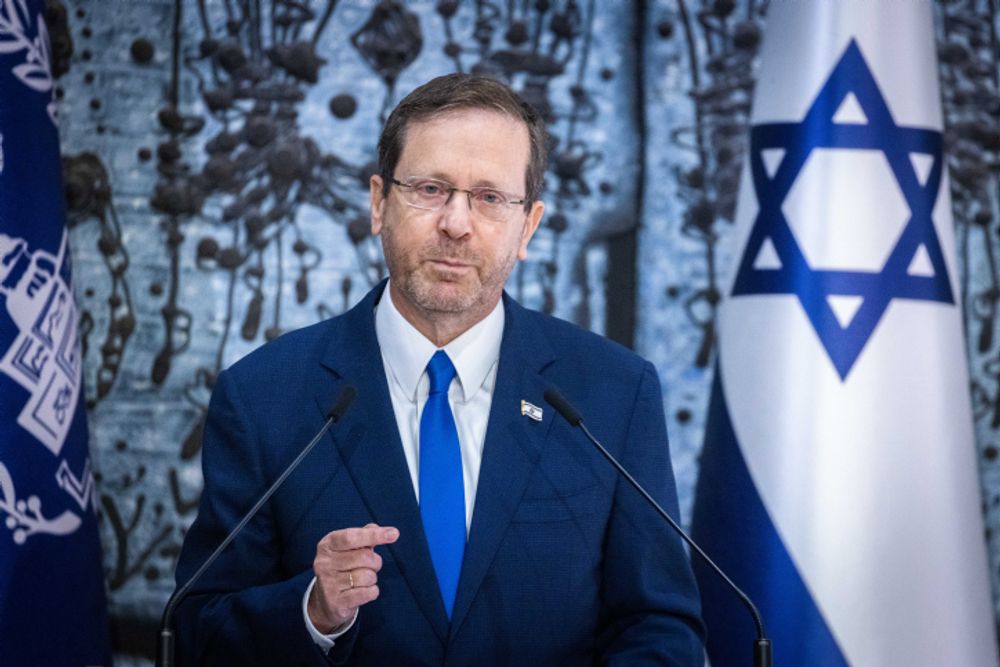
Israeli President Isaac Herzog


Israeli President Isaac Herzog has thanked Morocco's King Mohammed VI for his country's provision of "safe haven" for Jews during the Holocaust.

Mr Herzog's letter, marking two years since Morocco normalised ties with Israel, was the first time an Israeli official has paid tribute to the Holocaust-era actions of Morocco's monarch at the time, the presidency said.

He expressed Israel's gratitude to the king "and the people of Morocco who, for generations, have acted to protect the security, welfare and cultural heritage of the kingdom's Jewish community".

Mr Herzog mentioned Jews settling in Morocco after their expulsion from Spain in the late 15th century, before noting the North African country's protection of Jews during the Second World War.

"When millions of Jews faced the horrors of the Holocaust in the 20th century, King Mohammed V provided a safe haven for his Jewish subjects," Mr Herzog said in the letter, dated December 22.

"Moroccan Jews recall with pride and affection the memory of your grandfather, His Majesty King Mohammed V, who is remembered as the protector and guardian of Jews in his realm."

Mohammad V is famous for his refusal to apply anti-Jewish laws prescribed by France's pro-German Vichy government during the war.

Mr Herzog praised the current king's moves to support his country's Jewish community, noting the decision to include Holocaust education in Moroccan schools.

It would not only deepen "your people's commitment to tolerance and understanding but send a powerful message about these essential values to countries from the Atlantic to the Gulf", he wrote.

The presidency said the letter was co-ordinated with Israel's Foreign Ministry and the state's Yad Vashem Holocaust centre.

Rabat cut relations with Israel in 2000 after the outbreak of the second Palestinian intifada.

But in December 2020, the two countries formalised ties, following the signing of the Abraham Accords between Israel and the UAE and Bahrain.

Before then, Israel had reached peace treaties with neighbouring Egypt and Jordan, in 1979 and 1994.

Morocco's Jewish community dates to antiquity and grew in the 15th century with the expulsion of Spain's Jews.

By the 1940s its number had grown to 250,000, representing 10 per cent of the country's population, but mass emigration followed Israel's founding in 1948.

The kingdom's Jewish community is now estimated to number about 3,000 people, the largest in North Africa.

About 700,000 Israelis claim Moroccan descent and maintain strong ties with it.

Wednesday, December 21, 2022

Morocco Breaks Africa’s Neutrality With Arms For Ukraine — Reports

Image credit: CNBC

BY DAVID KIRICHENKO

The decision marks a significant setback for Russia’s attempts to foster African neutrality.

At the request of the United States, the Moroccan government has opted to transfer spare parts for T-72 tanks to Ukraine, the reports said. Moroccan T-72s being extensively modernized by the Czech company, Excalibur, are being diverted to Ukraine, the reports said. The firm said it would send 90 “African” tanks to Ukraine as part of a 2.2bn Czech crown ($97m) contract funded by the US and the Netherlands. Social media images state that the refurbished vehicles are Moroccan. Each tank features improved thermal imaging, night vision, and armor.

There has been no official confirmation from Morocco, which is known to have at least 60 T-72s in storage, and which purchases more than 90% of its arms from the US. Most of its inventory consists of much more effective American main battle tanks. Morocco has a longstanding dispute with its neighbor, Algeria, which has a particularly close relationship with the Kremlin. The kingdom may therefore be more resistant to Russian messaging than others.

Russia has invested heavily in efforts to keep the continent neutral, including the opening of five so-called Russia houses in Africa this fall, which aim to raise the country’s influence, and a constant stream of regime propaganda emphasizing the Soviet Union’s 20th-century role in assisting anti-colonial movements.

The need to maintain that support is clearly important for the Kremlin and it’s easy to see why. Taken as a whole, Africa has provided fertile ground for Russian arguments. At the first key United Nations (UN) vote after the invasion, 28 African countries (out of 54) either abstained or did not vote to condemn Russia’s aggression, including Morocco. In April, when the UN voted to suspend Russian membership of the Human Rights Council, just 10 out of 54 African states backed the resolution, nine were opposed, and 35 abstained or were absent. And in November, when the UN passed a historic resolution requiring Russia to pay reparations to Ukraine, five African states voted against and 27 abstained.

That’s not to say Africa has been indifferent to the war. Ukraine’s role as a provider of basic foods to the world — Ukraine accounts for 10% of world wheat, 15% of corn, and 13% of barley, as well as half of all sunflower oil — made the conflict, and the associated Russian blockade, matters of great importance. Skyrocketing food prices are, after all, the stuff of revolutions.

The United Nations warned of the biggest food crisis in decades. At one point, the price of wheat in Africa was up by 45%, according to the African Development Bank.

The issue began to concern the Kremlin as the consequences of its actions started to affect its friends. “Africa needs food, and the Kremlin needs allies,” as the New York Times wrote, highlighting that 14 of the continent’s states rely on Russia and Ukraine for more than half their wheat imports. Noticeably, when the African Union’s head visited Moscow in June, he referred to Putin as “dear Vladimir” and attacked Western sanctions. Russia allowed Ukrainian grain exports to resume the following month.

Russia meanwhile maintains a drumbeat of activity on the continent. Foreign Minister Sergey Lavrov has traveled extensively in the region to emphasize that the war and its consequences — including rising food prices — are attributable to the West. That message found a sympathetic hearing from the son of Uganda’s leader, General Muhoozi Kainerugaba, who is seen as being groomed to take over from his father, Yoweri Museveni. He praised the Russian invasion on social media, writing:

“The majority of mankind (that are non-white) support Russia’s stand in Ukraine. Putin is absolutely right!”

Russia’s efforts did not begin with its all-out war. In 2019, Vladimir Putin hosted a Russia-Africa Summit that was attended by over 40 African leaders. Within a year, Russia became Africa’s biggest arms supplier, and the Kremlin has blessed the deployment of Wagner Group mercenaries to several African countries including the Central African Republic, Libya, and Mali, where they have been accused of widespread killings, human rights abuses including torture and questionable deals for resources including gold and oil.

Russia continues its efforts to shape African public opinion through its state-run television network RT, formerly known as Russia Today, which has been taken off air in much of Europe and North America. RT announced earlier this year that it will open a new bureau in Johannesburg, South Africa, after it was removed from a continent-wide broadcasting platform. In July, Ugandan television said it would rebroadcast two RT bulletins daily.

Russia’s disinformation campaign has had some success, as researchers from Brookings discovered when they examined African audiences on Twitter. They found that almost 80% of tweets relating to Russia’s war “perpetuate the claim that Ukrainians are Nazis and/or that Russia is fighting fascism in Ukraine.”

Western states have had less success in turning the tide against Russian disinformation, and Ukraine too has struggled. It has recognized the need to engage but does not appear to have the ear of senior African leaders courted by the Kremlin. It took two months for the African Union to schedule a hearing at President Volodymyr Zelenskyy’s request, and even then only four heads of state followed it live.

Zelenskyy’s message might have been tailor-made for Africa. As the leader of a small country invaded again by its longstanding ruler and oppressor, the same country that triggered an African food crisis, Ukraine might reasonably expect some sympathy. “Russia is trying to conquer our land, to turn Ukraine into a Russian colony,” he told them. However, his message was largely ignored. 

Both Ukraine and the West have a lot of work to do in reversing Russian influence. Continued diplomatic efforts from the United States will be vital in this process, as Africa’s importance and economic strength continue to grow.

Morocco’s military aid — if confirmed — is an important win, but much, much more needs to be done.

SOURCE: CEPA

Wednesday, December 14, 2022

Morocco World Cup Wins Stir Mixed Feelings In Western Sahara

ASSOCIATED PRESS
Moroccans celebrate their World Cup victory against Portugal in the Morocco-administered Western Sahara city of Laayoune, Saturday, Dec. 10, 2022. (AP Photo/Noureddine Abakchou)

LAAYOUNE, WESTERN SAHARA (AP) — After the final whistle of every match Morocco won in its history-making World Cup run, crowds poured out of homes and cafes in the biggest city of Western Sahara, celebrating for hours.

The revelers included some Sahrawi people, members of an ethnic group that has sought independence for Western Sahara since Morocco annexed the disputed territory in 1975. Other Sahrawis rooted for Morocco’s defeat on the soccer field or refused to take part in the celebrations.

They accuse Moroccan authorities of increasingly cracking down on independence activists, and of touting the World Cup team’s success in Qatar to distract the population from economic challenges.

But the presence of some Sahrawi fans cheering for Morocco in the streets of Laayoune illustrates the unifying power of the first Arab or African team to advance so far in the world’s biggest sporting event. Morocco’s national team, known as the Atlas Lions, faces defending champion France in Wednesday’s semifinal.

Al-Salik Al-Yazid, a young Sahrawi in Laayoune, said “the historic success of the Moroccan national team” has created a collective feeling of “overwhelming joy that included all Arabs and Africans, despite the constant discontent with the Moroccan state.”

He called it a sign of gradually shifting mindsets among younger Sahrawis who grew up under Moroccan rule and under a 1991 cease-fire that ended a 16-year conflict between Moroccan forces and Algeria-backed Polisario Front independence fighters.

“With the growth of generations merging and coexisting in one common environment, it has become natural to find Sahrawi individuals celebrating the victory of the Moroccan national team,” Al-Yazid said. “Many Sahrawis have overcome the problem of identity caused by decades of political struggle.”

However, a long-promised referendum on the territory’s future never took place. Low-intensity hostilities have reignited, leaving the truce at risk of unraveling in Morocco-controlled Western Sahara.

Sahrawi people make up a minority of the estimated population of 350,000 in the territory, a Colorado-sized region rich in phosphates and fishing grounds. The rest, following nearly a half-century of resettlement efforts are mainly Moroccans. Other Sahrawis live in the sliver of Western Sahara ruled by the Polisario, or in refugee camps in Algeria.

On World Cup game nights, the atmosphere is festive but complex.

In past tournaments, Sahrawis generally supported the Algerian team. Activists accused Moroccan police of violently suppressing celebrations of Algerian victories. Algeria didn’t qualify for this year’s World Cup.

When Morocco played Spain last week, some Sahrawis welcomed Morocco’s win and others wore T-shirts supporting Spain, the Western Sahara’s former colonial ruler. Some threw stones at people celebrating the Moroccan victory.

Mohamed El-Yousefi, a Moroccan resident of Laayoune, said he understands the resentment, calling it “closely linked to the conflict in the desert.”

Some Sahrawi people, he said, rejoice in good faith, and others “hate everything that comes from Morocco.”

“Happy Moroccans also sometimes fall into the trap of politics and chant phrases such as ‘We won out of spite against the enemy’ in reference to Sahrawis who are dissatisfied with Morocco’s victory,” El-Yousefi said.

Sahrawi independence activists say it’s not possible to separate the Moroccan team from the Kingdom of Morocco itself.

The team represents the Royal Football League and by extension the monarchy, “which for us is the cause of the tragedy of our people through its forceful occupation of Western Sahara,” said Mubarak Mamine, a Laayoune-based Polisario Front activist.

“Football is a tool used by the Moroccan regime to divert the attention of the Moroccan people from their basic issues, especially in light of the deteriorating economic and social conditions in the country,” Marmine said.

Morocco denies there is an armed conflict in what it calls its “southern provinces,” and has grown increasingly assertive in defending its claim over the Western Sahara in recent years.

The kingdom received a major boost – and independence activists suffered a major blow – when the United States in 2020 recognized Morocco’s sovereignty over the territory in exchange for Morocco normalizing ties with Israel.

Morocco’s climb up the World Cup ladder has taken fans everywhere by surprise, including in Western Sahara.

Sports journalist Balfater Abdel-Wahhab said the celebrations he covered in Laayoune were unlike any the city had seen.

“All the masses in the city of Laayoune came out” as Morocco beat rival after rival to make it to the semifinal. He called it a “wonderful celebration of sportsmanship, decorated with national (Moroccan) flags and traditional (Sahrawi) desert costumes.”

___

AP World Cup coverage: https://apnews.com/hub/world-cup and https://twitter.com/AP_Sports

Sunday, September 04, 2022

Indigenous Coaches Lead Africa’s World Cup Campaign

Ghana Black Stars Coach Otto Addo

BY JUDE OBAFEMI

At the first-ever World Cup to be hosted on Arab soil, there is another unprecedented topic of near-equal significance especially for the African representation at football’s most prestigious event. When Morocco parted company with national team coach Vahid Halilhodzic last month, three months before the 2022 World Cup in Qatar, the country’s football federation (FRMF) said it was a decision reached because of internal disagreements on how to prepare the Atlas Lions for the Mondial. However, that decision created an opportunity to appoint a coach whose ideals aligned perfectly with the FRMF’s preparation strategies for the country’s senior men’s national football team. The Federation eventually settled for Walid Regragui, a former Moroccan international, who played as a defender for club and country, garnering no fewer than 46 caps during an active career that spanned 13 years. That decision to pick Regragui has historic significance for the African continent because it means that, for the first time, all five African representatives that have secured tickets for the quadrennial spectacle will be led by native, indigenous coaches.

THEWILL looks at the pedigree of these coaches, Walid Regragui of Morocco, Rigobert Song of Cameroon, Otto Addo of Ghana and Aliou Cisse of Senegal, all of whom played international football for their different countries, and Jalel Kadri, who will be in charge of Tunisia at the Qatar tournament to identify what they bring to their teams. Herein, it shall also be established what this significant occurrence means for the continent and the immeasurable benefits that will accrue to the continuous development of the local game if they are successful in carrying their teams to making exploits when hostilities kickoff in Group F for Morocco, Group G for Cameroon, Group H for Ghana, Group A for Senegal and Group D for Tunisia.

The choice of Regragui by the Moroccan Football Federation to manage the Atlas Lions at Qatar was a no-brainer for those conversant with football competitions on the continent. If there was confidence in any homegrown talents to improve on the coaching of Halilhodzic, the 46-year-old Regragui fitted the bill. He had the experience to organise a winning team through the rigours of an international competition and the marathon of a local league. The 69-year-old Halilhodzic who took charge of the North Africans in August 2019, led the Moroccan team to the quarter-finals of this year’s TotalEnergies Africa Cup of Nations in Cameroon and then secured World Cup qualification in March following a 5-2 aggregate win over DR Congo before the disagreements that led to the two parties amicably parting ways.

Regragui has the record to match the confidence reposed in his capacity to take this team progress to a level befitting their participation in Qatar. He was born on September 23, 1975 in Corbeil-Essonnes, France meaning he was eligible to represent Les Bleus but he elected to stick with his country of origin, Morocco. As a right-back, there was not much in terms of standout records from his playing career. In between representing the Moroccan national team, he was a player for Racing Santander, Toulouse, Grenoble, and AC Ajaccio. In the summer of 2009, Regragui transferred from Moroccan club Moghreb Tétouan to Grenoble for the last move of his active days as a player before making the switch to football management.

In September 2012, Regragui started working as an assistant football coach for Morocco’s national team. On October 1, 2013, Rachid Taoussi was fired as head coach, and, as assistant, Regragui’s contract was also terminated. He accepted a head coaching position at Fath Union Sport for the 2014/2015 season on May 8, 2014 and, by mutual accord, he left the team on January 22, 2020 after leading the team to life the Moroccan Throne Cup in the 2013/2014 season and the Botola Pro trophy in the 2015/2016 campaign. Regragui was named the Wydad AC head coach on August 10, 2021. He guided Wydad AC to its third CAF Champions League championship in May this year, defeating reigning champions and African football powerhouse Al Ahly in the final as only the second Moroccan manager to win the African Champions League after Hussein Ammouta’s triumph with Wydad in 2017. It is this winning mentality he hopes to incite in the team as they head to Qatar.

Alongside the Moroccans, Cameroon’s coach Song is no stranger to the high stakes of World Cup competitions, as he takes charge of their challenge for the title in November. Born July 1, 1976, he was a constant feature for the national team between 1993 and 2010 before transitioning to become coach of his country’s Under-23 national team. Renowned for his defensive prowess, he was irreplaceable in the defense line and participated in a record eight Africa Cup of Nations competitions, captained five of them (apart from South Africa 1996, Burkina Faso 1998, and Angola 2010) and holds the record for the most consecutive games played in the competition with 35 first team games. He was part of their triumphant teams at the 2000 and 2002 AFCON competitions, where his contributions were vital to their victories.

Professionally, Song started at Metz where he won the Coupe de la Ligue in 1996 before joining Salernitana, newly promoted to Serie A two years later. In 1999, he had successive stints with Liverpool, West Ham United and 1. FC Köln, but after failing to hold down a first-team place, he returned to France to play for Lens until 2004 when he moved to Turkey with Galatasaray to win two Süper Lig titles and the Turkish Cup. In 2008, he switched to Trabzonspor in 2008, won the Turkish Cup and stayed until 2010. Song is the only player, aside from Zinedine Zidane, to have been dismissed in two different World Cups, once against Brazil in 1994 and once against Chile in 1998. He was 17 years old when he become the youngest player ever to be dismissed from a World Cup. But, it is hoped that he will bring a solid disciplinary arc and indomitable winning mentality to the team going to Qatar.

In line with the theme of being born abroad but choosing to represent one’s country of origin, Ghana’s coach Addo was born on June 9, 1975 in Hamburg, West Germany. Playing as an attacking midfielder and winger, he spent all of his playing career in the German football scene with stints in clubs like VfL 93 Hamburg, Hannover 96, Borussia Dortmund, Mainz 05 and Hamburger SV, where he finished his active career. At the highpoint of his Bundesliga days, he won the 2001/2002 Bundesliga trophy with Dortmund, the club’s third in their history. He also turned up for the Black Stars of Ghana during the period for seven years beginning in 1999. In his debut, Ghana walloped Eritrea 5-0 in February 28, 1999. He rose to prominence on the global stage when he served as the nation’s captain during the 2000 AFCON.

In 2009, Addo began his coaching career with his old team, Hamburger SV first as a youth team coach and then, as assistant manager. Prior to the 2014 FIFA World Cup and the 2015 Africa Cup of Nations, Addo was appointed head scout of the Ghana national football team, succeeding Ibrahim Tanko. In April 2019, became “talent coach” for former side Dortmund after serving in a same capacity at Borussia Mönchengladbach. As an interim assistant to Edin Terzić, he won his first trophy as a coach after Dortmund defeated RB Leipzig in the finals of the 2020–21 DFB-Pokal. In February this year, he was made interim coach of the Black Stars and helped them qualify for Qatar on the away-goal rule against favourites Nigeria and will be hoping to give the Ghanaian team their best World Cup outing ever.

Of all the African coaches, Cisse is the oldest at the job who also played for the national team. The most recent recipient of the CAF award for best coach led the Senegalese team to their first ever victory at the AFCON in the Morocco-hosted edition to the jubilation of a grateful country. It was redemption for the coach who was born on March 24, 1976, as 20 years ago, when Cameroon defeated Senegal to win AFCON, Cisse missed the decisive penalty attempt in the shootout. But, the Teranga Lions recovered from that sad loss months later to shock France at the 2002 World Cup, defeating the tournament’s defending champions 1-0 in their opening match. They advanced quickly to the quarterfinals of the Korea/Japan event but were eliminated by Turkey through a “golden goal” in the final eight fixture.

Having played for Paris Saint-Germain between 1998 and 2002, Birmingham City and Portsmouth, in his active days, he in the defensive midfielder and occasionally as a centre back positions, he retired at Ligue 2’s Nîmes in 2009. He soon ventured into management and started off as the assistant coach of the U-23s in 2012 and 2013. Fortunately, in 2015, he replaced Frenchman Alain Giresse as the Teranga Lions coach after they crashed out of that year’s AFCON at the group stages and had gradually built the team to the level of champions that they finally attained this year and demonstrated when they beat Egypt again to pick the ticket to Qatar. He will be closely watched as Senegal look to improve on their world cup record this year.

Of the five indigenous coaches only Tunisia’s Kadri, born December 14, 1971, did not play football before taking up managerial duties. This possibly allowed him the luxury to have managed at no fewer than 20 teams in a coaching career spanning the years from 2001 to the present. With the experience coaching clubs as diverse as EGS Gafsa, Jendouba Sport, US Monastir, Al-Ansar FC, Al-Nahda Club, CA Bizertin, Emirates Club, Al Ahli Tripoli amongst others, his appointment as Tunisian coach still had the hand of good fortune with Nigeria’s Super Eagles playing a big role in the process. At the knockout stage of this year’s AFCON in January, Tunisia met Nigeria and Kadri had to replace the first coach, COVID-19 infected head coach Mondher Kebaier in leading the team. They beat Nigeria, regarded as the best team in the tournament, 1–0 to progress instead. By the end of January, he was made head coach and qualified Tunisia for Qatar with a 1-0 aggregate over two legs against Mali.

The five African coaches’ participation in the FIFA World Cup in Qatar is a significant step in the growth of African football. This is sufficient evidence that, when and if given the chance, local expertise can also work effectively. The entire world will have the chance to learn about the skills of African tacticians. The benefits are numerous, and one of them is that the money spent on the coaching staff will support economic growth in the nation. Furthermore, it means that, should they succeed in Qatar, they would offer a realistic model that other nations will be urged to use for the ongoing advancement of football on the continent.

SOURCE: THE WILL

Saturday, April 09, 2022

Spain PM In Morocco To Mend Ties After Western Sahara Shift

In this photo provided by the Royal Palace, Moroccan King Mohammed VI, center, Spain's Prime Minister Pedro Sanchez, second left, Crown Prince Moulay Hassan, second right, Prince Moulay Rachid, the king's brother, right, and Morocco's Prime Minister Aziz Akhannouch, left, pose before an Iftar meal, the evening meal when Muslims end their daily Ramadan fast at sunset, at the King Royal residence in Sale, Morocco, Thursday, April 7, 2022. Sanchez is on a two-day visit to Morocco that promises to mark an easing of diplomatic tensions centered on Morocco's disputed region of Western Sahara. (Moroccan Royal Palace via AP)

BY JOSEPH WILSON AND TARIK EL BARAKAH

RABAT, MOROCCO (AP)
— Spanish Prime Minister Pedro Sánchez traveled to Rabat on Thursday to meet with Moroccan King Mohammed VI seeking to mark the end of diplomatic tensions centered on Morocco’s disputed region of Western Sahara.

“Today is an important day for Spain and Morocco because we initiate a new phase of bilateral relations,” Sánchez said after meeting with the King before they shared, along with family members, the Iftar meal to break the day’s fast during the Muslim holy month of Ramadan.

Relations between the two countries separated by the Strait of Gibraltar were severely frayed last April. Morocco was angered by Spain allowing the leader of the pro-independence movement for Western Sahara to receive medical treatment for COVID-19 at a Spanish hospital on request by Morocco’s neighbor Algeria, an ally of pro-independence Sahrawis.

Morocco responded by loosening its border controls around Spain’s North Africa enclave of Ceuta, provoking the unauthorized crossing of thousands of young Moroccans and migrants from other African countries.

The mood did not improve until last month, when Sánchez took the surprising decision that angered many of his political allies back home to alter Spain’s long-standing position on Western Sahara, a former Spanish colony that’s largely barren but rich in phosphates and faces fertile fishing grounds in the Atlantic Ocean. Morocco annexed it in 1976.

In a letter to King Mohammed, Sánchez backed Morocco’s plan to give more autonomy to Western Sahara as long as it remains unquestionably under Moroccan grip.

Morocco, in turn, sent back its ambassador to Spain 10 months after she was recalled.

After their meeting on Thursday, King Mohammed’s Royal Office issued a statement saying Sánchez “reaffirmed the position of Spain on the Sahara issue, considering the Moroccan autonomy initiative as the most serious, realistic and credible basis for resolving the dispute.”

The Royal Office added that the leaders “agreed in particular to implement concrete actions in the framework of a roadmap covering all areas of the partnership, integrating all issues of common interest.”

Facing immense political pressure back in Spain for the policy change regarding Western Sahara, Sánchez needed to show some real gains from the meeting. He emerged with a commitment by Morocco to “progressively” reopen the frontiers with Ceuta and its sister enclave, Melilla, which had been closed since the start of the pandemic starting at a date to be determined. Maritime traffic of ferries that carry hundreds of thousands of travelers from Europe to visit family in Northern Africa at holidays will also be reinitiated, Sánchez said.

The Spanish leader said that both governments agreed to hold another meeting of high-level officials before the end of the year.

Morocco has grown in strategic importance to Spain over the past decade. Rabat is considered critical both in the fight against radical jihadi groups as well as in holding back increasing numbers of African migrants who want to reach Europe as they flee violence and poverty.

Sánchez and Spanish Foreign Minister José Albares have insisted that Spain continues to support the resolution of the Western Sahara question via a United Nations-backed referendum.

But the drive to appease Morocco has earned Sánchez sharp criticism both in Madrid and in Algiers.

His Socialist Party on Thursday lost a parliamentary motion backed by all the other parties, including the junior member in the government coalition, condemning the tilt toward Rabat. Its political opponents accuse Sánchez of having betrayed the Sahrawi people while getting nothing tangible in return from Morocco.

“Morocco has achieved one of its permanent demands in foreign policy, but I don’t think my country has received anything in exchange,” said Alberto Núñez Feijóo, the conservative leader of the main opposition party, after meeting with the primer minister ahead of the trip to Rabat and calling the government’s move “inadmissible” and a U-turn on 40 years of diplomacy.

Potentially even more problematic for Sánchez is the damage to relations with Algeria, which has recalled its ambassador to Spain in a sign of its continued support for the Western Sahara independence movement. Spain, while having a relatively low dependence on fossil fuel imports compared to other European Union countries, receives natural gas from Algeria via a pipeline and tankers carrying liquified natural gas.

Laurence Thieux, professor of Islamic Studies at the Autonomous University of Madrid, said that she was surprised by the “scant consideration of Algeria in the decision” by Spain to tilt toward Morocco in the Western Sahara dispute.

“I have the feeling that Spain’s government, like many other European governments, is managing crises that force them to take short-term decisions,” Thieux said. “From the other shore (of the Mediterranean) there is a different sense of time because they are authoritarian governments that have perspectives that stretch beyond the next election.”

___ Joseph Wilson reported from Barcelona, Spain

KNOCK, KNOCK

By issuing subpoenas to five Times journalists, the Trump administration reveals its first response to unwanted national security coverage: ...