Showing posts with label Vladimir Putin. Show all posts

Wednesday, August 30, 2023

Putin Powerless To Complain About China Claiming Russia Territory

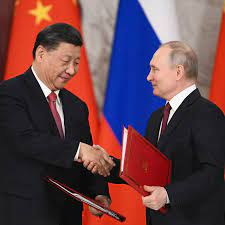
Russian President Vladimir Putin and China's President Xi Jinping shake hands after delivering a joint statement following their talks at the Kremlin in Moscow on March 21, 2023.© Mikhail Tereshchenko/Sputnik/AFP/Getty

BY JON JACKSON

Chinese media outlets this week shared a new geographic map from China's state-owned standard map service that shows Russian territory as part of China.

The map, which is said to have been approved by Beijing and was released by China's Ministry of Natural Resources, comes as Western observers have speculated that the relationship between Russian President Vladimir Putin and Chinese President Xi Jinping has become strained.

Shortly before Putin launched his invasion of Ukraine in February 2022, he and Xi signed a "no limits" partnership agreement, but Chinese officials have since publicly called for a peaceful resolution to the war. Earlier this month, the Institute for the Study of War think tank wrote that China's public stance of neutrality in regard to Ukraine is causing a fissure between Beijing and the Kremlin.

The new map will likely not help Russia-China ties, George Mason University Schar School of Policy and Government Professor Mark Katz told Newsweek.

"The Kremlin very definitely pays close attention to Chinese maps—especially official ones—claiming that Russian territory actually belongs to China," he said.

However, Katz added that if Putin is upset, he "is not in a position to loudly complain about this since Moscow has become so dependent on economic relations with China as a result of Western sanctions."

The 2023 geographic map indicates that Bolshoy Ussuriysky Island on the Amur River is part of China. Russia and China disputed claims over the island beginning in the 1860s until the two nations agreed to divide the territory in a 2008 treaty, according to the Russian business news outlet RBC.

Whereas the agreement gave the western part of Bolshoy Ussuriysky Island to China, the standard map service shows the entire island as Chinese territory.

Newsweek reached out to the Russian and Chinese foreign ministries via email for comment.

Russian land was not the only territory belonging to another country that was claimed by the Chinese map. India's Arunachal Pradesh state and the border region of Aksai Chin are also shown as belonging to Beijing on the map.

On Tuesday, New Delhi said it had lodged a formal protest with China over the map, and India's foreign minister, Subrahmanyam Jaishankar, called the claim on Indian territory "absurd."

"The Chinese like to use maps as assertions of their authority and power—or what they wish their authority or power was," David Silbey, an associate professor of history at Cornell and director of teaching and learning at Cornell in Washington, told Newsweek. "The most recent famous examples are the nine-dash line maps that they've put out, claiming grand swaths of land in the South China Sea."

Silbey said the new map doesn't quite violate the 2008 agreement, "but it's a tiny little poke of the Russians, nothing too major but just annoying enough to be meaningful, like stealing a piece of food off of someone's plate."

Katz said the Kremlin may take a different approach than India in protesting the territorial claim made in the map.

"Moscow's response to this new official Chinese map is likely to be reciprocal in the sense that the Russian government will point to its own map about what China and Russia agreed to in 2008," Katz said. "Besides, redrawing a map on paper is not the same thing as trying to forcefully redraw a map on the ground, as Russia has sought to do in Ukraine. Nor does Beijing seem likely to attempt to do anything like this at present."

He continued, "Still, Moscow must be concerned that this relatively small Chinese territorial claim, despite a previous agreement, might be followed by even larger ones."

Thursday, August 24, 2023

US Intelligence Says An Intentional Explosion Brought Down Wagner Chief Prigozhin’s Plane

A part of a private jet by the crash site, near the village of Kuzhenkino, Tver region, Russia, Thursday, Aug. 24, 2023. Russian mercenary leader Yevgeny Prigozhin, the founder of the Wagner Group, reportedly died when a private jet he was said to be on crashed on Aug. 23, 2023, killing all 10 people on board. (AP Photo)

BY EMMA BURROWS AND AAMER MADHANI

WASHINGTON (AP)
— A preliminary U.S. intelligence assessment concluded that an intentional explosion caused the plane crash presumed to have killed a mercenary leader who was eulogized Thursday by Vladimir Putin, even as suspicions grew that the Russian president was the architect of the assassination.

One of the U.S. and Western officials who described the initial assessment said it determined that Yevgeny Prigozhin was “very likely” targeted and that the explosion falls in line with Putin’s “long history of trying to silence his critics.”

The officials, who spoke on the condition of anonymity because they were not authorized to comment, did not offer any details about what caused the explosion, which was widely believed to be vengeance for the mutiny in June that posed the biggest challenge to the Russian leader’s 23-year rule. Several of Prigozhin’s lieutenants were also presumed dead.

Pentagon spokesman Gen. Pat Ryder said press reports that a surface-to-air missile took down the plane were inaccurate. He declined to say whether the U.S. suspected a bomb or believed the crash was an assassination.

Details of the intelligence assessment surfaced as Putin expressed his condolences to the families of those who were reported to be aboard the jet and referred to “serious mistakes” by Prigozhin.

The jet carrying the founder of the Wagner military company and six other passengers crashed Wednesday soon after taking off from Moscow with a crew of three, according to Russia’s civil aviation authority. Rescuers found 10 bodies, and Russian media cited anonymous sources in Wagner who said Prigozhin was dead. But there has been no official confirmation.

President Joe Biden, speaking to reporters Wednesday, said he believed Putin was behind the crash, though he acknowledged that he did not have information verifying his belief.

“I don’t know for a fact what happened, but I’m not surprised,” Biden said. “There’s not much that happens in Russia that Putin’s not behind.”

The passenger manifest also included Prigozhin’s second-in-command, who baptized the group with his nom de guerre, as well as Wagner’s logistics chief, a fighter wounded by U.S. airstrikes in Syria and at least one possible bodyguard.

It was not clear why several high-ranking members of Wagner, including top leaders who are normally exceedingly careful about their security, were on the same flight. The purpose of their joint trip to St. Petersburg was unknown.

At Wagner’s headquarters in St. Petersburg, lights were turned on in the shape of a large cross, and Prigozhin supporters built a makeshift memorial, piling red and white flowers outside the building Thursday, along with company flags and candles.

In this first comments on the crash, Putin said the passengers had “made a significant contribution” to the fighting in Ukraine.

“We remember this, we know, and we will not forget,” he said in a televised interview with the Russian-installed leader of Ukraine’s partially occupied Donetsk region, Denis Pushilin.

Putin recalled that he had known Prigozhin since the early 1990s and described him as “a man of difficult fate” who had “made serious mistakes in life, and he achieved the results he needed — both for himself and, when I asked him about it, for the common cause, as in these last months. He was a talented man, a talented businessman.”

Russian state media have not covered the crash extensively, instead focusing on Putin’s remarks to the BRICS summit in Johannesburg via video link and Russia’s invasion of Ukraine.

Several Russian social media channels reported that the bodies were burned or disfigured beyond recognition and would need to be identified by DNA. The reports were picked up by independent Russian media, but The Associated Press was not able to independently confirm them.

Prigozhin supporters claimed on pro-Wagner messaging app channels that the plane was deliberately downed.

Sergei Mironov, the leader of the pro-Kremlin Fair Russia party and former chairman of the upper house of the Russian parliament, said on his Telegram channel that Prigozhin had “messed with too many people in Russia, Ukraine and the West.”

“It now seems that at some point, his number of enemies reached a critical point,” Mironov wrote.

Russian authorities have said the cause of the crash is under investigation.

Anastasia Bukharova, 27, said she was walking with her children Wednesday when she saw the jet, “and then — boom! — it exploded in the sky.” She said she was scared it would hit houses in her village of Kuzhenkino and ran with the children. But the plane ended up crashing into a field.

“Something sort of was torn from it in the air,” she added.

Numerous opponents and critics of Putin have been killed or gravely sickened in apparent assassination attempts, and U.S. and other Western officials long expected the Russian leader to go after Prigozhin, despite promising to drop charges in a deal that ended the June 23-24 mutiny.

“It is no coincidence that the whole world immediately looks at the Kremlin when a disgraced ex-confidant of Putin suddenly falls from the sky, two months after he attempted an uprising,” said German Foreign Minister Annalena Baerbock, while acknowledging that the facts were still unclear.

“We know this pattern … in Putin’s Russia — deaths and dubious suicides, falls from windows that all ultimately remain unexplained,” she added.

Ukrainian President Volodymyr Zelenskyy also pointed the finger: “We have nothing to do with this. Everyone understands who does.”

Soon after the plane went down, people on social media and news outlets began to report that it was a Wagner plane. Minutes after Russian state news agencies confirmed the crash, they cited the civil aviation authority as saying Prigozhin’s name was on the mainfest.

Prigozhin was long outspoken and critical of how Russian generals were waging the war in Ukraine, where his mercenaries were some of the fiercest fighters for the Kremlin. For a long time, Putin appeared content to allow such infighting — and Prigozhin seemed to have unusual latitude to speak his mind.

But Prigozhin’s brief revolt raised the ante. His mercenaries swept through the southern Russian city of Rostov-on-Don and captured the military headquarters there without firing a shot. They then drove to within about 200 kilometers (125 miles) of Moscow and downed several military aircraft, killing more than a dozen Russian pilots.

Putin first denounced the rebellion as “treason” and a “stab in the back.” He vowed to punish its perpetrators, and the world waited for his next move, particularly since Prigozhin had publicly questioned the Russian leader’s justifications for the war in Ukraine.

Instead Putin made a deal that saw an end to the mutiny in exchange for an amnesty for Prigozhin and his mercenaries and permission for them to move to Belarus.

Now many are suggesting the punishment has finally come.

The Institute for the Study of War argued that Russian authorities likely moved against Prigozhin and his top associates as “the final step to eliminate Wagner as an independent organization.”

Abbas Gallyamov, a former speechwriter for Putin turned political consultant, said by carrying out the mutiny and remaining free, Prigozhin “shoved Putin’s face into the dirt front of the whole world.”

Failing to punish Prigozhin would have offered an “open invitation for all potential rebels and troublemakers,” so Putin had to act, Gallyamov said.

Videos shared by the pro-Wagner Telegram channel Grey Zone showed a plane dropping like a stone from a large cloud of smoke, twisting wildly as it fell, one of its wings apparently missing. A free fall like that typically occurs when an aircraft sustains severe damage. A frame-by-frame AP analysis of two videos was consistent with some sort of midflight explosion.
___

Burrows reported from London. Associated Press Writer Ellen Knickmeyer in Washington contributed to this report.

Aamer Madhani is a White House reporter.

Wednesday, July 19, 2023

South Africa Says Putin Will Skip A Summit Next Month Because Of His ICC Arrest Warrant

Russian President Vladimir Putin listens to Saratov Region Governor Roman Busargin during their meeting at the Kremlin in Moscow, Tuesday, July 18, 2023. (Alexander Kazakov, Sputnik, Kremlin Pool Photo via AP)

BY GERALD IMRAY

CAPE TOWN, SOUTH AFRICA (AP)
— Vladimir Putin has agreed not to attend an economic summit in Johannesburg next month after being asked to stay away by host country South Africa, which was facing a major legal quandary over whether to arrest the Russian president on an International Criminal Court warrant.

The August summit brings together Brazil, Russia, India, China and South Africa — a bloc of developing economies known as BRICS. Officials have said that Putin wants to attend the gathering but have been trying to persuade him to stay away to avoid the legal and diplomatic fallout over his international arrest warrant.

On Wednesday, the office of South African President Cyril Ramaphosa said Putin will not attend the BRICS summit after a “mutual agreement,” ending months of speculation. South Africa is a signatory to the Rome Statute that established the ICC and would have been obliged it to arrest him.

Although Moscow has dismissed the warrant and Russia doesn’t recognize the authority of the international court, Putin has not traveled to any country that is a signatory to the court’s treaty since he was indicted by the ICC in March for war crimes relating to the abduction of children from Ukraine.

South African authorities had given strong hints that they would have likely not executed the arrest warrant against Putin, but South Africa’s main opposition party has taken the government to court in an attempt to compel it to arrest the Russian leader if he sets foot on South African territory.

Russia will be represented at the BRICS summit by Foreign Minister Sergey Lavrov, Ramaphosa’s office said in a statement. All the leaders of the other four countries, including China’s Xi Jinping, will attend the summit, it said.

Ramaphosa has said that any attempt to arrest Putin would have serious consequences for South Africa, including it being viewed by Russia as a “declaration of war.”

“I must highlight, for the sake of transparency, that South Africa has obvious problems with executing a request to arrest and surrender President Putin,” Ramaphosa said in a court affidavit related to the legal case brought by the opposition party.

“Russia has made it clear that arresting its sitting president would be a declaration of war,” Ramaphosa added in the affidavit, which was made public on Tuesday.

However, Kremlin spokesman Dmitry Peskov denied that in a conference call with reporters on Wednesday. That call was held before South Africa’s announcement that Putin would not attend the summit.

“No one has indicated anything to anyone,” Peskov said. “In this world, it is absolutely clear to everyone what an attempt to encroach on the head of the Russian state means. So there is no need to explain anything to anyone here.”

Although the Kremlin had not confirmed Putin’s plans to attend the summit, South Africa has claimed he was determined to.

South Africa Deputy President Paul Mashatile said in an interview with a top South African news outlet last week that South Africa had proposed other solutions to the arrest warrant issue, including moving the summit to China or holding a virtual summit where Putin could appear on a screen from Russia.

Russia rejected those ideas and wanted Putin to attend in person, Mashatile said.

AP Africa news: https://apnews.com/hub/africa

Monday, June 05, 2023

Putin Gains Influence In Oil Rich Libya As US Struggles To Oust Wagner Group


While the US ponders whether to reopen its embassy in Libya, Vladimir Putin’s new ambassador is preparing to take up his post in the capital, extending Russian influence across an oil-producing nation on the doorstep of Europe.

Russia’s Wagner Group, a private military company controlled by Putin ally Yevgeny Prigozhin, already has access to key oil facilities and supported last year’s monthslong blockade that hit exports at the height of the energy crisis triggered by the invasion of Ukraine.

Moscow’s decision to reestablish its diplomatic presence in Tripoli — western seat of the United Nations-backed government — is the clearest sign yet that Putin is looking to make inroads beyond his traditional support for military commander Khalifa Haftar in the east.

The developments have prompted concern in the US, which has dispatched a slew of senior officials to counter Putin’s advances in an OPEC member that European governments are courting as a potential alternative to Russian energy.

They include CIA chief William Burns, who visited Libya in January, speaking to rival governments in east and west and later meeting officials in neighboring Egypt, which has also supported Haftar.

Top of the US agenda is a bid to oust an estimated 2,000 Wagner mercenaries who supported Haftar’s failed 2019-2020 campaign to capture Tripoli and have since helped bolster his grip on oil supplies in a country that’s home to 40% of Africa’s reserves.

“The status quo is inherently unstable,” US Special Envoy to Libya, Richard Norland, said in a phone interview, warning of unspecified efforts to exploit internal divisions and thwart UN efforts to hold elections. “Our message is you’re only going to get legitimacy through elections.”

The US embassy was closed in 2014 as Libya slid into civil war. An attack on the US consulate in the eastern city of Benghazi had already killed ambassador Christopher Stevens and three other Americans in 2012, fueling a domestic political uproar that complicates any potential decision to return.

That’s left the US with waning leverage as it tries to manage the situation from afar.

The renewed international rivalry in Libya comes as Russia makes other gains in the Middle East at the expense of the United States. Traditional Arab allies have refused to comply with US efforts to isolate Putin, going so far as to restore their ties with Syria’s Kremlin-allied President Bashar al-Assad. Saudi Arabia riled the White House late last year when OPEC+ — a cartel of oil producers led by Riyadh and Moscow — pushed up global fuel prices by cutting crude production

Meanwhile, China’s role in brokering a rapprochement between Saudi Arabia and Iran has highlighted the broader erosion of US authority.

Oil Hostage

Though their numbers have dwindled since the invasion of Ukraine from highs above 4,000, Wagner forces are present at four military bases in Libya, according to the Libya-based Sadeq Institute think-tank and the Navanti Group, which advises private clients and US government agencies. The paramilitaries also have access to some of the country’s most important energy facilities including the biggest oilfield, Sharara, and Es Sider crude export terminal, their on-the-ground research shows.

Putin’s spokesman Dmitry Peskov didn’t respond to a request for comment on Russia’s Libya policy or the role of Wagner forces in the North African country.

Mustafa Sanalla, the former head of Libya’s National Oil Company, or NOC, accused Wagner and the United Arab Emirates of involvement in Haftar’s 2020 oil blockade. A subsequent blockade in 2022 ended with Sanalla’s ouster in favor of a more eastern-friendly figure.

“The shutdown was of course mainly due to the domestic politics of oil revenue distribution,” said Navanti’s senior Libya analyst, Robert Uniacke. “But I do not believe that it could have unfolded in the way it did without Wagner’s role in propping up (Haftar’s forces) and projecting military power in the areas around the oil facilities.”

Moscow’s efforts to restore the influence that it lost with Qaddafi’s demise haven’t always gone smoothly. Both Haftar’s assault on Tripoli and efforts to elevate the late dictator’s son, Saif al-Islam, to the presidency have failed.

Putin now appears to have settled for a policy of supporting the status quo, a situation that potentially leaves Libya’s oil exports hostage to Russia, which is feeling the squeeze from sanctions on its own crude sales.

In an interview with Bloomberg, the new NOC chief, Farhat Bengdara, praised Haftar’s forces for their “great efforts in securing” the oil fields. He said Libya plans to open up new blocs to international companies in 2024 and raise output from 1.2 million to 2 million barrels a day within five years.

Most oil analysts doubt that the NOC can pull that off without more political stability.

“Our impression is that the West is trying to achieve stability in Libya to ensure that more oil and gas supplies from that country reach European markets,” said Elena Suponina, a Middle East analyst based in Moscow. “The Kremlin understands that the US wants to use any means to weaken Russia’s influence in Libya and one of our tasks is not to allow this to happen.”

Wagner’s possession of warplanes and air defense systems also complicates US efforts to counter the group. Haftar relies on them to protect him and fend off opposing Libyan militia.

Gleb Irisov, a former Russian air force officer who served in 2019-2020 in Syria’s Khmeimim air base, used by Moscow to supply Wagner forces in Libya, said he personally saw up to 20 Soviet-built MiG-29 fighter jets as well as attack helicopters delivered to Libya.

As Wagner’s influence spreads to Sudan, where the US says they’ve delivered surface-to-air missiles to the Rapid Support Forces waging war against the army, the Biden administration is stepping up pressure.

Last month, the US imposed sanctions on a man accused of overseeing Wagner’s operations in Mali. It alleges the group is running guns through Africa to support Putin’s campaign in Ukraine — where the paramilitaries have also fought.

The US has repeatedly imposed sanctions on Wagner and its leadership structure, including Prigozhin. Those efforts have so far made little dent in the group’s operations, including its push to deepen a toehold in several African and Middle Eastern nations. Absent military intervention, it’s not clear what will.

“These have been proclaimed as US objectives: No. 1 expel Wagner and No. 2 make sure the elections happen in 2023,” said Jalel Harchaoui, a Libya expert at the London-based Royal United Services Institute. “Neither thing is going to materialize, mainly because the US is not really going to try.”

--With assistance from Demetrios Pogkas and Tom Hall.

------------BLOOMBERG

Thursday, March 30, 2023

Multipolarity Is Here To Stay, But Can The Powers Avoid War?


BY COLIN CHAPMAN

The rhetoric this week from global leaders is moving the narrative of global war closer to reality. Xi Jinping’s visit to Russia hasn’t helped.

Some geopolitical analysts and much of Australian media devoted thousands of words and chunks of air time to highlighting the significance of the recent three-day meeting in the Kremlin between the indicted war criminal, Russian president Vladimir Putin, and China’s president Xi Jinping. It was hailed by some as China’s bold attempt to broker a peace deal to end the Ukraine war, an encore to Beijing’s clever diplomacy which persuaded Iran and Saudi Arabia to end to their long and bitter feud only a month earlier. They cannot have read the communiqué with due attention: the terms China offered were unacceptable to either side.

Other commentators suggested that the meeting signalled the start of a new Cold War with China and Russia on one side and the United States and much of the West on the other. What nonsense! It cannot be in the interests of any one of these three world powers to do so. In Washington DC these days, it is widely accepted that the US and China will be at war within two or three years – a proposition often stated as fact. A US Army general made just this prediction in Australia recently. And at the time of submitting this article, a flash on my screen reports Foreign Affairs magazine as quoting Xi as telling the Peoples’ Congress he too is preparing for war.

What is the real purpose of the Putin–Xi meetings? After all, three days is a long time for political discussions, and reported detail was sparse. Xi may think Putin’s invasion of Ukraine was a miscalculation, but did not say so, instead making it very clear he sees him as a “strong leader.” Rodger Baker of Stratfor’s Center for Applied Geopolitics points out that Beijing has made considerable efforts in recent years to improve its security situation on its Pacific flank, with very substantial spending on its Navy; but China is mainly reliant on Russia to protect it from an encroaching NATO, particularly with Finland about to swell its ranks, and has also benefited from large imports of Russian oil and gas, and access to Russia’s technologies.

Putin and Xi posed for official pictures sitting, formally attired, in front of an ornate fireplace, either side of a small table bearing a large bowl of white flowers. The “stage” seemed empty of energy and character, perhaps like the meeting itself. The reality is that we are witnessing a steady journey back to a multipolar world. The idea of a world polarised between the West and Russia/China has been engraved on us by the relatively recent memories of two world wars, the rise and fall of the Soviet Union, and the so-called Pax America. But we all, and especially Australians, need to snap out of this mindset. The “great divide” no longer exists. Nor is there a clean split between democracies and autocracies. India may be the world’s largest democracy by population, but Narendra Modi is helping Putin to evade sanctions and there are questions even about his commitment to democratic institutions.

The Economist newspaper has produced an interesting analysis of “Putin’s Pals,” which highlights the widespread differences among countries who support him. I have mentioned India; Turkey and South Africa are among others. Turkey, a NATO member, is frustrating its allies on both sides of the Atlantic by seeking to block the organisation’s expansion to include Sweden and Finland. A decade ago, Turkey was seeking to join the European Union, now it is helping Putin’s Russia evade EU sanctions, while at the same time providing drones and missiles to Ukraine.

South Africa is also a conflicted country, freed from the bondage of apartheid by the great African National Congress leader, Nelson Mandela. I first met the great man when he emerged from 27 years in the Robbin island jail. Since then, the new South Africa has struggled to live up to the hopes and dreams of the world. Understandably, many Africans reflect on the continent’s colonial history and many leaders have been quick to embrace anti-imperialistic views. Over the years, Russia and China, both heavy investors in Africa, have contributed to the diminishing European influence. So, it was not altogether surprising to see South Africa undertaking joint military exercises with Russia off its shores in recent months.

As policymakers, diplomats and observers seek to come to grips with a multipolar world, what should the priorities be? First, the “great powers” should pay their dues to mankind by working to avoid World War III rather than anticipating it. Given the chatter within the Washington Beltway, threats from the Kremlin, intelligence from China, and the news that Iran is only days away from refining nuclear – capable uranium, this is urgent.

Secondly, we need to reform global governance; the present structure of the United Nations is not fit for purpose. There should be a careful assessment of the panoply of UN agencies, some of which are more valuable than others. Just this week, Germany, strongly supported by US Treasury Secretary Janet Yellen, was demanding that the World Bank undertake “fundamental reform as early as next month” of its lending policies to ensure the lender “leads the way on climate action, pandemic control and crisis prevention.” Yellen and Germany’s development minister Svenja Schulze, who is Berlin’s governor on the World Bank board, this weekend will signal they and other shareholders will use the Bank’s spring meeting to push for this change.

There are many other global projects which could benefit from a broader international focus, from an effective G-20 or a G-50, both better alternatives than the narrow Atlantic-centric G7. A good example is China’s much vaunted Belt and Road initiative, designed to transform links and infrastructure between East Asia and Europe through the “Stans.” According to a study supported by the World Bank, Harvard’s Kennedy School, and the Kiel Institute for the World Economy, China has had to bail out 128 operations in 22 debtor countries worth a total of US$240 bn. This huge project designed to build China’s reputation has had the opposite effect in many debtor countries, many of which are also on the International Monetary Fund support list.

The big question for Australians is our dependency on the United States. On the one hand the value of the ANZUS treaty, which for some is pure gold and others questionable, is debatable. Moreover, there are still millions of Americans prepared to vote for Donald Trump, despite irrefutable evidence that he sought to overturn the legitimate election of Joe Biden and openly supported the attack on Capitol Hill on 6 January 2021 where five people died. Until we get a clearer idea of the post-2024 leadership of America, Australia will be best served by continuing to build strong relations with its friends in Asia Pacific.

Colin Chapman is a writer, broadcaster, public speaker, who specializes in geopolitics, international economics, and global media issues. He is a former president of AIIA NSW and was appointed a fellow of the AIIA in 2017. Colin is an editor at large with Australian Outlook.

Sunday, March 19, 2023

Prosecuting Putin for abducting Ukrainian children will require a high bar of evidence – and won’t guarantee the children can come back home


BY STEFAN SCHMITT

The International Criminal Court issued an arrest warrant for Russian President Vladimir Putin on March 17, 2023, over war crimes in Ukraine, alleging he bears “individual criminal responsibility” for abducting thousands of children from occupied parts of the country.

Russia’s Commissioner for Children’s Rights, Maria Alekseyevna Lvova-Belova, was also cited by the court on similar charges.

They mark the first arrest warrants the independent tribunal, based in The Hague, has issued since Russia launched a full-scale invasion of Ukraine in February 2022.

But the development will not guarantee the imminent arrest of Putin. The ICC, as it is often called, does not have its own police force and requires other supporting countries to enforce its warrants.

“The ICC is doing its part of work as a court of law. The judges issued arrest warrants. The execution depends on international cooperation,” the court’s president, Piotr Hofmanski, said in a statement on March 17.

As Russian police aren’t likely to arrest their country’s leader, as long as Putin remains inside Russia, he is probably safe.

Since Russia launched an invasion of Ukraine in February 2022, the Ukrainian government, Western powers and the United Nations have collected evidence of Russian violations of international humanitarian law, such as war crimes. This includes widespread sexual violence and the forced abduction and transfer of thousands of Ukrainian children to Russia.

Since 1998, I have worked in securing forensic evidence of these types of crimes in Afghanistan, Guatemala and other places. To me, it is apparent that identifying and collecting evidence of international crimes like killing civilians during conflict is beyond the capabilities and resources of local police crime scene teams, criminal investigators and prosecutors.

It’s also likely that the full extent of war crimes committed by both Ukraine and Russia won’t be credibly investigated and possibly prosecuted until after the war finally ends.

It surprises me that arrest warrants would be issued for the abduction of Ukrainian children. In order to successfully prosecute this crime, investigators will need to show that not only did the alleged abductors take the children against their will, but that they also did not intend to return the children to their legal guardians. This can be more challenging to prove than other kinds of war crimes.

To put these upcoming indictments into perspective, it is also useful to remember that the International Criminal Court, an independent tribunal based in The Hague often known as the ICC, tends to focus on high-level cases that go after political leaders and is not tasked to provide answers to families of all victims.

Proving war crimes

War crimes, under international law, happen when civilians, prisoners of war, hospitals or schools – essentially anyone and anything that isn’t involved in military activities – are targeted during a conflict.

The Ukrainian government and Donetsk People’s Republic, a Ukrainian breakaway region occupied by Russians, have prosecuted and convicted both Russian and Ukrainian soldiers for war crimes since February 2022.

Ukraine has so far convicted 25 Russian soldiers of war crimes in Ukraine. These prosecutions raise questions about how evidence is collected and handled to support these cases – and about credibility.

Ukraine has a history of government corruption, and Donetsk is both not recognized internationally and is backed by Russia, which has a judicial system known to tolerate torture.

I investigate cases in which law enforcement, military and police are alleged to have committed crimes against civilians without accountability. In many cases, these alleged crimes happen during a civil war, like the Guatemalan civil war in the late 1970s and early 1980s, or the Rwandan conflict and genocide in the mid-1990s.

This means that I often work with international organizations like the United Nations to travel to these places and document physical evidence of war crimes – take photographs, take notes, do measurements and draw sketches to illustrate a potential crime scene. The idea is that any other experts can pick up this evidence and reach their own conclusions about what happened there.

Crime scene investigators like me generally do not determine whether a war crime was committed. That is a decision reserved for the prosecutor or a judge who is given the evidence.

Beyond political interests

Considering that this war is fought between Ukrainians and Russians – but involves other countries like the United States – any independent effort to investigate war crimes will raise questions of credibility.

In this context, one has to consider if an independent investigation and prosecution is even possible. The ICC is perhaps the best candidate, even though it is far from immune to political pressure, particularly from powerful countries.

The ICC has a specific mandate to go after people allegedly responsible “for the gravest crimes of concern to the international community.” This includes genocide, crimes against humanity and war crimes. The forced transfer and deportation of a group of people is a war crime.

But the ICC isn’t tasked with investigating the fate of victims on all sides of the war. This will take a separate effort, decades of work and cost a large amount of money, requiring the support of rich countries.

Since its inception in 2002, the ICC has indicted more than 40 people, all from Africa, and convicted 10 of them. While 123 countries are party to the ICC, meaning they have signed on to support its work, neither Russia nor Ukraine has ratified the treaty that allows the ICC to investigate crimes on their territories or by their forces.

Russia’s foreign ministry responded to the March 17 announcement by the ICC by saying that the arrest warrant does not “have meaning” for Russia, since it is not a party to the ICC.

The U.S. also never ratified the ICC’s founding treaty, with the justification that it would not accept prosecution of U.S. soldiers by a foreign court.

Ukraine, though, has given the ICC narrow jurisdiction to investigate crimes there since 2014.

In some cases, the ICC has not been able to successfully prosecute people even when it issues indictments. The court in 2009 and 2010, for example, issued indictments against Omar al-Bashir, former head of state in Sudan, for his role in carrying out genocide, and directing war crimes in Darfur. Yet, even though al-Bashir traveled internationally, no authority in any country he visited ever arrested him, despite the ICC’s arrest warrant.

Proving abductions took place

Russian forces have moved at least 6,000 Ukrainian children to camps and facilities across Russia for forced adoptions and military training, according to a March 2023 report by the Conflict Observatory, a program supported by the U.S. State Department.

Showing sufficient evidence that Russia forcibly abducted the children and did not intend to return them to their legal guardians would likely involve the children’s family members giving witness statements. That is, unless the ICC’s prosecutor has obtained Russian military documents or communications that clearly indicate that these are involuntary abductions.

Contrast this with trying to prosecute Russian military commanders and leaders for conducting multiple bombings of nonmilitary sites in Ukraine, such as hospitals or schools. It would be relatively simple to provide evidence that the attacks on these places constituted war crimes, as long as there is no evidence that these sites lost their protected status under international law, such as evidence that a bombed hospital or school had been used for military purposes.

The victims

War crimes involving massive numbers of casualties leave behind a multitude of surviving family members, all of whom have the right to know the fate of their loved ones.

But it is important to remember that the ICC’s prosecution of any war crime will not extend beyond the individual arrest and prosecution of soldiers and political leaders. The court is not responsible for repatriating children to their respective families.

This is an updated version of an article originally published on Aug. 5, 2022.

READ ORIGINAL STORY HERE

Thursday, April 28, 2022

The Folly Of Isolating Russia

Vladimir Putin

BY DAVID C. SPEEDIE

As Americans ingest the constant feed of dire reports and heartbreaking photographs from the war in Ukraine, it behooves us to look at Europe’s views of a European conflict. First, these views are far from harmonious; there is, as the English Russia scholar Richard Sakwa has said, “no strategic European Union vision” on Ukraine—most members have merely been “shamed” into upping the ante in the supply of arms. Second, in general, Europe is divided between east and west: the new Scholz government in Berlin sputters to create a coherent set of policies, and in France, President Emanuel Macron won reelection despite criticism for his willingness to engage President Putin deep into the night before the invasion. In the newly extra-EU United Kingdom, Prime Minister Johnson is accused in some quarters of a kind of vicarious “Wag the Dog” scenario, in which trumpeting support for Kiev may obscure some unseemly activities at home [the most recent cover of the irreverent UK magazine, Private Eye, shows Johnson shaking hands with president Zelensky, with each saying simultaneously “Thank you for coming to my rescue”.] In the continent’s east, the Poles and Romanians have been more hawkish, the newly reelected Orban in Hungary a persistent outlier.

In the April 23-24 edition of the Financial Times there appeared an opinion piece by Ivan Krastev, chair of the Center for Liberal Strategies in Sofia, Bulgaria, and a fellow at both the Institute for Human Sciences in Vienna and the European Council on Foreign Relations. It is a thoughtful essay, titled “To isolate Russia is not in the west’s power or interest.” To support this, Krastev advances four reasons:

To isolate Russia “unconsciously adopts a discourse in which Russia as a civilization is immutable.” As 1991 showed, this is hardly so.

Isolation “closes off interest in what is happening in Russia”: there are protests against the war, albeit small in comparison with widespread public support [as a footnote to this, polling shows that the relentless tranches of U.S.-led sanctions serve to rally public opinion behind the Kremlin, and to create a “siege mentality”.]

Perhaps most important in the long run, Krastev predicts that “to bet on a world without Russia is ultimately futile, because the non-western world, which may not favor the Kremlin’s war is hardly eager to isolate Russia” [enter China, India, Brazil, South Africa and much of the African continent.]

Krastev stumbles at the last fence, however, with the fourth reason for eschewing isolation: “[It] justifies Putin’s twisted narrative that the only Russia the west can tolerate is a weak or defeated one”.

I would submit that this “narrative”, far from twisted, is in fact clear, linear, and supported by post-Cold War history. When was the west—most especially the United States, which despite all is of the most paramount importance to Russia—most “tolerant”, comfortable toward Russia? The answer, of course, is the disastrous decade of the 1990s when a largely compliant Russia welcomed the west’s alchemical application of economic “reform”; when NATO was expanded over Russia’s feeble and futile protests; when NATO attacked its key ally Serbia—contrary to the UN charter; when the United States ripped up the Anti-Ballistic Missile Treaty; when President Bill Clinton’s contempt for the increasingly tragicomic Boris Yeltsin could hardly be contained—his comment, reported by Deputy Secretary of State Strobe Talbott, says it all: “Yeltsin drunk is better than most of the alternatives sober.”

Putin, of course, is a different proposition for the west and—like it or not—for Russia: and had we been ready to deal seriously with a country reemerging from the ashes of the 90; to acknowledge that Russia, just like the United States, has legitimate strategic security interests in its extended neighborhood [should Russia create a Monroe Doctrine for our consideration?]; and that a Ukraine in NATO is, as even most expert observers not onside with Russia have agreed, a non-starter—we might have averted the growing prospect of a prolonged stalemate in the war in Ukraine, or, worse yet, a full-blown proxy war between Russia and NATO with potentially apocalyptic results.

It is for all those reasons that while I publicly and unequivocally condemn Russia’s invasion, nonetheless points out opportunities missed along the way. To these we should not add, as Ivan Krastev advises, permanent isolation of Russia.

*David C. Speedie is an ACURA board member and was Senior Fellow and Director of the Program on U.S. Global Engagement at the Carnegie Council for Ethics in International Affairs in New York from 2007 to 2017.

Saturday, April 23, 2022

Russian Mercenaries Are Putin’s ‘Coercive Tool’ In Africa

FILE - Malians demonstrate against France and in support of Russia on the 60th anniversary of the independence of the Republic of Mali in 1960, in Bamako, Mali, Sept. 22, 2020. The banner in French reads: "Putin, the road to the future". Russia has engaged in under-the-radar military operations in at least half a dozen countries in Africa in the last five years using a shadowy mercenary force, Wagner, analysts say is loyal to President Vladimir Putin. (AP Photo/File)

BY CARLEY PETSCH AND GERALD IMRAY

DAKAR, SENEGAL (AP)
— When abuses were reported in recent weeks in Mali — fake graves designed to discredit French forces; a massacre of some 300 people, mostly civilians — all evidence pointed to the shadowy mercenaries of Russia’s Wagner Group.

Even before these feared professional soldiers joined the assault on Ukraine, Russia had deployed them to under-the-radar military operations across at least half a dozen African countries. Their aim: to further President Vladimir Putin’s global ambitions, and to undermine democracy.

The Wagner Group passes itself off as a private military contractor and the Kremlin denies any connection to it or even, sometimes, that it exists.

But Wagner’s commitment to Russian interests has become apparent in Ukraine, where its fighters, seen wearing the group’s chilling white skull emblem, are among the Russian forces currently attacking eastern Ukraine.

In sub-Saharan Africa, Wagner has gained substantial footholds for Russia in Central African Republic, Sudan and Mali. Wagner’s role in those countries goes way beyond the cover story of merely providing a security service, experts say.

“They essentially run the Central African Republic,” and are a growing force in Mali, Gen. Stephen Townsend, the commander of U.S. armed forces in Africa, told a Senate hearing last month.

The United States identifies Wagner’s financer as Yevgeny Prigozhin, an oligarch who is close to the Russian president and sometimes is called “Putin’s chef” for his flashy restaurants favored by the Russian leader. He was charged by the U.S. government with trying to influence the 2016 U.S. presidential election, and the Wagner Group is the subject of U.S. and European Union sanctions.

Russia’s game plan for Africa, where it has applied its influence as far north as Libya and as far south as Mozambique, is straightforward in some ways, say analysts. It seeks alliances with regimes or juntas shunned by the West or facing insurgencies and internal challenges to their rule.

The African leaders get recognition from the Kremlin and military muscle from Wagner. They pay for it by giving Russia prime access to their oil, gas, gold, diamonds and valuable minerals.

Russia also gains positions on a strategically important continent.

But there’s another objective of Russia’s “hybrid war” in Africa, said Joseph Siegle, director of research at the Africa Center for Strategic Studies.

Siegle said Russia is also waging an ideological battle, using Wagner as a “coercive tool” to undermine Western ideas of democracy and turn countries toward Moscow. Putin wants to challenge the international democratic order “because Russia can’t compete very well in that order,” Siegle said.

“If democracy is held up as the ultimate aspirational governance model, then that is constraining for Russia,” Siegle said.

Rather, Wagner promotes Russian interests with soldiers and guns, but also through propaganda and disinformation, as Prigozhin has done for Putin before.

In Central African Republic, Wagner fighters ride around the capital Bangui in unmarked military vehicles and guard the country’s gold and diamond mines. They have helped to hold off armed rebel groups and to keep President Faustin-Archange Touadera in power, but their reach goes much further. Russian national Valery Zakharov is Touadera’s national security advisor but also a “key figure” in Wagner’s command structure, according to European Union documents accusing the mercenary group of serious human rights violations.

A statue erected last year in Bangui depicts Russian soldiers standing side by side to protect a woman and her children. Russia is cast as the country’s savior and pro-Russia marches have been held in support of the war in Ukraine and to criticize former security partner France — though several protesters said they are paid.

“A Central African adage says that when someone helps you, you have to reciprocate. This is why we have mobilized as one to support Russia,” said Didacien Kossimatchi, an official in Touadera’s political party. “Russia has absolved us of the unacceptable domination of the West.”

Kossimatchi said Russia was “acting in self-defense” in Ukraine.

Such support from African countries is a strategic success for Russia. When the United Nations voted on a resolution condemning the invasion of Ukraine, 17 of the 35 countries that abstained from the vote — nearly half — were African. Several other African nations did not register a vote.

“Africa is fast becoming crucial to Putin’s efforts to dilute the influence of the United States and its international alliances,” said a report in March by the Tony Blair Institute for Global Change, a non-profit set up by the former British prime minister.

Russia’s strategy in Africa comes at a minimal cost economically and politically. Analysts estimate Wagner operates with only a few hundred to 2,000 mercenaries in a country. Many are ex-Russian military intelligence, Siegle said, but because it’s a private force the Kremlin can deny responsibility for Wagner’s actions.

The real price is paid by ordinary people.

The people of Central African Republic aren’t more secure, said Pauline Bax, Africa Program deputy director of the International Crisis Group think tank. “In fact, there’s more violence and intimidation,” she said.

France, the U.S. and human rights groups have accused Wagner mercenaries of extra-judicial killings of civilians in Central African Republic. A U.N. panel of experts said private military groups and “particularly the Wagner Group” have violently harassed people and committed rape and sexual violence. They are just the latest accusations of serious abuses by the group.

Central African Republic in 2021 acknowledged serious human rights violations by Russians, which forced Russian ambassador Vladimir Titorenko to leave his post.

The Wagner group has responded with a charm offensive — creating films designed to please the public, sponsoring beauty pageants and distributing educational materials that promote Russia’s involvement in Africa. Russian is now being taught in universities.

Russia has taken its Central African Republic blueprint to Mali and elsewhere in Africa. In Mali, there has been an “uprooting of democracy,” said Aanu Adeoye, an analyst on Russia-Africa affairs at the London-based Chatham House think tank.

Following coups in 2020 and last year, France is withdrawing troops from its former colony that had been helping fight Islamic extremists since 2013. Wagner moved in, striking a security deal with Mali’s new military junta, which then expelled the French ambassador and banned French TV stations. Tensions with the West have escalated. So has the violence.

Last month, Mali’s army and foreign soldiers who witnesses suspected were Russian killed an estimated 300 men in the rural town of Moura. Some of those killed were suspected extremists but most were civilians, Human Rights Watch said, calling it a “deliberate slaughter of people in custody.”

This week, when French forces handed over control of the Gossi military base, suspected Wagner agents hurriedly buried several bodies nearby and a Russian social media campaign blamed France for the graves. The French military, however, had used aerial surveillance after their withdrawal to show the creation of the sandy graves.

Both atrocities bear the hallmarks of Wagner mercenaries and Russia’s foreign policy brand under Putin, say several analysts.

“They have no concerns about minor things like democracy and human rights,” said Chatham House’s Adeoye.

___

Imray reported from Cape Town, South Africa. AP writer Jean Fernand Koena in Bangui, Central African Republic contributed.

Saturday, April 02, 2022

EXPLAINER: What’s Next For Europe’s Natural Gas During War?

THE ASSOCIATED PRESS
RheinEnergie's Niehl combined heat and power plant in the Niehl district of Cologne, which is fired with natural gas, supplies central Cologne with district heating, among other things in Cologne, Germany, Thursday, March 31, 2022. The German government said Wednesday it was triggering the early warning level for gas supplies amid concerns that Russia could cut off supplies unless it is paid in rubles. (AP Photo/Martin Meissner)

Russian President Vladimir Putin is demanding payment in rubles for natural gas — or else. Germany is talking about gas rationing in case of a cutoff. Prices for the fuel used to heat homes, generate electricity and power industry are through the roof.

There’s a lot of discussion around natural gas in Europe against the background of Russia’s invasion of Ukraine, to say the least.

Here are key things to know:

WHAT IS PUTIN PROPOSING?

Putin has said importers of Russian gas must now pay in rubles. European leaders said no dice — the contracts say euros or dollars and one side can’t abruptly change that.

Changing currency would normally follow extended negotiations, analysts say, with customers demanding something in return for being exposed to fluctuations that would come with paying in the less-stable ruble.

The open questions about what the change could mean have sent shudders through energy markets, raising uncertainty about whether Europe’s natural gas could be cut off and cause a major hit to the economy. But Russia also relies on oil and sales to fund its government as sanctions have squeezed its financial system.

The Kremlin offered what could be seen as a loophole. Importers would simply have to establish an account in dollars or euros at a designated bank, then a second account in rubles. The importer would pay the gas bill in euros or dollars and direct the bank to exchange the money for rubles.

In any case, Kremlin spokesman Dmitry Peskov said Friday that the change won’t happen immediately: “Payments on shipments in progress right now must be made not this very day, but somewhere in late April, or even early May.”

European leaders have rejected the proposal as “blackmail” and say payments will continue in dollars and euros.

German officials wouldn’t discuss the impact of Putin’s decree other than to say they were examining it. Economy Ministry spokeswoman Beate Baron noted that Russia’s Gazprombank has been given 10 days to explain the procedure, “and of course we will in turn look carefully at that.”

A top European Commission energy official tweeted that the European Union was coordinating “to establish a common approach.”

WHAT IS PUTIN AFTER?

The Kremlin says the change is necessary because Western sanctions have frozen its reserves of foreign currency. Because the measure targets importers in “unfriendly countries,” it can be seen as retaliation for the sanctions that have cut many Russian banks off from international financial transactions and led some Western companies to abandon their businesses in Russia.

The economic advantages for Russia aren’t clear. In theory, payment in rubles would increase demand for the currency and help the Kremlin prop up its exchange rate, which has regained ground from its initial plunge after the invasion. But gas exporter Gazprom already has to sell 80% of its foreign earnings for rubles, so the boost to the currency could be minimal.

The Kremlin indicates it also wants to extend ruble payments to other commodities, such as metals.

One motive may be political, said Stefan Meister, head of the program on international order and democracy at the German Council on Foreign Relations.

“Russia is not interested in stopping gas, but it wants a kind of political victory,” Meister said. “It wants to show that Putin dictates the conditions under which it exports gas.”

The move is partly aimed at Russia’s domestic audience, Meister said, with Putin telling his people: “Look, these are enemy states and now they have to pay under a different scheme.”

“So I think that this is also about getting support inside the country, defining who are the enemies,” Meister said.

Another motive could be to protect the designated bank, Gazprombank, from being hit by sanctions because it would be the conduit for the payments that keep gas flowing, Meister said. It is the third-largest bank in Russia, and like Sberbank, the largest, it has not been cut off from the international SWIFT payment system.

WHAT’S THE STATE OF GAS SUPPLY TO EUROPE?

Coordinated U.S. and European Union sanctions exempt payments for oil and gas. That is a White House concession to European allies who are much more dependent on energy from Russia, which provides 40% of Europe’s gas and 25% of its oil.

Gas continued to flow Friday into the European pipeline system from Russia, according to pipeline operators’ websites.

Many aren’t happy that European utilities are still buying energy from Russia, which on average got 43% of its annual government revenue from oil and gas sales between 2011 and 2020, according to the U.S. Energy Information Administration.

That helped pay for the tanks and missiles used in the invasion. But it also means Russia has strong reasons not to cut off natural gas.

COULD EUROPE SURVIVE A GAS CUTOFF?

Europe’s economy would struggle without Russian gas, although the impact would vary based on how much countries use.

Germany, the continent’s largest economy, “is heavily dependent on Russian energy supplies,” said Monika Schnitzer, professor of economics at the University of Munich and member of the country’s government-appointed council of economic experts.

“A suspension of these supplies entails the risk that the German economy slides into a recession with significantly higher inflation rates,” she said.

Inflation is already at record highs, making everything from groceries to raw materials more expensive. It’s driven by soaring energy prices, with Europe facing an energy crunch even before the war broke out.

The crisis has left governments and companies scrambling to round up supplies from other sources, but it would not be enough to cover what’s used now if Russian gas suddenly stopped.

The Bruegel think tank estimated that Europe would be 10% to 15% short of normal demand to get through the next winter heating season, meaning exceptional measures would have to be taken to reduce gas use.

European leaders have said they can’t afford the consequences of an immediate boycott. Instead, they plan to reduce Russian gas use as fast as possible. They’re ordering more liquefied natural gas, which comes by ship; seeking more gas from pipelines from Norway and Azerbaijan; accelerating deployment of wind and solar energy; and pushing conservation measures.

The aim is to cut use of Russian gas by two-thirds by the end of the year and completely by 2027.

The situation is serious enough that Germany has declared an early warning of an energy emergency, the first of three stages.

In a full-blown emergency, government regulators must decide which companies would have their gas shut off to spare homes and hospitals. Makers of chemicals, glass, ceramics and galvanized metals use lots of gas.

Rationing would hit a European economy already suffering from the fallout from the war and high energy prices that have boosted inflation to a record 7.5%.

Friday, March 18, 2022

Putin Appears At Big Rally As Troops Press Attack In Ukraine

Russian President Vladimir Putin, centre right on a podium, delivers his speech at the concert marking the eighth anniversary of the referendum on the state status of Crimea and Sevastopol and its reunification with Russia, in Moscow, Russia, Friday, March 18, 2022 . (Evgeny Biyatov/Sputnik Pool Photo via AP)

BY CARA ANNA

MOSCOW, RUSSIA (AP
) -- Vladimir Putin appeared at a huge flag-waving rally at a packed Moscow stadium Friday and lavished praise on his troops fighting in Ukraine, three weeks into the invasion that has led to heavier-than-expected Russian losses on the battlefield and increasingly authoritarian rule at home.

Meanwhile, the leader of Russia’s delegation in diplomatic talks with Ukraine said the sides have narrowed their differences. The Ukrainian side said its position remained unchanged.

The Moscow rally came as Russian troops continued to rain lethal fire on Ukrainian cities, including the capital, Kyiv, and pounded an aircraft repair installation on the outskirts of Lviv, close to the Polish border.

“Shoulder to shoulder, they help and support each other,” the Russian president said of the Kremlin’s forces in a rare public appearance since the start of the war. “We have not had unity like this for a long time,” he added to cheers from the crowd.

The invasion has touched off a burst of antiwar protests inside Russia, and the rally — held to mark the eighth anniversary of Moscow’s annexation of Crimea, which was seized from Ukraine — was surrounded by suspicions it was a Kremlin-manufactured display of patriotism.

Several Telegram channels critical of the Kremlin reported that students and employees of state institutions in a number of regions were ordered by their superiors to attend rallies and concerts marking the anniversary. Those reports could not be independently verified.

Moscow police said more than 200,000 people were in and around the Luzhniki stadium. The event included patriotic songs, including a performance of “Made in the U.S.S.R.,” with the opening lines “Ukraine and Crimea, Belarus and Moldova, it’s all my country.”

Seeking to portray the war as just, Putin paraphrased the Bible to say of Russia’s troops: “There is no greater love than giving up one’s soul for one’s friends.”

Taking to the stage where a sign read “For a world without Nazism,” he railed against his foes in Ukraine as “neo-Nazis” and continued to insist his actions were necessary to prevent “genocide” — a claim flatly denied by leaders around the globe.

Video feeds of the event cut out a times but showed a loudly cheering crowd that broke into chants of “Russia!”

Putin’s appearance marked a change from his relative isolation of recent weeks, when he has been shown meeting with world leaders and his staff either at extraordinarily long tables or via videoconference.

In the wake of the invasion, the Kremlin has clamped down harder on dissent and the flow of information, arresting thousands of antiwar protesters, banning sites such as Facebook and Twitter, and instituting tough prison sentences for what is deemed to be false reporting on the war, which Moscow refers to as a “special military operation.”

The OVD-Info rights group that monitors political arrests reported that at least seven independent journalists had been detained ahead of or while covering the anniversary events in Moscow and St. Petersburg.

Standing on stage in a white turtleneck and a blue down jacket, Putin spoke for about five minutes. Some people, including presenters at the event, wore T-shirts or jackets with a “Z” — a symbol seen on Russian tanks and other military vehicles in Ukraine and embraced by supporters of the war.

Putin’s quoting of the Bible and an 18th-century Russian admiral reflected his increasing focus in recent years on history and religion as binding forces in Russia’s post-Soviet society. His branding of his enemies as Nazis evoked what many Russians consider their country’s finest hour, the defense of the motherland from Germany during World War II.

The rally came as Vladimir Medinsky, who led Russian negotiators in several rounds of talks with Ukraine, said that the sides have moved closer to agreement on the issue of Ukraine dropping its bid to join NATO and adopting a neutral status.

“That is the issue where the parties have made their positions maximally close,” Medinsky said in remarks carried by Russian media. He added that the sides are now “halfway” on issues regarding the demilitarization of Ukraine.

Mikhailo Podolyak, an adviser to Ukrainian President Volodymyr Zelenskyy, characterized the Russian assessment as intended “to provoke tension in the media.” He tweeted: “Our positions are unchanged. Ceasefire, withdrawal of troops & strong security guarantees with concrete formulas.

In other developments, U.S. President Joe Biden and Chinese leader Xi Jinping spoke for nearly two hours in a bid by the U.S. to deter Beijing from providing military or economic assistance for Russia’s invasion.

Earlier Friday, one person was reported killed in the missile attack near Lviv. Satellite photos showed the strike destroyed a repair hangar and appeared to damage two other buildings. Ukraine said it had shot down two of six missiles in the volley, which came from the Black Sea.

The early morning attack was the closest strike yet to the center of Lviv, which has become a crossroads for people fleeing from other parts of Ukraine and for others entering to deliver aid or join the fight. The war has swelled the city’s population by some 200,000.

Zelenskyy boasted that Ukraine’s defenses have proved much stronger than expected, and Russia “didn’t know what we had for defense or how we prepared to meet the blow.”

But British Chief of Defense Intelligence Lt. Gen. Jim Hockenhull warned that after failing to take major Ukrainian cities, Russian forces are shifting to a “strategy of attrition” that will entail “reckless and indiscriminate use of firepower,” resulting in higher civilian casualties and a worsening humanitarian crisis.

In city after city around Ukraine, hospitals, schools and buildings where people sought safety have been attacked. Rescue workers continued to search for survivors in the ruins of a theater that was being used a shelter when it was blasted by a Russian airstrike Wednesday in the besieged southern city of Mariupol.

Ludmyla Denisova, the Ukrainian Parliament’s human rights commissioner, said at least 130 people had survived the theater bombing.

“But according to our data, there are still more than 1,300 people in these basements, in this bomb shelter,” Denisova told Ukrainian television. “We pray that they will all be alive, but so far there is no information about them.”

Early morning barrages also hit a residential building in the Podil neighborhood of Kyiv, killing at least one person, according to emergency services, who said 98 people were evacuated from the building. Kyiv Mayor Vitali Klitschko said 19 were wounded in the shelling.

Two others were killed when strikes hit residential and administrative buildings in the eastern city of Kramatorsk, according to the regional governor, Pavlo Kyrylenko.

Maj. Gen. Oleksandr Pavlyuk, who is leading the defense of the region around Ukraine’s capital, said his forces are well-positioned to defend the city and vowed: “We will never give up. We will fight until the end. To the last breath and to the last bullet.”

The fighting has led nearly 3.3 million people to flee Ukraine, while an additional 6.5 million have left their homes for other parts of the country, according to the U.N.

The death toll remains unclear, though thousands of civilians and soldiers on both sides are believed to have been killed. World leaders have demanded Russia be investigated for possible war crimes over its attacks on civilians.

Associated Press writer Yuras Karmanau in Lviv, Ukraine, and other AP journalists around the world contributed to this report.

Follow the AP’s coverage of the war at:
https://apnews.com/hub/russia-ukraine

Wednesday, March 16, 2022

EXPLAINER: Who’s A War Criminal, And Who Gets To Decide?

President Joe Biden speaks about additional security assistance that his administration will provide to Ukraine in the South Court Auditorium on the White House campus in Washington, Wednesday, March 16, 2022. (AP Photo/Patrick Semansky)

BY COLLEEN LONG, MIKE CORDER AND ERIC TUCKER

WASHINGTON (AP)
— President Joe Biden on Wednesday flatly called Russia’s Vladimir Putin a “war criminal” for the unfolding onslaught in Ukraine, where hospitals and maternity wards have been bombed. But declaring someone a war criminal is not as simple as just saying the words. There are set definitions and processes for determining who’s a war criminal and how they should be punished.

The White House had been avoiding applying the designation to Putin, saying it requires investigation and an international determination. After Biden used the term, White House press secretary Jen Psaki said the president was “speaking from his heart” and renewed her statements that there is a process for making a formal determination.

In popular usage, though, the phrase has a taken on a colloquial meaning as a generic term for someone who’s awful.

Clearly Putin is a war criminal, but the president is speaking politically on this,” said David Crane, who has worked on war crimes for decades and served as chief prosecutor for the U.N. Special Court for Sierra Leone, which tried former Liberian President Charles Taylor.

The investigations into Putin’s actions already have begun. The U.S. and 44 other countries are working together to investigate possible violations and abuses, after the passage of a resolution by the United Nations Human Rights Council to establish a commission of inquiry. There is another probe by the International Criminal Court, an independent body based in the Netherlands.

“We’re at the beginning of the beginning,” said Crane. He predicted an indictment of Putin could happen within a year. But there is no statute of limitations.

Here’s a look at how this all works:

WHO IS A WAR CRIMINAL?

The term applies to anyone who violates a set of rules adopted by world leaders known as the law of armed conflict. The rules govern how countries behave in times of war.

Those rules have been modified and expanded over the past century, drawn from the Geneva Conventions in the aftermath of World War II and protocols added later.

The rules are aimed at protecting people not taking part in fighting and those who can no longer fight, including civilians like doctors and nurses, wounded troops and prisoners of war. Treaties and protocols lay out who can be targeted and with what weapons. Certain weapons are prohibited, including chemical or biological agents.

WHAT SPECIFIC CRIMES MAKE SOMEONE A WAR CRIMINAL?

The so-called “grave breaches” of the conventions that amount to war crimes include willful killing and extensive destruction and appropriation of property not justified by military necessity. Other war crimes include deliberately targeting civilians, using disproportionate force, using human shields and taking hostages.

The International Criminal Court also prosecutes crimes against humanity committed in the context of “a widespread or systematic attack directed against any civilian population.” These include murder, extermination, forcible transfer, torture, rape and sexual slavery.

The most likely way that Putin could come into the picture as a war criminal is through the widely recognized legal doctrine of command responsibility. If commanders order or even know or are in a position to know about crimes and did nothing to prevent them, they can be held legally responsible.

WHAT ARE THE PATHS TO JUSTICE?

Generally, there are four paths to investigate and determine war crimes, though each one has limits. One is through the International Criminal Court.

A second option would be if the United Nations goes beyond its commission of inquiry and acts to create a hybrid international war crimes tribunal to prosecute Putin.

A third would be to create a tribunal or court to try Putin by a group of interested or concerned states, such as NATO, the European Union and the U.S. The military tribunals at Nuremberg following World War II against Nazi leaders are an example.

Finally, some countries have their own laws for prosecuting war crimes. Germany, for example, is already investigating Putin. The U.S. doesn’t have such a law, but the Justice Department has a special section that focuses on acts including international genocide, torture, recruitment of child soldiers and female genital mutilation.

WHERE MIGHT PUTIN BE PUT ON TRIAL?

It’s not clear. Russia does not recognize the jurisdiction of the International Criminal Court and would not send any suspects to the court’s headquarters in The Hague, Netherlands. The U.S. does not recognize the authority of the court, either. Putin could be tried in a country chosen by the United Nations or by the consortium of concerned nations. But getting him there would be difficult.

HAVE NATIONAL LEADERS BEEN PROSECUTED IN THE PAST?

Yes. From the post-World War II tribunals in Nuremberg and Tokyo to more recent ad hoc tribunals, senior leaders have been prosecuted for their actions in countries including Bosnia, Cambodia and Rwanda.

Former Yugoslav leader Slobodan Milosevic was put on trial by a U.N. tribunal in The Hague for fomenting bloody conflicts as Yugoslavia crumbled in the early 1990s. He died in his cell before the court could reach a verdict. His Bosnian Serb ally Radovan Karadzic and the Bosnian Serb military leader, Gen. Ratko Mladic, were successfully prosecuted and are both now serving life sentences.

Liberia’s Taylor was sentenced to 50 years after being convicted of sponsoring atrocities in neighboring Sierra Leone. Chad’s former dictator Hissene Habre, who died last year, was the first former head of state to be convicted of crimes against humanity by an African court. He was sentenced to life.

Corder reported from The Netherlands. News researcher Rhonda Shafner in New York contributed to this report.

Saturday, March 12, 2022

Russian Footholds In Mideast, Africa Raise Threat To NATO

FILE - In this photo released by Russian Foreign Ministry Press Service, Russian Foreign Minister Sergey Lavrov, second right, and the U.N. special envoy for Syria Geir Pedersen, left, attend the talks in Moscow, on Feb. 23, 2022. (Russian Foreign Ministry Press Service via AP, File)


BY ELLEN KNICKMEYER AND ZEINA KARAM

BEIRUT (AP)
— Russian President Vladimir Putin’s invasion of Ukraine dominates world attention. But with less global scrutiny, Putin is also busy advancing Russia’s presence in the Middle East and Africa -- an expansion that military and civilian leaders view as another, if less immediate, threat to security in the West.

Putin’s strategy in the Mideast and Africa has been simple, and successful: He seeks out security alliances with autocrats, coup leaders, and others who have been spurned or neglected by the U.S. and Europe, either because of their bloody abuses or because of competing Western strategic interests.

— In Syria, Russia’s defense minister last month showed off nuclear-capable bombers and hypersonic missiles over the Mediterranean, part of a security partnership that now has the Kremlin threatening to send Syrian fighters to Ukraine.

— In Sudan, a leader of a junta that’s seized power in that East African country has a new economic alliance with the Kremlin, reviving Russia’s dreams of a naval base on the Red Sea.

— In Mali, the government is the latest of more than a dozen resource-rich African nations to forge security alliances with Kremlin-allied mercenaries, according to U.S. officials.

Especially in the last five or six years, “what you’ve seen is a Russia that is much more expeditionary and casting its military power further and wider afield,” retired U.S. Gen. Philip M. Breedlove told The Associated Press.

“Russia is trying to show itself as a great power, as at the seat in world affairs, as driving international situations,” said Breedlove, the second-highest military commander in NATO from 2013 through 2016, and now a distinguished chair at the Middle East Institute think tank in Washington.

But with Putin’s hands already full battling the fierce resistance from a much weaker Ukrainian military, experts view his expansionist goals in the Middle East and Africa as a potential long-term threat, not a present danger to Europe or the NATO alliance.

“It’s threatening NATO from below,” Kristina Kausch, a European security expert at the German Marshall Fund think-tank, said of the leverage Russia is gaining. “The Russians have felt encircled by NATO – and now they want to encircle NATO,” she said.

To achieve its strategic aims, Russia provides conventional military or Kremlin-allied mercenaries to protect the regimes of often outcast leaders. In return, these leaders pay back Russia in several ways: cash or natural resources, influence in their affairs, and staging grounds for Russian fighters.

These alliances help advance Putin’s ambitions of returning Russia’s influence to its old Cold War boundaries.

Russia’s new security partnerships also aid it diplomatically. When the U.N. General Assembly condemned Putin’s Ukraine invasion this month, Syria joined Russia in voting against, and many of the African governments that have signed security deals with Russian mercenaries abstained.

Kremlin spokesman Dmitry Peskov said Friday that Russia would bring recruits from Syria to fight in Ukraine. The threat was seen primarily as an intimidation tactic and U.S. officials say there’s been no sign of Syrian recruits in Ukraine. Some security experts say Russian mercenaries are using Mali as a staging ground for deployment to Ukraine, but U.S. officials have not confirmed these reports.

Regardless of how imminent the threat is, U.S. and European leaders are paying increasing attention to Putin’s moves in the Middle East and Africa — and Russia’s growing alliance with China — as it formulates plans to protect the West from future aggression.

German Foreign Minister Annalena Baerbock said in mid-February that the West could no longer ignore the competition for influence across Africa, where China spends billions on infrastructure projects to secure mineral rights, and Russia provides security through Kremlin-allied mercenaries.

“We see and realize that if we withdraw from this competition as liberal democracies, then others are going to fill these gaps,” Baerbock said as Western diplomats huddled on the Ukraine crisis, in the last days before Russia’s invasion.

Perhaps the boldest example of Russia flexing its global reach was when it sent defense minister Sergei Shoigu last month to Damascus to oversee Russia’s largest military drills in the Mediterranean since the Cold War, just as Russia’s military made final preparations for its assault on Ukraine.

The drills, involving 15 warships and about 30 aircraft, appeared choreographed to showcase the Russian military’s capability to threaten the U.S. carrier strike group in the Mediterranean.

Russia’s Hmeimeem air base on Syria’s Mediterranean coast has served as its main outpost for launching attacks in Syria since September 2015. Russia’s attacks in Syria, which leveled ancient cities and sent millions of refugees to Europe, allowed President Bashar al-Assad’s brutal government to reclaim control over most of the country after a devastating civil war.

“Hmeimeem base is now an integral part of Russia’s defense strategy not just in the Middle East but all the world,′′ said Ibrahim Hamidi, a Syrian journalist and senior diplomatic editor for Syrian affairs at the London-based Asharq al-Awsat newspaper.

In Africa, too, Russia is open to working with leaders known for anti-democratic actions and abuses of human rights.

On the eve of Russia’s invasion with Ukraine, Kremlin officials met in Moscow with an officer of a military junta that seized power in Sudan.

Isolated by the West, Gen. Mohamed Hamdan Dagolo warmly responded to Russia’s overture of a new economic-focused alliance. Upon returning home, Gen. Dagolo announced that Sudan would be open to allowing Russia to build its long hoped-for naval base at Port Sudan on the Red Sea.

It’s far from certain that Russia would be able to take advantage anytime soon. The Ukraine invasion is straining its military and financial resources and showing Russia’s military weaknesses, and international sanctions are crippling its economy.

But longer-term, a Red Sea port could help give it a greater role in the Mediterranean and Black Sea, increase Russian access in the Suez Canal and other high-traffic shipping lanes, and allow Russia to project force in the Arabian Sea and Indian Ocean.

“They certainly could create enough havoc to cause problems,” said Breedlove, the former NATO commander.

Russia’s expanding alliances aren’t just about its conventional military.

From 2015 to 2021, Russian mercenary security outfits increased their presence around the world seven-fold, with operations in 27 countries as of last year, according to the Center for Strategic and International Studies. The most prominent is the Wagner Group, which the U.S. and EU consider to be a surrogate of the Russian military, but which the Kremlin denies even exists.

From Libya to Madagascar, security contracts granted to Wagner Group and others give Russia access to mineral resources, staging grounds for deployments and substantial footholds challenging Western nations’ influence there.

In Mali, the U.S. and Europe expressed alarm in December at reports that the Wagner Group had signed a $10 million-a-month security contract with that government. Experts say Wagner took advantage of local unhappiness over the failures of a years-long French-led deployment in the sub-Saharan targeting extremist factions.

Mali denied any such deployment, but some in Mali saw the arrival of Russians as a slam to Mali’s colonial ruler France, which had struggled to protect them against armed extremists. They hope for better results from any Russian fighters arriving in the sub-Saharan. “Long live Russia!” cried one man in a crowd cheering the sight of a Russian delegation in the capital in January. “Long live the people of Mali!”

Knickmeyer reported from Washington. Associated Press reporter Bassem Mroue contributed from Beirut.

KNOCK, KNOCK

By issuing subpoenas to five Times journalists, the Trump administration reveals its first response to unwanted national security coverage: ...