Saturday, September 30, 2023

Book Review: “American Purgatory” — Prison As A Form Of Social Control

BY BILL LITTLEFIELD
 Benjamin Weber

AMERICAN PURGATORY: PRISON IMPERIALISM AND THE RISE OF MASS INCARCERATION
BY BENJAMIN WEBER
THE NEW PRESS, 288PP

American Purgatory is the sort of book reactionary politicians and organizations are trying to ban. It’s full of evidence that many of the attitudes and conditions prevalent in this country from its founding were racist, bigoted, even genocidal.

Much of American Purgatory is concerned with the practice of incarceration over the years in places other than the United States. Benjamin Weber, an assistant professor at the University of California at Davis, demonstrates that the exercise of colonial control and the commitment to a prison industry are historically linked. As Weber puts it, “Slavery and empire shaped nineteenth-century federal penal policy.” His examination of the policies in place today in the US and in territories this nation once controlled or still controls demonstrates that current conditions in jails, prisons, and work camps reflect and repeat that history.

American Purgatory is the sort of book reactionary politicians and organizations are trying to ban. It’s full of evidence that many of the attitudes and conditions prevalent in this country from its founding were racist, bigoted, even genocidal. The treatment of enslaved people and indigenous people arose from the conviction, sometimes baldly stated, that such people were incapable of assuming responsibility for themselves and that, left to their own devices, they were a real and present danger to white people. The responsibility of those blessed with the intellectual and moral strength of mind necessary to advance civilization — that is, white people — was to assume control over the lesser races, which often meant removing them from their homes and family members, incarcerating them, working them to benefit the wealth of their alleged benefactors, or all of the above. Sometimes it meant slaughtering them or looking the other way when they were lynched. Reactionary politicians and organizations maintain that reading about historical facts like this will cause children to hate themselves or each other. It’s an attitude that insults the intelligence of children and other potential readers and denies the power of history to inform the attempt to develop rational, compassionate attitudes and policies alternative to the vicious beliefs and practices of earlier Americans in control of various systems.

One contemporary target of American Purgatory is the current system of incarceration in this country, characterized, as Weber writes, by “sentences that transport people to distant federal prisons, farther away from family, friends, and networks of support.” In previous decades, indigenous people were uprooted and then marched to hopeless locations where they were forced to live in heinous circumstances. Government officials could then conveniently point to the demeaning conditions — which they had created — to allege that those indigenous people were incapable of taking care of themselves.

Like others writing about the impact of colonization, imperialism, and empire building, Weber points out that these endeavors “work to decivilize and brutalize the colonizer by stoking violence, race hatred, and moral relativism.… the colonizers themselves become the animal.” Weber applies this contention not only to historical attitudes and US practices in Puerto Rico, the Philippines, and Panama, for example, but to “US prison imperialism” today, which is characterized by “not only the highest incarceration rate” but also “the largest prisoner transportation system in the world.”

Readers familiar with current literature about incarceration in this country will recognize some of Weber’s researched claims. His discussion of “net-widening,” for example, is similar to criticisms elsewhere of the systems of parole and probation. But American Purgatory also demonstrates that the most persistent and pernicious aspects of the current system of incarceration — “the process of extending social control thorough the carceral system, often in the name of reform” — are “rooted in the colonial logic of prison imperialism.” His historical analysis is critical to an understanding of how the current system came to be, and why and how it must be abolished.

READ ORIGINAL STORY HERE

How Banal Germans Quickly Became Nazi Murderers


BY DONAL LYNCH

Over the last few years, as the few remaining Holocaust survivors have neared the end of their lives, there has been a rush to record their testimonies. The streaming services are full of shows recording the heartrending accounts of those who lived through humanity’s darkest night.

A much more neglected question about the Holocaust, however, is how the Germans and their various accomplices were able to commit mass murder and sleep soundly at night.

In the Nineties, writer Daniel Goldhagen advanced in his book Hitler’s Willing Executioners, a theory of “eliminationist antisemitism” – a virulent strain of prejudice which he traced from Luther to 1900s Germany, which he described as being “pregnant with murder”.

But antisemitism wasn’t unique to Germany, there were pogroms of Jews all across eastern Europe during World War II.

In 1993, academic Christopher Browning put forward a more persuasive theory in his book Ordinary Men: Reserve Police Battalion 101 and the Final Solution in Poland. He held that rather than any deeply held ideology, it was group dynamics and a fear of looking weak which enabled ordinary men to become mass murderers.

Browning’s book forms the basis for a new Netflix documentary and it makes for absolutely gripping viewing. He describes how he selected for his study a German police battalion active in World War II.

The men were too old to have grown up under the totalitarian regime, they had not been radicalised by Hitler Youth. They came from Hamburg, a city which had generally been left-leaning and had not been enamoured of the Nazi ethos.

And while not quite a ‘Dad’s army’, they were only pressed into action in 1942, which meant that, for various reasons, they had avoided conscription for quite some time.

When these men were sent into the newly conquered territories in Poland they quickly became aware of the brutal ethnic cleansing operation of which they were to become a part.

But the Nazi leaders already knew the psychological toll that hand-to-hand killing could have on its men; the whole reason the industrial system of gas chambers was developed was because German soldiers had been deeply traumatised by being ordered to shoot Jewish children in the Ukraine and elsewhere.

The hierarchy wanted to protect its men from the horrors of war.

So the commander of Police Battalion 101 gave his men an out. He told them that if they didn’t want to pull the trigger they didn’t have to. There would be no punishment. And yet, almost to a man, they got on with their dirty work.

The first ‘operations’ were burned into the men’s brains and they were traumatised by what they did – but they quickly became inured.

Browning speaks of some of them being “spattered with brain matter” as they shot entire families at point blank range.

He tells of the dark expedients they resorted to: such as shooting a mother through the child she was holding – so that only one bullet would be used.

And he tells of the stories they told themselves so that they might persevere, including that they were performing these murders in a more humane manner than might have otherwise been the case.

Hundreds of thousands of men, women and children perished at the hands of the Hamburg battalion. By the end of World War II it had the fourth highest kill rate of any battalion during the entire war.

Throughout it all a kind of warped camaraderie kept the wheels of the murder machine turning. These men weren’t “obsessed with Jews”, Browning notes, they were “obsessed with themselves and how they appeared to others.”

Their motivations were much more boringly universal than we might suspect, recalling the line about the “banality of evil”.

This insight is what makes this such a powerful film. Rather than comforting us in our distance from these terrible crimes, it lays bare the fact that everyday impulses – such as wanting to belong, or not wanting to let people down – could easily lead us into barbarism.

Men committed these acts, not monsters, and men could commit them again.

READ ORIGINAL STORY HERE

AI disinformation is a threat to elections − learning to spot Russian, Chinese and Iranian meddling in other countries can help the US prepare for 2024


BY BRUCE SCHNEIER

Elections around the world are facing an evolving threat from foreign actors, one that involves artificial intelligence.

Countries trying to influence each other’s elections entered a new era in 2016, when the Russians launched a series of social media disinformation campaigns targeting the U.S. presidential election. Over the next seven years, a number of countries – most prominently China and Iran – used social media to influence foreign elections, both in the U.S. and elsewhere in the world. There’s no reason to expect 2023 and 2024 to be any different.

But there is a new element: generative AI and large language models. These have the ability to quickly and easily produce endless reams of text on any topic in any tone from any perspective. As a security expert, I believe it’s a tool uniquely suited to internet-era propaganda.

This is all very new. ChatGPT was introduced in November 2022. The more powerful GPT-4 was released in March 2023. Other language and image production AIs are around the same age. It’s not clear how these technologies will change disinformation, how effective they will be or what effects they will have. But we are about to find out.

A conjunction of elections

Election season will soon be in full swing in much of the democratic world. Seventy-one percent of people living in democracies will vote in a national election between now and the end of next year. Among them: Argentina and Poland in October, Taiwan in January, Indonesia in February, India in April, the European Union and Mexico in June and the U.S. in November. Nine African democracies, including South Africa, will have elections in 2024. Australia and the U.K. don’t have fixed dates, but elections are likely to occur in 2024.

Many of those elections matter a lot to the countries that have run social media influence operations in the past. China cares a great deal about Taiwan, Indonesia, India and many African countries. Russia cares about the U.K., Poland, Germany and the EU in general. Everyone cares about the United States.

And that’s only considering the largest players. Every U.S. national election from 2016 has brought with it an additional country attempting to influence the outcome. First it was just Russia, then Russia and China, and most recently those two plus Iran. As the financial cost of foreign influence decreases, more countries can get in on the action. Tools like ChatGPT significantly reduce the price of producing and distributing propaganda, bringing that capability within the budget of many more countries.

Election interference

A couple of months ago, I attended a conference with representatives from all of the cybersecurity agencies in the U.S. They talked about their expectations regarding election interference in 2024. They expected the usual players – Russia, China and Iran – and a significant new one: “domestic actors.” That is a direct result of this reduced cost.

Of course, there’s a lot more to running a disinformation campaign than generating content. The hard part is distribution. A propagandist needs a series of fake accounts on which to post, and others to boost it into the mainstream where it can go viral. Companies like Meta have gotten much better at identifying these accounts and taking them down. Just last month, Meta announced that it had removed 7,704 Facebook accounts, 954 Facebook pages, 15 Facebook groups and 15 Instagram accounts associated with a Chinese influence campaign, and identified hundreds more accounts on TikTok, X (formerly Twitter), LiveJournal and Blogspot. But that was a campaign that began four years ago, producing pre-AI disinformation.

Disinformation is an arms race. Both the attackers and defenders have improved, but also the world of social media is different. Four years ago, Twitter was a direct line to the media, and propaganda on that platform was a way to tilt the political narrative. A Columbia Journalism Review study found that most major news outlets used Russian tweets as sources for partisan opinion. That Twitter, with virtually every news editor reading it and everyone who was anyone posting there, is no more.

Many propaganda outlets moved from Facebook to messaging platforms such as Telegram and WhatsApp, which makes them harder to identify and remove. TikTok is a newer platform that is controlled by China and more suitable for short, provocative videos – ones that AI makes much easier to produce. And the current crop of generative AIs are being connected to tools that will make content distribution easier as well.

Generative AI tools also allow for new techniques of production and distribution, such as low-level propaganda at scale. Imagine a new AI-powered personal account on social media. For the most part, it behaves normally. It posts about its fake everyday life, joins interest groups and comments on others’ posts, and generally behaves like a normal user. And once in a while, not very often, it says – or amplifies – something political. These persona bots, as computer scientist Latanya Sweeney calls them, have negligible influence on their own. But replicated by the thousands or millions, they would have a lot more.

Disinformation on AI steroids

That’s just one scenario. The military officers in Russia, China and elsewhere in charge of election interference are likely to have their best people thinking of others. And their tactics are likely to be much more sophisticated than they were in 2016.

Countries like Russia and China have a history of testing both cyberattacks and information operations on smaller countries before rolling them out at scale. When that happens, it’s important to be able to fingerprint these tactics. Countering new disinformation campaigns requires being able to recognize them, and recognizing them requires looking for and cataloging them now.

In the computer security world, researchers recognize that sharing methods of attack and their effectiveness is the only way to build strong defensive systems. The same kind of thinking also applies to these information campaigns: The more that researchers study what techniques are being employed in distant countries, the better they can defend their own countries.

Disinformation campaigns in the AI era are likely to be much more sophisticated than they were in 2016. I believe the U.S. needs to have efforts in place to fingerprint and identify AI-produced propaganda in Taiwan, where a presidential candidate claims a deepfake audio recording has defamed him, and other places. Otherwise, we’re not going to see them when they arrive here. Unfortunately, researchers are instead being targeted and harassed.

Maybe this will all turn out OK. There have been some important democratic elections in the generative AI era with no significant disinformation issues: primaries in Argentina, first-round elections in Ecuador and national elections in Thailand, Turkey, Spain and Greece. But the sooner we know what to expect, the better we can deal with what comes.

John Fetterman might be the first to try to bare his legs in the Senate, but shorts have been ticking people off for almost a century

Sen. John Fetterman arrives at the U.S. Capitol on Sept. 21, 2023. Pedro Ugarte/AFP via Getty Images.

BY DEIRDRE CLEMENTE

When Sen. Chuck Schumer quietly relaxed the U.S. Senate’s dress code, supposedly to accommodate Sen. John Fetterman’s desire to wear hooded sweatshirts and gym shorts, the backlash was swift.

Apparently, it was enough to compel senators to unanimously pass a resolution on Sept. 28, 2023, mandating a coat, tie and slacks for men on the Senate floor.

As a fashion historian, I’ve heard this tune before. It’s the same one sung by college administrators in the late 1950s when women wanted to wear pants to the campus cafeteria. And I could hear the chorus of befuddled office managers who wanted to ban polo shirts in the early 1990s, just as Casual Fridays revolutionized what people wear to work.

The people living through these changes often consider them devolution rather than evolution. An old guard steps forward to protect the sartorial standards of a previous time by using terms such as “respect” and “tradition.” They might be able to staunch the shift, as the Senate seems to have done. But time and again, their efforts to regulate attire ultimately end up failing.
‘Brainless’ students bare their legs

Shorts, in particular, have a history of eliciting ire.

The Shorts Protest of 1930 brought more than 600 students to the hallowed steps of Robinson Hall at then-all-male Dartmouth College to defy the much-hated dress codes outlawing exercise clothing in campus buildings.

The editors of the student newspaper had challenged readers to “bring forth your treasured possession – be it tailored to fit or old flannels delegged” so that the men could “lounge forth to the supreme pleasure of complete leg freedom.” The students came in old basketball uniforms, tweed walking shorts and newly minted cutoffs.

It was bigger than campus rules. It was about freedom and self-expression. The Associated Press picked up the story and took it national. Student papers at Princeton and Harvard covered it, too, and Fox Movietone News showed up to record the day’s events.

The blowback from the old guard was instant and vitriolic. A “Prominent Boston Clothier” sat down and wrote a letter to the university to declare the “average American student” to be “the most brainless of any student in the world” and “Having no brains to make them famous, they must use their legs.”

Regulating women’s bodies

Women also decided to get into the shorts game. Beginning in the late 1920s, shorts worn by women in public spaces were the subject of intense debate for more than 30 years.

Social critics, boyfriends and fashion writers tried to put parameters on “when” and “where” the garment could be worn. Shorts were banned from church services but not from informal social activities. You couldn’t wear them to dinner at the cafeteria, but they were OK for lunch. And some country clubs in the 1930s made women wear trenchcoats to the tennis court in order to cover their shorts.

Time moved on, and men and women continued to simply … wear shorts. In 1955, Esquire confirmed for readers, “You can now wear shorts for sports and informal business anywhere the weather’s hot, and no one is going to bat an eye.”

Pants pushback

For decades, written or unwritten dress rules also forbade women from wearing pants to formal settings.

University deans, schoolmarms and human resources managers penned dress codes outright forbidding the garment or relegating it to certain areas. Etiquette writers explained that slacks “insulted the aesthetic sense of men” and were appropriate in only one setting: when “you’re roughing it.”

Nonetheless, women continued to wear pants in many varieties.

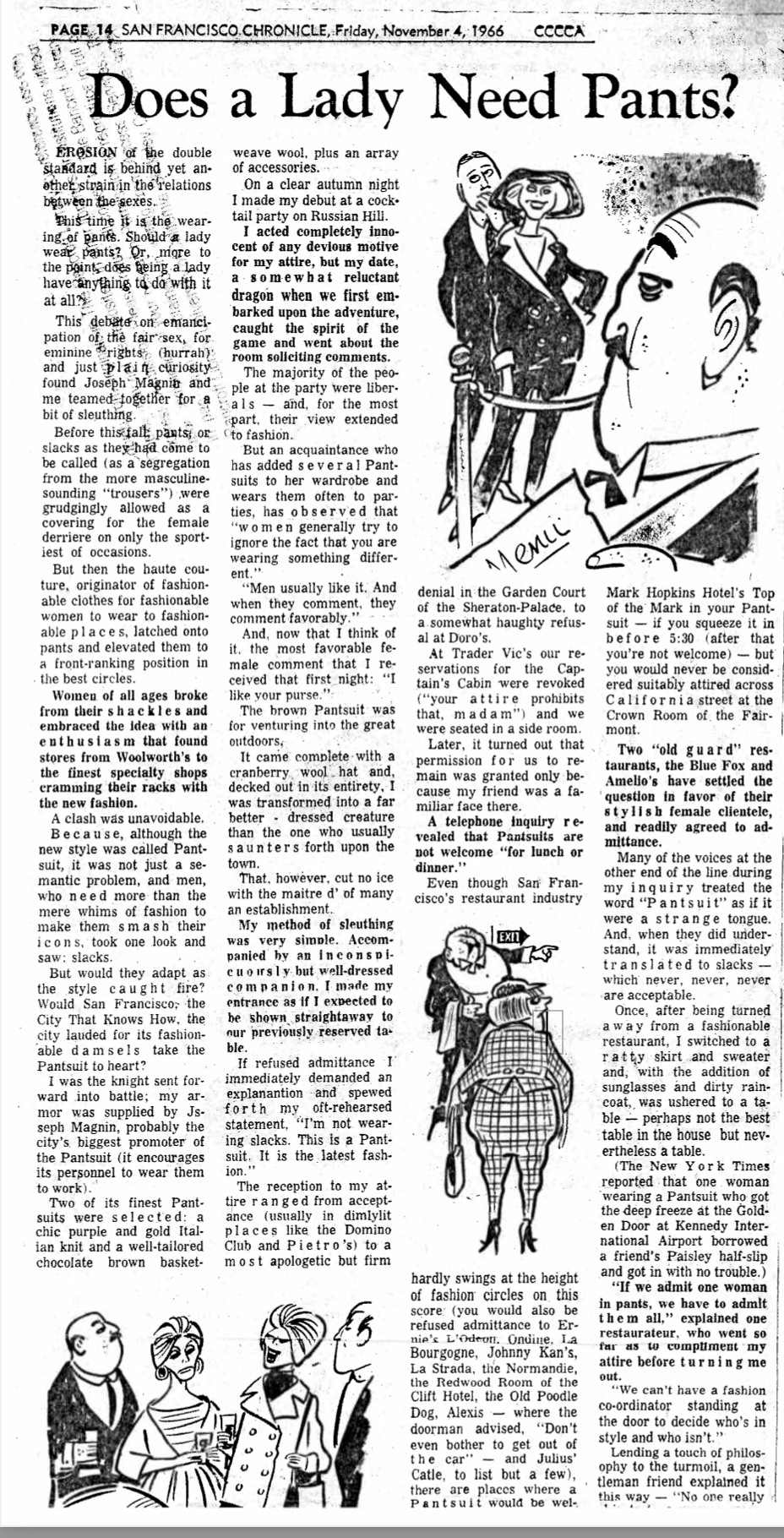
In November 1970, a reporter for the San Francisco Chronicle researched an article on maitre d’s at fancy restaurants refusing to seat women in pantsuits. At one establishment, the host explained to her, “If we admit one woman in pants, we have to admit them all.” Others cited “propriety” and “decorum” as reasons to deny entrance.

The criticisms surrounding Schumer’s decision sound a lot like the complaints against female politicians wearing pants. In 1993, Sens. Carol Moseley-Braun and Barbara Mikulski wore their pantsuits to the Senate floor.

Rather than remove the women, Martha Pope, the first female sergeant-at-arms, amended the written dress rules to specify pantsuits as appropriate business attire.

Independence and individuality

As sartorial standards change, what people wear in public becomes ground zero for hashing out new ideas of race, class and gender. Most often, wealthy white men are the arbiters of “appropriate” and “inappropriate.”

For more than a century, fashion has dramatically moved away from being a top-down regulatory process to being a means of individual expression. At a celebratory fashion show for the country’s bicentennial in 1976, former Miss America Bess Myerson told the audience, “Our clothing and our lifestyle have reflected each other, reinforcing our independence and individuality.”

She proclaimed that in 20th-century America, fashions were not “uniforms of rank or class, as they were in many old lands from which our people fled.”

Whether written down or just implicit, dress codes have meaning only when they are enforced. To me, the idea of policing the dress of adult professionals is simply outdated.

When John Fetterman wears gym shorts in public, I see him tapping into his personal identity and his political brand. Despite the buttoned-up outrage and jokes from Susan Collins about wearing a bikini on the Senate floor, fashion is born of culture, and culture is dynamic.

And cultural forces are almost impossible to beat back.

Africa’s Eswatini, One Of The Last Absolute Monarchies, Holds An Election Without Political Parties

Voters queue to cast their ballots at the voting station in Nhlangano, Eswatini, Sept. 20, 2013...(AP Photo/Mongie Zulu, File)

BY GERALD IMRAY

CAPE TOWN, SOUTH AFRICA (AP)
— The small southern African nation of Eswatini held elections Friday to decide part of the makeup of its Parliament, even as its extremely wealthy king retains absolute power, political parties are banned and elected representatives can merely advise a monarch whose family has reigned supreme for 55 years.

Eswatini, wedged between South Africa and Mozambique, is the last absolute monarchy in Africa and one of the few remaining in the world. King Mswati III, 55, has been the monarch since 1986, when he became ruler days after his 18th birthday. His father was king for 82 years before him, although Eswatini only gained independence from Britain in 1968.

It was formerly known as Swaziland.

Parliamentary elections are held every five years. Candidates for the lower chamber, the House of Assembly, and for the Senate cannot belong to political parties, which were banned in 1973, and are nominated at a local level before they face a popular vote.

Mswati III appoints a minority of House of Assembly members, and the majority are elected. He appoints a majority of the Senate, the prime minister and other key members of the government.

As king, or the “Ngwenyama” — which means lion — Mswati III is sometimes advised by a council but has executive and legislative powers under law in the country of 1.2 million people and makes decisions by decree.

A little over 500,000 people were registered to vote in Friday’s election, the electoral body said. The African Union and the regional Southern African Development Community bloc sent observers.

Mswati has faced increased pro-democracy protests in recent years, but activists demanding reform encountered a harsh crackdown from police and security forces under the king’s control in June 2021, with dozens killed.

The push for reform has continued, focusing primarily on allowing political parties and for the prime minister to be democratically elected.

Two members of parliament were jailed for calling for democratic reforms during the 2021 protests. They were convicted this year under an anti-terrorism law that rights groups say is only designed to suppress criticism of Mswati and halt the push for democracy.

The lawmakers, Mduduzi Bacede Mabuza and Mthandeni Dube, now face up to 20 years in prison, according to CIVICUS, a global alliance of civil society groups.

Mswati has been accused of living lavishly while Eswatini’s people struggle with widespread poverty, the world’s highest HIV infection rate per capita and a life expectancy of 57 years, one of the lowest in the world.

A 2008 report by Forbes magazine estimated Mswati’s wealth at $200 million. He owns private jets, a fleet of luxury cars and reportedly wore a suit beaded with diamonds to his 50th birthday celebration. The king has at least 15 wives and has been criticized for using public money to build palaces for them.

In its latest assessment, the World Bank estimated that more than half of Eswatini’s people live on less than $3.65 a day.

AP Africa news: https://apnews.com/hub/africa

Algeria Expands English-Language Learning As France’s Influence Ebbs

Schoolchildren attend a class in the Ben Omar district of Algiers, Algeria, on Sept. 19, 2023. (AP Photo, File)

ALGIERS, ALGERIA (AP) — More than a year after Algeria launched a pilot program to teach English in elementary schools, the country is hailing it as a success and expanding it in a move that reflects a widening linguistic shift underway in former French colonies throughout Africa.

Students returning to third and fourth grade classrooms this fall will participate in two 45-minute English classes each week as the country creates new teacher training programs at universities and eyes more transformational changes in the years ahead. Additionally, the country is strengthening enforcement of a preexisting law against private schools who operate primarily in French.

“Teaching English is a strategic choice in the country’s new education policy,” Education Minister Abdelkrim Belabed said last week, lauding the move as an immense success.

English is the world’s most widely spoken language, accounts for the majority of content on the internet and remains a lingua franca in business and science. And as France’s economic and political influence wanes throughout Africa, Algeria is among a longer list of countries gradually transitioning toward English as their main foreign language.

This year, neighboring Mali changed its constitution to remove French from its list of official languages and Morocco made English classes compulsory in high schools.

Algeria has more French speakers than all but two nations — France itself and the Democratic Republic of the Congo. Nearly 15 million out of the country’s 44 million people speak it, according to the International Organization of the French Language. Its officials frame English classes as a practical rather than political shift, noting the language’s importance in scientific and technical fields.

But questions about French’s position in Algerian society have long been polarizing, as teachers and former education policy officials acknowledge.

Retired high school principal Mohamed Arezki Ferdi believes Algeria should have begun the shift to English decades ago. The current initiative was launched by Algerian President Abdelmadjid Tebboune, who came to power in 2019. Previous leaders also tried to expand English but failed to overcome the French-educated elites who have long wielded power in the country.

“We lost a lot of time,” Ferdi said. “We should have introduced the English in primary schools when President (Abdelaziz) Bouteflika laid out his reform after coming to power in 1991. But at that time, French-speaking factions in Algeria had a lot of decision-making power in institutions.”

The expansion of English language learning comes as tensions increasingly flare between France and Algeria. The two share security interests over the political upheavals shaping contemporary West Africa. However, in recent years they have sparred repeatedly over immigration, extradition and how each country memorializes colonialism and the brutal war that resulted in Algeria’s independence in 1962.

Algeria plans to expand its current program to fifth grade next year. It will continue to instruct students in French for three hours each week in elementary schools.

When English-language learning was introduced last year, Algerian officials reaffirmed their commitment to French and said it would continue to be taught widely. But in remarks this week at the beginning of the school year, Kamal Bedari, Algeria’s minister of Higher Education, said expanding the program was to enable elementary school students to take technical courses later on in English — not French.

Though few dispute that English is important, some worry about how Algeria is implementing such a shift and caution against declaring victory too soon. Ahmed Tessa, a former adviser to Algeria’s Ministry of Education, believes getting students to master English can only happen gradually and will likely require more than simply adding classes.

“We need to get back to basics,” he said. “This is no small task.”

Regardless of how quickly schools transition to English, elsewhere signs of a pushback against French are clear.

Authorities have slowly replaced French with English in the official titles of various government ministries. And on his trip last year to Algiers, the country had French President Emmanuel Macron provide remarks from a lectern noting his title and the date in English and Arabic, one of Algeria’s two official languages along with indigenous Tamazight.

Last living Suspect In 1996 Drive-By Shooting Of Tupac Shakur Indicted In Las Vegas On Murder Charge

This booking photo provided by the Las Vegas Police Department shows Duane "Keffe D." Davis, Friday, September 29, 2023 in Las Vegas...(Las Vegas Police Department via AP) 

BY RIO YAMAT AND KEN RITTER

LAS VEGAS (AP)
— A man who prosecutors say ordered the 1996 killing of rapper Tupac Shakur was arrested and charged with murder Friday in a long-awaited breakthrough in one of hip-hop’s most enduring mysteries.

Duane “Keffe D” Davis has long been known to investigators as one of four suspects identified early in the investigation. He isn’t the accused gunman but was described as the group’s ringleader by authorities Friday at a news conference and in court. In Nevada you can be charged with a crime, including murder, if you help someone commit the crime.

“Duane Davis was the shot caller for this group of individuals that committed this crime,” said Las Vegas police homicide Lt. Jason Johansson, “and he orchestrated the plan that was carried out.”

Davis himself has admitted in interviews and in his 2019 tell-all memoir, “Compton Street Legend,” that he provided the gun used in the drive-by shooting.

Authorities said Friday that Davis’ own public comments revived the investigation.

Davis, now 60, was arrested early Friday while on a walk near his home on the outskirts of Las Vegas, hours before prosecutors announced in court that a Nevada grand jury had indicted the self-described “gangster” on one count of murder with a deadly weapon. He is due in court next week.

The grand jury also voted to add a sentencing enhancement to the murder charge for gang activity that could add up to 20 additional years if he’s convicted.

Hundreds of pages of transcripts released Friday provide a view into the first month of grand jury proceedings, which began in late July with testimony from former associates of Davis, friends of Shakur and a slate of retired police officers involved in the case early on. Their testimony painted a picture for the jurors of a deep, escalating rift between Shakur’s music label Death Row Records and Bad Boy Records, which had ties to Davis and represented Shakur’s rap rival, Biggie Smalls.

“It started the whole West Coast/East Coast” rivalry that primarily defined the hip-hop scene during the mid-1990s, one of Davis’ former associates testified.

The first-ever arrest in the case came after Las Vegas police in mid-July raided Davis’ home in the nearby city of Henderson for items they described at the time as “concerning the murder of Tupac Shakur.”

Davis denied an interview request Friday from jail, and court records don’t list an attorney who can comment on his behalf. Phone and text messages to Davis and his wife on Friday and in the months since the July 17 search weren’t returned.

In a statement Friday, Sekyiwa “Set” Shakur, the rapper’s sister, described the arrest as a victory.

“This is no doubt a pivotal moment. The silence of the past 27 years surrounding this case has spoken loudly in our community,” she said. “It’s important to me that the world, the country, the justice system, and our people acknowledge the gravity of the passing of this man, my brother, my mother’s son, my father’s son.”

On the night of Sept. 7, 1996, Shakur was in a BMW driven by Death Row Records founder Marion “Suge” Knight. They were waiting at a red light near the Las Vegas Strip when a white Cadillac pulled up next to them and gunfire erupted.

Shakur was shot multiple times and died a week later at the age of 25.

Davis, in his memoir, said he was in the front passenger seat of the Cadillac and had slipped a gun into the back seat, from where he said the shots were fired.

He implicated his nephew, Orlando “Baby Lane” Anderson, saying he was one of two people in the backseat. Anderson, a known rival of Shakur, had been involved in a casino brawl with the rapper shortly before the shooting.

“Little did anyone know that this incident right here would ultimately lead to the retaliatory shooting and death of Tupac Shakur,” said Johansson, the police lieutenant.

Anderson died two years later. He denied any involvement in Shakur’s death.

Emails seeking comment from two lawyers who have previously represented Knight were not immediately returned. Knight was grazed by a bullet fragment in the shooting but had only minor injuries. He is serving a 28-year prison sentence in California for an unrelated voluntary manslaughter charge.

On the night of July 17, Las Vegas police quietly surrounded the home where Davis lives with his wife, Paula Clemons. Police lapel video obtained by The Associated Press showed SWAT officers detaining a man and his wife outside the home lit up by a swirl of red and blue lights after announcing their presence on a bullhorn. The couple’s faces are blurred in the videos.

Police reported collecting multiple computers, a cellphone and hard drive, a Vibe magazine that featured Shakur, several .40-caliber bullets, two “tubs containing photographs” and a copy of Davis’ memoir.

Greg Kading, a retired Los Angeles police detective who spent years investigating the Shakur killing and wrote a book about it, said he’s not surprised by Davis’ arrest.

“He put himself squarely in the middle of the conspiracy,” Kading said, adding that Davis himself gave Las Vegas police “the ammunition and leverage to move forward.”

Kading said he had also anticipated the murder charge, because Davis’ public comments showed the crime was premeditated.

“All the other direct conspirators or participants are all dead,” Kading said. “Keefe D is the last man standing among the individuals that conspired to kill Tupac.”

The rapper’s death came as his fourth solo album, “All Eyez on Me,” remained on the charts, with some 5 million copies sold. Nominated six times for a Grammy Award, Shakur is still largely considered one of the most influential and versatile rappers of all time.

Associated Press writer Andrew Dalton contributed reporting from Los Angeles.

Thursday, September 28, 2023

How German Artists Helped The Nation Remake Itself After Hitler


BY MICHAEL DIRDA

Following the destruction of Adolf Hitler’s totalitarian Third Reich, how did Germany manage to remake itself into a democratic nation? In “After the Nazis: The Story of Culture in West Germany,” the historian Michael H. Kater contends that the arts deserve much of the credit. Kater’s new book — the latest among his many distinguished studies of 20th-century German culture and politics — focuses on West Germany, more formally the Federal Republic of Germany, between 1945 and 1990, the year when it was reunited with East Germany after the fall of the latter’s communist government. During these years, the FRG needed to rebuild its cities, political system and economy while also confronting — or sometimes refusing to confront — vestiges of Hitler’s National Socialism.

That today’s Germany is so highly respected — even as it navigates continued threats from 21st-century forms of racism and fascist ideology — can be largely attributed, Kater says, to the novelists, artists, critics, musicians, dramatists, journalists and filmmakers who refused to allow the nation to minimize, excuse or forget the Holocaust.

Throughout, the German-born Kater pulls no punches. Chapter 1 begins this way:

“On Tuesday, May 1, 1945, I was drying a small collection of Hitler stamps on the windowsill of my grandfather’s house in a small village near Bremen. … All of seven years old, I had been looking forward to joining the Hitler Youth like the older neighborhood boys whom I played with and admired. … Hitler’s portrait — a lithograph, black on white — hung in our dining room. Sitting underneath it, I loved listening to the march music on the radio, drumming to it on the tabletop.”

That day, however, the music was interrupted by a voice somberly announcing: “Our Führer Adolf Hitler has fallen in the defense of Berlin. Heil Hitler!” This was followed by the singing of the national anthem, “Deutschland, Deutschland uber alles.” Kater remembers being utterly bewildered.

After Germany’s surrender to the Allies, some 250,000 die-hard Nazis were initially placed in internment camps. As Kater recalls: “When I was allowed to visit a friend of my mother’s in Hanover in 1948, her husband, a former SS medical officer just returned from a British internment camp, put me and his children in a car. He took us to the railway station and pointed to some miserable-looking, badly dressed people hurrying to and fro. ‘See, those are Jews,’ he said to us, ‘filthy vermin. Unfortunately we did not remove enough of them.’ He was entirely unrepentant.”

Over the next 500 pages, Kater, a professor emeritus at Canada’s York University, repeatedly demonstrates that such antisemitism long persisted among many Germans. Programs of “denazification” were halfhearted, and numerous former Nazis easily obscured their past as they segued into positions of influence and power in the new Federal Republic. Many ordinary people retained their admiration, even reverence, for the führer. According to Kater, “As late as the mid 1950s, 42 percent of all Germans thought Hitler to have been one of the greatest German statesmen, had he not started the war.”

While the Nuremberg trials of the Nazi elite were taking place in 1945 and 1946, conservative German newspapers and media maintained that Hitler and his lieutenants were alone responsible for the Holocaust. Few recognized the culpability of the nation as a whole. Instead they pointed out that all of Germany had suffered. Surely, these pundits argued, Germans and Jews were both victims of the Nazi regime.

As Kater shows, all these comforting lies, moral equivocations and delusions were gradually exposed and dismantled by the postwar era’s cultural intelligentsia, largely through works of art and investigative reporting. But it took a long time. As Kater writes, “By the mid-1950s, covering the past up in silence was helping Germans to concentrate on the economic and social reconstruction of the country and forget their guilt, even though … this was morally questionable and futile in the long run.”

In the 1950s and the two following decades, artists led the attack on that willed amnesia. Rather than accept the complacency and conspicuous consumption brought about by West Germany’s “economic miracle,” they probed the society’s sore spots, questioned their families about what they had done or not done during the war, reopened the old wounds. Every sort of authoritarianism or censorship was utterly rejected as fascistic. While the elders yearned for art that was safe, traditional and nonconfrontational, the young weren’t going to let that happen.

Over the course of his book, Kater discusses the celebrated Gruppe 47 collective of writers, the new German cinema, experimental music, the dadaist “happenings” of the Fluxus movement, controversial plays and TV series. The 1950s, ’60s, and ’70s were the heyday of writers Heinrich Böll and Günter Grass (both Nobel laureates), as well as Ingeborg Bachmann, Martin Walser and the young Hans Magnus Enzensberger. The world-famous composers Hans Werner Henze and Karlheinz Stockhausen explored atonal and electronic music. Avant-garde filmmakers included Werner Herzog, Wim Wenders and Rainer Werner Fassbinder. Few artists were more innovative, not to say outrageous, than Joseph Beuys or his slightly more sedate colleagues Gerhard Richter and Anselm Kiefer. In these years, Wieland Wagner restaged his grandfather Richard Wagner’s operas, stressing their universality instead of Teutonic grandiosity, and Rolf Hochhuth’s searing play “The Deputy” exposed the connections between the Vatican and the Third Reich.

By the 1960s, intellectuals regularly morphed into political activists. One highly esteemed journalist, Ulrike Meinhof, remade herself into the leader of the Red Army terrorist group known as the Baader-Meinhof Gang. As Kater writes, Meinhof and “all members of the terrorist units were incensed by the presence of former National Socialists in the Federal Republic’s political and industrial, social and educational structures.” The group kidnapped, and eventually killed, the rich industrialist Hanns Martin Schleyer because of his “stellar Nazi record: Hitler Youth, Nazi student administrator, and SS.”

As a survey of West German culture, “After the Nazis” also discusses the spurious Hitler diaries; reflects on the popular but tacitly exculpatory TV series “Heimat” (“Homeland”), which tracks a small-town German family during the Nazi era; touches on the emerging women’s movement; and devotes several pages to the horrific mistreatment of the Turkish and East European “guest workers” who were essential to Germany’s “economic miracle.”

While Kater rightly extols the artists and intellectuals who both “helped Germany to defeat the spirit of Nazism” and acted as contrarian gadflies during the tenures of Chancellors Konrad Adenauer and Willy Brandt, as well as other political leaders, his book’s last chapter sounds a more disturbing note. Kater writes that by the late 1970s and 1980s, the momentum of change had started to slow: “As Nazi threats faded into the background, however, so did West Germany’s cultural scene begin to lose some of its former urgency, indeed quality, and the once innovative writers, artists and musicians came to resemble pillars of society.” Some conservative scholars now wanted “to relativize and historicize the Third Reich” — to liken it to other historic phenomena — “and thereby lift the moral stain.” In this view, the Holocaust wasn’t “unique”; there had been plenty of similar atrocities in the world’s past. Incredibly, the historian Ernst Nolte asserted that in Auschwitz, “not just Jews but also hard-working SS guards weighed down by their heavy burden could properly be regarded as ‘victims.’” Around this time, Nazi tokens and memorabilia grew fashionable among young people: The hip took to wearing swastikas on their jeans. Hans-Jurgen Syberberg’s 1977 epic, “Our Hitler,” as this Wagnerian experimental film is called in English, sympathetically mythologized its subject.

So, as illuminating as “After the Nazis” is, I wish Kater had continued his account past 1990 to show us more fully the development of today’s German nation. Might he be at work on a follow-up volume? Whatever the case, this book’s coda does mention, albeit only in passing, a certain chemical physicist with a doctorate from Leipzig named Angela Merkel.

READ ORIGINAL STORY HERE

Nigerian Couriers Central To Brazil-West Africa Cocaine Route


BY GAVIN VOSS

Small trafficking groups embedded in Nigeria’s expansive diaspora play a significant role in moving cocaine between Latin America and consumer markets, the United Nations drugs and crime agency reports.

Nigerian networks employ couriers to move small amounts of cocaine on commercial flights, mostly through Brazil, the United Nations Office on Drugs and Crime (UNODC) highlighted in a September 25 report titled “Organized Crime in Nigeria: A Threat Assessment.”

The cocaine moved by Nigerian couriers is sourced from Brazilian criminal groups and exits the continent through São Paulo, Brazil’s Guarulhos International Airport. From there, the authors found, couriers fly to Nigeria’s largest city, Lagos, with some passing through other African countries like Ethiopia or Benin first.

After receiving the drug in Nigeria, Africa’s most populous country, trafficking groups use more couriers to distribute cocaine to other African nations, Asia, and Europe. In this way, the report stated, “Nigeria appears to play an increasing role in the consolidation of cocaine entering the subregion and in the distribution to other countries.”

The amounts of cocaine moved using air couriers are much smaller than multi-ton consignments found in maritime shipping containers: a single courier can transport quantities of up to 10 kilograms, but often less than one kilogram.

Arrest statistics, however, indicate that Nigerian networks employ hundreds of couriers, meaning they are able to move significant quantities, albeit in piecemeal fashion.

In Brazil, Nigerians were the most frequently arrested foreign nationality for drug trafficking in 2018 and 2019, the UNODC found. Worldwide, authorities in at least 70 countries arrested Nigerian nationals for drug trafficking between 2010 and 2019. Nigerians were also the largest non-Latin American and European nationality arrested in European airports between 2016 and 2020 for the crime.
InSight Crime Analysis

Nigerian cocaine couriers have become crucial to the expanding transnational cocaine trade by finding holes in Latin American groups’ global distribution systems, pinpointing unmet demand and creating new markets.

Drug trafficking networks in the Nigerian diaspora are small, mainly consisting of members who are not committed to the trade in the long term, Ted Leggett, a research officer at UNODC and one of the authors of the report, told InSight Crime.

“There isn’t a mafia-type structure to it. The networks are small-scale and organic. As soon as they make enough money, they get out of the drug trade and go into other forms of business,” Leggett said.

These courier networks hire vulnerable or impoverished people looking to earn money. This includes not only Nigerians, but Venezuelans living in Brazil. Couriers swallow small amounts of the drug or carry it concealed in their luggage. They know the ins and outs of security at each airport, and even allow some couriers to be captured to distract law enforcement while others pass through, Leggett told InSight Crime.

These features can make it hard for authorities to target them, as their membership is fluid, and with each arrest, another courier will simply take their place.

In São Paulo, these networks cannot compete with the dominance of the First Capital Command (Primeiro Comando da Capital - PCC). The PCC are Brazil’s main cocaine traffickers and the criminal hegemon in the city. They even control cocaine transit into Brazil from Bolivia.

Instead, Nigerian courier groups have come to agreements with the PCC. Nigerian cocaine traffickers have been a prominent part of the West African route since at least 2005, the report highlighted, meaning they hold the knowledge and connections necessary to be efficient traffickers and valuable partners to the PCC.

Through Nigeria’s massive diaspora, which Nigerian media outlets estimate could consist of 15 million people, Nigerian traffickers are also well-connected to microtrafficking operations in African and Asian cities. This allows them to pinpoint possible new consumers at the street level, providing them with cocaine and other drugs.

“They fill gaps in the global cocaine distribution network,” Leggett told InSight Crime. “It's the invisible hand of the market in action.”

Leggett provided the example of South Africa, where cocaine traffickers embedded in the Nigerian community have created a substantial cocaine consumption market in cities around the country, especially among sex workers.

The courier networks, which are an example of opportunistic, low-level organized crime, are just part of the cocaine trafficking picture in Africa. The continent saw a 400% increase in cocaine seizures in 2021, spurred by trafficking in shipping containers and on private vessels, in addition to air couriers.

“The point of least resistance is usually the place that is least capable of absorbing the damage. West Africa is a perfect example,” Leggett told InSight Crime.

    READ ORIGINAL STORY HERE

A Solution To America’s K-12 STEM Teacher Shortage: Endowed Chairs


BY GERARD ROBINSON

Ever since the Soviet Union launched Sputnik into orbit on Oct. 4, 1957, America has been struggling to recruit and retain STEM teachers in its public middle and high schools.

In the 2017-2018 school year, approximately 100,000 teacher jobs in STEM – or science, technology, engineering and mathematics – went unfilled at the high school level. At the middle school level, there were about 150,000 unfilled STEM educator jobs.

The situation has been getting progressively worse over the past decade or so. For instance, in the 2011-2012 school year, 19% of public schools were unable to fill a teaching position for biology or life sciences. By the 2020-2021 school year, that number had grown to 31%. The situation was similar for other subjects, going from 19% to 32% for mathematics, and 26% to 47% for physical sciences, such as physics, geology and engineering.

Science shortages were a problem even before Sputnik, but the launch served as a wake-up call. Three months afterward, President Dwight D. Eisenhower stated during his Special Message to the Congress on Education that federal action was necessary to educate more science and mathematics teachers.

As a professor of education policy – and also as a former state secretary of education in Virginia – I have examined the STEM teacher shortage from multiple vantage points. In a September 2023 policy paper, a colleague and I recommend that in order to solve America’s STEM educator shortage, elected officials and education leaders should adopt something that is widely used in higher education – an endowed chair position for STEM teachers.

We think endowed chairs have the potential to retain and attract more STEM educators at the K-12 level, but it requires a willingness to rethink the ways that schools employ STEM educators.

What’s behind the gap?

Two factors contribute to so many unfilled vacancies in STEM education:

1. There are fewer college students graduating with a bachelor’s degree in education that ever before.

Between 1959-1976, bachelor’s degrees in education were the most popular college major in the United States, and they accounted for about 20% of all degrees. Between 1975-2021, the percentage of students majoring in education fell from 17% to 4%.

2. STEM graduates can earn more money outside of education.

When STEM majors go into a STEM career, they will earn, on average, US$101,100. When STEM graduates become a math, computer science or science teacher, they will earn, on average, only a fraction of that amount – roughly $60,000.

This salary gap between STEM professionals and STEM educators is what is known as the STEM teacher “wage penalty.”

According to a national survey of teacher salaries in 2017-18, average teacher salaries never exceeded $100,000,, regardless of years of experience.

But this only tells a portion of the STEM teacher salary story. In 2021, K-12 teachers’ weekly salary was only $1,348 – about $660 less than the $2,009 earned weekly by other college graduates.

Prior efforts to close the gap

Since developing a strong STEM workforce is vital to the nation’s security and economic well-being, several U.S. presidents have used their position to advance a STEM education agenda.

For example, when the Soviet Union launched Sputnik, Eisenhower and Congress came to realize that the nation needed to focus on what takes place in the classroom space – not just outer space.

The Senate and House passed the National Defense Education Act of 1958, and Eisenhower signed it into law on Sept. 2, 1958.

This set in motion a national STEM education agenda for American colleges and K-12 schools for decades to come.

Fifty-three years later, President Barack Obama utilized his 2011 State of the Union address to advance the national STEM agenda. “This is our generation’s Sputnik moment,” he said. “And over the next 10 years, with so many baby boomers retiring from our classrooms, we want to prepare 100,000 new teachers in the fields of science and technology and engineering and math.”

Through the leadership of 100Kin10, now named Beyond100K, the initiative exceeded the goal in 2021.

But the goal of the 100,000 STEM teacher campaign was to narrow the gap, not end it.

A shortage of STEM teachers remains. According to a survey of 53 states and territories, 39 states, the District of Columbia and the U.S. Virgin Islands had teacher vacancies in all subjects, STEM disciplines included, as of Feb 9, 2023. One additional reason for the current shortage is that public schools lost approximately 7% of their teachers – 233,000 instructors – between 2019-2021, which included STEM teachers.

Currently, President Joe Biden is promoting STEM education programs for teachers, the Department of Education has dedicated $120 billion to support STEM, and the National Science Foundation is supporting teacher fellowships.

The endowed chair as a potential solution

Federal investments in programs and fellowships to produce more STEM teachers are good. But those alone will not be enough to retain and attract the quality STEM educators we need.

That’s why a colleague and I recommend endowed chairs for K-12 educators.

Traditionally, an endowed chair is a prestigious faculty position funded through annual spending from a university’s endowment fund.

The interest earned on the endowment will partially or fully fund the salary of the position for as long as the university exists. Endowed chairs are awarded to those who are the best in their field.

The benefit of an endowed chair is that it will be paid for decades to come by the interest on investment. In our paper, we suggest that K-12 schools could use endowed chairs to support a K-12 STEM teacher’s salary, benefits and professional development, all the while saving money for the district and state.

If structured right, the interest on the endowment will pay a teacher’s salary and benefits, something the district would subsequently not have to pay. The endowment can be used to purchase STEM supplies. The money saved by the district can be used to invest in another teacher. The money could come from private individuals, corporations or foundations.

An endowed chair could also provide funding for teachers and students to have access to state-of-the-art learning technology. As part of the endowed chair contract, a teacher can participate in a fully paid externship at a STEM-focused public or private sector company during the summer months. The goal would be to bring to the classroom the experiences and insights the teacher learned from the externship.

An endowed STEM chair salary may never outpace what educators could earn if they entered the private market. But it can potentially help elevate their position and, perhaps, enable educators to make a salary that would be higher than what it would otherwise be.

READ ORIGINAL STORY HERE
WNBA Player Chiney Ogwumike Named To President Biden’s Council On African Diplomacy

FILE - Los Angeles Sparks forward Chiney Ogwumike (13) celebrates after a three-pointer during the second half of a WNBA basketball game against the Phoenix Mercury in Los Angeles, Friday, May 19, 2023. Ogwumike has always been passionate about her Nigerian heritage. Now she’s getting a chance to help all of Africa as a member of the inaugural President’s Advisory Council on African Diaspora Engagement in the United States, the White House announced Tuesday, Sept. 26, 2023. (AP Photo/Ashley Landis, File)

BY DOUG FEINBERG

WASHINGTON (ASSOCIATED PRESS) - Chiney Ogwumike has always been passionate about her Nigerian heritage.

Now she’s getting a chance to help all of Africa as a member of the inaugural President’s Advisory Council on African Diaspora Engagement in the United States, the White House announced Tuesday.

“Best way to describe it, it feels like its a calling of a lifetime,” Ogwumike told The Associated Press in a phone interview Tuesday. “It’s something so authentic to who I am and what I stand for and what I want to do for service. You can be exponentially impactful — calling of a lifetime for me.”

The 31-year-old Stanford graduate and WNBA player started her public advocacy for African women when she and her sister Nneka launched a UNICEF fundraiser in 2014 following the kidnapping of Nigerian girls by Boko Haram.

“It creates opportunities for kids and young people that look like m so that they can transform their lives the same way I experienced it,” Ogwumike said. “I had the best of both worlds, with Nigerian determination and American opportunities that are endless. It’s a pathway for youth to change their lives to empower themselves.”

The council, which was first announced by Vice President Kamala Harris at the 2022 U.S.-Africa Leaders Summit, will be chaired by Rev. Dr. Silvester Beaman of the African Methodist Episcopal Church. Other council members, who will serve until 2025, include Oscar-winning actress Viola Davis.

Ogwumike, who is an NBA analyst for ESPN, is the youngest female on the council.

They will provide invaluable guidance to reinforce cultural, social, political, and economic ties between the U.S. and Africa, and promote trade, investment, and educational exchanges between the United States and Africa.

Ogwumike spoke at the UN General Assembly last year and heard about the council and wanted to be part of it.

“I talked about the power of sports and how it could transform the world,” she said. “I submitted my resume and had my fingers crossed.”

Food Prices Are Rising As Countries Limit Exports. Blame Climate Change, El Nino And Russia's War

(AP Photo/Brian Inganga)

BY ANIRUDDHA GHOSAL, EVELYNE MUSAMBI AND JOEAL CALUPITAN

How do you cook a meal when a staple ingredient is unaffordable?

This question is playing out in households around the world as they face shortages of essential foods like rice, cooking oil and onions. That is because countries have imposed restrictions on the food they export to protect their own supplies from the combined effect of the war in Ukraine, El Nino’s threat to food production and increasing damage from climate change.

For Caroline Kyalo, a 28-year-old who works in a salon in Kenya’s capital of Nairobi, it was a question of trying to figure out how to cook for her two children without onions. Restrictions on the export of the vegetable by neighboring Tanzania has led prices to triple.

Kyalo initially tried to use spring onions instead, but those also got too expensive. As did the prices of other necessities, like cooking oil and corn flour.

“I just decided to be cooking once a day,” she said.

Despite the East African country’s fertile lands and large workforce, the high cost of growing and transporting produce and the worst drought in decades led to a drop in local production. Plus, people preferred red onions from Tanzania because they were cheaper and lasted longer. By 2014, Kenya was getting half of its onions from its neighbor, according to a U.N. Food Agriculture Organization report.

At Nairobi’s major food market, Wakulima, the prices for onions from Tanzania were the highest in seven years, seller Timothy Kinyua said.

Some traders have adjusted by getting produce from Ethiopia, and others have switched to selling other vegetables, but Kinyua is sticking to onions.

“It’s something we can’t cook without,” he said.

Tanzania’s onion limits this year are part of the “contagion” of food restrictions from countries spooked by supply shortages and increased demand for their produce, said Joseph Glauber, senior research fellow at the International Food Policy Research Institute.

Globally, 41 food export restrictions from 19 countries are in effect, ranging from outright bans to taxes, according to the institute.

India banned shipments of some rice earlier this year, resulting in a shortfall of roughly a fifth of global exports. Neighboring Myanmar, the world’s fifth-biggest rice supplier, responded by stopping some exports of the grain.

India also restricted shipments of onions after erratic rainfall — fueled by climate change — damaged crops. This sent prices in neighboring Bangladesh soaring, and authorities are scrambling to find new sources for the vegetable.

Elsewhere, a drought in Spain took its toll on olive oil production. As European buyers turned to Turkey, olive oil prices soared in the Mediterranean country, prompting authorities there to restrict exports. Morocco, also coping with a drought ahead of its recent deadly earthquake, stopped exporting onions, potatoes and tomatoes in February.

This isn’t the first time food prices have been in a tumult. Prices for staples like rice and wheat more than doubled in 2007-2008, but the world had ample food stocks it could draw on and was able to replenish those in subsequent years.

But that cushion has shrunk in the past two years, and climate change means food supplies could very quickly run short of demand and spike prices, said Glauber, former chief economist at the U.S. Department of Agriculture.

“I think increased volatility is certainly the new normal,” he said.

Food prices worldwide, experts say, will be determined by the interplay of three factors: how El Nino plays out and how long it lasts, whether bad weather damages crops and prompts more export restrictions, and the future of Russia’s war in Ukraine.

The warring nations are both major global suppliers of wheat, barley, sunflower oil and other food, especially to developing nations where food prices have risen and people are going hungry.

An El Nino is a natural phenomenon that shifts global weather patterns and can result in extreme weather, ranging from drought to flooding. While scientists believe climate change is making this El Nino stronger, its exact impact on food production is impossible to glean until after it’s occurred.

The early signs are worrying.

India experienced its driest August in a century, and Thailand is facing a drought that has sparked fears about the world’s sugar supplies. The two are the largest exporters of sugar after Brazil.

Less rainfall in India also dashed food exporters’ hopes that the new rice harvest in October would end the trade restrictions and stabilize prices.

“It doesn’t look like (rice) prices will be coming down anytime soon,” said Aman Julka, director of Wesderby India Private Limited.

Most at risk are nations that rely heavily on food imports. The Philippines, for instance, imports 14% of its food, according to the World Bank, and storm damage to crops could mean further shortfalls. Rice prices surged 8.7% in August from a year earlier, more than doubling from 4.2% in July.

Food store owners in the capital of Manila are losing money, with prices increasing rapidly since Sept. 1 and customers who used to snap up supplies in bulk buying smaller quantities.

“We cannot save money anymore. It is like we just work so that we can have food daily,” said Charina Em, 32, who owns a store in the Trabajo market.

Cynthia Esguerra, 66, has had to choose between food or medicine for her high cholesterol, gallstones and urinary issues. Even then, she can only buy half a kilo of rice at a time — insufficient for her and her husband.

“I just don’t worry about my sickness. I leave it up to God. I don’t buy medicines anymore, I just put it there to buy food, our loans,” she said.

The climate risks aren’t limited to rice but apply to anything that needs stable rainfall to thrive, including livestock, said Elyssa Kaur Ludher, a food security researcher at the ISEAS-Yusof Ishak Institute in Singapore. Vegetables, fruit trees and chickens will all face heat stress, raising the risk that food will spoil, she said.

This constricts food supplies further, and if grain exports from Ukraine aren’t resolved, there will be additional shortages in feed for livestock and fertilizer, Ludher said.

Russia’s July withdrawal from a wartime agreement that ensured ships could safely transport Ukrainian grain through the Black Sea was a blow to global food security, largely leaving only expensive and divisive routes through Europe for the war-torn country’s exports.

The conflict also has hurt Ukraine’s agricultural production, with analysts saying farmers aren’t planting nearly as much corn and wheat.

“This will affect those who already feel food affordability stresses,” Ludher said.

Ghosal reported from Hanoi, Vietnam, Musambi from Nairobi, Kenya, and Calupitan from Manila, Philippines.

Associated Press climate and environmental coverage receives support from several private foundations. See more about AP’s climate initiative here. The AP is solely responsible for all content.

Wednesday, September 27, 2023

Hip-hop On Trial: When Can A Rapper’s Lyrics Be Used As Evidence In A Criminal Case?


BY TAIFHA NATALEE ALEXANDER

When police arrested Nevada rapper Kenjuan McDaniel on a murder charge in August 2023, they cited a music video he posted on YouTube that they say includes details of a 2021 killing that had not been made public.

McDaniel, who uses the social media handle TheBiggestFinn4800, had previously been considered a person of interest in the case. His lyrics included: “Parked the car / double back on feet / the smartest way to slide / drove in / double lock yo man / make sure you get yo bod’.”

As a critical race theory scholar who researches systems of oppression, I know McDaniel’s case is not unique. Lawyers have used rappers’ lyrics as evidence in criminal cases since shortly after the rise of gangsta rap in the late 1980s.

Rap lyrics were introduced as evidence in criminal cases against San Francisco Bay Area rapper Andre “Mac Dre” Hicks in 1992, Snoop Dogg in 1996, McKinley “Mac” Phipps, Jr. in 2000, Lil Boosie in 2012, Drakeo the Ruler in 2016, 6ix9ine in 2019 and Young Thug in 2022.

In fact, researchers at the University of Richmond documented at least 500 cases from 2009 to 2019 where rap lyrics were introduced as evidence in criminal trials.

Rap lyrics as criminal evidence

Both federal and state courts have established rules that require the use of a balancing test to determine whether to exclude evidence.

If prosecutors can show that a rapper’s lyrics establish motive, intent or identity related to an alleged crime, then most judges will allow for the evidence to be used.

Judges are expected to balance whether the proof outweighs any prejudicial value – or tendency to unfairly or improperly influence the jury. For example, under this balancing test, a defendant rapper’s lyrics should be excluded if the lyrics will do more to poison the jury against the defendant than to establish their connection to a specific crime.

But case law regarding using rap lyrics as evidence of a crime can vary from state to state, and judge to judge.

In 2014, the New Jersey Supreme Court found that the introduction of a defendant rapper’s lyrics should not have been admitted into evidence, because the lyrics were general in nature and did not demonstrate motive or intent. Instead, the court found, the lyrics served to activate particular biases the jury had against rap and, as a result, the defendant rapper.

In 2020, the Maryland Court of Appeals decided that a defendant rapper’s lyrics – despite also lacking specific details related to the alleged crime – could be admitted as evidence. According to the judge, the lyrics intended to intimidate witnesses prior to the trial. To be clear, the defendant rapper recorded the lyrics from a detention center 10 months after the alleged murder he was being held for, and three weeks before his trial. Essentially, the court focused more on the timing of the lyrics in relationship to the trial and a completely new alleged crime, not the commission of the crime the rapper was being held for, or the substance of his recorded lyrics.

Criminalizing Black artists

Using rap lyrics as evidence in criminal cases is problematic not only because it can deny a defendant a fair trial, but also because many lyrics are creative, metaphorical works that have double meanings or are based on fictional experiences.

In 1991, federal prosecutors demonstrated that a defendant rapper knowingly possessed and intended to distribute drugs that he was carrying in two suitcases upon his arrest. During the trial, the defendant rapper claimed he was not aware of the contents of the suitcase. Prosecutors introduced the defendant rapper’s notebook, which included the following lyrics: “Key for key. Pound for pound. I’m the biggest dope dealer and I serve all over town … ”

During the trial, prosecutors submitted evidence to demonstrate that the word “key” was common slang used in cocaine trafficking to refer to kilogram. In this instance, the defendant rapper’s lyrics were accepted as autobiographical, and not metaphorical. They qualified as one of the only pieces of evidence to establish criminality.

While there have been hundreds of cases in the past 30 years brought against defendant rappers to use their rap lyrics as evidence of a crime, similar charges have not been brought against creatives in other genres at the same rate. Some scholars have suggested that this difference in treatment is, in part, a result of rap lyrics oftentimes being excluded from certain First Amendment protections.

As a result, allowing a rap artist’s lyrics to be used as evidence of a crime risks weaponizing an art form dominated by Black and other people of color. As it is, Black Americans are already incarcerated in state prisons at nearly five times the rate as white Americans.

Protecting artistic expression

In recent years, lawmakers in California and New York have sought to limit the use of rap lyrics in evidence of criminality.

California passed a bill in September 2022 that would ban lyrics from being cited in court cases unless prosecutors can illustrate that the words are directly relevant to the case in question and won’t “inject racial bias into the proceedings.” The New York bill was introduced in January 2023 and aims to leverage statewide free speech protections to ensure criminal defendants are tried based on evidence and not on their artistic works. That bill is currently stalled.

In July 2022, Democratic Rep. Hank Johnson of Georgia introduced the Restoring Artistic Protection Act, or RAP Act. The federal legislation aims to limit the admissibility of artistic expression as evidence.

Since most state evidence law is based on federal rules of evidence, the RAP Act could create a new standard in most states for limitation of rap lyrics as evidence of a crime. However, it has been awaiting review in the House Subcommittee on Crime, Terrorism, and Homeland Security.

Case for caution

English jurist William Blackstone asserted in the 1760s that “all presumptive evidence of felony should be admitted cautiously: for the law holds, that it is better that 10 guilty persons escape, than that one innocent suffer.”

I believe admitting rap lyrics as evidence violates constitutional free speech considerations – especially considering the lyrics may be fictitious. The probability of prejudice against defendants who are rappers in any scenario, unfortunately, in 2023 is still too high. Prohibiting the use of lyrics can help ensure that not “one innocent suffer.”

READ ORIGINAL STORY HERE

Racism At The World Cup Is An Ugly Reality. How To Understand Where It Comes From

BY CHRISTIAN UNGRUHE RESEARCH FELLOW, UNIVERSITY OF PASSAU No African teams made it past the quarter-finals of the 2026 men’s football World...