Showing posts with label Afro Beat. Show all posts

Wednesday, April 15, 2026

FELA KUTI: ROCK & ROLL HALL OF FAME 2026 INDUCTEE

Fela and Egypt 80 Band performs inside the shrine. Image: William F. Campbell, 1983

"The Shrine

The Rituals.

The Banter, Yabis Night.

The Audience.

The Protest Songs. Related Activism

Societal ills

Politicians and widespread Scandals of Bribery and Corruption

The junta, dictatorship and absolute shutdown of Press Freedom

No one else could have done it"

Afro Beat legend will be presented with the 'Early Influence Award' at the 2026 Rock & Roll Hall of Fame induction on November 14, 2026 at the Peacock Theater in Los Angeles.

Friday, April 22, 2022

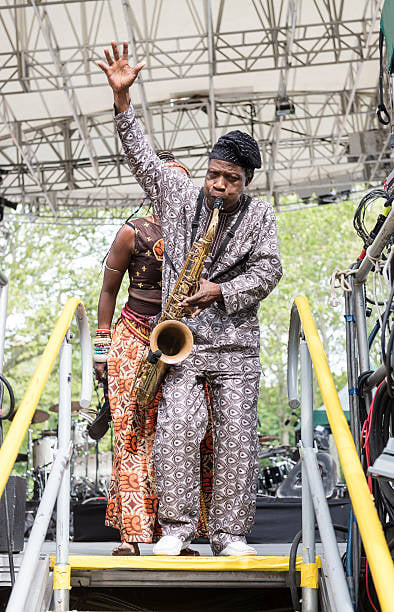
Orlando Julius, Nigeria’s Afrobeat Pioneer, Lived For His Art


Orlando Julius Ekemode (1943-2022) - O.J. Ekemode in performance as he leads his band, the Afro Soundz, during a City Parks Foundation and World Music Institute concert at Central Park Summer Stage, New York, New York, July 3, 2016. Image: Jack Vartoogian

BY SANYA OSHA

Orlando Julius (Orlando Julius Aremu Olusanya Ekemode), who passed on 15 April 2022, lived the sort of life many had hoped fellow Afrobeat star Fela Kuti would. Julius was well-mannered, well-spoken and cultivated a reputation mostly devoid of raucousness and pyrotechnics.

Born in 1943 at Ikole-Ekiti, south west Nigeria, his first major musical experience as a boy was serving as a drummer while his mother danced. Julius became a saxophonist, band leader and global star. His extensive background and travels offer an encyclopedic sweep of 20th century West African and African American music.

He worked with top notch highlife acts such as Julius Araba, Cotey Necoy, J.O. Oyeshiku and maestro I.K. Dairo in Ibadan – the south-western Nigerian city famed for its cultural heritage. Highlife is a West African music genre that borrows from traditional music but is influenced by rock ‘n’ roll and jazz. And then he further deepened his knowledge of highlife in Lagos in the 1960s. It was amid an eclectic potpourri of musical styles (including Cuban phrasings and beats), personalities and happenings.

By the early 1970s, he was already a notable contender for the Afrobeat mantle alongside the redoubtable Kuti and the supercool, perennially dark-shaded drummer, Remi Kabaka. Afrobeat is a movement in West African music characterised by harmonic and melodic grooves, call and response choruses and intricately layered syncopation (disrupted rhythms). While the politically outspoken, free living Kuti was barred from television appearances, Julius frequently graced Nigerian TV screens and quickly became a darling.

America

And then when his star seemed set to rise even higher, he relocated to the United States where he hooked up with South African jazz star Hugh Masekela to form a band, Ashiko.

The combo went on to acquire good standing, opening for famed US musicians like Herbie Hancock, The Pointer Sisters and Grover Washington Jr. In fact Julius would teach one of Michael Jackson’s older brothers to play African drums, having struck up a warm relationship with their parents.

In the US as with many Africa-centred artists – such as the talented Nigerian musicians the Lijadu Twins – Julius tried to remain true to his cultural roots. This path of cultural authenticity might have been inspiring but couldn’t always have made great business sense in view of having to compete with funk, disco and soul music.

A meeting in Nigeria

Julius returned to Nigeria for a spell in 1984 along with Latoya Aduke, his African-American wife. I first ran into them in the late 1990s in Lagos at publisher Kunle Tejuoso’s The Jazzhole, a record-cum-bookstore on Awolowo Road, Ikoyi. At once I was invited to visit them at their studio in a Lagos suburb. They proved to be two of the most charming interviewees I have ever encountered. In spite of having an impending show, they had all the time for me.

Latoya, an unstinting nucleus of unalloyed energy, was rehearsing with a dance troupe for the show. Julius was busy with the music at a state-of-the-art production desk. Latoya, a dancer, was spry, taut and muscled whilst Julius was only slightly rotund, given to easy, infectious smiles, as chilled out as your favourite uncle.

When it was time to talk, they were more concerned with their future plans. I, on the other hand, was more intrigued by their remarkable past. They had played at every venue and city that mattered and had jammed with or opened for the crème de la crème of the music world, including Miles Davis. What was Davis like? The ever amiable Julius merely shook his head incredulously. Davis – the king of America’s East Coast cool jazz – wasn’t someone to be toyed with.

A faint impression I got from them was that the music industry wasn’t what it was cracked up to be. Without their actually saying so, one sensed it was full of disappointments, betrayals and heartache. Nonetheless, there was no other choice but to forge ahead.

But the most powerful memory of that interview was their passion for music and performance. They rehearsed as if they had everything to prove, as if their lives depended on it, even though they had already done countless shows and undertaken innumerable tours and recordings. The dedication, humility and commitment with which they handled their business would always be rare and exceptional.

It became apparent chatting to them that, at the end of the day, it isn’t the personality of the artist that matters but the art itself.

Kuti and Julius

Julius’s Afrobeat didn’t blow off rooftops like highlife, juju, fuji or even Kuti’s version of the genre for a number of reasons. He went abroad at a critical stage, when he needed to be at home nurturing his audiences. In addition, Afrobeat was initially considered rebel music, cliquish and lacking in the apparently feelgood vibes of Nigerian genres like juju or fuji.

And, when it was still evolving, Afrobeat seemed too cosmopolitan and experimental, and culturally shifty. This ensured that only a very small circle of musicians were equipped to play it.

As for audiences, it took enormous amounts of work to build anything resembling a critical mass. Eventually, most of the heavy lifting was left to Kuti when Julius departed Nigerian shores. At this stage, Afrobeat was split between these two distinct polarites; Kuti and Julius, and with very little in between to fuel their primal grooves.

Personality-wise, they couldn’t have been more different. Kuti remained in Nigeria to irritate the political and economic elites at every turn. Julius, on the other hand, became a global troubadour exhibiting almost unfathomable depths of African music wherever he could and with whomever cared to listen.

When the ever avuncular Julius finally returned to Nigeria, he had a head filled with experiences and a heart brimming with memories which he was always gracious to share with younger generations of artists.

It didn’t appear he was motivated by fame and fortune. He was essentially an artist and that was what he took to his grave.

READ ORIGINAL ARTICLE @ THE CONVERSATION

Tuesday, October 15, 2019

FELABRATION: Afrobeat No Go Die, Lai Lai: Baba Lives!

Fela Kuti, lyricist, composer and activist at his home in Lagos. Image: Bruno Barney/Magnum, 1977


BY AMBROSE EHIRIM


As usual, much has been said, about the Chief Priest, the Abami Eda, Fela Anikulapo Kuti, the radical activist who had used his powerful lyrics and the vibe that he had helped coined during the Experimental years, and most musicians who had crossed over to go with the theme of a revolving musical genre over time, and the performers and key figures who had played significant role for we who had been curious to understand the origin and players who had been involved in the development of the coinages in its varieties, and the unique sound that identified each category, when the assembled music combos appeared to display their stuff in every event, amphitheater, arena and things like that they surfaced.

This was the outcome during the remarkable Experimental Era, phenomenal in its take, and the jam sessions, and hangouts, which would include folks who would energize the scene in Lagos at the peak of the city's nightlife when there was no one in particular calling the shots on what should deserve play or rating, or airplay and national audience by way of commercial.

In Nigeria and the West African concept, and music bands that erupted from cultural lines with its distinct patterns, folks were beginning to study notes and the originals to identify with each performer and what brand to connect with in what seem to have the potential for commercial success, which was key to popular music and its generation at the time. As it had happened, every region by way of its tribal line and the language spoken, became an identification of what the people in question loved to hear and danced to. In the Igbo heartland, Highlife had been the genre in every beat that was created in its vernacular lyrics and the expression which oftentimes combines calypso, rumba, ekwe omenala, ikwokirikwo, experimental era jazz, afrorock, bongo, ogene, abu owu (Amazano Jungle Blues), and the list goes on and on.

While the Lagos explosion was akin to the Experimental Jazz Era, many bands emerged with keynotes to its tribal lines and its vernacular rhythm that made the sounds representative of who they were and their origin which would be classified in coinages and musical genre--Juju, Fuji, Akpala coupled with other local make-up vibes which extended to other horizons--Ghana, Cotonou, Togo, Senegal, Gambia--and by then, Kuti was within the framework of his own local ensemble of highlife outfits carved during his Trinity College of Music years, the Koola Lobitos, after which the Lagos experiments began upon Ginger Baker exploring the talents he had bumped on, and embraced, and found becoming of singing groups, generating superb music bands of the era in a sensation that would catapult each and everyone of them to the top and high acclaim of the local waves.

Interestingly, Kuti, Joni Haastrup, Berkeley Ike Jones, and other cats of the day--Franco Adams, Lola da Silva, Paul Nwoko, Victor Damole, Michael "Micro Mike" Akpo, Remi Kabaka, Tee Mac Omotoshola, Willy Bestman, Pat Finn Okonjo, Emile Lawson, Jerry Samuels, Tony Benson, Felix Umuofia, Jeff Stone Afam, Larry Ifedioranma, Jerry Jiagbogbu, Jake Solo, Bob Miga, Harry "Mosco" Agada, and as the list goes on and on--had one thing in common, the desire to give it their best and produce what is unique and the pattern of each particular music to recognize the artists by their rights, becoming masters of their own craft.

Kuti, on his trials in what would identify and make his line of music special, dabbled into playing with some of the old cats of the day which included Victor Olaiya's All Stars Band, demonstrating his ability to go with the flow and what probably would work and identify with the ideal that would stand out on its own, as Afrobeat began to emerge, in his musical scores with the band members and a coinage that would follow, giving the Africa 70 its trademark and a music that would change the social structure of the land.

The Post Biafran War and the "Reconstruction Era" was Kuti's Lagos, when displaced persons, civil servants and related inner-city bunker hustlers who had to compromise with military dictatorships, found solace with the Afrobeat vibes, a remedy to the social ills and juntas that had overshadowed perspectives of becoming conducts in a nation blessed with overwhelming human capital and abundant natural resources.

Life has been a distress and discomfort on the public square, and Kuti's music and pot smoking had become a trademark and a way out of the frustration, and a government that didn't care much about its citizens, pushing the youths to the limit with attractions of the shrine where the rituals and following took effect making it a household name that included all and sundry, and the military juntas, too.

Kuti had made the shrine home to many and ground for comfort, justifying defiance with no restrictions to who visits and hangs out in the shrine, a plot that played well with the youths of the day, coupled with songs depicting social ills that consumed all. In the beginning, to identify with the societal problems, Kuti was yet to blame the establishment on a lack of storm-drain-pothole roads, run-of-the mill structures, lifestyles and trend of a ghetto Lagos for its dysfunctional state, but on the inhabitants themselves and the nature of who cares attitude when the single "Shenshema" in its heavy, heavy-windy flavored horns, big band ensemble, postured the typical Eko situation:

...Ebe motor, den start you u no dey start
dem dey push you all over Lagos;...
Ebe black man, you no dey think like black man
You dey do like white man everyday...
You be woman, u dey bleach yourself everyday,
u forget say u be black woman...
You be Shenshema, Shenshema...

Or, the everyday drama on the streets of Lagos, "Go Slow", the musical, "Open and Close," complexion enhancing creams and its side effects in "Yellow Fever," and the excruciating pain of what one encounters trying to survive the hostile environment, doing the best out of bad situations, living basically in Eko, in power outage districts, blackout foul smell markets, open bucket latrines which had everything to do with life in the jungle where nothing in nature is organized, and where one is left with no choice but join the crowd and make life as simple as it can get. But suddenly, here you are, in the midst of a crowd where your own friend is engaged in a nasty duel and you begin to watch the real stuff of what Lagos has been all about, in a land where there are no rules to any kind of tussle which is settled on bragging rights kind of stuff, the "Roforofo Fight" duel:

Two people dey yab
Crowd dey look
Roforofo dey
Two people dey yab
Crowd dey look
Roforofo dey
Wetin you go see?
Roforofo fight eh
Wetin you go hear?
Roforofo fight eh
If you dey among the crowd wey dey look
If you yourself
You yourself dey among the crowd wey dey look
And your friend
Your friend dey among the two wey dey yab

Such characterized the legend and his beats as it swagged up all across the nation, and the West African coast, and around the world, and nothing could mean a damn thing with the public, but lyrics and rhythms of Baba, the Chief Priest, adopting what had made body and soul one in the post-Experiment Era. Everybody checked out the shrine--the clean cut image folks, the amugbo, the insane and the abnormal behavior drug addled military juntas, permanent secretaries, activists, labor union leaders, and civil servants, including journalists--all came and had a good time at a particular time what everyone wanted was to dance and have a great time and forget the sorrows of the Biafran War, which had turned Lagos into Africa's Big Apple. 

The wave had come on time at the eruption of the oil boom and what would lead to widespread scandals of bribery and corruption, of which Kuti would cease the moment and start his protest songs against an inept, corrupt regime, that had its devastating effects on the people. This had included ordinary and prominent civilians who had connived with the juntas in destroying every aspect of civil liberties, which compelled Kuti, times without number, to move up his theme and give the military juntas and their civilian collaborators some demonstrations and criticisms, requiring the juntas take their hands off the people as seen in all sound democratic societies. 

But the juntas had been absolute in their events and could care less what the public had perceived of a drastic regime and its draconian laws, invading the civilian structure with impunity, pillaging it, and angering every soul that knew the value of free press, freedom of assembly, and constitutional laws on the peoples mandate. Songs like "Alagbon Close," "Zombie," "Everything Scatter," "Kalakuta Show," "Unknown Soldier," "International Thief Thief (ITT)," "Army Arrangement," "Sorrow, Tears and Blood," "Big Blind Country" (BBC), etc,. depicted dictatorship, bribery and corruption from the regimes of Olusegun Obasanjo to the Ibrahim Babaginda criminal mafia and military juntas, in addition to the spooky Sani Abacha years reign of terror.

More damaging were events at the Kalakuta Republic in more than one occasion from around which the first instance of plundering by the juntas had lawyers, civil servants as patrons, and the hobos who had nothing to do with anything, at all, but take life easy and move on despite a dysfunctional government, run for their lives upon invasion. Kuti had begun to get used to the challenges and barrels of the gun that confronted and threatened him regarding his protest songs, by regrouping and keeping up with the vibes each time the juntas struck. But what would take toll on the nation and the legend himself, after songs and releases that continue to denounce despots and absolute power drunk men, was the "Zombie" lyrics Kuti had unveiled upon which the juntas had swiftly act in their operation to a song that was a case of sad reality, and a necessary invasion that would be tragic in what was established and orchestrated by the junta, Obasanjo, who happened to be Kuti's own cousin and age-mate of the Egba clan.

The master composer thought deeply into what his own kin had done to him, a barbaric invasion that traumatized his mother and consequently leading to her death, and a kangaroo court of the junta's setting that puts the blame on an unknown soldier. Kuti would go to work for another masterpiece in his composition for public hearing, in what the juntas had done to a supposedly effective press and effective democracy, and his mark of symbolic speeches by measure of the nation's positioning in the world. "Unknown Soldier" was released; a hit and a national anthem, and realistically a damning indictment to the Obasanjo-led brutal regime:

One thousand soldiers them dey come
People dey wonder, dey wonder, dey wonder...
Stevie Wonder dey there too
Na one week after FESTAC too
And dey broadcast on American satellite
Around that time too now, I say to you...
Where these one thousand soldiers them dey go?
Na Fela house Kalakuta
Them don reach the place, them dey wait...
Fela dey for house
Beko dey there too
Them mama dey there too
Beautiful people dey there too
Frenchman dey there too
Press man dey there too
One-fifty of us dey there too...
Then suddenly, suddenly....

His soundbites on the ruckus between him and outrageous military regimes and governing flaws in and around the continent, was evident of his activism that was universally reached, and call to dismantle totalitarianism for effective democratic fabric, as in all organized societies, was at a terrible cost for the legend. As it had happened, the bloodthirsty military juntas did what no one could ever have imagined, silencing the people with draconian laws and back-paddled decrees, raping the entire treasury, and passing it on to their cronies, the "civilian structure" in its quasi democracy and the stealing of natural resources to continue apace.

The assault on Kalakuta Republic was begun in earnest, and all that Kuti had built over the years was gone for him to start all over again with a clean slate. He sang about every junta and had directly questioned and challenged their legitimacy and the audacity to wrestle power from the people, and those vultures, the beasts of no nations, did not like that, at all, and had to come upon the legend in series of intimidation to quiet him, which was impossible and never happened.

Felabration, coined and established, founded by the legend's daughter, Yeni, recognizes his work and marks events that commemorates its anniversary and observed all around the Globe.

Baba Lives!


Fela Kuti, lyricist, composer and activist with his wives, family members and friends at his home in Lagos. Image: A. Abbas, 1981

Sunday, October 06, 2019

FELABRATION: A Ganja Trip With Fela

Fela Kuti with his wives


This is Fela’s week. We must continue to thank Femi, Yeni and their siblings as well as the devotees of The Shrine for keeping the memory of our icon alive. What they are doing billions of Naira left by the rich could not do for the departed owner. Which is to say do what is worthy, and not stash up wealth and materials things. All of that will never keep your memory in the minds of the living.

This piece is on a lighter mood, an anecdote to further give us an idea of the free spirit of the man who had death in his pouch and will never die, our own Anikulapo – Kuti. I remember when Fela changed his name from Ransome – Kuti to Anikulapo- Kuti and his elder Brother was asked why he didn’t go with him in the change of name business, his retort was that Fela never discussed it with him. He went further to say “ I am a medical doctor who is trained to stave off death how then can I say I have death in my pouch.” Prof Olikoye had a wry sense of humour and he was a delight to be with particularly when in company of his maverick siblings.

This is not the koko (focus) of this piece.

It is a different matter altogether. Read it and laugh. We all need laughter to ease the tension of these times.

Now you have seen the title of this piece. Don’t start judging me. I can see some of my enemies, old boy many

they are, saying ah amugbo ti e ni. No wonder ki gbo, ki gba ( he a hemp smoker; no wonder he is stubborn). No, I never smoked and will not do although I love the swag of the revolutionary Che Guevara holding the tobacco.

Do try and read this as you follow me on a journey with Abami Eda, Fela Anikulapo – Kuti.

This is not astral travel. It is real. It was a journey I made with him in 1990(? ).

Beko Ransome Kuti and his comrades in trouble, Gani Fawehinmi, Femi Falana, Baba Omojola and I think that young man then, Mayegun, the one with dada (dreadlocks) hair on his head made a lot of noise in Lagos questioning the authority of Ibrahim Babangida, our then military President.

I learnt the man with the gap-tooth had sleepless nights. Our activist brothers even threatened to organize a sovereign national conference. The conference was not the problem but the word ‘sovereign’ just as now that protest is not the problem but the phrase ‘revolution now’. Let me not put my feet on a treason ground, a dangerous path to tread.

As I was saying our brothers, (no woman among them), the Beijing Conference had not held then, were arrested and taken to Abuja. Before we could locate them they have been charged with treasonable felony and remanded in Kuje Prison.

Hearing in their case was to come up in a Kuje Magistrate Court some days after to determine if they qualified to be bailed or not.

To cut a long story short and not delay this trip, we the activists, from veterans to rookies mobilized to give support to our comrades in Abuja on the chosen day.

Fela too was not left out. The abami eda hardly left his house except when on foreign tours or had a show in some parts of Nigeria. He offered to be part of the Lagos crowd storming Abuja. It was exciting that he chose to go. There will be drama with his presence and that we reasoned will provide a good copy for the media both local and international.

It was my lot to travel with him and some of his aides as well as three of his numerous wives. Apart from we humans he had with him, there were three pillows and a big piece of home-baked cake. The pillows were meant to support his bum. He suffered then from a chronic case of haemorrhoid. The cake was to be our snack to and fro.

As we set out he regaled us with stories. You cannot but laugh at Fela stories. He said looking back he considers himself stupid for singing “ my darling valentine” at a point in his musical career. He made jest of Beko and his human rights campaigner crowd and said a lot of self-deprecating things.

I didn’t only enjoy stories but guffaw as I helped myself with his my share of his cake. I have never had any cake that delicious. I learnt from him it was called sponge cake. Sponge cake? Iyen tun yato (that is different). The onijekuje (glutton) that I was then, had a fill going to Abuja and returning!

Fela got to Abuja, spread his mat on the floor in front of the court and laid face down while people trooped to see abami himself. It was a rare life opportunity, particularly for northerners who had heard of him but had never seen him live.

Case called. The accused persons to our utter surprise were granted bail. Of course, there had been an outcry in the media and internationally. Bail was a face-saving measure for the then Babangida regime. There was jubilation and back-slapping. Lagos here we come. Abuja was like a no-no for many of us at that time. It was a bourgeois enclave where we reasoned the national wealth was stolen.

We set out. Fella puffed on his Obiaruku jumbo wrap. We became passive smokers.

It was not only that day I have passive smoked Igbo around Fela. If you were a journalist at this period or human rights activist, you have a sit at a special location at the Shrine. Dele Omotunde, that great journalist, now a Redeem Church pastor, Lanre Arogundade, Femi Falana, Chuzi Udenwa, also now a pastor in the US among several others, were devotees of the Shrine and we had our special place then. I once returned home one day at about 4.00 am and had my headlight and my gaze and steps not stable. It took three days of sleeping before I recovered.

On our way back from Abuja to Lagos, I continued sponging on Fela’s cake. We arrived Akure and decided to refuel and empty our bowels. Chief Fawehinmi visited the bathroom. We almost lost him that night. If you know how spiritedly he walked you will imagine what I am talking about. Not seeing the drainage on his path he slipped into it one leg first and fell hard. We rushed to pull him up. It was scary. We thanked God then he didn’t hit his head on the concrete floor.

We proceeded on our journey to Lagos eating Fela’s sponge as if it was going out of fashion. We arrived Lagos and I left for my home. The following morning I found myself in the heart of Mushin where Beko had his clinic being attended to by Dr Balogun. No one could explain what the matter was with me. I couldn’t decode it neither the doctor could. It was assumed it was exhaustion. And I was placed on intravenous drip.

Later in the evening, Beko came to see me on my sickbed as he resumed his daily consultation at the poor folks’ enclave.

“What is the matter with you”, he asked.

Feeling dizzy, couldn’t stand on my feet and my head spinning, I told him. What did you eat in the morning? Nothing, I said. What of yesterday, he asked? I only had cake, I told him. “You bought it”, he asked. I took from the cake Fela brought along to Abuja, I said.

“Ha ha ha”, he smiled wryly. “O lo je cake Fela ?” ( you ate Fela’s cake)? Igbo lo je yen ( you ate Indian hemp. It was then I discovered that Fela baked his cake with hemp soaked water.

Happy Felabration!

-Babafemi Ojudu is Special Adviser on Political Affairs at the Presidency


SOURCE: THE NEWS NIGERIA

Monday, April 28, 2014

Excerpt From Fubara David West "Nigeria Fire At Afro Beat King Fela's"


In the first place, Fela lived in one of the most notorious 
areas of Lagos. Prostitution and armed robbery were 
regular features. There was never a dull moment in the
area. 


Some of the shady characters in the area, took full 
advantage of Fela’s growing popularity, to turn the 
area in close proximity to Fela’s residence, Kalakuta, 
into a black market for all sorts of things. 


Among other things, one could buy drugs in the area. 
Furthermore, Fela turned his house into a commune,
where his beautiful, scantily dressed girls could always 
be seen in the front yard. 


The girls celebrated the care-free lifestyle of the roaring
1960’s in the United States, marked by the sexual
revolution and women’s liberation, in general. They 
numbered more than 60 at a point. 


Even though many Nigerians viewed those young 
people, many of whom were from respectable families 
as an immoral lot, I admired them. I thought that they 
were remarkable, because they were willing to stand out 
in the crowd. 


I also felt a sense of kinship with them. I could
understand the possibilities and the challenges of life
for a young person, especially in Nigeria during the
period. 


Employment for young people was not a priority.
There were very scholarships for higher education,
job training for young people was rare. The situation
forced young people to lower their expectations. 


Even though many of my high schoolmates were from
well-to-do families, and were looking forward to law
School and bachelors degrees, others looked at the 
Nigerian Ports Authority as the place to be. 


It was rumored that one of the attractions of the Ports
Authority was that it gave people great opportunities,
for getting bribes. Young people had a tough time
indeed. 


My Ivy-League Educated Father 


My father, Prof. Tam. S. David-West, for instance,
would tell me, even before I received my high school 
graduation certificate: “your life is in your own hands,
now.” 


It was as if being responsible for his son’s education was 
a burden, he could not wait to off-load. Most people 
would never believe that my dad could behave in such 
a manner. However, he would. 


In fact, he tried to sabotage my final year in high school,
by delaying payments for my fees. For the first time ever,
I became a boy, who would skip classes. 


I would hide out in the city library, unwilling to discuss
the situation with the principal, who adored Dad.
They were friends, and like most of the people who knew
Dad, he was smitten by his brilliance, and his amiability. 


The kind of regard he had for Dad was once highlighted,
by his suggestion in our Assembly Hall, that Dad might
follow T.O.S. Benson’s example, by sponsoring an 
indigent kid. 


I smiled. Dad might, if he was assured that there would
be mass accolades, following such a noble gesture. No:
I did not share the thought with Mr. Familoyi, the
principal 


Why would Dad do refuse to pay for my fees? I talked
back at him: something even an uneducated man, with 
any knowledge about childhood development, should
have merely smiled at. 


It is just a demonstration of the fact that your son is
developing a good sense of self, independence, and
maturity, Ivy League professor! Chief Akpana might
have told him, if he had approached him with
questions. 


The other telling thing was that Chief Akpana was at
time a manager at the Ports Authority in Apapa. Dad
did not approach him, to get me employed at the Ports
Authority, as I was leaving high school, even as he
told me that my life was in my own hands. 


Dad had to put up appearances. He did not want his
friend, and my aunt, his friend’s wife, to lose all respect 
for him as a father. He had to deceive them. He had to
give them the impression, that he was pushing Fubara
to go to college. 


Prof. Tam. S. David-West would actually leave his 
teenage son in Lagos, to cater for himself, and
supposedly to work for the rest of his life, with a high
school education, unless he was “lucky enough,” to 
get a scholarship. 


I will come back to that term, “lucky enough,”
momentarily. No Ivy League graduate in the United 
States would behave in such a manner, towards his
child. 


An Ivy League professional in the United States would
do everything, in his power, to ensure that his children 
were the best educated in the community. What is a
parent, if he/she does not fight for that? 


Of course, I never considered for one second, that a 
high school education was enough. How could I? 
My dad had given me a picture of his, taken, after his
graduation, with a PhD in Virology from McGill. 


It was put in a folder, with all of his degrees listed on it. 
The picture was always a treasure, even after one of my 
uncles: the future Nigerian Ambassador to the United
Nations, Jim Blankson made a telling remark to me. 


When I showed it to him, with all of the pride of a son,
Jim Blankson said to me: “Tell him, nobody gets all of
that without help.” 


Did he ever plan for my education beyond high School? 
No; there was no indication, that he wanted me to go 
beyond high school. Did he think, that his first son 
could not possibly be “university material?” 


“University material,” was a phrase he loved to use, 
constantly, when he would argue that Nigeria should 
not expect all of its high school graduates, to go on to
university education. It was a strange thing. 


Of course, everyone will not opt for a university
education. However, society should always encourage
young people, to aim for the highest level of education
possible. The great professor should have stood up, as 
an advocate for such a value. 


How could I not be university material, if I also have 
the same genetic materials that make up the great 
professor? It is not the kind of question Dad ever asks
himself. 


I actually think that he wanted the Blanksons to take 
over the responsibility for my education, but was not 
man enough to tell them just that. The window-
dressing was all that mattered to the man. 


Sometimes, I also think that he was praying to see me 
get a poor passing grade, in my West African School
Certificate Examination. That might have been used 
as an excuse, for not encouraging me, to get into a
university. 


Otherwise, he might have wanted me to fail. My
failure might have been used as a justification, for
quickly getting out of his fatherly responsibilities.
The Ivy-league man has dumb son! The professor
can’t do anything about it. 


My failure might also have magnified in his mind, 
how great he was. He had after all, overcome his 
own childhood difficulties with his father, to become 
an Ivy League educated professor. 


It is the kind of a terrible psychological problem, which 
affects most of the things that Dad does. That includes 
his tendency to pick fights with both his extended 
family members, and public officials. 


My grade report in Class Three made the comment,
“not good enough for first class.” At every opportunity,
he would bring that up, but what should that have told
an Ivy-League trained professor? 


If I was the one, that comment about my son would 
have told me, that the school expects my son to have
a first class, but he needs some help. The school 
considers him to be one of its top students! 


Let me do something. I should get him a tutor for 
the exam and for his university entrance examinations. 
However, to Dad, the convenient message was that his
son might just not be smart enough. He is not meant
for university education. 


It would be the kind of a convenient take for a parent, 
who was merely looking for some excuse, to abandon his
child. The man keeps his prestige among his colleagues. 
The child is sacrificed, on the alter of the parent’s ego. 


Meanwhile, the son knows that it is all a lie. You do not
become a Prefect at the MBHS, if you are not one of the
top students. I was a Prefect. I recently reestablished
contacts with one of my classmates, who would tell me,
“you were one of the smart kids!” 


I did have more difficulties with mathematics and the
sciences, than I did with the arts. I would get excellent
grades in the arts, without much effort. I would make
good grades in math with tremendous effort. Physics,
biology, chemistry came in the middle range. 


Looking back now, I fully understand why. My brain
is wired in ways that appreciate and absorb the broader
interconnections, between the sounds in the bush in
Bakana, and the formulae of mathematics. They must 
be related, my mind constantly insists. 


The wiring does not make for rote learning and the
mere cramming of information. Even in primary 
school, my mind would always ask questions, such as
this: one plus one equals two, so what? 


What does the formula have to do with Kaine’s prayer,
early this morning, for instance? I would make up all
sorts of stories in my head, about how they were related.
Should an Ivy League-educated man recognize such
things? 


When the parent is willing to sacrifice the child in the
manner we are dealing with, even an Ivy League
education will not help, as the parent becomes an
animal, in an early evolutionary stage. 


At that stage, it is yet to develop a genetic code telling 
it, not to eat its young for dinner. In later stages of
evolution, of course, the animal will sacrifice its life for
the life of the child, which is the key to the survival of
its gene pool through time. 


No!!! People are not beasts. They are humans. Prof.
Tam S. David-West is definitely not a beast. He is 
one of the most refined people you could meet. He 
would fit in with the upper class, in any American or
Asian, or European society. 


His dinner table had to be properly set. His children
must know what knives and forks to use with what,
on the table. He loved philosophy and the stars of his
generation: Frank Sinatra, and Louis Armstrong. 


I loved to get myself lost in the books of Bertrand
Russel that Dad loved to read. He would be curious. 
He once asked me, as was absorbed in one of the
voluminous books by Russel: “Do you understand
that?” I did. 


Ironically, his position in the Academy also gave
me an early gift. At a time when Wole Soyinka’s
The Man Died was something of a contraband in
Nigeria, Dad had a copy. I read it like a voracious
young man. 


I often wonder where the great scientist thinks that 
intelligence comes from. Does it not come from a
combination of the genetic materials that make up a 
person, and the socio-cultural milieu within which the
individual grows up and functions? 


Is there any case of mental retardation in Dad’s family 
or in my mother’s? No. Both families were made up 
of very smart people, who were increasingly involved 
in community leadership. 


My maternal cousin, Joe Iyalla, for instance, was the
Nigerian Ambassador to the United Nations, as I was 
growing up. I used to be really excited, anytime he 
was in Bakana, accompanied by security officers. 


I once came in ninth, in my class of 30 or so students, 
in my end-of-term exam. Dad would make one of his
promises that one could never really depend on. 


“I will get you a special present, if you come in fifth 
next term,” he said to me. I was fifth in class in the
next term, but Dad pretended as if he forgot about his
promise. He never brought it up again. 


Apparently, it was just a set up. If I did not make it 
to the fifth position, that would have been another big 
mark against his son. May be, he was just not smart
enough. 


Dad would feel justified, to not encourage his son to
aim beyond high school education. I did all I could,
for the boy. He just could not be university material!
I am sure, that would have been a useful message to 
his friends. 


At no time, did he talk to me about what I wanted to 
do, after my graduation from high school. Just a year
or so after my graduation, I even wrote a full-page
article for the Daily Times, on culture and politics. 


That was just as if a high school kid writes an article
for the New York Times. I can imagine the young
man’s high school in say Austin, Texas, or Boston,
Massachusetts organizing a program to recognize the
kid. 


Dad never made any move to get me into the
University of Ibadan (UI): one of the country’s best
universities. He was (and is still) a professor at the
university. 


The University also had the International School 
attached to it. Some MBHS students went there for
their A-Levels, which students would take, as a ticket
for admission into the freshman class at the UI or
anywhere else. 


Note that Dad is also an alumnus of UI, with its rich
and intellectually stimulating campus. The campus
was also linked to the United Stated consulate, where
Dad would often give great public lectures. 


Dad did give me the greatest of compliments, upon 
reading the Daily Times article: “it’s a chip off the old
block,” he remarked. That was it. 


Could he not realize that his son was very interested
in writing? Of course, he could. Might he also have
contacted Yale, Michigan State, and McGill, to admit 
his son? That should have been expected of him. 


All of those great universities have legacy programs, for 
the children of their alumni. I once commented in one 
of my Internet notes, about the interesting fact that both 
President George W. Bush and Dad attended the same
Yale. 


There seems to be a complete intellectual mismatch 
there. That is one of the reasons, why hyperbolic mass 
media debates and individual legal actions, regarding
affirmative action programs for minorities, seem to me,
to be so bizarre. 


How many Tam. David-Wests were left out of Yale, for
the younger Bush to be admitted? 


We can be sure that there were many American-African 
students, who were brighter than the younger Bush, at
the time he was admitted into his freshman class. 


Those African-Americans, might not even have been
considered. Meanwhile, for the rest of their lives, they
would have to listen to a barrage of news reports about 
some white student, who alleges in a lawsuit that a less
qualified minority student took his/her place. 


An interesting experience of mine, with respect to these
kinds of programs comes from a graduate class, at the
University of Oklahoma, Norman. 


A particular female, would use every opportunity to
impress it upon everyone, that she was the smartest
person at her workplace. If she talked long enough,
one might find a real mind at work in her head. 


The problem with her work, she insisted was that
minorities were always being promoted ahead of her,
even though she was getting the best grades in the
civil service exams. I would usually be the only
black student in class. 


I was often tempted to confront her, but I would not. 
Why disrupt the ever engaging class of Dr. Hummel? 
On the last day of the seminar, he wanted to know if
any of us had a question. 


This lady puts up her hand. I was ready for another 
one of her stories about minorities and her job. No:
she had a more interesting problem. After going
through a full semester, she could not understand
what the class was all about! 


I digressed. I think Dad’s unwillingness to copy the
elder President Bush and other Yale alumni derives
from deep psychological problems. Dad, after all of
his success, continues to be bitter, about his supposed
mistreatment by his own father. 


The fact that for a period, his father forced him to 
adopt his maternal grand-father’s name continues to
trouble him. He was, in effect, taking out his revenge 
on his son, without appearing to be crass about it, to 
friends and family. 


One of his old friends, whom he has known since high 
school, Chief Walter Akpana is married to my aunt, my
late mother’s sister. The two of them could pass for 
brothers. They are both very gregarious and smart men. 


The significant difference between the two men is that
Chief Akpana has none of Dad’s psychological baggage.
He had the kind of a relationship with his children, that
any enlightened person would clearly adore. 


His wife, Faustina, obviously was a better judge of 
character and personality, at the time when the two
young women met both men in their youth. 


I often wonder if she warned her sister, to stay away
from the Kalabari boy with an Igbo first name, and
his maternal grandfather’s last name at the time. 


There is a particularly telling story about the future
professor, which I do not care to share here. I can
imagine my aunt, reacting rather sadly and telling 
my mother: I told you to stay away from him! 


The good news for the professor was that his son had 
too much of a native intelligence, from the great Clara
Leopold. You do not go inviting other people into your
affairs, especially when it might complicate your life,
instead of solving any problem. 


That good sense would not allow me to go telling the
Akpanas what I suspected. My dad was merely window-
dressing. He never wanted me to climb the ivory towers 
that he had climbed, so masterfully. 


A psychological baggage can floor the most intelligent
and accomplished of humans. Thus, a parent should be
expected to strive to create a better life than he or she 
had for the children. 


For Dad that was a difficult value to live by, especially 
with respect to his first son. Why bother? His smart
mind might have told him. You can always act the role 
and make it believable. You are an Ivy League man! 


I think it was the act that made him decide to come
into my life, as I was leaving primary school. He might
have wanted to tell people that he was better than his
allegedly terrible dad. 


Even as I write this, I am yet to be convinced that his 
father; a banking executive, actually abandoned all
assistance to his first son, during his years in some of 
the best universities in the world. 


I noticed how concerned and engaged he was with 
my grand-father’s health problems, as he aged. He
talked about his living situation. He would be worried
about the old man’s mental state. 


Everything about Dad tells me, that he would never
have been so attentive and compassionate, if his father
was really callous towards him, at any point in his life. 


Dad is too unforgiving, too vindictive, too much of 
an illiterate fisherman, with his fidelity to tribal 
norms, too pugnacious, to forgive his father, if he 
was really callous towards him, when he was, say at
Yale. 


Dad is the intellectual, who will stop all forms of
communication with his son, and send him a copy
of a note to his attorney, instructing him to ensure
that his son, does not get anything from his estate,
upon his death. 


No: I have never expected anything from his estate.
Indeed, I did not know that he had a huge estate out
there. However, the gesture speaks volumes, about 
the illiterate fisherman in him that I have referred to. 


It is the kind of a thing that an illiterate fisherman, full
of all of the tribal pride of paternal power will do. It is
the kind of behavior, we can expect from a fisherman
in a hut, who has never spent more than a few days
in formal education. 


Why was he doing all of that? His son gave his book, 
Philosophical Essays, a bad review that it fully deserved. 
I did read it with Wole Soyinka’s term, “hypocritical self-
righteousness,” in my head. 


I had read parts of the book before publication. Indeed, I 
gave him some of the questions that he answers in the 
work. The book is composed of a series of questions and
answers. Dad’s son poses the questions. Dad answers. 


However, as I read it over at the University of Wisconsin-
Superior, certain points began to whisper in my ears, those
famous words from Soyinka. The literary giant will never
fully know, how much of an influence he has on me. 


Dad was engaged in a self-serving philosophical exercise, 
which even justified his service under the totally ruinous 
military junta in Nigeria. He was waxing incisive, with a
note that the intellectual must question conventional
wisdom. 


However, he questioned no single conventional
wisdom that mattered. His note on luck and being
chosen for national service, hit me in the face like
a brick. 


Imagine a professor, who also walks in the corridors of 
political power, thinking that luck should determine,
whether his son gets more than a high school education.
The gardener says, my plant should die, if there is no
rain! 


I think he used some merit scholarship, somewhere in his
training. Does that imply that everyone else should?
Should every generation go through the growing pains of
parents and grand-parents? 


If yes, then cultural progress will become quite impossible.
Furthermore, the species could not survive, because its
genes will fail to create the kinds of immune responses to
environmental threats, that the species absolutely needs. 


Dad is a virologist. Obviously, he has to know about that
dynamic: that gene-environment interaction, which has
led to the evolutionary marvel we have in the human
species. This species can even destroy life as we know it. 


“It is dangerous, to see luck as the determining factor in 
the distribution of social value,” I wrote. “For, we can do
nothing about luck. It lacks political definition.” 


The remarkable thing was that when I read it over, I 
heard Tam. David-West’s voice in every word I had
written. It sounded every bit like Dad. 


It was the kind of a scathing review that Dad would 
give to a writer, who was so untidy a thinker. I could 
see him fully enjoying the intellectual back and forth 
with the writer. 


I could imagine him, standing on the shoulders of
the great Zik of Africa (the first post-independence 
president of Nigeria, Dr. Nnamdi Azikiwe), in 
attempting intellectually, to pulverize a careless
thinker. 


I could, indeed, see him reproducing one of those 
pleasant memories of mine: reading the newspaper
rejoinders of the great Dr. Nnamdi Azikiwe, to
critics of his article, which advocated a military/
civilian Diarchy for Nigeria. 


With regard to the act of sending me a copy of the 
note to his attorney, I would tell him in a letter from
Wisconsin: “you should never do that, because you do
not know the future.” 


Was I trying to “pulverize” Dad as a thinker with my
review? Of course, not. I admired and respected him
too much for that. I also fully realized, that he had the
intellectual reflexes of the great Dr. Azikiwe. 


He did know the future, however. As his son was 
graduating with a summa cum laude in Political 
Science, and a magna cum laude in Liberal Arts, he
decided that his son’s penalty for a worthy critique
of his book was death. 


He would go into parental hibernation once more, in
order not to be bothered with his son’s plans for
graduate school. Indeed, he never asked me whether
I wanted to proceed to graduate school. 


That was even before the book review was published
in the Times. My professors in the Political Science
Department and the Mass Communications Department ....

Tuesday, February 26, 2013

'Fela!' is ferocious, exuberant, but also a little irresponsible

By Mark Kemp/The CLOG, Tuesday, February 26, 2013


Adesola Osakalumi kneeling by Sharen Bradford

Here's what you should not look for if you go see the Broadway smash Fela! at Belk Theater tonight: a linear narrative; songs performed in their entirety; context for some of the thornier details of the life of Nigerian Afrobeat legend Fela Anikulapo Kuti.

Here's what you can expect: ferocious, exuberant, awe-inspiring music and dance; lots of shimmering washboard abs and bouncing booties; a whirlwind of pop-cultural references ranging from Frank Sinatra to John Coltrane to James Brown to Bob Marley to Stokely Carmichael; feel-good displays of revolutionary righteousness. And did I mention ferocious, exuberant, awe-inspiring music and dance?

The big stars of the production, which opened Monday and returns to the Belk tonight for a second performance, are Adesola Osakalumi, who plays Fela with dazzling energy and charisma, and Melanie Marshall, whose rich, angelic voice as Fela's mother steals several scenes. The unsung stars are the musicians of the traveling Fela Band, whose original leader, Aaron Johnson of the Antibalas Afrobeat Orchestra, arranged Fela's songs for the stage, turning his extended funk and jazz improvs into digestible nuggets that somehow retain the spirit of the original music. The weakest link in the touring line-up is new member Michelle Williams, the former Destiny's Child singer. She landed the role of Fela's African-American lover Sandra Isadore, who was responsible for introducing the late singer and activist to '60s and '70s American black power figures from Malcolm X to Angela Davis. Williams has neither the dance moves, the acting chops nor the voice - her Minnie Mouse vocals aren't at all believable when she's lecturing Fela on tough, American-style political activism - to pull off such an important role.The setting for the musical is Fela's final show at the Afrika Shrine, a nightclub located at his Kalakuta Republic commune outside Lagos, Nigeria. Throughout the 1970s, the Nigerian military had regularly harassed Fela for his outspokeness about the country's political corruption. Then, in 1977, after the singer released his classic album Zombie - which characterized Nigeria's military troops as brain-dead puppets of the country's dictator-like general Olusegun Obasanjo - soldiers raided Fela's commune, raped many of its occupants and threw the singer's mother, political activist Funmilayo Ransome Kuti, out of a second-story window, causing injuries that would lead to her death two months later.

All of that and more is told in the musical by way of whiplash monologues that switch back and forth in time so quickly it's hard to figure out when the appearances by Fela's mother are apparitions and when they are real. Not that it matters too much. This is theater, and if you want to learn about the real Fela, it's best to enjoy this play for what it is and then go back to Fela's massive discography, authoritative books like Michael Veal's Fela: The Life of an African Musical Icon, and the documentary Fela Kuti: Music is the Weapon.

Don't get me wrong: Fela!, the Broadway musical, is an enjoyable production and I think it's great that mainstream American audiences are finally hearing the Nigerian Afrobeat legend's music and learning a little about his life and work. But what's missing from the production is really, really important stuff: while the play emphasizes the political oppression Fela fought, it glosses over or makes light of his dark sides (for example, he was a raging misogynist who believed women are inferior to men) and it never once mentions that the singer died in 1997, at 58, as a result of AIDS-related complications. (To his final days, Fela denied HIV/AIDS, opposed contraception as "un-African," and went on to father at least three more children after becoming infected with the virus.)
For me, the omission of AIDS, in particular, was a glaring problem in Fela! that extends beyond oversight into irresponsibility. During the song "Who's Coffin Will You Carry," toward the end of the play, the writers and producers (including Jay-Z, Will Smith and Jada Pinkett Smith) thrust so many important topics into the audience's consciousness - names of exploiters from "Buhari" and Shagari" to "Halliburton," "AIG" and "The World Bank" were literally scrawled onto coffins stacked up on stage for dramatic effect. And yet there was not one mention of AIDS, the real killer of Fela that has been one of Africa's most destructive enemies, killing more people than any military dictator or rogue capitalist.

Tuesday, October 16, 2012

Fela Kuti Museum Opening In Lagos (Photo Essay)


Seun Kuti (L) and Femi Kuti, sons of Nigeria's music legend Fela Kuti, share jokes at the opening ceremony of a museum in honour of their father in Lagos, October 15, 2012. Kuti, a human rights activist and Afrobeat music pioneer, died of AIDS related complications in 1997. Image: Akintunde Akinleye/Reuters


A cameraman shoots framed photographs of Afro Beat King, Fela Kuti, during the opening ceremony of the legend's museum, at the start of a week-long annual "FELABRATION" to mark Kuti's seventy fourth birthday in Lagos. Image: Akintunde Adeleye/Reuters


A man stands near a mural on a wall of Nigeria's music legend Fela Kuti during the opening ceremony of a museum in his honour in Lagos. Image: Akintunde Akinleye.


The front view of a museum opened in honour of Nigeria's music legend Fela Kuti in Lagos October 15, 2012. Kuti, a human rights activist and Afrobeat music pioneer, died of AIDS related complications in 1997. Image: Akintunde Akinleye/Reuters


he daughter of Nigeria's music legend Fela Kuti, Yeni, attends the opening ceremony of a museum in honour of her father. Image: Akintunde Akinyele

KNOCK, KNOCK

By issuing subpoenas to five Times journalists, the Trump administration reveals its first response to unwanted national security coverage: ...