Showing posts with label Libya. Show all posts

Monday, June 24, 2024

Strategic Ambitions: Russia’s Deepening Military And Geopolitical Footprint In Libya


BY VICTORIA MALDONADO
COLUMNIST, GEORGETOWN
SECURITY STUDIES REVIEW
GEORGETOWN UNIVERSITY

The Wagner Group’s entrenched and increasingly overt operations in Libya reflect Russia’s strategic challenge to Western influence and its ambition to solidify its geopolitical power in North Africa. By backing Khalifa Haftar, Russia has leveraged private military contractors (PMCs) to exploit global distractions and Libya’s political disarray, cementing its presence in the Mediterranean and extending its reach into Sub-Saharan Africa. The Wagner Group’s evolution from covert operations to a pronounced military role aligns with Russia’s broader objectives of controlling strategic resources and key geographic areas that can encircle Western powers and challenge them on multiple fronts.

The Wagner Group’s History in Libya

Functioning as an instrument of Russian foreign policy, Wagner’s presence in Libya dates back to early 2017, initially involved in demining operations. Their significant engagement began in May 2018, with around 300 mercenaries aiding the LNA in various military operations. Wagner’s influence expanded during the LNA’s offensive to capture Tripoli in 2019, with substantial financial backing from the United Arab Emirates. Despite suffering setbacks due to Turkish military intervention supporting the Government of National Accord (GNA), Wagner shifted focus to defending strategic locations in eastern Libya, constructing defense lines, and collaborating with regional militias such as the Sudanese Janjaweed and Chadian militia FACT.

Throughout its operations, Wagner employed various advanced military tactics and equipment, including drones, anti-aircraft systems, and armored vehicles. Politically, Wagner has supported Khalifa Haftar and established contacts with Saif al-Islam Gaddafi, son of the late dictator Muammar Gaddafi, to influence Libyan politics in favor of Russia’s strategic interests.

The Wagner Group’s expansion into North Africa, West Africa, and the Sahel has become a critical element of Russia’s foreign policy, which has expanded its footprint in the region by exploiting Libya’s political fragmentation. Despite the upheavals following the death of its founder, Yevgeny Prigozhin, the Wagner Group’s operations have been integral to the Kremlin’s support of General Khalifa Haftar’s Libyan National Army (LNA). For instance, during the Tripoli offensive in 2019, Wagner was accused of using illegal booby traps and land mines and recruiting Syrian fighters to bolster Haftar’s forces. In addition, Wagner has facilitated weapons transfers, established bases, and trained LNA forces, which has solidified Russia’s role as a dominant power in the region. Lastly, Libya’s geographic location, linking Niger, Chad, and Sudan to North Africa and Europe, makes it of vital strategic importance to the Kremlin. Indeed, Wagner’s involvement in Libya has facilitated Russia’s use of Libya as a logistical hub for operations extending into the Sahel and beyond and interference in unstable and war-torn countries like Niger and Sudan.

As Libya remains divided between the UN-backed Government of National Unity (GNU) in Tripoli, led by Prime Minister Abdul Hamid Dbeibah, and a rival administration in Benghazi, dominated by Khalifa Haftar’s Libyan National Army (LNA), Wagner’s alignment with Haftar has allowed the group to leverage Libya’s vast oil reserves and gold deposits in Africa, ranking among the world’s top fifty to reinforce Russia’s energy dominance across the Mediterranean and Sub-Saharan Africa. This strategic alignment with Haftar allows Russia to control and influence one of the world’s most significant oil-producing regions. By securing access to Libya’s extensive oil reserves, Russia not only ensures a steady flow of energy resources but also gains leverage over global energy markets. This control can be used to manipulate oil prices, exert political pressure on oil-dependent nations, and create economic dependencies. Furthermore, by establishing a presence in Libya, Russia can potentially disrupt European energy supplies, particularly as Europe seeks to diversify its energy sources away from Russian gas.

General Averyanov’s Leadership and Expansion Strategy

Since Prigozhin’s death, the Wagner Group’s operations in Libya have increasingly come under the direct control of the Russian Defense Ministry, as the involvement of General Andrei Averyanov and Colonel General Yunus-Bek Yevkurov shows. As the de facto leader of the Wagner Group, General Averyanov has orchestrated a series of military and diplomatic initiatives across Libya. Since his appointment, Averyanov has been implicated in high-profile operations, such as targeted killings of opposition leaders and orchestrating attacks aimed at destabilizing rival factions. These actions serve to weaken opposition to Haftar and consolidate Russian influence in Libya. Averyanov’s strategy involves orchestrating destabilization efforts to create chaos among anti-Haftar forces, thereby facilitating the Libyan National Army (LNA) to gain ground. His strategy has been instrumental in advancing Moscow’s geopolitical goals in the region by enhancing military training programs, securing key oil fields, and providing essential resources to support Haftar’s forces.​

In September 2023, Averyanov met with General Khalifa Haftar to solidify their alliance, followed by diplomatic trips to Mali, Burkina Faso, the Central African Republic (CAR), and Niger. Under Averyanov’s command, analysts estimate several hundred to 2,000 Wagner operatives remain in Libya, with an additional 4,600 spread across sub-Saharan Africa. These contractors run three significant airbases in the oil-rich Sirte basin, in al-Jufra, and Brak al-Shati, facilitating the movement of goods and military supplies between allies in Sudan and other sub-Saharan regions.

In April 2024, significant quantities of military equipment, including towed artillery, armored personnel carriers, and rocket launchers, were offloaded from Russian vessels at the port of Tobruk, sourced from the Russian-controlled port of Tartus in Syria. Further talks are underway to provide Russian warships with docking rights at Tobruk, enhancing military collaboration by exchanging air defense systems and training LNA pilots. This expansion is part of a comprehensive strategy to boost Russia’s regional naval presence. The strategic location of Tobruk, near the Suez Canal and the Mediterranean, would effectively turn Libya into a critical operational base for Russia’s African and Mediterranean military and strategic actions. Additionally, granting Russian warships docking rights at the port of Tobruk would enable Russia to exert substantial control over Libyan airspace and project military power across the Mediterranean. Such a development would diminish Western influence in the region, undermining the strategic and operational flexibility of NATO and the EU while bolstering Russia’s ability to challenge and counteract Western geopolitical interests.

Averyanov’s initiatives have also enabled Haftar to exert significant influence over the civil war in Sudan by using bases under his control to ship weapons to Sudan’s Rapid Support Forces (RSF). These moves are part of Russia’s broader strategy to strengthen its military presence in Libya and exert influence across the Mediterranean and North Africa. By positioning itself as a formidable counterbalance to Western powers like NATO and the European Union, Russia aims to counter Western geopolitical interests in the region.

Implications for Regional Security and Western Response

The visible escalation of Russian activities in Libya presents a direct threat to Western interests and regional stability. Wagner Group’s operations now potentially include manipulating migration flows to Europe and restricting airspace rights, strategic moves that could enable Moscow to exert significant pressure on the European Union and NATO. This manipulation is seen in Russia’s leveraging of migration through Libya, where the instability and human rights abuses in migrant detention centers contribute to a surge in migrants heading to Southern Europe, creating socio-political strain within the EU. The presence of the Wagner Group and its influence over local militias and detention centers exacerbate this humanitarian crisis. Research indicates that 20% of transit migrants in Libya come from countries like Eritrea, Somalia, and Sudan, which have high asylum acceptance rates in Europe.

To curb Wagner’s influence in Libya, the United States and its allies should implement a multi-faceted strategy. This may include enacting new legislation similar to the RICO Act to increase punitive measures against Wagner’s financial operations, thereby disincentivizing their presence by cutting off financial gains. Strengthening diplomatic ties with Libyan factions aligned with Western interests, particularly the Government of National Unity (GNU), and imposing targeted sanctions on key Russian figures will further limit Wagner’s support. Additionally, enhancing NATO’s presence in the Mediterranean and providing military assistance to anti-Wagner factions in Libya could bolster local resistance. The evolving dynamics in Libya underscore the need for a coordinated international response to counterbalance Russia’s strategic maneuvers and mitigate its growing influence. Russia’s exploitation of Libya further demonstrates that its challenge to NATO is not confined to the Eastern flank but also aims at the Southern flank. Addressing Russia’s multifaced strategy is the best option for NATO to avoid a future multi-front confrontation with Russia.

READ ORIGINAL STORY HERE

Monday, September 18, 2023

Libya Was Mired In Chaos And Corruption. For Years, Warnings The Derna Dams May Burst Went Unheeded

Victims of the flash flood are buried in Derna, Libya, on Sept. 15, 2023

BY SAMY MAGDY

CAIRO (AP)
— The warnings were clear but went unheeded.

Experts had long said that floods posed a significant danger to two dams meant to protect nearly 90,000 people in the northeast of Libya. They repeatedly called for immediate maintenance to the two structures, located just uphill from the coastal city of Derna. But successive governments in the chaos-stricken North African nation did not react.

“In the event of a big flood, the consequences will be disastrous for the residents of the valley and the city,” Abdelwanees Ashoor, a professor of civil engineering, wrote in a study published last year in the Sabha University Journal of Pure and Applied Sciences.

The warnings came true in the early hours of Sept. 11, when residents of Derna woke up to loud explosions before floodwaters pounded the Mediterranean city. They found that two dams had broken, unleashing a wall of water two stories high that wreaked destruction and swept entire neighborhoods out to sea.

The deluge proved deadly for thousands in just seconds, uprooting apartment buildings and washing away roads and bridges. More than 11,300 people were reported killed, including foreigners, and over 10,000 remained missing a week after the disaster, according to the Libyan Red Crescent and the United Nations.

Neglect and corruption are rife in Libya, a country of about 7 million people that lies on a wealth of proven oil and natural gas reserves. As of 2022, the country ranked 171 out of 180 on the transparency index compiled by Transparency International.

The North African nation has been in chaos since 2011, when an Arab Spring uprising, backed by NATO, ousted longtime dictator Moammar Gadhafi, who was later killed.

The country has since divided between rival administrations: one in the west backed by an array of lawless armed groups and militias, and the second in the east allied with the self-styled Libyan National Army, which is commanded by powerful Gen. Khalifa Hifter.

The dams, Abu Mansour and Derna, were built by a Yugoslav construction company in the 1970s above Wadi Derna, which divides the city. Abu Mansour, 14 kilometers (8.6 miles) from the city, was 74 meters (243 feet) high and could hold up to 22.5 million cubic meters of water. The Derna dam, also known as Belad, is much closer to the city and could hold 1.5 million cubic meters of water.

The dams, built from clay, rocks and earth, were meant to protect the city from flash floods, which are not uncommon in the area. Water collected behind the dams was used to irrigate crops downstream.

“Both dams had not been maintained for many years, despite repeated floods that struck the city in the past,” said Saleh Emhanna, a geological researcher with the University of Ajdabia in Libya. “They were dilapidated.”

The dams suffered major damage in a strong storm that hit the region in 1986, and more than a decade later a study commissioned by the Libyan government revealed cracks and fissures in their structures, Libya’s general prosecutor, al-Sediq al-Sour, said late Friday.

At a news conference in the stricken city, al-Sour said prosecutors would investigate the collapse of the two dams, as well as the allocation of maintenance funds.

“I reassure citizens that whoever made mistakes or negligence, prosecutors will certainly take firm measures, file a criminal case against him and send him to trial,” al-Sour said.

A report by a state-run audit agency in 2021 said the two dams hadn’t been maintained despite the allocation of more than $2 million for that purpose in 2012 and 2013. No work was done in the area, and the audit agency blamed the Ministry of Works and Natural Resources for failing to cancel the contract and give it to a company that would do the work.

A Turkish firm was contracted in 2007 to carry out maintenance on the two dams and build another dam in between. The firm, Arsel Construction Company Ltd., says on its website that it completed its work in November 2012.

Arsel was one of dozens of Turkish companies that had projects worth more than $15 billion in Libya before the 2011 uprising. Many of these companies fled the Libya chaos before returning in the past couple of years, especially when the Turkish government stepped in to help the Tripoli-based government fend off an attack by Hifter’s forces in 2019.

Arsel didn’t respond to an email seeking further comment on the two dams. No third dam appeared to have ever been built, recent satellite photos show.

Ahead of Mediterranean storm Daniel, authorities also gave contradicting messages. They imposed a curfew in Derna and other areas in the east. The municipality of Derna published statements on its website urging residents to evacuate the coastal areas for fear of a surge from the sea.

However, many residents said they received text messages on their phones urging them not to leave their homes.

The floods flattened Derna and officials have estimate that as much as a quarter of the city has been erased. Such devastation reflected the storm’s intensity, but also Libya’s vulnerability. The country’s infrastructure has suffered widespread neglect despite Libya’s oil wealth.

Al-Sour, the chief prosecutor, said prosecutors would probe local authorities in Derna as well as previous governments. He appointed investigators from different parts of the country to carry out the investigation.

East Libya’s government suspended Derna’s mayor, Abdel-Moneim al-Gaithi, pending an investigation into the disaster. The mayor didn’t respond to phone calls seeking comment.

Since 2014, eastern Libya has been under the control of Hifter and his forces. The rival government based in the capital, Tripoli, controls most national funds and oversees infrastructure projects. Neither tolerates dissent.

Activists are calling for an international probe, fearing that a local investigation would be fruitless in a country largely ruled by armed groups and militias. The “predatory” behavior of these groups and militias has resulted in “the misappropriation of Libyan State funds and the deterioration of institutions and infrastructure,” according to a report by the U.N. panel of experts.

Libya has suffered from weak public institutions, internal conflict and deep instability, which allowed corruption to become rife with few to no checks on public sector abuse, according to Transparency International.

An online petition signed in recent days by hundreds of people, including Libyan rights groups and NGOs, said an independent international committee is needed to “uncover the causes of this catastrophe” and hold those responsible accountable.

Jalel Harchaoui, an expert on Libya at the London-based Royal United Services Institute for Defence and Security Studies, said an investigation into the disaster would face towering challenges since it could reach top officials in west and east Libya.

Such an inquiry “might potentially reach into the highest ranks of responsibility,” he said. “This presents a unique challenge.”

Tuesday, September 12, 2023

How Libya’s Chaos Left Its People Vulnerable To Deadly Flooding

A general view of the city of Derna is seen on Tuesday, Sept. 12, 2023 (AP Photo)

BY JACK JEFFERY

LONDON (AP)
— A storm that has killed thousands of people and left thousands more missing in Libya is the latest blow to a country that has been gutted by years of chaos and division.

The floods are the most fatal environmental disaster in the country’s modern history. Years of war and lack of a central government have left it with crumbling infrastructure that was vulnerable to the intense rains. Libya is currently the only country yet to develop a climate strategy, according to the United Nations.

The north African country has been divided between rival administrations and beset by militia conflict since NATO-backed Arab Spring uprising toppled autocratic ruler Moammar Gadhafi in 2011.

The city of Derna in the country’s east saw the most destruction, as large swaths of riverside buildings vanished, washed away after two dams burst.

Videos of the aftermath show water gushing through the port city’s remaining tower blocks and overturned cars, and later, bodies lined up on sidewalks covered with blankets, collected for burial. Residents say the only indication of danger was the loud sound of the dams cracking, with no warning system or evacuation plan.

Here’s a look at why the storm was so destructive and what obstacles stand in the way of getting aid to those who need it most:

TWO GOVERNMENTS, TWO PRIME MINISTERS

Since 2014. Libya has been split between two rival governments, each backed by international patrons and numerous armed militias on the ground.

In Tripoli, Prime Minister Abdul Hamid Dbeibah heads Libya’s internationally recognized government. In Benghazi, the rival prime minister, Ossama Hamad, heads the eastern administration, which is backed by powerful military commander Khalifa Hiftar.

Both governments and the eastern commander have separately pledged to help the rescue efforts in the flood-affected areas, but they have no record of successful cooperation.

Rival parliaments have for years failed to unify despite international pressure, including planned elections in 2021 that were never held.

As recent as 2020, the two sides were in an all-out war. Hifter’s forces besieged Tripoli in a year-long failed military campaign to try to capture the capital, killing thousands. Then in 2022, former eastern leader Fathi Basagah tried to seat his government in Tripoli before clashes between rival militias forced him to withdraw.

The support of regional and world powers has further entrenched the divisions. Hifter’s forces are backed by Egypt, Russia, Jordan and the United Arab Emirates, while the west Libya administration is backed by Turkey, Qatar and Italy.

The UAE, Egypt and Turkey are all helping rescue efforts on the ground. But as of Tuesday, rescue operations were struggling to reach Derna.

Claudia Gazzini, a senior Libya analyst at International Crisis Group, says the problem is partially logistical with many of the roads entering the port city having been severed by the storm. But political strife also plays a role.

“International efforts to send rescue teams have to go through the Tripoli-based government,” said Gazzini. That means permissions to allow aid inside the most affected areas have to be approved by rival authorities.

She was skeptical the Benghazi government could manage the problem alone, she said.

GROWING UNREST AND DISCONTENT

The flooding follows a long line of problems born from the country’s lawlessness.

Last month, protests broke out across Libya after news broke of a secret meeting between the Libyan and Israeli foreign ministers. The demonstrations turned into a movement calling for Debibah to resign.

Earlier in August, sporadic fighting broke out between two rival militia forces in the capital, killing at least 45 people, a reminder of the influence rogue armed groups wield across Libya.

Libya has become a major transit point for Middle Eastern and African migrants fleeing conflict and poverty to seek a better life in Europe. Militias and human traffickers have benefited from the instability in Libya, smuggling migrants across borders from six nations, including Egypt, Algeria and Sudan.

Meanwhile, Libya’s rich oil reserves have done little to help its population. The production of crude oil, Libya’s most valued export, has at times slowed to a trickle due to blockades and security threats to companies. Allocation of oil revenues has become a key point of disagreement.

TALE OF A NEGLECTED CITY

Much of Derna was constructed when Libya was under Italian occupation in the first half of the 20th century. It became famous for its scenic white beachfront houses and palm gardens.

But in the aftermath of Gaddafi’s ouster in 2011, it disintegrated into a hub for Islamist extremist groups, was bombarded by Egyptian airstrikes and later besieged by forces loyal to Hiftar. The city was taken by Hiftar’s forces in 2019.

Like other cities in the east of the country, it has not seen much rebuilding or investment since the revolution. Most of its modern infrastructure was constructed during the Gaddafi era, including the toppled Wadi Derna dam, built by a Yugoslav company in the mid 1970s.

According to Jalel Harchaoui, an associate fellow specializing in Libya at the London-based Royal United Services Institute for Defence and Security Studies, Hiftar views the city and its population with suspicion, and has been reluctant to allow it too much independence. Last year, for instance, a massive reconstruction plan for the city was led by outsiders from Benghazi and elsewhere, not natives of Derna.

“Tragically, this mistrust might prove calamitous during the upcoming post-disaster period,” Harchaoui said.

Associated Press writer Cara Anna contributed to this report from Nairobi, Kenya.

Monday, June 05, 2023

Putin Gains Influence In Oil Rich Libya As US Struggles To Oust Wagner Group


While the US ponders whether to reopen its embassy in Libya, Vladimir Putin’s new ambassador is preparing to take up his post in the capital, extending Russian influence across an oil-producing nation on the doorstep of Europe.

Russia’s Wagner Group, a private military company controlled by Putin ally Yevgeny Prigozhin, already has access to key oil facilities and supported last year’s monthslong blockade that hit exports at the height of the energy crisis triggered by the invasion of Ukraine.

Moscow’s decision to reestablish its diplomatic presence in Tripoli — western seat of the United Nations-backed government — is the clearest sign yet that Putin is looking to make inroads beyond his traditional support for military commander Khalifa Haftar in the east.

The developments have prompted concern in the US, which has dispatched a slew of senior officials to counter Putin’s advances in an OPEC member that European governments are courting as a potential alternative to Russian energy.

They include CIA chief William Burns, who visited Libya in January, speaking to rival governments in east and west and later meeting officials in neighboring Egypt, which has also supported Haftar.

Top of the US agenda is a bid to oust an estimated 2,000 Wagner mercenaries who supported Haftar’s failed 2019-2020 campaign to capture Tripoli and have since helped bolster his grip on oil supplies in a country that’s home to 40% of Africa’s reserves.

“The status quo is inherently unstable,” US Special Envoy to Libya, Richard Norland, said in a phone interview, warning of unspecified efforts to exploit internal divisions and thwart UN efforts to hold elections. “Our message is you’re only going to get legitimacy through elections.”

The US embassy was closed in 2014 as Libya slid into civil war. An attack on the US consulate in the eastern city of Benghazi had already killed ambassador Christopher Stevens and three other Americans in 2012, fueling a domestic political uproar that complicates any potential decision to return.

That’s left the US with waning leverage as it tries to manage the situation from afar.

The renewed international rivalry in Libya comes as Russia makes other gains in the Middle East at the expense of the United States. Traditional Arab allies have refused to comply with US efforts to isolate Putin, going so far as to restore their ties with Syria’s Kremlin-allied President Bashar al-Assad. Saudi Arabia riled the White House late last year when OPEC+ — a cartel of oil producers led by Riyadh and Moscow — pushed up global fuel prices by cutting crude production

Meanwhile, China’s role in brokering a rapprochement between Saudi Arabia and Iran has highlighted the broader erosion of US authority.

Oil Hostage

Though their numbers have dwindled since the invasion of Ukraine from highs above 4,000, Wagner forces are present at four military bases in Libya, according to the Libya-based Sadeq Institute think-tank and the Navanti Group, which advises private clients and US government agencies. The paramilitaries also have access to some of the country’s most important energy facilities including the biggest oilfield, Sharara, and Es Sider crude export terminal, their on-the-ground research shows.

Putin’s spokesman Dmitry Peskov didn’t respond to a request for comment on Russia’s Libya policy or the role of Wagner forces in the North African country.

Mustafa Sanalla, the former head of Libya’s National Oil Company, or NOC, accused Wagner and the United Arab Emirates of involvement in Haftar’s 2020 oil blockade. A subsequent blockade in 2022 ended with Sanalla’s ouster in favor of a more eastern-friendly figure.

“The shutdown was of course mainly due to the domestic politics of oil revenue distribution,” said Navanti’s senior Libya analyst, Robert Uniacke. “But I do not believe that it could have unfolded in the way it did without Wagner’s role in propping up (Haftar’s forces) and projecting military power in the areas around the oil facilities.”

Moscow’s efforts to restore the influence that it lost with Qaddafi’s demise haven’t always gone smoothly. Both Haftar’s assault on Tripoli and efforts to elevate the late dictator’s son, Saif al-Islam, to the presidency have failed.

Putin now appears to have settled for a policy of supporting the status quo, a situation that potentially leaves Libya’s oil exports hostage to Russia, which is feeling the squeeze from sanctions on its own crude sales.

In an interview with Bloomberg, the new NOC chief, Farhat Bengdara, praised Haftar’s forces for their “great efforts in securing” the oil fields. He said Libya plans to open up new blocs to international companies in 2024 and raise output from 1.2 million to 2 million barrels a day within five years.

Most oil analysts doubt that the NOC can pull that off without more political stability.

“Our impression is that the West is trying to achieve stability in Libya to ensure that more oil and gas supplies from that country reach European markets,” said Elena Suponina, a Middle East analyst based in Moscow. “The Kremlin understands that the US wants to use any means to weaken Russia’s influence in Libya and one of our tasks is not to allow this to happen.”

Wagner’s possession of warplanes and air defense systems also complicates US efforts to counter the group. Haftar relies on them to protect him and fend off opposing Libyan militia.

Gleb Irisov, a former Russian air force officer who served in 2019-2020 in Syria’s Khmeimim air base, used by Moscow to supply Wagner forces in Libya, said he personally saw up to 20 Soviet-built MiG-29 fighter jets as well as attack helicopters delivered to Libya.

As Wagner’s influence spreads to Sudan, where the US says they’ve delivered surface-to-air missiles to the Rapid Support Forces waging war against the army, the Biden administration is stepping up pressure.

Last month, the US imposed sanctions on a man accused of overseeing Wagner’s operations in Mali. It alleges the group is running guns through Africa to support Putin’s campaign in Ukraine — where the paramilitaries have also fought.

The US has repeatedly imposed sanctions on Wagner and its leadership structure, including Prigozhin. Those efforts have so far made little dent in the group’s operations, including its push to deepen a toehold in several African and Middle Eastern nations. Absent military intervention, it’s not clear what will.

“These have been proclaimed as US objectives: No. 1 expel Wagner and No. 2 make sure the elections happen in 2023,” said Jalel Harchaoui, a Libya expert at the London-based Royal United Services Institute. “Neither thing is going to materialize, mainly because the US is not really going to try.”

--With assistance from Demetrios Pogkas and Tom Hall.

------------BLOOMBERG

Tuesday, March 28, 2023

EU Defends Its Libya Migrant Record Over UN Team Allegations

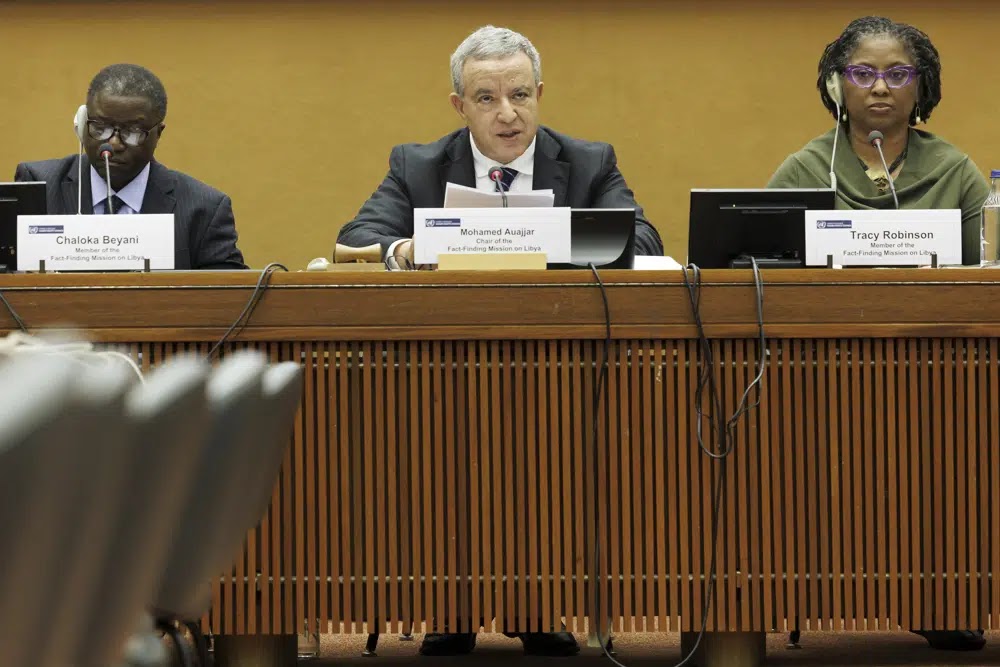
Mohamed Auajjar, center, Chairperson of the Independent Fact-Finding Mission on Libya, Chaloka Beyani, left, and Tracy Robinson, members of the Fact-Finding Mission, speak to the media ahead of presenting the findings of the final report, at the 52nd session of the Human Rights Council during a press conference, at the European headquarters of the United Nations in Geneva, Switzerland, Monday, March 27, 2023. (Salvatore Di Nolfi/Keystone via AP)

BY LORNE COOK

BRUSSELS (AP)
— The European Union on Tuesday defended its record on helping relieve the suffering of migrants in Libya after U.N.-backed investigators accused the 27-nation bloc of abetting human rights abuses and other crimes in the largely lawless north African country.

Libya is a major departure point for people from northern Africa and elsewhere willing to make the perilous Mediterranean Sea crossing in poorly maintained boats in search of better lives or sanctuary in Europe.

At least 529 migrants were reported dead and 848 others missing off Libya last year, according to the United Nations’ International Organization for Migration (IOM). More than 24,680 people were intercepted by the Libyan coastguard as they tried to leave, and brought back.

Presenting a report on Monday by a U.N.-commissioned fact-finding mission to Libya, investigator Chaloka Beyani said that EU assistance to the Libyan authorities, migration department and the coastguard “has aided and abetted the commission of the crimes,” including crimes against humanity.


The report said that migrants, some of whom might have been eligible for asylum, “were apprehended, detained, and disembarked in Libya solely to prevent their entry into Europe as a corollary of both European immigration policy and the economic agenda of migration in Libya via their subsequent detention and exploitation.”

The EU’s executive branch, the European Commission, said it takes the allegations “very seriously” but noted that its work in Libya is vital and often done in coordination with U.N. agencies like the IOM and U.N. High Commissioner for Refugees.

“Not doing anything is not an answer. And our objective, our joint objective, is to help to improve the situation of the people stranded in Libya,” commission spokesman Peter Stano said.

“Of course, there are incidents. There are issues which are a source of concern. We try to address them with the partners in Libya, with the international partners,” Stano told reporters in Brussels. He said the EU’s Libya mission had cooperated with the investigators.

The report also said that investigators believe the EU and its member countries “directly or indirectly, provided monetary and technical support and equipment, such as boats, to the Libyan Coast Guard and the Directorate for Combating Illegal Migration,” which were used to intercept and detain migrants.

But Stano denied suggestions that the EU might be paying to keep migrants in Libya.

“We are not financing any Libyan entity. We are not giving physical money to partners in Libya,” he said. “What we are doing is allocating a lot of money, which is then usually used by our international partners. A lot goes through the U.N., for example.”

Earlier this month, the commission said that a new boat was recently handed over for coastguard service. Two more new boats and an undisclosed number of refurbished ones are yet to come.

At the same time, the EU has refurbished six other boats for Libya’s General Administration of Coastal Security, which is separate to the coastguard. In February, Italy supplied two more fast boats to the GACS fleet. The commission said Tuesday that 142 GACS officers have received EU training.

Italy, where most people leaving Libya arrive, has received at least 15 million euros ($16.3 million) in EU money to fund migration and border control work there.

Last year, in a written answer to a question from the European Parliament, EU Home Affairs Commissioner Ylva Johansson said that “the EU has devoted around EUR 700 million ($760 million) to Libya during 2014-20, including EUR 59 million ($64 million)” for the coastguard and GACS.

___ Follow AP’s global migration coverage at https://apnews.com/hub/migration

Wednesday, September 21, 2022

Libya Working Towards A Democratic Transformation, President Tells UN

UNITED NATIONS
Mohamed Younis Menfi, President of the Presidential Council of the State of Libya, addresses the general debate of the General Assembly’s seventy-seventh. Image: Cia Pak/UN


Libyan President Muhammad Yunus Al-Manfi told the 77th session of the UN General Assembly on Tuesday that as it moves towards building a State of institutions and establishing principles of democracy, his country has through a decade of “pain and hope”.

He upheld his commitment to the Libyan Political Agreement, and as “the supreme political authority” will lead efforts to prepare for a peaceful and democratic transfer of power through presidential and parliamentary elections.

The most senior Libyan official thanked the African Union (AU) for its cooperation in launching a national reconciliation project, which represents the most important track for the country to reach its desired goal of peace and stability.

Moreover, he stressed the need for time limits during dialogues between the House of Representatives and the State Supreme Council, offering his willingness to intervene “to get the political process out of its impasse whenever necessary”.

Role of the UN

Mr. Al-Minfi noted positively the UN’s involvement in Libya and envisioned an active role through the country’s new leadership.

He urged the Organization to seriously work to support comprehensive national solutions to the political impasse, noting that it has almost undermined the political achievements gained through the UN-sponsored Libyan dialogue.

The President also called for restoring economic momentum and reducing the “power of corruption”.
External interference

The Libyan leader stated that proxy wars and conflicting visions for a solution in his country is preventing a national option from being formed.

He said that negative international interventions are still charting paths of “contradictory solutions” that could push Libya into armed confrontations and lead to rigid political positions that bar approaches to bridging gaps and building partnerships in the country.

Managing oil

Turning to the economy, Mr. Al-Manafi maintained that the Libyan Presidential Council supports every effort to resume oil and gas production throughout all regions of the country.

He underscored the Libyan Presidential Council’s keenness for transparent and fair oil revenue management to neutralize public money from the political conflict and ensure, without political or geographical discrimination, that it benefits all Libyans.

The President expressed his hope that this may alleviate the severity of the economic situation and the ongoing struggle over the executive authority, while also providing a more stable environment for a democratic transformation.

Wednesday, May 18, 2022

Clashes Break Out In Tripoli, Drive Rival Libyan PM Away

Forces loyal to Abdul Hamid Dbeibah, one of Libya’s two rival prime ministers, secure the streets of the capital, Tripoli, Tuesday May, 17, 2022. Clashes broke out in Tripoli after Dbeibah’s rival, Prime Minister Fathi Bashagha, announced his arrival in the city on Tuesday morning. But Bashagha left soon after the fighting started. (AP Photo/Yousef Murad)

BY SAMY MAGDY

CAIRO (AP)
— An attempt by one of Libya’s rival prime ministers to seat his government in the capital of Tripoli triggered clashes Tuesday between competing militias, forcing the newly appointed premier to leave the city.

The development underscored the fragility of the situation in the war-wracked country while the two rival prime ministers blamed each other for the escalation.

Prime Minister Fathi Bashagha’s office said he had arrived in Tripoli with a number of Cabinet ministers early Tuesday — three months after his appointment to lead an interim government.

The move was likely to fuel more tensions between Libya’s rival administrations and in the morning, local media reported clashes between different militias and rival forces in central Tripoli and elsewhere in the city.

The Tripoli-based government of embattled Prime Minister Abdul Hamid Dbeibah slammed Bashagha, describing Tuesday’s developments as an armed group’s “desperate attempt to spread terror and chaos” in the Libyan capital — a reference to Bashagha.

Debeibah was seen inspecting damage caused by the fighting in Tripoli and chatting with residents in the streets, according to videos broadcast by local media.

Residents reported hearing heavy gunfire across the city. “There was shooting and gunfire everywhere,” said Salim Ahmed, a schoolteacher. Some Tripoli schools suspended classes.

Bashagha’s office said he and his ministers later left Tripoli “for the sake of the security and safety of citizens and to stop the bloodshed.” Bashagha tweeted that they had entered the city “peacefully, without using violence” but were met with a “dangerous military escalation” from armed groups loyal to his rival.

Both governments reported that at least one man was killed by gunfire and five others were wounded in the clashes.

A Western diplomat in Tripoli said Bashagha entered the city accompanied by the Nawasi Brigade militia but they faced stiff resistance from militias loyal to Dbeibah.

Another militia, known as the 444 Brigades, mediated between the rivals and facilitated the withdrawal of Bashagha, according to the diplomat, who demanded anonymity to speak about the events.

The U.N. special adviser on Libya, Stephanie Williams, urged calm and for rival parties to engage in talks to resolve their disputes.

“Conflict cannot be solved with violence, but with dialogue and mediation,” she tweeted, adding that the United Nations is ready to host all parties “in helping Libya find a genuine, consensual way forward towards stability and elections.”

In Washington, U.S. State Department spokesman Ned Price said to reporters that the U.S. was “highly concerned” by the violence in Libya and appealed for all sides to “recognize that trying to seize or retain power through force will only hurt the people of Libya.”

“It’s critical for Libyan leaders to find consensus to avoid clashes, like the ones we saw yesterday. We continue to believe that the only viable path to legitimate leadership is by allowing Libyans to choose their leaders through free and fair elections,″ Price said.

Bashagha, a former interior minister, was named prime minister by the country’s east-based parliament in February. But Dbeibah, a wealthy businessman, has refused to step down, insisting he will hand over power only to an elected government. Dbeibah was appointed last year in a U.N.-led process, mired with alleged corruption and bribery, to lead the country through elections in December that never took place. Both men hail from the powerful western city of Misrata.

Jalel Harchaoui, a Libya researcher, said the violence that unfolded during Bashagha’s brief presence inside Tripoli reflected his “clear failure.” Dbeibah enjoys the support of well-financed armed groups — not only in the capital but also in Misrata — that are fierce opponents of east-based military commander Khalifa Hifter, with whom Bashagha is now aligned, said Harchaoui.

The latest violence is likely to undermine ongoing talks in the Egyptian capital between the east-based parliament and the High Council of State, an advisory body from western Libya, on constitutional amendments for elections.

Over the weekend, rival militias clashed in Tripoli’s Janzour neighborhood. No casualties were reported but local authorities said there was damage to infrastructure, including a power plant. The U.N. mission in Libya condemned the clashes and said they involved indiscriminate fire and reports of heavy weapons use in the densely populated neighborhood.

Lawmakers have argued that Dbeibah’s mandate expired after Libya failed to hold presidential elections in December. The failure was a major blow to international efforts to end decade of chaos in Libya. It opened a new chapter in Libya’s long-running political impasse, with rival governments claiming power after tentative steps toward unity past year.

The impasse worsened over the past two months and the closure of oil facilities, including Libya’s largest oil field, in areas controlled by Hifter’s forces was likely a move to deprive Debeibah’s government of funds and boost his rival.

The oil-rich country has been wrecked by conflict since the NATO-backed uprising toppled and killed longtime dictator Moammar Gadhafi in 2011. Libya has since been split between rival administrations in the east and west, each supported by different militias and foreign governments.

Wednesday, December 29, 2021

EXPLAINER: Lbya Future At Stake After Failing To Hold Vote

FILE - This photo provided by the High National Elections Commission shows Seif al-Islam Gadhafi, left, the son and one-time heir apparent of late Libyan dictator Moammar Gadhafi registering his candidacy for the country's presidential elections next month in Sabha, Libya, Nov. 14, 2021. Libya has failed to hold its first presidential election as planned in Dec. 2021. The vote has faced many challenges, including controversial presidential hopefuls, disputes over laws governing the elections and occasional infighting among armed groups. (Libyan High National Elections Commission via AP, File)


BY SAM MAGDY

CAIRO (AP)
— Libya failed to hold its first presidential election as planned this month, a major blow to international efforts to end a decade of chaos in the oil-rich Mediterranean country.

The postponement of the Dec. 24 vote has opened up uncertainty over what comes next in the tenuous peace process, raising worries Libya could slide into new round of violence after more than a year of relative calm.

The planned vote was the lynchpin of international peace efforts, and major regional and international powers had for months pushed for it to take place as scheduled.

But many inside and outside Libya doubted the election would proceed as planned. Some warned that holding the vote could destabilize the country, given the continued polarization.

Libya descended into chaos following the 2011 NATO-backed uprising that ousted and then killed longtime dictator Moammar Gadhafi. Since then, armed groups have proliferated, including local and tribal militias, nationalist and mainstream Islamist groups, al-Qaida and the Islamic State group.

Since parliamentary elections in 2014, the country has been divided between two main rival administrations: one in the east backed by military commander Khalifa Hifter, and another in the west - an array of militias loosely allied with a weak, U.N.-recognized government in the capital Tripoli.

WHAT WAS THE PLAN?

Hifter, who was senior officer under Gadhafi but defected in the 1980s, is based in the eastern city of Benghazi, the epicenter of the 2011 uprising. His forces, the self-styled Libyan Arab Armed Forces, control much of eastern and southern Libya, including its oil fields and terminals. He is backed by Russia, the United Arab Emirates and Egypt.

In April 2019, Hifter and his forces launched an offensive on Tripoli, but Turkey and Qatar stepped up their military support for his Tripoli-based rivals, including deploying troops and Syrian mercenaries. The offensive failed after 14 months of fighting.

An internationally brokered October 2020 cease-fire has kept a relative peace since. But some its main provisions — the withdrawal of all foreign forces and mercenaries within three months and adherence to a U.N. arms embargo — have not been met.

After the cease-fire deal, the U.N. led a political process called the Libyan Political Dialogue Forum, which includes 75 delegates from across the country.

The forum set presidential and parliamentary elections for Dec. 24. It also appointed an interim government that included a three-member Presidential Council led by an eastern figure, and a Cabinet led by Prime Minister Abdul Hamid Mohammed Dbeibah, a powerful businessman from the western city of Misrata.

The interim government’s main task was to prepare the country for the elections.

WHAT HAPPENED?

From the beginning, the process was hampered by disputes.

The main leadership body in the west, the Tripoli-based Supreme Council of State, denounced the rules governing the election, drawn up by the eastern-based parliament. Dbeibeh joined the criticism. With legal challenges over the rules still unresolved, the Council of State persistently called for the vote to be delayed.

Mistrust deepened when lawmakers decided to hold parliamentary elections a month after the planned Dec. 24 presidential vote, rather than simultaneously.

The presidential election became sharply polarized when several figures who were considered intolerable by their opponents declared their intention to run — particularly Hifter and Seif al-Islam Gadhafi, the ousted dictator’s son and one-time heir apparent.

Khalid al-Mishri, the head of the Supreme Council of State, threatened violence to prevent Hifter from taking office if he is elected.

Seif al-Islam’s declaration of his candidacy prompted vows from opponents never to allow a return of Gadhafi family rule. The election commission disqualified him along with two dozen other would-be candidates. But on appeal, courts restored most of them, including Seif al-Islam.

Dbeibeh also declared his candidacy, causing outrage because when he was appointed to the head the transitional government, he had promised not to run.

Around 100 people submitted documents to run for president, but with legal disputes still roiling, the election commission was unable to declare a final list of candidates.

It was also never clear what would happen after the elections. All sides agree the constitution needs to be rewritten, but there has been no agreement on who will do so or when.

With so much at stake and so much still unresolved, militias showed their discontent. Militias demanding a postponement blocked roads in parts of Tripoli, raising warnings from the U.N. mission in Libya that the tensions could explode into violence.

And each side in the country’s main east-west split remains ready for a fight, bolstered by mercenaries provided by their foreign backers who have not withdrawn. The current number of mercenaries is not known, but according to the U.N., they have numbered as high as 20,000, including Syrians, Russians, and Sudanese in the country.

WHAT IS NEXT?

The failure to hold the vote as planned threatens to open a political vacuum.

Lawmakers have argued that the interim government’s mandate ended on Dec. 24. They say the government failed in its main tasks, preparing the country for the vote, unifying its institutions, and dismantling militias or integrating them into regular security forces.

Dbeibeh, the interim prime minister, said in a televised address Tuesday that he and his administration would remain until “real elections” are held. He said the election laws were “flawed” and called for the vote to be based on a newly crafted constitution.

Major Western governments have called for the government to remain in power until “prompt” parliamentary and presidential elections are held.

The election commission proposed Jan. 24 as a new date.

But it’s not clear when or if the factions can resolve the disputes that led to the failure to hold the vote as planned. Stephanie Williams, the U.N. special adviser on Libya, has for two weeks shuttled between major Libyan players.

A legislative committee for the election blamed militias that it said wanted “to craft a distorted electoral process,” an apparent reference to complaints from Tripoli over the election rules.

The committee suggested drawing a “practical roadmap” for elections and restructuring the interim government to “achieve stability,” without specifying dates.

More than 100 lawmakers held two days of deliberations this week in the eastern city of Tobruk over the future of the electoral process and the interim government. The session ended without a decision and is expected to continue next week.

Thursday, December 16, 2021

Libya’s Election Faces Uncertainty Amid Towering Challenges

BY SAM MAGDY

Demonstrators protest in Tripoli, Libya, on Sept. 24, 2021, in opposition to parliament passing a vote of no-confidence in the transitional government. The motion represented a challenge to planned December elections and impedes efforts to unite the oil-rich North African nation after a decade of turmoil. The country's presidential election, meant to help unify it after a decade of civil war, is supposed to take place in just over a week, but calls are mounting for a delay. Either scenario — holding the vote on time or postponing it — could turn into a destabilizing setback. The vote, scheduled for Dec. 24, is to choose Libya’s first president since the ouster and killing of Moammar Gadhafi more than a decade ago. (AP Photo/Yousef Murad, file)


CAIRO (AP) — Libya’s presidential election, meant to help unify the nation after a decade of civil war, is supposed to take place in just over a week, but calls are mounting for a delay.

Either scenario — holding the vote on time or postponing it — could turn into a destabilizing setback.

The vote, scheduled for Dec. 24, is to choose Libya’s first president since the ouster and killing of longtime dictator Moammar Gadhafi more than a decade ago.

For nearly a year, the election has been the lynchpin of international efforts to bring peace to the oil-rich North African nation, and supporters fear a dangerous void if it is not held on schedule.

But critics warn that going ahead with the vote now could throw the country into new violence. They say Libya remains too bitterly divided among armed factions that are likely to reject any victory by rivals in the election. The presence of some of Libya’s most polarizing figures in the race — including one of Gadhafi’s sons — only makes it more explosive.

Nearly 100 people have announced their candidacies, but the election commission has still not announced a final list of candidates because of legal disputes. It should have announced the list earlier this month. The rules governing the election are also in dispute, with western Libya politicians accusing the east-based parliament of adopting them without consultations.

Libya plunged into chaos after Gadhafi’s death during a 2011 uprising backed by a U.S.-led NATO military campaign. Control splintered among a myriad of armed militias. For years, the country was split between rival administrations in the east and the west, each backed by militias and foreign governments.

The current political process emerged last year after the latest round of brutal fighting.

In April 2019, the eastern-based military commander Khalifa Hifter launched an offensive aimed at capturing the capital, Tripoli, and bringing down the U.N.-recognized government based there. Hifter was backed by Russia, Egypt and the United Arab Emirates. Turkey and Qatar responded by stepping up support for pro-Tripoli militias, supplying them with advanced weapons and providing troops and Syrian mercenaries.

After 14 months of fighting, Hifter’s offensive collapsed. After a U.N.-brokered cease-fire in October 2020, a grouping of Libyan factions called the Political Forum drew up a road map that led to the creation of an interim government to run the country until the Dec. 24 election.

Those calling for a delay in the election say the mistrust between east and west remains too deep and volatile. The interim government has not been able to unify Libya’s institutions, particularly the military, dismantle militias or ensure the exit of foreign mercenaries and fighters, said one U.N. official.

“These issues should have been settled before going to elections. They need more time and effort to be resolved,” he said, speaking on condition of anonymity because he was not authorized to talk to the press.

Tarek Mitri, a former U.N. envoy for Libya, warned that “without unified military forces, the election poses a threat to peace.”

“How can you win the argument in a democratic election when guns are loaded to the hilt on both sides?” he said.

In a last-minute effort to save the elections, U.N. Secretary-General Antonio Guterres named American diplomat Stephanie Williams, who led the talks resulting in the October 2020 cease-fire deal, as his special adviser on Libya.

Williams met with Libyan officials in Tripoli on Sunday. She called for all sides to respect the “overwhelming demand of the Libyan people to elect their representatives through a free, fair and credible election.” She did not mention the Dec. 24 dateline in her public comments.

The United States and some others in the international community want the vote to go ahead. As he stepped down on Dec. 8, outgoing U.N. envoy Jan Kubis said the election must take place on schedule, calling it “a critically important step that opens doors to future solutions.”

The polarization around the election only grew hotter after both Hifter and Seif al-Islam Gadhafi, the son and one-time heir apparent of the longtime dictator, announced their candidacies.

Hifter, touted in the east as a hero, is hated by many in the west of the country.

“The entire western region will fight Hifter ... he will never rule Libya,” Islamist Khalid al-Mishri, head of the Tripoli-based Supreme Council of State, said in televised comments last month.

Seif al-Islam’s bid raised cries of an attempted return to the days of his father.

“Those who believe in the possibility of Libya’s returning to the era of dictatorship after all these sacrifices are delusional,” Abdel-Rahman el-Swahili, a lawmaker from Misrata, the western city that was one of the leading forces in the rebellion against the elder Gadhafi.

The prime minister of the interim government, Abdul Hamid Dbeibah, also caused an uproar when he announced his bid to enter the race. When he took his post, he had vowed not to run in the election.

Many Libyans are skeptical.

“All (the factions) say publicly they want elections, but in in fact, all worked against it,” said Ramadan al-Zawi, a 29-year-old teacher. “We are deceiving ourselves when we talk about elections while we are still in such an unchanged situation since 2011.”

Monday, February 17, 2020

EU Agrees To End Med Anti-Smuggler Mission Off Libya

Luxembourg's Foreign Minister Jean Asselborn, centre, talks to Italy's Foreign Minister Luigi di Maio, left, and Bulgaria's Foreign Minister Ekaterina Zaharieva during an European Foreign Affairs meeting at the Europa building in Brussels, Monday, Feb. 17, 2020. A number of European Union countries are blocking a decision to resume a naval operation in the Mediterranean Sea over concerns that it might encourage migrants to set out from the Libyan coast in search of better lives in Europe, the EU's top diplomat said Monday. (AP Photo/Francisco Seco)


BY LORNE COOK

BRUSSELS (AP)
— European Union foreign ministers agreed Monday to end Operation Sophia, the bloc’s naval mission in the Mediterranean Sea, and launch a new maritime effort focused more on enforcing the U.N arms embargo around Libya.

Operation Sophia was set up in 2015 as tens of thousands of migrants headed across the sea from North Africa to Europe. Its aim was to crack down on migrant smugglers, but also to enforce the arms embargo, which is routinely being flouted.

But tensions over how to distribute migrants picked up at sea and claims that the naval presence encouraged people to leave led Italy to block the deployment of naval vessels last year. Austria, too, opposed the return of warships and the operation has been functioning for months exclusively using aircraft and pilot-less drones.

“We agreed to launch a new operation in the Mediterranean and Operation Sophia will be closed,” EU foreign policy chief Josep Borrell told reporters after chairing the meeting of EU foreign ministers in Brussels. He said that Sophia would end on March 20 when its mandate expires.

A legal text defining the exact terms of the new mission must still be thrashed out by experts and submitted for the ministers’ next meeting, in March. The idea is to shift the new operation further east, away from the usual waters used by migrants leaving Libya in search of better lives in Europe.

The new, as yet unnamed, operation will have as its aim the implementation of the arms embargo and comprise aerial, satellite and maritime assets, Borrell said. He said several countries had offered to take part, but that military commanders must yet work out how much equipment is needed.

Sophia operated along the length of the Libyan coast out to sea, but Borrell said the new operation would have to move closer to Egypt. “If we want to control the arms embargo, we have to concentrate our surveillance on the east part where the arms are coming from,” he said.

Should commanders signal that migrants are being drawn toward the mission in hopes of being picked up, the ministers have the possibility to decide that the “maritime assets will be withdrawn from the relevant area.” This is meant to satisfy the objections of Austria and Italy.

Libya has been in turmoil since 2011, when a civil war toppled long-time dictator Moammar Gadhafi, who was later killed. Fighting between the country’s factions has intensified over the past year.

A weak U.N.-recognized Libyan government that now holds the capital, Tripoli, and parts of the country’s west is backed by Turkey, which recently sent thousands of soldiers to Libya, and to a lesser degree Qatar and Italy, as well as local militias.

On the other side is a rival government in the east that supports self-styled Gen. Khalifa Hifter, whose forces launched an offensive to capture Tripoli last April. They are backed by the United Arab Emirates, Egypt, France and Russia.

“What’s important is that Sophia is history. Now comes a new mission, with a clear focus on the arms embargo,” Austrian Foreign Minister Alexander Schallenberg told reporters after the agreement was reached.

Asked whether Operation Sophia’s ships really did attract migrants, Borrell said: “the figures show clearly during the first year of Operation Sophia the number of migrants continued to climb ... but then it went down, a lot.”

Luxembourg Foreign Minister Jean Asselborn underlined the importance of focusing on the embargo.

“If there are no weapons, there’s no war. There are thousands of thousands of weapons in Libya,” Asselborn said. “We in Europe are the ones who will suffer if anarchy spreads in Libya.”

But taking aim at Austria — a landlocked country far from the Mediterranean but which many migrants crossed in 2015 and 2016 trying to get to Germany — for blocking the deployment of ships, he said: “It’s too much, to abandon or break with our consensus just to avoid having to save a few people.”

Kirsten Grieshaber and Frank Jordans in Berlin contributed to this report.

Friday, January 17, 2020

Libya's Rival Military Commander Seeks Support In Greece

Libyan Gen. Khalifa Hifter, right, and Greek Foreign Minister Nikos Dendias shake hands before their meeting in Athens, Friday, Jan. 17, 2020. The commander of anti-government forces in war-torn Libya has begun meetings in Athens in a bid to counter Turkey's support for his opponents. (AP Photo/Thanassis Stavrakis)


BY ELENA BECATOROS

ATHENS, GREECE (AP)
— The commander of forces fighting the U.N.-supported government in Libya visited Athens Friday in a bid to counter Turkey’s support for his opponents, ahead of a weekend summit on Libya in Berlin.

Gen. Khalifa Hifter’s surprise trip to Greece came two days before the Berlin summit, which aims to halt the conflict in the oil-rich country that is being fueled by competing international support for the warring sides.

Separately, the Kremlin announced that Russian President Vladimir Putin would be attending the meeting in Germany.

Turkey, which has sent troops to back Libya’s government against Hifter’s offensive, is at odds with Greece over oil-and-gas drilling rights in the East Mediterranean.

In November, Turkey and the Libyan government in Tripoli signed a controversial maritime deal delineating a boundary between the two countries in the Mediterranean. Libya has been divided between two competing governments since 2015, one based in Benghazi in the east and the other based in Tripoli.

The agreement would give Turkey and Libya access to an economic zone across the Mediterranean despite the objections of Greece, Egypt and Cyprus, which lie between the two geographically.

Greek Foreign Minister Nikos Dendias, speaking after meeting with Hifter, said the Greek government had encouraged the Libyan general to “participate (in the Berlin meeting) constructively” and to work toward achieving a cease-fire and restoring security in Libya “by removing mercenaries and by the recognition of the invalidity of the illegal agreements” between Turkey and the government in Tripoli.

“l must tell you with great pleasure that the commander agreed to all of those remarks,” Dendias said. The minister said Greece was willing to help police a European ban on arms shipments to Libya.

Hifter made no comments after his talks with Dendias or a later meeting with Greek Prime Minister Kyriakos Mitsotakis.

Mitsotakis, who was not invited to Berlin, said late Thursday that Greece “will never accept a political solution for Libya that does not require the cancellation” of the maritime deal with Turkey. “We will use our veto before the case gets to the summit meeting. We will veto it at a foreign ministers’ level,” he said.

However, it was unclear exactly what Greece could block. A Greek official, speaking on condition of anonymity, said the veto would be applied to “any decision concerning Libya on a European level if it doesn’t include the annulment” of the maritime deal.

Asked in Berlin why Greece wasn’t invited to Berlin, German government spokesman Steffen Seibert said “Greece’s participation in the Berlin Libya conference was never up for debate.”

Seibert said the “substance of the conference” was considered when determining who would attend.

“Those international actors with immediate influence in the Libya conflict are taking part in this conference and that’s the focus of the event,” he said.

In Moscow, the Kremlin said Sunday’s Berlin talks would focus on a cease-fire and the launch of a broad political dialogue under the United Nations.

Russia and Turkey held talks with the warring sides in Moscow on Monday, focusing on a cease-fire agreement. Hifter and Fayez Sarraj, the head of Libya’s U.N.-recognized government in Tripoli, didn’t meet directly and held separate talks with Russian and Turkish diplomats and military officials.

But Hifter refused to sign the cease-fire document.

Russia’s acting foreign minister, Sergey Lavrov, said Friday the most important outcome of the talks was that the truce was still holding in Libya.

Turkish President Recep Tayyip Erdogan, however, expressed doubt that Hifter would abide by any cease-fire.

“This man is not a trustworthy man,” he told reporters in Istanbul on Friday. “Yesterday, they continued to bomb Tripoli.”

Erdogan, who will be attending the meeting in Berlin, said Turkey would monitor Hifter’s actions following the conference.

“My hope is that he will stand behind the promise he made,” Erdogan said.

Apart from the maritime deal made with the government in Tripoli, Turkey has also reached a security cooperation agreement with Libya and has sent troops to support the U.N.-backed government there.

German foreign ministry spokesman Rainer Breul, asked about the deployment of Turkish troops to Libya, said that “sending international troops to Libya breaches the United Nations arms embargo.”

Rights groups have urged participants at the summit to work toward reaching a lasting peace deal.

Amnesty International said any deal must prioritize “protection of civilians and justice for victims of violations.” In a statement, it said a field investigation it released in October had “unearthed evidence of potential war crimes by both the UN-backed Government of National Accord and the LNA,” Hifter’s Libyan National Army.

The United Nations Children’s Fund called on leaders attending the summit to reach a peace deal that would end the “dire and untenable” situation of children in Libya. UNICEF said 150,000 people, including 90,000 children, have been forced to flee their homes since Hifter launched his offensive in April.

The Libya director of the International Rescue Committee, Thomas Garofalo, said in a statement that violence had forced the group to stop some of its relief operations in recent weeks for those displaced by the conflict.

“We call upon all parties gathered in Berlin to ensure that all civilians, including migrants and refugees, are protected in line with International Humanitarian and Human Rights Law,” he said.

Separately, The U.N. Support Mission in Libya called Friday for the immediate release of Libyan lawmaker Seham Sergiwa, who was kidnapped by gunmen from her house in Hifter’s stronghold, the eastern city of Benghazi, in July. Her whereabouts remain unknown.

The UNSMIL said Sergiwa’s “enforced disappearance constitutes an attempt to silence one of Libya’s prominent female voices and to intimidate others seeking to participate in the country’s political life.”

The statement held the eastern government responsible for establishing her whereabouts.

Following her disappearance, the Tripoli-based government accused forces loyal to Hifter of kidnapping her after she sharply criticized his offensive on Tripoli. The pro-Hifter, east-based government dismissed the allegations and said an investigation was underway to find Sergiwa.

___

Derek Gatopoulos in Athens, Suzan Fraser in Istanbul, Vladimir Isachenkov in Moscow, Frank Jordans in Berlin and Noha ElHennawy in Cairo contributed.

___

Follow Becatoros at https://www.twitter.com/ElenaBec

Tuesday, December 31, 2019

EU Funds For Migrants In Libya Enrich Their Abusers Instead

Maps shows satellite image of Zawiya detention center in Libya where migrants are held and overlays information on structures inside and nearby the compound.;


BY MAGGIE MICHAEL, LORI HINNANT, RENATA BRITO

TRIPOLI, LIBYA (AP)
— When the European Union started funneling millions of euros into Libya to slow the tide of migrants crossing the Mediterranean, the money came with EU promises to improve detention centers notorious for abuse and fight human trafficking.

That hasn’t happened. Instead, the misery of migrants in Libya has spawned a thriving and highly lucrative web of businesses funded in part by the EU and enabled by the United Nations, an Associated Press investigation has found.

The EU has sent more than 327.9 million euros to Libya, with an additional 41 million approved in early December, largely funneled through UN agencies. The AP found that in a country without a functioning government, huge sums of European money have been diverted to intertwined networks of militiamen, traffickers and coast guard members who exploit migrants. In some cases, UN officials knew militia networks were getting the money, according to internal emails.

The militias torture, extort and otherwise abuse migrants for ransoms in detention centers under the nose of the UN, often in compounds that receive millions in European money, the AP investigation showed. Many migrants also simply disappear from detention centers, sold to traffickers or to other centers.

The same militias conspire with some members of Libyan coast guard units. The coast guard gets training and equipment from Europe to keep migrants away from its shores. But coast guard members return some migrants to the detention centers under deals with militias, the AP found, and receive bribes to let others pass en route to Europe.

The militias involved in abuse and trafficking also skim off European funds given through the UN to feed and otherwise help migrants, who go hungry. For example, millions of euros in UN food contracts were under negotiation with a company controlled by a militia leader, even as other UN teams raised alarms about starvation in his detention center, according to emails obtained by the AP and interviews with at least a half-dozen Libyan officials.

In many cases, the money goes to neighboring Tunisia to be laundered, and then flows back to the militias in Libya.

This story is part of an occasional series, “Outsourcing Migrants,” produced with the support of the Pulitzer Center on Crisis Reporting.

The story of Prudence Aimée and her family shows how migrants are exploited at every stage of their journey through Libya.

Aimée left Cameroon in 2015, and when her family heard nothing from her for a year, they thought she was dead. But she was in detention and incommunicado. In nine months at the Abu Salim detention center, she told the AP, she saw “European Union milk” and diapers delivered by UN staff pilfered before they could reach migrant children, including her toddler son. Aimée herself would spend two days at a time without food or drink, she said.

In 2017, an Arab man came looking for her with a photo of her on his phone.

“They called my family and told them they had found me,” she said. “That’s when my family sent money.” Weeping, Aimée said her family paid a ransom equivalent of $670 to get her out of the center. She could not say who got the money.


Diagram shows how income from migrant exploitation, aid misuse and fraud in the currency black market helps fund militias in Libya, destabilizing the country and furthering human rights abuses. ;


She was moved to an informal warehouse and eventually sold to yet another detention center, where yet another ransom — $750 this time — had to be raised from her family. Her captors finally released the young mother, who got on a boat that made it past the coast guard patrol, after her husband paid $850 for the passage. A European humanitarian ship rescued Aimée, but her husband remains in Libya.

Aimée was one of more than 50 migrants interviewed by the AP at sea, in Europe, Tunisia and Rwanda, and in furtive messages from inside detention centers in Libya. Journalists also spoke with Libyan government officials, aid workers and businessmen in Tripoli, obtained internal UN emails and analyzed budget documents and contracts.

The issue of migration has convulsed Europe since the influx of more than a million people in 2015 and 2016, fleeing violence and poverty in the Mideast, Afghanistan and Africa. In 2015, the European Union set up a fund intended to curb migration from Africa, from which money is sent to Libya. The EU gives the money mainly through the UN’s International Organization for Migration (IOM) and the High Commissioner for Refugees. (UNHCR).

But Libya is plagued by corruption and caught in a civil war. The west, including the capital Tripoli, is ruled by a UN-brokered government, while the east is ruled by another government supported by army commander Khalifa Hifter. The chaos is ideal for profiteers making money off migrants.

The EU’s own documents show it was aware of the dangers of effectively outsourcing its migration crisis to Libya. Budget documents from as early as 2017 for a 90 million euro outlay warned of a medium-to-high risk that Europe’s support would lead to more human rights violations against migrants, and that the Libyan government would deny access to detention centers. A recent EU assessment found the world was likely to get the “wrong perception” that European money could be seen as supporting abuse.

Despite the roles they play in the detention system in Libya, both the EU and the UN say they want the centers closed. In a statement to the AP, the EU said that under international law, it is not responsible for what goes on inside the centers.

“Libyan authorities have to provide the detained refugees and migrants with adequate and quality food while ensuring that conditions in detention centers uphold international agreed standards,” the statement said.

The EU also says more than half of the money in its fund for Africa is used to help and protect migrants, and that it relies on the UN to spend the money wisely.

The UN said the situation in Libya is highly complex, and it has to work with whoever runs the detention centers to preserve access to vulnerable migrants.

“UNHCR does not choose its counterparts,” said Charlie Yaxley, a spokesman for the UN refugee agency. “Some presumably also have allegiances with local militias.”

After two weeks of being questioned by the AP, UNHCR said it would change its policy on awarding of food and aid contracts for migrants through intermediaries.

“Due in part to the escalating conflict in Tripoli and the possible risk to the integrity of UNHCR’s programme, UNHCR decided to contract directly for these services from 1 January 2020,” Yaxley said.

Julien Raickman, who until recently was the Libya mission chief for the aid group Médecins Sans Frontières, also known as Doctors Without Borders, believes the problem starts with Europe’s unwillingness to deal with the politics of migration.

“If you were to treat dogs in Europe the way these people are treated, it would be considered a societal problem,” he said.

EXTORTION INSIDE THE DETENTION CENTERS

About 5,000 migrants in Libya are crowded into between 16 and 23 detention centers at any given time, depending on who is counting and when. Most are concentrated in the west, where the militias are more powerful than the weak UN-backed government.

Aid intended for migrants helps support the al-Nasr Martyrs detention center, named for the militia that controls it, in the western coastal town of Zawiya. The UN’s migration agency, the IOM, keeps a temporary office there for medical checks of migrants, and its staff and that of the UNHCR visit the compound regularly.

Yet migrants at the center are tortured for ransoms to be freed and trafficked for more money, only to be intercepted at sea by the coast guard and brought back to the center, according to more than a dozen migrants, Libyan aid workers, Libyan officials and European human rights groups. A UNHCR report in late 2018 noted the allegations as well, and the head of the militia, Mohammed Kachlaf, is under UN sanctions for human trafficking. Kachlaf, other militia leaders named by the AP and the Libyan coast guard all did not respond to requests for comment.


In this Sept. 23, 2019 photo, rescued migrants draw a map of the Zawiya, Libya detention center run by the al-Nasr Martyrs militia. Migrants at the center are tortured for ransoms to be freed and trafficked for more money, only to be intercepted at sea by the coast guard and brought back to the center, according to more than a dozen migrants, Libyan aid workers, Libyan officials and European human rights groups. (AP Photo/Renata Brito)


Many migrants recalled being cut, shot and whipped with electrified hoses and wooden boards. They also heard the screams of others emerging from the cell blocks off-limits to UN aid workers.

Families back home are made to listen during the torture to get them to pay, or are sent videos afterward.

Eric Boakye, a Ghanaian, was locked in the al-Nasr Martyrs center twice, both times after he was intercepted at sea, most recently around three years ago. The first time, his jailers simply took the money on him and set him free. He tried again to cross and was again picked up by the coast guard and returned to his jailers.

“They cut me with a knife on my back and beat me with sticks,” he said, lifting his shirt to show the scars lining his back. “Each and every day they beat us to call our family and send money.” The new price for freedom: Around $2,000.

That was more than his family could scrape together. Boakye finally managed to escape. He worked small jobs for some time to save money, then tried to cross again. On his fourth try, he was picked up by the Ocean Viking humanitarian ship to be taken to Italy. In all, Boakye had paid $4,300 to get out of Libya.

Fathi al-Far, the head of the al-Nasr International Relief and Development agency, which operates at the center and has ties to the militia, denied that migrants are mistreated. He blamed “misinformation” on migrants who blew things out of proportion in an attempt to get asylum.

“I am not saying it’s paradise -- we have people who have never worked before with the migrants, they are not trained,” he said. But he called the al-Nasr Martyrs detention center “the most beautiful in the country.”

At least five former detainees showed an AP journalist scars from their injuries at the center, which they said were inflicted by guards or ransom seekers making demands to their families. One man had bullet wounds to both feet, and another had cuts on his back from a sharp blade. All said they had to pay to get out.

Five to seven people are freed every day after they pay anywhere from $1,800 to $8,500 each, the former migrants said. At al-Nasr, they said, the militia gets around $14,000 every day from ransoms; at Tarek al-Sikka, a detention center in Tripoli, it was closer to $17,000 a day, they said. They based their estimates on what they and others detained with them had paid, by scraping together money from family and friends.

The militias also make money from selling groups of migrants, who then often simply disappear from a center. An analysis commissioned by the EU and released earlier this month by the Global Initiative Against Transnational Organized Crime noted that the detention centers profit by selling migrants among themselves and to traffickers, as well as into prostitution and forced labor.

Hundreds of migrants this year who were intercepted at sea and taken to detention centers had vanished by the time international aid groups visited, according to Médecins Sans Frontières. There’s no way to tell where they went, but MSF suspects they were sold to another detention center or to traffickers.

A former guard at the Khoms center acknowledged to the AP that migrants often were seized in large numbers by men armed with anti-aircraft guns and RPGs. He said he couldn’t keep his colleagues from abusing the migrants or traffickers from taking them out of the center.

“I don’t want to remember what happened,” he said. The IOM was present at Khoms, he noted, but the center closed last year.

A man who remains detained at the al-Nasr Martyrs center said Libyans frequently arrive in the middle of the night to take people. Twice this fall, he said, they tried to load a group of mostly women into a small convoy of vehicles but failed because the center’s detainees revolted.

Fighting engulfed Zawiya last week, but migrants remained locked inside the al-Nasr Martyrs center, which is also being used for weapons storage.

TRAFFICKING AND INTERCEPTION AT SEA

Even when migrants pay to be released from the detention centers, they are rarely free. Instead, the militias sell them to traffickers, who promise to take them across the Mediterranean to Europe for a further fee. These traffickers work hand in hand with some coast guard members, the AP found.

The Libyan coast guard is supported by both the UN and the EU. The IOM, the UN’s agency for migration, highlights its cooperation with the coast guard on its Libya home page. Europe has spent more than 90 million euros since 2017 for training and faster boats for the Libyan coast guard to stop migrants from ending up in Europe.

This fall, Italy renewed a memorandum of understanding with Libya to support the coast guard with training and vessels, and it delivered 10 new speedboats to Libya in November.

In internal documents obtained in September by the European watchdog group Statewatch, the European Council described the coast guard as “operating effectively, thus confirming the process achieved over the past three years.” The Libyan coast guard says it intercepted nearly 9,000 people in 2019 en route to Europe and returned them to Libya this year, after quietly extending its coastal rescue zone 100 miles offshore with European encouragement.

What’s unclear is how often militias paid the coast guard to intercept these people and bring them back to the detention centers -- the business more than a dozen migrants described at the al-Nasr Martyrs facility in Zawiya.

The coast guard unit at Zawiya is commanded by Abdel-Rahman Milad, who has sanctions against him for human trafficking by the UN’s Security Council. Yet when his men intercept boats carrying migrants, they contact UN staff at disembarkation points for cursory medical checks.

Despite the sanctions and an arrest warrant against him, Milad remains free because he has the support of the al-Nasr militia. In 2017, before the sanctions, Milad was even flown to Rome, along with a militia leader, Mohammed al-Khoja, as part of a Libyan delegation for a UN-sponsored migration meeting. In response to the sanctions, Milad denied any links to human smuggling and said traffickers wear uniforms similar to those of his men.

Migrants named at least two other operations along the coast, at Zuwara and Tripoli, that they said operated along the same lines as Milad’s. Neither center responded to requests for comment.

The IOM, the UN migration agency, acknowledged to the AP that it has to work with partners who might have contacts with local militias.

“Without those contacts it would be impossible to operate in those areas and for IOM to provide support services to migrants and the local population,” said Safa Msehli, the spokeswoman for the UN’s International Organization for Migration. “Failure to provide that support would have compounded the misery of hundreds of men, women and children.”

The story of Abdullah, a Sudanese man who made two attempts to flee Libya, shows just how lucrative the cycle of trafficking and interception really is.

All told, the group of 47 in his first crossing from Tripoli over a year ago had paid a uniformed Libyan and his cronies $127,000 in a mix of dollars, euros and Libyan dinars for the chance to leave their detention center and cross in two boats. They were intercepted in a coast guard boat by the same uniformed Libyan, shaken down for their cell phones and more money, and tossed back into detention.

“We talked to him and asked him, why did you let us out and then arrest us?” said Abdullah, who asked that only his first name be used because he was afraid of retaliation. “He beat two of us who brought it up.”

Abdullah later ended up in the al-Nasr Martyrs detention center, where he learned the new price list for release and an attempted crossing based on nationality: Ethiopians, $5,000; Somalis $6,800; Moroccans and Egyptians, $8,100; and finally Bangladeshis, a minimum $18,500. Across the board, women pay more.

Abdullah scraped together another ransom payment and another crossing fee. Last July, he and 18 others paid $48,000 in total for a boat with a malfunctioning engine that sputtered to a stop within hours.

After a few days stuck at sea off the Libyan coast under a sweltering sun, they threw a dead man overboard and waited for their own lives to end. Instead, they were rescued on their ninth day at sea by Tunisian fishermen, who took them back to Tunisia.

“There are only three ways out of the prison: You escape, you pay ransom, or you die,” Abdullah said, referring to the detention center.

In all, Abdullah spent a total of $3,300 to leave Libya’s detention centers and take to the sea. He ended up barely 100 miles away.

Sometimes members of the coast guard make money by doing exactly what the EU wants them to prevent: Letting migrants cross, according to Tarik Lamloum, the head of the Libyan human rights organization Beladi. Traffickers pay the coast guard a bribe of around $10,000 per boat that is allowed to pass, with around five to six boats launching at a time when conditions are favorable, he said.

The head of Libya’s Department for Combating Irregular Migration or DCIM, the agency responsible for the detention centers under the Ministry of Interior, acknowledged corruption and collusion among the militias and the coast guard and traffickers, and even within the government itself.

“They are in bed with them, as well as people from my own agency,” said Al Mabrouk Abdel-Hafez.

SKIMMING PROFITS

Beyond the direct abuse of migrants, the militia network also profits by siphoning off money from EU funds sent for their food and security -- even those earmarked for a UN-run migrant center, according to more than a dozen officials and aid workers in Libya and Tunisia, as well as internal UN emails and meeting minutes seen by The Associated Press.

An audit in May of the UNHCR, the UN refugee agency responsible for the center, found a lack of oversight and accountability at nearly all levels of spending in the Libya mission. The audit identified inexplicable payments in American dollars to Libyan firms and deliveries of goods that were never verified.

In December 2018, during the period reviewed in the audit, the UN launched its migrant center in Tripoli, known as the Gathering and Departure Facility or GDF, as an “ alternative to detention.” For the recipients of the services contracts, sent through the Libyan government agency Libaid, it was a windfall.

Millions of euros in contracts for food and migrant aid went to at least one company linked to al-Khoja, the militia leader flown to Rome for the UN migration meeting, according to internal UN emails seen by the AP, two senior Libyan officials and an international aid worker. Al-Khoja is also the deputy head of the DCIM, the government agency responsible for the detention centers.

One of the Libyan officials saw the multimillion-euro catering contract with a company named Ard al-Watan, or The Land of the Nation, which al-Khoja controls.

“We feel like this is al-Khoja’s fiefdom. He controls everything. He shuts the doors and he opens the doors,” said the official, a former employee at the UN center who like other Libyan officials spoke anonymously out of fear for his safety. He said al-Khoja used sections of the UN center to train his militia fighters and built a luxury apartment inside.

Even as the contracts for the UN center were negotiated, Libyan officials said, three Libyan government agencies, including the prosecutor’s office, were investigating al-Khoja in connection with the disappearance of $570 million from government spending allocated to feed migrants in detention centers in the west.

At the time, al-Khoja already ran another center for migrants, Tarik al-Sikka, notorious for abuses including beating, hard labor and a massive ransom scheme. Tekila, an Eritrean refugee, said that for two years at Tarik al-Sikka, he and other migrants lived on macaroni, even after he was among 25 people who came down with tuberculosis, a disease exacerbated by malnutrition. Tekila asked that only his first name be used for his safety.

“When there is little food, there is no choice but to go to sleep,” he said.

Despite internal UN emails warning of severe malnutrition inside Tarik al-Sikka, UN officials in February and March 2018 repeatedly visited the detention center to negotiate the future opening of the GDF. AP saw emails confirming that by July 2018, the UNHCR’s chief of mission was notified that companies controlled by al-Khoja’s militia would receive subcontracts for services.

Yaxley, the spokesman for UNHCR, emphasized that the officials the UN refugee agency works with are “all under the authority of the Ministry of Interior.” He said UNHCR monitors expenses to make sure its standard rules are followed, and may withhold payments otherwise.

A senior official at LibAid, the Libyan government agency that managed the center with the U.N., said the contracts are worth at least $7 million for catering, cleaning and security, and 30 out of the 65 LibAid staff were essentially ghost employees who showed up on the payroll, sight unseen.

The U.N. center was “a treasure trove,” the senior Libaid official lamented. “There was no way you could operate while being surrounded by Tripoli militias. It was a big gamble.”

An internal U.N. communication from early 2019 shows it was aware of the problem. The note found a high risk that food for the UN center was being diverted to militias, given the amount budgeted compared to the amount migrants were eating.

In general, around 50 dinars a day, or $35, is budgeted per detainee for food and other essentials for all centers, according to two Libyan officials, two owners of food catering companies and an international aid worker. Of that, only around 2 dinars is actually spent on meals, according to their rough calculations and migrants’ descriptions.

Yaxley, the spokesman for the UNHCR, said the UN refugee agency monitors expenses to make sure its standard rules are followed, and may withhold payments otherwise. He also emphasized that the officials UNHCR works with are “all under the authority of the Ministry of Interior.”

Despite the investigations into al-Khoja, Tarik al-Sikka and another detention center shared a 996,000-euro grant from the EU and Italy in February.

At the Zawiya center, emergency goods delivered by UN agencies ended up redistributed “half for the prisoners, half for the workers,” said Orobosa Bright, a Nigerian who endured three stints there for a total of 11 months. Many of the goods end up on Libya’s black market as well, Libyan officials and international aid workers say.

IOM’s spokeswoman said “aid diversion is a reality” in Libya and beyond, and that the UN agency does its best.

“Were it to become a regular occurrence IOM would be forced to re-evaluate the support it is providing to migrants in detention centres under DCIM despite our awareness that any reduction in this lifesaving assistance will add to the misery of the migrants,” Msehli said.

Despite the corruption, the detention system in Libya is still expanding in places, with money from Europe. At a detention center in Sabaa where migrants are already going hungry, they were forced to build yet another wing funded by the Italian government, said Lamloum, the Libyan aid worker. The Italian government did not respond to a request for comment.

Lamloum sent a photo of the new prison. It has no windows.

TUNISIA LAUNDERING

The money earned off the suffering of migrants is whitewashed in money laundering operations in Tunisia, Libya’s neighbor.

In the town of Ben Gardane, dozens of money-changing stalls transform Libyan dinars, dollars and euros into Tunisian currency before the money continues on its way to the capital, Tunis. Even Libyans without residency can open a bank account.

Tunisia also offers another opportunity for militia networks to make money off European funds earmarked for migrants. Because of Libya’s dysfunctional banking system, where cash is scarce and militias control accounts, international organizations give contracts, usually in dollars, to Libyan organizations with bank accounts in Tunisia. The vendors compound the money the money on Libya’s black-market exchange, which ranges between 4 and 9 times greater than the official rate.

Libya’s government handed over more than 100 files to Tunisia earlier this year listing companies under investigation for fraud and money laundering.

The companies largely involve militia warlords and politicians, according to Nadia Saadi, a manager at the Tunisian anti-corruption authority. The laundering involves cash payments for real estate, falsified customs documents and faked bills for fictitious companies.

“All in all, Libya is run by militias,” said a senior Libyan judicial official, who spoke on condition of anonymity for fear of risking his life. “Whatever governments say, and whatever uniform they wear, or stickers they put....this is the bottom line.”

Husni Bey, a prominent businessman in Libya, said the idea of Europe sending aid money to Libya, a once-wealthy country suffering from corruption, was ill-conceived from the beginning.

“Europe wants to buy those who can stop smuggling with all of these programs,” Bey said. “They would be much better off blacklisting the names of those involved in human trafficking, fuel and drug smuggling and charging them with crimes, instead of giving them money.”

Hinnant reported from Zarzis, Tunisia. Brito reported from aboard the Ocean Viking. Contributors include Lorne Cook in Brussels; Rami Musa in Benghazi, Libya, and Jamey Keaten in Geneva.

War, Erasure, And The Politics Of Culture In Sudan

BY LARISSA-DIANA FUHRMANN This article examines contemporary cultural erasure in Sudan. It highlights resilient Sudanese efforts and interna...