Showing posts with label Jimmy Carter. Show all posts

Tuesday, April 14, 2026

A Justice Department Opinion Arguing The Presidential Records Act Is Unconstitutional Could Revert The Nation To A Time When Presidents Freely Burned Their Papers

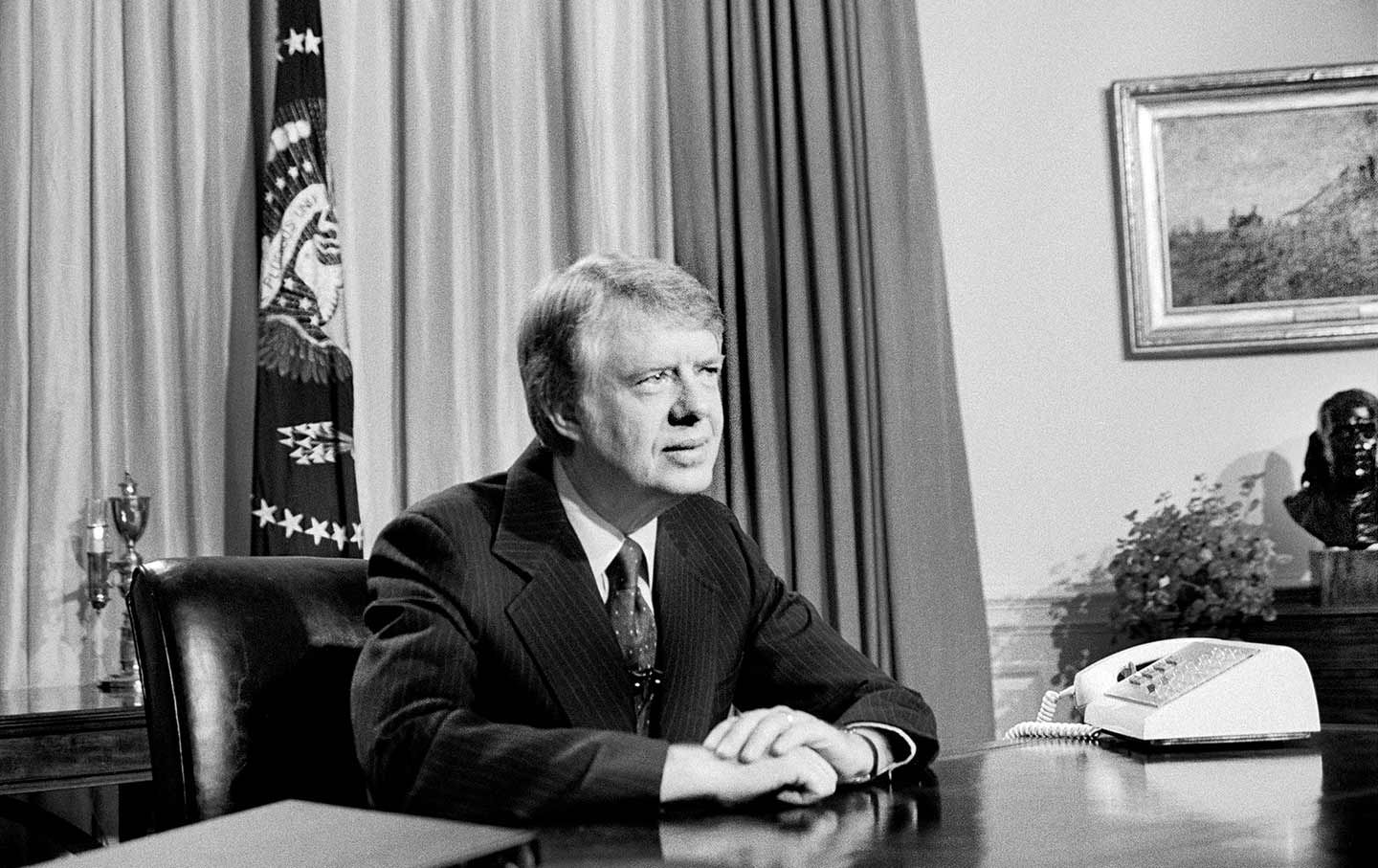
President Jimmy Carter, seen here at his Oval Office desk, signed legislation in 1978 that he said would ‘ensure that Presidential papers remain public property after the expiration of a President’s term.’ Corbis/Getty Images

BY AUSTIN SARAT
WILLIAM NELSON CROMWELL
PROFESSOR OF JURISPRUDENCE AND
POLITICAL SCIENCE, AMHERST COLLEGE

Prior to 1978, U.S. presidents could do what they pleased with the records from their time in office. They owned them.

But in 1978, the Presidential Records Act established new rules for the official records of a president. Passed in the wake of Watergate, when President Richard Nixon tried to keep incriminating materials from being made public, the law changed who legally owned the papers: It was now the American public.

Under the act’s terms, “all records must be furnished to the White House Archivist and ultimately made subject to public disclosure … and the President may not discard or destroy records without the express agreement of the Archivist.”

When he signed the act, President Jimmy Carter heralded it as a way to “make the Presidency a more open institution” and ensure “that our Government … merits the trust of the people from whom a President and his Government derive their power.”

But now the Trump administration wants to undo the reform that put presidential papers in the hands of the public.

On April 1, 2026, the Justice Department’s Office of Legal Counsel, known as the OLC, released an opinion claiming that the Presidential Records Act is unconstitutional. Its opinion says that Congress lacks authority to regulate what happens to documents maintained in the executive branch and, as a result, the Presidential Records Act violates the separation of powers.

Public interest groups and some historians responded to the OLC memo with alarm. The watchdog group American Oversight called the Presidential Records Act a bulwark against the possibility that presidents will “hide evidence of corruption, abuse of power, and misconduct from the public …” On April 6, 2026, the group filed a lawsuit seeking to prevent the president from acting on the OLC memo.

Whether the Trump administration or American Oversight is right about the Presidential Records Act is likely to be determined by a judge. In the meantime, the significance of the OLC’s opinion cannot be overstated.

That’s because the Office of Legal Counsel is “the Executive Branch’s preeminent legal advisor,” wrote federal judge Florence Pan in 2025. “Executive Branch agencies treat OLC’s legal conclusions as binding.”

I’ve written about secrecy in government, and the argument about the Presidential Records Act has a familiar ring. It is the latest version of an ongoing conflict about how much transparency is necessary and desirable in American government.

Neglected, burned, sold, vanished

Throughout most of U.S. history, presidential records have been treated as the president’s personal property. They could dispose of them as they wished.

The Indiana University library’s Guide to Presidential Papers, Congressional Papers, and Classified Materials says, “Sometimes the Library of Congress purchased a president’s papers from his heirs, as in the case of George Washington. Sometimes the president’s heirs sold off or donated various parts of the collection to different collectors and organizations.”

Some presidential materials were neglected and vanished. And one president, Martin Van Buren, burned some of his papers.

The idea that presidential papers had some public value began to emerge in the 20th century. In 1934, Congress passed legislation establishing the National Archives. It charged the new agency with preserving the official records of the federal government.

However, that legislation did not require that the president turn over his records to the archives. So in 1955, Congress passed the Presidential Libraries Act.

That law was designed to encourage presidents to turn over their records to the federal government. It also provided funding for presidential libraries to provide places to keep presidential records and make them available to the public. But here again, there were no teeth: The law did not require a departing president to give anything to the government, nor to build a library to house his papers.

All that changed in the wake of the Watergate scandal. That’s when it became clear that, but for the intervention of the U.S. Supreme Court in the 1974 United States v. Nixon case, Nixon intended to cover up what had happened and would have gotten rid of his incriminating White House tapes.

The passage in 1978 of the Presidential Records Act was a response to the Nixon scandal. Yet as attorney Sara Worth writes in a blog post for Yale Law School’s Media Freedom and Information Access Clinic, Congress “declined to include an enforcement mechanism to ensure compliance,” instead envisioning “future Presidents’ good-faith cooperation with the statutory mandate.”

DOJ: It’s a negotiation

After the FBI raid on his Mar-a-Lago residence in 2022 uncovered a trove of classified documents that had been removed from government premises, then former-President Trump argued that the Presidential Records Act didn’t apply to what he had done. He said he was actually complying with the act by refusing to relinquish presidential records.

In March 2023, Trump told Fox News that the law is “very specific”: “It says you are going to discuss the documents. You discuss everything – not only docu– everything – about what’s going in NARA, et cetera, et cetera. You’re gonna discuss it. You will talk, talk, talk. And if you can’t come to an agreement, you’re gonna continue to talk.”

Trump apparently meant that there would be negotiation over what constituted a presidential document that could be kept by the former president and what didn’t. That view is hard to reconcile with one of the Presidential Records Act’s unambiguous provisions: “Presidential records automatically transfer into the legal custody of the Archivist as soon as the President leaves office.”

Now, the Office of Legal Counsel is telling Trump that he can ignore that provision.

In addition, in its consideration of the Presidential Records Act, the OLC embraced Trump’s expansive view of presidential power. It argued that the Presidential Records Act is “unconstitutional for two independent but interlocking reasons: It exceeds Congress’s enumerated and implied powers, and it aggrandizes the Legislative Branch at the expense of the constitutional independence and autonomy of the Executive.”

The Justice Department’s lawyers appealed to history and tradition to buttress their conclusion: “Over the first two centuries of the American experiment in self-government, Presidents owned and controlled presidential papers, and Congress obtained such papers through political negotiation and interbranch accommodation, rather than as a matter of right. That historical practice was interrupted by the Presidential Recordings and Materials Preservation Act.”

‘Let the people know the facts’

The idea that citizens have a right to access information of the kind made possible by the Presidential Records Act can be traced back to the Enlightenment. American revolutionary Patrick Henry observed in 1788, “The liberties of people never were, nor ever will be, secure, when the transactions of their rulers may be concealed from them.”

Seven decades later, Abraham Lincoln echoed Henry when he said, “Let the people know the facts, and the country will be safe.”

In our era, that is what laws like the Presidential Records Act make possible. The Presidential Records Act plays an important role in preserving the liberty and security that Henry and Lincoln spoke about.

READ ORIGINAL STORY HERE

Monday, December 30, 2024

Jimmy Carter’s Lasting Cold War Legacy: His Human Rights Focus Helped Dismantle The Soviet Union


BY ROBERT C. DONNELLY
ASSISTANT PROFESSOR OF HISTORY,
GONZAGA UNIVERSITY

Former President Jimmy Carter, who died on Dec. 29, 2024, at age 100 at his home in Plains, Georgia, was a dark horse Democratic presidential candidate with little national recognition when he beat Republican incumbent Gerald Ford in 1976.

The introspective former peanut farmer pledged a new era of honesty and forthrightness at home and abroad, a promise that resonated with voters eager for change following the Watergate scandal and the Vietnam War.

His presidency, however, lasted only one term before Ronald Reagan defeated him. Since then, scholars have debated – and often maligned – Carter’s legacy, especially his foreign policy efforts that revolved around human rights.

Critics have described Carter’s foreign policies as “ineffectual” and “hopelessly muddled,” and their formulation demonstrated “weakness and indecision.”

As a historian researching Carter’s foreign policy initiatives, I conclude his overseas policies were far more effective than critics have claimed.

A Soviet strategy

The criticism of Carter’s foreign policies seems particularly mistaken when it comes to the Cold War, a period defined by decades of hostility, mutual distrust and arms buildup after World War II between the U.S. and Russia, then known as the Soviet Union or Union of Soviet Socialist Republics (USSR).

By the late 1970s, the Soviet Union’s economy and global influence were weakening. With the counsel of National Security Advisor Zbigniew Brzezinski, a Soviet expert, Carter exploited these weaknesses.

During his presidency, Carter insisted nations provide basic freedoms for their people – a moral weapon against which repressive leaders could not defend.

Carter soon openly criticized the Soviets for denying Russian Jews their basic civil rights, a violation of human rights protections outlined in the diplomatic agreement called the Helsinki Accords.

Carter’s team underscored these violations in arms control talks. The CIA flooded the USSR with books and articles to incite human rights activism. And Carter publicly supported Russian dissidents – including pro-democracy activist Andrei Sakharov – who were fighting an ideological war against socialist leaders.

Carter adviser Stuart Eizenstat argues that the administration attacked the Soviets “in their most vulnerable spot – mistreatment of their own citizens.”

This proved effective in sparking Soviet leader Mikhail Gorbachev’s social and political reforms of the late 1980s, best known by the Russian word “glasnost,” or “openness.”

The Afghan invasion

In December 1979, the Soviets invaded Afghanistan in response to the assassination of the Soviet-backed Afghan leader, Nur Mohammad Taraki. The invasion effectively ended an existing détente between the U.S. and USSR.

Beginning in July 1979, the U.S. was providing advice and nonlethal supplies to the mujahideen rebelling against the Soviet-backed regime. After the invasion, National Security Advisor Brzezinski advised Carter to respond aggressively to it. So the CIA and U.S. allies delivered weapons to the mujahideen, a program later expanded under Reagan.

Carter’s move effectively engaged the Soviets in a proxy war that began to bleed the Soviet Union.

By providing the rebels with modern weapons, the U.S. was “giving to the USSR its Vietnam war,” according to Brzezinski: a progressively expensive war, a strain on the socialist economy and an erosion of their authority abroad.

Carter also imposed an embargo on U.S. grain sales to the Soviets in 1980. Agriculture was the USSR’s greatest economic weakness since the 1960s. The country’s unfavorable weather and climate contributed to successive poor growing seasons, and their heavy industrial development left the agricultural sector underfunded.

Economist Elizabeth Clayton concluded in 1985 that Carter’s embargo was effective in exacerbating this weakness.

Census data compiled between 1959 and 1979 show that 54 million people were added to the Soviet population. Clayton estimates that 2 to 3 million more people were added in each subsequent year. The Soviets were overwhelmed by the population boom and struggled to feed their people.

At the same time, Clayton found that monthly wages increased, which led to an increased demand for meat. But by 1985, there was a meat shortage in the USSR. Why? Carter’s grain embargo, although ended by Reagan in 1981, had a lasting impact on livestock feed that resulted in Russian farmers decreasing livestock production.

The embargo also forced the Soviets to pay premium prices for grain from other countries, nearly 25 percent above market prices.

For years, Soviet leaders promised better diets and health, but now their people had less food. The embargo battered a weak socialist economy and created another layer of instability for the growing population.

The Olympic boycott

In 1980, Carter pushed further to punish the Soviets. He convinced the U.S. Olympic Committee to refrain from competing in the upcoming Moscow Olympics while the Soviets repressed their people and occupied Afghanistan.

Carter not only promoted a boycott, but he also embargoed U.S. technology and other goods needed to produce the Olympics. He also stopped NBC from paying the final US$20 million owed to the USSR to broadcast the Olympics. China, Germany, Canada and Japan – superpowers of sport – also participated in the boycott.

Historian Allen Guttmann said, “The USSR lost a significant amount of international legitimacy on the Olympic question.” Dissidents relayed to Carter that the boycott was another jab at Soviet leadership. And in America, public opinion supported Carter’s bold move – 73% of Americans favored the boycott.

The Carter doctrine

In his 1980 State of the Union address, Carter revealed an aggressive Cold War military plan. He declared a “Carter doctrine,” which said that the Soviets’ attempt to gain control of Afghanistan, and possibly the region, was regarded as a threat to U.S. interests. And Carter was prepared to meet the threat with “military force.”

Carter also announced in his speech a five-year spending initiative to modernize and strengthen the military because he recognized the post-Vietnam military cuts weakened the U.S. against the USSR.

Ronald Reagan argued during the 1980 presidential campaign that, “Jimmy Carter risks our national security – our credibility – and damages American purposes by sending timid and even contradictory signals to the Soviet Union.” Carter’s policy was based on “weakness and illusion” and should be replaced “with one founded on improved military strength,” Reagan criticized.

In 1985, however, President Reagan publicly acknowledged that his predecessor demonstrated great timing in modernizing and strengthening the nation’s forces, which further increased economic and diplomatic pressure on the Soviets.

Reagan admitted that he felt “very bad” for misstating Carter’s policies and record on defense.

Carter is most lauded today for his post-presidency activism, public service and defending human rights. He was awarded the Nobel Peace Prize in 2002 for such efforts.

But that praise leaves out a significant portion of Carter’s presidential accomplishments. His foreign policy, emphasizing human rights, was a key instrument in dismantling the power of the Soviet Union.

READ ORIGINAL STORY HERE

Tuesday, October 01, 2024

Jimmy Carter And His Hometown Of Plains Celebrate The 39th President’s 100th Birthday

An estimated crowd of 35,000 people gather for a noontime speech by Presidential candidate Jimmy Carter in downtown Philadelphia, October 26, 1976. (AP Photo, File)

BY BILL BARROW

PLAINS, GA. (AP)
— Longtime friends, family and fans of Jimmy Carter milled around his hometown of Plains to celebrate his 100th birthday on Tuesday, the first time an American president has lived a full century and the latest milestone in a life that took the Depression-era farmer’s son to the White House and across the world as a Nobel Peace Prize-winning humanitarian and advocate for democracy.

Living the last 19 months in home hospice care, the 39th president keeps defying expectations, just as he did through a remarkable rise from his family peanut farming and warehouse business to the world stage. The Democrat served one presidential term from 1977 to 1981 and then for four decades led The Carter Center, which he and his wife Rosalynn co-founded in 1982 to “wage peace, fight disease, and build hope.”

“Not everybody gets 100 years on this earth, and when somebody does, and when they use that time to do so much good for so many people, it’s worth celebrating,” his grandson Jason Carter, chair of The Carter Center governing board, said in an interview.

“These last few months, 19 months, now that he’s been in hospice, it’s been a chance for our family to reflect,” he continued, “and then for the rest of the country and the world to really reflect on him. That’s been a really gratifying time.”

James Earl Carter Jr. was born Oct. 1, 1924 in Plains, where he lives in the same one-story home he and Rosalynn built in the early 1960s, before his first election to the Georgia state Senate. The former first lady, also from Plains, died last November at 96.

About 25 family members filled his home Tuesday, enjoying cupcakes on the front lawn while antique World War II planes flew over in his honor. At night, they planned to gather around the TV to watch the vice-presidential debate.

Chip Carter said his father’s next goal is to make it to Election Day.

“He’s plugged in,” Carter said in an interview. “I asked him two months ago if he was trying to live to be 100, and he said, No, I’m trying to live to vote for Kamala Harris.”

Chip Carter sat in the front row of a naturalization ceremony held annually on his father’s birthday for 100 new citizens at Plains High School, which his father attended. The building is now a museum.

Jill Stuckey, superintendent of the Jimmy Carter National Historic Park, recalled that a teacher once told Carter’s class that one of the students would be president someday. She said Carter “took it to heart.”

“One thing I’ve learned is to never underestimate Jimmy Carter, because if you do, he will prove you wrong,” Stuckey said.

President Joe Biden, the first sitting senator to endorse Carter’s 1976 campaign, praised his longtime friend for an “unwavering belief in the power of human goodness.”

“You’ve always been a moral force for our nation and the world (and) a beloved friend to Jill and me and our family,” the 81-year-old president said in a tribute video, recorded in front of Carter’s White House portrait. Carter asked Biden to eulogize him at his state funeral when the time comes.

But even on Carter’s 100th birthday, Donald Trump could not pass up repeating his longstanding jab at the Georgia Democrat. Trump labeled Biden “the worst president,” and said Carter is “the happiest man because Carter is considered a brilliant president by comparison.” It was hollow praise for the one-term president who was defeated by Ronald Reagan in 1980 but went on to become a respected world figure.

Georgia’s Republican Gov. Brian Kemp, for his part, declared Tuesday “Jimmy Carter Day” to recognize his legacy as the state’s 76th governor. Other birthday events have included a musical gala in Atlanta with dozens of artists, airing Tuesday evening on Georgia Public Broadcasting, that has raised more than $1.2 million for The Carter Center. Townspeople in Plains planned another concert Tuesday evening.

And Habitat for Humanity volunteers are devoting this week to build 30 houses in his honor in St. Paul, Minnesota. The Carters served as ambassadors for the organization, hosted annual building projects into their 90s.

Minister Barbara Green and Deacon William Le Green of Americus came to Main Street in Plains to honor Carter, who helped build their Habitat for Humanity home in the early 2000s. Le Green recalled how Carter gave the couple hammers to keep, along with their keys.

“He didn’t mind getting his hands dirty, or anything of the kind,” Le Green said.

Jimmy Carter was last seen publicly nearly a year ago, visibly diminished and silent as he used a reclining wheelchair to attend his wife’s two funeral services. Jason Carter said the family hadn’t expected to enjoy his 100th birthday after she died. The former president’s hospital bed had been set up so he could see and talk to his wife of 77 years in her final days and hours.

“We frankly didn’t think he was going to go on much longer,” Jason Carter said. “He’s really given himself over to what he feels is God’s plan. He knows he’s not in charge. But in these last few months, especially, he has gotten a lot more engaged in world events, a lot more engaged in politics, a lot more, just engaged, emotionally, with all of us.”

He said the centenarian president, born four years after women were granted the constitutional right to vote and four decades before Black women won ballot access, is eager to cast his 2024 presidential ballot for the Democrat who would be first woman, second Black person and first person of south Asian descent to reach the Oval Office.

“He, like a lot of us, was incredibly gratified by his friend Joe Biden’s courageous choice to pass the torch,” the younger Carter said. “You know, my grandfather and The Carter Center have observed more than 100 elections in 40 other countries, right? So, he knows how rare it is for somebody who’s a sitting president to give up power in any context.”

Early voting in Georgia begins Oct. 15, two weeks into Carter’s 101st year.

Barrow reported from Atlanta.

Friday, October 06, 2023

The Splendid Life Of Jimmy Carter – 5 Essential Reads


BY HOWARD MANLY, DAVID SWARTZ, JENIFFER LYNN MCCOY, KIMBERLY PAUL, ROBERT C. DONNELLY AND THOMAS J. WHALEN

In Mark 8:34-38 a question is asked: “For what shall it profit a man, if he shall gain the whole world, and lose his own soul?”

Jimmy Carter never lost his soul.

A person who served others until the days leading to his death, Jimmy Carter did more to advance the cause of human rights than any U.S. president in American history. That tireless commitment “to advance democracy and human rights” was noted by the Nobel Committee when it honored Carter with its Peace Prize in 2002.

From establishing the nonprofit Carter Center to working for Habitat for Humanity, Carter never lost his moral compass in his public policies.

Over the years, The Conversation U.S. has published numerous stories exploring the legacy of the nation’s 39th president – and his blessed life after leaving the world of American politics. Here are selections from those articles.

1. A preacher at heart

As a scholar of American religious history, Asbury University Professor David Swartz believes that a speech Carter gave on July 15, 1979, was the most theologically profound speech by an American president since Lincoln’s Second Inaugural Address, on March 4, 1865.

Carter’s nationally televised sermon was watched by 65 million Americans as he “intoned an evangelical-sounding lament about a crisis of the American spirit,” Swartz wrote.

“All the legislation in the world,” Carter proclaimed during the speech, “can’t fix what’s wrong with America.”

What was wrong, Carter believed, was self-indulgence and consumption.

“Human identity is no longer defined by what one does but by what one owns,” Carter preached. But “owning things and consuming things does not satisfy our longing for meaning.”

2. Tough-minded policies on human rights

Though Carter was considered a weak leader after Iranian religious militants seized the U.S. Embassy in Tehran in 1979, his overseas policies were far more effective than critics have claimed, wrote Gonzaga College historian Robert C. Donnelly, especially when it came to the former Soviet Union.

Shortly after the Soviet invasion of Afghanistan in 1979, for instance, Carter imposed an embargo on U.S. grain sales that targeted the Soviet Union’s dependence on imported wheat and corn to feed its population.

To further punish the Soviets, Carter persuaded the U.S. Olympic Committee to refrain from competing in the upcoming Moscow Olympics while the Soviets repressed their own people and occupied Afghanistan.

Among Carter’s critics, none was harsher than Ronald Reagan. But in 1986, after beating Carter for the White House, even he had to acknowledge Carter’s foresight in modernizing the nation’s military forces, a measure that further increased economic and diplomatic pressure on the Soviets.

“Reagan admitted that he felt very bad for misstating Carter’s policies and record on defense,” Donnelly wrote.

3. Carter’s unexpected liberal foe

Reagan’s win over Carter in the 1980 U.S. presidential race was due in part to Carter’s bitter race during the Democratic primary against an heir to one of America’s great political families – Ted Kennedy.

Kennedy’s decision to run against Carter was “something of a shock to Carter,” wrote Thomas J. Whalen, a Boston University associate professor of social science.

In 1979, Kennedy had pledged to support Carter’s reelection bid but later succumbed to pressure in liberal Democratic circles to launch his own presidential bid and fulfill his family’s destiny.

In addition, Whalen wrote, Kennedy “harbored deep reservations about Carter’s leadership, especially in the wake of a faltering domestic economy, high inflation and the seizure of the American Embassy in Iran by radical Muslim students.”

In response, Carter vowed to “whip (Kennedy’s) ass.”

And did.

But that win over Kennedy came at a high cost.

“Having expended so much political and financial capital fending off Kennedy’s challenge,” Whalen wrote, “he was easy pickings for Reagan in that fall’s general election.

4. A quiet fight against a deadly disease

Guinea worm is a painful parasitic disease that is contracted when people consume water from stagnant sources contaminated with the worm’s larvae.

Clemson University Professor Kimberly Paul has worked as a parasitologist for over two decades.

"I know the suffering that parasitic diseases like Guinea worm infections inflict on humanity, especially on the world’s most vulnerable and poor communities,” she wrote.

In 1986, it infected an estimated 3.5 million people per year in 21 countries in Africa and Asia.

Since then, that number has been reduced by more than 99.99% to 13 provisional cases in 2022, in large part because of Carter and his efforts to eradicate the disease. Those efforts included teaching people to filter all drinking water.

Over time, Carter’s efforts proved tremendously successful. On Jan. 24, 2023, The Carter Center, the nonprofit founded by the former U.S. president, announced that “Guinea worm is poised to become the second human disease in history to be eradicated.”

The first was smallpox.

5. Carter’s brave step in Cuba

In 2002, long after his departure from the White House in 1981, Carter became the the first U.S. president to visit Cuba since the 1959 Cuban Revolution. Carter had accepted the invitation of then President Fidel Castro.

Jennifer Lynn McCoy, now at Georgia State University, was director of The Carter Center’s Americas Program at the time and accompanied Carter on that trip, on which he gave a speech in Spanish that called on Castro to lift restrictions on free speech and assembly, among other constitutional reforms.

Castro was unmoved by the speech but instead invited Carter to watch a Cuban all-star baseball game.

At the game, McCoy wrote, “Castro asked Carter for a favor” – to walk to the pitcher’s mound without his security detail to show how much confidence he had in the Cuban people.

Over the objections of his Secret Service agents, Carter obliged and walked to the mound with Castro and threw out the first pitch.

Carter’s move was a symbol of what normal relations could look like between the two nations – and of Carter’s unwavering faith.

Editor’s note: This story is a roundup of articles from The Conversation’s archives.

Monday, February 27, 2023

How Jimmy Carter integrated his evangelical Christian faith into his political work, despite mockery and misunderstanding

Jimmy Carter meets with news editors at the White House on April 15, 1977. AP Photo/Charles Bennett

BY LORI AMBER ROESSNER

“I am a farmer, an engineer, a businessman, a planner, a scientist, a governor, and a Christian,” Jimmy Carter said while introducing himself to national political reporters when he announced his campaign to be the 39th president of the United States in December 1974.

As journalists and historians consider Carter’s legacy, this prelude to Carter’s campaign offers insight into how he wanted to be known and how he might like to be remembered.

After studying Carter’s presidential campaign, presidency and post-presidency for years, which included examining more than 25,000 archival documents, media sources, oral histories and interviews, I wrote “Jimmy Carter and the Birth of the Marathon Media Campaign.” Along the way, I had the opportunity to interview former President Carter in October 2014, when we discussed his life, his presidency and his legacy.

Based upon this experience, one observation is certain – Carter was a man of faith committed to a vision of the nation that aligned with his views of Jesus’ teachings.
A campaign cloaked in a message of love and justice

In the fall of 1975, after his initial announcement failed to elicit much national attention for his candidacy, the still relatively unknown Georgia governor published the campaign biography, “Why Not the Best?

Within the book, he told the story of his wholesome childhood on his family’s peanut farm in Archery, Georgia, and of achieving his childhood dream through his appointment to the Naval Academy in 1943.

He wrote of his dedication to his family as a loyal son, husband and father and his duty-bound career transition to manage his family-owned peanut farm, warehouse and store after his father Earl Carter’s premature death from pancreatic cancer in 1953. He also shared his lifelong commitment to community and public service.

Moreover, he offered himself as a public servant who could bridge the chasm between the American people and the government that had emerged after the revelations of presidential corruption amid Vietnam and Watergate.

“Our government can and must represent the best and the highest ideals of those of us who voluntarily submit to its authority. In our third century, we must meet these simple, but crucial standards,” he wrote in the campaign biography.

Though Carter cloaked his campaign in Jesus’ teachings about love and justice, most national reporters did not give Carter’s faith much attention until he became the Democratic Party’s front-runner in advance of the North Carolina primary in 1976.
‘Lust in my heart’

When national reporters finally turned their attention to his faith, what campaign director Hamilton Jordan referred to as Carter’s “weirdo factor,” the evangelical politician acknowledged that he had “spent more time on my knees in the four years I was governor … than I did in all the rest of my life.”

Carter continued to share his understanding of the gospel with journalists and their audiences in a plain-spoken manner, even though it was not always advantageous to his political fortunes. For instance, after continued probes about his faith that summer from Playboy Magazine correspondent Robert Scheer, Carter launched into a sermon on pride, lust and lying that would haunt him later.

“I try not to commit a deliberate sin. I recognize that I’m going to do it anyhow, because I’m human and I’m tempted … I’ve looked on a lot of women with lust,” Carter, believing he was off the record, said in attempting to clarify his religious views. “I’ve committed adultery in my heart many times.”

Carter referred to Matthew 5:28, the biblical passage in which Jesus shares this interpretation of the Seventh Commandment, with the words: “But I say unto you, That whosoever looketh on a woman to lust after her hath committed adultery with her already in his heart.”

Uninterrupted, Carter continued his salty explanation of the verse: “Christ says don’t consider yourself better than someone else because one guy screws a whole bunch of women while the other guy is loyal to his wife.”

“We have heard Jesus’ words all our lives ever since we were 3, 4 years old, and we knew what it meant,” Carter later explained to me. “But, obviously, the general public, when I said, ‘lust in my heart,’ that was a top headline, it looked like I was – like I spent my time trying to seduce other women. Rosa(lynn) knew that wasn’t true.”

Though Carter’s comments were “on solid theological ground,” according to many people of faith, up-and-coming leaders of the religious right, such as televangelist Jerry Falwell, castigated Carter. And, in the end, many folks agreed with well-regarded columnist Mary McGrory – the interview “should have been an off-the-record conversation with God, not one taped by Playboy.”
Crisis of confidence

Despite the erosion of support among the emerging religious right after the Playboy gaffe, Carter remained steadfast in his commitment to his Christian values and a faith-inspired vision for the nation that advanced human rights at home and abroad. He called it a “new beginning.”

Carter beseeched his American brethren to chart a new course during his inaugural address in January 1977: “Our commitment to human rights must be absolute, our laws fair, our natural beauty preserved; the powerful must not persecute the weak, and human dignity must be enhanced.”

Carter had achieved what Time magazine hailed as one of the most astonishing “political miracles” in the nation’s history because of his rapid ascension from a virtual unknown politician to the presidency. But many citizens, suffering from an emerging crisis of confidence in the American dream and faith in its institutions and leaders, had already begun to tune out Carter’s political sermons about the looming energy crisis, stagflation and international conflicts.

Moreover, in the coming years, they would become indignant toward the man who had condemned the corruption of his predecessors and promised to never tell a lie on the campaign trail, yet remained loyal to one of his oldest advisers, the Office of Management and Budget Director Bert Lance, who was accused of unethical banking practices.
Long-lasting commitment to public service

In the end, Carter stood accused of failing to live up to his campaign promises from the vantage point of many American citizens amid domestic crises and foreign conflicts.

Amid news coverage of these events and his dwindling public support, Carter lost his reelection campaign, and his administration was hailed by many journalists, political insiders and average Americans alike as a “failed presidency.”

Nevertheless, Carter remained committed to his religious convictions. “I have spoken many times of love, but love must be aggressively translated into simple justice,” he invoked his audience when he accepted the Democratic nomination in July 1976.

For the remainder of his life, he attempted to model the translation of Jesus’ love into action through his life of public service. His post-presidential commitments involved The Carter Center’s initiatives of fighting disease and seeking international peace and his private efforts of building homes for Habitat for Humanity and teaching Sunday school.

In the end, Carter will leave this world with only one acknowledged regret: “I wish I’d sent one more helicopter to get the hostages and we would have rescued them and I would have been re-elected,” he said referring to the April 1980 military rescue attempt of the 53 U.S. hostages held by Iranian revolutionaries.

In Carter’s final days, his words from his presidential farewell address, which remain true today, are worth remembering:

“The battle for human rights – at home and abroad – is far from over. … If we are to serve as a beacon for human rights, we must continue to perfect here at home the rights and values which we espouse around the world: A decent education for our children, adequate medical care for all Americans, an end to discrimination against minorities and women, a job for all those able to work, and freedom from injustice and religious intolerance.”

READ ORIGINAL STORY HERE

Saturday, February 18, 2023

Jimmy Carter’s Lasting Cold War Legacy: Human Rights Focus Helped Dismantle The Soviet Union


BY ROBERT C. DONELLY

Former President Jimmy Carter, who has entered hospice care at age 98 at his home in Plains, Georgia, was a dark horse Democratic presidential candidate with little national recognition when he beat Republican incumbent Gerald Ford in 1976.

The introspective former peanut farmer pledged a new era of honesty and forthrightness at home and abroad, a promise that resonated with voters eager for change following the Watergate scandal and the Vietnam War.

His presidency, however, lasted only one term before Ronald Reagan defeated him. Since then, scholars have debated – and often maligned – Carter’s legacy, especially his foreign policy efforts that revolved around human rights.

Critics have described Carter’s foreign policies as “ineffectual” and “hopelessly muddled,” and their formulation demonstrated “weakness and indecision.”

As a historian researching Carter’s foreign policy initiatives, I conclude his overseas policies were far more effective than critics have claimed.

A Soviet strategy

The criticism of Carter’s foreign policies seems particularly mistaken when it comes to the Cold War, a period defined by decades of hostility, mutual distrust and arms buildup after World War II between the U.S. and Russia, then known as the Soviet Union or Union of Soviet Socialist Republics (USSR).

By the late 1970s, the Soviet Union’s economy and global influence were weakening. With the counsel of National Security Advisor Zbigniew Brzezinski, a Soviet expert, Carter exploited these weaknesses.

During his presidency, Carter insisted nations provide basic freedoms for their people – a moral weapon against which repressive leaders could not defend.

Carter soon openly criticized the Soviets for denying Russian Jews their basic civil rights, a violation of human rights protections outlined in the diplomatic agreement called the Helsinki Accords.

Carter’s team underscored these violations in arms control talks. The CIA flooded the USSR with books and articles to incite human rights activism. And Carter publicly supported Russian dissidents – including pro-democracy activist Andrei Sakharov – who were fighting an ideological war against socialist leaders.

Carter adviser Stuart Eizenstat argues that the administration attacked the Soviets “in their most vulnerable spot – mistreatment of their own citizens.”

This proved effective in sparking Soviet leader Mikhail Gorbachev’s social and political reforms of the late 1980s, best known by the Russian word “glasnost,” or “openness.”

The Afghan invasion

In December 1979, the Soviets invaded Afghanistan in response to the assassination of the Soviet-backed Afghan leader, Nur Mohammad Taraki. The invasion effectively ended an existing détente between the U.S. and USSR.

Beginning in July 1979, the U.S. was providing advice and nonlethal supplies to the mujahideen rebelling against the Soviet-backed regime. After the invasion, National Security Advisor Brzezinski advised Carter to respond aggressively to it. So the CIA and U.S. allies delivered weapons to the mujahideen, a program later expanded under Reagan.

Carter’s move effectively engaged the Soviets in a proxy war that began to bleed the Soviet Union.

By providing the rebels with modern weapons, the U.S. was “giving to the USSR its Vietnam war,” according to Brzezinski: a progressively expensive war, a strain on the socialist economy and an erosion of their authority abroad.

Carter also imposed an embargo on U.S. grain sales to the Soviets in 1980. Agriculture was the USSR’s greatest economic weakness since the 1960s. The country’s unfavorable weather and climate contributed to successive poor growing seasons, and their heavy industrial development left the agricultural sector underfunded.

Economist Elizabeth Clayton concluded in 1985 that Carter’s embargo was effective in exacerbating this weakness.

Census data compiled between 1959 and 1979 show that 54 million people were added to the Soviet population. Clayton estimates that 2 to 3 million more people were added in each subsequent year. The Soviets were overwhelmed by the population boom and struggled to feed their people.

At the same time, Clayton found that monthly wages increased, which led to an increased demand for meat. But by 1985, there was a meat shortage in the USSR. Why? Carter’s grain embargo, although ended by Reagan in 1981, had a lasting impact on livestock feed that resulted in Russian farmers decreasing livestock production.

The embargo also forced the Soviets to pay premium prices for grain from other countries, nearly 25 percent above market prices.

For years, Soviet leaders promised better diets and health, but now their people had less food. The embargo battered a weak socialist economy and created another layer of instability for the growing population.

The Olympic boycott

In 1980, Carter pushed further to punish the Soviets. He convinced the U.S. Olympic Committee to refrain from competing in the upcoming Moscow Olympics while the Soviets repressed their people and occupied Afghanistan.

Carter not only promoted a boycott, but he also embargoed U.S. technology and other goods needed to produce the Olympics. He also stopped NBC from paying the final US$20 million owed to the USSR to broadcast the Olympics. China, Germany, Canada and Japan – superpowers of sport – also participated in the boycott.

Historian Allen Guttmann said, “The USSR lost a significant amount of international legitimacy on the Olympic question.” Dissidents relayed to Carter that the boycott was another jab at Soviet leadership. And in America, public opinion supported Carter’s bold move – 73% of Americans favored the boycott.

The Carter doctrine

In his 1980 State of the Union address, Carter revealed an aggressive Cold War military plan. He declared a “Carter doctrine,” which said that the Soviets’ attempt to gain control of Afghanistan, and possibly the region, was regarded as a threat to U.S. interests. And Carter was prepared to meet the threat with “military force.”

Carter also announced in his speech a five-year spending initiative to modernize and strengthen the military because he recognized the post-Vietnam military cuts weakened the U.S. against the USSR.

Ronald Reagan argued during the 1980 presidential campaign that, “Jimmy Carter risks our national security – our credibility – and damages American purposes by sending timid and even contradictory signals to the Soviet Union.” Carter’s policy was based on “weakness and illusion” and should be replaced “with one founded on improved military strength,” Reagan criticized.

In 1985, however, President Reagan publicly acknowledged that his predecessor demonstrated great timing in modernizing and strengthening the nation’s forces, which further increased economic and diplomatic pressure on the Soviets.

Reagan admitted that he felt “very bad” for misstating Carter’s policies and record on defense.

Carter is most lauded today for his post-presidency activism, public service and defending human rights. He was awarded the Nobel Peace Prize in 2002 for such efforts.

But that praise leaves out a significant portion of Carter’s presidential accomplishments. His foreign policy, emphasizing human rights, was a key instrument in dismantling the power of the Soviet Union.

READ ORIGINAL STORY HERE

Sunday, May 19, 2019

Jimmy Carter Finds A Renaissance In 2020 Democratic Scramble

In this Sunday, Aug. 23, 2015 file photo, former President Jimmy Carter teaches Sunday School class at Maranatha Baptist Church in his hometown in Plains, Ga. Carter carved an unlikely path to the White House in 1976 and endured humbling defeat after one term. Now, six administrations later, the longest-living chief executive in American history is re-emerging from political obscurity at age 94 to win over his fellow Democrats once again. (AP Photo/David Goldman, File)

BY BILL BARROW

ATLANTA (AP)
— Former President Jimmy Carter carved an unlikely path to the White House in 1976 and endured humbling defeat after one term. Now, six administrations later, the longest-living chief executive in American history is re-emerging from political obscurity at age 94 to win over his fellow Democrats once again.

A peanut farmer turned politician then worldwide humanitarian, Carter is taking on a special role as several Democratic candidates look to his family-run campaign after the Watergate scandal as the road map for toppling President Donald Trump in 2020.

“Jimmy Carter is a decent, well-meaning person, someone who people are talking about again given the time that we are in,” Minnesota Sen. Amy Klobuchar said in an interview. “He won because he worked so hard, and he had a message of truth and honesty. I think about him all the time.”

Klobuchar is one of at least three presidential hopefuls who’ve ventured to the tiny town of Plains, Georgia, to meet with Carter and his wife, Rosalynn, who is 91. New Jersey Sen. Cory Booker and Mayor Pete Buttigieg of South Bend, Indiana, also have visited with the Carters, including attending the former president’s Sunday School lesson in Plains.

Carter had planned to teach at Maranatha Baptist Church again Sunday, but he is still recuperating at home days after hip replacement surgery following a fall as he was preparing for a turkey hunt.

“An extraordinary person,” Buttigieg told reporters after meeting Carter. “A guiding light and inspiration,” Booker said in a statement. Klobuchar has attended Carter’s church lesson, as well, and says she emails with him occasionally. “He signs them ‘JC,’” she said with a laugh.

It’s quite a turnabout for a man who largely receded from party politics after his presidency, often without being missed by his party’s leaders in Washington, where he was an outsider even as a White House resident.

To be sure, more 2020 candidates have quietly sought counsel from Trump’s predecessor, former President Barack Obama. Several have talked with former President Bill Clinton, who left office in 2001. But those huddles have been more hush-hush, disclosed through aides dishing anonymously. Sessions with Carter, on the other hand, are trumpeted on social media and discussed freely, suggesting an appeal that Obama and Clinton may not have.

Unlike Clinton, impeached after an affair with a White House intern, Carter has no #MeToo demerits; he and Rosalynn, married since the end of World War II, didn’t even like to dance with other people at state dinners. And unlike Obama, popular among Democrats but polarizing for conservatives and GOP-leaning independents, Carter is difficult to define by current political fault lines.

He’s an outspoken evangelical Christian who criticizes Trump’s serial falsehoods, yet praises Trump for attempting a relationship with North Korean leader Kim Jong Un. Carter touts his own personal relationship with Russian President Vladimir Putin, another Trump favorite. “I have his email address,” Carter said last September.

For years, Carter has irked the foreign policy establishment with forthright criticism of Israel and its treatment of Palestinians.

He confirms that he voted for Vermont Sen. Bernie Sanders, a democratic socialist, over Hillary Clinton in Georgia’s 2016 presidential primary. In 2017, Carter welcomed Sanders, who’s running again this year, to the Carter Center for a program in which the two men lambasted money in politics. Carter called the United States “an oligarchy.”

Yet Carter has since warned Democrats against “too liberal a program,” lest they ensure Trump’s re-election.

Klobuchar credited Carter with being “ahead of his time” on several issues, including the environment and climate change (he put solar panels on the White House), health care (a major step toward universal coverage failed mostly because party liberals thought it didn’t go far enough) and government streamlining (an effort that angered some Democrats at the time). But she also alluded to how his presidency ended: a landslide loss after gas lines, inflation-then-unemployment, and a 14-month-long hostage crisis in Iran. “Their administration was not perfect,” she said.

It’s enough of an enigma that Carter is the only living president not to draw Trump’s ire or mockery, even if Republicans have lambasted Carter for decades as a liberal incompetent. Trump and Carter chatted by phone earlier this spring after Carter sent Trump a letter on China and trade. Both men said they had an amiable conversation.

Nonetheless, 2020 candidates cite Carter’s juxtaposition with Trump.

“There was a feeling that people had been betrayed in our democracy by someone who wasn’t telling the truth,” she said, referring to President Richard Nixon’s resignation in 1974.

Buttigieg said he and Carter “talked about being viewed as coming out of nowhere” and how Carter ran two general election campaigns entirely on the public financing system that now sits unused as candidates collectively raise money into the billions.

Klobuchar recalled Carter telling her that “family members would disperse to different states and then they would all come back on Friday, go back through the questions they had gotten.” Then “he would talk about how he would answer them” so they’d all be prepared on their next trips, she said.

It was “a different era,” Klobuchar added, recalling that Carter said he felt “hi-tech because they had a fax machine on his plane.” Indeed, Klobuchar, born in 1960, wasn’t old enough to vote for Carter until he sought a second term. Booker, 50, recalls voting for Carter, but in a grade-school mock election. Buttigieg, 37, wasn’t even born when Carter left office.

Nonetheless, Klobuchar said she regularly meets Iowans who remember Carter and his family members campaigning in 1975 before his rivals and national media recognized his strength, and she said she sometimes references on the campaign trail how her fellow Minnesotan and Carter’s vice president, Walter Mondale, remembers their term: “We obeyed the law. We told the truth. We kept the peace.”

Whatever the reasons for the renewed attention, Carter allies say they hope the 2020 campaign is part of bolstering his reputation as a president.

“People are tired of hearing that he was a better ex-president than president,” said DuBose Porter, a former Georgia Democratic chairman who has known the Carters for decades. “Of course he’s done amazing things at the Carter Center, but he did great things for the country, and we’re proud of it.”

Follow Barrow on Twitter at https://twitter.com/BillBarrowAP .

Tuesday, May 09, 2017

Carter Fears Global Effect Of New US Human Rights Policies

THE ASSOCIATED PRESS
MAY 9, 2017


In this image taken from video, former President Jimmy Carter gestures at the annual Human Rights Defenders Forum at The Carter Center, Tuesday, May 9, 2017, in Atlanta. Carter says he's concerned that the Trump administration's approach to foreign policy will hasten declining support for human rights in other countries.

ATLANTA (AP) — As the Trump administration signals a de-emphasis of human rights in U.S. foreign policy decisions, former U.S. President Jimmy Carter said Tuesday that he's concerned America's approach will erode support for such rights in other countries.

The 92-year-old Carter spoke with The Associated Press amid a two-day meeting of dozens of human rights activists at The Carter Center in Atlanta. Carter cited a portion of President Donald Trump's inaugural address promising that his administration does "not seek to impose our way of life on anyone, but rather to let it shine as an example for everyone to follow." Secretary of State Rex Tillerson expanded on that slightly last week when he told State Department employees that some national security efforts can't always be conditioned on "our values."

"The president made this clear in his inaugural address — I was there — when he said that no longer would we try to force American standards on other countries," Carter said. "And I assumed that meant the standards of peace and human rights and freedom and justice and that sort of thing. Our standards that we've always claimed to be American standards are really the implementation of a universal declaration of human rights, plus peace."

Carter also challenged the idea that a commitment to human rights can't coexist with national security, calling it a "false premise." "The best way for a nation to guarantee security, absence from fear and absence from violence, is to promote human rights and freedom," he said.

Carter has worked on various human rights issues, from fair elections to health care, since leaving the White House and forming the nonprofit. This year's forum on human rights is the 10th held since 2003, bringing together activists from around the globe.

"They come to tell their stories collectively and also to form an alliance with people around the world who are joined with them in a collective effort to promote the standards of human rights," Carter said. "And to make sure the world doesn't forget that the basic moral values and ethical standards of human beings are being abandoned or ignored in many societies."

The participants share strategies and stories with one another, interspersed with spirited musical performances or videos featuring participants' work. The event also gives The Carter Center and other organizations "a fairly good picture of what's going on in the entire world," Carter said.

Maryam Al-Khawaja, a Bahraini activist who has been imprisoned for her work, said repressive governments learn from each other, and activists need to make connections and work across borders. If there's muted international backlash to a policy in one country limiting human rights work, others will adopt it without fear of consequences, she said.

"We need to put up a challenge and do the same," she said. Beyond the opportunity to share ideas and make connections, the event provides emotional support for people whose work puts them in constant danger, said Rubina Bhatti, an activist focused on the rights of women and religious minorities in Pakistan. Her organization was shut down by authorities last year.

"When we come to these points, we find a lot of struggle but also strength, solidarity, passion, compassion, love," Bhatti said. "I am not alone in this ocean; we all are trying to swim."

Monday, December 09, 2013

Carter, Annan: Mandela Group Will Continue Work

Former UN Secretary-General and Chair of The Elders Kofi Annan, left, and former US President Jimmy Carter, right, speak to The Associated Press during an interview at a hotel in Johannesburg, South Africa Monday, Dec. 9, 2013. Former U.S. President Jimmy Carter and former U.N. Secretary-General Kofi Annan say that the group of world leaders set up by Nelson Mandela will continue its work. Carter and Annan spoke to The Associated Press on Monday after just arriving in Johannesburg, ahead of a major planned memorial for Mandela that will draw some 100 world leaders and tens of thousands of mourners.

JOHANNESBURG, SOUTH AFRICA (ASSOCIATED PRESS) — Former U.S. President Jimmy Carter and former United Nations Secretary-General Kofi Annan say the group of world leaders brought together by Nelson Mandela will continue its work.

Carter and Annan spoke to The Associated Press on Monday after arriving in Johannesburg, ahead of a major planned memorial for Mandela that will draw some 100 world leaders and tens of thousands of mourners.

They are part of The Elders, an independent group of world leaders and human rights activists. Mandela became the group's honorary chairman after its founding in 2007 but was never an active member. Annan said of Mandela: "The way he lived his life and what he did also should convey the message to each and every one of us that as individuals, we have power."

KNOCK, KNOCK

By issuing subpoenas to five Times journalists, the Trump administration reveals its first response to unwanted national security coverage: ...