Showing posts with label Olusegun Obasanjo. Show all posts

Saturday, April 09, 2022

Obasanjo: From A Nigerian Village To The Pinnacle Of Power On The Continent

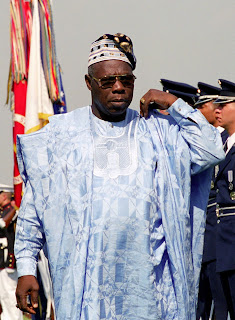
Olusegun Obasanjo


Olusegun Obasanjo, Nigeria’s former president and a pan Africanist extraordinaire, turned 85 on 5 March 2022.

Obasanjo was Nigeria’s military head of state between 1976 and 1979 and two-time democratically elected president, from 1999 to 2007.

“OBJ”, as he is widely called, is probably the most globally known and celebrated Nigerian leader. One probable reason is his political credentials as military and civilian head of state. He also led Africa’s biggest country longer than any other person.

His initiatives and policies as Nigerian leader are another reason. In 1976, he introduced Operation Feed the Nation, a social revolution aimed at changing the fortunes of the people through farming. To increase production and exports, his administration also created the Nigerian National Petroleum Corporation in 1977. This initially recorded some successes but is currently unable to make refined fuel available for local consumption and export.

Obasanjo returned Nigeria to democratic rule in 1979, the country’s first successful transition from military to civilian rule. After 19 years of social and political upheavals, including bloody coups, a civil war, economic crisis and a corruption pandemic occasioned by an oil boom, Obasanjo handed over power to civilian successors. He also set up a constitutional conference culminating in the 1979 Constitution. Thus, he helped create a path towards a multiparty democracy.
Obasanjo’s second coming

The years between 1979 and 1999 witnessed political instability, corruption in public office, economic collapse and decay of social infrastructure. Becoming president in 1999, Obasanjo introduced an anti-corruption regime with three agencies: the Economic and Financial Crimes Commission, Independent Corrupt Practices and Other Related Offences Commission and the Budget Monitoring and Price Intelligent Unit. The unit is also known as the Due Process Commission.

The agencies’ dragnets caught some big fish, projecting the administration as the first of its kind in Nigerian politics.

Pan-Africanism as personal philosophy

Obasanjo’s vision for Africa, which manifested in his public policies as a leader, brought back memories of the radical pan-Africanism of the 1960s. For example, British Petroleum was nationalised in 1979 as a sanction against Britain for supporting apartheid in southern Africa. His administration granted asylum to leaders and financed the anti-apartheid movement in southern Africa. It also supported liberation movements in Angola and other African countries.

In 1988, Obasanjo established the African Leadership Forum. This brought thought leaders to Nigeria from across Africa and the world to discuss issues relating to black people and the African continent. He also travelled widely to attend high-profile meetings and meet world leaders about charting new paths for the continent. These meetings became the thinking hub for African regeneration. Some of the outcomes included some continental bodies and initiatives.

Obasanjo joined others to form the New Partnership for Africa’s Development in 2001. The partnership introduced the African Peer Review Mechanism, an initiative intended to commit leaders to good governance. For the years that it was effective, accountability and transparency in leadership became the watchwords for most African governments and governance picked up positively.

He was also there when the African Union succeeded the Organisation of Africa Unity in 2002.

In an assessment of Obasanjo’s policy score-sheet, I found that his administration’s West Africa policy between 2001 and 2006 tried to stem the tide towards war in Togo, Côte d'Ivoire and Equatorial Guinea. Rebuffed by the latter two, he had to influence the Economic Community of West African States and the African Union to attend to the situation.

Having secured US$20 billion in debt relief for Nigeria and cleaned up the Nigerian debt profile, he rallied other African leaders to do the same thing. However, his successors in Nigeria have raised the country’s debt profile to dangerous levels.

Obasanjo was appointed as the African Union’s High Representative for the Horn of Africa in 2021. His task is to work towards achieving lasting peace and stability in the region. His experience in peacemaking, his personality and his leadership qualities make him the right person for the job.
Controversies galore

Obasanjo is, however, not free from controversies.

His administration’s Operation Feed the Nation is dismissed sometimes as having been used to advance his own personal cause.

He has also been described in some quarters, by either political opponents or some Yoruba ethnic leaders, as someone who often put other ethnic groups ahead of his own. He has been accused of being too soft on Northern ethnic militants and highhanded on Southern counterparts.

He was also alleged to have nursed an ambition to remain in power after his constitutional two terms.
Humble beginnings

Obasanjo’s legacies are better appreciated when viewed against his humble background. He was born into a poor family in Ibogun-Olaogun, a farming settlement in Owu-Egba, near Abeokuta, south-west Nigeria. In 1958 he joined the Nigerian Army, where he specialised in engineering. He had military training in the Congo, Britain and India.

He fought on the Nigerian side of the civil war between 1967 and 1970. From 1975 to 1976, he was second-in-command to military ruler Murtala Muhammad. Many regard him as the man who put an end to the civil war.

He became a farmer and published 24 books on various issues, including military and political leadership, the civil war and his vision for Africa.

Obasanjo remained the nemesis of several successive rulers, checking their excesses. He will be remembered for his roles in the rebirth of the African Union and peacemaking.

Some see Obasanjo as a great Nigerian; others as an African hero like Nelson Mandela, or an influential thinker. Some believe he is just a self-serving tyrant who tries to bring the world to his feet.

No matter how others see him, Obasanjo may just pass for another local but influential village farmer who was fortunate to lead his country and Africa in many diverse ways.

This article is republished from The Conversation under a Creative Commons license. Read the ORIGINAL ARTICLE.

About The Conversation

The Conversation (https://theconversation.com/us) is an independent, nonprofit publisher of commentary and analysis, authored by academics and edited by journalists for the general public. The Conversation publishes short articles (800-1000 words) by academics on timely topics related to their research.

Thursday, January 06, 2022

Nigeria’s Hypocritical Leaders

Olusegun Obasanjo


When the issue is Nigeria, former President Obasanjo is never afraid of controversy. It is the oxygen he effortlessly manufactures using the distillation process. Last week he took his battle with Pa Edwin Clark to another level by insisting “No territory in Nigeria, including the minerals found therein, belongs to the area of location. But except in Nigeria where military adventurers redesigned our federalism through arrogance of ignorance, we know of no other federation in the world where Obasanjo’s thesis has been validated.

Obasanjo also insisted the tribe has no role in a modern state. Again that has been settled after Europe debilitating tribal wars, often described as ‘world wars’ with a federal arrangement which confers dual citizenship on everyone and also prevents the tyranny of the state against individuals and groups.

The tragedy of our nation however has been this display of arrogance of ignorance by our successive leaders who equated their brainwaves to brilliant ideas to be imposed as government policy thrusts on the nation resulting in such aberrations as federal government-funded LGA that is accountable to state government, quota system aimed at lowering standard instead of building capacity for excellence, decreed political parties and decreed constitutions fraudulently foisted on Nigeria. Ironically these are the celebrated achievements our leaders bandy around to justify their statesmen, foremost patriot and father of modern Nigeria – titles.

But our leaders know themselves. It is therefore a relief that it was Pa Clark who last week dismissed Obasanjo in spite of his chest-beating as a hypocrite attracting Obasanjo’s response of I am ‘nobody’s lackey’. But what history, whether as record of our self-proclaiming heroes or summation of their quest to render selfless service to our nation has shown is that all our past leaders were lackeys to the two major political tendencies that have held Nigeria hostage since independence.

Tafawa Balewa was a minion of Ahmadu Bello who, as leader of victorious NPC, was expected to be crowned prime minister in 1959. He however in a deft political move picked as his lackey Tafawa Balewa, of Sayawas ethnic group of southern Bauchi, marginalized by their minority Fulani immigrant rulers. Indeed Trevor Clark, the biographer of ‘Tafawa Balewa: The Right Honorable Gentleman’, reminded us how his grandmother had agonised on her death bed over the presence of Fulani on their land and wanted all of them killed if they refused to leave.

And as Ahmadu Bello’s lackey, Balewa fought his master’s wars like a slave. In 1962, he imposed a state of emergency on the West over the throwing of chairs by Remi Fani-Kayode, leader of NCNC in the Western House and a few other Akintola supporters while he did not think Northern Region where Benue/Plateau’s armed insurrection had to be suppressed by the military required declaration of state of emergency. And then in 1965 while the ‘wild wild west’ burned following the resolve of the people to make Akintola and Fani-Kayode that had sowed the wind reap the whirlwind, Balewa writhed his hands waiting for his principal to return from hajj in Saudi Arabia until he was consumed by the crisis.

Similarly, Ironsi was a pencil in the hand of Igbo power-hungry elite who pressurized him to take over power following the disappearance of Tafawa Balewa instead of swearing in the most senior surviving minister as acting prime minister in line with constitutional provision. If there was any doubt that he was in government to serve Igbo interest, his decision to turn Nigeria into a unitary state, an NCNC/ Igbo agenda until 1959, following pressure from the Ibo politicians he surrounded himself with, laid such doubt to rest.

Gowon, the son of a Christian cleric is Angas from Lur in Kante Local Government of Plateau State was put in power by the surviving Fulani power-wielders instead of Murtala Mohammed, of Genawa Fulani clan of Kano State, the leader of the vengeance coup of July 1966. The 33 months war he led was termed ‘war of unity”. But since there is no perfect crime, Obasanjo’s latest Freudian slip that federal government victory in the civil war prevented Biafra from colonizing Niger Delta with its oil deposits was an admission the war was over ownership of Niger Delta oil.

It was obvious whose interest Murtala Muhammed, the leader of the vengeance coup that sought to sink Lagos with dynamite and secede after ferrying northern children and women back to Kaduna in a hijacked British Airways, was serving. Obasanjo who seized and centralized all regional interests from economic investments to education and health served the same interest as Murtala Mohammed. Since one good turn deserves another, Obasanjo was in 1998 brought out of prison and imposed as Yoruba candidate. He went on to literarily climb the palm tree from the top by winning the 1999 election despite his total rejection by his Yoruba people.

Of course Pa Clark and his Ijaw people on their part have since independence been lackeys to the Fulani ruling hegemonic class. Following Clark’s disagreement with northern elders over sponsorship of Boko Haram insurgency in 2012, he was quickly reminded by Alhaji Lawal Kaita, a fiery northern political commentator that he, Clark “used to be a very good friend of the north”.

It was not just that these lackeys served their principals, one thing they have in common is their contempt for Nigeria and Nigerians. Only last week, Wole Soyinka in his ‘forward’ to Pa Bisi Akande’s latest contribution to the literature on Nigerian leadership, “My Participations”, called our attention to “the repetition of the military opportunism that dons the wily garb of neutrality as it organizes an elaborate rituals of constitutional making with a predetermined outcome”, an assault he describes as “a contemptuous form of conduct that even the departing colonial powers did not impose on their fiefdom during their own rites of departure.”

One example of this, according to Bisi Akande was Obasanjo his junta’s ‘insertion of 19 amendments to the 1978/79 Constituent Assembly report to whittle down the authorities of the federating unit in their relationship with the central government”. But contemptuous treatment of Nigerians only got worse with the Babangida’s decreed political parties, Abacha’s hilarious constitution and “five fingers of a leprous hand” and Abdulsalami Abubakar 1999 constitution described by Professsor Akin Oyebode as ‘a military decree masquerading as a constitution’.

But while we were held in contempt by our leaders, we got better deal from the imperial powers as constitution making umpires. If they intervened, it was to protect Nigerians against self-serving politicians as when in order to stop the mischief of those canvassing a unitary constitution for a multi ethnic and multi-cultural Nigeria, they took side with protagonists of a federal constitution which they said would allow each group to develop at its own pace without interference from others. They also did the same at the 1957 Lancaster House debate when Zik and his allies lusting over Lagos land found a willing ally in Ahmadu Bello’s opposition to boundary adjustment in order to forestall losing Yoruba populated provinces in the north to the west by reneging on 1950 settled issue of status of Lagos. While the West did not get all they wanted, Zik and Ahmadu Bello’s motive to renounce a 1950 agreement was queried by Lord Milverton.

It is nothing but a sardonic humour that lackeys who have been confirmed to have served other tendencies instead of Nigeria, continue to pontificate, chair Bishop Kukah’s ‘National Peace Committee’ or preside over’ Nigeria Pray’ group as we search for the way forward.

---------------THE NATION

Sunday, March 15, 2020

NIGERIA: No Record Of How Obasanjo, Jonathan Spend $5bn


SUNDAY, MARCH 15, 2020

ABUJA (PM NEWS)
--The Federal Government has told the Socio-Economic Rights and Accountability Project (SERAP) that it has no records of the exact amount of public funds stolen by a former military head of state, Sani Abacha and no records of the spending of about $5 billion recovered loot for the period between 1999 and 2015.

Three presidents ruled Nigeria between 1999 and 2015. They are Presidents Olusegun Obasanjo, Umaru Yar’Adua and Goodluck Jonathan.

The government’s response followed SERAP’s Freedom of Information (FoI) requests sent to Mr Abukabar Malami, SAN, Attorney General of the Federation and Minister of Justice and Mrs Zainab Ahmed, Minister of Finance, Budget and National Planning, requesting: “information on the exact amount of public funds stolen by Abacha, and details of spending of about $5 billion recovered loot since the return of democracy in 1999.”

According to SERAP, only Mr Malami has sent a reply to its FoI requests. In the reply dated 26 February 2020 but which SERAP said it received 9 March 2020, Mr Malami said: “We have searched our records and the information on the exact amount of public funds stolen by Abacha and how recovered loot was spent from 1999–2015 is not held by the Ministry.”

Mr Malami also said: “However, a total of $322 million was recovered from Switzerland in January 2018 and the funds were used for Social Investment Project. Also, $308 million was recovered from the Island of Jersey in collaboration with the USA. While awaiting the transfer of the money to Nigeria, it has been designated for the following projects: Lagos—Ibadan Expressway; Abuja—Kano Expressway, and Second Niger Bridge.”

Dissatisfied with Mr Malami’s reply, SERAP deputy director Kolawole Oluwadare said: “The failure to provide information on the exact amount stolen by Abacha and on spending of recovered loot for the period between 1999 and 2015 implicitly amounts to a refusal by the government. The government also failed to provide sufficient details on the spending and planned spending of the $630 million it said it recovered since 2018.”

In the statement dated 15 March, 2020, SERAP said: “in the circumstances and given that Mrs Zainab Ahmed has failed and/or refused to response to our FoI request, we are finalising the papers for legal actions under the FoI Act to compel the government of President Muhammadu Buhari to fully and effectively comply with our requests.”

Mr Malami’s reply with reference number MJ/FOI/REQ/035/11/34, was signed on his behalf by Hamza Adeyinka Omolara, Principal Counsel at the Ministry of Justice.

It would be recalled that SERAP’s FoI requests expressed: “concerns that substantial part of the estimated $5 billion returned Abacha loot since 1999 may have been diverted, re-stolen or mismanaged, and in any case remain unaccounted for.”


The FoI requests dated 14 February 2020, read in part: “the Federal Government should disclose details of projects executed with the Abacha loot and their locations, details of companies and contractors involved in the execution of any such projects, details of all the agreements on the loot, the roles played by the World Bank and other actors, as well as the implementation status of all projects since 1999.

“Publishing the details of projects on which Abacha loot has been spent would allow the public to know the specific projects carried and the areas of the country in which the projects have been implemented as well as the officials that may be responsible for any alleged diversion or mismanagement of the loot.

“According to our information, a special panel set up on 23 July 1998 by the former head of state General Abdulsalami Abubakar to probe the late military dictator General Sani Abacha stated that he stole over $5 billion between 1993 and 1998 when he was in power. Much of the stolen public funds have been returned to Nigeria.

“The report by the panel shows that the government recovered some $635 million, £75 million, DM 30 million and N9 billion as well as several vehicles and properties in Abuja, Lagos and Kano together with 40% interests in West African Refinery in Sierra Leone. Other assets were recovered from the Abacha family and associates.

“Furthermore, former president Olusegun Obasanjo administration also reportedly recovered over $2 billion of Abacha loot. Mr Obasanjo would seem to confirm this fact when he stated in the second volume of his book titled My Watch that: ‘by the time I left office in May 2007, over $2 billion and £100 million had been recovered from the Abacha family abroad, and N10 billion in cash and properties locally.

“Similarly, former president Goodluck Jonathan administration reportedly recovered $226.3 million and €7.5 Million from Liechtenstein. Some £22.5 million was also recovered from the Island of Jersey while $322 million and £5.5 million from the Abacha loot were reportedly returned to the government.

“The government of president Muhammadu Buhari has also recovered several millions of dollars of Abacha loot since assuming office in May 2015, including $321 million from Switzerland, and $300 million from the US and Jersey.”


SOURCE: PM NEWS

Saturday, October 19, 2019

Nigerians, Listen To Olusegun Obasanjo

Olusegun Obasanjo


Chief Obasanjo’s reaction to a recent BBC well researched and popular programme “Hard Talk’’ was published in the Republican News. One wonders why the majority of Nigerian newspapers have not reproduced it. It is weighted. It is germane and is spot on and relevant to the Nigerian issue. If I had to recast and re-set that contribution, the title would be “What the Igbo Have Known All Along.’’

Just to jog our memories a bit. General Obasanjo as the General Officer Commanding (GOC) the Third Marine Commandos brought the civil war to an end. He was also versed in the workings of the civil war Federal Executive Council which had General Gowon as Chairman and Chief Obafemi Awolowo as his deputy. Of course, he also belonged to the Supreme Military Council. All these highlight Chief Obasanjo’s knowledge of the workings of government pre and post-civil war.

The Federal Executive Council short-changed all Igbo by creating a flat level of poverty with Twenty Pounds. That government in 1972 went on to promulgate and execute the indigenization decree which sold government industries to Nigerians. Government in many cases guaranteed the bank loans with which these companies were bought. This was at a time when most Igbo in Nigeria were financially castrated and emasculated. In spite of all these almost insurmountable road blocks, the Ibetos, Ezumas, Ezennias, Ekes, Ofong, Nwandus, Innosons et cetera continue to float, swim and compete. This however is the story for another day.

General Obasanjo went on to become Military Head of State and two-time Civilian President. His name therefore is indelibly etched in Nigeria’s history and when he speaks, courtesy demands that Nigeria pays attention; whether one likes him or not is immaterial to his standing in Nigeria’s history.

I was not in Nigeria when Chief Obasanjo launched his bid for third term presidency. I opposed it vehemently from the U.K. where I was residing. Kudos to Senator Ken Nnamani and his Senators for scuttling third term as nobody else will take this risky gamble.

This discussion is limited to snippets culled from the General’s discourse and will not attempt to reproduce the entire article for reasons of copyright and plagiarism.

Chief Obasanjo’s remarks are properly captured in quotes. Here he comes: “After the civil war, Nigeria placed glass ceilings and no-go areas for Igbos’’. While the country was too embarrassed to put the discrimination programme on official gazette, it was there for anyone who cared to look “No Victor, No Vanquished was a slogan mouthed for the consumption and deceit of the outside world.”

Chief Obasanjo continues: “It was there when Buhari appointed 47 people to man the critical areas of his government and no one from the South East was there.” The Igbos cry of marginalization was official policy. Chief Obasanjo laments further: “How can any nation grow when leaders are mandated to keep a viable component of her resources subjugated and useless because of insecurity?”

Sometimes one cannot help but identify with Dame Patience Jonathan and shout “There is God O-O”.

Let us return to Chief Obasanjo: “Go to the South East today, since the 1970’s and the oil boom, Nigeria has invested in critical industries across the country. None has been cited in the South -east. None.

Recently, it was only the South-east that was conspicuously missing in the new National Railway Plan and nobody cares. Even President Buhari changed the plan to include his village but a major zone of the country was not included.

Yet Amaechi is Minister of transportation. I hear from the grape vine he says he is not Igbo. Someone has to explain the names Chibuike and Amaechi or have they been transformed and subsumed to Rotimi of the South-west.

Let us welcome back ourselves to Baba: “You cannot preach unity and indivisibility of the country on TV and all your actions point to discrimination against the components of the hypocrisy. It is also dangerous as it is fool hardy. Let those who preach unity walk the talk and stop open discrimination of their countrymen. History has shown that you cannot decree peace.” Words of Wisdom General.

Real progress will only happen when we say it as it is. The Pre-Christ Chinese Sage and Philosopher, Confucius, said that “Knowing what is right and not doing it is the greatest cowardice”.

During the civil war, Her Majesty’s government sent Lord Shepherd to try and mediate between Nigeria and Biafra. After a few briefings with the Biafran Leader General Ojukwu, the Ikemba replied the British Government with one sentence saying: “This particular Lord cannot be our Shepherd”. By the same logic, anybody who has bad belly and bad heart cannot solve the problem of the Igbo. For emphasis, APC cannot win an overall election in the South-east unless INEC is under instruction to write the results.

In the very grim and dark days of the 2nd world war when the nation of England was threatened with obliteration by the Germans, Sir Winston Churchill in mobilizing the spirit of the English ended one of his speeches with these words: “If we must die, then let us die like men, not like chicken, some chicken and some neck”. In the same spirit of resistance, a group of proud Romanian citizens who had been condemned to death for a crime they believed they did not commit were taken before Emperor Julius Caesar to beg for a pardon. They believed in their innocence and all they could muster in unison was “Murituri te salutamus”.

Let me end with the words of the Beatles: Let it Be


SOURCE: THIS DAY LIVE

Saturday, May 18, 2019

Obasanjo Reveals How President Buhari Is Empowering Terrorist Group, Boko Haram


BY OBAFEMI JAMES

OLEH, DELTA (NIGERIA NEWS)
-- The Boko Haram has been a terrorist group that has been disturbing the peace in Nigeria since 2011 during the Goodluck Jonathan regime with various suicide bombing carried out. The formal President of Nigeria, Olusegun Obasanjo reveals how President Buhari has been empowering the terrorist group, Boko Haram, NIGERIA NEWS reports.

Obasanjo speaks at the 2nd session of the Synod which took place at St. Paul Anglican church, Oleh, Delta state. He addressed on the topic titled, “Mobilizing Nigeria’s human& natural resources for national development and stability”. He said Buhari attempts paying a ransom as a form of negotiation in which the terrorist group does not succumb to take.

The few speeches concerning how Buhari administration has taken the fight against the terrorist group with levity hands by Olusegun Obasanjo is as quoted below:

“They have both incubated and developed beyond what Nigeria can handle alone. They are now combined and internationalized with ISIS in control. It is no longer an issue of lack of education and lack of employment for our youths in Nigeria which it began as, it is now West African fulanization, African Islamization and global organized crimes of human trafficking, money laundering, drug trafficking, gun trafficking, illegal mining, and regime change.

“Yet, we could have dealt with both earlier, and nip them in the bud, but Boko Haram boys were seen as rascals not requiring serious attention in administering holistic measures of stick and carrot. And when we woke up to reality, it was turned to industry for all and sundry to supply materials and equipment that were already outdated and that were not fit for active military purpose.

“Soldiers were poorly trained for the unusual mission, poorly equipped, poorly motivated, poorly led and made to engage in propaganda rather than achieving results. Intelligence was poor and governments embarked on games of denials while paying ransoms which strengthened the insurgents and yet governments denied payments of ransoms. Today, the insecurity issue has gone beyond the wit and capacity of the Nigerian Government or even West African Governments”.

Friday, March 22, 2019

Nigeria More Divided, In Danger, Says Obasanjo

Olusegun Obasanjo image via Punch


ABEOKUTA, NIGERIA (PUNCH)
-- Former President Olusegun Obasanjo has raised the alarm that Nigeria was more divided and in danger over the current state of disunity in the country.

Obasanjo said the country was in a worse situation at the moment when compared to the period of the civil war.

The former President stated this on Thursday while speaking at a one-day 2019 annual retreat/conference and general meeting of members of Association of Chief Audit Executives of Banks in Nigeria held in Abeokuta.

Obasanjo who was a guest speaker, spoke on five Ps. He urged Nigerians to partner one another and even go further, at home, within communities, states, countries, sub-African region and African continent.

He said, “When we look at this country today, even during the civil war, we were not as divided as we are today.

“Today, we are in danger if we don’t take partnership seriously. Partnership within our people and partnership within Africa and the rest of the world.”

Addressing the members of ACAEBIN, Obasanjo said private sector is the life blood of development in every economy of a country.

He hinged his talk on ‘Politics; Population; Prosperity; Protection and Partnership.’

He said, “As chief audit executives, it is defined by virtue of what you are doing as a profession. If the audit is awry, banking business will not be right.

“What I want to emphasise is that, it is a must as Nigerians and as Africans, that we have certain elements that we have to take very seriously which I put as five Ps.

“The first is politics which is governance. Unless we get governance right, any other thing we are trying to do will not be right.

“The second is population. Our population at independence, we were estimated to be 45 million; but today, we are 200 million.

“By the year 2050, we will be over 400 million. Normally, population should be an asset, but looking at the condition we are in now, when in the North-East of Nigeria, the percentage of adult literacy is about 53 per cent. You can see that we have a problem and education is basic in all human development.

“How do we think of making education to be useful? Those people who will make our population over 400 million in years time are already born and you cannot unborn them. So, the problem is here, what do we do?

“We must provide education for them, housing, healthcare, education for them, and more importantly, employment for them.”

Speaking on the prospect of agriculture, Obasanjo said, “One thing that I believe will help us is to provide employment, and probably part of what will help us is agric business.

“And you in the banking business must pay attention to how we build the agric sector.

“I am not talking of horticulture, I am talking of the whole value chain, from land preparation.

“And if we are able to get that right, maybe we will be able to get the issue of employment for our teeming youths right, we will be able to get even the issue of rural development right, we will be able to get the issue of the gap between the have and the have not right.

“The next one is prosperity. I am not being bothered about Nigeria’s poverty or Africa poverty. We have everything to generate wealth. We have God’s given resources under our soil. We also have human resources. If we bring these together, then, we will definitely get prosperity.

“Another one is protection; that is security. People must be protected in all aspects. Protection of lives, protection of property and the people can actually feel that they are protected,” stressed Obasanjo.

Earlier, Ogun State Governor, Ibikunle Amosun, said the state government had always been desirous of partnering with practical efforts that positively impact on the lives of the people, particularly, in the area of financial management.

The governor, who was represented by the state Commissioner for Finance, Mr Adewale Oshinowo, spoke on the theme: “banking in the digital age: challenges and opportunities.”

Copyright PUNCH.
All rights reserved. This material, and other digital content on this website, may not be reproduced, published, broadcast, rewritten or redistributed in whole or in part without prior express written permission from PUNCH.

Contact: theeditor@punchng.com

Sunday, January 27, 2019

The Obasanjo Missile: A Lesson From History

GUARDIAN, JAN. 28, 2019


Olusegun Obasanjo image via Guardian


If I were a president or political leader, one of my prayers to God would be: may I never receive a public letter from Chief Olusegun Obasanjo, ex military Head of State, ex-president of the Federal Republic of Nigeria and world-President-at-Large! His letters to leaders are often guided missiles, much like the famed ‘ogbunigwe’ of the Biafra era, designed to achieve maximum impact of confusion and destruction.

I marvel at his international connections and how much he can and could galvanize the world community on matters Nigerian! I am sure former President Goodluck Jonathan has not forgotten the letter which OBJ wrote to him when the entire world decided that he should not, must not win a second term! I also remember that there was a letter exchange between OBJ and former super permanent secretary Allison Ayida before the 1990 violent shake-up of the IBB administration by the Gideon Orkar boys.

OBJ usually sends his missiles when push has come to shove, when ‘e get as e be’, when ‘water don pass garri’, when in the words of Chinua Achebe ‘the thief has taken enough for the owner to notice! And anyone with a sense of history must take his letters seriously.

Since his last missive which came in form of a missile, some overzealous citizens have gone to town disparaging the person of OBJ. They have ignored the message and focused on the messenger.

You know, in our days as boys on the football field, towards the end of the match there used to be what we called ‘ten minutes ugbo! During this time rough tactics were allowed. It was only for the strong.

Guys with spindly legs quietly stayed away or avoided those ‘yam legs’, which you could only confront if you didn’t mind ending up flat on the floor! Talking about yam legs, I remember when as a Form Two boy I collided with one Joshua Habila a classmate of mine who ran on the field like a locomotive train from Lokoja and how I saw stars and how I avoided him thenceforth and how it taught me a lesson on legs that could be missiles in objectives!

Three weeks to elections we are now in ‘ugbo’ period. All is fair. Fair is foul.

Foul is fair! The Vice President is distributing money in marketplaces! The parties are preparing to buy votes. The anti-corruption fight wears a shortsighted pair of glasses.

The great and revered Adams Oshiomole with a basket mouth has declared that sinners who join the ruling party become saints. Presidential debates are being stage-managed.

An obviously reluctant and unfit president is being goaded into the rigours of electioneering campaigns.

The sword of Damocles hangs over opponents and journalists who get too ambitious. The Chief Justice is being hounded.

The hounding has split the country into two parts, along ethnic and party lines. The Nigerian Army has declared ‘Python Dance’ in an election period.

Herdsmen activities have subsided for reasons not so clear. There is hunger everywhere. But politicians have money to fritter away.

The universities have been shut since November 5 and the Federal Government is not in a hurry to end ASUU strike. All is fair, fair is foul, and foul is fair!

What can we say is the substance of OBJ’s guided missile? That PMB has become a dictator, reminiscent of the Abacha days; that the incumbent government has become desperate; that the forthcoming elections are not likely to be fair because INEC is compromised; that there was injustice in the last Osun State governorship election; that the public trial of the Chief Justice stinks to the high heavens; that the international community is watching.

Now, which of these assertions is not true? But as always, we ignore the message and attack the messenger.

To be sure OBJ is not a saint. As a Niger Delta man how may I forget the Odi Massacre? No Nigerian can ever forget the third term attempt, whether it was true or a figment of the imagination! No matter what you say, the words of OBJ carry weight.

You may abuse, ridicule or tear him apart with criticism: he speaks for the millions of unheard voices, on the side of the people.

I was amused to no end when OBJ showed up at the Council of States meeting the very week he sent out that stinging uppercut.

Imagine the temerity of showing up at the table of the man whom he had taken to the cleaners the day before.

These Generals eh! Well, as a statesman the President gave him his due. OBJ is his senior in the Army. And in the Army Forces, once you are a senior you will always remain a senior.

No? Yes? What happens if you retired as a Brigadier and your former Staff Officer later became a General? Hehehehehehe! We are not sure about the age of these generals.

Who is older? Who is 84years passing for 76? That’s beyond me.

It’s only in Nigeria that we doctor our date of birth in order to remain in service.

I once chaired an interview panel in which a man who applied for the post of registrar left primary school at Age 6, that is, judging by the CV which he presented!

I read somewhere that it was OBJ himself that said the opening prayer in the assembly of who-is-who in Nigeria! You know, not Oga, the living ancestor Dr. retired General Yakubu Gowon, the prayerful, soft-spoken ex-Head of State; not retired General Abubakar Abdulsalami former Head of State the man of peace.

They asked the rambunctious and straight-shooting OBJ himself to lead the prayer.

You know, we play politics with everything; even with prayer to God Almighty.

In my short foray into the midst of politicians, I learnt that politicians believe that even the devil can see God when the proper arrangements are made! Is that why they do yeye and jagajaga politics and treat the rest of us like mumu? May be!

I would give everything, including the loincloth of granny (whom I never met) to hear the kind of prayer that the Missile-Giver rendered on that day in the presence of enemy and friendly forces, while walking through the valley of the shadow of death.

Did he pray for all enemies to fall down and die in the Mountain and Fire tradition? Did he pray for the walls of Jericho to crumble? Did he pray for the president to ensure a free and fair election?

Did he pray that at the next debate the president should find the right words to convey his inner thoughts, hopes and aspirations to the Nigerian people?

Did he pray for the president not to stumble during campaigns? Did he pray that the president should rein in the murderous herdsmen?

Did he pray for the good health of the nation’s first citizen? Whatever the prayer was the guided missiles of OBJ should not be ignored by friend or foe – that is one of the lessons of our contemporary history. Baba Abeokuta I salute you with all of my mouth!

Sunday, May 27, 2018

PDP Government Under Obasanjo Used Police, DSS To Topple Governors – Presidency

Former President Olusegun Obasanjo


ABUJA, NIGERIA (EAGLE ONLINE)--The Presidency has told the Peoples Democratic party that it lacks the moral right to ask the United Nations to look in the direction of Nigeria for rights abuses by the President Muhammadu Buhari Administration.

Rather, it accused the PDP, under the leadership of then President Olusegun Obasanjo, of having used the Police and the Department of State Services to remove State Governors legitimately elected for reasons that were unwholesome.

The Senior Special Assistant to the President on Media and Publicity, Malam Garba Shehu, stated this in a write-up, titled: “The Real Price of Change the Change campaign (2),” on Sunday.
Though Shehu did not mention Obasanjo’s name in the article, all the removal of State Governors listed were done under the former President’s watch.

Those removed from office then listed by Shehu were Ayo Fayose of Ekiti State, Rashidi Ladoja of Oyo State, Peter Obi and Chris Ngige of Anambra State.

Shehu wrote: “When they ran the government at the centre, the opposition PDP showed aptitude in only one thing: the toppling of elected state governments using the police and secret service under their control.

“A five-man legislature met at 6:00 am and “impeached” Governor Dariye in Plateau; 18 members out of 32 removed Governor Ladoja of Oyo from office; in Anambra, APGA’s Governor Obi was equally impeached at 5:00 a.m. by members who did not meet the two-thirds required by the constitution.

“His offence was that he refused to inflate the state’s budget.”

Shehu said the lawmakers had reportedly met with representatives of Obasanjo in Asaba, Delta State and then accompanied to Awka by heavy security provided by the police Mobile Unit.

He explained that the PDP President at that time had reportedly told Obi to forget reelection in 2007 if he did not join the PDP because he would not support a non-PDP member.

He added: “In Ekiti, Governor Fayose in his first term faced allegations of financial corruption and murder.

“Following the failure to heed the instruction of the presidency to impeach only Fayose and spare the deputy, (Bidoun) Olujimi, now a senator, the PDP President declared that there was a breakdown of law and order in the state and declared a state of emergency.”

This led to the appointment of retired Brigadier General Adetunji Olurin as the Sole Administrator of the state on October 19, 2006.

Shehu wrote further: “In an earlier incident in Anambra, it took an insider collaboration to thwart the unseating of Governor Ngige by a powerful thug sponsored by the PDP administration.

“The parliament at the centre seized the law-making powers of the Rivers State House of Assembly as a way to save Governor Rotimi Amaechi, the then chairman of the Nigerian Governors Forum, from impeachment by the PDP presidency.

“Thank God for Buhari, none of these absurdities has happened under his watch but the PDP is indicating their boredom with his meticulous observance of the constitution by calling for a return to the old order.

“If not for ‘dry eyes,’ as said in our common parlance, what is it that would push this party to write a letter to the United Nations, laying false claims to constitutionality and alleging that democracy is presently under threat?

“But then, we all understand that by its tone, this is an angry opposition unhappy about the loss of privileges they desperately want to hang on to, privileges now abolished by the prudent, austere Buhari Administration.”

Shehu observed that former Minister of Finance and Coordinating minister of the Economy, Dr. Ngozi Okonjo-Iweala, shocked the world by the revelation in her new book, titled: “Fighting Corruption is Dangerous: The Story Behind the Headlines,” that they paid N17 billion bribe to the National Assembly to get them pass the 2015 budget.

He, however, stated that President Buhari’s first budget in 2016 was the first year of passing the budget without the bribing of legislators.

“He came to power to clean up the mess and has so far managed a cleaner government than all of the past administrations,” he noted.

Saturday, April 28, 2018

A Sense Of Direction For Africa


A packed JFK Jr. Forum listened in on the discussion between Thoko Moyo (from left), Kikwet, Obasanjo, and Carlos Veiga of Cape Verde. Image: Rose Lincoln/Harvard Staff Photographer


CAMBRIDGE (THE HARVARD GAZETTE)--On Wednesday, the Kennedy School brought together former leaders of three African republics — Tanzania’s Jakaya Mrisho Kikwete, Nigeria’s Olusegun Obasanjo, and Cape Verde’s Carlos Veiga — to discuss the continent’s political history and its prospects.

Moderator Thoko Moyo, associate dean for communications and public affairs at HKS, began the conversation, titled “Public Leadership and Africa’s Developmental Agenda,” by noting a divide in American narratives about Africa — “land of plenty on a fast track to prosperity” or “basket case” of famines and corruption. She asked the panel to respond in particular to the second misconception.

“Whoever says there is nothing good in Africa does not get that from the context of history,” said Kikwete, adding: “When you compare Africa with other continents, we are still left behind. But compared to where we were, there has been significant progress.”

Veiga cited Cape Verde’s shift to a democratic system. “I am proud of having worked with many people to change the single-party system to a democratic one. The lives of people were improved.”

One step for the future, Obasanjo said, would be putting oil and mineral resources to better use. “Whatever we export, we do not add value. We are exporting commodities in raw form and not really taking advantage.”

Moyo invoked Nigerian novelist Chinua Achebe’s view that a failure of leadership plagued his country. Obasanjo didn’t fully disagree.

“He was a great Nigerian and a great African,” he said. “But I am wary of painting everything with such a broad brush.”

Before Obasanjo took office, in 1999, Nigeria endured a history of violent coups — a problem he solved by removing 93 military officials from power. No longer commanding respect without their uniforms, they were less likely to pose a threat.

The rapport between the guests made for some lively exchanges. One came in response to Moyo invoking former President Barack Obama’s statement that Africa needs strong institutions rather than strong leaders.

“I’m not sure what context he said that in,” Kikwete replied.

“Whatever the context, he was wrong,” Obasanjo interjected.

Strong leaders and strong institutions are equally important, they agreed.

“When you have strong leaders and weak institutions, you have dictatorships,” Kikwete said.

During the audience questions, one attendee from South Africa asked about the influence of Nelson Mandela. This brought a tribute from Obasanjo.

“If there was a man who made a strong impression on me the first time, Mandela did. He was put into prison for 27 years for doing nothing, other than fighting for what is right. And he forgives those who put him into prison — that requires something far more than a normal human being would be able to do. That’s something we don’t get enough of from our fellow human beings: love and forgiveness.”

Tuesday, April 03, 2018

NIGERIA: 2019: Presidency Replies Obasanjo On Allegations Buhari Has Failed

Former President Olusegun Obasanjo


ABUJA, NIGERIA (PREMIUM TIMES)--The Presidency on Monday night said the administration of President Muhammad Buhari would not join issues with former President Olusegun Obasanjo over his comments on the administration.

The News Agency of Nigeria (NAN) reports that Mr Obasanjo had on Monday while addressing a group of youth who visited him at his country home in Abeokuta described the Buhari administration as a failure. This is not the first time he will be dying this in recent months.

Mr Obasanjo also asked the All Progressives Congress (APC) -led government to stop complaining about the challenges it met on the ground.

“What we have now is failure. Never you reinforce failure, let failure be failure… Those of you who are in business, your business could have been better today if we have a competent and effective and performing government.’’

However, the President’s Special Adviser on Media and Publicity, Femi Adesina, who responded to Mr Obasanjo’s comments in a telephone interview on Channels Television on Monday, said the assessment was not new.

“Already, the statement issued few months ago by the Minister of Information and Culture, Lai Mohammed, in response to the earlier criticism made against the government by Obasanjo had adequately addressed the issues raised.”

He maintained that the APC-led federal government would keep making reference to the failures of the past administration with a view to guiding against such mistakes in future.

According to Mr Adesina, the Buhari administration has successfully tackled mismanagement of the nation’s economy, as Nigeria now has more savings in its foreign reserve than ever before.

The former President had earlier issued a 13-page statement, criticising Mr Buhari’s performance and concluded that Mr Buhari should not seek re-election in 2019.

The statement attracted mixed reactions from a cross section of Nigerians, including politicians and opinion leaders from within and outside the country.

Sunday, February 11, 2018

Northern Elders Float New Group, Counter Obasanjo’s Coalition For Nigeria


The Northern elders on Saturday floated a new group the Northern Political Leaders Forum (NPLF).

The group is aimed at enabling the region take its destiny in its hand ahead of next year’s elections, especially the presidential poll.

The group emerged at a meeting of the Northern Elders’ and Stakeholders Conversation co-convened by a former national chairman of the Peoples Democratic Party (PDP), Dr. Bello Mohammed; former Deputy Senate President Ibrahim Mantu; and Second Republic Senator, Paul Wampana.

It was gathered that the group was formed as the north’s direct response to former president Olusegun Obasanjo-inspired Coalition for Nigeria Movement (CNM) and its main goal is to have a northerner rule Nigeria in 2019.

Bello Mohammed, speaking at the opening session yesterday said the group was formed “after due consideration of the current political situation in the country and formation of new movement.”

The elders appointed Dr. Umar Ardo as NPLF’s Secretary and Commodore Isaac M Mankilik (rtd ) as Deputy Secretary.

It also raised five committees: 2019 Election Sub-Committee, Security Sub-Committee, Political Sub-Committee, Northern Unity Sub-Committee and a Restructuring of Nigeria Sub-Committee to that respect

In a statement, the group also agreed to hold a Northern Political Summit on 15th March 2018.

Former PDP chairman, Bello Mohammed speaking on new group said “From what is apparent in the political arena today, it is clear that the major political operators have agreed that in the forthcoming 2019 General Elections, it is the turn of the North to produce the president.

“And what we can see in the political arena is that most political operators have agreed that the political leadership of our country should be zoned to the North according to our Constitution with regards to zoning and rotation. But from what we have seen earlier, it has always been zoned to the North but the decision on what to do and who to be has never been a Northern decision.

“What we observed is that the same trend is starting now. We have seen all kinds of movements coming up. If you look at what is happening now and remember what happened when it was the time of the North to produce president, President Umaru Yar’Adua of blessed memory was produced but was he really a Northern choice? At the end of the day, Yar’Adua had mishap and lost his life in the process and somebody else was also chosen, his Vice President.

“We knew the struggle that went on when it was decided that the presidency should leave the North. It wasn’t the northerners who decided that the Presidency should leave the North. We had to follow the bandwagon.

“The same thing happened in 2015, the North voted for the northern candidate but the decision on who should be the candidate wasn’t a northern decision. What we want is that this time around; with the new group let us have the opportunity to come together so that whatever is decided for the North, it is the Northern leaders who decide it and then we get support from other regions.

“If we are able to do that, then we should be able to produce a leadership for this country that would be just, equitable and lead us to nation’s development which is eluding us. That is the reason why we are here. “

2019: Governors Shun Obasanjo’s Coalition


Olusegun Obasanjo Image Via The News


ABUJA (THE NEWS) -- Governors are yet to identify with the Coalition for Nigeria Movement (CNM) – former President Olusegun Obasanjo’s antidote to Nigeria’s leadership quandary.

CNM had claimed that 13 of the 36 governors would embrace it.

But with the exception of a southern governor whose commitment is “fluid”, no governor has joined the movement, The Nation learnt.

The development is said to be troubling some of the coordinators of the organization, which Obasanjo hopes could transmit into a party.

According to sources, the seeming stability in the Peoples Democratic Party (PDP) and the prospect of a sustainable reconciliation in the All Progressives Congress (APC) have made some of the governors to have a rethink on CNM.

It was also learnt that time constraint accounted for the avoidance of the coalition by the governors and most members of the National Assembly.

The governors are said to prefer fighting for survival in their parties than taking a gamble.

Although the CNM is banking on a likely implosion in APC, the permutations are said to be “not working” right following the consolidation of the party’s strength in the Southwest especially in Lagos, Ogun, Oyo, Ondo, Ekiti, and Osun states.

A PDP governor, who spoke in confidence with our correspondent, said: “We believe there is no basis for going to a new movement when we have a virile party. Most of our governors,who are eligible for second term, may get automatic ticket. So, what is the basis for teaming up with CNM.

“Nobody wants to leave a known party for the unknown and risk his political career. CNM cannot fly in spite the fact that its ultimate target is to turn into a political party.

“Their target is to produce a party, which will be a hybrid of PDP, APC and lesser parties.

“In fact, technically, if you look at their plan, there is no time for any effective movement against APC other than adopting PDP which the CNM does not want.

“Obasanjo’s coalition is already tackling APC on socio-economic problems facing the nation. PDP is ready to benefit from the consequences of their Cold War.”

The source added: “I think there is a PDP governor whose position is fluid on CNM but we are watching him. We may end up expelling him from the party.”

A source in APC said: “We are preoccupied with reconciliation and consolidation of our strength in many states. We have heard rumours of some governors defecting to CNM and PDP, but none of them has signed up for Obasanjo’s coalition.

“There is no doubt that some of our leaders, governors and lawmakers are unhappy; we will try to reconcile our differences because allowing irreconcilable division will affect all of us.

It was learnt that ex-President Goodluck Jonathan might not join forces with Obasanjo in CNM.

He reportedly told his associates that he preferred to remain in PDP.

A source close to the ex-President said: “His Excellency, Dr. Jonathan, told us that he believes in the leadership of Obasanjo and he respects him a lot but he won’t join any movement outside PDP.

“So far, this is where we are at present. We are focusing on how to strengthen the PDP, which has a good chance of returning to power in 2019.

“We are working on our vision bordering on the reconstruction of Nigeria for better.”

Our correspondent spoke to CNM spokesman Akin Osuntokun at about 7:53pm. He promised to return the call but he never did until this paper went to bed.

Wednesday, January 24, 2018

Obasanjo Lacks Moral, Political Credibility – Kano Rep

Olusegun Obasanjo Image Via The Nation


ABUJA (THE NATION) -- Former President Olusegun Obasanjo ‘s advise to President Muhammadu Buhari to disregard any intention of contesting for a second term in office has been described as rather unfortunate by a member of the House of Representatives.

Alhassan Ado Doguwa (APC, Kano), in a press briefing on Wednesday in Abuja said former President Obasanjo lacks moral and political credibility to offer such advise considering his own attempt at returning to the Presidency contrary to the provision of the nation’s constitution.

He said the former President’s comments amounts to fighting back because he is corrupt.

Ado-Doguwa, who represents Tudun Wad/Doguwa Federal constutuency spoke in his private capacity as a representative of his constutuency in the House and not as the leader of Kano State caucus in the House or as the Chief Whip of the House.

Saying that he was entitled to his opinion on the subject, the lawmaker said, “The former President, who was used to engaging in very unreasonable political comments shoukd know that he can not in any way be a stumbling block against the popular desire of Nigerian to give President Buhari a second term to rule this great nation, which unfortunately was put to a state of economic and political quagmire by the likes of Obasanjo and his cohorts.

“It is also pertinent to note that the former President lacks moral and political credibility to even speak in the way he is doing on political affairs of our country.

“After all a man who is involved in all sorts of corruption issues in his administration and indeed his unpopular bid to violate out respected constitution by wanting to take a third term is not any way a credible democratic voice to count on.

“It is against this background that I want at this point of our democratic journey to nationhood wish to urge my good country men and women to disregard the destructive comments made by the former President as baseless.

“Nigerian should consider him as mere confusionist, mischievous and an enemy of true democracy in Nigeria as he has always been”.

While urging Buhari not to relent on his fight against corruption, as well as his effforts on security and economic reconstruction, Doguwa implored him not to be distracted by the likes of Obasanjo, “Who have failed this country and disappointed our people when they had public trust in their hands”

He said all Nigerians are impressed with the work Buhari is doing and should answer the clarion call to accept to run for the second term by 2019.

“While of course we must appreciate and acknowledge the health challenge of Mr President which is naturally human, it is my sincere belief that Mr President’s health has significantly improved and therefore has the physical and mental capacity to continue to rule this country to the best of his abilities,” he added.

Why Nigeria Needs A Third Force To Dislodge Buhari — Obasanjo


Olusegun Obasanjo Image Via Premium Times, Nigeria


ABUJA (PREMIUM TIMES) -- Former President Olusegun Obasanjo has suggested the creation of a new political movement to oust President Muhammadu Buhari from office in 2019, saying the president, whom he supported during the 2015 election, has failed and lacks what it takes to take country out of the woods.

In a statement released on Tuesday, where he asked Mr Buhari not to consider seeking re-election in 2019, the former president said since the ruling All Progressives Congress (APC) and the main opposition, the Peoples Democratic Party (PDP) have failed the country, concerned Nigerians should rise and form a third option capable of leading the country towards the path of recovery.

“I have had occasion in the past to say that the two main political parties – APC and PDP – were wobbling. I must reiterate that nothing has happened to convince me otherwise. If anything, I am reinforced in my conviction,” the octogenarian wrote.

“If neither APC nor PDP is a worthy horse to ride to lead Nigeria at this crucial and critical time, what then do we do? Remember Farooq Kperogi, an Associate Professor at the Kennesaw State University, Georgia, United States, calls it ‘a cruel Hobson’s choice; it’s like a choice between six and half a dozen, between evil and evil. Any selection or deflection would be a distinction without a difference.’ We cannot just sit down lamenting and wringing our hands desperately and hopelessly.”

Mr. Obasanjo said the present situation in the country is similar to what prevailed at the outset of the present republic in 1999. He recalled that at that time, the country was saved of what looked like sure damnation because every Nigerian joined hands in a single resolve to roll back the slide.

He therefore called for such concerted effort as was displayed in 1999 to save the country from its current nosedive.

“Wherever I go, I hear Nigerians complaining, murmuring in anguish and anger,” the former president said. “But our anger should not be like the anger of the cripple. We can collectively save ourselves from the position we find ourselves.

“It will not come through self-pity, fruitless complaint or protest but through constructive and positive engagement and collective action for the good of our nation and ourselves and our children and their children. We need moral re-armament and engaging togetherness of people of like-mind and goodwill to come solidly together to lift Nigeria up.

“This is no time for trading blames or embarking on futile argument and neither should we accept untenable excuses for non-performance.”

He said the APC and the Buhari administration had proven that they do not have what is required to take the nation out of its economic situations, which he said has resulted in an increase in reported cases of suicide.

He also dismissed his former party, the PDP as being incapable of turning the tide adding that nothing much was to be expected from them.

“Let us accept that the present administration has done what it can do to the limit of its ability, aptitude and understanding,” he continued. “Let the administration and its political party platform agree with the rest of us that what they have done and what they are capable of doing is not good enough for us. They have given as best as they have and as best as they can give.

“Nigeria deserves and urgently needs better than what they have given or what we know they are capable of giving. To ask them to give more will be unrealistic and will only sentence Nigeria to a prison term of four years if not destroy it beyond the possibility of an early recovery and substantial growth. Einstein made it clear to us that doing the same thing and expecting a different result is the height of folly.

“Already, Nigerians are committing suicide for the unbearable socio-economic situation they find themselves in. And yet Nigerians love life. We must not continue to reinforce failure and hope that all will be well. It is self-deceit and self-defeat and another aspect of folly.

“What has emerged from the opposition has shown no better promise from their antecedents. As the leader of that Party for eight years as President of Nigeria, I can categorically say there is nothing to write home about in their new team.

“We have only one choice left to take us out of Egypt to the promised land. And that is the coalition of the concerned and the willing – ready for positive and drastic change, progress and involvement. Change that will give hope and future to all our youth and dignity and full participation to all our women.”

Mr Obasanjo then called for a third force which must put the youth of the country at the forefront in the struggle to rescue the country from the muck it is enmeshed in.

“Our youth should be empowered to deploy their ability to learn, innovate and work energetically at ideas and concepts in which they can make their own original inputs. Youth must be part of the action today and not relegated to leadership of tomorrow which may never come. Change that will mean enhancement of living standard and progress for all. A situation where the elected will accountably govern and every Nigerian will have equal opportunity not based on kinship and friendship but based on free citizenship.

“Democracy is sustained and measured not by leaders doing extra-ordinary things, (invariably, leaders fail to do ordinary things very well), but by citizens rising up to do ordinary things extra-ordinarily well.

“Our democracy, development and progress at this juncture require ordinary citizens of Nigeria to do the extra-ordinary things of changing the course and direction of our lackluster performance and development. If leadership fails, citizens must not fail and there lies the beauty and importance of democracy. We are challenged by the current situation; we must neither adopt spirit of cowardice nor timidity let alone impotence but must be sustained by courage, determination and commitment to say and do and to persist until we achieve upliftment for Nigeria.

“Nothing ventured, nothing gained and we believe that our venturing will not be in vain. God of Nigeria has endowed this country adequately and our non-performance cannot be blamed on God but on leadership. God, who has given us what we need and which is potentially there, will give us leadership enablement to actualize our potentiality.”

Mr Obasanjo then christened the third force he hoped will wrest power from the APC and the PDP, Coalition for Nigeria (CN). He said CN need not necessarily be a political party but rather it should be a movement for democracy, good governance, and progress.

He then offered himself as part of this movement that would “salvage and redeem [the] country.” He however, said he would break link with the movement if it decides to become a political party because of his avowed non-partisanship.

“Last time, we asked, prayed and worked for change and God granted our request. This time, we must ask, pray and work for change with unity, security and progress. And God will again grant us. Of course, nothing should stop such a Movement from satisfying conditions for fielding candidates for elections.

“This Coalition for Nigeria will be a Movement that will drive Nigeria up and forward. It must have a pride of place for all Nigerians, particularly for our youth and our women. It is a coalition of hope for all Nigerians for speedy, quality and equal development, security, unity, prosperity and progress. It is a coalition to banish poverty, insecurity and despair.

“Our country must not be oblivious to concomitant danger around, outside and ahead. Coalition for Nigeria must be a Movement to break new ground in building a united country, a socially-cohesive and moderately prosperous society with equity, equality of opportunity, justice and a dynamic and progressive economy that is self-reliant and takes active part in global division of labour and international decision-making.

“The Movement must work out the path of development and the trajectory of development in speed, quality and equality in the short- medium- and long-term for Nigeria on the basis of sustainability, stability, predictability, credibility, security, cooperation and prosperity with diminishing inequality. What is called for is love, commitment and interest in our country, not in self, friends and kinship alone but particularly love, compassion and interest in the poor, underprivileged and downtrodden. It is our human duty and responsibility so to do. Failure to do this will amount to a sin against God and a crime against humanity,” he said.

Saturday, March 04, 2017

Presidential Library Fulfillment Of My Vision, Mission To Collect Vital Civil War Materials – Obasanjo

…Obasanjo is helping Nigeria secure its future – Osinbajo

BY LEKE ADESERI AND DAUD PLATUNJI
VANGUARD NIGERIA, MARCH 5, 2017


Former Commonweaith Secretary -General, Chief Emeka Anyaoku, Acting President of Nigeria, Prof Yemi Osinbanjo, and Chief Olusegun Obasanjo during the Grand Opening of the Olusegun Obasanjo President Library in Abeokuta Ogun State


ABEOKUTA, OGUN STATE (VANGUARD NIGERIA) -- In what can be described as an endorsement of former President Olusegun Obasanjo’s unmatched contributions to Nigeria’s history, Acting President, Professor Yemi Osinbajo, SAN, yesterday said the former President, through the establishment of a Presidential Library, is assisting Nigerians to chart a pathway for development and progress.

This came as has Obasanjo, in his remarks, said the Library was the fulfilment of his vision and mission which he had in 1988, to collect vital materials of the civil war. 

The Acting President, who was among the plethora of dignitaries who graced the grand commissioning of the Olusegun Obasanjo Presidential Library, OOPL, Abeokuta, Ogun State, said one of the ways to approach the future with sure-footedness is by preserving the lessons, the failures and the successes of the past.

 According to him, that is what President Olusegun Obasanjo has been able to do with the establishment of the Presidential Library. 

Some of the World leaders who attended the event included but were not limited to: Liberian President, Ellen Johnson-Sirleaf; Presidents Faure Gnassingbe (Togo); Ernest Koroma (Sierra Leone); Boni Yayi (Benin Republic); Laila Ndinga (Kenya); Joyce Banda (Malawi); William Mkapa (Tanzania); and Nicephore Soglo.

 Others included former US Ambassador to UN, Andrew Young; Michael of Kent; former UN Secretary-General, Kofi Anan; Prof. Akinwunmi Adesina; and John Kuffor, former President of Ghana.

 Also on the roll call, were former President Goodluck Jonathan, Ernest Sonekan, Abdul Salam Abubakar, Emeka Anyaoku, Namadi Sambo, Asiwaju Bola Ahmed Tinubu, Chief Olusegun Osoba and Rabiu Kwakwaso. 

Also in attendance were Africa’s richest man, Aliko Dangote; Finance Minister, Kemi Adeosun and his counterpart in the Mines and Steel ministry, Kayode Fayemi; Minister for Information, Lai Mohammed; Femi Otedola; factional National Chairman of PDP, Ali Modu Sheriff. 

Former governors Goodswill Akpabio, Emmanuel Uduaghan, Donald Duke, Liyel Imoke and Alao Akala were also present, as well as former Chairman of Economic and Financial Crimes Commission, EFCC, Nuhu Ribadu.

 OSINBAJO ON OBASANJO’S ACHIEVEMENT

 The Acting President in his remarks, extolled the virtues of Chief Obasanjo, describing him as a world statesman, detribalised Nigerian as well as a gift to Nigeria in various ways.

 Osinbajo, who spoke shortly after the guests were taken round the various sections of the library including the museum and bookshops, described Obasanjo as a rare gem.

 He said “very few human beings have a chance of making history and fewer still have a good fortune of making history and writing it as you go along and living longer to even establish a library and write history in your own words. Baba Olusegun Obasanjo is certainly one of those rare human beings. 

“But the most serious advantage is that it is one of the sure ways of preserving the lessons, the failures and the successes of the past and also that we can approach the future with more sure-footedness and less pains. History is the most compassionate teacher.” This, he said, is what Obasanjo has done.

 Continuing, he said: “At some point in time we were told in an adage that experience is the best teacher, but, now we know it is only half of a wise saying. The full statement of that adage is that experience is the best teacher for a fool, a wise man doesn’t need the pain of experience, history is a kind and a more compassionate teacher. 

“President Olusegun Obasanjo is therefore a gift in various ways, being so intricately tied to the history of Nigeria, few years away from independence, to the civil war and then Head of State with the Nigerian people, and then the transition to civil rule and then from retirement and farming, and being twice elected as President of Nigeria and then handed over to another President. 

“At every turn, he recorded his views and perspectives and his perspectives, especially of the times in various books, articles, seminars and now in this amazing monument, to add credible life of service to our continent and to our world. 

“We are fortunate that it is not only a life-participant and sometimes victim of the twist and turns of history of our nation and continent, but, he is an enthusiast. 

“Aside from all else, his enduring legacy will be his belief in one strong, detribalised Nigeria, and this is so evidence in the gatherings of Nigerians here and also his belief in words and in practice in an Africa united in vision and thoughts again; that Pan-Africanist vision is evident in the large gathering of African serving and former heads of governments here present.

 “But we diminish his vision if we do not recognize his place as a world-stateman; even that is evident from the representatives of the world that are present here today. “I’m sure that as visitors to this Library, especially young Nigerians who, through this magnificently created place, will learn from both what they see and hear but perhaps what is unsaid, that our place in the history of our society is not what we take from it but what we manage to give it. The more selfless the giving, the more historic. I’m previleged to be here to celebrate in this Library, a man who has given and is continuously giving, an authentic African icon, Chief Olusegun Obasanjo”, Osinbajo said. 

In her remarks, the Liberian President, who also doubles as Chairperson of Economic Community of West Africa States, Ellen Johnson-Sirleaf, quoted the 22nd President of the USA, President Franklin Roosevelt, and commended Obasanjo for the gesture.

 She said “History will bear truth to this President, setting the pace in Africa that will spell a long legacy of successful retiring Presidents to record and preserve the history of nation building for posterity and for the benefit of today and future generations.

 “You (Obasanjo) are inspired by the examples of President Jimmy Carter with whom you share the vision of preserving the record of the past for future purposes. In your early efforts you faced difficulties and decided that as you go on, you remain firm in your commitment to preserve the institutional memory of the nation in your journey. Today, it is a great delight to witness and rededicate Africa’s first. This was achieved through your innovative efforts. 

“Through these facilities we witness the extension of Roosevelt’s vision as a living testimony of Africa’s belief in itself, in a capacity to learn from the past and create a better future. We take pride that through it, our own history, your own history, your nation’s history is recorded, presented and graphically displayed by ourselves, by yourself through these structures for posterity sake. 

“The lessons herein are more than academic or events from the past, when history and technology meet as eloquently displayed in Olusegun Obasanjo Presidential Library, history becomes alive as a dynamic reality and development of human kind for our people, our children who will read events of history, who will live, interact, feel and challenge the interpretation of past events.

 “I advise African children, adults, scholars everywhere and friends of Africa worldwide to visit this Presidential Library as we have experienced today, feel the exhibits from the life and times of a great son of Nigeria and Africa; more importantly read, see, hear, feel and interact with history and culture”

. Earlier, Obasanjo, in his remarks, said the Library was the fulfilment of his vision and mission which he had in 1988, to collect vital materials of the civil war. 

Obasanjo, who described the Library as a centre of knowledge, said the Library would also sustain culture and encourage tourism.

 The former President commended the Board of Trustees and the management of the Library, saying without them, the Library wouldn’t have been possible. 

AWUJALE, FAYOSE ABSENT 

Whereas it was a capacity crowd attendance, the conspicuous absence of the Awujale of Ijebuland, Oba Sikiru Adetona, was noticeable. The Ijebu monarch had disagreed sharply with former President Obasanjo a few months back. 

Awujale in an Autobiography titled “Awujale: The Autobiography of Alaiyeluwa Oba S. K. Adetona, Ogbagba II”, published by Mosuro Publishers in 2010, had accused Obasanjo of behaviour unbecoming of a president when he was the nation’s leader. Obasanjo then reacted sharply to the monarch’s comment calling him a liar among other names. It had been expected that the occasion of the commissioning would have served to a fence-mending purpose.

 Apart from the monarch, other notable personalities that shunned the much-publicised programme from the South-West were governor of Ekiti State, Ayodele Fayose, and his Oyo State counterpart, Abiola Ajimobi.

 Fayose, who leads governors of Obasanjo’s former party, the Peoples Democratic Party, PDP, is a known critic of the former president. 

BANTER BETWEEN SHERIFF AND OBASANJO

 Obasanjo, not one known to shy away from joke, spotted Modu Sheriff of PDP and asked, “Sheriff, what are you doing here? “Sheriff, who invited you here” Sheriff, in his response, said “I'm here in my capacity as the national chairman of the largest political party in Africa”.

Sunday, December 28, 2014

Malaria Killing Thousands More Than Ebola In West Africa

Former British Prime Minister Tony Blair, left, former Nigerian President Olusegun Obasanjo, on Blair's left, and Religion Leaders hold a Mosquito net with a women lying inside to demonstrate the use of the net against malaria in Abuja, Nigeria. The operation to fight Ebola in West Africa has hampered the campaigns against malaria, a preventable and treatable disease that is claiming many thousands of lives. In information released Sunday Dec. 28, 2014, Dr. Bernard Nahlen, deputy director of the U.S. President’s Malaria Initiative says they have had to stop pricking fingers to do blood tests for malaria, so statistics show a decrease in reported cases of maleria but the decrease is likely because people are too scared to go to health facilities and are not getting treated for malaria.


GUECKEDOU, Guinea (AP) — West Africa's fight to contain Ebola has hampered the campaign against malaria, a preventable and treatable disease that is claiming many thousands more lives than the dreaded virus.
In Gueckedou, near the village where Ebola first started killing people in Guinea's tropical southern forests a year ago, doctors say they have had to stop pricking fingers to do blood tests for malaria.
Guinea's drop in reported malaria cases this year by as much as 40 percent is not good news, said Dr. Bernard Nahlen, deputy director of the U.S. President's Malaria Initiative. He said the decrease is likely because people are too scared to go to health facilities and are not getting treated for malaria.
"It would be a major failure on the part of everybody involved to have a lot of people die from malaria in the midst of the Ebola epidemic," he said in a telephone interview. "I would be surprised if there were not an increase in unnecessary malaria deaths in the midst of all this, and a lot of those will be young children."
Figures are always estimates in Guinea, where half the 12 million people have no access to health centers and die uncounted. Some 15,000 Guineans died from malaria last year, 14,000 of them children under five, according to Nets for Life Africa, a New York-based charity dedicated to providing insecticide-treated mosquito nets to put over beds. In comparison, about 1,600 people in Guinea have died from Ebola, according to statistics from the World Health Organization.
Malaria is the leading cause of death in children under five in Guinea and, after AIDS, the leading cause of adult deaths, according to Nets for Life. Ebola and malaria have many of the same symptoms, including fever, dizziness, head and muscle aches. Malaria is caused by bites from infected mosquitoes while Ebola can be contracted only from the body fluids of an infected victim — hence doctors' fears of drawing blood to do malaria tests.
People suffering malaria fear being quarantined in Ebola treatment centers and health centers not equipped to treat Ebola are turning away patients with Ebola-like symptoms, doctors said. WHO figures from Gueckedou show that of people coming in with fever in October, 24 percent who tested positive for Ebola also tested positive for malaria, and 33 percent of those who did not have Ebola tested positive for malaria — an indication of the great burden of malaria in Guinea.
Malaria killed one of 38 Cuban doctors sent to Guinea to help fight the Ebola outbreak. One private hospital had a kidney dialysis machine that could have saved his failing organ but the clinic was shut after several people died there of Ebola.
The U.S. President's Malaria Initiative ground to a halt in Guinea months ago and the WHO in November advised health workers against testing for malaria unless they have protective gear. The malaria initiative is doing a national survey of health facilities and elsewhere to try to find out "what's actually happening here ... where people with malaria are going," said Nahlen, of the U.S. campaign. There was some positive news in Guinea — it had just completed a national mosquito net campaign against malaria when Ebola struck, he said.
Neighboring Liberia, on the other hand, suspended the planned distribution of 2 million nets, said Nahlen. In Sierra Leone, the third country hard-hit by Ebola, Doctors Without Borders took unprecedented, pre-emptive action this month, distributing 1.5 million antimalarial drugs that can be used to both prevent and treat, aiming to protect people during the disease's peak season.
"Most people turn up at Ebola treatment centers thinking that they have Ebola, when actually they have malaria," said Patrick Robataille, Doctors Without Borders field coordinator in Freetown. "It's a huge load on the system, as well as being a huge stress on patients and their families."
He said a second distribution is planned in Freetown and western areas most affected by Ebola. Robataille said the huge delivery of antimalarial drugs was "in proportion to the scale of the Ebola epidemic — it's massive."

KNOCK, KNOCK

By issuing subpoenas to five Times journalists, the Trump administration reveals its first response to unwanted national security coverage: ...