Showing posts with label Lagos. Show all posts

Wednesday, April 15, 2026

FELA KUTI: ROCK & ROLL HALL OF FAME 2026 INDUCTEE

Fela and Egypt 80 Band performs inside the shrine. Image: William F. Campbell, 1983

"The Shrine

The Rituals.

The Banter, Yabis Night.

The Audience.

The Protest Songs. Related Activism

Societal ills

Politicians and widespread Scandals of Bribery and Corruption

The junta, dictatorship and absolute shutdown of Press Freedom

No one else could have done it"

Afro Beat legend will be presented with the 'Early Influence Award' at the 2026 Rock & Roll Hall of Fame induction on November 14, 2026 at the Peacock Theater in Los Angeles.

Tuesday, March 12, 2024

African Development Bank Chief Criticizes Opaque Loans Tied To Africa’s Natural Resources

Akinwumi Adesina, President African Development Bank, speaks during an interview with The Associated Press in Lagos, Nigeria, Tuesday, March 5, 2024. (AP Photo/Sunday Alamba)

BY TAIWO ADEBAYO

LAGOS, NIGERIA (AP)
— The head of the African Development Bank is calling for an end to loans given in exchange for the continent’s rich supplies of oil or critical minerals used in smartphones and electric car batteries, deals that have helped China gain control over mineral mining in places like Congo and have left some African countries in financial crisis.

“They are just bad, first and foremost, because you can’t price the assets properly,” Akinwumi Adesina said in an interview with The Associated Press in Lagos, Nigeria, last week. “If you have minerals or oil under the ground, how do you come up with a price for a long-term contract? It’s a challenge.”

Linking future revenue from natural resource exports to loan paydowns is often touted as a way for recipients to get financing for infrastructure projects and for lenders to reduce the risk of not getting their money back.

The shift to renewable energy and electric vehicles has caused a spike in the demand for critical minerals, driving these kind of loans. That includes a China-Congo deal that strengthens Beijing’s position in the global supply chain for EVs and other products as it taps into the world’s largest reserves of cobalt, a mineral used to make lithium-ion batteries, in the impoverished central African country.

Adesina, whose Abidjan, Ivory Coast-based institution helps finance development in African countries, said these arrangements come with a litany of problems.


He highlighted the uneven nature of the negotiations, with lenders typically holding the upper hand and dictating terms to cash-strapped African nations. This power imbalance, coupled with a lack of transparency and the potential for corruption, creates fertile ground for exploitation, Adesina said.

“These are the reasons I say Africa should put an end to natural resource-backed loans,” Adesina said. He pointed to a bank initiative that helps “countries renegotiate those loans that are asymmetric, not transparent and wrongly priced.”

Adesina said loans secured with natural resources pose a challenge for development banks like his and the International Monetary Fund, which promote sustainable debt management. Countries may struggle to get or repay loans from these institutions because they have to use the income from their natural resources — typically crucial to their economies — to pay off resource-tied debts, he said.

Adesina specifically mentioned Chad’s crippling financial crisis after an oil-backed loan from commodity trader Glencore left the central African nation using most of its oil proceeds to pay off its debt.

A Glencore spokesperson did not immediately respond to a request for comment.

After Chad, Angola and the Republic of Congo approached the IMF for support, the multilateral lender insisted on the renegotiation of their natural resource-backed loans.

At least 11 African countries have taken dozens of loans worth billions of dollars secured with their natural resources since the 2000s, and China is by far the top source of funding through policy banks and state-linked companies.

Western commodity traders and banks, such as Glencore, Trafigura and Standard Chartered, also have funded oil-for-cash deals, notably with the Republic of Congo, Chad and Angola.

Standard Chartered didn’t immediately respond to an email seeking comment, while Trafigura pointed to its 2020 report called “Prepayments Demystified,” which says that “trading firms are enabling production that would otherwise not be possible — thus underpinning economic growth, job creation and the generation of fiscal revenues in the countries concerned.”

Adesina said there was no “fixation” on one country as being behind these types of loans when asked about criticisms over China’s lending backed by oil; critical minerals such as cobalt and copper used in electric vehicles and other products; and bauxite, the main mineral in aluminum manufacturing, which has been used in China’s recent resource-backed loan contracts with Guinea and Ghana.

“It is not about one country or the other; any country can exploit when you don’t know what you are doing,” he said, adding, “The capacity to negotiate at the country level, the capacity to plan, the capacity for debt management is very important.”

Mao Ning, spokesperson for China’s Ministry of Foreign Affairs, told reporters last year that Beijing operates with the “principle of transparency and openness” in relations with Africa.

Congo has been looking to review the infrastructure-for-minerals agreement it signed with China in 2008 over concerns it gets too few benefits from the arrangement. That grants Chinese firms Sinohydro and China Railway Group a 68% stake in a joint venture for copper and cobalt with Congo’s state mining company, Gecamines.

Last year, Congo’s state auditor demanded China’s infrastructure investment commitment be increased to $20 billion from the original $3 billion to match the value of the resources sold by the state under the deal. China rejected the auditor’s report.

Adesina, a former Nigerian minister for agriculture, said the African Development Bank’s new Alliance for Green Infrastructure in Africa aims to mobilize $10 billion to help countries finance “bankable” sustainable infrastructure, including in the energy and transport sectors, which could limit the allure of problematic financing.
___

The Associated Press’ climate and environmental coverage receives financial support from multiple private foundations. AP is solely responsible for all content. Find AP’s standards for working with philanthropies, a list of supporters and funded coverage areas at AP.org.

Monday, June 12, 2023

When A White Man Writes A Good Book About Africa: On Tim Cocks’s “Lagos”

BY KOVIE BIAKOLO

Tim Cocks. Image: Twitter

IN THE LAST two weeks of December 2022, during the proverbial 11th hour if you will, I finished what became one of my favorite books of last year—Lagos: Supernatural City by Tim Cocks, a journalist who has reported throughout the African continent for almost 20 years. Against my best wishes to not like a book about Africans written by a British-born white man, I did. But more on that later. A year following its release, Lagos is best described as a remarkable if underrated book of narrative nonfiction about what everyday life looks like for a range of the Nigerian city’s residents, in all of their shame and glory. Back in December, however, my initial impression of the book and its writer reminded me of a cinematic take on another city that couldn’t be more different—Joe Talbot’s 2019 film The Last Black Man in San Francisco.

In that movie, protagonist Jimmie Fails, played by himself, listens to two women on the bus gripe about his home city. (Fails wrote the story with director Joe Talbot, partially based on the former’s life.) The women’s tirade is the kind many an unconscientious transplant makes when residing in a place they are not from, displeased that it hasn’t lived up to their expectations or has failed to satisfy the so-called “hype” attached to inhabiting certain coveted locales. But there’s much more than a battle of native city-dweller versus migrant resident going on here: Jimmie is Black, the women are white, and the film largely centers the racialized politics of gentrification and its consequences for those displaced by it. The women conclude their characterizations with an emphatic “Fuck this city.” Jimmie, listening intently, asks the pair whether they love San Francisco. One woman responds, “It’s … I mean, yeah, I’m here. Do I have to love it?” Jimmie asserts a conclusion of his own, onto which he will cleave hereafter, “You don’t get to hate it unless you love it.”

I’ve reexamined this sentiment a lot over the past few years, given my status as a migrant resident many times over, in a few cities and countries outside the one I was born in—Ibadan, Oyo State, Nigeria—or the one my family hails from—Ughelli, Delta State, Nigeria. It certainly came to mind as Cocks’s Lagos renewed my understanding of a city I had only become familiar with in adulthood; he uncovers its dynamism by documenting the lives of a handful of its residents—their hardships and ambitions, their failures, and their seemingly unending hope—with the theme of faith in the divine a universal through line that unites the book’s characters. It’s a theme that arguably also bonds the roughly 20 million people who live in the city today—an uncertain number because, as Cocks notes in the book, no one is quite sure just how many people really live in Lagos.

A hybrid work of journalistic profiles and literary nonfiction, Cocks’s book blends sociology with history, offering a wonderfully composite portrait of the miraculous doggedness and delight Lagosians display in the face of the complexities and Nigeria-specific hardships that make living in the city challenging. While I found some of the author’s storytelling choices and language unsettling, the book boasts a cohesive, compelling narrative, even as it is broken into individual accounts that merge candor and hope with much-needed humor. But perhaps, most unexpectedly (and this is personal), Cocks’s book—and the author himself—instigated a self-examination of some struggles I’ve had in the last few years, during which time I had been quietly but noticeably limiting my interactions with white people.

If you can’t tell from his name—and this is undoubtedly a presumption, though an accurate one—Cocks is not from Lagos or Nigeria. Currently working as the Reuters chief correspondent for Southern Africa, he was previously the bureau chief of Central and West Africa and formerly based in Dakar, and before that Lagos, where he lived from 2011 to 2015. He is also white, born in England, and of South African parentage via a host of European descendants. Learning of his genealogy—German, Cornish, Danish, Scottish—is akin to being at a bar with a multigenerational white American as they inform you of the array of colonizers—sorry, ancestors—that made their way to the Native American lands that later became the United States.

I, of course, am also not from Lagos, although Ibadan, the city of my birth, is less than three hours away, in the southwest of Nigeria. Unlike Cocks, my own ethnic background is quite straightforward: Urhobo on both sides of my family, a people who reside mainly in what is currently the Delta and Bayelsa states in the part of the country known as the Niger Delta, the south-south of the country. (Or, as I like to say, a people whose exploitation has paid the price for rich and poor Nigerians alike, including many Lagosians.) In 2009, however, I began to adopt Lagos as a place I consider home when my parents returned to live in Nigeria years after departing from the country during the regime of dictator Sani Abacha in the early 1990s. Observing Lagos over the last 13 years in slivers of concentrated time, I can attest that it is both an exciting and an extremely exhausting place to live, with a host of incessant frustrations and failures.

Cocks, veteran journalist that he is, does not spare his readers warranted and harsh assessments of the city. He describes the eyesore it can be in terms of aesthetics, from the violent negligence and inequality to the downright destitution that is often difficult to ignore—although politicians and elites do try. These assessments are factual, of course, but they are still written by an oyibo man, one born in the country that colonized both Lagos and the nation-state it would occupy. And so, while reading the book, there were moments when I found myself having to actively relax my penchant to “defend” the perceptions of my partially adopted city against this white outsider, who I (begrudgingly) eventually had to admit knows this place more fully and better than I do.

This is not an easy admission. It does, however, demonstrate the limits of a certain kind of representational politics that rests only on the knowledge of what superficial identity characterizations can offer—e.g., I am Nigerian, he is not, and therefore I should know Lagos better than he does. Still, I do not. I may at any given moment understand the inner psyche of what it means to be a Nigerian, including a Lagosian, better than any non-Nigerian, but in the specificity of what makes Lagos work, the contrasts and contradictions its residents abide by, and the discrepancies between the lives of various Lagosians, it takes a keen and committed observer to accurately condense these people’s experiences without patronizing them or the many kinds of readers that might encounter the book, Nigerian and non-Nigerian.

Cocks illuminates the histories of different Yoruba groups within the ethnic nation and their claims to different parts of the city, and he shows why Lagos is also a place that can and does belong to migrants, non-Yoruba and Yoruba alike; Lagos respects its subject’s history and contemporary reality without allowing its many narratives to supersede the author’s own perspective. In fact, Cocks’s understanding of the megacity showcases the so-called “outsider perspective” at its best, capturing the ethos of a people with affection but also with veracity, seeking to comprehend rather than condemn, aware of his perspective as one among many without needing his view to be seminal. Cocks, oyibo man that he is, also does not enact a political correctness that would have explained the material and moral choices of his Nigerian characters as merely the outcome of living in a country marred by inequality, governmental failures, and numerous social and cultural conflicts. Lagosians—and many Lagosians would agree—are not merely the historical and personal sum total of the accidents that have brought them to the city.

In colorfully constructed vignettes, Cocks unfolds narratives of a wide range of people, avoiding big-city typecasts in favor of the kind of real-life Lagosians you are likely to encounter if you stay awhile. He includes six main accounts. Toyin is a devout Muslim woman and transportation gangster gone soft. Eric is an Edo Christian witchcraft practitioner, a dump-site treasure hunter in the day and a hopeful singer at night. Uju is a Catholic-turned-evangelical-Christian executive who takes an all-or-nothing gamble on a prospective project that requires finding oil. Fatai is a Muslim and Yoruba polytheist, an overlord who is trying to claim land in the part of city he believes is his ancestral right. Noah is a Christian native of the famous Makoko slum who honors the voodoo practices of his people while hoping that his educational pursuits might be his way out. Kemi, a born-and-raised Muslim, is also an Osun-worshiping devotee whose business in the sand industry affords her independence even as the industry itself becomes fodder for violent turf wars, with real estate and money at the center.

I didn’t exactly relate to any of these characters, but that didn’t matter as much as knowing that all of them and their stories sounded familiar, unique to each individual, yet easily, truly Lagosian. Besides, my relating to them was not as important as the way Cocks telegraphed their authenticity, sometimes offering counternarratives to the stereotypical stories you might hear, even among Nigerians. You get the sense that Toyin, for example, despite her growing softness, remains a woman not deeply interested in pursuing marriage with another man, after both her tough upbringing and her heartbreaking disappointment with the man she loved, who also fathered her children. The portrayal offers a much-needed counter to the idea that, for Nigerian women, marriage and relationships with men are of utmost importance. Add to that Noah’s unconventional narrative of staying in his Makoko slum: not exactly a rags-to-riches story but rather one of a son of the soil who has seen what his people might become, and rather than japa (i.e., leave for greener pastures), as the “Nigerian dream” often entails, he stays and becomes an anchor in the community.

Unsurprisingly, money, as much as religion and spirituality, is the focal point of many of the narratives—striving for it for the sake of survival, desiring it to attain a dreamed-up lifestyle, or pursuing more of it to fulfill a prophecy, as determined by The Divine, of course. Cocks seamlessly captures the shamelessness with which Nigerians of all classes pursue capital, and while this might bring discomfort to the reader who doesn’t understand the country or its people, it will be clear to most Nigerians that many of us do see money as the solution to life’s problems. And in a country where over three-fifths of the sizable population live in poverty, why wouldn’t we? This is especially noticeable in the case of Uju, who has a comfortable middle-class life. Uju’s belief that God desires more for her causes her to put her entire family’s finances on the line in pursuit of real riches in the country’s most prized means of accumulation: oil wealth. As you read Uju’s story, you may also note how Cocks has a flair for keeping the reader on their toes, only slowly revealing whether a character’s pursuit of money is successful, whether their faith in The Divine literally pays off.

Weaving the personal histories of his characters with that of the city, and even of the country of Nigeria more broadly, Lagos contextualizes the way that the city’s inhabitants manage to occupy what at times feels like entirely different universes. It’s a feeling that rings true to being in Lagos if you know it well enough. Cocks’s descriptions of people and places are also worthy of envy—the details are rendered in crisp, vivid language, the tone a mix of empathy, directness, and at times indulgent (if adopted) Nigerian banter, transporting the reader to scenes in a manner that is both striking and easeful. For example, Cocks periodically reiterates the tiresome nature of Lagos traffic in a way that anyone who has visited the city will instantly appreciate. His emphasis on the gaudiness of new buildings in the richer parts of Lagos, which showcase the laughable lack of taste of many wealthy Nigerians, is also notable. But most commendable of all, Cocks’s descriptions and depictions achieve a near-impossible feat that any writer documenting a place they are not from would envy: he never seems to be trying too hard.

That these descriptions are not without their limitations, even for the most imaginative reader, begs one stark criticism of the project: Why does a book about a place, and such a vibrant place at that, avoid the inclusion of any illustrations or pictures? Surely, if it is a copyright issue, the author, who is, after all, a journalist, might have taken some photographs himself? For example, when Cocks contrasts older Lagosian architecture with the new, the reader experiences the lack of images acutely. The absence of images to expose both Makoko’s beauty and its slum-like unseemliness is a serious shortcoming in a book that purports to depict Lagos as a city of many forms—the reader ought to see this.

Certain language and observations in the book also generated uncomfortable pauses for me, such as Cocks’s habitual use of the term “thugs” to denote those who inflict violence in the city (but who are ostensibly also victims of the state’s neglectful violence). The first time I read the word, I was shocked, given my own adulthood largely spent in the United States and the racialized context of that word there—before recalling that, in Nigeria, even coming from an oyibo person’s mouth, the word would not necessarily have the same connotations. Making greater use of the Yoruba equivalent, agbero, however, might have been a more linguistic and culturally appropriate characterization, and certainly would have saved me from cringing whenever I encountered the word in the book.

Cocks also takes some liberties when chronicling his secondary and tertiary characters. In one instance, he describes a woman’s hair loss as stemming “from a lifetime of having used too much hair straightener.” Now, how on earth would he know that for sure unless he asked her? (He certainly didn’t indicate that he had.) Even some Nigerians might find such criticisms needless, bordering on Western-oriented political correctness, a concept clearer to me given that my own Black consciousness has largely been shaped outside of Nigeria. But aside from my frequent disagreements with many of my countrypeople on matters of race, language, and identity, Cocks trades in words and therefore knows the power they wield, and how that power has been used to discipline and denigrate Black women’s bodies, from hair to toe. Simply put, he knows better and should have reflected as much in his writing.

Perhaps it is a near-impossible task for a white man writing about Africa to not slip at times into a colonial gaze or its implied language, no matter his best wishes. (I am not sure it is even possible for us, the previously colonized, to avoid this entirely due to our own sometimes unconscious mimicry of our oppressors.) Kenyan author Binyavanga Wainaina’s 2005 satirical essay “How to Write About Africa” outlines all the ways Western-minded writers erase nuances of the continent and its people; the essay points especially to the use of language that makes Africa into a monolith and simplifies our idiosyncrasies. Cocks largely avoids this problem, but he does not entirely escape the underlying attitude. For example, he repeatedly spotlights how poor people defecate in the city’s open spaces, thereby feeding into historical ideas and portrayals of the “uncleanliness” of the “savages”—a racist narrative Europeans have inflicted on the people they enslaved and colonized. Again, Cocks is not inaccurate in recounting this very real, desperate expediency, but who the speaker—or in this case, the writer—is while calling out this practice does matter. The writer’s relationship to the subjects and places he writes about, what he chooses to emphasize and to erase in terms of race, nationality, and space, cannot be ignored, even if he is technically correct.

On the matter of choices made and events emphasized (and maybe this is my most peevish criticism of all the problems that may not be entirely the responsibility of the author), there is rather too much repetition of certain observations, such as the public defecations and the city’s overall “filth.” Cocks’s editor should have gone over Lagos once or twice more to root out such belaboring of topics. Still, as a journalist, Cocks knows and would likely agree that he is ultimately responsible for his byline and his book.

Beyond what Cocks didn’t quite get right, what the book could have used more of—though I suspect this would have gone against the author’s instincts—was greater inclusion of his interactions with the peoples he was documenting. He allows himself into the stories in a way that is often humanizing, confessing, if slightly, his own relationship to faith—or lack thereof—relative to those he interviews. He discloses the personal struggles that affected him while meeting with religious and spiritual leaders, such as his wife’s mental health problems, revealing an attempt to receive an evangelical (Christian) spiritual healing but backing out of it, out of fear. Despite hints of self-deprecation in the account, Cocks affords himself this vulnerable moment, congruent with many others he recounts in Lagos.

Cocks makes other admissions in Lagos that might be easy to miss, such as his affection for animals and his vegetarianism (animals slaughtered for sacrifice or sustenance in the book are always written about with pity). But there is also, in my opinion, a most unconscionable confession: the author says he finds unbearable the smell of stockfish, a necessary ingredient in some Nigerian cuisines. The consequence for Cocks is that, during his time in Nigeria, he probably did not partake in the country’s full breadth of dishes, especially the soups that are a true culinary art form. It is likely that this will be the most egregious discovery Nigerians note while reading the book. Certainly, for me, the revelation ensures that—whatever Cocks may write about in the future, whether in books or journalistic articles—food should certainly not be among his subjects. Were he to venture into that realm, we would all recall his lack of taste for stockfish and promptly ignore anything further he has to say.

On this topic, I have a confession of my own: I knew about Cocks’s dislike of stockfish before I opened the book, having met him at the Aké Arts & Book Festival in Lagos in November. (I am still struggling to come to terms with his unbelievable comparison of his dislike of stockfish to mine of marmite—one contributes to an aphrodisiacal food that keeps many Nigerian homes happy and the country’s birth rate high, while the other ought to be listed among Britain’s greatest crimes, likely contributing to its declining birth rate.) But while I am making admissions, here is another: had I not met Cocks, it is highly unlikely that I would have picked up Lagos at all.

White people have been writing about Africa for centuries, and much of it—apart from being racist and infantilizing, often expressing Eurocentric and white-supremacist sensibilities—is just not all that interesting. Consider the historical writings of “explorer” Henry Morton Stanley and how his book In Darkest Africa (1890) influenced the 20th-century Western media depictions of, and cultural perspectives on, Africans, from our historical civilizations to our present-day ones. Stanley’s book contains a litany of inaccuracies and an underlying perspective steeped in Western superiority; it is an influential depiction that Africans are still subject to today—and thus my inclination to steer away from the writings of white people on any aspect of Africa.

Given my own parents’ politics and academic backgrounds, I was raised reading African literature, fiction, and nonfiction, written by Black Africans, as the (resisting) standard for contemplating the continent and its people, historically and in the contemporary moment. Living between the West and the continent hasn’t changed this, except for adding Black European (including Black British), Black American, and Afro-Caribbean literature to my canon.

When I gifted a copy of Lagos to a fellow West African friend also living in New York City, we laughed heartily because neither of us could remember the last book we read by a white person, much less a white man. And yet we were keen on this one because it was just a damn good book. As I attentively made my way through it, even with my notable criticisms, I said to her, “A white man wrote a good book about Africa! Ma sœur, we are doomed! Who will we be reading next?” This bemused statement contains a kernel of truth I found myself having to reckon with in my encounter with Cocks at Aké and when reading his book: I had been avoiding white storytellers, yes, but I had also been avoiding white people in general.

That is, perhaps, a silly statement given that I write for many mainstream (i.e., white/white-owned) publications, teach at New York City’s public university, live in a (sadly) gentrifying part of Brooklyn, and therefore encounter white people every day. (Some of my best editors and colleagues are white!) And yet it is still also true—I had been avoiding white people when I didn’t have to be around them. Given that my life of migration, of travel between cities and countries in Africa, Europe, and the United States, has all but guaranteed me a gauntlet of multiracial relationships, including with white people, it is surprising in taking stock of my life to realize that, some time in adulthood, my interactions with white people narrowed, and that this was intentional.

Perhaps it was a consequence of the shooting of Mike Brown in 2014, the rise of the Black Lives Matter movement, and the subsequent reactions of ordinary white people, some of whom I had broken bread with, and the racism that reared its ugly head among them—the racism many of our Black elders had always warned us is never too far from white people’s perspectives on ordinary Black people (whom they don’t know personally). Maybe it was witnessing Trump’s rhetoric at the start of his 2016 campaign for president, and the openly bigoted rhetoric coming out of his White House thereafter. Or it might have been the way Brexit’s biggest supporters and leaders in the United Kingdom (i.e., Nigel Farage and company) spouted racialized xenophobia. London is another of my many homes, but as with my experiences of New York, I extract my feelings about a city from the way I feel towards the country at large and how many of its people may feel towards folks who look like me and are from countries like the one I’m from.

Whenever this avoidance strategy began—which was clearly in fragmentary fashion rather than in one sweeping decision—it came with a set of what I like to think of as “defensive prejudices,” which I told myself (and certainly believe) were in service of my own self-preservation as a Black Nigerian woman, and of course a migrant resident many times over. These defensive prejudices often meant that I met white people I didn’t know as if they were liable to whiteness and the baggage that comes with it until proven otherwise. Being around the average white person I wasn’t already acquainted with started to feel like it required an energy that I wasn’t willing to give—an energy that often assumed a goodness and innocence in them that ran counter to all the theories I had learned in graduate school and all the stories I was reading and writing for work. Beyond the Black-white binary, I tended to give non-Black people of color more grace, but not that much more, knowing how prevalent anti-Blackness can be; as a result, my circle got smaller, Browner, and Blacker. The joke among my closest friends, including those who were white, was that most of the white people in my life would have to be grandfathered in by age 24, with only rotating openings when a relationship with another oyibo came to an end. And even then, to put it in the words of the very quotable Real Housewives of Atlanta, the door was (often) closed.

When I officially moved to New York City from Chicago in 2015, I found myself breaking off, eluding, and distancing myself from past (and potential future) relationships with white people—platonic and otherwise—because the burden of being in a community I had built, and in a place I was familiar with, no longer applied. I could thus start afresh. Back then, I was self-reflective enough to know that is what I was doing, even though the extent to which I had done it did not hit me until the BLM protests of 2020, when several white people from my past came out of the woodwork to apologize for their transgressions, many of which were relatively minor insensitive remarks I had mostly forgotten about. I found most of these blasts from the past humorous despite choosing not to respond to many of them—an absolver of white guilt I am not. And I usually let bygones be bygones anyhow. Besides, while I had no interest in rekindling connections with some white people from my past, my position on avoiding white people as a group was due for a shift.

If the causes of my white avoidance were a series of events rather than one major incident, then the way I came to soften my stance and navigate back to the openness that felt most natural to me was also episodic. I fell out of love with Pan-Africanism and a certain kind of Black identitarianism that can sometimes require Black women (and queer people) to ignore their own personal and political needs, and which has led to my most overemphasized political belief—that shared identity does not indicate shared values. Or maybe I also just periodically continued to encounter white people I didn’t know very well but who were the actual #notallwhitepeople examples I needed to witness, and not those on Twitter or in real life who act like the #whitepeople that prompted my defensive prejudices in the first place.

All this brings me back to encountering Cocks at Aké. He is as contemplative a person (of any background) as one could hope for. I admired this quality in his dialogues with myself and others, and especially when watching him navigate a panel discussion on how and whether outsiders (mostly white people) should tell stories of Africans in Africa given their repeated historical and contemporary blunders. I had joked that he was completely set up given the audience and subject matter, and I suspect he might have slightly felt that way too. Yet still, he handled the event in a gently assertive manner, without obvious defensiveness, acknowledging the negative realities of the history of white storytelling in Africa without feeling the need to answer for every white person’s crime on the continent, which would have been tedious and boring. And so, Cocks becomes another living example, the latest yet, of the fallacies of my (previous) defensive prejudices.

When I related this account of Cocks to the same West African friend I mentioned earlier, she said, “Ah, so he is just a white person who knows how to be around Black people. Then the book is certainly worth a try.” And maybe what is left unsaid between my friend and myself is that the writer’s proximity to the people he writes about is not that of the tourist or transplant, but of a person who is part of the community where he lives, for however long or short his time in Lagos may have been. In one of the book’s more profound moments, Noah from the Makoko slum tells Cocks he is tired of how outsiders write about his home, to which Cocks responds that he wants people to see the place as Noah does. So, I, as an outsider-insider in Lagos myself, would be so bold as to say that Cocks, in this book, writes about Lagos as Lagosians see it and want—no, need—others to see it.

I believe that the only way the author could have pulled this off was by exemplifying the posture that Jimmie in The Last Black Man of San Francisco demands of us when we talk about people’s cities, the places they’re from: “You don’t get to hate it unless you love it.” As such, even in those parts of Lagos where you might question Cocks’s use of language or his adoption of a colonializing gaze, or indeed where you can feel his overt contempt, he still clearly loves the city. In fact, he manifests almost perfectly the fact that an outsider’s hate can be permissible, even endearing, when they also clearly love the place they are talking about and the people who are from it.

READ ORIGINAL ESSAY HERE

Monday, April 17, 2023

NIGERIA: SANWO-OLU WOOS AMERICAN INVESTORS, SAYS LAGOS RIGHT PLACE FOR INVESTMENTS

Babajide Sanwo-Olu

Lagos State Governor, Mr. Babajide Sanwo-Olu, has urged existing and potential investors to continuously see Lagos, “the crown sub-national jewel of the African economy,” as a choice place for investments.

The Governor said Lagos State is the right place for investments in FinTech, EdTech, Health-Tech, Business Process Outsourcing (BPO), Talent Training and Placement, or Physical Infrastructure like Data Centers, among others.

“It is always my very great pleasure to engage with existing and potential investors and business people in Nigeria, and most especially, Lagos State, the crown subnational jewel of the African economy. I am sure many of you will be familiar with the numbers, the fact that Lagos is the fifth largest economy on the continent, the most populous city, and the fastest-growing urban center, with a very vibrant and entrepreneurial population, made up of mostly young people.

“We have the market, we have the talent, we have the enabling environment, we have the physical infrastructure, all in place. And we have the success stories, great testimonials of what is possible when people come together to develop and implement great ideas and solutions, backed by the power of private capital and the support of understanding and enthusiastic governments,” he said.

Governor Sanwo-Olu spoke at a High-Level US-Nigeria Council for Food Security, Trade and Investment (UNSC) event on the sidelines of the World Bank-IMF Spring Meetings in Washington DC, United States on Thursday.

The Governor acknowledged the place of the US-Nigeria Council, as the pre-eminent business organisation working to strengthen economic and commercial ties between the United States and Nigeria.

Governor Sanwo-Olu during the event spoke on the giant strides of his administration in different sectors, especially in Infrastructure, Food Security and Digital Technology, in line with the THEMES six pillars developmental agenda – Transportation and Traffic Management, Healthcare and Environment, Education and Technology, Making Lagos a 21st Century Megacity, Entertainment, Tourism and Sports, and Security and Governance.

He said: “One of the accomplishments we are proudest of, in our first four years, has been the completion of the first phase of the Lagos Light Rail Blue Line – the first modern intra-city rail system in Lagos State.

“As I speak test-running is going on, allowing Lagosians to have a long-overdue feel of what it is to belong to a city with the 21st-century rail system.

“We are also completing work on the first phase of the Red Line; together the Blue and Red Lines form two of the planned total of six Lines that will crisscross the metropolis.

“At the beginning of this year, the President joined us in Lagos to commission the Lekki Deep Sea Port, on the eastern corridor of Lagos. It will interest you to know that the Deep-Sea Port is the first Deep Sea Port to be built in Nigeria, and is now the most modern one in West Africa. A real game-changer for shipping and logistics in Nigeria and all of the West Coast of Africa.

“Lagos State owns a 20 percent stake in that Port, while private investors own 75 percent. The Port will create an estimated 170,000 direct and indirect jobs and generate government revenue over of $200 billion over its 45-year concession period. It is in our view among the biggest and most transformational infrastructure investments in Lagos State in several decades, and we worked very hard with the private sector and the Federal Government to deliver it. Expect more of these kinds of collaboration in the next four years, especially as we look to deliver on a new bridge across the Lagos Lagoon, the 4th Mainland Bridge, and a new International Airport in Lagos.”

The Governor said some of the large-scale infrastructure projects being implemented by his administration are, a 10-lane Expressway, linking Nigeria to Benin Republic; a network of Access Roads to the Lekki Deep Sea Port.

Speaking on the Lagos State Government’s commitment to agriculture and food security, Governor Sanwo-Olu said his government focus is on processing and storage because of the State’s population, which makes it Nigeria’s biggest food consumption hub.

“We are also very blessed with water – a lagoon and the Atlantic Ocean, which means fisheries is a huge opportunity. It is with these opportunities in mind that we have recently completed the largest rice mill in sub-Saharan Africa, which will be managed by private players, while also building what will be the largest Food Security Systems and Central Logistics Park in sub-Saharan Africa.

“This Park with storage facilities that can guarantee uninterrupted food supplies to more than 10 million persons, for at least 90 days, is one of the outcomes of our five-year Lagos State Agricultural and Food Systems Road Map (2021–2025). I will encourage you all to get as familiar as possible with these Lagos State Government policy documents and road maps, which give an overview of our thinking and policy direction.”

Governor Sanwo-Olu also spoke about Lagos State Government’s success in digital technology and innovation, noting that Nigeria’s ICT Sector, a component of the digital economy, was the only sector of the economy that grew by double digits during the COVID-19 pandemic.

“Lagos, I am proud to say, is the Fintech Capital of Africa, the city where companies like Flutterwave, Paystack and Interswitch were birthed. And these are only three of several thriving startups in our ecosystem.

“According to Afridigest, Africa had, as of February 2023, seven Unicorn Companies. Of those seven, four originated in Nigeria, Lagos to be precise, and all four attained their unicorn status between 2019 and 2021. These four are 9 also reported to be responsible for $7.5billion of the 11.45 billionon total valuation of African unicorns.

“Last year, Microsoft launched its Africa Development Center in Lagos, while Google landed its Equiano Sub-Sea Cable on our shores. We have, in the last few years, seen a huge number of major new data center investments, value more thanof 1.5 billion US dollars.”

He stressed further that “As a State Government we are partnering with the Federal Government, and the private sector, to redevelop the National Theatre, a Lagos landmark, into a world-class Creative and Technology Park, with hubs for IT, Music, Film and Fashion. That multi-million-dollar redevelopment is very well advanced now and should be completed this year.

“I must also not fail to mention the fact that Nigeria now has a Startup Act, The Nigeria Startup Act, which was signed into law by President Buhari some months ago, and which is further solidifying our status as the country of choice for technology investment in Africa.

“On our own, as the Lagos State Government, we have recently completed the laying of 3,000km fiber-optic cable and associated infrastructure across the State, connecting public buildings and infrastructure, as part of our Smart City Project. That Smart City Project also includes hundreds of video surveillance cameras, to improve security in the metropolis, as well as help us better coordinate our emergency response systems.

“Another key element of this Smart City Project is our Intelligent Transport System, which helps us to manage traffic better. Anyone who’s familiar with Lagos knows that traffic management is very key to maximizing the potential of the megacity.

“Our Lagos State Science Research and Innovation Council (LASRIC) exists to provide funding and strategic support to science and technology research and innovation in Lagos State, from academia and from the private sector. So far LASRIC has funded more than 60 startups working in healthcare, agriculture, construction, alternative energy, the circular economy, Software as a Service (SaaS) and so on.

“Digital Transformation is a key priority for us, introducing digital tools to re-imagine and underline everything we do as a government, from our internal operations to our interactions with the public. Some of the ways we have digitally transformed our service offerings across various economic sectors include; digitizing the payments systems for our multi-modal transport networks, as well as the delivery of our educational curriculum in our public schools.”

Speaking on the May 29 swearing-in of the President-Elect, Asiwaju Bola Tinubu, Governor Sanwo-Olu said: “We have a new President-Elect who will be sworn in on May 29: Asiwaju Bola Ahmed Tinubu, former Governor of Lagos State, between 1999 and 2007. For me personally, it means a lot, my first public sector job was in the Lagos State Government when he was Governor, and also the fact that we will have a President who, having governed Lagos, has a very personal understanding of its needs and challenges.

“Lagos will continue to be in alignment with the ruling party at the center, which we have enjoyed for the last eight years, and which has been transformational for us in various ways.”

SOURCE: P. M. EXPRESS

Tuesday, May 31, 2022

Lagos Urges Residents Not To Panic As Okada Ban Takes Effect

BY ADURAGBEMI OMIYALE


The Lagos State government has urged residents not to panic over the enforcement of the ban on commercial motorcycles, popularly known as okada, from Wednesday, June 1, 2022.

On May 18, 2022, after the killing and lynching of a sound engineer, Mr David Imoh, by some okada riders in the highbrow Lekki area of the state, Governor Babajide Sanwo-Olu, announced another ban on operations of commercial motorcycles in six local government areas of the metropolis.

“After a critical review of our restriction on okada activities in the first six Local Government Areas where we restricted them on February 1, 2020, we have seen that the menace has not abated.

“We are now directing a total ban on okada activities across the highways and bridges within these six Local Governments and their Local Council Development Areas, effective from June 1, 2022,” Mr Sanwo-Olu had said when he held a meeting with senior police officials in the state led by the Commissioner of Police for Lagos Command, Mr Abiodun Alabi.

He listed the affected councils as Eti-Osa, Ikeja, Surulere, Lagos Island, Lagos Mainland, and Apapa.

On Tuesday, some security operatives embarked on a roadshow to prepare the minds of residents for the enforcement of the okada ban from today. The team said mobile courts would be available for the prosecution of both the riders and passengers who flout the traffic law.

The action created anxiety in some quarters and the Commissioner for Information and Strategy, Mr Gbenga Omotoso, in a statement allayed the fears of residents over the ban.

He advised “all law-abiding citizens to go about their businesses without any fear whatsoever as measures have been put in place to forestall any disturbance.”

“Lagosians and visitors are urged to co-operate with the law enforcement agencies in our collective interest,” he further said in the statement, stressing that the government will not change its decision on the ban as it would be “enforced without any compromise.”

“There is no need for any anxiety over the enforcement of the ban, which has been hailed by the majority of Lagosians as a reinforcement of the Lagos Traffic Law 2012 (amended in 2018),” he declared.

Wednesday, March 30, 2022

Group Trains Wikipedia Editors On Human Trafficking, Smuggling Of Migrants


BY KEMI AKINTOKUN

LAGOS (NAN)
- The European-funded project, Action Against Trafficking in Persons and Smuggling of Migrants (A-TIPSOM) Nigeria, has begun a two-day Capacity Building and Editathon Workshop on Trafficking In Person, Smuggling on Migrants (TIP&SOM) for Wikipedia editors.

The News Agency of Nigeria (NAN) reports that not fewer than 45 Wikipedia editors from across the country are participating in the programme which started on Tuesday in Lagos.

A-TIPSOM Technical Adviser on Communication, Mr Joseph Osuagwu, in his remarks, said the training was meant to build the capacity of Wikipedia editors on issues of human trafficking and smuggling of migrants.

Osuagwu noted that Wikipedia is the world’s largest encyclopedia, most referenced and most accessible compilation of knowledge ever existed in the history of the human race.

“There is need to increase the content and articles about human trafficking and smuggling of migrants on Wikipedia where millions of visitors will read, being the brain behind this workshop.

“Wikipedia has over 6 million English articles, so this workshop is organised so as to enable them to create evidence-based contents on TIP and SOM on Wikipedia.

“Wikipedia can be read in over 300 languages and averages more than 18 billion page views monthly, making it one of the most visited websites in the world with 46 million articles accessed by 1.4 billion unique devices monthly,” he said.

Osuagwu said that the initiative would go a long way to boost awareness and increase citizen’s general knowledge on human trafficking and measures to eradicate the problem.

He added that the objectives was to build the capacity of participants on the role of Wikipedia editors in combating TIP&SOM and to increase the number of TIP&SOM articles/pages on Wikipedia.

Osuagwu disclosed that emphasis would be in English, Hausa, Igbo and Yoruba languages respectively as part of efforts to improve existing TIP and SOM contents on Wikipedia.

“This workshop is part of the Action Against Trafficking in Persons and Smuggling of Migrants in Nigeria (A-TIPSOM), funded by European Union and implemented by International and Ibero-American Foundation for Administration and Public Policies(FIIAPP),” he added.

The workshop had Media Relation Officer of National Agency for the Prohibition of Trafficking in Persons (NAPTIP), Mr Adeloye Vincent, Mr Muslimu Mohammed, a Superintendent of Immigration as facilitators.

Others are Nosakhare Erhunmwunsee, National Public Relations Officer of Network Against Child Trafficking Abuse and Labour (NACTAL) in Nigeria, and DSP Kondom Terhemba. (NAN)

Sunday, March 20, 2022

NIGERIA: Hijab: Why I Sued The Inspector General Of Police

BY MALCOLM OMIRHOBO

Malcolm Omirhobo. Image: Facebook

Today , I have filed an action via suit No FHC/L/CS/453 /2022 at the Federal High Court , Ikoyi , Lagos against the Inspector General of the Nigerian police Force, joining the Federal Government of Nigeria and the Attorney of Nigeria as co defendants .

The basis of the action is the impropriety of the IG's approval of a new dress code for female Muslim police officers of the Nigerian police which permits them to wear stud earrings and Hijab (headscarf) under their berets or peak caps as the case may be while in uniform with the tacit support of the FG and AG .

The IG unveiled the new dress code on 3/3/2022 and went on to order the immediate distribution of uniforms, kits and other accoutrements to its officers across the country.

My complain is that Hijab is a traditional scarf worn by Muslim women to cover the hair and neck and sometimes the face and that it is a dress code for Muslim women Worldwide and is associated with Islam and is also synonymous with Islam. Hijab is an Islamic concept of modesty and privacy that has no bearing with the performance of our Muslim police women in the discharge of their statutory duties and responsibilities.

Nigeria is a multi-religious State inhabited by over 200 million Citizens and that by virtue of Section 10 of the Nigerian 1999 constitution (As Amended), Nigeria is a secular State without any officially recognized religion. The Nigerian police comprises of Nigerian Citizens of different religious beliefs and that the Nigerian police do not have any official religion being a public institution created by the Nigerian constitution and funded with public funds and tax payers money.

It is my contention that it is illegal, unlawful and unconstitutional for he IG to use public funds/ tax payers money to produce and/or procure Hijab for use as part of the official dress code for female Muslim police officers which gives the impression that Nigeria is an Islamic country contrary to the provisions of section 10 of Nigerian constitution that states that : the government of the federation or of a state shall not adopt any religion as state religion .

It is also my contention that said new dress code which allows the use of hijab by female Muslim Nigeria police officers is discriminatory to other Nigerian female police officers of other religious faiths and beliefs and therefore a breach of Section 10 and 42(1)(a)(b) of the Nigerian 1999 constitution. 

The use of Hijab by a public institution like the Nigerian Police which is part of the government of Nigeria is indicative of an attempt by the IG to adopt and/or propagate in a way Islam as a State religion and thereby tacitly foisting Islam as a State religion in Nigeria, through the sub consciousness of the Nigerian citizens and making the international community to view Nigeria as an Islamic State.

For Nigeria to move forward we must detach religion from government. This by implication means that Nigeria must remain a “SECULAR STATE” that is Nigeria shall be a non-religious state.
“SECULAR STATE”

It is my submssion that Nigeria is a secular State without any official religion. and I further that submit that no religion is superior to the other just as no Nigerian citizen is superior to the other and that it is improper, illegal, unlawful and unconstitutional for the IG, FG and and AG to allow the propagation of Islam over and above other religions in Nigeria and thereby giving Nigerian Muslims female police officers some air of importance over other female Nigerian police officers of other religious faiths and beliefs.

Nigeria is a multi religious State with her citizens practicing several religions like Christianity, Islam, Buddhism, Hinduism, Judaism, Daoism, Atheism, Baha’i, Confucianism, Druze, Gnosticism, Jainism, Rastafarianism, Shinto, Skihism, Zoroastrianism, Traditional African Religions, Eckist, Armocs, grail message, Voodism etc. We submit that it is improper, illegal, unlawful and unconstitutional for the IG to promote or propagate one religion over the other and that the use of Hijab in official capacity by the police which is a national institution funded by public funds of tax payers by the IG is discriminatory improper, illegal, unlawful and unconstitutional.

The Nigerian police is not a private establishment but one established by the Nigerian constitution to perform statutory responsibilities of the enforcement of law and order of Nigeria and accordingly equipped, maintained and funded with public funds. it is improper, illegal, unlawful and unconstitutional for her female Muslim officers to wear Hijab in violation of the provisions of Section 10.

Unless the IG, FG, and AG are restrained they will continue to violate our constitution and the status of Nigeria as a secular state will continue to be under played and undermined. With the bad precedent laid , in no distant time our Army, Navy, Air Force and other para Military organizations like the customs , correctional centre, immigration, civil defence, road safety corps will join in the use of Hijab for their Muslim female officers as dress code and thereby polarzing our entire security public officers on religious lines.

Wednesday, February 16, 2022

Rename MMIA After Herbert Macaulay (1)


BY OCHEREOME NNANNA

SATURDAY, February 13, 2022 was the 48th anniversary of the assassination of General Murtala Mohammed by Col. B. S. Dimka. As Head of State, Murtala was immensely popular because he was taking knee-jerk military measures to rid Nigeria of the “rot and corruption” of his predecessor, General Yakubu Gowon.

Gowon led Nigeria through the Biafra-Nigeria war which ended at the cusp of the first oil boom. Gowon used much of that oil money to lay the infrastructural foundation of the Federal Capital, Lagos, which we still enjoy. He built most of the flyovers, bridges, causeways and expressways (such as Apapa-Oworonsoki and Ikorodu Road).

In his miscarriage of reforms, Murtala destroyed the structure of the civil service and predisposed governance to the unrequited corruption we see today. He did not steal, but he unwittingly threw the treasury’s door open for future robbers. As he ran roughshod over the political firmament with his naïve “messianic” policies, the ever gullible Nigerian public clapped for him and called him a “hero”.

On Friday, February 13, 1976, he was blown to smithereens by Dimka at Ikoyi while returning from Jumat prayers. Dimka’s act was apparently a retaliation for the ouster of Gowon who, like him, hailed from Plateau State. Six years after the Civil War, the Middle Belt was still a very powerful subset of the victorious Nigeria Army. They felt also entitled to the crown.

With top generals like Lt. Gen. TY Danjuma, the Army Chief; Major Gen. Joe Garba, Major General Zamani Lekwot and a host of others who played leading roles on the federal side of the Civil War, the Middle Belt seemed an emergent independent (of Arewa) power bloc. The overthrow of Gowon and ascendance of Murtala Muhammed as Head of State, with a Yoruba man, Brigadier Olusegun Obasanjo, who was his Deputy, infuriated some senior Middle Belt officers who felt sidelined.

Arewa North had endured nine years of a Christian (Gowon) occupying a position which they felt entitled to. With his ouster, Arewa wanted their power back. They deftly forged an alliance with the Yoruba subset of the military establishment as a means of eventually reclaiming the presidency. When Murtala was killed, Arewa allowed the most senior officer, Obasanjo, to take the lead subject to terms and conditions.

Firstly, Col. Shehu Yar’Adua, a core Fulani royal and son of a First Republic Minister, Alhaji Musa Yar’Adua, was given double promotion to Major General and made Obasanjo’s Deputy. Some Middle Belt officers were annoyed that Danjuma was bypassed for Yar’Adua. They had lost a lot of officers in the execution of Dimka and other coup plotters. They were to lose so many more in future failed attempts such as those of Major General Mamman Vatsa (December 1985) and Major Gideon Orkar (April 1990) through public executions.

The Middle Belt people, as “Northerners”, had been actively involved during the pogroms that saw the massacre of thousands of Easterners, mainly Igbo, in the North. But after the war, the Middle Belt was relegated.

During the war, though the Nigerian Army “wore the mask” of Arewa (or “Hausa”), the main fighters who stopped the Biafra secession were soldiers of Middle Belt, South West and South-South extraction. After the war, the South West gained immense political capital through their alliance with Arewa. They produced the Head of State three times (Obasanjo, 1976-1979; Ernest Shonekan (81 days) 1993 and Obasanjo: 1999 to 2007). South-South got one president (Goodluck Jonathan, 2010 to 2015). Even the South East had one Deputy President, Commodore Ebitu Ukiwe, 1985 to 1986). The Middle Belt got nothing, except juicy commands in the armed forces and civilian postings.

Strangely, Southern Kaduna, Plateau, Taraba and Benue became the first takeoff points of the ongoing herdsmen attacks to “conquer” indigenous people and seize their lands for the settlement of Fulani from all over Africa. The Middle Belt has been systematically subdued more than at any other time in their history!

And so, Murtala Muhammed was either a pawn or party to the Arewa plan to take back power after using the Middle Belt, the South West and South-South to neutralise the East, the only part that has challenged them militarily. Murtala’s father was from Aviele in today’s Edo State, while his mother was from Kano. Murtala was more a son of his mother than father. His maternal uncle, Inuwa Wada, was an influential Arewa politician and second Defence Minister after Muhammadu Ribadu. Wada had personally enrolled Murtala in the Army.

Murtala demonstrated his Arewa commitments during the Civil War. Fringe elements tend to be “overzealous angels” to prove they also belong. When you see Dr. Rabiu Kwankwaso being so passionate about the North, it could be a ploy to divert attention from his alleged Igbo roots.

Murtala Muhammed committed horrendous and cowardly war crimes. He killed thousands of unarmed civilians, mostly men from the Igbo-speaking Delta in Asaba. This was graphically documented in the late Emma Okocha’s book, Blood on the Niger. Some army officers who killed Northern leaders in the 1966 coup were from the Asaba area.

Murtala killed unarmed civilians as revenge. Therefore, his assassination was a karmic fulfilment of the dictum: “He who kills by the sword dies by the sword”. Every charitable and uncharitable attitude is a boomerang.

As a Head of State, Murtala Muhammed positioned himself as a “patriot”. Whose patriot, I ask? Arewa patriot, obviously! His transition programme was packaged to ensure the handover of power back to Fulani in 1979. When he was killed, Yar’Adua was appointed Obasanjo’s Deputy to make sure of that, though Obasanjo is a natural willing tool of Caliphate rule.

Murtala Muhammed lived, fought, killed and died for Arewa. He is their hero, not mine. A war criminal can’t be my hero.

-----------------VANGUARD

Tuesday, January 18, 2022

Trains Built In Milwaukee Head To Nigeria After Decade-long Legal Saga Over High-Speed Rail

Talgo Trains Milwaukee, Wisconsin. Image: Wisconsin Public Radio


BY ROSE SCHMIDT

MILWAUKEE, WIS. (CBS 58)
-- A Milwaukee manufacturing plant has reached a major deal between Milwaukee and a Nigerian state.

The governor of Lagos State, Nigeria is visiting Wisconsin this week to buy two trainsets that were originally built for the state of Wisconsin.

"They'll actually be in service -- serving people and providing a new transit option in another community," said Acting Mayor Cavalier Johnson during a news conference on Tuesday, Jan. 18.

The Spanish company Talgo, which has a plant at 27th and Townsend in Milwaukee's Century City business park, manufactured the trains 11 years ago.

"For us, it's important that our trains are utilized. It doesn't make any good for the trains that we built in Wisconsin to be stored or to be kept without passengers riding them," said Antonio Perez, CEO and president of Talgo USA.

Lagos State, Nigeria is buying the trains for its red line. It'll be the first operational metro system in West Africa. The area currently has heavy traffic congestion with limited rail transport. Lagos is one of the largest cities in Africa.

His Excellency Babajide Sanwo-Ol, the governor of Lagos State, said he hopes the deal is the "beginning of a mutually beneficial business relationship."

"It's all about providing jobs, jobs, jobs for our people and that's what we're doing. It's about ensuring that we can build our economy. It's that our people can move from one location to another," he said.

So why have these trains been storage for a decade? Politics.

In 2009, former Gov. Jim Doyle announced the state would buy two Talgo trains to use for the high-speed rail to connect Madison and Milwaukee. But when former Gov. Scott Walker took office, he blocked the deal, which set off a court battle with the company.

"While I'm happy about (the deal) today, I am a little disappointed in a sense that these trains are not in service in our state. I think that our previous governor unfortunately made a mistake in turning these trains away," Johnson said.

But city leaders say these trains will forever mark a partnership across continents. The trains are striped in Badger red.

"One state's loss is another state's gain," Johnson said.

The governor of Lagos State expects operation of the first phase of the Red Line to begin by the last quarter of 2022 with a capacity of 500,000 passengers daily.

"We're proud of the products that are produced here, proud of the Milwaukee workers who are employed here, and we're very proud of the trains that are here in this facility, as well. When they arrive in service in Lagos, I hope that you'll think about Milwaukee," Johnson said.

Monday, January 10, 2022

NIGERIA: Magodo And Our Wacky Federalism

BY RAY EKPU


The basic facts of the recent siege of Magodo GRA phase II in Lagos by policemen imported from Abuja and thugs recruited from Lagos are in the public space already. However, for the benefit of those who have been distracted either by their personal problems or the larger problems of a limping country the story is worthy of being retold. Between 1984 and 1985 the Military Government in Lagos State acquired land in Shangisha village without paying compensation to the land owners or giving them alternative land. The aggrieved land owners went to court and won the case all the way to the Supreme Court which gave its verdict in 2012. It asked the Lagos State Government to allocate 549 plots of land to the judgement creditors as a “matter of first priority.” Plots of land have over the years, been allocated to some of them in Badagry and Ibeju-Lekki. About 300 of them have taken the plots while others refused, insisting it must be Magodo GRA phase II or nothing. It is obvious that if the various governments in Lagos were interested in complying with the Supreme Court order this matter would have been resolved before now. As 2021 was gliding to a close a contingent of armed policemen accompanied by thugs besieged the Magodo GRA phase II estate marking buildings in different colours with the inscription “ID 795/88 possession taken today 21/12/21 by court order.” The police gang from Abuja tried to enter the estate with bulldozers but the residents locked the two entry gates even though some of the policemen were already camping in the estate, armed to the teeth.

This provocative incident easily throws up a number of issues. One, if the residents of the estate most of whom are people of influence and affluence decided to defend themselves and protect their families against the invaders there would have been bloodshed caused in a civil matter by the use of force. The invaders never reported to the Lagos State Police Command and never showed the Supreme Court judgement on the decision to anybody. They merely produced a press release on the matter. Is that how things are supposed to be done in any civilised community? I doubt. The Governor of Lagos State is designated by the Constitution as the Chief Security Officer of the State and his state was about being set on fire by some external forces. Even though the State Government is a party to the dispute, that action was very disrespectful to the office of the governor which has supported the police massively, financially, and materially in Lagos State. That means that the governor is only de jure chief security officer of the state. The de facto chief security officer of the State is the Inspector General of Police, someone not elected but appointed by the President and the Governors.

The altercation between the Governor, Mr. Babajide Sanwo-Olu and the Chief Superintendent of Police (CSP) that led the police invading team is very illustrative of the extreme dysfunctionality of our law and order architecture. Here it is:
Sanwo-Olu: “Please call your superiors in Abuja, tell them that I want you to disengage right now.”

CSP: “You can call them yourself sir. I am too low or small to call them.” The CSP as a way of burking the issue had to issue duchessy orders to a Governor who is the Chief Security Officer of the land on which he stands. To him what the Governor asked him to do was the equivalent of squaring the circle. For him the best approach was to behave like Horatius at the bridge, a clear master of artful evasion. That short conversation has thrown into bold relief, once more, the dysfunctionality and the aberrant nature of our governance system.

Two, in the present security imbroglio that Nigeria faces today whereby Zamfara, Kaduna, Niger, Imo and other parts of Nigeria are terrorised daily by an assortment of criminals, thousands killed, houses burnt, is the Magodo invasion on the top burner of our nation’s priority. It is fair to say that it is appropriate for the police to seek to get an enforcement for a Supreme Court decision taken some years ago. However, it is by no means such a top priority issue when juxtaposed with wide ranging insecurities nationwide as to warrant the deployment of a large army of policemen all the way from Abuja to Lagos. Many Nigerians are asking what may have been the special interest of the Inspector General of Police and the Attorney General of the Federation, Mr Abubakar Malami in this matter. Only they can tell Nigerians since by all counts this matter, though important, could by its poor handling, have easily brought bloodshed to a hitherto peaceful community but for the maturity, reasonableness and law abiding nature of the Magodo GRA phase II residents. Is sending a large contingent of fully armed policemen to Magodo more important than confronting the debilitating uprooting of Nigerians from their towns and villages in the north by terrorists, bandits, kidnappers and arsonists? By my hierarchy of security priorities it is not.

Three, Magodo is a peaceful community because the people who live there have made it so. They contribute money to establish a security outfit that polices the estate and even though there is a police station there, the policemen are virtually idle because the crime level is minimal. The residents contribute money to use in tarring the roads and managing the waste. They manage their transport and parking system and noise pollution, thus making the estate a kinder and gentler community of civilised people. They carry on their backs a burden that ought, ordinarily, to be borne by the government and the police.

Four, the Buhari government and its police high command have been crowing about community policing. Community policing is basically an alternative dispute resolution mechanism, using policemen and community leaders who speak the language and are versed in the culture of the community. The basic difference with what is touted as community policing in Nigeria is that operational authority resides in the community. In Nigeria the operational authority resides in Abuja, not the community. That is why the CSP had that disrespectful altercation with the Lagos State Governor. The CSP kept sir-ring the Governor but the disrespect was manifestly obvious because he knew that the Governor does not have the last word on security in a State in which he is called the Chief Security Officer. If the Inspector General of Police is an apostle of community policing did he try to resolve the dispute by talking to the Governor instead of simply sending a large army of armed policemen to intimidate the Governor. Talking to the Governor to find a way of resolving the matter would have been community policing at work.

Five, while the Magodo show of shame was going on Buhari gave Channels television an interview in which he said magisterially that “State Police is not an option.” Then he took off on a tangential detour: “Find out the relationship between local governments and the governors. Are the third tiers of government getting what they are supposed to get constitutionally? Are they getting it? Let the people in the local governments tell you the truth, the fight between local governments and the governors.” What he said about local governments and their governors was some kind of irrelevant meandering on the outskirts of the subject of state police. The last time that the President spoke about the workability of State Police he made money the issue, by stating that he was offering states bail-out funds and they would therefore not be liquid enough to fund state police. To him at the time money, or lack of it, was the issue not its necessity or desirability. The truth, however, is that President Buhari is living in denial. There are more than 20 State Police formations in the states of the Federation today. They are established by law enacted by the State Houses of Assembly and they are called by various names.

In Kano there is a fully kitted State Police called Hisbah Corps; in Cross River State it is called Green Sheriff; in Taraba they are called Taraba Marshalls; in Rivers State they go by Rivers Neighbourhood Safety Corps; in Sokoto there is Yan Banga and in Buhari’s state Katsina it is called Yan Sakai; in Zamfara it is called Yan Kansai Local Vigilantes. Some of them may have limited mandates but they all perform police duties: intelligence gathering and arrest of offenders. All of these outfits can be generically called State Police. In the same manner there exist today two regional police outfits namely Amotekun in the six states of the South West and Ebubeagu in the five states of the South East. The South South is working on its own. So frankly we have three police forces today (a) Federal Police force called Nigeria Police Force (b) Regional Police Forces and (c) State Police forces called by different names in the states that they are domiciled. These various police forces may be limited in their operational capacity but the fact that they exist means that there was, and still is, need for them. It is obvious that Buhari as a former military leader is not open to any act that appears to be a bifurcation of his authoritarian powers.

But he will not be able to solve the country’s security problems if he continues to resist the operational involvement of Governors. Every crime is local. Governors are on the ground in their communities and if operational command does not reside with the Governors in the states we are just tilting at windmills. We are simply fooling ourselves. In security terms, Nigeria has gone far beyond what one centrally controlled police force based in Abuja and removed from local crime scenes in the states and local communities can handle. Even in matters of crime the heterogeneity of the country is obvious, because crimes have a nexus with the economic, cultural and idiosyncratic tendencies of our regions and states. I know of no federation of Nigeria’s size and complexity that has a single, centrally controlled police force. None. Those who surround Buhari may choose to deceive him with fruitless legal pyrotechnics so as to deny the country statutorily established and fully functional State Police that can lead to a de-escalation of insecurity. At the end of the day we will all be the losers if insecurity persists unabated because of the unreasonably stiff stance of the ruling elite.

-------------------THE GUARDIAN


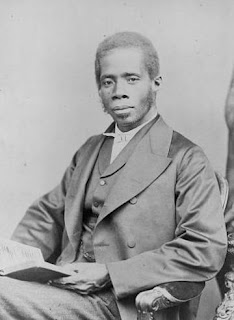
Wednesday, December 29, 2021

130 Years After, Nigerian Researchers Declare Bishop Ajayi Crowther National Hero

Samuel Ajai Crowther
 

LAGOS, NIGERIA (NAN)--The researchers say it is imperative to look into the life and times of the Bishop Ajayi Crowther 130 years after his death.

Samuel Ajayi Crowther, Nigeria’s foremost clergyman, deserves to be declared a national hero, some researchers say.

The late cleric was the multi-linguist who translated the Holy Bible into Yoruba language.

He was born at Osogun in present-day Ibarapa East Local Government Area of Oyo State around 1807 and died in Lagos on Dec. 31, 1891.

His death predated Nigeria as a country.

Slave traders captured him alongside members of his family when he was 12 years old. He was later returned to Sierra Leone.

Pelumi Awofeso is one of the researchers who spoke with the News Agency of Nigeria (NAN) in Lagos on Tuesday about Mr Crowther.

He said it was imperative to look into the life and times of the cleric 130 years after his departure.

“I started the research about Bishop Crowther after I stumbled on a tweet that talked about his death.

“Looking at the date at which he died, I realised that it is a milestone to celebrate him and dig out more research about him and his activities as a priest, educator, linguist, nationalist and a peacemaker.


“I thought it wise that something should be done in terms of having a documentary about him.

“I do not know the plans of the Anglican Communion, a church where he served as a bishop,’’ he said.

Mr Awofeso said what Mr Crowther stood for has not been fully appreciated adding that his life transcended the Bible translation to his nationalistic movement.

“Bishop Crowther did not translate the entire Bible in one fell swoop, when he was in Badagry as he moved from place to place on other assignments.

“It took him about 40 years to complete the translation.

“All that he did would be exposed in the documentary and how he created national consciousness among the people he met and his impact as an evangelist,’’ he said.

Findings

He also said the team of researchers has been able to unravel more about Mr Crowther after visiting 12 states.

“The team found that there are more than a thousand things he did which are not in the peoples’ consciousness.


“Bishop Crowther could be described as a man of passion who translated the Bible when there was no formal alphabetical order, no electricity, technology or other luxury that we enjoy these days.

“The man was able to keep his sanity in spite of the harsh conditions around him; he was also a linguist of repute who could be regarded as a Professor Emeritus of languages in our time,’’ he added.

“Bishop Crowther’s character and comportment had a lot to teach us in this 21st century. We have it on record that he was able to speak and teach 13 languages both foreign and local.

“He was a self-taught linguist in Latin, Nupe, Igbo, Hausa and other languages. He was always keeping the journals of his travels across the globe.

“Bishop Crowther also authored the Yoruba Primer and other books used in the Anglican Communion.

“He was a man that appreciated western education and always made sure that he built schools anywhere he went to evangelize.

“Many did not know his profession as a carpenter aside from his ministerial work as a priest and also had a lot of empowerment programmes for the people,’’ he stressed.
Funding

Mr Awofeso called for support for the project from Nigerians, noting that the documentary was a self- funded adventure running into millions of Naira.

A co-researcher, Sesede Simeon, also told NAN that Mr Crowther was well grounded educationally and had his education at the highest levels during his time.

“After Bishop Crowther was resettled in Sierra Leone, he was schooled at the famous Fourah Bay College and later he studied Latin and Greek and other things he could learn.

“He lived in different cities such as Ota, Abeokuta, Lokoja, Bonny Island, Freetown, Asaba and many more. He was also awarded an honorary Doctoral Degree at Oxford University.


“I think the sage had been grossly undervalued and underappreciated in the scheme of things.


“It takes a lot before a Blackman could rise to the level of a Bishop in a White-dominated setting.

“We need to attach the requisite honour to this man because he was a hero by all standards,’’ she said.

Friday, March 06, 2020

BOOK SHELF: What’s Dirty? English Professor Explores The Question In Lagos


BY SUSAN GONZALEZ

Dirt and dirtiness are ubiquitous — but the ways we conceive of it vary in ways both cultural and personal. In her new book, “Histories of Dirt: Media and Urban Life in Colonial and Postcolonial Lagos” (Duke University Press), Yale English Professor Stephanie Newell examines how and why spaces and people in that Nigerian city have been labeled “unclean” from the days of British colonial rule to today.

Newell investigated newspaper articles, colonial travel writing, public health films, and other sources to show how perceptions of “dirt” or being “dirty” influenced colonial governance, and — through interviews with Lagosians themselves — explored urban Nigerians’ own values and opinions about what constitutes dirtiness.

YaleNews interviewed Newell about her book via email; this semester she is the Leverhulme Visiting Professor at Newcastle University in England. She is also Professor Extraordinaire at the University of Stellenbosch in South Africa.

How did you, an English professor, become interested in a historical examination of what you describe as the “cultural politics of dirt”?

I’ve always been interested in popular culture as much as literature in English, and while researching a previous project on colonial creative writing, I became intrigued by the number of times British travelers in West Africa used ideas about dirt to interpret local people’s appearances, clothing, consumption patterns, and domestic lifestyles. Slowly it dawned on me that “dirt” and “dirtiness” were not simply terms to describe physical uncleanliness and insanitary behavior. People’s cultural differences — in food preferences, beauty products, interior decoration, commodities, fashion, etc. —gave rise to judgments about a person’s “dirtiness.” I started to wonder if there were similar local categories in West Africa for “dirty” people, places, and things, and how the history of colonialism and European trade in the region impacted on local ways of thinking about dirt and dirtiness.

Dirt, then, in your book, is less about substance and more about people’s perceptions of others. When you use the word “dirt,” what do you mean?

The book is concerned with “dirtiness,” what is judged to be “dirty,” and all the ways “dirt” is used as a category of interpretation when people refer to others in terms of filth, uncleanliness, shabbiness, immorality, etc. Once the project got started in Lagos, the research team quickly moved away from English words into local Nigerian concepts of dirt and dirtiness in a range of Nigerian languages. Rather than imposing our own definitions of dirt, we asked our interviewees to tell us what they understood by the word “dirty” (in English, Nigerian Pidgin, Yoruba, Igbo, Hausa, etc.), and whether they could give us examples of dirty people, places, and things. In this way, we built an understanding of local perceptions without superimposing an external concept.

Can you share a few examples of things Lagosians commonly labelled as dirty?

One of the more surprising findings from our interviews was that, when asked to describe a “dirty” person, numerous Lagosians talked about people’s unkempt appearances and cluttered houses over and above a person’s need to wash. Large numbers of people said someone was dirty if he or she was not “neat.” Neatness was the opposite of dirtiness; it referred to a well-ordered home, the presence of consumer goods, and the absence of litter, mosquitoes, overcrowding, shabbiness, clutter, creases, and dust. Interestingly, this idea about neatness took account of the fact that the majority of Lagosians live in cash-strapped households where goods and garments are rarely brand new. Neatness doesn’t refer to someone or something that looks shiny and new, but to a person or thing that is washed and correctly placed.

One particularly interesting definition of dirt emerged when Yoruba-speaking Lagosians commented on trash in the city. Whereas household waste was described as “light dirt,” easily removable and often recyclable, retaining its usefulness and value in society, the city’s dumpsites were regarded as completely negative spaces, capable of swallowing and annihilating what is human. Dumpsites were regarded by many people as a space outside, or beyond, society; the objects to be found there were beyond reclamation into society. These were places where “true dirt” could be found. One consequence of this way of thinking was that the people who worked on dumpsites, and the animals that picked over them for food, were sometimes seen as toxic and untouchable, as if they too had been transformed into waste.

What did British colonizers characterize as dirty that local people did not?

British colonizers had long lists of things they considered dirty in Lagos. The one that comes immediately to mind, because it is probably the most unfair, is the traditional African house made from bamboo, clay, thatch, wood, or other locally available construction materials. By the late 1920s, this type of house was prohibited by the colonial authorities in favor of dwellings built with imported materials. While wealthier Africans could afford to build houses out of bricks and tiles, the detached mud-and-thatch houses used by the masses were replaced by rows of “face-me-face-you” dwellings, as Lagosians call single-story tenements. These were constructed with concrete, and had corrugated iron roofs that became unbearably hot in the tropical sun and noisy when it rained. As a number of colonial officials reluctantly admitted in the 1930s and 1940s, these dwellings duplicated some of the worst features of British inner-city slums, and were in no way superior to the houses they replaced.

Other things regarded as dirty by British colonial administrators included African water containers, which often comprised recycled tin cans and bottles. If left uncovered, the British feared these would attract mosquito larvae. African “pit latrines” were also condemned by the colonial authorities; these were deep holes in which fecal matter slowly turned to compost. Unfortunately, the toilets introduced to replace pit latrines in Lagos were so few and far between, and served so many people, that their removable buckets often overflowed, and public latrine sites became breeding grounds for diseases. This latter type of toilet also created a whole new category of waste worker: the stigmatized night-soil man — in Yoruba, the agbépóò.


What are some examples of ways that people’s perceptions of “dirt” or filth contributed to stigmatization, racism, and homophobia, including government-sanctioned prejudice or discrimination in Lagos?

In the course of my research, a clear difference emerged between institutional condemnations of “dirty bodies,” and urban dwellers’ perceptions of the same bodies. For example, anti-homosexuality speech from church leaders is often inflammatory, and the Nigerian government’s law of 2013 banning homosexuality can be seen as an incitement to homophobic hatred and violence. But with the exception of only two men, the 120 people we interviewed in Lagos were not willing to condemn LGBTQ+ people outright. Our interviewees expressed curiosity about why somebody whose behavior was stigmatized would continue with such a lifestyle, and they offered a vast array of theories about LGBTQ+ people and other stigmatized bodies such as street-sweepers and dump workers. We realized that public opinion in Lagos has the capacity to be more accommodating and far less dogmatic than “official” statements about what that same public wishes or believes.

In Nazi Germany, Jews were compared to “vermin,” and in Rwanda, the Tutsis were referred to as “cockroaches” — both pests targeted for eradication. These characterizations helped to justify genocide, the worst consequence of associating others with dirt or filth. Are there any parallels for this in colonial or postcolonial Lagos?

There are no parallels for this in postcolonial Lagos, although in colonial Lagos in the 1910s, as in other British colonies at the time, serious consideration was given to the racial segregation of the city on grounds of public health. Basically, Africans were seen by colonial officials as less sanitary than Europeans, and more likely to harbor “filth diseases” as well as to transmit malaria because of their poor domestic hygiene. The effort to institutionalize these racist beliefs about Africans was driven by the Secretary of State for the Colonies in London, Viscount Lewis Harcourt, who pushed —unsuccessfully in Lagos — for full racial segregation on grounds of “public health” to protect European traders and colonial officials.

You offer a story about people who perform one of the dirtiest jobs in Lagos — the trash collectors. They collected and cleaned dolls and other toys and left them at the homes of children from poor families. Do you see a lesson in this story?

The lesson is that people who may be described by the majority as dirty, marginal, and “other” are full of their own agency. These are ordinary people whose lives are greater than any label their work attracts, including the labels used by scholars in their studies of stigmatized people.

Does your research have implications for the world at large?


In using categories of dirt and dirtiness to describe other people’s lifestyles and practices, very often we are not referring to an objective lack of cleanliness in them, but to stark cultural differences separating our own lives and theirs. To see another person as “dirty” might actually reflect our own failure of cross-cultural understanding rather than their need for soap and water: Such a failure can become dangerously dehumanizing when used in political speech.


SOURCE: YALE NEWS

KNOCK, KNOCK

By issuing subpoenas to five Times journalists, the Trump administration reveals its first response to unwanted national security coverage: ...