Showing posts with label Nigerian Jungle Blues. Show all posts

Wednesday, January 12, 2022

NIGERIA: Checkpoints As Threat To Citizens’ Safety

THE GUARDIAN EDITORIAL BOARD


The perennial menace, (it is difficult to not to term it so) of police and military checkpoints on Nigerian roads was brought to the fore by a Southeast group, Cultural Credibility Development Initiative. It complained in a letter to the Inspector General of Police (IGP), Usman Alkali Baba, and the Chief of Defence Staff (CDS), General Lucky Irabor, about the ‘strangulation of Igbo land with checkpoints’ and the “suffocation caused by the humongous number of checkpoints in Igboland.” The group alleged existence of checkpoints at every kilometer that create five-kilometer –long traffic snarl and demanded that these ‘security’ posts be reduced by 75 per cent.

A media report has gone so far as to say that the Southeast geopolitical zone ‘‘can be rightly said to be under siege by soldiers and the police.’’ While no one doubts that the nation is on the precipice security-wise, police checkpoints have been so abused as to compound rather than relieve citizens of their misery. This situation needs be reformed.

Security officers at checkpoints have been accused by not a few persons, high and low, of excesses that patently violate the rules of engagement on their duty. House of Representatives member, Ifeanyi Momah, has gone so far as to accuse checkpoint officials of human rights abuse, ‘‘devastating, degrading, and inhuman treatment’’ of citizens that include whipping women and searching traditional rulers ‘‘in an embarrassing manner.’’ No less a person than the President-General of Ohaneze Ndigbo, Nnia Nwodo, reportedly accused security agents of using the checkpoints to extort, harass, and intimidate road users. Vehicles, from motorcycles to large trucks are forced to pay varying sums according to type and size of goods. It is also reported that checkpoints are deliberately set up on market roads. The question cannot but be asked: how can the security agencies receive cooperation and intelligence while they behave in ways that generate distrust and ill feeling against them?

Checkpoint, by ordinary meaning of the phrase, simply is ‘‘a place where traffic is stopped so that it can be checked’’ for any act of illegality.
Of course, it is used in other lands within and at the borders. Alas, like many other things that are borrowed from other jurisdictions, some crooked –minded Nigerians have devised a way of bastardising a sound idea and a good process to enable them derive personal benefit. Indeed, with the aid of modern technology, human factor in checking people and vehicles for illegal items has reduced. But those who would gain from not adopting this method will not let it happen. A journey that should take a few hours ‘costs’ hapless travellers twice or even thrice precious time. The received opinion is that checkpoints have been turned into ‘‘toll gates’’ and ‘‘collecting centres.’’

The menace of extortionate security men at checkpoints is nationwide. Countless times, literally, police chiefs have directed their officers and men to desist from mounting checkpoints unless they are approved for specific reason. Successive IGPs have had to order their men off the road because they do not do what they ought to by law. Besides, they tend to go beyond their briefs. Policemen on legal checkpoints have been repeatedly told that they have no business checking the documents of vehicles, unless a particular vehicle is reported missing. They hardly comply with this simple order from ‘above’. In late September 2017, the then IGP Ibrahim Idris ordered that checkpoints be dismantled ‘‘to enable ease of business in Nigeria, safeguard and guarantee free passage of goods and travellers throughout the country.’’ Indeed, according to the police spokesperson, Moshood Jimoh, ‘‘special X-squad teams of the force have been deployed throughout the country with strict instructions to arrest, investigate and discipline police personnel violating the IGP directive.’’ Mohammed Adamu had, in December 2019, directed that ‘‘only checkpoints and nipping points that are operationally expedient for crime prevention and other forms of key duties’’ should be allowed on the roads. Adamu went further to specifically address the heart of the problem about checkpoints. He admonished that ‘police officers posted on checkpoint duties are expected to eschew corruption …be firm…courteous and polite to citizens.’’ That was two years ago. If anything changed, the Cultural Credibility Development Initiative, the Ohaneze Ndigbo leader and the House of Representatives would have no cause to lament.

Early December 2021, a resolution of the House of Representatives asked the IGP to order that ‘‘illegal and unnecessary checkpoints’’ be dismantled. Where checkpoints were not properly mounted, they have caused accidents many times. Just one example: along the Owerri-Onitsha road, on November 28, 2021, a fully loaded articulated truck rammed into vehicles stopped at a check point. 20 people were killed.

Clearly, checkpoints are not serving the pure and simple purpose that they are meant for. In the Southeast, police posts are attacked and sacked at will, About 30 communities are reported to have been taken over by criminal elements. These are happening all over the country. Criminals move freely on highways, terrorists with ease, trucks transporting aliens with their deadly arms hidden on the floor of the vehicles move through so-called checkpoints. Often, it is the local vigilante teams that accost, detect and arrest them, not at all the officials at the checkpoints.

The current IGP Baba promised, on assumption of duty in April 2021, a police force ‘‘guided by the principles of public accountability … conformity with the rule of law, compassionate servants and helpers of citizens.’’ Unfortunately, the conduct of his subordinates at checkpoints denies these good intentions. They constitute an existential threat to the convenience and safety of road users. Baba has much work to do to bring his wishes into reality.

Friday, March 06, 2020

BOOK SHELF: What’s Dirty? English Professor Explores The Question In Lagos


BY SUSAN GONZALEZ

Dirt and dirtiness are ubiquitous — but the ways we conceive of it vary in ways both cultural and personal. In her new book, “Histories of Dirt: Media and Urban Life in Colonial and Postcolonial Lagos” (Duke University Press), Yale English Professor Stephanie Newell examines how and why spaces and people in that Nigerian city have been labeled “unclean” from the days of British colonial rule to today.

Newell investigated newspaper articles, colonial travel writing, public health films, and other sources to show how perceptions of “dirt” or being “dirty” influenced colonial governance, and — through interviews with Lagosians themselves — explored urban Nigerians’ own values and opinions about what constitutes dirtiness.

YaleNews interviewed Newell about her book via email; this semester she is the Leverhulme Visiting Professor at Newcastle University in England. She is also Professor Extraordinaire at the University of Stellenbosch in South Africa.

How did you, an English professor, become interested in a historical examination of what you describe as the “cultural politics of dirt”?

I’ve always been interested in popular culture as much as literature in English, and while researching a previous project on colonial creative writing, I became intrigued by the number of times British travelers in West Africa used ideas about dirt to interpret local people’s appearances, clothing, consumption patterns, and domestic lifestyles. Slowly it dawned on me that “dirt” and “dirtiness” were not simply terms to describe physical uncleanliness and insanitary behavior. People’s cultural differences — in food preferences, beauty products, interior decoration, commodities, fashion, etc. —gave rise to judgments about a person’s “dirtiness.” I started to wonder if there were similar local categories in West Africa for “dirty” people, places, and things, and how the history of colonialism and European trade in the region impacted on local ways of thinking about dirt and dirtiness.

Dirt, then, in your book, is less about substance and more about people’s perceptions of others. When you use the word “dirt,” what do you mean?

The book is concerned with “dirtiness,” what is judged to be “dirty,” and all the ways “dirt” is used as a category of interpretation when people refer to others in terms of filth, uncleanliness, shabbiness, immorality, etc. Once the project got started in Lagos, the research team quickly moved away from English words into local Nigerian concepts of dirt and dirtiness in a range of Nigerian languages. Rather than imposing our own definitions of dirt, we asked our interviewees to tell us what they understood by the word “dirty” (in English, Nigerian Pidgin, Yoruba, Igbo, Hausa, etc.), and whether they could give us examples of dirty people, places, and things. In this way, we built an understanding of local perceptions without superimposing an external concept.

Can you share a few examples of things Lagosians commonly labelled as dirty?

One of the more surprising findings from our interviews was that, when asked to describe a “dirty” person, numerous Lagosians talked about people’s unkempt appearances and cluttered houses over and above a person’s need to wash. Large numbers of people said someone was dirty if he or she was not “neat.” Neatness was the opposite of dirtiness; it referred to a well-ordered home, the presence of consumer goods, and the absence of litter, mosquitoes, overcrowding, shabbiness, clutter, creases, and dust. Interestingly, this idea about neatness took account of the fact that the majority of Lagosians live in cash-strapped households where goods and garments are rarely brand new. Neatness doesn’t refer to someone or something that looks shiny and new, but to a person or thing that is washed and correctly placed.

One particularly interesting definition of dirt emerged when Yoruba-speaking Lagosians commented on trash in the city. Whereas household waste was described as “light dirt,” easily removable and often recyclable, retaining its usefulness and value in society, the city’s dumpsites were regarded as completely negative spaces, capable of swallowing and annihilating what is human. Dumpsites were regarded by many people as a space outside, or beyond, society; the objects to be found there were beyond reclamation into society. These were places where “true dirt” could be found. One consequence of this way of thinking was that the people who worked on dumpsites, and the animals that picked over them for food, were sometimes seen as toxic and untouchable, as if they too had been transformed into waste.

What did British colonizers characterize as dirty that local people did not?

British colonizers had long lists of things they considered dirty in Lagos. The one that comes immediately to mind, because it is probably the most unfair, is the traditional African house made from bamboo, clay, thatch, wood, or other locally available construction materials. By the late 1920s, this type of house was prohibited by the colonial authorities in favor of dwellings built with imported materials. While wealthier Africans could afford to build houses out of bricks and tiles, the detached mud-and-thatch houses used by the masses were replaced by rows of “face-me-face-you” dwellings, as Lagosians call single-story tenements. These were constructed with concrete, and had corrugated iron roofs that became unbearably hot in the tropical sun and noisy when it rained. As a number of colonial officials reluctantly admitted in the 1930s and 1940s, these dwellings duplicated some of the worst features of British inner-city slums, and were in no way superior to the houses they replaced.

Other things regarded as dirty by British colonial administrators included African water containers, which often comprised recycled tin cans and bottles. If left uncovered, the British feared these would attract mosquito larvae. African “pit latrines” were also condemned by the colonial authorities; these were deep holes in which fecal matter slowly turned to compost. Unfortunately, the toilets introduced to replace pit latrines in Lagos were so few and far between, and served so many people, that their removable buckets often overflowed, and public latrine sites became breeding grounds for diseases. This latter type of toilet also created a whole new category of waste worker: the stigmatized night-soil man — in Yoruba, the agbépóò.


What are some examples of ways that people’s perceptions of “dirt” or filth contributed to stigmatization, racism, and homophobia, including government-sanctioned prejudice or discrimination in Lagos?

In the course of my research, a clear difference emerged between institutional condemnations of “dirty bodies,” and urban dwellers’ perceptions of the same bodies. For example, anti-homosexuality speech from church leaders is often inflammatory, and the Nigerian government’s law of 2013 banning homosexuality can be seen as an incitement to homophobic hatred and violence. But with the exception of only two men, the 120 people we interviewed in Lagos were not willing to condemn LGBTQ+ people outright. Our interviewees expressed curiosity about why somebody whose behavior was stigmatized would continue with such a lifestyle, and they offered a vast array of theories about LGBTQ+ people and other stigmatized bodies such as street-sweepers and dump workers. We realized that public opinion in Lagos has the capacity to be more accommodating and far less dogmatic than “official” statements about what that same public wishes or believes.

In Nazi Germany, Jews were compared to “vermin,” and in Rwanda, the Tutsis were referred to as “cockroaches” — both pests targeted for eradication. These characterizations helped to justify genocide, the worst consequence of associating others with dirt or filth. Are there any parallels for this in colonial or postcolonial Lagos?

There are no parallels for this in postcolonial Lagos, although in colonial Lagos in the 1910s, as in other British colonies at the time, serious consideration was given to the racial segregation of the city on grounds of public health. Basically, Africans were seen by colonial officials as less sanitary than Europeans, and more likely to harbor “filth diseases” as well as to transmit malaria because of their poor domestic hygiene. The effort to institutionalize these racist beliefs about Africans was driven by the Secretary of State for the Colonies in London, Viscount Lewis Harcourt, who pushed —unsuccessfully in Lagos — for full racial segregation on grounds of “public health” to protect European traders and colonial officials.

You offer a story about people who perform one of the dirtiest jobs in Lagos — the trash collectors. They collected and cleaned dolls and other toys and left them at the homes of children from poor families. Do you see a lesson in this story?

The lesson is that people who may be described by the majority as dirty, marginal, and “other” are full of their own agency. These are ordinary people whose lives are greater than any label their work attracts, including the labels used by scholars in their studies of stigmatized people.

Does your research have implications for the world at large?


In using categories of dirt and dirtiness to describe other people’s lifestyles and practices, very often we are not referring to an objective lack of cleanliness in them, but to stark cultural differences separating our own lives and theirs. To see another person as “dirty” might actually reflect our own failure of cross-cultural understanding rather than their need for soap and water: Such a failure can become dangerously dehumanizing when used in political speech.


SOURCE: YALE NEWS

Thursday, November 14, 2019

Rejoinder: Ken Saro-Wiwa: A Playwright And Revolutionary, But A Man With Trading Instinct

Ken Saro-Wiwa


Dear Editor,

Please see and publish the article below with above headline.

Thank you.

Sincerely,

Ben Ikari, author of Ken Saro-Wiwa and MOSOP: The Story and Revelation; Rights and Environmental Justice Advocate.

Dear Janet Anderson:

Thank you for taking the time to write these good words credited to you about Ken Saro-Wiwa in the headline above. It was reportedly published in the Tempo Newspaper Nigeria, on Jan. 2, 1996 though originally printed in the Daily Telegraph of Nov. 13, 1995. Saro-Wiwa was, of course, the foremost minority rights crusader of Africa. He was a prolific and accomplished writer who authored more than 27 books. He also had several newspaper publications and position papers to his name; a non-violent and peaceful, intelligent, smart and witty world’s environmental martyr he was. He was truly altruistic.

The aforementioned piece you wrote and titled, “Ken Saro-Wiwa: A Playwright and Revolutionary, But a Man with Trading Instinct,” therefore speaks volumes. It is a piece that deals with your experience with Saro-Wiwa while you were a BBC’s correspondent in London and Lagos, Nigeria. It speaks to the person— courageousness, boldness and fearlessness, the astuteness and passion of Saro-Wiwa for the cause of the Ogoni and Niger delta people, other minorities of Nigeria and Africa, and the need for justice.

Meanwhile, accept my apologies for not seeing this piece since it was first published in 1995, and did justice to it until now. Having said the above may I draw your attention to three points you made in error, and for which I write to correct or argue against though not in the chronological order you place them. First, in discussing Saro-Wiwa at the Kangaroo military tribunal you declared: “His trial was a travesty. I still do not know if he really took it seriously, because he presented no defence,” while also saying “his defence lawyers withdrew part way through, alleging a biased tribunal.”

My questions are: which position above should your audience or the public believe; is it that he did not present any defence or defense, or that he presented his defence through his lawyers who withdrew half-way because they alleged the tribunal was biased? These conclusions you have advanced are confusing or at best contradictory. It is obvious that Saro-Wiwa presented a strong defence against the frivolous (trumped-up) accusations made by the Nigerian government supported by Dis-Royal Dutch Shell and its Nigerian subsidiary. It is also clear the tribunal, which was set up and members appointed by the Nigerian military government with support from Shell, and handed a predetermined disposition was biased.

Among many legal concepts and conclusions, I refer you to the report of former Queen’s Counsel, Michael Birnbaum, who has decades of formidable legal credentials as prosecutor and defence lawyer. He briefly observed the predetermined trial on behalf of Article 19 and the British Bar Human Rights Committee of England and Wales and the Law Society of England and Wales. In summary, Mr. Birnbaum said, “The tribunal was fundamentally unfair and not independent of the government.”

He continued among other comments by saying the tribunal pretended that Saro-Wiwa did not make any effort to defend himself even though he submitted over 40 pages of written defence, which was ignored. He also said the tribunal acted in manners that strongly suggests it was favorable to the prosecution team and the Nigerian government despite granting some of the defence prayers. See “Nigeria-Fundamental Rights Denied: Report of the Trial of Ken Saro-Wiwa and others,” (Michael Birnbaum, 1995). Also check out his video or Youtube commentaries for more.

And, although economic sanctions, which should have stopped the buying of stolen oil and stopped the hangings was not imposed on Nigeria (the Ogoni and Niger delta oil thief with Shell), which used obnoxious laws to steal oil lands and resources from Ogonis and other oil producing communities in the British colonialists’ imposed country, due to western interest and influence, the Commonwealth of Nations suspended Nigeria. The summary condition imposed on the country if it were to return to the Commonwealth of Nations was to end military dictatorship and embrace democratic governance.

Governments around the world and civil society organizations and institutions condemned the trial, judgement and execution by hanging as unfair and barbaric or inhuman. The execution was hasty and against the review and appeal provisions stipulated in the decree number 2 of 1987, which established the so-called Civil Disturbances Special Tribunals. The former British Prime Minister, John Mayor called the hanging, “Judicial Murder.” I call it State and corporate murder since there was nothing truly judicial about it, but a travesty as you rightly said.

I read Saro-Wiwa’s defence and also witnessed firsthand at the tribunal premises the harassing and intimidating, uncooperative moves of the military and tribunal, which forced the defence lawyers to withdraw. It is on record that Mr. Femi Falana (SAN) who was one of the defence lawyers, and spoke in protest before announcing the defence team’s withdrawal was subsequently arrested and jailed for no crimes he committed. No honest and neutral observer of the sham trial will claim Saro-Wiwa did not present any defence as you alleged incorrectly and falsely so. If the defence team did not withdraw the predetermined conviction verdict will not have changed.

Secondly, you said the young men who took over the streets of Ogoni caused a breakdown in law and order. This could be true but not uncommon with experiences around the world when aggrieved people or youths who have been exposed to their fundamental rights long denied due to decades of oppression, and a dangerously polluted environment, which threaten their existence, seeking to assert them are in protest mode. While it could be true that Ogoni youths, who took over the streets justifiably threatened “the interests of their elders in the Ogoni community who had been used to a cosy relationship with government and the oil companies,” as you said, those youths did not murder their elders on May 21, 1994.

“Ken therefore posed a threat to the state, but he was a hero to many of his people,” you also said and I agree. He was a justified threat without guns and other harmful and deadly weapons but the truth. In addition, you said they believed he could change the world. But he did not realize what his power could do and what his supporters would do without his permission. Consequently, you concluded that, “Perhaps I do feel Ken bore some responsibility for the murders that were committed.”

My concern and position on your conclusion regarding the murders is that you did not provide any iota of or substantive legal evidence which ties Saro-Wiwa to the unfortunate murder of the Ogoni chiefs, some of whom were his friends, mentors and in-laws, and for which he was trumped-up and executed unjustly. You also did not show proof that the youths and others who followed and supported Saro-Wiwa murdered the chiefs. The fact that Saro-Wiwa aroused the consciousness of his long oppressed people to know and stand up for their rights does not justify linking him to said gruesome murder without any direct or indirect circumstantial evidence. Note that the Nigerian government and Shell planted the murder of the four Ogoni chiefs and elders.

Shell, like the Nigerian government had monitored Saro-Wiwa long before the orchestrated Giokoo’s murder. The reasons were conspicuous. He exposed severe environmental pollution and degradation in Ogoni and told the world how these two powerful and evil entities (Shell and the Nigerian government) conspired to rape and oppress Ogoni and other Niger delta oil producing communities. He and Ogonis accused Shell and Nigeria of genocide against Ogoni. When asked to recount his position on Shell’s pollution, cover-up and exploitation and he refused because he was convinced telling the truth by exposing these crimes will force global attention on these entities, question their rationale and dealings, and help to hold them accountable. This is irrespective of the state and non-state (corporate) actors’ power, influence and manipulation on the global stage which makes holding them accountable difficult.

Furthermore, then Major Paul Okuntimo sent a proposal between 1993 and 1994 to the Rivers State Military Government headed by Lt. Col. Dauda Musa Komo, and Shell. The memo detailed how crisis can be stirred and sustained in Ogoni to allow commercial activities, oil production in particular which had been stopped by Ogonis in 1993 to continue. This, in his infamous restrictive memo for “wasting operations in Ogoni” was to apply ruthless tactics aimed at intimidating and scaring Ogonis. He planned these tactics against MOSOP and other Ogoni meetings and rallies as avenues to waste some prominent Ogonis, create insecurity to secure their so-called security, which to date has become elusive in Nigeria.

As a result the Ogoni youths you said caused breakdown of law and order for asserting their rights on the streets did not kill the Ogoni chiefs as mentioned inter alia. The government killed them using the military and their thugs in conspiracy with Shell, which in recent years accepted paying allowances to the military forces headed by Okuntimo. This happened after Shell severally denied any involvement including its rejection of the notion that it paid the military and bribed witnesses to lie against Saro-Wiwa. Also the chiefs who were in a meeting at Giokoo when murdered unjustly were promised security and safety by the Rivers State Military Governor Komo.

The Nigerian Sun-Ray newspaper he disbanded about 1994 published the governor’s security and protection—support press release. I bought a copy and read it like thousands of other citizens in the state who read it. This is the same governor who in less than 24 hours of the incident declared Saro-Wiwa and MOSOP guilty and ordered his arrest while he declared other MOSOP executives wanted without any formal independent investigation as provided by law.

The question becomes who bypassed or broke through the military or security protection promised by the governor, to kill the chiefs? There was, of course, dreadful military presence everywhere in Ogoni on that day, to confirm the military governor’s promise of protection. Nevertheless when it was time to produce the press statement (the defence team demanded to prove the trial was predetermined), which contained the governor’s less than 24 hours declaration of guilt without any investigation the government lied that the tape was recycled thus not available.

As I have mentioned and you may be aware, Ogoni was infested with geared-up men of the Nigerian Armed Forces on the day of the gruesome murder. I was on errand courtesy the Council of Ogoni Professionals (COPS) that Saturday morning of May 21, 1994, visiting some Ogoni communities scheduled for Saro-Wiwa’s stops for the government’s national conference’s interest campaign. Saro-Wiwa was an honest, tough and brave man; an honest yet tough negotiator or broker he was. He was always available to making his case and grant compromise where necessary hence his interest for the national conference. The government of Nigeria and Shell were terrified; they were scared of him, especially his ability to speak and persuade. They planned to trap him when he announced his participation as the Ogoni representative to the conference. The government feared his presence at the conference could persuade participants, the oppressed minorities of the country in particular to threaten breaking away from Nigeria due to the suffering imposed on them by successive governments which mismanaged and nearly ruined the country.

In addition, let me state here that I saw the military following Saro-Wiwa from Sogho, an Ogoni community. He was followed to Bori and Gokana. The military stationed at Sogho stopped me while I was coming from Kaani and entering Sogho-Kaani junction. This was the exact time Saro-Wiwa was forcefully stopped from entering and speaking in Sogho, and was ordered to leave. He peacefully left for Bori, headquarters of Ogoni Kingdom in the company of the military without incident. The military accepted his deputy’s (Mr. Ledum Mitee) suggestion that Saro-Wiwa follow him to his hometown, K-Dere in Gokana Local Government Area of Ogoni (Rivers State) for refreshment since he was not allowed to speak anywhere but ordered to return to Port-Harcourt, the capital of Rivers State.

They knowingly did not stop him nor did they suggest any other route to Mitee’s home but the one linking the venue of the meeting attended by the chiefs, and which they were aware. It was not until he was escorted close to the meeting’s venue that he was stopped and ordered again to return to Port Harcourt. This act was to make it appear Saro-Wiwa’s stop created the alleged mob, which the government claimed murdered the chiefs. My source which was his personal aide in the car with him disclosed that he was told his presence there was not in his best interest so he should help make their job easy.

This is what they knew from the outset but did not reveal rather he was misled until they reached the road linking the meeting venue at Giokoo. As narrated further his personal aide said after a brief talk with the officers who were following and stopped him, and Mitee who parked his car and walked to him (Saro-Wiwa who remained in his car), his driver revised the car and in military escort drove to Port Harcourt without any incident he saw nor partook. How then should he be responsible for a government’s master-minded killing, which was predetermined as the only way to get him implicated and put away?

Shell in 2009 settled the case: Wiwa vs. Shell for $15.5 million out of American court days before trial. Although the company did not accept responsibility or liability for the unjust and wrongful killing of Saro-Wiwa and others, as common with culpable and guilty powerful corporations and other entities, including individuals who are rich enough to settle their wrongdoings out of court, the public and court system understand that if Shell had nothing to do with the hangings it will fight to the end and not settle out of court.

In the third instance you posited that, “Ken also argued that Nigeria’s minority groups should have the right to run their own government; I did not agree,” you declared. The reason adduced in your disagreement was that Nigeria needed a functional democracy to enable everyone have their fair share of the resources, not especially set aside places for the 250-odd minorities. You reasoned that granting these so-called minorities the right to govern themselves will be a recipe for chaos. In this consideration I am tempted to wonder or ask if you truly had the chance to listen to Saro-Wiwa and understood what he meant by the need for minority groups to have and run their own government.

If you had the opportunity to hear him out then you did not understand what he meant. And if you did not have the chance to listen and hear him well then asked questions for clarification, you took this position from a misunderstood angle. You misunderstood his viewpoint thus misunderstood or did not understand how Nigeria is configured into so-called majority and minority ethnic groups. Against your claim: not specially set aside places for 250-odd minorities, no record has it that Nigeria is made up of 250-odd minorities rather the general and to a great extent scholarly view is that Nigeria has about or over 250 ethnic groups. These groups comprise both minority and majority ethnic peoples. Those who claim the majority title are but three groups namely Hausa-Fulani, Yoruba and Igbo.

What Saro-Wiwa said repeatedly in every MOSOP meeting and rallies I attended, and in his writings is that Ogoni being one of these ethnic groups, classified minorities should be granted its right to self-determination, which equally means self-government or governance. He likewise spread this argument to other minorities of the country, especially those whose oil and gas resources are used to grant the so-called majority groups multiple self-government structures or states and statuses. Self-government for Saro-Wiwa meant political autonomy or internal self-determination, which allows groups to govern and control their respective affairs without undue interference while also working collaboratively with the federal or central government. It is a natural right recognized by national laws and international norms, including the right to external self-determination or independence.

Self-government proposal is not strange to Nigeria nor is it strange to America and other western democracies though America and the latter does not have wide-spread ethnic composition as Nigeria, an artificial creation, which rogue British colonialists used as one of their conduits to siphon natural wealth from Africa. America, for example has states, which have self-government or autonomy yet these states collaborate with the federal government for the security, safety and development of the country through strategic and effective states’ and national policies. Nigeria currently has thirty six states. About twenty five of these states are created on ethnic basis.

While there are about eleven states created by military fiat for Hausa-Fulanis, six states for Yorubas and five for Igbos (the so-called majority ethnic groups), two states are also created for Ibibios, and one for Ijaws—so-called minority ethnic groups. More than ninety percent of the twenty two (out of thirty six) states created for the above three ethnic groups, which claims majority status depends on sharing oil money from the minority groups’ land on monthly basis without which they cannot create their budget and pay salaries. It is therefore clear here that the three states created for these minorities have not caused any chaos as your conclusion misrepresented.

This means Saro-Wiwa was right even though you disagreed without fully understanding what he meant. And the clamor in recent years for a return to Nigeria’s regional system of governance that worked well, if the country is restructured on regional lines you will see these oil producing minorities in the South-south geopolitical region governing themselves alongside other regions. All the regions, say six, eight or ten will contribute to the center and not depend solely on sharing oil money while the minorities whose lands have oil and gas are polluted and cause to endure pains, suffering and die for Nigeria to survive; a proposition Saro-Wiwa vehemently challenged, opposed and exposed, and was killed.

Ben Ikari is the author of Ken Saro-Wiwa and MOSOP: The Story and Revelation; Rights and Environmental Justice Advocate.


SOURCE: ROYAL DUTCH SHELL

Monday, May 14, 2012

Nigeria's Economy 'll Collapse Unless -- Eze


ABUJA—chairman, Senate Committee on Works, Senator Ayogu Eze, yesterday, raised alarm that unless the Federal Government took urgent measures on the deplorable situation of the nation’s roads, the economy stood the risk of imminent collapse.

READ FULL STORY

Saturday, March 24, 2012

Nigerian Jungle Blues: Trans Amadi Slaughter House

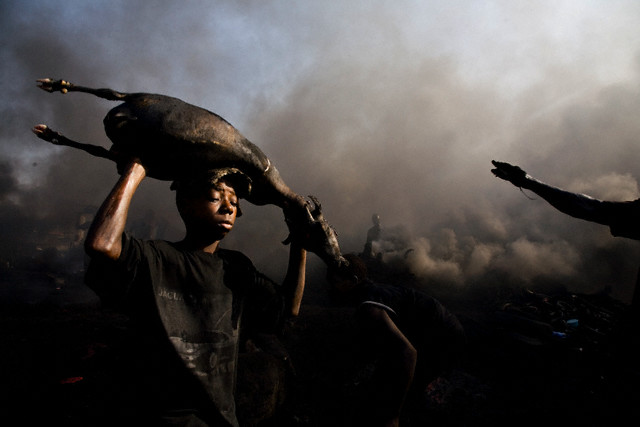
A young man carries an animal carcass through the Trans-Amadi Slaughter, the main abbatoir of Port Harcourt.


A butcher cuts up a cow carcass amidst a pool of blood and guts, at the Trans-Amadi Slaughter, the main abbatoir of Port Harcourt. At the slaughter, animals are killed in the open, their blood spilt into the waterways below and their skin is burned by the flames of old tires, which creates thick clouds of black smoke over the city. Fish had been the traditional source of protein in the Niger Delta, but as fish stocks have dwindled due to pollution from the oil industry and over fishing, meat is becoming more common. Date: June 20, 2006. Location: Port Harcourt. Image: Ed Kashi


Amidst the bones and smoke, a young girl sells drinks to the workers at the Trans-Amadi Slaughter, the main abbatoir of Port Harcourt. At the slaughter, animals are killed in the open, their blood spilt into the waterways below and their skin is burned by the flames of old tires, which creates thick clouds of black smoke over the city. Fish had been the traditional source of protein in the Niger Delta, but as fish stocks have dwindled due to pollution from the oil industry and over fishing, meat is becoming more common. Date: June 20, 2006. Location: Port Harcourt. Image: Ed Kashi

Monday, October 03, 2011

New Report Expose Shell Complicity In Nigerian Human Rights Abuses

Graphic: Guardian
By John Donovan, Royal Dutch Shell PLC

Shell fueled human rights abuses in Nigeria by paying huge contracts to armed militants, according to a new report published today by Platform and a coalition of NGOs and featured in The Guardian.

This evening we received an email of thanks from Ben Amunwa of platformlondon.org. Ben is the author of the 41 page report called Counting the Cost, which uncovers how Shell’s routine payments to armed militants exacerbated conflicts, in one case leading to the destruction of Rumuekpe town where it is estimated that at least 60 people were killed.

Shell also continues to rely on Nigerian government forces who have perpetrated systematic human rights abuses against local residents, including unlawful killings, torture and cruel, inhumane and degrading treatment.

What writer and activist Ken Saro-Wiwa dubbed the “slick alliance” between oil multinationals and the Nigerian military is alive and harmful as ever. Shell’s operations remain inextricably linked to human rights violations committed by government forces. The Nigerian government, driven to keep oil revenues flowing and working in close partnership with oil multinationals, has heavily militarised the Delta. Shell alone has hired over 1,300 government forces as armed guards. For communities, the impacts have been devastating and are in addition to ongoing environmental damage from oil spills and gas flaring.

Commenting on the report, Nnimmo Bassey of Friends of the Earth International said: “Shell’s obligations are clear: it must clean up after decades of devastating oil spills, end the illegal practice of gas flaring and compensate the victims of human rights abuses in Nigeria. It is unacceptable that Shell continues to deny responsibility, while pushing communities deeper into poverty and fuelling destructive conflicts.”

“Shell’s divisive practices have led to daily human rights violations in the Niger Delta,” added Geert Ritsema from Friends of the Earth Netherlands. “Many of the victims have no access to justice and cannot afford to take the oil giant to court. Lawsuits in Nigeria can take decades to resolve and the remedies are often inadequate. Yet Shell must be held accountable for its environmental destruction and complicity in human rights abuses in Nigeria, and home governments like the UK and Netherlands must ensure that remedies are available and accessible to the victims.”

Interviews with Ben Amunwa and the former Royal Dutch Shell Group Chairman, Sir Mark Moody-Stuart, will be aired during a related feature on the BBC World Service “Business Daily” at 8.30am tomorrow, Tuesday 4 October.

I have been reporting on these disturbing matters since 2007 e.g. Is Shell skulduggery in Nigeria pumping up global oil prices?: 18 July 2007. The astonishing revelations in my article came from a high level manager inside Shell Nigeria.

Friday, July 15, 2011

Documentary: Orphans and Vulnereable Children in Nigeria

Justice Development Peace Commission, JDPC, is actively involved in peacebuilding, early warning, early response and conflict mapping in this area because of tribal violence. Father John Attah is the coordinator of JDPC, he is wearing a white frock. Every three months they have events in the area of the communities involved, including the Agbaduma area, of Agatu local government. This month they are having a Peace rally with speakers being from the Methodist Church, the Catholic churches and the four chiefs of the involved tribes. One community, Ekaidar, was distroyed this past April by people from the Egba community because of misconceptions. Five people were killed. Father John with local villagers and police tour the damage. Police are also involved in the peace-building activities. Date: August 27, 2010. Location: Obagijir, Benue. Image: Karen Kasmauski for CRS


Akula Ajir, 10 years old is part of the OVC program in Makurdi district, Nigeria. His mother and father have died of AIDS. He lives with his mother's sisters, Rose Ahua and her husband Justin Ahua. They are both HIV positive and volunteers with the Makundi Diocese volunteer program . The Ahua have three children of their own, including an adult daughter who is married and has a three month child. Akula does jobs around the compound including the laundry. He baths his little brother, Tersoo and little sister, Mrumun. CRS pays for him to go to school as well as his health visits. He is frequently visited by the head nurse of local health clinic, Fidelia Nyior (she is wearing a blue dress) He also hangs out with his buddies, his peers for meetings and general support. Date: August 23, 2010. Location: Makurdi, Benue. Image: Karen Kasmauski for CRS.


Orphans & Vulnerable Children in Nigeria
Parish of SS Peter and Paul in the village of Aliade, Nigeria supports the OVC program along with CRS. One of the members is Magdalene Shemba. Her caregiver is her father, Mathew Shemba who is also PLHIV. She works with her sister, Jennifer,18, cooking dinner and cleaning. She also meet with her peer group young women who are OCV between the ages of 11-18. She is wearing green dress and then changes into a white shirt with black strips and a pink skirt.Date: August 24, 2010. Location: Aliade, Benue. Image: Karen Kasmauski for CRS.

Thursday, December 02, 2010

Images: Nigerian Jungle Blues

This one here beats me...Getting high on his own supply


10 Dec 2008, LAGOS, Nigeria --- A child washes clothes in Iwaya, one of the poorest areas of Lagos --- Image by Friday Zannu/Handout/Reuters


01 Feb 1999, Finima, Nigeria --- Flooding in the Niger Delta --- Image by George Steinmetz


2005, Lagos, Nigeria --- Cars Passing Checkpoint in Nigeria --- Image by James Marshall


28 Jul 2004, Afiesere town, Delta, Nigeria --- Urohobos Bake Tapioca in the Heat of a Shell Gas Flare Site --- Image by Ed Kashi/Corbis Images

Sunday, May 02, 2010

Nigerian Jungle Blues and Sunday Cartoons

The ACF, Sunday Vanguard can also reveal, is insisting that the zoning arrangement of the PDP is a sure panacea for the evolution of equity in the country. A source in the party’s Board of Trustees, BoT, told Sunday Vanguard that “what we are hearing is that the Acting President wants to contest the presidential election of next year and it is dividing the party....MORE @ VANGUARD


SOURCE: GUARDIAN


SOURCE: SUNDAY TRUST


SOURCE: SUN NEWS ONLINE

Tuesday, April 20, 2010

Nigerian Jungle Blues and Tuesday Cartoons

Palpable tension has gripped the House of Representatives, over plot to remove the Speaker, Dimeji Bankole. Bankole is among some notable Nigerians including no fewer than five governors who are currently stranded in Europe due to the volcanic ash, which led to cancellation of flights.
As members of the Nigeria First Forum (NFF) who are pushing for Bankole’s removal confirmed the plot and the scheduling of a meeting for last night to fine-tune their strategies, there is uncertainty over whether the House, which had been on Easter vacation would sit today... MORE @ SUN NEWS ONLINE


SOURCE: DAILY TRUST


SOURCE: SUN NEWS ONLINE


SOURCE: GUARDIAN

Sunday, April 18, 2010

Nigerian Jungle Blues and Sunday Cartoons

When a religious crisis convulsed the city, a handful of fundamentalists were hot on his trail. They stormed his office and dragged him out by the scruff of his pastor’s collar to the back of his office. After beating him unconscious, his assailants crudely cut off his testicles with a sharp dagger and plucked out his right eye. They went away triumphantly with these vital body parts as a trophy and he was left to bleed to death. More @ Sun News


SOURCE: Sun News Online


SOURCE: PUNCH


SOURCE: Guardian


SOURCE: Sunday Trust

Sunday, April 04, 2010

Nigerian Jungle Blues and Sunday Cartoons

Fresh troubles may be in the horizon for members of the kitchen cabinet of ailing President Umaru Yar’Adua as they are said to be explaining how they disbursed a whopping N70 billion allegedly on behalf of the former Katsina governor as security vote between November 2009 and January 2010. Sources claimed that two former close allies of the ailing leader who failed to make it back to the newly reconstituted cabinet by acting President Goodluck Jonathan, are said to be answering questions over the manner the money was spent and for what purpose... MORE @ SUN NEWS ONLINE


Posers Over Cleric's Visit to Yar'Adua: Thursday’s unexpected visit by four Islamic clerics to ailing President Umaru Yar’Adua at the Presidential Villa, Abuja, has sparked fresh anxiety in the polity with questions now being asked about the propriety of allowing the clerics access to the President while same is denied Acting President Goodluck Jonathan... MORE @ VANGUARD


SOURCE: SUN NEWS ONLINE


SOURCE: GUARDIAN


SOURCE: PUNCH

Thursday, March 25, 2010

Nigerian Jungle Blues and Cartoons

Senate, Reps okay N4.6 trn budget: ABUJA—THE National Assembly, yesterday, approved a harmonized N4.6 trillion 2010 budget for the Federal Government directed at boosting infrastructure development across the country. Underlining its priority for infrastructure development, the budget has set N1.85 trillion representing 40 per cent of the total budget for capital expenditure. It is the highest proportion earmarked for capital development since the return to democratic rule in 1999.... MORE @ VANGUARD


There is unquantifiable shock in the camps of three former governors over the failure of the ex-state chief executives to make Acting President Goodluck Jonathan’s ministerial list.
A highly-placed Presidency source told correspondents in Abuja yesterday that until what seemed to be a Jonathan shocker earlier in the week, the trio of Chief Achike Udenwa, Dr. Sam Egwu and Obong Victor Attah, former governors of Imo, Ebonyi and Akwa Ibom states respectively, were said to be very sure of landing ministerial nominations... MORE @ SUN NEWS ONLINE


SOURCE: PUNCH


SOURCE: SUN NEWS ONLINE


SOURCE: DAILY TRUST

Sunday, March 21, 2010

Nigerian Jungle Blues and Sunday Cartoons

Deposed emir of Gwandu and former ADC to former Head of State, Major- General Mohammad Buhari (rtd), Major Al-Mustapha Jokolo (rtd), seldom grants press interviews. But each time he does, he comes out smoking, sparing no one or issue in the process. After about one year of persuasion, he reluctantly granted Sunday Sun an exclusive interview last Friday on topical national issues, most importantly on the return of Aliyu Gusau, former National Security Adviser, NSA to IBB and Obasanjo, to the corridors of power... MORE @ SUN NEWS ONLINE


US okays Jonathan’s style: Acting President Goodluck Jonathan’s consolidation of his grip on power is drawing applause from the United States of America which says his efforts are easing a political crisis that once fanned fears of instability in the country. Assistant Secretary of State Johnnie Carson said Washington was encouraged that Jonathan was moving on electoral reforms, anti-corruption efforts and peace outreach in the restive Niger Delta, the centre of Nigeria’s largest energy industry... MORE @ VANGUARD


SOURCE: SUN NEWS ONLINE


SOURCE: SUNDAY TRUST

Monday, March 15, 2010

Nigerian Jungle Blues and Monday Cartoons

Participants decry bombing at Post Amnesty programme: The first dynamite exploded at about 11.05, this was minutes before Governor Emmanuel Uduaghan of Delta state drove into the premises of the event. The coincidence caused many to think that the explosion was probably a canon shot fired to herald the coming of the governor who led other dignitaries like governors Adams Oshiomole of Edo state, Ikedi Ohakim of Imo state, the Minister of Niger Delta, Chief Ufot Ekaette and several others... MORE @ VANGUARD


SOURCE: DAILY TRUST


SOURCE: SUN NEWS ONLINE


SOURCE: PUNCH


SOURCE: NIGER DELTA STANDARD


SOURCE: GUARDIAN

KNOCK, KNOCK

By issuing subpoenas to five Times journalists, the Trump administration reveals its first response to unwanted national security coverage: ...