Showing posts with label DW. Show all posts

Monday, January 24, 2022

Malawi's President Fires Cabinet Over Corruption Charges

President Lazarus Chekwara


Lazarus Chakwera dissolved his Cabinet due to graft charges against three ministers. The president is facing a revolt over perceived inaction on corruption within the government.

Malawi's President Lazarus Chakwera on Monday dissolved his entire Cabinet over corruption charges against three of its members.

Chakwera told the nation in a televised address that "all the functions of Cabinet revert to my office until I announce a reconfigured Cabinet in two days."

He vowed to "confront all forms of lawless conduct by public officials."
Which ministers are accused of corruption?

The three ministers in question are Lands Minister Kezzie Msukwa, who stands accused of profiting off land deals involving a Malawian businessman based in the UK; Labour Minister Ken Kandodo, who is accused of siphoning COVID-19 funds; and Energy Minister Newton Kambala, who is accused of illegally manipulating fuel import deals.

President Chakwera said that he had taken the decision to allow the three ministers and other public officers to account for their charges.
How serious a problem is corruption in Malawi?

Chakwera was elected in 2020 on a promise to fight corruption. He has recently come under criticism from the Episcopal Conference of Malawi (ECM) and the Public Affairs Committee (PAC) — which comprises church groups that act as a government watchdog — for his inaction.

"Let no suspect, however powerful, wealthy, or who their connections are, be shielded or protected," read a recent statement by Catholic bishops from the ECM.

Chakwera also serves as the head of the Malawi Congress Party (MCP), the country's oldest political party and the largest in Malawi's ruling Tonse Alliance.

The president has faced a growing rebellion from within the alliance, with many members accusing the MCP of corruption and nepotism, while at the same time pursuing economic policies that threaten to drive the country into a full economic crisis.

Chakwera's decision came shortly after the arrest of three former officials of the Democratic Progressive Party (DPP), which previously ruled Malawi — the arrest included the former finance minister and central bank governor, arrested on allegations they manipulated accounts to obtain loans from the International Monetary Fund (IMF). Both men were considered favorites to challenge Chakwera in Malawi's 2025 presidential election.

Malawi is amongst the smallest countries on the African continent as well as one of its most densely populated.

It is one of the world's poorest countries, with nearly three-quarters of its population living on less than $2 (€1.77) a day. Malawi has suffered massive floods, prolonged drought, crop-destroying pests and the coronavirus pandemic — leaving 15% of its population in desperate need of food aid.

Wednesday, January 19, 2022

Are Armies In Africa More Of A Problem Than A Solution?

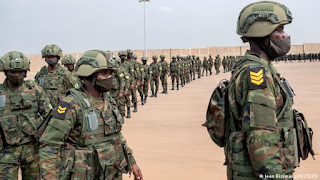
Rwandan troops have been praised for helping to quell an Islamic uprising in northern Mozambique (DW)


Many armies in African countries are perceived as underfunded, underequipped and ineffective. They are also seen as prone to staging coups and violating human rights. But experts say a more nuanced view is needed.

According to a study by the Stockholm-based International Peace Research Institute (SIPRI), out of a total of 49 sub-Saharan African states, at least 20 were involved in some armed conflict in 2020. This places African armies at the center of events — and under scrutiny to an extent unknown in other parts of the world.

Many African armies suffer from a bad reputation. They are often poorly trained and ineffective. The reasons are manifold, including underfunding, revealed when they need to combat insurgents, as seen in Nigeria and Mozambique. In addition, armies are to blame for military coups backed by political actors, as happened in Mali, Guinea, and Sudan. Some are accused of corruption and misuse of resources, explains Nan Tian, senior researcher at SIPRI. "This is, however, a false representation. In general, African militaries are not like this," Tian told DW. One example is the Rwandan army, which has won international respect for its discipline and efficiency.

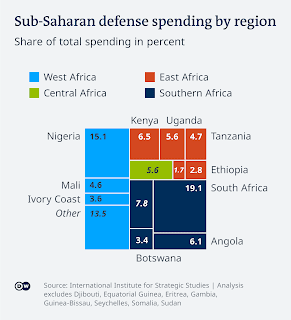
There is also a wrong perception of African armies being outsized and eating up too much of the state budgets. "Both the relative number of personnel per inhabitants and the relative size of the budgets for the military are small in Africa in general," said Matthias Basedau, director of the GIGA Institute for African Affairs in Hamburg.

Fighting corruption in the army

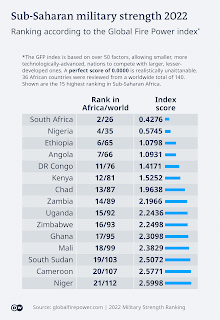
Nigeria, for example, has the second biggest sub-Saharan army after South Africa. But with more than 150 million inhabitants, it has a comparatively modest number of 200,000 enlisted personnel. Russia, a country of 140 million, has more than one million soldiers.

African armies are also associated with a lack of transparency and corruption. "Much of this is a structural problem. The lack of financial resources in the country means that the military and other state actors are all competing for a very small slice of the pie," Tian said, pointing out that real progress has been made.

In Angola, several high-ranking army officers were detained and sued for embezzlement last year in an anti-corruption drive launched by President Joao Lourenco. The president is also trying to dismantle a system of patronage put in place by his long-serving predecessor, Jose Eduardo dos Santos.
The army as a political actor

Owing to the continent's colonial history, the military in many African countries assumed a political role from the start. "Once the genie is released from the bottle, it's hard to put it back in," Basedau said.

In Angola, some top combatants were compensated for the fight for independence from Portugal and their participation in the ensuing decades of civil war. Such an arrangement offered an opportunity to those well placed to get rich quickly. General Manuel Hélder Vieira Dias Jr, nicknamed "Kopelipa", for instance, was estimated in 2014 to be worth $3 billion (€2.64 billion). While Lourenco's government has since removed him from powerful positions following the departure of former President dos Santos, he has been able to keep his wealth.

Though Angola is rich in oil and diamonds, most of its 32 million people live in poverty.

As in Angola, the governments of many countries have included the military "in corrupt practices to keep them happy and to keep them in line," Basedau said. It is often a tactic to gain the military's support.

Military coups on the rise again

Since the middle of 1950, Africa has averaged four coups per year. The number of attempted or successful coups declined between 2010 and 2019, a recent study called "Global instances of coups from 1950 to 2010: A new dataset" found. But in 2021, their number suddenly grew to six, a worrying trend for many analysts.

The threat of a military coup is never far, especially in West and Central Africa. "When we encounter weak states that have more unaccountable and weak political institutions, we can also bet that their armies are going to be unaccountable and probably fragmented," Benjamin Petrini of the International Institute for Strategic Studies (IISS) told DW.

Experts like Petrini believe that the erosion of democratic norms, including in the US and the European Union, is a major contributing factor "to a feeling that a military coup does not carry the same consequences as it used to."

Crimes against humanity

This has also increased the feeling of impunity among some armies notorious for committing crimes against humanity. Sexual violence against women and girls and other human rights abuses "are not just incidents, but are, in effect, tactics of war," Petrini says. This is far from being a specific African problem. "The disregard of human rights in warfare is a universal feature," researcher Basedau maintains.

The coronavirus pandemic, which laid bare many institutional deficits, has increased the threat of coups. "In several countries, the military had to step in," fueling the perception of a failure of the democratic state, Petrini says. He calls for an increase of pressure on coup leaders and lauded the Economic Community of West African States (ECOWAS) for slapping strict sanctions on Mali's junta.

Analysts warn that interference in Africa from outside could be a double-edged sword. China and Russia, increasingly at loggerheads with the West, are becoming significant players in the continent. "If you have these international rivalries and they happen to meddle with domestic conflicts in African countries, of course, it's a great risk that these conflicts will become more intense and more protracted," Basedau said.


Sunday, January 09, 2022

Dictators In Africa Using Social Media To Cling To Power

Ugandan rights lawyer Nicholas Opiyo. Image via Human Rights Watch


Uganda's President Yoweri Museveni is suspected of using fake social media accounts to consolidate his power. He wouldn't be the only one in Africa. Is social media becoming a threat to democracy on the continent?

In early 2021, Facebook (Meta) deactivated more than 20 accounts linked to Ugandan President Yoweri Museveni's ruling National Resistance Movement (NRM) party. Shortly afterward, Twitter also followed suit, closing 11% of the nearly 3,500 accounts worldwide that allegedly spread pro-government propaganda.

Thus in total, almost 440 Ugandan social media accounts close to the Ugandan government have been blocked by social media networks in the East African country to date.

Both Twitter and Facebook accuse the Ugandan government of using social media as a tool politicians to manipulate public opinion, spread disinformation, and intimidate the opposition. Facebook also stated that as part of its strategy, the Ministry of Information had been using "fake and duplicate accounts" for propaganda purposes.

A new favorite tool used by autocratic leaders

When Facebook took action, President Museveni's press secretary, Don Wanyama, whose Facebook and Instagram accounts were also suspended, accused Facebook of trying to influence the 2021 election in Uganda:

"Shame on the foreign powers who think they can impose a puppet government on Uganda by disabling the online accounts of NRM supporters," Wanyama wrote on Twitter at the time. Twitter said in a statement, however, that "(i)n most cases, the accounts were suspended for various violations of our platform manipulation and spam policies."

According to analysis by the Oxford Internet Institute, the spread of misinformation driven by political organizations on social media has been sharply on the rise in recent years. The report states that in 2017, disinformation campaigns were carried out in 28 countries. Three years later, that figure had risen to 81 countries.

"The spread of fake news is a real problem," said Ugandan human rights activist Nicholas Opiyo in a DW interview. "This method is gaining ground in countries whose leaders are desperately struggling to maintain their image and reputation on social media."

According to Opiyo, this involves using bots and trolls, computer programs, and paid users who use fake accounts to flood social media with posts favorable to the government.
Bans across Africa

In Tanzania, Uganda's neighbor, Twitter took similar action, removing 268 accounts for spreading "malicious reports" directed at members and supporters of the Tanzanian human rights organization Fichua Tanzania and its founder.

Meanwhile, similar reports are also surfacing from west Africa: In Nigeria, President Muhammadu Buhari "criticized the activists of the #EndSARS movement in June and called for action to be taken against them. However, Twitter deleted this call, and in reponse, Buhari's government banned Nigerians from accessing the micro-blogging site," Franziska Ulm-Düsterhöft, Africa expert at Amnesty International in Germany, told DW.

The #EndSARS movement was initated by social media-savvy young Nigerians, who sought to put pressure on the government to abolish Nigeria's controversial Special Anti-Robbery Squad (SARS) police unit. The campaign also called for better overall governance in West Africa's largest democracy.
Social media restrictions: 'overreaction' by elites

Back in Uganda, the government in the capital Kampala has also been trying to make it harder for Ugandans to get independent information online by imposing taxes on mobile data. The government also doesn't shy away from temporarily shutting down social media alrogether, as was witnessed during the run-up to the presidential election a year ago.

At the time, Ugandan Foreign Minister Sam Kutesa initially justified the move by saying that Facebook and Twitter had shut down government accounts, making the social media blackout sound like a retaliatory measure. However, after the January 16 election, Kutesa said the shut-down had been "a necessary step to stop the biting language and incitement to violence."

Angelo Izama, a political consultant and journalist from Uganda, describes the move rather as an "overreaction" rooted in deeply-held patriarchal beliefs. Izama says that "(t)he political leadership, especially here in sub-Saharan Africa, comes from a generation where society was structured so that the child would not contradict the father."

"If it did, it was punished. And that's the relationship between the state and the citizen," Izama told DW.

But he says that society is changing, he says, leaving such political elites in the dust. Young people in particular, he highlights, are now able with the help of the internet to react immediately to laws and bans, and make their opinions known about the performance of the government or of private institutions.

Surveillance via social media

In 2021, social media shutdowns also took place in Burkina Faso, South Sudan, Senegal, Congo, Zambia, Chad, Ethiopia, Nigeria, and Sudan. Again, the reasons were mainly political, with protests, elections and political unrest resulting in information shutdowns across the continent, with no end in sight:

"It will take a while for those in power to understand that young people today expect them to sit down and talk to them," political consultant Angelo Izama said. "It will also take time for those in power to stop using surveillance and monitoring as a means to counter criticism."

Meanwhile, some governments are even going further and targeting their citizens directly by exploiting their internet affinity: "Spy software is being bought by governments and installed specifically on smartphones," Amnesty expert Ulm-Düsterhöft told DW. "We documented this last year for Togo and Rwanda, for example. First, apps are downloaded via email attachments, then the software instals itself and accesses microphones, cameras, and social media."

Ulm-Düsterhöft warns users not to download any unknown apps, take a close look at dubious social media accounts, and contact the app operators if in doubt.
Risks and opportunities

According to a report published by the South African Institute of International Affairs, shutting down the internet and arresting government critics voicing their views on social media channels are signs that several governments in sub-Saharan Africa are becoming increasingly autocratic.

In Uganda, author Kakwenza Rukirabashaija posted comments that were critical of the government on social media, which led to his detention, during which he allegedly was tortured by security agents.

Human rights activist Opiyo says that with reports like these, it is becoming clear that the earlier view of social media as "a liberating force for democracy" is disappearing: "(N)ow we see the dangers associated with it, and how social media can be used to undermine democratic processes. Social media is becoming another tool of oppression."

Opiyo believes that this is why social media regulations are becoming necessary. But he also calls for users to act responsibly and remember that not everything found on social media is true.

This article was translated from German by Chrispin Mwakideu

Edited by: Sertan Sanderson

Wednesday, January 29, 2020

WEST AFRICA: Ghanaian Traders Livid At Nigeria Border Closure

Kaduna Melon Farmers market. Image: Z. Umar/DW


Traders in Ghana have labeled Abuja's decision to continue shutting its border as needless and un-African. On the contrary, Nigeria claims the border closure has spurred local production and reduced arms smuggling.

Gabriel Nartey casts a sad look as he sits idly in his spare parts shop located in Ghana's capital Accra. The 50-year-old trader complained that he has not seen business this bad. "I am stuck, I am losing customers because I don't have what they need," Nartey told DW in an interview. "I don't know what to do, it's just a few who can go to China, which is more expensive that can manage, but for those like us who rely on Nigeria only, it is challenging for us."

When Nigeria decided to close its border with Benin in August 2018, Ghanaian traders initially downplayed the move hoping that they could cope with the momentary interruption. "Right from the word go, we were not worried about the border closure," Clement Boateng, National Organizer of Ghana's Union of Traders Association, told DW. "It is Nigeria's right, but what we thought was not right was Nigeria's refusal to give prior notice to its ECOWAS citizens," Boateng said.
Nearly six months later, Abuja has shown no interest in re-opening its border. President Muhammadu Buhari's government had raised hopes that goods may start flowing in and out by January 31. But Nigeria's Comptroller-General Hameed Ali says that is no longer the case: "Certainly not the end of January. When we initially closed the border, we intended to get our neighbors to adhere to the ECOWAS protocol on transit goods," Ali told DW in an interview.

Nigeria 'happy' with the border closure
Nigeria says after it closed the border, it has reaped more good than bad. "We discovered that our economy is completely bastardized because we Nigerians have not learned to consume what we produce. And therefore, our industries are not able to produce and enhance their production," Nigeria's top customs official, Ali, said.
"What we are trying to do now by this border closure is to get Nigerians to consume what we produce and produce what we consume because that's the only way that our economy would grow."

Ali's sentiment is shared by many Nigerians who have long complained that other ECOWAS member states have been taking advantage of the regional body's free trade and movement agreement to dump illegal and sub-standard goods in Nigeria.

Rice farmers had taken the government to task over what they called cheap imported imports that were making their way into the Nigerian market via Benin. Peter Dama, Chairman, Rice Millers Association of Nigeria, (RIMAN), boasted to DW about the positive impact of the closed border. "It has raised our production because we have markets now," Dama said.

"The mills are operating, we had dead mills that were not operating before, but now you find that everywhere mills are coming up. We are producing trying our best to feed the nation."

According to Ali, Nigeria's local poultry industry has been given a boost following the border closure. "Our big hotels in Nigeria used to buy eggs from Ghana. With the border closure, we have compelled them to buy the eggs from our [Nigerian] poultry farmers," Ali proudly said. "They are now expanding. An economy that does not have an industrial base can never claim to be an economy."

Ghana caught between a rock and a hard a place

At a recent meeting held in London, Ghana's President Nana Akuffo-Addo acknowledged the need for Nigeria to protect its citizens but, at the same time, pleaded with his Nigerian counterpart to consider re-opening the border. He noted that Nigeria is essential for specific categories of businesspeople in Ghana.

For trade unionist Boateng, President Akufo-Addo needs to do more than just diplomacy. "Nigeria has shown us that when it comes to ECOWAS protocols, they don't care because they put their citizens first," Boateng said. "That is why we think our Ghanaian government needs to implement some of the local laws that can protect the local people, especially regarding the influx of foreigners in the retail trade."

Boateng said the closure is not affecting only Ghanaian traders. "A lot of Nigerians have businesses here in Ghana, and since the closure, they have also spoken bitterly against their government." He said they had been forced to be creative to deal with the current situation. "We can't tell those who trade in Nigeria to sit down and fold their hands, we have to find alternative means, and we have been able to find so many places where we can get the goods from."

Should Ghana close its border too?

Many Nigerians such as Peter Dama would rather see the border kept shut: "As far as I am concerned, it [ the border closure] can be forever," Dama said. "This is because it will stimulate the economy, it will help the nation to become self-sufficient, and it will help us to create jobs," Dama added.
Dama and other officials argue that by keeping the border closed, all the security challenges that the country has had arms smuggling particularly can now be effectively dealt with.

However, Clement Boateng of Ghana Traders Association, said a similar move would be counter-productive."There is no need for Ghana to close its borders. Ghana does not share a border with Nigeria. We share a border with Togo, Burkina Faso, and Ivory Coast, and they are not the ones that have shut down their borders," Boateng said. "It is not necessary, and it is not something that I would encourage the government to do. It is needless."

Back in Gabriel Nartey's car spare parts shop, not one customer has come in a while talking to him. His frustration is evident; his finger of blame remains squarely on Buhari. "It is rather unfortunate for Africa and not just for Ghana because Nigeria is the center for the market at the moment," Nartey said. "Such a thing would not move Africa forward. Young people are trying to make a living to make Africa move forward. For all, I know it is not helping business at all."


SOURCE: DEUTSCH WELLE

KNOCK, KNOCK

By issuing subpoenas to five Times journalists, the Trump administration reveals its first response to unwanted national security coverage: ...