Tuesday, January 04, 2022

Record Number Of Migrant Boats Crossed Channel In 2021

A group of people thought to be migrants are brought in to Dover, Kent, Britain, by the RNLI following a small boat incident in the Channel, Tuesday Jan. 4, 2022. At least 28,300 people packed into small boats crossed the Channel from France to England’s south coast in 2021, an annual record that was three times the number of crossings a year earlier. The leap in numbers, reported by the Press Association news agency based on data from Britain's Home Office, reflects the soaring number of migrants seeking to cross the world’s busiest shipping lane often in flimsy boats provided by people smugglers. (Gareth Fuller/PA via AP)


LONDON (THE ASSOCIATED PRESS) — At least 28,300 people packed into small boats crossed the Channel from France to England’s south coast in 2021, an annual record that was three times the number of crossings a year earlier.

The leap in numbers, reported Tuesday by the Press Association news agency based on data from Britain’s Home Office, reflects the soaring number of migrants seeking to cross the world’s busiest shipping lane often in flimsy boats provided by people smugglers.

The arrivals continued Tuesday, with a group of people, mostly men but also a young child in a pink, one-piece suit, rescued by a British lifeboat and brought to Dover on England’s south coast.

The risks were tragically underscored on Nov. 24, when at least 27 migrants drowned as their boat sank after leaving France. The crossings have become a source of tension between France and Britain.

As winter approached last year, November was the busiest month for crossings of the Channel, which is about 20 miles (32 kilometers) wide at its narrowest point, with 6,869 people reaching the U.K. On Nov. 11 alone, 1,185 people made the risky crossing in 33 boats.

The figures also show that the boats are getting larger, with an average of 28 people on board each vessel that arrived in the UK, up from just over 13 a year earlier.

Activists are calling for the British government to offer more opportunities to asylum-seekers in a bid to decrease the number of Channel crossings.

Tim Naor Hilton, chief executive at Refugee Action, said that the U.K. government’s policy will lead to more deaths in the Dover Strait.

“People will continue to cross the Channel in flimsy boats, and smugglers will continue to profit, unless ministers open up more routes for refugees to claim asylum here,” Naor Hilton said.

Clare Moseley, founder of charity Care4Calais which supports refugees living in northern France, agreed.

“If the government were serious about stopping people smugglers, it would create a safe way for people to claim asylum and put people smugglers out of business once and for all,” she said.

But Home Office minister Tom Pursglove said that “seeking asylum for protection should not involve people asylum shopping country to country, or risking their lives by lining the pockets of criminal gangs to cross the Channel.”

He said that planned government reforms to immigration law will criminalize entering the U.K. without permission and introduce life prison terms for people smugglers as well as strengthening powers of the country’s Border Force to stop and redirect boats and clearing the way for asylum-seekers to have their claims processed outside the U.K.

When the reforms were introduced to Parliament in July, Naor Hilton said they were “built on a deep lack of understanding of the reality of refugee migration.”

Insurrection Prompts Year Of Change For US Capitol Police

 
U.S. Capitol Police officers stand outside a door on the Senate side of the U.S. Capitol as rioters storm the capitol on Jan. 6, 2021, in Washington. (AP Photo/Manuel Balce Ceneta)


BY MICHAEL BALSAMO AND FARNOUSH AMIRI

WASHINGTON (AP)
— A year after thousands of violent pro-Trump rioters overwhelmed police officers at the U.S. Capitol — severely injuring dozens in the process — the force dedicated to protecting the premier symbol of American democracy has transformed.

The leaders who were in charge of the U.S. Capitol Police on Jan. 6 were ousted following criticism for intelligence and other failures that left the legislative branch vulnerable to the stunning attack. And more broadly, the agency that was once little-known outside of Washington now has an elevated profile, leading to a roughly 15% increase in funding and a greater awareness of its role in the patchwork of groups that protect the region.

With the nation’s political divide running deep and an unprecedented number of threats against lawmakers, there is still concern about the readiness of the Capitol Police to thwart another attack. But experts say the shock of the insurrection has prompted needed changes, including better communication among the Capitol Police, other law enforcement agencies and the public.

“It’s a sea change between this year and last year in terms of how the Capitol Police are thinking, and operating,” said Chuck Wexler, the head of the Police Executive Research Forum, an organization that focuses on professionalism in policing. “They’re going to be over-prepared, and willing to be criticized for being over-prepared.”

As the temporary public face of the department, then-acting Police Chief Yogananda Pittman conceded to Congress in February that multiple levels of failures allowed rioters to storm the building. But she disputed the notion that law enforcement had failed to take the threat seriously, noting how Capitol Police several days before the riot had distributed an internal document warning that extremists were poised for violence.

The police department had compiled numerous intelligence documents suggesting the crowd could turn violent and even target Congress. The intelligence documents, obtained by The Associated Press, warned that crowds could number in the tens of thousands and include members of extremist groups like the Proud Boys.

The Capitol Police Board has oversight of the force and is comprised of the House and Senate sergeants-at-arms and the architect of the Capitol, who oversees the building. It passed over Pittman in its search for a permanent chief and, in July, selected J. Thomas Manger, the former chief of the police departments in Fairfax County, Virginia, and Montgomery County, Maryland.

Manger has focused on making major changes to the agency, which includes 1,800 sworn police officers and nearly 400 civilian employees. He’s ordered new equipment for front-line officers and officers assigned to the civil disturbance unit while expanding training sessions with the National Guard and other agencies. He’s also pushed for stronger peer support and mental health services for officers.

“I think that the damage that was done on Jan. 6 was not just the physical damage to the Capitol itself. It was not just the harm, the injuries, the deaths that occurred to the men and women of the Capitol Police Department, to the demonstrators, to the folks that were on the Capitol grounds that day,” Manger said in an interview with the AP in September. “The damage went beyond that. It went to where it damaged, I think, the confidence of the American public that the Capitol could be adequately protected.”

In the last year, Capitol Police say they have also improved the way that investigators gather, analyze and disseminate intelligence and have brought on someone dedicated to planning major events to focus on intelligence and coordination. The agency has also started conducting planning sessions and exercises ahead of major events and is briefing officers in person.

Many officers within the department had criticized their own leaders, saying they had failed to recognize the threat ahead of the insurrection and didn’t do enough to bolster staffing. Some officers were outfitted with equipment for a protest, rather than a riot.

But even with a new chief and major changes to operations, questions still remain about whether the Capitol is adequately protected. While many, both inside and outside the Capitol, were surprised by the attack that took place last January, some were cautioning the intelligence community to take the planned rallies by pro-Trump entities seriously.
Capitol Riots One Year Later

Sen. Mark Warner, D-Va., who chairs the Senate intelligence committee, said he had been calling the FBI for days leading up to the attack and had been assured officials were prepared. But as he made his way to the Senate floor for the certification of Democrat Joe Biden’s electoral votes, he saw the crowd of protesters coming up the hill through the Capitol windows.

“I’ve been here a long time and lived in Washington for years, and never before had I seen protesters appearing to be that close to the building, and there was a lot of them,” Warner told the AP last month. What happened next, he says, could only be described as chaotic, “ad hoc,” and an embarrassment of a response.

The Capitol Police watchdog has said only a small number of the recommendations he made to make the Capitol complex “safe and secure” have been adopted. And he says there were clear systemic issues identified after the insurrection.

“The Department still lacks an overall training infrastructure to meet the needs of the department, the level of intelligence gathering and expertise needed, and an overall cultural change needed to move the department into a protective agency as opposed to a traditional police department,” Inspector General Michael Bolton told lawmakers on the Senate Rules Committee last month.

Police say they have been focused on “completing the recommendations that could help prevent another attack” and have detailed plans in place to address the dozens of recommendations from the inspector general.

Still, the most pressing issue the force faces is staffing shortages. Manger plans to hire about 400 new officers and officials plan to bring on about 280 sworn officers this year.

“The United States Capitol Police is stronger than it was before January 6,” the agency said in a statement. “We are incredibly proud of the work our dedicated employees have done during this challenging year.”

Associated Press writer Colleen Long contributed to this report.

Monday, January 03, 2022

The US And The West Fund The Jihadists. Really?

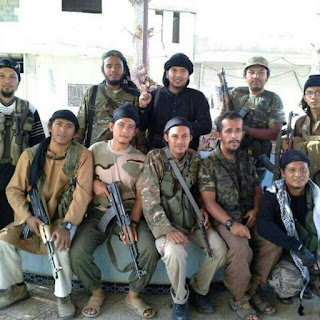
Pictures of smiling young IS fighters on social media glorify their narratives to people back home. Image via The Conversation


BY STEVE KRAMER

KFAR SABA, ISRAEL (SAN DIEGO JEWISH WORLD)
  — The West abhors terror attacks for good reason, whether in their country or an ally. Except when it comes to Israel. Not having learned the lesson that Islamist terror doesn’t abide by any type of agreement, the U.S. and the West still think that they can buy off terrorists. They can’t, as experience has proven. But when it comes to Israel, not a problem. In fact, these countries fund it, knowing and unknowingly! And those who don’t, spend other people’s money to have the United Nations and other Israel haters do it for them. In fact, the U.S. pays more than 20% of the U.N. budget, an organization that has chosen Israel as the worst country in the world, or at least the worst that it pays attention to.

In 2021, the U.N. General Assembly passed 14 resolutions against Israel. The number of resolutions passed against all the other member states totaled five. In addition, the General Assembly recently passed an unlimited and open-ended probe of alleged war crimes against Israel, by a vote of 125 for, eight against, and 34 abstentions. It’s open season on Israel, all the time.

A story about “Israel’s apartheid and persecution against millions of Palestinians,” topped the list of Human Rights Watch’s (HRW) most-read reports of 2021, the NGO has reported. HRW’s report on Israel’s conduct ranked higher (in readership) than reports on topics including sexual violence against women in India, extrajudicial killings in the Philippines, restrictions on women’s rights in Taliban-controlled Afghanistan, digital sex crimes in South Korea and others.

“In FY 2019-2020, total income was $75.9 million; total expenses were $89 million, of which $5.9 million was spent on the Middle East and North Africa [Israel!] Among HRW’s biggest supporters are the Ford Foundation and the Dutch government via Oxfam NoviB, the Dutch affiliate of Oxfam international, an international confederation of 17 organizations networked together in 92 countries. Within the Oxfam umbrella, Oxfam Novib plays a leading role on the Arab-Israeli conflict, including demonization and other anti-Israel campaigns.” Many nations give similar support to anti-Israel NGOs.

Kenneth Roth, the executive director of HRW, characterizes Israel as an apartheid regime whose human right acts are more significant than the abuses committed by the Iranian or Syrian governments against their own people, by China against the Uyghurs, or by the Taliban against those unfortunate Afghans who now find themselves under its rule.

“Respected” organizations like HRW continually single out Israel as a human rights malefactor. The Palestinian Authority (PA) reaps the benefits. Even the U.S., which effectively cut off payments during the last administration, has partially resumed funding the PA. This is in direct opposition to the 2018 Taylor Force Act, which prohibits for five years certain economic assistance that directly benefits the Palestinian Authority. Payments are allowed if the Department of State certifies that the PA, ends acts of violence against U.S. and Israeli citizens, ends compensation for imprisoned terrorists, or publicly celebrates such acts of violence. By any definition, none of these terms have been met, yet the money tap has been reopened. Even worse, Israel’s government is “loaning” the PA 100 million shekels to prop it up.

How are individuals and nations so naive as to believe that the PA, let alone Hamas which rules Gaza, can ever create a “state” that any democracy could approve as a neighbor? The Middle East neighborhood tells the tale: On Israel’s northern border, Lebanon, which once was described as the “playground” of the Middle East, is brutally ruled by Hezbollah, a proxy army of Iran. On Israel’s northeastern border is Syria, brutally ruled by the dictator Bashar al-Assad, who has eclipsed his brutal father, Hafez al-Assad. South of Syria is Jordan, which at least has a peace treaty with Israel, albeit a cold one. A warmer neighbor to Israel’s south is Egypt, whose President Abdel Fattah el-Sisi, is much more open to cooperation with Israel in multiple areas.

So, two brutal, despotic neighbors border Israel. But Jordan abuts Iran to the east, Israel’s most implacable enemy and the puppet master of Hezbollah. Iran is the most dangerous country for Israel and the West. Why? Because it is intent on being a regional power with nuclear weapons. What’s worse, it proudly proclaims it will destroy Israel if (meaning when) it achieves its goal of having nuclear weapons. No other country broadcasts such a dangerous message, except for perhaps North Korea, which is rightly treated as a pariah nation.

But Iran isn’t treated similarly. Instead, it’s courted by other nations as a trading partner and perhaps even an ally. Its vitriol towards Israel doesn’t impede those nations from making diplomatic overtures to Iran and cutting it all kinds of slack when it comes to its bomb making efforts. Israel can’t afford to slough off Iran’s deadly predictions and continually weighs its options against Iran, be they preparatory measures or a preventative attack. Unfortunately, Israel can rely on no other country, not even its greatest friend and ally, America.

Samantha Power, no friend of Israel, currently serves as the Administrator of the United States Agency for International Development (USAID) and is the former Ambassador to the U.N. under President Obama. Power says, “Investments in the health and wellbeing of Palestinians benefits everyone, including Israelis. Yet today, it has become controversial to provide life-saving aid to the Palestinian people and invest in their development.”

Why are these payments controversial? Guns or butter: Journalist Daniel Greenfield writes that U.S. funds the PA, which is undeniably a terror-sponsoring welfare state in the West Bank and Gaza. These funds are used to purchase butter (welfare) allowing Hamas and the PLO (synonymous with the PA) to focus on buying guns and materiel for terrorists. Blatantly, the PLO’s Palestinian Authority paid out some $150 million in 2019 and $180 million in 2020 to imprisoned terrorists and the families of dead terrorists as part of its “Pay-to-Slay Jews” program.

Israel fights on its own and doesn’t make the mistake of expecting any other nation to fight its battles. It never has. But as a democratic state with perhaps the most humane military on the planet, it does deserve backing from its Western allies in the common Western fight against Jihadism.

Africa’s Heritage Is Humanity’s – And It’s Been Overlooked For Too Long

The Nok Caves in Togo. Image: Oliver S/Shutterstock via matador


BY SADA MIRE
THE GUARDIAN

As an archaeologist, I am hoping my new project will connect the continent’s people to the hidden history of their land

In my first class on an archaeology course at Lund University in Sweden, I stood out more than usual. It was not just that it was full of blond and blue-eyed students, more than in any other class I had ever attended – it was that archaeology is not a field that many migrants study.


My teacher and classmates were lovely, yet I still had this feeling of “What am I, a Somali refugee, doing here?” Furthermore, I had never even seen an archaeologist before, or held an archaeological object. But I had read a sentence in a book (Africa: history of a continent, by Basil Davidson) which said that to write African history we need to do archaeological research.

As this first class was on European stone age archaeology, stone implements were handed out. An axe was passed to me. To my astonishment the label read “Somaliland”. Wow: an axe from my own country. The moment was like a message. It was as if someone was saying to me: “Yes, you belong in this classroom”.

I bombarded our teacher with questions about the axe. He had no idea where it was from – he did not seem to care. Why would he? Stone age artefacts are mostly the same. No, he did not think there was any further documentation: only that they were palaeolithic objects.

I later discovered that these objects were extraordinary. It turns out the axes were in fact history-making implements, taken out of my country in the exciting days when the idea of human evolution was taking shape.

Fast-forward 20 years from that day in Lund and I’m creating a new global initiative, a digital museum to bring together in one platform all Somali objects and materials. I want people across Africa to feel the same connection to the subject as I did.

In archaeology, context is everything: if your bones are found with those of extinct bears and mammoths, then you’ve probably been dead for tens of thousands of years and are most likely not even a Homo sapiens. In 1856 the first Neanderthal was discovered in Neander Valley in Germany. The Neanderthal would understandably not have liked to be thought of as the only link between modern humans and the great apes – they were too sophisticated. So it must have been a relief when, in the 1890s, Homo erectus came into the picture.

The Java man, as this find came to be known, was labelled the “missing link”. Soon this “upright-ape-man” was joined by more hominids discovered in Asia. These discoveries reinforced the theories of Charles Darwin, first set out in 1859 in On the Origin of Species, and his idea of natural selection gained more ground. This was further evidence for the idea that humans had evolved from one common ancestor.

Archaeologists didn’t bother to look to Africa until 1896, when Heywood Walter Seton-Karr, a Scottish game hunter, returned to London with hundreds of stone implements from British Somaliland. He proclaimed, to global attention, that he had found the garden of Eden: “Here it was, in my opinion, that the human race originated.” Major museums – one of which must have been the Lund natural history museum – lined up to acquire Somaliland artefacts, including stone tools. More discoveries on the continent followed, such as Kenya’s “Turkana boy” or Ethiopia’s “Lucy”.

I have spent the past year surveying the same area where Seton-Karr stumbled on the stone axes. I asked village elders about him, hoping for some lingering generational memory. And though the name did not ring a bell – why should it – they told me the Ingriiskii (the British) used to come looking for macdan (gems) here. Often, foreign archaeological missions failed to tell the locals what they were really doing – indeed sometimes this still happens. The village chief vowed to me to protect his area, which also includes newly located 5,000-year-old rock paintings.

By uncovering the hidden history of African collections long forgotten in museums in the west, the founders of our new archive have unearthed a wealth of art, technology and human history. With the application of technology, things of the past can come alive – through photogrammetry and 3D virtual tours – and feel more relevant to modern-day societies. We are collaborating with major western museums that hold African collections, including a number of UK institutions (the British Museum and Powell-Cotton Museum among them). But with all our digital work being carried out by African local teams, we are tapping into a new tech-savvy generation. The idea is to inspire Africans to be the owners of their heritage and its narratives.

This is not just about the past. Our fast-growing demands for goods have put huge pressure on climate and resources and also made us forget our traditional ways of resource management and interacting with nature.

One of the most extraordinary individuals we worked with was a blind potter. She had been trained by her mother who was in turn trained by her mother. Now she was with her own daughter who was training her daughters. This lineage of female potters will die out after surviving so many adversities just because so many people now opt for machine-produced pottery and imported plastic goods.

Our museum aims to revitalise craft technologies such as pottery and iron-making. With objects often locally neglected, or forgotten in the storage departments of major museums, this heritage is at risk for the first time in history. If we do not bring together the people and stories that reflect what is most beautiful about human life – the ability to adapt to change and challenges – we may well lose sight of humanity itself.


Sada Mire is an archaeologist and incoming associate professor of heritage studies at UCL Institute of Archaeology. She is author of the book Divine Fertility

How CIA Plots Undermined African Decolonisation


BY EVE OTTENBERG
NEW AGE

For those who believe Africa was decolonised decades ago, it’s time to wake up from dream world. True, colonial European powers no longer impose direct rule on African nations, which are nominally ‘independent.’ But those European countries, beaten back from their African colonies in the second half of the 20th century, had no intention of losing their investments or access to Africa’s vast mineral wealth. So, with the help of groups like the Central Intelligence Agency, Europeans and Americans covertly recolonised the continent, with bribes, murders, loans, privatisations, also known as looting, and the installation of western-friendly regimes.

The latest and most noxious of these colonial iterations is the US military’s AFRICOM, although a French oligarch ‘controls 16 West African ports through bribery and influence peddling,’ as Margaret Kimberley recounted in the Black Agenda Report. ‘Canadian companies control gold mining in Burkina Faso, Mali and DRC. British soldiers are still stationed in Kenya.’ So the west never stopped strangling African nations. In this effort, the vile 1961 assassination of Patrice Lumumba was key. Needless to say, the CIA was involved up to its eyeballs.

As the Congo’s first freely elected leader after the Belgian rout, Lumumba made the honest mistake of trusting western democratic ideals. Then, when he discovered they were phony, he tilted — very slightly — towards the Soviets. That sealed his fate. ‘President Eisenhower authorised the assassination of Lumumba,’ writes Susan Williams in her newly published book, White Malice: the CIA and the Covert Recolonisation of Africa. The consequences were ghastly. After Lumumba’s murder and dismemberment, for well over three decades, ‘the Congo was ruled with an iron fist by Mobutu — a dictator chosen by the US government and installed by the CIA.’

Now the Congo again leaps into headlines — not because of its rich uranium deposits, so coveted by Washington in the 1940s and 1950s, but because of cobalt and other minerals essential to a green energy transition. Mining cobalt is an ugly business. Roughly 40,000 cobalt miners are children, out of 255,000 Congolese cobalt miners. They work in nearly slave-labour conditions, earning less than $2 per day. Their intensive labour is extremely hazardous and there have been charges that AFRICOM indirectly oversees these mines. Context is key here. The Democratic Republic of the Congo is an extremely poor country. But the United States craves DRC resources, as it has, going back to the 1940s. So pretty much anything goes.

Once again in the Congo, Washington finds itself snarling imbecilically at a communist competitor — this time China. But unlike the struggle with the USSR, which had safely sequestered its economy from western capitalism, China is the US’s biggest trading partner; the two economies are inextricably intertwined. Insulting and threatening someone you regularly do business with may seem cretinous to the casual observer, but somehow it’s the best the American politicos can come up with lately.

So Washington fulminates in fury at being outmanoeuvred by a supposed foe, when in fact China, recently an American friend until idiotic sachems in the US declared it otherwise, has long invested in Africa, occasionally quite generously handed its infrastructure over to local governments, and, contrary to western financial barbarism, forgiven loans when African countries couldn’t pay. The US government long knew about the nature of these Chinese investments, but lately goes out of its way to distort and lie about them.

Trump’s secretary of state, Mike Pompeo fibbed about a port in Sri Lanka, which those supposedly devious Chinese had, he lied, repossessed as part of their ‘debt trap’ for Africa. This repossession never happened. Even comedian Trevor Noah flogged this bogus story, demanding to know what is going to be done about how those Asiatics ensnare poor nations to steal their infrastructure. And the most recent propaganda has been some nonsense about an airport in Uganda, supposedly stolen by China. It wasn’t.

The description of the CIA’s viperous attitude towards Lumumba, made by journalist Cameron Duodu and recounted in Williams’ book, unfortunately, still holds for today: ‘His country has got resources. We want them. He might not give them to us. So let us go get him.’ In addition, Washington bigwigs regard the entire African continent as a stage for their great game competition with China, which is disastrous. Africans of all nationalities will only suffer as a result.

So a history like White Malice could not arrive at a more opportune time. It shows how Ghanian president Kwame Nkrumah — ousted by a CIA plot in 1966 — dreamed of a united states of Africa. While Washington ensured that never emerged, African countries can still coordinate and work towards shared goals. Williams’s account spells out the cost of not doing so.

This book showcases three main villains — CIA director Allan Dulles, diplomat and arts patron William Burden, a one-time director of New York City’s Museum of Modern Art, which boosted the abstract expressionism the CIA so vigorously funded and promoted, and the crudely murderous Leopoldville CIA station chief, Larry Devlin. But behind these three monsters loomed a vast, homicidal military empire, piloted by capitalist ideologues, who did not value human life, to put it mildly, especially if that life belonged to black, brown or communist people.

In that sense, little has changed from the 1950–1960s to the present. Which should be cause for alarm. It probably is, to the Chinese, and to the Ethiopians, who find their prosperous country in imperial crosshairs, much as another once wealthy African nation, Libya, recently did. But otherwise, most of the world sleeps through this repeat performance of the African tragedy.

It shouldn’t. The CIA committed atrocious crimes in the 1950s and 1960s, and not just on the African continent. Williams cites the suspiciously premature deaths of left-leaning African notables, as well as that, in Paris, of the great African American writer, Richard Wright. And one of the most despicable of the CIA’s many murders was that of the Congo’s first elected leader. ‘Lumumba, Malcom X believed, was the “greatest black man who ever walked the African continent,”’ Williams writes. Malcom X was not alone in this judgement. Which is why, as Williams notes, when CIA hands got together to boast of their dirty exploits, the CIA’s man in the Congo, Devlin, so pivotal in schemes to trap and murder Lumumba, always carefully kept his mouth shut.

Over 4,000 Migrants Died Trying To Reach Spain In 2021

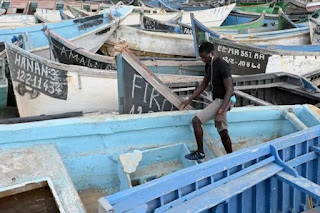
The shortest route to the Canary archipelago is more than 100 kilometres (60 miles) from the Moroccan coat. Photo: Lluis Gené/AFP


MADRID, SPAIN (DAWN) -- Over 4,000 migrants died or disappeared trying to reach Spain by sea in 2021, twice as many as in the previous year, a migrant rights group said on Monday.

Migrant arrivals in Spain’s Canary Islands in the Atlantic have increased since late 2019 after increased patrols along Europe’s southern coast dramatically reduced crossings to the continent via the Mediterranean.

This route is fraught with dangers due to strong currents and the greater distances involved.

A total of 4,404 migrants perished or vanished in attempts to reach Spain last year, up from 2,170 in 2020, according to Spanish non-governmental organisation Caminando Fronteras, which tracks data from boats in distress.

That is the highest yearly number since the group started keeping records in 2015.

The bodies of the vast majority of migrants, 94 percent, were never found so they are counted as missing.

Over 90 percent of the deaths or disappearances last year, 4,016, took place during attempts to reach Spain’s Canary Islands.

The shortest route to the archipelago is more than 100 kilometres (60 miles) from the Moroccan coat.

“There are painful figures”,Maria Gonzalez Rollan, one of the authors of the annual report, told a news conference.

Migration routes to Spain were becoming more “feminised”, with 628 women and 205 children among those who died or went missing last year while trying to reach the country, she added.

The figures from the NGO are much higher than those from the UN International Organization for Migration which has tallied 1,279 deaths or disappearances of migrants on their way to Spain from northern Africa last year.

At least 37,385 migrants arrived in Spain by sea last year, according to Spanish interior ministry figures, slightly less than the 38,014 that arrived in 2020.

Cries in dark trigger migrant search

Spanish rescue services searched off the country’s southeast coast on Monday for 10 migrants missing at sea, after a passing vessel heard cries during the night from people in the water.

Emergency crews pulled 16 survivors and three bodies from the Mediterranean Sea after one small migrant boat sank and another took on water, Spanish authorities told state news agency EFE.

The search with helicopters and rescue boats began after a vessel in the area reported cries for help some 25 kilometres off the coast.

Survivors said there were 29 people, mostly men, on the two boats, according to EFE.

In another rescue, authorities rescued 51 men from an inflatable boat near Lanzarote, one of the Canary Islands off northwest Africa.

Spains National Police announced that last year it arrested 202 people suspected of operating the boats taking migrants on the long and dangerous crossing from West Africa to the Spanish archipelago.

The Spanish Interior Ministry says more than 36,300 migrants reached Spain by sea last year up to Nov. 30. That was an increase of 1.4pc on the same period in 2020.

Sunday, January 02, 2022

Capitol Rioters’ Tears, Remorse Don’t Spare Them From Jail

FILE - This image from Metropolitan Police Department body worm camera video and contained in the Statement of Facts supporting an arrest warrant for Pauline Bauer, pointing second to left, taken in the Rotunda of the U.S. Capitol on Jan. 6, 2021, in Washington. (Justice Department via AP)


BY MICHAEL KUNZELMAN, COLLEEN LONG, JACQUES BILLEAUD AND LINDSAY WHITEHURST

WASHINGTON (AP)
— Florida business owner Robert Palmer cheered on the violence at the U.S. Capitol on Jan. 6 before he joined the fray. Screaming obscenities, he hurled a wooden plank and a fire extinguisher at police officers trying to ward off the mob.

Nearly a year later, Palmer fought back tears when he faced the federal judge who sentenced him to more than five years in prison. He said he was “horrified, absolutely devastated” by what he had done.

“I’m just so ashamed that I was a part of that,” Palmer told U.S. District Judge Tanya Chutkan on Dec. 17 before she gave him the longest prison term for any rioter so far.

Judges are hearing tearful expressions of remorse — and a litany of excuses — from rioters paying a price for joining the Jan. 6 insurrection, even as others try to play down the deadly attack on a seat of American democracy.

The Justice Department’s investigation of the riot has now entered the punishment phase. So far, 71 people have been sentenced for riot-related crimes. They include a company CEO, an architect, a retired Air Force lieutenant colonel, a gym owner, a former Houston police officer and a University of Kentucky student. Many rioters have said they lost jobs and friends after their mob of Donald Trump loyalists disrupted the certification of Joe Biden’s presidential victory.

Fifty-six of the 71 pleaded guilty to a misdemeanor count of parading, demonstrating or picketing in a Capitol building. Most of them were sentenced to home confinement or jail terms measured in weeks or months, according to an Associated Press tally of every sentencing. But rioters who assaulted police officers have gotten years behind bars.

With hundreds of people charged, the Justice Department has taken heat for not coming down harder on some rioters, and it has failed to charge anyone with sedition or treason despite hints early on in the investigation. But lower-level cases tend to be easier to prosecute and typically get resolved before more complex ones.

At least 165 people have pleaded guilty so far, mostly to crimes punishable by a maximum sentence of six months. There are dozens of cases involving more serious offenses still moving through the system. More than 220 people have been charged with assaulting or impeding law enforcement officers at the Capitol, according to the Justice Department. Since November, three of them have been sentenced to prison terms ranging from more than three years to just over five years.

The District of Columbia federal court is overloaded with Jan. 6 cases. More than 700 people have been charged so far and the FBI is still looking for more. Among the most serious charges are against far-right extremist group members accused of plotting attacks to obstruct Congress from certifying the 2020 presidential election. Their cases haven’t yet gone to trial.

The rioters’ refrains before the judges are often the same: They were caught up in the moment or just following the crowd into the Capitol. They didn’t see any violence or vandalism. They thought police were letting them enter the building. They insist they went there to peacefully protest.

Their excuses often implode in the face of overwhelming evidence. Thousands of hours of videos from surveillance cameras, mobile phones and police body cameras captured them reveling in the mayhem. Many boasted about their crimes on social media in the days after the deadly attack.

Judge Amy Berman Jackson said then-President Trump’s incendiary speech on Jan. 6 “stoked the flames of fear and discontent.” But she told Russell James Peterson, a rioter from Pennsylvania, that he “walked there on his own two feet” and must bear responsibility for his own actions.

“No one was swept away to the Capitol. No one was carried. The rioters were adults,” Jackson said before sentencing Peterson to 30 days’ imprisonment.

Eighteen judges, including four nominated by Trump, have sentenced the 71 defendants. Thirty-one defendants have been sentenced to terms of imprisonment or to jail time already served, including 22 who received sentences of three months or less, according to the AP tally. An additional 18 defendants have been sentenced to home confinement. The remaining 22 have gotten probation without house arrest.

A seemingly genuine display of contrition before or during a sentencing hearing can help a rioter avoid a jail cell. The judges often cite remorse as a key factor in deciding sentences.

But Chutkan told Palmer that she couldn’t tell if his remorse was genuine.

“I can’t look into your heart or your mind,” the judge said. “The way you conduct your life after this case is going to speak volumes about whether you are truly remorseful.”

Anna Morgan-Lloyd, the first rioter to be sentenced, told Senior Judge Royce Lamberth in June that she was ashamed of the “savage display of violence” at the Capitol. A day later, however, the Indiana woman told Fox News host Laura Ingraham that people were “very polite” during the riot, that she saw “relaxed” police officers chatting with rioters and that she didn’t believe the Jan. 6 attack was an insurrection.

Her inconsistency didn’t escape Lamberth’s notice. In a footnote to an order in another case, the judge said his “hopes have been recently dashed” when Morgan-Lloyd’s Fox interview “directly conflicted with the contrite statements that she made” to him.

Dona Sue Bissey ’s case is one of only six in which prosecutors agreed to recommend probation without home detention. But instead, Chutkan sentenced her to 14 days in jail. The judge questioned whether Bissey, 53, of Indiana, truly was remorseful because she bragged about her participation in the riot.

“There must be consequences for taking part, even a small part, in a mass attempt to stop the certification of the presidential election and prevent the transfer of power,” said Chutkan, who was nominated by President Barack Obama.

All eight of the Jan. 6 defendants sentenced by Chutkan have received jail or prison terms. In all but one of those cases, the sentence that she handed down was stricter than prosecutors’ recommendation.

In contrast, all four rioters sentenced by Chief Judge Beryl Howell received three months of home detention after prosecutors recommended jail terms. Howell, also an Obama nominee, questioned the Justice Department’s “muddled approach” in resolving cases with misdemeanor pleas despite using “scorching strong language” to describe rioters’ actions.

She said it was “almost schizophrenic in some ways” for prosecutors to recommend a three-month jail sentence for a Tennessee man, Jack Jesse Griffith, in a court filing that referred to rioters as “those who trespassed.”

“No wonder parts of the public in the United States are confused about whether what happened on January 6th at the Capitol was simply a petty offense of trespassing with some disorderliness or shocking criminal conduct that represented a grave threat to our democratic norms,” Howell said during Griffith’s Oct. 28 sentencing, according to a transcript.

The judge who sentenced Boyd Camper to 60 days’ imprisonment for a misdemeanor offense said the Montana man’s presence in the mob “helped create the momentum for violence” and provided safety for violent rioters even though he personally didn’t attack law enforcement officers.

“Violence is an unacceptable way to resolve political differences,” Judge Colleen Kollar-Kotelly told Camper.

Some judges have rejected prosecutors’ recommendations for prison sentences. Judge Trevor McFadden, a Trump nominee, said it is “almost unheard of” for first-time offenders to get jail time for nonviolent misdemeanors. Howell questioned why a short jail term for riot defendant Glen Wes Lee Croy, without a longer term of court supervision, would be the best way to ensure that the Colorado man “stays on a law-abiding path.”

Many other prominent cases remain unresolved. Dozens of people linked to extremist groups have been charged with conspiring to carry out coordinated attacks on the Capitol, including more than 20 defendants tied to the anti-government Oath Keepers and at least 16 connected to the far-right Proud Boys.

At least five people associated with the Oath Keepers have pleaded guilty. At least one Proud Boys member has pleaded guilty and agreed to cooperate with prosecutors. None of them has been sentenced yet.

Approximately 20 trials are scheduled in 2022. Meanwhile, judges are plowing through daily dockets of guilty pleas and sentencings.

Anthony Mariotto, a Florida man who was sentenced to three years of probation and ordered to pay a $5,000 fine, said he “got caught up in the moment” but knows he broke the law by entering the Capitol.

“I was hoping that they would just pause the election,” Mariotto said during his December sentencing. “I wish Joe Biden, President Biden, would have won by billions of votes. None of this would have happened.”

Judge Reggie Walton dryly replied, “He won by 7 million.”

Kunzelman reported from College Park, Maryland, Billeaud from Phoenix and Whitehurst from Salt Lake City.

Saturday, January 01, 2022

They Were Paid N10m To Kill Me, But I Escaped — Imo Journalist


Illustration: Greenbarg Reporters


BY EMMA NNADOZIE


OWERRI, IMO STATE (VANGUARD)
 -- A journalist in Imo state, 55-year-old Prince Chibuzor Ndukwe, has miraculously escaped from hired assassins who were paid N10m to kill him. He was abducted from his residence, blindfolded and taken into a thick bush. Few days later after his abductors confirmed payment of N10m for him to be killed; he succeeded in escaping from their grip. His narrow escape was as miraculous as it was bizarre. He gave a vivid account of the incident. Excerpts:

My travail started with the destruction of my house in the village by some hoodlums. They came with sledgehammer and were busy destroying my house in broad daylight while armed policemen were there.

Later, another group came and kidnapped one of my guards, they thought I was the one. Unfortunately, when they discovered that it was not me, they connived with their police collaborators, tagged him an IPOB member and threw him into the cell at the Anti-kidnapping Unit, Owerri.

When we got information that my guard was in their cell, we moved in, pacified them with some money and he was released.
My abduction

On the day of my abduction, I was lying down on the bed at 7:15 pm when one motorcyclist rode into my compound. When my wife asked what he was looking for, he said he came to drop something from my wife’s school for her.

My wife wanted to know why he came at that time of the night but he assured that there was no cause for alarm and left. We did not know that he came to monitor us.

Fifteen minutes after he left, some other men came in a red Toyota vehicle, drove inside my compound and one of them, armed with a dagger, proceeded straight to my bedroom.

When they dragged me outside to the sitting room, I saw one of them pointing a gun on my wife’s head. As soon as we came out, he directed the gun at me and shouted that if I talk, he would kill me.

They asked where I kept the money and I said I didn’t have money in the house, I don’t normally keep money in the house. They said, ‘go and bring your ATM card, where is your car key? Where is your phone?’

I brought my two phones which they collected as well as my wife’s phone before they asked me to lie down. I then asked them, ‘why do you want me to lie down, tell me what you want, is it not money, let me look for money and give you, leave me alone’, but they said no, that I should go out.

They led me out and I followed them. They went to the car, asked me to open it and enter. They then collected the key from me immediately I entered, blindfolded me and asked me to lie down flat.

But when I demanded to be allowed to sit since I had already been blindfolded as it would not be easy for me to lie down, one of them hit my face with the butt of the gun which forced me to lie down in the car.

I was sandwiched between two of them with another one behind the wheels while three of them entered another other car and zoomed off to an unknown place.
Exchanges with their paymasters

That was how these people took me away on that Friday night. They took me to one small old building on the road where we spent the night.

When we were going, they were calling the people that sent them, what I heard was, ‘pay the money now. We are with this man now, if you don’t do it, we will leave him oo. We don’t need to waste time with this man inside this vehicle, we want to complete the mission and go our way’.

It was like they had a little misunderstanding with the people that hired them. The people didn’t pay that money that Friday evening, so the following day, being Saturday, I was still in that small building, blindfolded.

There were tiles there. I managed to know this because I raised the blindfold after they locked me inside and went outside the building.

I saw the window, I saw that it was a burglary proof that they used in that room and when they started coming, I put back the blindfold. I was there that Saturday.

In the night, they picked me, took me to a bush where I was kept in a two-storey building.
Torture

In the building, they left one of them, who was armed with a gun, to keep watch over me. Meanwhile, they tied my legs and hands. They then started to beat me and told me that I should forget this world, that it was over for me.

They were beating me with something like a metal; they hit it on my head and cut a small part of my head, they did same on my legs. On my hand, there were bruises, they cut my hand also and tied me with chain and other things.

So, I was there till Sunday when the money they were asking for came. I heard them when they were quarreling with the people that hired them. They were telling the people, ‘you raise the money na, what is going on, what is happening, we will leave this man o’.

They were speaking in Igbo. The person replied them that they should exercise patience, that they would bring the money in cash that night, that it was not going to be by transfer again.

On Sunday morning, their boss, called Mopol left. They left their member called ‘Agile’ to stay with me and monitor me. In the same building they kept me, there were three or four churches where people were singing praises.

The one who was guarding me pointed gun at me saying that if I made the slightest noise he would kill me there. I stayed there till the people at the church dismissed and left.
‘N10 million paid for my head’

Their boss came back at 3pm. I knew the time because they were openly talking about time. I gathered all information while they were communicating.

They were freely behaving as if my fate was already concluded and nothing would make me survive and tell any story. In fact, they had already condemned me and that must be why they were discussing not minding whether I heard or not.

One of them said it was ten million naira that was given to them to kill me. He said “this night, at least, we go go rest now, after tonight we go go relax’.

I kept on asking myself the meaning of that. After that, they brought bread to me to eat, I said I don’t want to eat, they brought water, I said I didn’t want to drink.

They said ‘ok, make you no think say na this thing go save you, whether you eat or not’.
Going to the ‘gallows’

On Monday morning, they walked me downstairs and crossed a tarred road. I discovered that the building was near a tarred road and nobody knew that something terrible was happening in that building.

This is because, as we walked down, we crossed the tarred road and I heard voices of other people around. The one that took me down handed me over to another person.

After crossing the road, another person took over and we started walking inside the bush. After sometime, he asked me to sit down, he called the other person and told him, ‘come now, let’s go and waste this man and get away’.

I was crying, pleading with them to spare my life because I have five small children, that they should not waste me. As we were walking inside the bush, we got to a certain point where they removed what they used in covering my eyes.

I now saw the kind of hefty men that were holding me. The next thing they did was to show me a dead body around.

They said, ‘do you see that dead body, na so you go be very soon.’ We passed that one, they showed me another dead body.

By then, they had removed the rope with which they tied my leg, leaving the one on my hands. I then told them I wanted to urinate and they agreed.
Narrow escape

While we were trekking, one of the abductors was in front, the second one was behind. After I requested to urinate, the one at my back moved in front, following his colleague and they were walking slowly while waiting for me to finish urinating.

When I was about to finish, the other one turned and said ‘come, haven’t you finished?’ I said ‘it remains small,’ he said, okay and turned because I was watching them.

As he moved, a voice came to me saying, ‘man, can’t you run away now?’ It continued like a whisper saying, ‘run away’.

Immediately that voice came to me, I turned round and started running inside that bush. When they noticed it, they turned back and pursued me.

And the place I entered was a thick forest, so I entered one small bush and stayed quiet, they fired shots but they didn’t get me, they flashed their torch light but they didn’t see me.

Inside the bush, I used my teeth to untie the rope with which they tied my hands and I started creeping slowly on my knees like an animal.

They were looking for me here and there and I heard them quarreling and asking the one at my back why he left me to escape. As I was creeping away from them, crying in pains, they continued blaming each other.
How succor came

When I got to one road, I started walking fast heading to nowhere in particular. I walked till I got to another road and saw a light from a generator.

I didn’t know that one of them was around that place and I started to move fast.

Unfortunately, the sound of my feet alerted them and they pursued me until I got to a fenced compound and I jumped into the place and continued running when one of them shouted on his colleagues warning that they should not follow me because vigilante men were around the place.

If they had followed me, they would have caught up with me because when I ran into the compound, nobody came to my rescue because they were all asleep and there was also no vigilante men there.

I had to run into one man’s house and started knocking at his door, I pleaded with the man to help me but he refused. I started telling him that ‘I am Prince Ndukwe Chibuzo, the son of a traditional ruler, I came from Ihitte-Uboma, I was kidnapped from my house’.

I began to explain to the man but I think the man was afraid; he didn’t open that door. I now said ‘ok forgive me, help me, let me stay at the corner of your compound till the morning so I can explain myself better’.

He didn’t say anything, he left me. I stayed there. I think the man contacted the vigilante people on his phone.

So, vigilante people came from nowhere to where I was and began to flash light. I wanted to run, but they said “don’t run, we are here for you’.

When they flashed that light on me, I asked them ‘are you vigilante?’ they said, ‘yes’ and I said ‘God, thank you’. They now took me to a better place. That was how I was saved.

I cannot imagine my escape, up till now; I have never believed that I am out of these people’s hands. The vigilante people later told me that we were in Anyara in Isiala-Mbano, about seven kilometers to Owerri town.

Later, the vigilante people gave me hot water to drink because I had not tasted anything for days. They called their President General and other notable men in the community including the chairman of the Local Government.

They later invited policemen from Anti-Kidnapping Unit in Owerri. We met them while we were on our way to Owerri.

Initially, I was very skeptical to go with them. However, after much persuasion including making a call to their Commissioner who assured me of my safety, I followed them.

I later heard that a team of policemen from IGP’s Intelligence Response Unit also came to the place after getting information that I escaped and they frantically searched for me.

But the network was very poor and they missed where I was with the vigilante team.
After rescue

Meanwhile, it was gathered that after he was rescued, he made a statement with the operatives of IGP’s Intelligence Response Team in Owerri, IRT who swung into action.

Sources said few weeks later, men of the IRT succeeded in arresting one of the key suspects in the kidnap saga. The suspect, according to reports, turned out to be one of the escapees from Oweri Prisons during the end SARS protest.

Police sources said he played a prominent role in the kidnap of the journalist in connivance with other suspects still at large, said to be close relatives of the victim.

It was also learned that the police team arrested a serving policeman suspected to be the supplier of arms to the kidnappers. Police sources said he was later taken to the Commissioner of Police for interrogation after which he was dismissed from the police and handed over to the investigating unit.

So far, it was further learned that the team was closing in on other major suspects in the crime, including those that allegedly paid N10m for the journalist to be killed.

2023 Presidency: Nigerians Will Run To Ghana If APC Returns – PDP Scribe

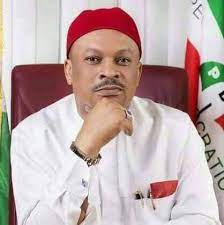
Samuel Anyanwu. Image: Facebook


BY TUNJI ADEDEJI

OWERRI, IMO STATE (DAILY POST)
-- The National Secretary of the Peoples Democratic Party (PDP), Senator Samuel Anyanwu has expressed worries over the security challenges in the country, especially, the South East geopolitical zone.

He said Nigerians, especially the youths will have no option than to leave for Ghana if APC returns to power after President Muhammadu Buhari’s administration.

Senator Anyanwu, who was a member of the 8th Senate, expressed regret that the APC government had only worsened the suffering of Nigerians, after using Chibok girls to blackmail Jonathan’s administration out of power in 2015.

The party scribe, who stated this at his country home in Ikeduru Council area of Imo State while fielding questions from journalists, expressed the readiness of the party to reclaim the country from the All Progressives Congress (APC) in 2023

He said, “under the current APC administration, Nigerians are going through economic and political trials. Every sector in the country has collapsed. Aside hunger, starvation and high cost of food items, Nigerians are still hiding from kidnappers or unknown or known gunmen.”

Anyanwu, who represented Imo East Senatorial District under the PDP went on to state that if President Muhammadu Buhari and APC did not leave office in 2023, nothing good should be expected from the administration.

Anyanwu said the only thing Nigerians are asking for is a smooth transition of results from the polling units but because the APC wants to rig the general election in 2023, they have refused to do the needful.

He said Nigeriains shouldn’t expect much from a party with too many factions being manned by a state governor.

He said more factions will emerge in Imo APC and at the Federal level before March 2022, “because they are not together. Nigerians will resist APC, in Imo State, because they are standing on the neck of the people,”

He urged Nigerians not to lose hope over the present challenges confronting the country, assuring them of PDP’s readiness to rescue and rebuild the nation when it takes over power.

He said the APC government had lowered the bar of governance in the State and the country.

He described Nigeria as the most indebted country in the world.

“There is a seriously high level of corruption in the country today under the APC led administration,” he lamented.

‘Moral Compass’: Requiem For South Africa’s Archbishop Tutu

Relatives stand in front of the casket carrying the remains of Anglican Archbishop Emeritus Desmond Tutu after it was put in a hearse following his funeral service at the St. George's Cathedral in Cape Town, South Africa, Saturday, Jan.1, 2022. Tutu, the Nobel Peace Prize-winning activist for racial equality and LGBT rights died Sunday at the age of 90. (AP Photo/Jerome Delay)


BY ANDREW MELDRUM

CAPE TOWN, SOUTH AFRICA (AP)
— Anglican Archbishop Emeritus Desmond Tutu has been remembered at a state funeral Saturday for his Nobel Peace Prize-earning role in ending South Africa’s apartheid regime of racial oppression and for championing the rights of LGBTQ people.

“When we were in the dark, he brought light,” Archbishop of Canterbury Justin Welby, the head of the worldwide Anglican church, said in a video message shown at a requiem Mass celebrated for Tutu at St. George’s Cathedral in Cape Town.

“For me to praise him is like a mouse giving tribute to an elephant,” Welby said. “South Africa has given us extraordinary examples of towering leaders of the rainbow nation with President Nelson Mandela and Archbishop Tutu .... Many Nobel winners’ lights have grown dimmer over time, but Archbishop Tutu’s has grown brighter.”

Tutu died last Sunday at age 90. His plain pine coffin, the cheapest available at his request to avoid any ostentatious displays, was the center of the service, which also featured African choirs, prayers and incense.

Tutu, who became an Anglican priest in the early 1960s, was awarded the Nobel prize in 1984 for his non-violent opposition to apartheid. He later became the first Black archbishop of Cape Town.

After South Africa achieved democracy in 1994, Mandela named Tutu to chair the Truth and Reconciliation Commission, a body created to report on human rights violations that took place during apartheid.

Throughout his life, Tutu actively promoted equal rights for all people and denounced corruption and other failures he saw in South Africa’s government, led by the African National Congress party.

“Archbishop Desmond Tutu has been our moral compass and national conscience,” South African President Cyril Ramaphosa, who delivered the funeral eulogy, said. “Even after the advent of democracy, he did not hesitate to draw attention, often harshly, to our shortcomings as leaders of the democratic state.”

Ramaphosa handed a national flag to Tutu’s widow, Leah, as she sat in a wheelchair.

The cathedral can hold 1,200 worshippers, but only 100 mourners were allowed to attend the funeral because of COVID-19 restrictions.

A few dozen people braved stormy weather to watch the service on a large screen in front of Cape Town City Hall. The municipal government building is where Tutu held hands aloft with Nelson Mandela on the day in 1990 when Mandela was released after serving 27 years in prison because of his opposition to apartheid.

Michael Nuttall, the retired bishop of Natal, delivered the sermon. Nuttall called his relationship with Tutu “an unlikely partnership at a truly critical time in the life of our country from 1989 through 1996, he as archbishop of Cape Town and I as his deputy,” With humor, he described himself as “No. 2 to Tutu.”

“Our partnership struck a chord, perhaps, in the hearts and minds of many people: a dynamic Black leader and his white deputy in the dying years of apartheid,” Nuttall continued. “And hey, presto, the heavens did not collapse. We were a foretaste, if you like, of what could be in our wayward, divided nation.”

Two of Tutu’s daughters, Mpho and Nontombi, both church ministers, participated in the service along with former Irish President Mary Robinson and Graca Machel, the widow of two African presidents, Samora Machel of Mozambique and Nelson Mandela.

The cathedral’s bells rang as Tutu’s casket was taken away after the funeral for a private cremation.

In keeping with Tutu’s commitment to the environment, his body will be “aquamated,” a process that uses water to prepare remains for final disposition. Tutu’s remains are to be interred at the cathedral where his funeral was held.

In the days before the funeral, several thousand people paid their respects to Tutu by filing by his casket in the cathedral and signing condolence books.

Friday, December 31, 2021

Retired General Warns The U.S. Military Could Lead A Coup After The 2024 Election

Retired two-star U.S. General Paul Eaton co-authored a recent op-ed about the fear that a coup could succeed after the 2024 elections. Brent Stirton/Getty Images


MARY LOUISE KELLY

WASHINGTON (NPR)
--As the anniversary of the insurrection at the U.S. Capitol approaches, three retired U.S. generals have warned that another insurrection could occur after the 2024 presidential election and the military could instigate it.

The generals – Paul Eaton, Antonio Taguba and Steven Anderson – made their case in a recent Washington Post Op-Ed. "In short: We are chilled to our bones at the thought of a coup succeeding next time," they wrote.

Paul Eaton, a retired U.S. Army major general and a senior adviser to VoteVets, spoke with NPR's Mary Louise Kelly earlier this week.

Below are the highlights of the conversation.

Edited for brevity and clarity.

How could a coup play out in 2024?

The real question is, does everybody understand who the duly elected president is? If that is not a clear cut understanding, that can infect the rank and file or at any level in the US military.

And we saw it when 124 retired generals and admirals signed a letter contesting the 2020 election. We're concerned about that. And we're interested in seeing mitigating measures applied to make sure that our military is better prepared for a contested election, should that happen in 2024.

How worried is he on a scale of 1 to 10?

I see it as low probability, high impact. I hesitate to put a number on it, but it's an eventuality that we need to prepare for. In the military, we do a lot of war-gaming to ferret out what might happen. You may have heard of the Transition Integrity Project that occurred about six months before the last election. We played four scenarios. And what we did not play is a U.S. military compromised – not to the degree that the United States is compromised today, as far as 39% of the Republican Party refusing to accept President Biden as president – but a compromise nonetheless. So, we advocate that that particular scenario needs to be addressed in a future war game held well in advance of 2024.

Can the current Pentagon leadership handle it?

I'm a huge fan of Secretary [of Defense Lloyd] Austin, a huge fan of the team that he has put together and the uniformed military under General Milley. They're just superb. And I am confident that the best men and women in the U.S. and in our military will be outstanding. I just don't want the doubt that has compromised or infected the greater population of the United States to infect our military.

What should the military do?

I had a conversation with somebody about my age and we were talking about civics lessons, liberal arts education, and the development of the philosophical underpinnings of the U.S. Constitution. And I believe that bears a re-teach to make sure that each and every 18-year-old American truly understands the Constitution of the United States, how we got there, how we developed it and what our forefathers wanted us to understand years down the road. That's an important bit of education that I think that we need to re-address.

I believe that we need to wargame the possibility of a problem and what we are going to do. The fact that we were caught completely unprepared – militarily, and from a policing function – on January 6, is incomprehensible to me. Civilian control of the military is sacrosanct in the U.S. and that is a position that we need to reinforce.

Are civics lessons 'weak tea' to stave off an insurrection?

A component of that – unsaid – is that we all know each other very well. And if there is any doubt in the loyalty and the willingness to follow the Oath of the United States, the support and defend part of the U.S. Constitution, then those folks need to be identified and addressed in some capacity. When you talk to a squad leader, a staff sergeant, a nine man Rifle Squad, he knows his men and women very, very well.

Better Parenting Starts With Knowing What Works. We Tested A Project In 8 African Countries

BY INGE VALLANCE AND GENEVIEVE HAUPT RONNIE Raising adolescents can be difficult under the best of circumstances. On top of that, some famil...