Thursday, December 23, 2021

Ethiopia Says Its Army Will Not Advance Further Into Tigray

ASSOCIATED PRESS


Prime Minister Abiy Ahmed


NAIROBI, KENYA (AP) — Ethiopia’s government has announced that its forces will not advance deeper into the Tigray region.

Ethiopian forces have been ordered to maintain the areas they have won back from the Tigray People’s Liberation Force, but not to go further into the Tigray region, the Government Communication Service head, Legesse Tulu, said Thursday.

The Ethiopian federal army and its allies have made strong advances in recent weeks, recapturing major towns and cities in the neighboring Amhara and Afar regions that Tigray fighters had seized earlier this year. The Tigray forces have been forced to retreat back to their home region.

“The first phase operation to expel the terrorist group from the areas it invaded has ended with victory. At this moment the enemy’s desire and ability (to engage in war) is severely destroyed,” said Legesse.

“The government will take further steps to make sure that (the Tigray forces) desire won’t arise again in the future. For now, Ethiopian forces are ordered to maintain the areas it has controlled,” he said.

The government of Prime Minister Abiy Ahmed’s announcement that its soldiers will not pursue the Tigray forces into their home region could be an opening that encourages a cease-fire and negotiations to resolve the conflict.

Earlier this week the leader of the Tigray forces said its fighters have been ordered to withdraw back to Tigray.

“I have ordered those units of the Tigray Army that are outside the borders of Tigray to withdraw to the borders of Tigray within immediate effect,” Debretsion Gebremichael said in a letter to U.N. Secretary-General Antonio Guterres. Debretsion proposed an immediate cease-fire to be followed by negotiations.

He also proposed the establishment of a no-fly zone over Tigray to prevent air attacks over the region and the imposition of an international arms embargo on Ethiopia and Eritrea.

Tens of thousands of people have been killed in the Tigray conflict that erupted in November 2020 between Ethiopian forces and fighters from the country’s Tigray region, who dominated the national government before Abiy became prime minister in 2018.

As a result of a months-long government blockade, some of Tigray’s 6 million people have begun starving to death, according to aid groups. Thousands of ethnic Tigrayans have been detained or forcibly expelled in an atmosphere stoked by virulent speeches against Tigrayans by some senior Ethiopian officials. Alarmed human rights groups have warned some of the anti-Tigrayan rhetoric is hate speech.

Last month, the Ethiopian government declared a state of emergency as Tigray fighters moved closer to the capital, Addis Ababa, and carried out a number of abuses against ethnic Amhara, according to accounts by local residents. The Tigray forces say they are fighting to lift the blockade on their people.

The Ethiopian government’s military appears to have been strengthened by aerial drones purchased from China, Turkey and the United Arab Emirates, said William Davison of the International Crisis Group.

“Tigray forces appear to be in a weakened position after giving up all the areas they controlled,” he said.

U.N. Says 22 million Ethiopians Will Need Food Aid In 2022

An Ethiopian woman argues with others over the allocation of yellow split peas distributed by the Relief Society of Tigray in the town of Agula, in the Tigray region of northern Ethiopia, on May 8, 2021. In war-torn Tigray, it is not just that people are starving; it is that many are being starved, The Associated Press found. (AP Photo/Ben Curtis)


NAIROBI, KENYA (ASSOCIATED PRESS) — An estimated 22 million Ethiopians will require humanitarian assistance in 2022, according to a United Nations report.

Ethiopia’s already high humanitarian needs are expected to rise in the coming year due to the ongoing conflict, drought, flooding, disease outbreaks and locust infestation, the U.N. Office for the Coordination of Humanitarian Affairs stated.

“Humanitarian needs remain high in several parts of Ethiopia with at least 20 million people requiring some form of humanitarian assistance until the end of the year,” the report says adding the number of people depending on emergency food assistance is increasing in the conflict-stricken regions of Tigray, Afar and Amhara.

“Also, urgent action is needed to reverse deepening drought impacts in southern and eastern Ethiopia. The continuous drought-like condition in the south of Oromia and Somali regions is of particular concern,” said the report.

The Amhara region, where several cities and towns were controlled by Tigray forces from July until recently, has registered the largest increase with 3.7 million people in urgent need of assistance. About 4 million internally displaced people across Ethiopia, the majority of whom have been forced to leave their homes due to the conflict in search of safety and assistance, according to U.N estimates.

The East African country will need aid worth about $1.4 billion, of which $892 million must still be raised, said the report.

Ethiopian officials confirmed drought in several areas across the country and said they are distributing food aid to some affected parts. But aid groups state their activities are still restricted in many parts of the embattled Tigray region as government forces have blocked deliveries of aid to the region.

Ethiopia has been involved in a deadly conflict with the Tigray People’s Liberation Front forces from the northern Tigray region since November 2020. The conflict is estimated to have taken the lives of tens of thousands of people and displaced millions of others.

After a sweeping campaign in early July in which they won control of large parts of the neighboring Amhara and Afar regions, the Tigray forces are retreating to their region claiming they want to give a chance for negotiations and peace. But government officials state the Tigray forces are crushed and have been forced to retreat.

The Ethiopian government has been hitting Tigray regional forces with drone strikes over the past week, and Tigray region media outlets report that dozens of people have been killed, including women and children.

In Africa, Rescuing The Languages That Western Tech Ignores

BY MATT O'BRIEN AND CHINEDU ASADU 

In this photo taken Wednesday Nov 24, 2021, Kola Tubosun, is photograph in his house in Lagos, Nigeria. Computers have become amazingly precise at translating spoken words to text messages and scouring huge troves of information for answers to complex questions. At least, that is, so long as you speak English or another of the world's dominant languages. But try talking to your phone in Yoruba, Igbo or any number of widely spoken African languages and you'll find glitches that can hinder access to information, trade, personal communications, customer service and other benefits of the global tech economy. (AP Photo/Sunday Alamba)


LAGOS, NIGERIA (AP) — Computers have become amazingly precise at translating spoken words to text messages and scouring huge troves of information for answers to complex questions. At least, that is, so long as you speak English or another of the world’s dominant languages.

But try talking to your phone in Yoruba, Igbo or any number of widely spoken African languages and you’ll find glitches that can hinder access to information, trade, personal communications, customer service and other benefits of the global tech economy.

“We are getting to the point where if a machine doesn’t understand your language it will be like it never existed,” said Vukosi Marivate, chief of data science at the University of Pretoria in South Africa, in a call to action before a December virtual gathering of the world’s artificial intelligence researchers.

American tech giants don’t have a great track record of making their language technology work well outside the wealthiest markets, a problem that’s also made it harder for them to detect dangerous misinformation on their platforms.

Marivate is part of a coalition of African researchers who have been trying to change that. Among their projects is one that found machine translation tools failed to properly translate online COVID-19 surveys from English into several African languages.

“Most people want to be able to interact with the rest of the information highway in their local language,” Marivate said in an interview. He’s a founding member of Masakhane, a pan-African research project to improve how dozens of languages are represented in the branch of AI known as natural language processing. It’s the biggest of a number of grassroots language technology projects that have popped up from the Andes to Sri Lanka.

Tech giants offer their products in numerous languages, but they don’t always pay attention to the nuances necessary for those apps work in the real world. Part of the problem is that there’s just not enough online data in those languages — including scientific and medical terms — for the AI systems to effectively learn how to get better at understanding them.

Google, for instance, offended members of the Yoruba community several years ago when its language app mistranslated Esu, a benevolent trickster god, as the devil. Facebook’s language misunderstandings have been tied to political strife around the world and its inability to tamp down harmful misinformation about COVID-19 vaccines. More mundane translation glitches have been turned into joking online memes.

Omolewa Adedipe has grown frustrated trying to share her thoughts on Twitter in the Yoruba language because her automatically translated tweets usually end up with different meanings.

One time, the 25-year-old content designer tweeted, “T’Ílù ò bà dùn, T’Ílù ò bà t’òrò. Èyin l’ęmò bí ę şe şé,” which means, “If the land (or country, in this context) is not peaceful, or merry, you’re responsible for it.” Twitter, however, managed to end up with the translation: “If you are not happy, if you are not happy.”

For complex Nigerian languages like Yoruba, those accent marks -- often associated with tones -- make all the difference in communication. ‘Ogun’, for instance, is a Yoruba word that means war, but it can also mean a state in Nigeria (Ògùn), god of iron (Ògún), stab (Ógún), twenty or property (Ogún).

“Some of the bias is deliberate given our history,” said Marivate, who has devoted some of his AI research to the southern African languages of Xitsonga and Setswana spoken by his family members, as well as to the common conversational practice of “code-switching” between languages.

“The history of the African continent and in general in colonized countries, is that when language had to be translated, it was translated in a very narrow way,” he said. “You were not allowed to write a general text in any language because the colonizing country might be worried that people communicate and write books about insurrections or revolutions. But they would allow religious texts.”

Google and Microsoft are among the companies that say they are trying to improve technology for so-called “low-resource” languages that AI systems don’t have enough data for. Computer scientists at Meta, the company formerly known as Facebook, announced in November a breakthrough on the path to a “universal translator” that could translate multiple languages at once and work better with lower-resourced languages such as Icelandic or Hausa.

That’s an important step, but at the moment, only large tech companies and big AI labs in developed countries can build these models, said David Ifeoluwa Adelani. He’s a researcher at Saarland University in Germany and another member of Masakhane, which has a mission to strengthen and spur African-led research to address technology “that does not understand our names, our cultures, our places, our history.”

Improving the systems requires not just more data but careful human review from native speakers who are underrepresented in the global tech workforce. It also requires a level of computing power that can be hard for independent researchers to access.

Writer and linguist Kola Tubosun created a multimedia dictionary for the Yoruba language and also created a text-to-speech machine for the language. He is now working on similar speech recognition technologies for Nigeria’s two other major languages, Hausa and Igbo, to help people who want to write short sentences and passages.

“We are funding ourselves,” he said. “The aim is to show these things can be profitable.”

Tubosun led the team that created Google’s “Nigerian English” voice and accent used in tools like maps. But he said it remains difficult to raise the money needed to build technology that might allow a farmer to use a voice-based tool to follow market or weather trends.

In Rwanda, software engineer Remy Muhire is helping to build a new open-source speech dataset for the Kinyarwanda language that involves a lot of volunteers recording themselves reading Kinyarwanda newspaper articles and other texts.

“They are native speakers. They understand the language,” said Muhire, a fellow at Mozilla, maker of the Firefox internet browser. Part of the project involves a collaboration with a government-supported smartphone app that answers questions about COVID-19. To improve the AI systems in various African languages, Masakhane researchers are also tapping into news sources across the continent, including Voice of America’s Hausa service and the BBC broadcast in Igbo.

Increasingly, people are banding together to develop their own language approaches instead of waiting for elite institutions to solve problems, said Damián Blasi, who researches linguistic diversity at the Harvard Data Science Initiative.

Blasi co-authored a recent study that analyzed the uneven development of language technology across the world’s more than 6,000 languages. For instance, it found that while Dutch and Swahili both have tens of millions of speakers, there are hundreds of scientific reports on natural language processing in the Western European language and only about 20 in the East African one.

O’Brien reported from Providence, Rhode Island.

Wednesday, December 22, 2021

France In Africa: New Face Of Colonialism Or A Repentant Posture?

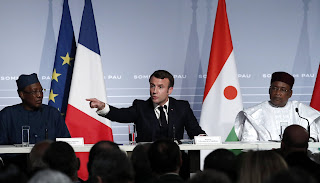
French President Emmanuel Macron, flanked by Niger President Mahamadou Issoufou and Chad's President Idriss Deby following the G5 Sahel summit in Pau, southwestern France, Monday Jan.13, 2020. (Guillaume Horcajuelo/Pool Photo via AP)


BY AYMAR N. BISOKA, DAVID MWAMBARI AND SABELO J. NDLOVU-GATSHENI


REVIEW OF AFRICAN POLITICAL ECONOMY/THE ELEPHANT

At the beginning of 2021, French President Emmanuel Macron approached the Cameroonian historian and political scientist Achille Mbembe to prepare the New Africa-France Summit, which was to take place in Montpellier, France, on 9 and 10 October 2021. The most immediate context of a forthcoming election in France itself in which the French president might be using this occasion to win the Afro-descendant votes should not escape our minds. Unlike previous summits, this one was to welcome a new generation of young Africans from Africa and its diasporas to an open and direct dialogue with Macron. For the first time in history, the summit between France and African countries was held with no African head of state.

 As part of the preparation for the summit, Mbembe had to lead a series of discussions in twelve African countries and the diaspora, ahead of the actual event, around themes of common interest. According to him, the aim of these discussions with African and diaspora youth was to “directly and openly question the fundamentals of this relationship [and] to redefine it together.” 

Four days before the summit started, Mbembe submitted a 140-page report containing thirteen proposals for a ‘refoundation’ of relations between France and Africa. These proposals focus on an Innovation Fund for Democracy, a House of African and Diasporas Views, migration, employment, intercontinental economic transparency, the transformation of development aid, the voice of Africa on climate change, the narrative on Africa, the rethinking of the relations between Africa and Europe, the restitution of stolen works of art, among others. During the summit itself, twelve young people were selected to discuss with Macron and mount a critique on the issues arising from the proposals contained in the Mbembe Report. 

 What is the real meaning of this summit beyond the organisers’ pronouncements? How can we understand the controversies and discourses that came out of it? Was this summit simply a way for France to improve its image that has deteriorated sharply over the past four years? 

Placing the summit in its historical context

 The historical context of this summit is firstly, colonial and neo-colonial (Françafrique) and secondly, a context of increased global connections in which the Afro-descendent population has increased with France and cannot be ignored. Thirdly, it is also a context of insurgent and resurgent decolonization of the 21st century, which has also seen the escalation of activism – by African youth – targeting colonial symbols of domination in general, and those of French interests in particular. Therefore, a key question arises: Was the summit organised to respond to recent events on the African continent or in France, and to push France to open-up to debates that are uncomfortable but essential? 

On the African continent, Senegalese youth protests that vandalised French interests in March 2021 are still fresh in the minds of French policymakers. The youth on the streets spoke loud and clear when they attacked French shops, petrol stations, supermarkets and you can guess that their names did not feature on the French list of the desired invitees to dine with Marcon at the summit. The invited youth were mostly the educated, youth with a pre-existing and official platform and means. There were few, if any, of the young protestors like those who revolted against French interests. 

Other recent events in Africa include protests in Mali against the French military presence and the move to hire Russian militias to combat terrorism where the French have failed. On the day the summit was to start in October, Mali’s Premier accused France of training ‘terrorist groups’ and summoned the French ambassador. Youth also attacked French interests in Northern Mozambique, resulting in the deployment of forces from the SADC region and Rwanda. 

These are a few examples to show that popular pressure on France informed Macron’s choice of inviting young participants instead of the heads of state to the summit. Throughout his presidency, Marcon has also defended the establishment of the ECO to replace the controversial CFA currency that is part of the French colonial heritage that West African protestors have rejected. French monetary imperialism has been subjected to heightened opposition from African youth. 

In addition, recent global events like the #BlackLivesMatter movement instigated debates amongst French intellectuals who aligned with their politicians to dismiss the claims by Afro-descendants in France to have racism directly confronted. These elites dismissed demands to challenge racism in France as irrelevant to France’s past or present, claiming that the French state is based on anti-racist ideals of republicanism. Macron himself declared these are ‘certain social science theories entirely imported from the United States’. 

Other prominent intellectuals joined in to argue that contemporary theories on race, gender, and post-colonialism were a threat to the French identity of liberté, égalité, and fratenité. These assertations were made ignoring a long tradition of French-speaking scholars like Aimé Cesaire, Léopold Sédar Senghor, Frantz Fanon, Cheikh Anta Diop, Valentin-Yves Mudimbe, Fabien Eboussi Boulaga, Souleymane Bachir Diagne, Françoise Verges or more recently Norman Ajari, Pape Ndiaye, Nadia Kisukidi, even the academic director of the summit itself, Achille Mbembe, and many others whose works on post-colonialism have critiqued French society. 

In fact, debates on the question of identity in France have shown that non-white communities’ lived experiences show that liberté, égalité, and fraternité are empty slogans and merely a façade to the reality of French society. For instance, issues of police brutality against non-white communities, especially the Afro-diaspora, did not feature prominently in the summit, although they concern the community whom Macron might want to lure in next year’s elections. 

The summit claimed to break ties with the colonial past, but it was hardly the case as the major problems that continue to strain the relationship between France and its African colonies were not even addressed. Yet, the voices of young people were present on stage and they asked questions, made arguments that have long existed in post-colonial literature. Articulating these views in front of the sitting president and in France was a significant moment. For example, there was a speaker from Burkina Faso civil society who asked Macron to stop patronising Africans, and that a change of vocabulary was needed to move from aid to partnership. Nevertheless, even partnership is not radical enough; the correct demand must be for reparations and restitution. Such a demand would constitute a total turn in what mainly were political and diplomatic debates. 

The other unique feature of this summit was the fact that they asked Achille Mbembe to take on the task as intellectual scholar for the forum. Was this a radical gesture by the president to engage an African intellectual – a one-time outspoken critic of France’s policy in Africa, rather than another politician? Mbembe traveled around the continent to listen and record divergent voices about Africa’s relationship with France. Mbembe’s involvement in the 2021 summit leads us to ask three questions we explore below. 

Firstly, the gesture to endorse an African intellectual with ties to France was intriguing. Was this a sign that the French establishment are taking African intellectuals seriously? It was indeed curious for Mbembe to accept this task with its high risks of being accused of doing the clean-up work for an imperial power which has never left Africa and is increasingly being exposed for its continued neo-colonial, exploitative relations with the continent. 

Secondly, Mbembe’s involvement and young civil society activists who voiced criticism can also be viewed cynically as part of the French strategy to divert attention to real issues, namely CFA monetary coloniality, the presence of its troops in Mali and France interference with the monetary reforms spearheaded by ECOWAS. Or was it to collect data on the changing pattern of West African consciousness and capture the new vocabulary of African youth as part of an effort to monitor debates, listen to frustrations, then re-align French interests across the continent accordingly? Or can this be a case of a ‘cognitive empire’ needing data to sharpen its tools and recruit new allies? Doubtless, though, is a popular demand for Europe in general, and France in particular, to embark on de-imperialisation as part of an essential pre-requisite to redefine relations. 

Thirdly, the much-publicised summit was held in France. The selection of these young participants was preceded by a preliminary consultation with France. Even if it is argued that these debates had started during previous meetings on Macron’s visits to the African continent, the summit in Montpellier was a platform to send a message to Macron’s electorate that he cares about minority issues, and to African youth that France cares where their governments have failed, and to other world powers competing for Africa’s resources, that France is in a leadership position and in touch with ‘authentic’ issues. 

The counter-summit 

The counter-summit was an eye-opener. A collective of associations, unions, and political parties organised a counter-summit to denounce the Françafrique (the term used to describe the continued and unabated influence of France, its government, and businesses, over its former colonies). Their objective was to unmask ‘the hidden face’ of the ‘New Africa-France summit’ and to challenge France’s policy in Africa. For most of the detractors, the summit was simply a publicity stunt to restore the image of France, which has deteriorated sharply in recent years, particularly in the eyes of African youth. It is indeed true that several events of the last three years were behind the demonstrations against France in Africa and, therefore, Emmanuel Macron had an interest in a charm offensive to try and restore the image of his country in many regions of the continent. The counter-summit registered the participation of significant political figures such as Mireille Fanon-Mendès-France, daughter of Frantz Fanon, and Miriam Sankara, the wife of the African hero, Thomas Sankara from Burkina Faso. For those attending the counter-summit, Macron’s announcements for a change in France-Africa relations over the past four years were being challenged as nothing but the usual operations of colonial seduction to give neo-colonial relations a new lease of life. 

For example, the reform of the CFA franc, in favour of the future West African currency ECO, still guarantees a central role for France in the monetary policy of West African countries. Also, the announced end of Opération Barkhane is, like other previous military operations in Africa, part of a strategic redeployment towards maintaining French influence through military cooperation and the action of Special Forces. 

Macron’s France has therefore never introduced a break in its African policy but, on the contrary, continues to increase its neo-colonial influence in Africa strategically to fight against growing criticism, particularly from young protestors. These are the reasons why this summit was considered as a symbolic renewal of old Franco-African summits, by using topics such as ‘Youth and actors from the diaspora, entrepreneurship, culture and sports’ to continue to revive the same colonial practices of France in Africa. 

The counter-summit of a hundred organisations and supported by several political parties and unions succeeded in organising itself around a message which clearly showed what the meaning of “putting an end to the coloniality of France-Africa” had to involve. The meetings, debates and events they organised on the side-lines of the official summit showed a great mistrust towards Macron, based on their deep knowledge of existing contradictions between France’s discourse and its actions in Africa. 

It emerges from these debates that this is not the first time a French president has promised to put an end to France-Africa coloniality, including president Nicolas Sarkozy (2007-2012) and president François Hollande (2012-2017). These presidents always talked about cosmetic change and a change of style in their relationship with Africa, but not the kind of rupture that the counter-summit participants were asking for. 

An example of changing styles over time is how from President Charles de Gaulle (1959-1969) to Jacques Chirac (1995-2007), France had a personal relationship with African presidents, in order to maintain its influence on the African continent. The style then changed with Sarkozy and increased with Francois Hollande, with more emphasis and focus on ‘democratisation’, but still insisting on positioning a relationship with politicians and the Élysée (the official residence of the French president). More recently, the gradual disappearance of former dictators in some African countries has not allowed the Élysée to establish personal and deep relations with certain African presidents. Therefore, it was necessary to change the former way of doing things, in order to maintain, above all, the influence of France in Africa. 

Sarkozy, who did not appreciate the need to change the old model of the France-Africa relationship, paid dearly in a lawsuit related to his relations with President Muammar al-Gaddaf. Macron thus had no choice but to try and refigure the relationship in a different way. Yet, this does not mean that the core of France-Africa coloniality has altered in any way. 

This is what the counter-summit meant in demanding a sign from Macron, showing that there really was a will for radical change. This would consist of France’s commitment towards five very specific points: (a) ending its military presence in Africa, (b) ending the neoliberal trade policy of France and the EU in Africa, (c) stopping support to presidents who remain in power in an undemocratic manner and French interference in the internal political and economic affairs of African countries, (d) cancelling the odious and illegitimate debts of African countries, (e) respecting the freedom of movement and settlement of people as well as putting an end to expulsions of asylum seekers from France in accordance with international treaties. 

Some post-colonial thinkers, including Mbembe, argue that we should not only see cynicism in France’s declaration of its desire to improve its relations with Africa. Sometimes the will is there, but differences still appear on the issue of what a healthy multilateral relationship means. Though, we would argue, that beyond cynicism, there is above all an issue of ideological and cognitive incapacity which is at stake in the official French political imagination. 

For those who follow topical issues in French politics, there is still in its political world a kind of nostalgia for the French empire, power and influence in the world, which ultimately makes imperialism a criterion of the greatness of a state. According to Achille Mbembe, this deep rationality implies that “France is struggling to enter into the ‘decolonial’ world that is coming” . For this reason, the counter-summit argued that the official summit organised by Mbembe was unable to break with this imperialist baggage which is at the very foundation of the French state. 

The empire and its technologies of domination 

The cognitive empire sustains colonial relations. It continues to invade the mental universes of its targets. It maintains surveillance over new knowledge which is not informed by colonial and capitalist interests. What sense do we make of the fact that the summit took place within a context in which conservative politicians in alliance with conservative intellectuals were mounting a push-back against critical race theory, intersectionality theory, post-colonial theory, and decolonial thought? These are frameworks that emerged from the battlefields of history and struggles against racism, enslavement, colonialism, capitalism, and patriarchy. It is these frameworks that the current insurgent and resurgent decolonisation of the 21st century is building on, with students, youth and other progressive forces at the forefront. 

The new world now has a critical language with which to propose and imagine a future beyond racism, colonialism, capitalism, and patriarchy. The counter-summit was inspired not just by rethinking but unthinking all toxic colonial relations. Summits have been well-known techniques of sugarcoating colonialities. The long history since the 1958 referendum in France has amply demonstrated that colonial relations do not need reform but abolition for any genuinely new relations between France and Africa. What is needed is a double rupture—which is simultaneously epistemic and systemic.

Aymar N. Bisoka is a lawyer and political scientist and assistant professor at the University of Mons. He also teaches at the Catholic Univesity of Bukavu, Congo Democratic Republic of the Congo and is a Meaning-Making Research Initiative (MRI) fellow CODESRIA, Senegal. In addition, Bisoka is a researcher at the Conflict Research Group (CRG) at the University of Ghent, Belgium. David Mwambari is a Lecturer in African Security and Leadership Studies at the African Leadership Centre, King’s College London and is a Meaning-Making Research Initiative (MRI) fellow CODESRIA, Senegal. Sabelo J. Ndlovu-Gatsheni is the Professorial Chair of Epistemologies of the Global South Faculty of Humanities and Social Sciences Africa Multiple Cluster of Excellence University of Bayreuth. He is also Honorary Professor, School of Education (Education and Development Studies, University of KwaZulu-Natal (October 2020-September 2023), South Africa.


US House Shuffle Continues With California Districts In Play

BY MICHAEL R. BLOOD


LOS ANGELES (AP) — The once-a-decade reshaping of California congressional districts set off another round of political maneuvering Wednesday, with House members jumping into newly drawn districts that will play into the fight for control of Congress in 2022.

Republican U.S. Rep. Michelle Steel announced she will run in an inland district anchored in Orange County, avoiding a potential showdown on her old political turf with Democratic Rep. Katie Porter, a national progressive star and powerhouse fundraiser. Porter announced plans Monday to switch districts after her hometown of Irvine was drawn into the new coastal seat, the 47th.

"Although the district lines have changed, my mission has not," Steel said in a statement. "Californians today are facing so many challenges, from high taxes to concerns over affordability, crime, and the quality of education our children receive."

Democrats are defending a fragile eight-seat House majority in a midterm election next year, when the party that controls the White House historically loses seats in Congress. President Joe Biden's approval ratings have been shaky, adding further anxiety for Democrats hoping to hold the House and Senate.

The revised boundaries were endorsed Monday by the California Citizens Redistricting Commission, which was tasked with drawing new districts to account for shifts in population, a requirement that happens once a decade. Each district must represent 760,000 people.

In other moves, Republican U.S. Rep. Young Kim said she would run in an inland district anchored in Orange County, the 40th. The district has a Republican tilt and was vacated by Porter, who jumped to the neighboring contest where the the number of Democratic and Republican voters is nearly equal.

Former Democratic U.S. Rep. Harley Rouda, who was ousted by Steel in 2020 and planned to run against her next year, said on Twitter that he would "evaluate all the options" after Porter entered the race, a statement that didn't preclude he might drop out.

"I firmly believe that I am the most electable Democrat in this district but I am also a realist whose goal has always been to put my constituents ... first," he wrote.

In the state's farm belt, Democratic U.S. Rep. Josh Harder announced he would run for reelection in the 13th District, which includes his hometown of Turlock. The district is firmly Democratic in registration, with a large Latino population.

California will lose a House seat next year, dropping to 52 from 53 seats, because the population in other states is growing faster. It will remain the largest House delegation.

California is one of the nation's most Democratic states, where the party holds every statewide office and dominates the Legislature and congressional delegation. In many cases the new district lines appear to favor Democrats. Republican registration has been withering in the state for years, and registered Democratic voters outnumber Republicans by nearly 2-to-1 statewide.

Still, there are a string of competitive districts that will factor in the fight for House control.

Rep. Mike Garcia, a Republican who saw his district north of Los Angeles stripped of the Republican-rich community of Simi Valley, said Monday that "the commission has shown they were not acting independently when they drew all the Democratic incumbents into safer seats while making five out of the 11 Republican districts more vulnerable."

Secret Service: Nearly $100B Stolen In Pandemic Relief Funds

BY JENNIFER MCDERMOTT 

Web pages used to show information for collecting unemployment insurance in Virginia, right, and reporting fraud and identity theft in Pennsylvania, are displayed on the respective state web pages, on Feb. 26, 2021, in Zelienople, Pa. The Secret Service said it has seized more than $1.2 billion while investigating unemployment insurance and loan fraud and has returned more than $2.3 billion of fraudulently obtained funds by working with financial partners and states to reverse transactions. (AP Photo/Keith Srakocic, File)


WASHINGTON, DC (AP)--Nearly $100 billion at minimum has been stolen from COVID-19 relief programs set up to help businesses and people who lost their jobs due to the pandemic, the U.S. Secret Service said Tuesday.

The estimate is based on Secret Service cases and data from the Labor Department and the Small Business Administration, said Roy Dotson, the agency’s national pandemic fraud recovery coordinator, in an interview. The Secret Service didn’t include COVID-19 fraud cases prosecuted by the Justice Department.

While roughly 3% of the $3.4 trillion dispersed, the amount stolen from pandemic benefits programs shows “the sheer size of the pot is enticing to the criminals,” Dotson said.

Most of that figure comes from unemployment fraud. The Labor Department reported about $87 billion in unemployment benefits could have been paid improperly, with a significant portion attributable to fraud.

The Secret Service said it has seized more than $1.2 billion while investigating unemployment insurance and loan fraud and has returned more than $2.3 billion of fraudulently obtained funds by working with financial partners and states to reverse transactions. The Secret Service says it has more than 900 active criminal investigations into pandemic fraud, with cases in every state, and 100 people have been arrested so far.

The Justice Department said last week that its fraud section had prosecuted over 150 defendants in more than 95 criminal cases and had seized over $75 million in cash proceeds derived from fraudulently obtained Paycheck Protection Program funds, as well as numerous real estate properties and luxury items purchased with the proceeds.

One of the best-known programs created through the March 2020 CARES Act, PPP offered low-interest, forgivable loans to small businesses struggling to meet payroll and other expenses during pandemic-related shutdowns.

Law enforcement early in the pandemic focused on fraud related to personal protective equipment, the Secret Service said. Authorities have now prioritized the exploitation of pandemic-related relief because the federal funding through the CARES Act attracted the attention of individuals and organized criminal networks worldwide.

“Can we stop fraud? Will we? No, but I think we can definitely prosecute those that need to be prosecuted and we can do our best to recover as much fraudulent pandemic funds that we can,” said Dotson, who is the Secret Service’s assistant special agent in charge of the agency’s field office in Jacksonville, Florida.

US Treasury Creates Pathway To Send Aid To Afghanistan

BY JOSH BOAK

A cemetery stands on Tape Nadir Khan hill as at the background is seen the city of Kabul, Afghanistan, on Saturday, Dec. 4, 2021. (AP Photo/ Petros Giannakouris)


WASHINGTON (AP)--The Treasury Department on Wednesday announced it was issuing special licenses to ensure that some international aid could flow to Afghanistan, where the economy collapsed following the Taliban takeover in August.

The licenses will enable the U.S. government, international organizations such as the United Nations and nongovernmental organizations to operate in the country and offer humanitarian assistance despite sanctions. They will also allow Afghans living abroad to send money to their families in Afghanistan through remittances.

“We are committed to supporting the people of Afghanistan,” said Deputy Treasury Secretary Wally Adeyemo in a statement. “Unfortunately, the economy faces grave challenges, exacerbated by the country’s long dependence on foreign aid, donor and private sector flight sparked by the Taliban’s takeover, drought, structural macroeconomic issues, and the COVID-19 pandemic.”

The U.S. government has labeled Afghanistan’s Taliban and the related Haqqani network as terrorists, severely restricting their access to global institutions and the outside money that supported the country’s economy before the withdrawal of U.S. forces this year and the swift demise of its previous government.

Biden administration officials face the awkward task of trying to help the Afghan people without also funding a Taliban government that the U.S.-led coalition supplanted after the 9/11 attacks in 2001 and then fought for roughly 20 years.

As much as 80% of Afghanistan’s budget comes from the international community. Without greater access to foreign money, the Afghan economy is likely to contract by about 30% this year — furthering the humanitarian crisis.

The State Department said the U.S. government plans to provide Afghanistan with an additional 1 million vaccine doses in the coming weeks. That brings the total U.S. donation for Afghanistan to 4.3 million doses, though the country has an estimated population of about 40 million.

Earlier in December, the U.S. government worked to transfer $280 million from the World Bank’s Afghanistan reconstruction trust fund to U.N. organizations to address health and nutrition needs in the country.

Pfizer Pill Becomes 1st US-Authorized Home COVID Treatment

BY MATHEW PERRONE

This image provided by Pfizer in October 2021 shows the company's COVID-19 Paxlovid pills. U.S. health regulators on Wednesday, Dec. 22, 2021 authorized the first pill against COVID-19, a Pfizer drug that Americans will be able to take at home to head off the worst effects of the virus. (Pfizer via AP)


WASHINGTON (AP) — U.S. health regulators on Wednesday authorized the first pill against COVID-19, a Pfizer drug that Americans will be able to take at home to head off the worst effects of the virus.

The long-awaited milestone comes as U.S. cases, hospitalizations and deaths are all rising and health officials warn of a tsunami of new infections from the omicron variant that could overwhelm hospitals.

The drug, Paxlovid, is a faster way to treat early COVID-19 infections, though initial supplies will be extremely limited. All of the previously authorized drugs against the disease require an IV or an injection.

An antiviral pill from Merck also is expected to soon win authorization. But Pfizer’s drug is all but certain to be the preferred option because of its mild side effects and superior effectiveness, including a nearly 90% reduction in hospitalizations and deaths among patients most likely to get severe disease.

“The efficacy is high, the side effects are low and it’s oral. It checks all the boxes,” said Dr. Gregory Poland of the Mayo Clinic. “You’re looking at a 90% decreased risk of hospitalization and death in a high-risk group — that’s stunning.”

The Food and Drug Administration authorized Pfizer’s drug for adults and children ages 12 and older with a positive COVID-19 test and early symptoms who face the highest risks of hospitalization. That includes older people and those with conditions like obesity and heart disease, though the drug is not recommended for patients with severe kidney or liver problems. Children eligible for the drug must weigh at least 88 pounds (40 kilograms).

The pills from both Pfizer and Merck are expected to be effective against omicron because they don’t target the spike protein where most of the variant’s worrisome mutations reside.

Pfizer currently has 180,000 treatment courses available worldwide, with roughly 60,000 to 70,000 allocated to the U.S. The company said it expects to have 250,000 available in the U.S. by the end of January.

Federal health officials are expected to ration early shipments to the hardest hit parts of the country. Pfizer said the small supply is due to the manufacturing time — currently about nine months. The company says it can halve production time next year.

The U.S. government has agreed to purchase enough Paxlovid to treat 10 million people, and it will be provided free to patients. Pfizer says it’s on track to produce 80 million courses globally next year, under contracts with the U.K., Australia and other nations.

President Joe Biden said the pill marks a “significant step forward in our path out of the pandemic” and said his administration will work with states to ensure equitable distribution.

Health experts agree that vaccination remains the best way to protect against COVID-19. But with roughly 40 million American adults still unvaccinated, effective drugs will be critical to blunting the current and future waves of infection.

The U.S. is now reporting more than 140,000 new infections daily and federal officials warn that the omicron variant could send case counts soaring. Omicron has already whipped across the country to become the dominant strain, federal officials confirmed earlier this week.

Against that backdrop, experts warn that Paxlovid’s initial impact could be limited.

For more than a year, biotech-engineered antibody drugs have been the go-to treatments for COVID-19. But they are expensive, hard to produce and require an injection or infusion, typically given at a hospital or clinic. Also, laboratory testing suggests the two leading antibody drugs used in the U.S. aren’t effective against omicron.

Pfizer’s pill comes with its own challenges.

Patients will need a positive COVID-19 test to get a prescription. And Paxlovid has only proven effective if given within five days of symptoms appearing. With testing supplies stretched, experts worry it may be unrealistic for patients to self-diagnose, get tested, see a physician and pick up a prescription within that narrow window.

“If you go outside that window of time I fully expect the effectiveness of this drug is going to fall,” said Andrew Pekosz, a Johns Hopkins University virologist.

The FDA based its decision on company results from a 2,250-patient trial that showed the pill cut hospitalizations and deaths by 89% when given to people with mild-to-moderate COVID-19 within three days of symptoms. Less than 1% of patients taking the drug were hospitalized and none died at the end of the 30-day study period, compared with 6.5% of patients hospitalized in the group getting a dummy pill, which included nine deaths.

Pfizer’s drug is part of a decades-old family of antiviral drugs known as protease inhibitors, which revolutionized the treatment of HIV and hepatitis C. The drugs block a key enzyme which viruses need to multiply in the human body.

The U.S. will pay about $500 for each course of Pfizer’s treatment, which consists of three pills taken twice a day for five days. Two of the pills are Paxlovid and the third is a different antiviral that helps boost levels of the main drug in the body.

Associated Press writer Tom Murphy contributed to this report.

The Associated Press Health and Science Department receives support from the Howard Hughes Medical Institute’s Department of Science Education. The AP is solely responsible for all content.

Guinea’s 2008 Coup Leader Returns Home From Exile

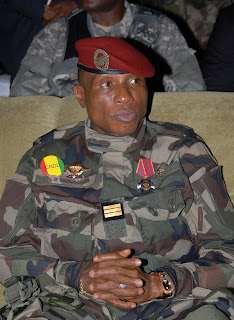
MOUSSA DADIS CAMARA


BY BOUBAKAR DIALLO

CONAKRY, GUINEA (AP)
— The man who led a 2008 coup in Guinea and whose brief rule was marked by a stadium massacre against peaceful demonstrators returned to the West African country Wednesday after more than a decade in exile in Burkina Faso.

Moussa “Dadis” Camara left the country in December 2009 after narrowly surviving an assassination attempt carried out by one of his own bodyguards. For years the government had sought to prevent his homecoming, fearing it could stoke political instability.

However, another coup earlier this year in Guinea put a military junta in power that was more amenable to Camara’s return.

Camara’s plane touched down Wednesday at the airport in Conakry.

Camara, now 57, was a little-known army captain when he seized power in Guinea in December 2008 just hours after the death of longtime dictator Lansana Conte had been announced on state television.

By the following September, opposition to the ruling junta had deepened. And during a peaceful anti-junta demonstration that month at a soccer stadium, Camara’s soldiers fired upon the crowd, killing at least 157 people, according to U.N. figures.

It remains unclear whether Camara could face criminal charges in connection with the massacre. However, to date, no trial has ever been held for the perpetrators of the violence, during which dozens of women also were gang-raped, according to human rights groups.

Camara’s exile after he was shot in the head eventually paved the way for Guinea’s first democratic elections since independence from France, which put Alpha Conde in power.

The ex-coup leader did manage to make a brief visit to Guinea in 2013 to attend his mother’s funeral, crossing at a land border with Liberia. But Guinean authorities have resisted Camara’s permanent return, fearing it could stoke political tensions.

When Camara tried to visit Conakry in 2015, Conde forced him to deplane on a layover in Abidjan before the commercial flight could continue to Guinea’s capital.

Now Conde has been forced from power by another military junta and remains in their custody. First elected in the landmark 2010 vote, Conde saw his popularity sink over the decade he was in power, particularly after he ran for a third term and said term limits did not apply to him. He ultimately won re-election in October 2020, only to be deposed in the military coup less than a year later.

Associated Press writer Krista Larson in Dakar, Senegal contributed.

Entranced By Paul McCartney’s Book Of Lyrics? Thank The Great Poet Paul Muldoon

BY CHARLES FINCH

Book covers, with lyrics, of the two volumes of “The Lyrics: 1956 to the Present” by Paul McCartney and Paul Muldoon.
(Liveright) via LA Times


Paul McCartney hasn’t snuck up on anyone for at least 60 years, since the days when you could have walked into a random Hamburg nightclub (the Indra! the Kaiserkeller!) and happened upon the apprentice-years Beatles playing one of their noisy sets. It was a brief window of anonymity: The square where they played is named Beatles-Platz now, and everything McCartney does feels like breaking news, from the long, candid interviews (The Stones? A blues cover band) to his spontaneous composition of the riff to “Get Back” (52 years ago but still news!) in Peter Jackson’s wildly popular new eight-hour documentary of the same name.

And yet “The Lyrics,” McCartney’s collection, published this fall, of lyrics he’s written during those 60 years, somehow snuck up on us. There’s nothing quiet about it, exactly. It’s a big, beautifully designed number in two volumes, clocking in at $100, with hundreds of revealing and surprising pictures. That’s not the surprise, though — every legacy artist seems to be offering a similar product now, from Dolly Parton to the Grateful Dead. What’s surprising is how much people love it. The book has landed on numerous Best of 2021 lists, been called a “triumph” in the normally acidic Times of London and a “joy” in the Times of New York. As of this writing, it’s the No. 1 book in sales rank on Barnes & Noble’s website.

A good share of the credit for this must go to McCartney’s unlikely editor and collaborator on the project, Irish poet Paul Muldoon — a writer with his own long list of laurels, including a Pulitzer Prize and professorships at Oxford and Princeton. Muldoon is part of a rarefied world; he got the job when he went to the opera with McCartney’s editor.

But if the match sounds like a strange high-low mashup, it worked. “We’re of about the same age,” Muldoon told me over a Zoom from New York, twirling some kind of stress ball on the end of a short, braided leash for most of the hour. He’s a gregarious, nervy, appealing, owlish presence — a John to Paul’s, well, Paul. “We had a very similar education. And Liverpool sounds quite Irish.” It’s also worth noting that Muldoon published a book of rock lyrics in 2013, which he performed with a Princeton, N.J., band called the Wayward Shrines, and once collaborated on a song with Warren Zevon.

Muldoon and McCartney met dozens of times between 2015 and 2020, the last few virtually, and together they created something much more than a book of lyrics (in case the idea of a book reprinting the words of McCartney’s 2012 album “Kisses on the Bottom” doesn’t electrify you). Organized into 154 texts, it’s more like a collaged memoir, covering an incredible amount of terrain: memories of Paul’s practical, loving parents (his father, Jim, would order him and his brother Mike into the streets to pick up horse manure when they were bored), John Lennon’s coruscating Liverpool dreams (‘to go beyond where we once belonged,” as McCartney says), his literary influences from Jarry to Dickens, his deeply happy marriage to Linda Eastman. It’s already a book that Beatles completists agree holds the most new information to come out about the band in decades.

Muldoon’s masterstroke was to organize the book alphabetically rather than chronologically. “I was very keen to do it that way,” he said. “It takes the curse of the Beatles bulge” — the predominance of the Beatles despite their brevity — “out of things.” The book’s charming freedom comes from this randomness. “We know his life,” Muldoon said. “We were very conscious of coming up with something he hadn’t said before.”

Muldoon’s own work is witty, full of wordplay, often recondite. (His new book is called “Howdie-Skelp,” a term for “the slap in the face a midwife gives a newborn.”) I asked him if that didn’t make him something of a mismatch with McCartney’s lyrics, which are often simple, sometimes, as McCartney says, written on the fly. It’s pop music. Muldoon agreed, to an extent — for sheer density of lyrical meaning, he admires Paul Simon and Leonard Cohen — but both he and “Lyrics” are eager to draw out a hidden poetics in McCartney’s words.

For Muldoon, this begins with the uncanny power of the earliest songs: “They had figured out that if one used pronouns in a certain way that it made some kind of very strange connection between them and the people listening,” he said. The yearning “Hold me — love me” from “Eight Days a Week,” the obscured but powerfully meaningful “she” and “you” of “She Loves You” — these set new emotional stakes for rock music, both generalizing the emotions of the songs and making them seem fiercely personal to the four Beatles. As Muldoon told me, “A song lyric is not a poem. Nor does it have to be.”

Virginia Woolf observed in her diaries that art must be unrepresentative of life in general, because artists (especially writers) are so often melancholy souls. Who is describing the inner life of the happy, contented butcher? “Lyrics” answers the question; the thing that struck Muldoon was how McCartney could have survived his immense fame and wealth and veneration to become such a good person. (A sample ingenuousness: “The reason I don’t eat animals is that I want them to have their shot, like I got my shot.”) The book is down on Trump and Thatcher but for the most part it’s startlingly positive, describing figures from Ringo to Mal Evans to Jane Asher with clear-eyed but unmistakable love.

“He’s a very generous person,” Muldoon said, reflecting on his time with McCartney. “I never once had a sense of anything troubling about him.” Perhaps this is why people are responding to “Lyrics”: Like “Get Back,” it’s a jolt of good feelings in a hard year. Writers deal in complexity more ably than simplicity, but Muldoon was able to edit McCartney’s memories into a form that permits both. The result is a surprise hit in the shape of a book that could never have been anything but a hit.

Because, of course, he’s still Paul McCartney: Turn to the page laying out the beautiful handwritten lyric of “Blackbird” — McCartney describes writing it “only a few weeks after the assassination of Martin Luther King Jr.” — and you remember the magic of the music, the reason the book exists. Sixty years later, McCartney himself often seems most curious about that part of it, and in particular his magnetic connection with Lennon, whose results still course through the world.

“We wrote a song a day,” MCartney remembers of “Can’t Buy Me Love.” “We would just meet at my house or John’s. The usual two guitars, two pads, two pencils.” It’s one of the few places in the book where McCartney’s powers of memory seem smaller than the moment. But then, it’s the Beatles, so much more than the sum of any of its parts — so much more to many of us than we even understand. As Muldoon said of McCartney’s musings on those distant days, “He still almost seems surprised by it himself.”

Finch’s novels include the Charles Lenox mysteries.

Tuesday, December 21, 2021

Travesty Of ECOWAS Court’s Verdicts Raises Concern

BY BOLA OLAJUWON


ABUJA, NIGERIA (THE NATION)--The ECOWAS Court of Justice marked its 20 years of existence with remarkable rulings, verdicts and opinions to show. But, critical stakeholders believe flouting of the community court’s judgments by member-states will not give succours to those in need of justice, ASSISTANT EDITOR BOLA OLAJUWON reports.

The ECOWAS Court of Justice few days ago rolled out the drum to mark its 20 years of existence. The organ of the Economic Community of West African States – a regional integration community of 15 member states in Western Africa – was created pursuant to the provisions of Articles 6 and 15 of the Revised Treaty of the regional organisation.

The court was created after the adoption of the Protocol on the Community Court of Justice in 1991, about 16 years after the ECOWAS itself was formed. The ECOWAS Revised Treaty of 1993 established the Court of Justice as an institution of the regional grouping.

The expansion of the court’s competences from just a mere community court to civil service tribunal, court of human rights and court of arbitration, gave the court an almost universal scope of intervention in many areas with significant increase in the number of cases handled in recent years. It is also seen as the last resort for those who saw national judicial templates as inept to give them justice.

Member-states shunning ECOWAS Community Court’s rulings

For the people of West Africa with a population of 416,631,763 – based on the latest United Nations estimates – obtaining justice in their individual country is like camel passing through the proverbial eye of the needle.

Still, with the setting up of the ECOWAS Court, the hope of some of those plaintiffs had been lost to inability of many member-states to abide by the court’s rulings.

For instance, the Court of Justice declared the arrest and continued detention of the immediate past former National Security Adviser, Col. Sambo Dasuki (retd), as unlawful, arbitrary and a violation of his right to liberty.

The court ordered that the former NSA be released from the custody of the Department of State Services, whose operatives re-arrested him shortly after he was released from Kuje Prison, Abuja on bail on December 29, 2015.

Dasuki, who was arrested for alleged economic crimes and other offences, was later granted bail by all three courts where he is currently facing charges relating to criminal diversion of funds meant for procurement of arms for fighting Boko Haram terrorists in the North-East.

But, in a ruling on the fundamental human rights enforcement suit filed by Dasuki, the ECOWAS court said it was wrong for the Federal Government to continue to detain him over undisclosed offences after he had been granted bail by different courts, where he was being prosecuted.

The court, in a unanimous judgment of a three-man panel, read by Justice Chijioke Nwoke, also awarded N15 million damages against the Federal Government.

But, despite the Nigerian courts and ECOWAS Court rulings, he remained in the custody of the DSS since he was re-arrested at Kuje prison, before he was finally released after meeting his bail conditions.

Also in 2016, the ECOWAS Court ordered the release of leader of the Islamic Movement in Nigeria (IMN), Sheikh Ibraheem el- Zakzaky and his wife, Zeenah. It described their detention as unlawful and arbitrary. But the government did not obey the order.

The Islamic cleric was arrested in December 2015, following a clash between his followers and the Nigeria Army in Zaria, Kaduna State.

Scores of people, mostly his followers were reportedly killed and buried in a mass grave in the Mando area of Kaduna metropolis.

On July 28, 2021, a Kaduna State High Court freed El-Zakzaky and his wife.

Just like Dasuki’s and El-Zakzaky’s cases, the Nigerian government refused to enforce ECOWAS’ judgments for the provision of free and basic education for Nigerian children as enshrined under chapter two of the Nigerian Constitution, in the case between Socio-Economic Rights and Accountability Project (SERAP) v. Federal Republic of Nigeria & Anor.

The community court on Friday, October 22, 2021, also ordered the Government of Cote d’Ivoire to pay 1,250,000,000 CFA Francs as compensation to Mr. Oumar Diawara, a Congolese resident of Abidjan (the applicant), for the violation of his right to a fair hearing and right to property. A symbolic one Franc was also awarded to him for the moral prejudice he suffered from how the case against him at the domestic court was handled.

In the judgment, which was delivered by Hon. Justice Dupe Atoki, the judge rapporteur in the suit, the court also ordered the Court’s Registry to assess the litigation costs in favour of the applicant.

However, till today, nothing has been heard about the implementation of the court’s decision.

In another case, the ECOWAS Court ordered the Republic of Niger to pay 7,564,250 CFA francs as recoverable costs to the heirs of late General Ibrahim Mainassara Bare, who ruled the country between January 1996 and April 1999, when he was assassinated while boarding an aircraft.

Justice Dupe Atoki, the judge rapporteur who read the order, said the court, having delivered an earlier judgment, had jurisdiction to hear the matter concerning recoverable costs in relation to the court’s judgment No ECW/CCJ/JUD/23/15 delivered on October 23, 2015.

The application, ECW/CCJ/APP/25/13/COSTS, filed on February 4, 2020, by Mr. Chaibou Abdourahaman, lawyer to the 17 heirs of the late General Bare, asked the court to review its judgment No ECW/CCJ/APP/23/15 based on an alleged omission by the court to specify an amount as recoverable costs to be awarded for the proceeding.

Abdourahaman told the court that part of the judgment reads: “The Republic of Niger shall bear the costs”, without specifying an amount, which resulted in the presentation of their incurred expenses to the court, seeking its order in this regard.

Still, the Niger Republic has not implemented the court’s decision.

Following the cold attitude of the ECOWAS member-states, human rights lawyer Femi Falana called on President Muhammadu Buhari and other leaders to obey court orders in the interest of political stability and justice.

He said the president should also comply with a court order compelling the Federal Government to release the details of stolen assets recovered so far.

“Buhari and ECOWAS leaders should comply with judgments and orders of municipal courts and regional tribunals in the interest of public accountability and political stability,” Falana said.

Lack of national authorities to implement rulings

Despite its achievements in the last six years, only six countries of the 15 member states met the pre-requisite for obeying the court’s rulings. All countries ought to have set up national authorities to implement its rulings.

The court’s president, Justice Edward Amoako Asante (Ghana), listed Guinea, Nigeria, Mali, Burkina Faso, Togo and Ghana, as the six countries that had set up a competent authority to implement the court rulings as stipulated in the protocol. But still, Nigeria refused to implement most of the cases adjudicated upon by the court.

The other member-countries yet to set up such authority include: Benin, Cape Verde, Côte d’Ivoire, The Gambia, Guinea Bissau, Liberia, Niger, Senegal and Sierra Leone.

The poor rate of compliance with the court’s judgments, currently standing at about 50 per cent, is of grave concern to the court, Justice Asante said.

“We regret that only six member states have appointed the competent national authorities for the enforcement of judgments of the court in their respective domains.

“These are the Republic of Guinea, Nigeria, Mali, Burkina Faso, Togo and Ghana. We will continue to appeal for the remaining members to do the needful,” he said.

But, the Speaker of the ECOWAS Parliament, Dr. Sidie Tunis, called on presidents and leaders of West Africa states to ensure obedience to the community court’s ruling.

Tunis said the attitude of selective adherence to the ruling of the court was also diminishing its reputation.

Lawyers to African govts: obey courts’ decisions

Lawyers from across Africa have urged governments of countries in the continent to learn to give effect to decisions of continental and sub-regional courts and tribunals as a way of bolstering democracy and rule of law in the continent.

The lawyers, under the aegis of the Pan African Lawyers Union (PALU) and other stakeholders deplored the growing practice where countries in the continent treat decisions of African international courts and tribunals

Among those who appealed to ECOWAS leaders are Vice President of the ECOWAS Court, Justice Gberi-Be Ouattara; Boniface Ogoti of the East African Court of Justice; Meredith Lwanga of the African Court on Human and Peoples’ Rights; and Falana (SAN).

Others included Donald Deya of PALU, Moussa Coulibaly, President of the West African Bar Association (WABA); Archilleus Romward of the East Africa Law Society; Deborah Nyokabi Mburu of the Network of African Human Rights Institutions (NANHRI); Osai Ojigho of Amnesty International (AI); Simitie Lawvalry of the Human Rights Commission of Sierra Leone, and Anne Mary Okutoyi of the Kenya Nation Commission of Human Rights.

Justice Ouattara, who expressed discomfort with some recent policy decisions of the governments of ECOWAS states in relation to the court, said it was becoming difficult for the court to meet its obligations.

He noted that, aside that most member states were reluctant to implement the court’s decisions, they have decided to reduce the number of its judges and their tenure despite the growing workload of the court.

Justice Ouattara noted that before now, the court had seven judges, who were entitled to a renewable term of five years, but now, the number has been reduced to five, with their tenure limited to four years, which is no longer renewable.

He argued that the relevance of a court lies in the implementation of and respect for its decisions, noting that no matter the quality of a court’s decision, if not implemented, it becomes useless.

Ogoti of the East African Court said his court is experiencing similar challenges as those identified by the ECOWAS Court, particularly in areas of implementation of its decisions and its capacity to monitor compliance.

“Currently, there are no means of monitoring enforcement/implementation of the court’s decisions. Whether judgments are enforced or not, we still depend on litigants to report back to us,” he said.

Lwanga of the African Court noted that her court’s still suffer from low patronage owing, partly to the reluctance of some African states to make the necessary commitment to allow their citizens access the court as well as insufficient information about the court’s operations.

Falana said there was need for sustained advocacy and engagements on the part of all stakeholders to ensure that African states and leaders realise the need to obey and respect the decisions of the courts.

Commendations and achievements

But, looking at the court in the last 20 years, Justice Asante described it as a pacesetter for other regional courts, particularly those in Africa. Asante asserted that although young, the court had through its jurisprudence set examples for other courts. He noted that the celebration “provides an opportunity to examine various dimensions of the young court, which has, through its enviable jurisprudence, become an exemplar among regional courts, particularly in Africa”.

According to Asante, the court also acts as an Arbitration tribunal with key role in the integration process of the community and as the guardian of the community law and protector of human rights.

“It is significant to note that the human rights mandate of the court has become the dominant aspect of its judicial functions. We are proud to note that due to its bold decisions on human rights complaints, the international community has recognised the evolving ECOWAS human rights regime.

“The unique feature of this human rights regime is that there is no requirement for the exhaustion of local remedies. Community citizens, therefore, have the option of lodging complaints for human rights violations before their national courts or the ECOWAS Court of Justice.

“With all humility, the ECOWAS Court of Justice is a source of pride for our community,” he said.

He thanked all past and serving judges of the court, who had contributed to its impressive judicial record.

ECOWAS Commission President Mr. Jean-Claude Brou, while looking at the court’s journey so far, asserted that the ECOWAS had in 2005 amended its protocol to strengthen the community court and made strong provisions for the execution of its judgments, to give citizens access to justice.

“The Court of Justice thus evolved into a major instrument of regional integration. This community’s organ is now better known to the citizens of the region.

“The expansion of its competences from Community Court to Civil Service Tribunal, Court of Human Rights and Court of Arbitration, gives it an almost universal scope of intervention in many areas, as shown by the significant increase in the number of cases handled in recent years,” he said.

The president noted that the protection of human rights remained particularly fundamental, along with the promotion of the rule of law among litigants, especially women and youth.

In spite of challenges confronting it, the court had registered 561 initiating applications and delivered 130 rulings and 301 judgments. It also registered 38 applications for revision of judgments from which it delivered 24 decisions. It has also given five advisory opinions. The court has held a total of 1,226 court sessions. It currently has 166 cases pending before it.

Going forward

Many of the cases before the court, bordering on human rights abuses in ECOWAS member-states, each carry the burden of exigency, which only five justices cannot meet in record time.

The court president insists the reduction of judges from seven as provided in the initial protocol to five in 2018 is of grave concern and has adverse effects. He lamented that despite the challenges, the cases yet to be heard continue to grow “astronomically”.

“In the light of the increasing caseload, it is obvious that a court composed of only five members cannot cope. It is also difficult to form more than one chamber in the court, since a chamber requires a minimum of three judges,” he said.

Asante also proposed a review of the tenure of justices from the four years non-renewable to the initial five years renewable for another term of five years. Falana, SAN, while corroborating Asante’s position, also lamented that the number of judges is too small, calling for it to be increased to 15.

The human rights lawyer called on the court to always make itself available to community’s citizens, especially in states that had been taken over by the military through coups.

He stressed that the ECOWAS, while suspending such countries, should give room for its citizens to seek redress on human rights violations, adding that ECOWAS should also seek to prevent coups by calling erring presidents to order.

“I suggest that the court must allow community citizens in countries where there is coup to assess the court. The suspension of those two countries from the ECOWAS should not prevent victims of human rights abuse from accessing the court,” he stressed.

Brou said the ECOWAS Court should help to promote good governance, rule of law and fundamental freedoms in West Africa.

He said it was important for the court to ensure access to fair, transparent and credible social justice in the region. These, he said, were shared universal values that would contribute to the development of the region and promote the culture of peace, consistent with the 2063 agenda of the African Union.

As part of its function, United Nations High Commission for Refugees (UNHCR) urged the ECOWAS Court of Justice to save 5.5 million possible displaced persons in West Africa.

Regional Director of UNHCR West & Central Africa, Ms. Millicent Mutuli, said the court, through its advocacy, held the key to curbing the rising spate of displacement and statelessness in the sub-region and protecting victims’ rights. Mutuli said the court also had a great responsibility in ensuring the rights of displaced persons were protected.

However, Falana advocated the setting up of an appellate division of the ECOWAS Court as a solution for flagrant disregard to court rulings by member states. But, a Justice of the court, Dupe Atoki, countered his position, saying that an appeal court is no solution to the impunity by member states and lack of enforcement of court rulings.

In an interview with The Nation, Professor Damilola S. Olawuyi, SAN and Global Vice Chair, International Law Association and Deputy Vice Chancellor, Afe Babalola University, Ado Ekiti (ABUAD), said as the judicial organ of ECOWAS, the ECOWAS Court was established to ensure the observance of law and justice in economic integration efforts across the West African community.

He said while the court has recorded some noteworthy achievements in advancing this goal, several practical challenges continue to limit its relevance and effectiveness.

“Chief amongst these is the flagrant disregard for the court’s decisions by several member states. The court has one of the lowest compliance rates of all regional or sub-regional courts in the world. Strengthening the court will therefore require greater commitment by all member states to comply with and implement the binding decisions of the court in accordance with norms of responsibility in international law.

“Another key challenge is the inadequate financial and technical resources that the court faces, which continues to slow down its modernisation and digitalisation when compared to other regional courts across the world. The COVID-19 pandemic has indeed accentuated the urgency of having innovative and technology-driven courts. While the ECOWAS Court promptly issued a Practice Direction on Electronic Case Management to enable the timely and efficient resolution of disputes during the pandemic, its implementation has not been seamless. Old developmental challenges such as lack of suitable accommodation space, inadequate remote technology and e-justice tools, and skills deficit, especially low number of ICT-competent staff and language translators, all mean that the ECOWAS court remains several years behind its peers.

“Without addressing these old developmental challenges, building a stronger and more relevant ECOWAS Court would be very difficult. One step would be for ECOWAS to immediately appoint a Working Group of eminent jurists and experts across the region, tasked with reviewing the progress of the court, and developing a strategic plan to strengthen the court’s relevance, modernisation, and future role in regional economic governance, including its legal structures and resource needs.

Therefore, the court, after remarkable achievements so far, needs more capacity and supports from member-states to deliver on its mandates and give succours to those in need of justice. The stakeholders told The Nation that ECOWAS must contemplate imposing sanctions, including suspension of member countries that flout rulings of the community court.

Flouting the community court’s ruling, they said, is against the dictates of the ‘Community Texts’’ and which also equates to disruption of democratic and justice processes.

Better Parenting Starts With Knowing What Works. We Tested A Project In 8 African Countries

BY INGE VALLANCE AND GENEVIEVE HAUPT RONNIE Raising adolescents can be difficult under the best of circumstances. On top of that, some famil...