Sunday, January 09, 2022

Sudan Protest Group rejects UN Offer For Talks With Military

People chant slogans during a protest to denounce the October 2021 military coup, in Khartoum, Sudan, Thursday, Jan. 6, 2022. Sudanese took to the streets in the capital, Khartoum, and other cities on Thursday in anti-coup protests as the country plunged further into turmoil following the resignation of the prime minister earlier this week. (AP Photo/Marwan Ali)


BY SAM MAGDY

CAIRO (AP)
— A leading Sudanese protest group on Sunday rejected a United Nations initiative to hold talks with the military aimed at restoring the country’s democratic transition following an October coup.

The move is a blow to international efforts seeking an end to Sudan’s political deadlock, and suggest that relentless street protests are likely to continue. Over 60 people have been killed since the military takeover.

The U.N. offer Saturday came a week after embattled Prime Minister Abdalla Hamdok resigned, citing a failure to reach compromise between the generals and the pro-democracy movement.

The Oct. 25 coup scuttled hopes of a peaceful transition, over two years after a popular uprising forced the military overthrow of longtime autocrat Omar al-Bashir and his Islamist government.

In a statement, the Sudanese Professionals’ Association, which led the upraising against al-Bashir, said the “only way” out of the ongoing crisis is through the removal of the generals from power. It seeks a fully civilian government to lead the transition, underlined by the motto “No negotiations, no compromise, no power-sharing” with the military.

The SPA has been the backbone of anti-coup protests, alongside youth groups known as the Resistance Committees.

Protesters continued their marches in Khartoum on Sunday, with security forces firing tear gas to disperse demonstrators near the presidential palace, according to activist Nazim Sirag. Security forces also opened fire on protesters in the capital’s Bahri district. At least one protester was injured, Sirag said.

Healthcare workers, who joined Sunday’s protests, demanded the government guarantee security at hospitals, which have been repeatedly stormed by security forces during demonstrations.

A young protester, meanwhile, died in the hospital Sunday from his injuries, the Sudan Doctors Committee said. Alaa el-din Adel, 17, was shot in the neck during Thursday’s protests in Khartoum’s twin city of Omdurman. His killing raised the death toll since the coup to at least 61, according to the doctors committee.

Volker Perthes, the U.N. envoy for Sudan, said that the talks would be inclusive to try to reach a “sustainable path forward towards democracy and peace” in the country.

“It is time to end the violence and enter into a constructive process. This process will be inclusive,” he said.

Though the envoy has yet to offer details of the U.N.-facilitated political process, the SPA’s rejection deals a blow to his efforts to bring the generals and the pro-democracy movement to the negotiating table.

Perthes is planning to offer more details in a news conference in Khartoum on Monday.

The SPA said Perthes’ moves have been “controversial,” citing his efforts in supporting a deal Hamdok stuck with the military in November that reinstated him but sidelined the pro-democracy movement.

“He has to listen carefully to the aims of our proud people and their revolutionary forces in establishing a fully civilian, national rule,” it said.

World and regional powers welcomed the U.N. initiative.

The United States, the United Kingdom, Saudi Arabia and the United Arab Emirates urged all Sudanese players to “seize this opportunity to restore the country’s transition to civilian democracy” in accordance with the 2019 constructional document that establishing the transitional government.

At the United Nations, five countries – the U.S., U.K., Albania, France and Norway – requested a U.N. Security Council meeting on the situation in Sudan. Diplomats said it will likely take place Tuesday or Wednesday.

This Will Be South Sudan’s Hungriest Year Ever, Experts Say

A mother sits with her malnourished baby at a hospital run by Medicines Sans Frontieres (Doctors Without Borders) in Old Fangak in Jonglei state, South Sudan Tuesday, Dec. 28, 2021. Aid groups say more people than ever in the country will face hunger this year, because of the worst floods in 60 years as well as conflict and the sluggish implementation of the peace agreement that has denied much of the country basic services. (AP Photo/Sam Mednick)


BY SAM MEDNICK AND DENG MACHOL

OLD FANGAK, SOUTH SUDAN (AP)
— Nyayiar Kuol cradled her severely malnourished 1-year-old daughter as they traveled for 16 hours on a crowded barge to the nearest hospital to their home in rural South Sudan. For months she had been feeding her four children just once a day, unable to cultivate because of disastrous flooding and without enough food assistance from the government or aid groups. She worries her daughter might die.

“I don’t want to think about what could happen,” she said.

Seated on her hospital bed in Old Fangak town in hard-hit Jonglei state, the 36-year-old Kuol tried to calm her daughter while blaming the government for not doing more. Nearly two years have passed since South Sudan formed a coalition government as part of a fragile peace deal to end a five-year civil war that plunged pockets of the country into famine, and yet Kuol said nothing has changed.

“If this country was really at peace, there wouldn’t be hunger like there is now,” she said.

More people will face hunger this year in South Sudan than ever, said aid groups. That’s because of the worst floods in 60 years, as well as conflict and the sluggish implementation of the peace agreement that has denied much of the country basic services.

“2021 was the worst year since independence in the 10 years of the life of this country and 2022 will be worse. Food insecurity is at horrific levels,” said Matthew Hollingworth, country representative for the World Food Program in South Sudan.

While the latest food security report by aid groups and the government has yet to be released, several aid officials familiar with the situation said preliminary data show that nearly 8.5 million people — out of the country’s 12 million — will face severe hunger, an 8% increase from last year. The officials spoke on condition of anonymity because they weren’t authorized to speak to the media.

Aid officials say worst affected Fangak county is now as bad as Pibor county was this time last year, when global food security experts said some 30,000 Pibor residents were likely in famine.

During trips to three South Sudan states in December, some civilians and government officials expressed concern to The Associated Press that people were beginning to starve to death.

In October, a mother and her child died in Pulpham village because they didn’t have food, said Jeremiah Gatmai, the humanitarian representative for the government in Old Fangak.

Nearly 1 million people across South Sudan have been affected by the floods, according to the United Nations, which last year had to reduce food aid by half in most places because of funding constraints, affecting some 3 million people.

Two years of floods have prevented people from farming and killed more than 250,000 livestock in Jonglei state alone, according to the U.N. Food and Agriculture Organization.

Some displaced families in Old Fangak said ground-up water lilies were their only daily meal. “We eat once a day in the morning and then sleep without food,” said Nyaluak Chuol. The 20-year-old like some others lost her fishing net in the floods. When she has enough money, she pays a boy to fish for her.

Many residents from Jonglei have fled to neighboring states for food and shelter but have found little respite. In Malakal town, some 3,000 displaced people were crammed into abandoned buildings or sheltered under trees with nothing to eat.

“We’re eating leaves and look like skeletons,” Tut Jaknyang told the AP. The 60-year-old has received food assistance just once since fleeing floods in Jonglei in July, he said. He and others said a sack of donated rice had to be shared among 20 people.

North of Malakal in the town of Wau Shilluk, health workers said the number of malnourished children coming into the medical center rose from 10 between January and July to 26 between August and December, according to Christina Dak, a health worker with the International Medical Corps.

While flooding is the main driver of hunger, it’s compounded by government deadlock as the country’s two main political parties try to share power.

Local officials in Malakal aligned with the opposition accused members of longtime President Salva Kiir’s party of undermining them by blocking political appointees and not letting them fire corrupt staff, making it hard to govern and provide services.

“We’re not working as one team. No one’s looking out for the people,” said Byinj Erngst, the health minister in Upper Nile state.

Adding to the political tensions is ongoing fighting between government and opposition-aligned militias in the country’s breadbasket in the southwest.

Government spokesman Michael Makuei said some relief such as medical services continues but there is only so much help that national authorities can give. “The floods have destroyed crops, what can the government do in that case?” he said.

Observers’ frustration is growing. In a speech to the U.N. Security Council in December, the head of the U.N. mission in South Sudan, Nicholas Haysom, warned of a collapse in the country’s peace deal if all parties didn’t renew their political will.

Jill Seaman, who works in Old Fangak with the South Sudan Medical Relief and has more than 30 years of local experience, concluded: “There are no resources, no harvest, and no cows, there’s no place to look for food.”

Saturday, January 08, 2022

Medical Education In Ghana, The Preserve Of The Rich And Privileged


BY DESMOND APPENTENG

Many continue to question the attitude medical professionals display at work these days and continue to wonder if the profession is still a calling for those who desired to serve their fellow men and women on their sick beds as it was in the days of Hippocrates and other forebears of medicine.

Growing up, I had the impression that, to become a medical Doctor you need to be the most brilliant kid until I got to Australia in the year 2003 I completed Bsc. nursing in one of the prestigious Universities in Ghana with Second Class Lower after several years of struggle due to financial constraints. After completion I sat for the NMC licensing exams and passed but had to relocate to that country with the help of uncle Ato Akorful who was residing there for over 15 years. Arriving in Australia I decided to rekindle my childhood ambitions of becoming a Medical Doctor. I discussed it with Uncle Ato and he assured me of his support so I applied to Western Sydney University the following year. To my surprise I had admission to the School in the year 2007. The mode of teaching and learning in that country was modest, practical and interesting. In short I had a wonderful experience as a medical undergraduate student in that country and now a proud Physician Specialist which would never have happened if I had remained in Ghana.

Whiles these developed countries continue to preserve medical training for the average and dedicated students willing to save lives, and preserving engineering for the most brilliant kids, we in Africa where patient to Doctor ratio remains very high with maternal and child mortality always skyrocketing. Not to talk of the unmet MDG goals, we decided to adopt the opposite.

I have also been told of how Dr. Kwame Nkrumah of blessed memory used taxpayers money and fully funded training of Doctors both in and outside Ghana in his days. I will also not forget the late Jerry John Rawlings and former President John Mahama who in their quest to improve patient to Doctor ratio in Ghana, decided to send many Ghanaians to Cuba to be trained as medical Doctors and nurses. Many of those trained in the days played and are still playing various roles in the Ghana’s health sector to improve healthcare delivery.

It will interest readers to know that the story has changed, medical education in Ghana today has become the preserve of the rich and privileged with foreign students especially Nigerians dominating the schools many of who leave the country after training, thanks to the greed of the Authorities paid with our taxes to manage the schools. The entry requirement to our medical schools have changed from good grades and willingness to save human life to ability to pay the fees and whom you know. Today its either you have a presidential protocol or have a good bank statement and willing to pass on a brown envelope filled with cash. In fact you must prove your ability to pay the exorbitant fees charged by the schools before the likes of University Ghana Medical school will sell forms for their Graduate entry program to you. One wonders if governments over the years have stopped sponsoring medical education in the country because we have enough Doctors or its the greed and corruption that has eaten into the moral fabric of Authorities paid with our taxes to manage the schools.

Readers would wonder what monies collected by the schools are really used for, since Government still pays the lecturers teaching in the schools whiles students unlike in the days of Nkrumah, buy their books and other items needed for their training

Though we are made to believe the kids needed to make straight As in the secondary school exams in order to qualify for admission to the schools the reality on the campuses is different.

I personally had to engage five private teachers for my daughter months after he secured admission to one of the prestigious SHS in Central Region and paid them termly.

I went ahead and set up a personal library for her. She was a child I so much loved and wanted her to follow my steps. She was a brilliant kid so with the help of these teachers the child got selected to represent that school in the 2019 National Maths and Science quiz competition where their team put up an outstanding performance. It was not surprising when She completed SHS and scored straight As.

I made her apply to University of Ghana Medical School and KNUST Medical schools same year just to ensure she doesn’t miss her chance of getting admission to a medical School.

Then came the shock of my life where I was exposed to what it really takes to get admission to a medical school in Ghana.

The child had a notification from University of Ghana Medical School alerting her of an entrance exams scheduled 3 days from the day of the notification and was made to pay GHC150 for the exams. She reported for the exams, took part and was shortlisted for an interview. She went for the interview and was asked if she has any member of the family who has ever been a medical Doctor and how she intends to finance her medical education? She answered the dad is a Physician Specialist. She was later asked how she got selected as National Maths and Science Quiz contestant and She answered. Then She was discharged and told “congratulations you will hear from us" but was never called.

Then came later a call from KNUST inviting her for an interview. She went for the interview and was successful but was admitted as a fee paying student. I went out to pay the fees 3 days later and was told by the cashier that the payment is not going through because the admission number on the provisional admission letter had been inactivated. I called the school only to be told because I delayed in paying the fees within 24 hours of issuance of the admission, the slot was given to another applicant.

When i called the school of Medicine KNUST to enquire why such a development, I was told they had a lot of applications and had issued too many provisional admissions that year and many had paid so their classrooms are full and cannot take any more child.

At this point I decided to started making calls to friends in politics who I think can help. Eventually i was linked to one powerful man in the country who promised to help. Few days to matriculation my daughter had admission as a regular medical student not fee paying as stated in the previous admission letter. Her fees had reduced from over GHC 11,000 to GHC1,900 and i paid. She got to the school and to her surprise, her class is full of Nigerians and other Ghanaians whose SHS results cannot be compared to her’s yet I had to go extra miles to get her admission to the school.

Then I remembered what a friend told me about his experience. This guy completed University of Ghana Nursing School with first class and applied for graduate entry medicine in same school. He went for the interview and was asked, being a nurse and now coming to do medicine, where will his loyalty be if he becomes a medical Doctor and he replied his loyalty will be with his new profession. This was the only question he was asked yet he was denied admission. He has since given up his ambition of becoming a medical doctor and working with a foreign IT firm.

I recently saw a provisional result slip of a Youngman who happened to represent Bishop Herma College in the 2020 National maths and science quiz competition of which the guy had straight As yet was unable to gain admission to UGM and KNUST medical schools, thanks his old students who contributed to pay his fees, he is currently a student at the department of pharmacy at the KNUST doing Doctor of pharmacy.

The exorbitant fees charged by the medical schools alone is enough to make any poor but brilliant Ghanaian child with the calling to be come a medical doctor to rethink and opt for marketing instead. The story is not too different from those seeking admission to nursing and Physician Assistant training schools where students pay fees in excess of GHC5000 (FOR GOVERNMENT SCHOOLS) and GHC6000 or more per annum for private schools (accommodation exclusive).

I recently advised a friend to consider sending his son to a private medical school other than public if he seriously want the child to become a medical Doctor. Checks revealed the schools are charging between $10,000 (GHC 65, 000) to $12,000 (GHC78, 000) as fees annually excluding accommodation fees and the schools are more interested in Bank statement of financiers of the students other than their academic qualifications and their calling into the medical profession.

Readers at this point might be wondering what the exact requirements for admission into our medical schools are and if the issue of inadequate classrooms is factual.

Many Youngmen and women in an attempt to avoid these frustrations as regards admission to Ghanaian medical schools, decided to travel outside to train and on return write licensing exams supervised by the Medical and Dental Council of Ghana. Each of the applicants who sit for this exams is made to pay over GHC4,000 as exams fees of which many are failed at the end though most of these students studied in countries with more advanced medical facilities and robust teaching tools and more experience teachers, so why are they failing the exams?

Could it be that there is a cartel that is making sure that Ghana does not have enough Doctors so to maintain the status quo and to ensure we continue to praise the few Doctors in the system at the disadvantage of the poor Ghanaian?

It will interest readers to know that most of the foreign train Doctors who relocate to other countries do perform excellently in those countries and are saving lives, whiles we in Ghana continue to cry for inadequate number of Doctors with the consistently high maternal and child mortality rates with unmet MDGs goals, so what exactly is our problem as a nation?

We have inadequate classrooms and learning materials in our medical schools to admit qualified Ghanaian child but same schools are admitting Nigerians and other foreign nationals who we train with our resources after which they leave for their respective countries.

The health profession is no more a calling but a preserve of the rich and privileged in Ghana it is the reason why that surgeon you visited the last time will not want to give you a listening ear unless you are able to pay the GHC10,000 he is charging as cost of your surgery.

It is the same reason why your gynecologist decided to charge you GHC3,000 for that cesarean section though you presented your NHIS card at the hospital.

The same reason why the Doctor you went to see the last time instructed his nurse not to bring him more than 20 folders of which you missed out and had to return home

The reasons listed above are some of the reasons why that newly qualified Doctor has refused to be posted to Kpandai Health post but would prefer to be in the cities.

Same reason why that Doctor at the Cardio Thoracic centre in Korlebu will decide to Charge that poor boy with hole in heart GHC70,000 as cost of his surgery such that the parents had to seek help from the public throw TV3 in order to raise the money for the surgery

It is these same reasons why most Doctors would prefer to create artificial traffic at surgical and maternity wards so they can transfer unsuspecting patients to their private hospitals so to make additional income. If you think this is lie just pay a visit to Asamakese Government hospital, Tetteh Quarshie Memorial Hospital at Mampong Akuapem, the almighty Korlebu teaching Hospital, KATH, etc and see for yourself.

It is the same reason why most Doctors at our district hopitals will decide to spend all the working hours at the theatre where they pocket every pesewa they collect from every patient they operate on (eg. Akim Oda Government Hospital) whiles leaving work at the OPD for Physician Assistants who often become overburden with workload yet paid peanuts at the end of the month because they did not attend medical schools.

It is my hope the powers that be will take steps to tackle the rot in the health system starting with the training institutions

Lets be citizen and not spectators. God bless our homeland Ghana and make our nation great and strong.

Friday, January 07, 2022

Oscar Winner And Groundbreaking Star Sidney Poitier Dies

Poitier poses with his Oscar for best actor for "Lillies of the Field" at the 36th Annual Academy Awards in Santa Monica, Calif. on April 13, 1964. (AP)


BY HILLEL ITALIE

NEW YORK (AP)
— Sidney Poitier, the groundbreaking actor and enduring inspiration who transformed how Black people were portrayed on screen and became the first Black actor to win an Academy Award for best lead performance and the first to be a top box-office draw, has died. He was 94.

Poitier, winner of the best actor Oscar in 1964 for “Lilies of the Field,” died Thursday in the Bahamas, according to Eugene Torchon-Newry, acting director general of the Ministry of Foreign Affairs in the Bahamas.

Few movie stars, Black or white, had such an influence both on and off the screen. Before Poitier, the son of Bahamian tomato farmers, no Black actor had a sustained career as a lead performer or could get a film produced based on his own star power. Before Poitier, few Black actors were permitted a break from the stereotypes of bug-eyed servants and grinning entertainers. Before Poitier, Hollywood filmmakers rarely even attempted to tell a Black person’s story.

Messages honoring and mourning Poitier flooded social media, with Whoopi Goldberg writing on Twitter: “He showed us how to reach for the stars.” Tyler Perry on Instagram wrote: “The grace and class that this man has shown throughout his entire life, the example he set for me, not only as a Black man but as a human being will never be forgotten.” And musician Lenny Kravitz wrote that Poitier “showed the world that with vision and grace, all is possible.”

Poitier’s rise mirrored profound changes in the country in the 1950s and 1960s. As racial attitudes evolved during the civil rights era and segregation laws were challenged and fell, Poitier was the performer to whom a cautious industry turned for stories of progress.

He was the escaped Black convict who befriends a racist white prisoner (Tony Curtis) in “The Defiant Ones.” He was the courtly office worker who falls in love with a blind white girl in “A Patch of Blue.” He was the handyman in “Lilies of the Field” who builds a church for a group of nuns. In one of the great roles of the stage and screen, he was the ambitious young father whose dreams clashed with those of other family members in Lorraine Hansberry’s “A Raisin in the Sun.”

Debates about diversity in Hollywood inevitably turn to the story of Poitier. With his handsome, flawless face; intense stare and disciplined style, he was for years not just the most popular Black movie star, but the only one.

“I made films when the only other Black on the lot was the shoeshine boy,” he recalled in a 1988 Newsweek interview. “I was kind of the lone guy in town.”

Poitier peaked in 1967 with three of the year’s most notable movies: “To Sir, With Love,” in which he starred as a school teacher who wins over his unruly students at a London secondary school; “In the Heat of the Night,” as the determined police detective Virgil Tibbs; and in “Guess Who’s Coming to Dinner,” as the prominent doctor who wishes to marry a young white woman he only recently met, her parents played by Spencer Tracy and Katharine Hepburn in their final film together.

Theater owners named Poitier the No. 1 star of 1967, the first time a Black actor topped the list. In 2009 President Barack Obama, whose own steady bearing was sometimes compared to Poitier’s, awarded him the Presidential Medal of Freedom, saying that the actor “not only entertained but enlightened ... revealing the power of the silver screen to bring us closer together.”

His appeal brought him burdens not unlike such other historical figures as Jackie Robinson and the Rev. Martin Luther King Jr. He was subjected to bigotry from whites and accusations of compromise from the Black community. Poitier was held, and held himself, to standards well above his white peers. He refused to play cowards and took on characters, especially in “Guess Who’s Coming to Dinner,” of almost divine goodness. He developed a steady, but resolved and occasionally humorous persona crystallized in his most famous line — “They call me Mr. Tibbs!” — from “In the Heat of the Night.”

“All those who see unworthiness when they look at me and are given thereby to denying me value — to you I say, ‘I’m not talking about being as good as you. I hereby declare myself better than you,’” he wrote in his memoir, “The Measure of a Man,” published in 2000.

But even in his prime he was criticized for being out of touch. He was called an Uncle Tom and a “million-dollar shoeshine boy.” In 1967, The New York Times published Black playwright Clifford Mason’s essay, “Why Does White America Love Sidney Poitier So?” Mason dismissed Poitier’s films as “a schizophrenic flight from historical fact” and the actor as a pawn for the “white man’s sense of what’s wrong with the world.”

Stardom didn’t shield Poitier from racism and condescension. He had a hard time finding housing in Los Angeles and was followed by the Ku Klux Klan when he visited Mississippi in 1964, not long after three civil rights workers had been murdered there. In interviews, journalists often ignored his work and asked him instead about race and current events.

“I am an artist, man, American, contemporary,” he snapped during a 1967 press conference. “I am an awful lot of things, so I wish you would pay me the respect due.”

Poitier was not as engaged politically as his friend and contemporary Harry Belafonte, leading to occasional conflicts between them. But he participated in the 1963 March on Washington and other civil rights events, and as an actor defended himself and risked his career. He refused to sign loyalty oaths during the 1950s, when Hollywood was barring suspected Communists, and turned down roles he found offensive.

“Almost all the job opportunities were reflective of the stereotypical perception of Blacks that had infected the whole consciousness of the country,” he recalled. “I came with an inability to do those things. It just wasn’t in me. I had chosen to use my work as a reflection of my values.”

Poitier’s films were usually about personal triumphs rather than broad political themes, but the classic Poitier role, from “In the Heat of the Night” to “Guess Who’s Coming to Dinner,” was as a Black man of such decency and composure — Poitier became synonymous with the word “dignified” — that he wins over the whites opposed to him.

His screen career faded in the late 1960s as political movements, Black and white, became more radical and movies more explicit. He acted less often, gave fewer interviews and began directing, his credits including the Richard Pryor-Gene Wilder farce “Stir Crazy,” “Buck and the Preacher” (co-starring Poitier and Belafonte) and the Bill Cosby comedies “Uptown Saturday Night” and “Let’s Do It Again.”

In the 1980s and ’90s, he appeared in the feature films “Sneakers” and “The Jackal” and several television movies, receiving an Emmy and Golden Globe nomination as future Supreme Court Justice Thurgood Marshall in “Separate But Equal” and an Emmy nomination for his portrayal of Nelson Mandela in “Mandela and De Klerk.” Theatergoers were reminded of the actor through an acclaimed play that featured him in name only: John Guare’s “Six Degrees of Separation,” about a con artist claiming to be Poitier’s son.

In recent years, a new generation learned of him through Oprah Winfrey, who chose “The Measure of a Man” for her book club. Meanwhile, he welcomed the rise of such Black stars as Denzel Washington, Will Smith and Danny Glover: “It’s like the cavalry coming to relieve the troops! You have no idea how pleased I am,” he said.

Poitier received numerous honorary prizes, including a lifetime achievement award from the American Film Institute and a special Academy Award in 2002, on the same night that Black performers won both best acting awards, Washington for “Training Day” and Halle Berry for “Monster’s Ball.”

“I’ll always be chasing you, Sidney,” Washington, who had earlier presented the honorary award to Poitier, said during his acceptance speech. “I’ll always be following in your footsteps. There’s nothing I would rather do, sir, nothing I would rather do.”

Poitier had four daughters with his first wife, Juanita Hardy, and two with his second wife, actress Joanna Shimkus, who starred with him in his 1969 film “The Lost Man.” Daughter Sydney Tamaii Poitier appeared on such television series as “Veronica Mars” and “Mr. Knight.”

His life ended in adulation, but it began in hardship. Poitier was born prematurely, weighing just 3 pounds, in Miami, where his parents had gone to deliver tomatoes from their farm on tiny Cat Island in the Bahamas. He spent his early years on the remote island, which had a population of 1,500 and no electricity, and he quit school at 12 1/2 to help support the family. Three years later, he was sent to live with a brother in Miami; his father was concerned that the street life of Nassau was a bad influence. With $3 in his pocket, Sidney traveled steerage on a mail-cargo ship.

“The smell in that portion of the boat was so horrendous that I spent a goodly part of the crossing heaving over the side,” he told The Associated Press in 1999, adding that Miami soon educated him about racism. “I learned quite quickly that there were places I couldn’t go, that I would be questioned if I wandered into various neighborhoods.”

Poitier moved to Harlem and was so overwhelmed by his first winter there he enlisted in the Army, cheating on his age and swearing he was 18 when he had yet to turn 17. Assigned to a mental hospital on Long Island, Poitier was appalled at how cruelly the doctors and nurses treated the soldier patients. In his 1980 autobiography, “This Life,” he related how he escaped the Army by feigning insanity.

Back in Harlem, he was looking in the Amsterdam News for a dishwasher job when he noticed an ad seeking actors at the American Negro Theater. He went there and was handed a script and told to go on the stage. Poitier had never seen a play in his life and could barely read. He stumbled through his lines in a thick Caribbean accent and the director marched him to the door.

“As I walked to the bus, what humiliated me was the suggestion that all he could see in me was a dishwasher. If I submitted to him, I would be aiding him in making that perception a prophetic one,” Poitier later told the AP.

“I got so pissed, I said, ‘I’m going to become an actor — whatever that is. I don’t want to be an actor, but I’ve got to become one to go back there and show him that I could be more than a dishwasher.’ That became my goal.”

The process took months as he sounded out words from the newspaper. Poitier returned to the American Negro Theater and was again rejected. Then he made a deal: He would act as janitor for the theater in return for acting lessons. When he was released again, his fellow students urged the teachers to let him be in the class play. Another Caribbean, Belafonte, was cast in the lead. When Belafonte couldn’t make a preview performance because it conflicted with his own janitorial duties, his understudy, Poitier, went on.

The audience included a Broadway producer who cast him in an all-Black version of “Lysistrata.” The play lasted four nights, but rave reviews for Poitier won him an understudy job in “Anna Lucasta,” and later he played the lead in the road company. In 1950, he broke through on screen in “No Way Out,” playing a doctor whose patient, a white man, dies and is then harassed by the patient’s bigoted brother, played by Richard Widmark.

Key early films included “Blackboard Jungle,” featuring Poitier as a tough high school student (the actor was well into his 20s at the time) in a violent school; and “The Defiant Ones,” which brought Poitier his first best actor nomination, and the first one for any Black male. The theme of cultural differences turned lighthearted in “Lilies of the Field,” in which Poitier played a Baptist handyman who builds a chapel for a group of Roman Catholic nuns, refugees from Germany. In one memorable scene, he gives them an English lesson.

The only Black actor before Poitier to win a competitive Oscar was Hattie McDaniel, the 1939 best supporting actress for “Gone With the Wind.” No one, including Poitier, thought “Lilies of the Field” his best film, but the times were right (Congress would soon pass the Civil Rights Act of 1964, for which Poitier had lobbied) and the actor was favored even against such competitors as Paul Newman for “Hud” and Albert Finney for “Tom Jones.” Newman was among those rooting for Poitier.

When presenter Anne Bancroft announced his victory, the audience cheered for so long that Poitier momentarily forgot his speech. “It has been a long journey to this moment,” he declared.

Poitier never pretended that his Oscar was “a magic wand” for Black performers, as he observed after his victory, and he shared his critics’ frustration with some of the roles he took on, confiding that his characters were sometimes so unsexual they became kind of “neuter.” But he also believed himself fortunate and encouraged those who followed him.

“To the young African American filmmakers who have arrived on the playing field, I am filled with pride you are here. I am sure, like me, you have discovered it was never impossible, it was just harder,” he said in 1992 as he received a lifetime achievement award from the American Film Institute. “

“Welcome, young Blacks. Those of us who go before you glance back with satisfaction and leave you with a simple trust: Be true to yourselves and be useful to the journey.”

___

AP Film Writer Jake Coyle and former Associated Press Writer Polly Anderson in New York contributed to this report.

Thursday, January 06, 2022

Nigeria’s Hypocritical Leaders

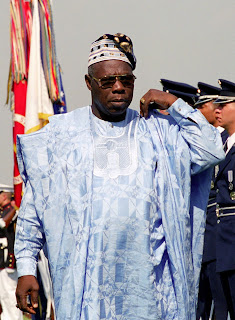
Olusegun Obasanjo


When the issue is Nigeria, former President Obasanjo is never afraid of controversy. It is the oxygen he effortlessly manufactures using the distillation process. Last week he took his battle with Pa Edwin Clark to another level by insisting “No territory in Nigeria, including the minerals found therein, belongs to the area of location. But except in Nigeria where military adventurers redesigned our federalism through arrogance of ignorance, we know of no other federation in the world where Obasanjo’s thesis has been validated.

Obasanjo also insisted the tribe has no role in a modern state. Again that has been settled after Europe debilitating tribal wars, often described as ‘world wars’ with a federal arrangement which confers dual citizenship on everyone and also prevents the tyranny of the state against individuals and groups.

The tragedy of our nation however has been this display of arrogance of ignorance by our successive leaders who equated their brainwaves to brilliant ideas to be imposed as government policy thrusts on the nation resulting in such aberrations as federal government-funded LGA that is accountable to state government, quota system aimed at lowering standard instead of building capacity for excellence, decreed political parties and decreed constitutions fraudulently foisted on Nigeria. Ironically these are the celebrated achievements our leaders bandy around to justify their statesmen, foremost patriot and father of modern Nigeria – titles.

But our leaders know themselves. It is therefore a relief that it was Pa Clark who last week dismissed Obasanjo in spite of his chest-beating as a hypocrite attracting Obasanjo’s response of I am ‘nobody’s lackey’. But what history, whether as record of our self-proclaiming heroes or summation of their quest to render selfless service to our nation has shown is that all our past leaders were lackeys to the two major political tendencies that have held Nigeria hostage since independence.

Tafawa Balewa was a minion of Ahmadu Bello who, as leader of victorious NPC, was expected to be crowned prime minister in 1959. He however in a deft political move picked as his lackey Tafawa Balewa, of Sayawas ethnic group of southern Bauchi, marginalized by their minority Fulani immigrant rulers. Indeed Trevor Clark, the biographer of ‘Tafawa Balewa: The Right Honorable Gentleman’, reminded us how his grandmother had agonised on her death bed over the presence of Fulani on their land and wanted all of them killed if they refused to leave.

And as Ahmadu Bello’s lackey, Balewa fought his master’s wars like a slave. In 1962, he imposed a state of emergency on the West over the throwing of chairs by Remi Fani-Kayode, leader of NCNC in the Western House and a few other Akintola supporters while he did not think Northern Region where Benue/Plateau’s armed insurrection had to be suppressed by the military required declaration of state of emergency. And then in 1965 while the ‘wild wild west’ burned following the resolve of the people to make Akintola and Fani-Kayode that had sowed the wind reap the whirlwind, Balewa writhed his hands waiting for his principal to return from hajj in Saudi Arabia until he was consumed by the crisis.

Similarly, Ironsi was a pencil in the hand of Igbo power-hungry elite who pressurized him to take over power following the disappearance of Tafawa Balewa instead of swearing in the most senior surviving minister as acting prime minister in line with constitutional provision. If there was any doubt that he was in government to serve Igbo interest, his decision to turn Nigeria into a unitary state, an NCNC/ Igbo agenda until 1959, following pressure from the Ibo politicians he surrounded himself with, laid such doubt to rest.

Gowon, the son of a Christian cleric is Angas from Lur in Kante Local Government of Plateau State was put in power by the surviving Fulani power-wielders instead of Murtala Mohammed, of Genawa Fulani clan of Kano State, the leader of the vengeance coup of July 1966. The 33 months war he led was termed ‘war of unity”. But since there is no perfect crime, Obasanjo’s latest Freudian slip that federal government victory in the civil war prevented Biafra from colonizing Niger Delta with its oil deposits was an admission the war was over ownership of Niger Delta oil.

It was obvious whose interest Murtala Muhammed, the leader of the vengeance coup that sought to sink Lagos with dynamite and secede after ferrying northern children and women back to Kaduna in a hijacked British Airways, was serving. Obasanjo who seized and centralized all regional interests from economic investments to education and health served the same interest as Murtala Mohammed. Since one good turn deserves another, Obasanjo was in 1998 brought out of prison and imposed as Yoruba candidate. He went on to literarily climb the palm tree from the top by winning the 1999 election despite his total rejection by his Yoruba people.

Of course Pa Clark and his Ijaw people on their part have since independence been lackeys to the Fulani ruling hegemonic class. Following Clark’s disagreement with northern elders over sponsorship of Boko Haram insurgency in 2012, he was quickly reminded by Alhaji Lawal Kaita, a fiery northern political commentator that he, Clark “used to be a very good friend of the north”.

It was not just that these lackeys served their principals, one thing they have in common is their contempt for Nigeria and Nigerians. Only last week, Wole Soyinka in his ‘forward’ to Pa Bisi Akande’s latest contribution to the literature on Nigerian leadership, “My Participations”, called our attention to “the repetition of the military opportunism that dons the wily garb of neutrality as it organizes an elaborate rituals of constitutional making with a predetermined outcome”, an assault he describes as “a contemptuous form of conduct that even the departing colonial powers did not impose on their fiefdom during their own rites of departure.”

One example of this, according to Bisi Akande was Obasanjo his junta’s ‘insertion of 19 amendments to the 1978/79 Constituent Assembly report to whittle down the authorities of the federating unit in their relationship with the central government”. But contemptuous treatment of Nigerians only got worse with the Babangida’s decreed political parties, Abacha’s hilarious constitution and “five fingers of a leprous hand” and Abdulsalami Abubakar 1999 constitution described by Professsor Akin Oyebode as ‘a military decree masquerading as a constitution’.

But while we were held in contempt by our leaders, we got better deal from the imperial powers as constitution making umpires. If they intervened, it was to protect Nigerians against self-serving politicians as when in order to stop the mischief of those canvassing a unitary constitution for a multi ethnic and multi-cultural Nigeria, they took side with protagonists of a federal constitution which they said would allow each group to develop at its own pace without interference from others. They also did the same at the 1957 Lancaster House debate when Zik and his allies lusting over Lagos land found a willing ally in Ahmadu Bello’s opposition to boundary adjustment in order to forestall losing Yoruba populated provinces in the north to the west by reneging on 1950 settled issue of status of Lagos. While the West did not get all they wanted, Zik and Ahmadu Bello’s motive to renounce a 1950 agreement was queried by Lord Milverton.

It is nothing but a sardonic humour that lackeys who have been confirmed to have served other tendencies instead of Nigeria, continue to pontificate, chair Bishop Kukah’s ‘National Peace Committee’ or preside over’ Nigeria Pray’ group as we search for the way forward.

---------------THE NATION

I Cheered When I heard That The ‘Colston Four’ had Been Acquitted – How Could I Not?

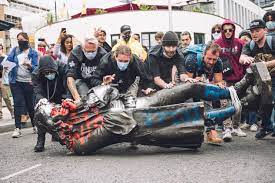
UK slave trader Edward Colston toppled. Image: Nur Photo/Getty


BRISTOL (INDEPENDENT)
-- I cheered when I heard that the anti-racism campaigners arrested after the toppling of the statue of slave trader Edward Colston in Bristol – the ‘Colston Four’ – had been cleared of criminal damage. How could I not?

My ancestors were the Eboe – or Igbo – people of Nigeria, many of whom ran away from their captors after they were stolen from the continent and brought to Jamaica. When I reflect on their journeys and the brutality they endured, it fuels my resounding desire to see racial justice achieved.


Edward Colston was both racist and murderous – the fact that he was long-gifted with immortalisation through this statue is a stain on our society.

Campaigners had been lobbying for the removal of this statue since as far back as the 1920s. Over the years, various petitions were launched; there was even a relatively short-lived consultation regarding the erection of a plaque explaining the slaver’s true legacy of subjugation and bloodshed.


The plaque, perhaps needless to say, never came to fruition. Too uncomfortable of an undertaking, I expect.

As such, Colston’s presence – elevated to lofty heights on its cosy plinth while his victims were cast into the shadows – felt akin to a hate crime. I simply don’t see how there aren’t grounds for Bristol City Council to be investigated for its failure to safeguard the residents of its city.


Bristol Crown Court did arrive at the correct conclusion in the Colston case, but it is a shame that prosecution was brought in the first place at the expense of the taxpayer – that money could have gone towards slavery reparations, as far as I’m concerned.

Despite the fact that many people from within marginalised communities do not trust the criminal justice system, the outcome of the Colston Four trial has been widely lauded as a victory. Sure, people have speculated whether the same outcome would have transpired were the defendants Black, given how much we’re overrepresented in prisons.

However, even if this is “white privilege” in action – reflecting the reality that white people are not criminalised at the rates which Black people are – on this occasion, such a benefit has arguably been used to further the anti-racism cause, and so should be grounds for celebration all round.

I noted that during the trial, the defence largely relied upon four points: that the intention was not to damage the statue, but merely to remove it; that the statue is owned by the citizens of Bristol, so there’s a claim to it (and its fate) by those who live in the city; that the damage inflicted upon the memorial was “proportionate in relation to the prevention of crime” such as indecency – in that the statue is an indecent display of a colonialist which causes offence to many of the population of Bristol; and that removing the statue was tantamount to the prevention of the crime of “misconduct of public offence”, where calls to remove the statue were ignored by the council.


According to co-defendant Rhian Graham, an art valuer found that the Colston statue has actually increased in worth, post-toppling. Before it was pulled down, the monument was valued at £6,000, while it would now go for up to £300,000.

I’m deeply uncomfortable with this sense of profiteering – to me, this would suggest that the city of Bristol stands to benefit from the statue in a way that’s not dissimilar to how enslaved Black people were torn from their families and bought and sold at auction.


Who really loses out in this situation? It’s not the city, which gained £70,000 from Colston’s estate; or the plethora of commentators who are foaming at the mouth, disappointed that the Colston Four weren’t convicted.

No, it is the legions of Black people who are still forced to grapple with the legacy of colonialism on a daily basis; who are living in a society entrenched with racism, alongside many more commemorations to the British empire.

It’s these same people, having been hurt by the statue’s existence, who are being gaslighted by commentators who ask glib questions such as, “Oh, where will it end?”

I’ll tell you how this story ends: the Colston statue is down and currently resting in the M Shed museum (reclining, if you please) – while Black people still don’t have the luxury of relaxing. We are too busy in the continuous fight for our lives and liberty.


Speaking on Good Morning Britain this morning, the right-wing commentator Calvin Robinson dismissed the brutal legacy of Colston, like so many across this country do: “Edward Colston had a very wicked past; he made his money in evil ways – but he did also put his money to good use in setting up old houses, charities and schools, so there’s a balance to be addressed.”

If Jeffrey Epstein and Ghislaine Maxwell opened shelters for sexual abuse victims, would that absolve them of their crimes? If Hitler financed counselling for Holocaust survivors, would that justify a bronze memorial of the dictator being pushed down their throats each day?

And if it’s history that Colston’s defenders want to talk about, then let’s talk about history: having been born into a wealthy merchant’s family, Colston rose to become a chief executive in the Royal African Company, which held a monopoly over the slave trade for a large part of the 17th century. He was directly involved in the trafficking and enslavement of tens of thousands of African people, including children, between 1680 and 1692. Many Black people resided in the city of Bristol.

Young people were snatched from villages in Africa for enslavement, while those deemed of little worth – such as babies and the elderly – would be butchered in front of them as part of the “seasoning” process of psychologically and spiritually destroying captives. Many would be branded with a hot iron before being packed in and chained to the decks of the ships bound for the Caribbean.


At one point, Bristol was Britain’s largest slaving city, accounting for 20 per cent of the trade, and was involved in the transportation of more than half a million people – more than its current population.

Owners had the right to torture and kill slaves who tried to rebel, and the bodies of those killed were often nailed to posts around plantations as a warning to others. Slave-owning in British colonies was not abolished until 1834.

The British government raised a huge sum, £2m, through bonds to compensate slave owners for their loss – the inconvenience of not owning Black people to make them rich.

This held the record for the largest ever government bailout of an industry until the bailout of the banks during the financial crisis of 2008 and 2009; through the payment of taxes, many of us – including descendants of those enslaved – unwittingly financially contributed to the payment of that debt which was paid off in 2015. Let that sink in.


The very least that Black people are owed is the right to not be confronted by slaver statues and colonial relics, which serve as reminders of what our families endured and continue to as a result of broken families, interrupted histories and intergenerational socioeconomic deprivation.

Black people today still live with the legacy of the actions of people like Colston. Yet despite being instrumental in atrocities against so many Black families, Colston was able to successfully rebrand during his lifetime, donating huge amounts of money to charitable causes in Bristol.

Following his death, a “cult of Colston” sprouted in the city – which saw statues erected, and societies, schools and streets named after him (some of which were renamed after the death of George Floyd and the resurgence of the Black Lives Matter movement).

To keep up to speed with all the latest opinions and comment sign up to our free weekly Voices Dispatches newsletter by clicking here


Renaming or no renaming, some of us will never forget the truth – least of all people who, like me, are descendants of enslaved African people.

I can’t forget the grim statistics: such as the fact that at least 19,000 Black people died on ships bound for the Caribbean and the Americas. Many of their bodies were tossed overboard while some opted to jump of their own accord, resolving to embrace a watery grave over a life of enslavement. That’s the reality.

Let’s also not forget that slavery, despite its atrocities, was considered legal at the time of its operation – and would still exist today were it not for actions then deemed illegal and rebellious.

So, I’ve got to tell you: witnessing the Colston statue being tossed into the water – like countless enslaved African people were disposed of, as though they were chattel, having been stolen from their homes – satisfied me no end.


How could I not celebrate the acquittal of the Colston Four? In pre-Covid times, parties would’ve been thrown and I’d have been in the middle of the dance-floor, jubilant that some small part of a deeply tragic history was being set right.

NIGERIA: PDP Chieftain Faults Buhari On Nnamdi Kanu, State Police

Muhammadu Buhari


BY ADEJOKE ADELEYE
PM NEWS

A chieftain of Peoples Democratic Party (PDP), Segun Sowunmi has said the position of President Muhammadu Buhari on the leader of Indigenous People of Biafra, IPOB, Nnamdi Kanu, as he espoused during his interview on television on Thursday showed that he has not gotten over the shock of civil war.

The President had in the interview said he will not interfere in the ongoing treason trial of the IPOB leader or accede to request to release him from detention.

But Sowunmi said the tone of the President Kanu and IPOB was certainly not re-conciliatory nor reflective of the need to heal and unite the country.

In the same vein, Sowunmi said the President’s opposition to establishment of state police was not well thought out.

The PDP Chieftain noted that with the increasing population of the country, the attendant security challenges will naturally demand a multilayered policing framework and therefore Buhari’s decline to sign state police is not progressive.

“It is clear that the needed level of reflections has not gone into the opposition to state police by Mr President, the truth of the matter is that the multifaceted security challenges we have all over the country makes it imperative for the Fact and all leaders of goodwill to rethink this state police issue.

“If President Buhari is unwilling, he will find out with time, that he can only delay it, for an idea whose time has come cannot be killed.

“The population of the country is increasing, the attendant security challenges will naturally demand a multilayered policing framework. To obstinately say no is certainly not progressive.”

“On the Igbo issues generally and the Nnamdi Kalu specifically, it is most unfortunate that it seems the president has not gotten over the civil war after all these years, the tone is certainly not re-conciliatory nor reflective of the need to heal and unite the country.

“No one is interested in a crisis nor is a nation that is not harmonious with itself the best legacy for the president’s generation to bequeath to Nigeria,” Sowunmi said.

Nigerian Sentenced For Federal Fraud Violations In The Eastern District Of Texas

 PRESS RELEASE

Shalom Olumide Ayotunde. Image: Henderson County Mugshots


SHERMAN, TEXAS (US DEPARTMENT OF JUSTICE) – A Nigerian man has been sentenced to federal prison for fraud violations in the Eastern District of Texas, announced U.S. Attorney Brit Featherston today.

Shalom Olumide Ayotunde, 39, pleaded guilty on July 1, 2021, to passport fraud, false claim to U.S. citizenship, wire fraud, and false statement to a financial institution, and was sentenced to 46 months in federal prison today by U.S. District Judge Amos L. Mazzant, III.  Ayotunde was also ordered to pay restitution in the amount of $1,067,000.

According to court documents, in June 2018, Ayotunde provided false identifying information in his application for a U.S. passport, and in doing so, also falsely claimed to be a U.S. citizen.  Ayotunde was also involved in falsifying information in connection with numerous applications for Payment Protection Program loans, and ultimately received more than $1 million in fraudulent PPP loan proceeds. Additionally, evidence showed that Ayotunde was part of a conspiracy to defraud companies through business email compromise schemes and acted as a money mule when he knowingly received and transferred proceeds of fraudulent activity. Evidence showed that Ayotunde received or attempted to receive more than $800,000 in stolen funds.  A federal grand jury returned an indictment charging Ayotunde with federal violations on Nov. 13, 2020.

On May 17, 2021, the Attorney General established the COVID-19 Fraud Enforcement Task Force to marshal the resources of the Department of Justice in partnership with agencies across government to enhance efforts to combat and prevent pandemic-related fraud. The Task Force bolsters efforts to investigate and prosecute the most culpable domestic and international criminal actors and assists agencies tasked with administering relief programs to prevent fraud by, among other methods, augmenting and incorporating existing coordination mechanisms, identifying resources and techniques to uncover fraudulent actors and their schemes, and sharing and harnessing information and insights gained from prior enforcement efforts. For more information on the Department’s response to the pandemic, please visit https://www.justice.gov/coronavirus.

Anyone with information about allegations of attempted fraud involving COVID-19 can report it by calling the Department of Justice’s National Center for Disaster Fraud (NCDF) Hotline at 866-720-5721 or via the NCDF Web Complaint Form at: https://www.justice.gov/disaster-fraud/ncdf-disaster-complaint-form.

 If you or someone you know is age 60 or older and has been a victim of financial fraud, help is standing by at the National Elder Fraud Hotline: 1-833-FRAUD-11 (1-833-372-8311).  This U.S. Department of Justice hotline, managed by the Office for Victims of Crime, is staffed by experienced professionals who provide personalized support to callers by assessing the needs of the victim, and identifying relevant next steps.  Case managers will identify appropriate reporting agencies, provide information to callers to assist them in reporting, connect callers directly with appropriate agencies, and provide resources and referrals, on a case-by-case basis.  Reporting is the first step.  Reporting can help authorities identify those who commit fraud and reporting certain financial losses due to fraud as soon as possible can increase the likelihood of recovering losses.  The hotline is staffed 10am-6pm Eastern Time, Monday-Friday. English, Spanish, and other languages are available.   

This case was investigated by the U.S. Department of State- Diplomatic Security Service and the Federal Bureau of Investigation and was prosecuted by Assistant U.S. Attorney Camelia Lopez.

Report: Ethiopia Detains Many Tigrayans Deported From Gulf


FILE - A group from the Tigrayan diaspora in North America protest about the conflict in Ethiopia, near the State Department, on Dec. 22, 2021, in Washington. Officials in Ethiopia have arbitrarily detained and forcibly disappeared thousands of ethnic Tigrayans who recently were deported from Saudi Arabia, a new Human Rights Watch report said Wednesday, Jan. 5, 2022, as the country's deadly Tigray conflict continues. (AP Photo/Alex Brandon, File)


NAIROBI, KENYA (AP) — Officials in Ethiopia have arbitrarily detained and forcibly disappeared thousands of ethnic Tigrayans who recently were deported from Saudi Arabia, a new Human Rights Watch report says as the country’s deadly Tigray conflict continues.

This is the latest report citing witnesses who have described mass arrests of ethnic Tigrayans. Ethiopia’s government says it is targeting people suspected of supporting the Tigray forces who have fought the government since November 2020 but pulled back into their region weeks ago.

“Tigrayan migrants who have experienced horrific abuse in Saudi custody are being locked up in detention facilities upon returning to Ethiopia,” said Nadia Hardman, refugee and migrant rights researcher at Human Rights Watch. “Saudi Arabia should offer protection to Tigrayans at risk, while Ethiopia should release all arbitrarily detained Tigrayan deportees.”

The report released Wednesday called on Saudi officials to “stop holding ethnic Tigrayans in abhorrent conditions and deporting them to Ethiopia, and instead help the United Nations high commissioner for refugees to provide them with international protection.”

Thousands of Ethiopians, mostly from the Tigray and Amhara regions, make illegal travel each year to Saudi Arabia through Yemen in search of a better life. But Saudi officials have deported thousands of them in recent years.

According to Ethiopian officials, tens of thousands of the migrants have returned home in recent months. Human Rights Watch said Ethiopian authorities have transferred Tigrayan deportees to reception centers in the capital, Addis Ababa, where some were unlawfully held.

A federal police spokesman did not immediately respond to a request for comment on the Human Rights Watch allegations.

Trhas, a 33-year-old Tigrayan woman who was deported from Saudi Arabia in December 2020, told the rights group that federal police stopped her at a checkpoint at Awash Sebat in Ethiopia’s Afar region in April and took her to a “military camp” where she was held with up to 700 other Tigrayan deportees.

After two days they took her to Shone in the southern part of the country. “We asked the federal police for food and water and the toilet, but we were beaten if we left our seats,” she told the rights group, adding that police told the Tigrayans that “Bandits don’t need food.”

Ethiopia’s war is estimated to have killed tens of thousands of people and displaced millions. Meanwhile, Tigrayans have told The Associated Press they live in fear.

Ethiopia’s government has sought to restrict reporting on the war and detained some journalists, including a video freelancer accredited to the AP, Amir Aman Kiyaro.

‘Hatred In The Eyes’: How Racist Rage Animated Jan. 6 Riots

FILE - Rep. Cori Bush, D-Mo., speaks during an interview Nov. 12, 2021, in Northwoods, Mo. Bush is no stranger to protests. She spent years marching the streets of St. Louis and Ferguson, Mo., rising to public office on the strength of her activism. But as she looked out the window of the Capitol on Jan. 6, 2021, only her third day as a member of Congress, she knew what was about to take place would be no peaceful protest. The Confederate flags in the crowd, and the makeshift noose and gallows erected on the Capitol grounds, spoke to a more sinister reality. (AP Photo/Jeff Roberson, File)


BY FARNOUSH AMIRI

WASHINGTON (AP)
— Rep. Cori Bush is no stranger to protests. She spent years marching the streets of St. Louis and Ferguson, Missouri, rising to public office on the strength of her activism.

But as the Missouri Democrat looked out the window of the Capitol on Jan. 6, 2021 — only her third day as a member of Congress — she knew what was about to take place would be no peaceful protest. The Confederate flags in the crowd, and the makeshift noose and gallows erected on the Capitol grounds, spoke to a more sinister reality.

“I’ve been to hundreds of protests and have organized so many protests, I can’t count. I know what a protest is: This is not that,” Bush, who is Black, said recently in an interview with The Associated Press.

The insurrection by pro-Trump supporters and members of far-right groups shattered the sense of security that many had long felt at the Capitol as rioters forcibly delayed the certification of Democrat Joe Biden’s election victory.

But for people of color, including many in Congress, the attack was more than a violent challenge to a free and fair election — it was an eerily familiar display of white supremacist violence, this time at the very seat of American democracy.

“First of all, as a Black woman, that is already just tough on a level that’s different from what a white person would experience,” Bush said of the imagery and rhetoric surrounding the attack, especially the Confederate flag that was carried by a rioter inside the Capitol. “But it’s especially different for Black people because of our history. The history of this country has been that type of language and imagery is directed right at us in a very negative and oftentimes violent way.”

While Bush managed to escape the Capitol and barricade with her staff in her office in a nearby building, dozens of police officers faced down the violent mob in hours of frantic hand-to-hand combat. More than 100 officers were injured, some severely.

A group of officers testified to Congress in July about the physical and verbal abuse they faced from supporters of former President Donald Trump. Harry Dunn, a Black officer, recalled an exchange he had with rioters who disputed that Biden defeated Trump.

When Dunn said that he had voted for Biden and that his vote should be counted, a crowd began hurling a racial slur at him.

“One woman in a pink MAGA (Make America Great Again) shirt yelled, ‘You hear that guys, this n—- voted for Joe Biden!’” said Dunn, who has served more than a dozen years on the Capitol Police force.

“Then the crowd, perhaps around 20 people, joined in, screaming, ‘Boo! F—-ing n—-!’” he testified. He said no one had ever called him the N-word while he was in uniform.

Later that night, Dunn said, he sat in the Capitol Rotunda and wept.

Meanwhile, as the attack unfolded at the Capitol, a handful of lawmakers remained trapped in the House and Senate galleries with no escape as rioters fought to break in.

After a gunshot killing Ashli Babbitt, who was among the rioters and attempting to leap through a broken window, rang out in the House chamber, Democratic Rep. Jason Crow of Colorado decided the best thing members could do was take off their congressional pins identifying them as lawmakers.

But for lawmakers of color like Rep. Pramila Jayapal, D-Wash., removing the pin was not an option.

“I thought there’s no way I’m taking off my pin. Because it was either you get recognized by the insurrectionist or you don’t get recognized by Capitol Police as a brown woman or Black woman,” Jayapal told the AP in December.

She added: “And so many of the members of color that I know did not take off their pins.”

Rep. Bennie Thompson, D-Miss., the chairman of the panel investigating Jan. 6 and among those stuck in the gallery, said that day specifically brought back “unpleasant experiences” from his early days as a Black politician in Mississippi.

“I saw the kind of hatred in the eyes of the people who broke in the Capitol. It was that same kind of hatred I saw in people who wanted to stop people of color from casting a ballot for the candidate of their choice in Mississippi,” Thompson said.

In the aftermath of the attack, Crow and other white lawmakers reckoned with the experiences their colleagues of color faced that day. Crow told his Democratic colleague Rep. Val Demings, a Black former Orlando police chief who was also trapped in the gallery, that he didn’t realize at the time how difficult it would be for members of color to disguise themselves from the mob.

“Jason shared after all of it with me that for him — these are his words — as a white male he could take off his pin, or he could keep his pin and run over to the other side with the Republicans and stand there and people may not know the difference,” Demings said.

Rep. Jim Himes, D-Conn., also reflected on his ability to blend in more easily.

“I think to myself, well, if I need to, I can untuck my shirt, I can throw my jacket away. I’m a white guy,” Himes said. “There’s actually a reasonable probability that I get through this crowd, right? In retrospect, I reflected on the fact that that was not true for Ilhan Omar,” he said, referring to the Black Democrat from Minnesota.

Crow himself called the interaction that day a “learning moment.”

“It wasn’t until that day when I was on the receiving end of the violence of white supremacy in our nation that I understood,” he said.

The attack finally ended and the Capitol was secured. The rioters were allowed to peacefully leave the complex and lawmakers who stayed to finish the certification of the election went home. The images that surfaced online and on television showed the Capitol’s janitorial staff, the majority of them people of color, sweeping the broken glass and scrubbing the walls.

Rep. Andy Kim, D-N.J., joined them, getting on his hands and knees to pick up water bottles, clothing, Trump flags and U.S. flags. The son of Korean immigrants and, in 2018, the first Asian American to represent New Jersey in Congress, Kim reflected at the time how he, a person of color, was cleaning up after people who waved white supremacist symbols like the Confederate flag during the melee.

While he hadn’t considered race at the time, Kim told the AP shortly after the attack, “It’s so hard because we don’t look at each other and see each other as Americans first.”

___

Associated Press writer Mary Clare Jalonick contributed to this report.

Wednesday, January 05, 2022

FBI Still Hunting Jan. 6 Suspects, Pipe Bomber A Year Later


This image from an FBI poster seeking a suspect who allegedly placed pipe bombs in Washington on Jan. 6, 2021. Just before the U.S. Capitol was stormed by a sea of pro-Trump rioters the pipe bombs discovered. It quickly became one of the highest-priority investigations for the FBI and the Justice Department. Now, a year later, federal investigators are no closer to learning the person’s identity. And a key question remains: was there a connection between the pipe bombs and the riot at the Capitol? (FBI via AP)

BY MICHAEL BALSAMO

WASHINGTON (AP) — The suspect was covered from head to toe, skulking through the dark streets of the nation’s capital before methodically placing two explosives outside the offices of the Republican and Democratic national committees.

Only 17 hours later — and just before the U.S. Capitol was stormed by a sea of pro-Trump rioters — were the pipe bombs discovered. It quickly became one of the highest-priority investigations for the FBI and the Justice Department.

But the trail grew cold almost immediately. A year later, federal investigators are no closer to learning the person’s identity. And a key question remains: Was there a connection between the pipe bombs and the riot at the Capitol?

The suspect is among hundreds of people still being sought by the FBI following last January’s deadly insurrection. So far, 250 people seen on video assaulting police at the Capitol still haven’t been fully identified and apprehended by the FBI, and another 100 are being sought for other crimes tied to the riot.

The investigation has been a massive undertaking for federal law enforcement officials. More than 700 people have been charged with federal crimes stemming from the Jan. 6 attack, and arrests are still being made regularly.

But for the FBI agents working on the cases, the job is far from over. Agents and investigative analysts have been poring over thousands of hours of surveillance video, going second by second in each video to try to capture clear images of people who attacked officers inside the Capitol.

“This investigation takes time because it is a lot of lot of work, a lot of painstaking work that they look at the video kind of frame by frame,” said Steven D’Antuono, the assistant director in charge of the FBI’s field office in Washington.

In one case, police body camera footage captures a man using a cane with electric prods on the end jabbing at officers and shocking them as they fight to hold back the riotous crowd trying to break through a barricaded line of officers at one of the doors of the Capitol. The crackling sound of the electricity can be heard as he prods his cane into one of the officers. The man, known only as “AFO114” — using shorthand for “assaulting a federal officer” — is still being sought.

“The assaults against the police officers are extremely serious,” D’Antuono said. More than 100 police officers were attacked by rioters on Jan. 6, some attacked by multiple people and some attacked multiple times, he said.

In another video, a man is seen repeatedly bashing a police officer over the head with a 6-foot (1.8-meter) metal pole as he tries to push his way into the Capitol. And a third shows a man spraying some kind of chemical from a can into the faces of other officers.

“There is still a lot of work to be done on this,” D’Antuono said. “There were a lot of people up there at the Capitol, a lot of people that either committed violence up there did other unlawful actions up there.”

In the search for the person who left the pipe bombs at the RNC and DNC offices, investigators have interviewed more than 900 people, collected 39,000 video files and examined more than 400 leads. They have dived into the components of the explosives and have been working to try to discern anything they can about the suspect, from analyzing the person’s gait to trying to collect information about purchases of the distinctive Nike sneakers the person wore.

But they are still no closer to finding the suspect’s identity and are hoping renewed attention on the video of the person may spark a tip to crack the case.

The explosive devices were placed outside the two buildings between 7:30 p.m. and 8:30 p.m. on Jan. 5, 2021, but weren’t located by law enforcement until the next day. U.S. Capitol Police and agents from the FBI and the Bureau of Alcohol, Tobacco, Firearms and Explosives were called to the Republican National Committee’s office around 12:45 p.m. on Jan. 6. About 30 minutes later, as the agents and bomb technicians were still investigating at the RNC, another call came in for a similar explosive device found at the Democratic National Committee headquarters nearby. The bombs were rendered safe, and no one was hurt.

Video released by the FBI shows a person in a gray hooded sweatshirt, a face mask and gloves appearing to place one of the explosives under a bench outside the DNC and separately shows the person walking in an alley near the RNC before the bomb was placed there. The person wore black and light gray Nike Air Max Speed Turf sneakers with a yellow logo.

“We’ve used and continue to use every investigative tool that we lawfully have to find this individual,” D’Antuono said. But, a year later, investigators still don’t know whether the suspect is a man or a woman. The person carried the bombs — made of threaded galvanized pipes, kitchen timers and homemade black powder — in a backpack.

“We’re still nose to the grindstone here and trying to find this individual, trying to bring the person to justice,” D’Antuono said. “But there is hopefully maybe somebody still out there that knows the person or sees the video again.”

It is unclear whether the bombs were related to planning for the insurrection or whether they were unrelated to the deadly riot. Both buildings are within a few blocks of the Capitol.

And the fact the suspect was covered from head to toe has made identifying the person extremely difficult for the FBI.

“In normal times, like if this wasn’t COVID,” D’Antuono said, “a person walking down the street in D.C. covered from head to toe with a mask on, glasses and gloves would have been a red flag.”

Better Parenting Starts With Knowing What Works. We Tested A Project In 8 African Countries

BY INGE VALLANCE AND GENEVIEVE HAUPT RONNIE Raising adolescents can be difficult under the best of circumstances. On top of that, some famil...