Tuesday, August 12, 2025

Free Ralph Uwazuruike


BY OBI NWAKANMA

This week, on July 6, (2007), it would be exactly forty years since the Federal forces launched a two-pronged military attack on the peoples of the old Eastern Nigeria, from Nsukka and Garkem, which effectively began the civil war in 1967.

The Eastern Region had seceded from the old federation of Nigeria, and declared itself a new country, the Peoples Republic of Biafra. This was a remarkable development, especially for a people, who had led the anti-colonial nationalist liberation movement, invested much of their energy to create a united Nigeria, and a modern nation state, basically coined the term, “unity in diversity” as the guiding principle of their Nigerian vision, and made remarkable political and economic compromises to ensure the emergence of a free, liberated, Nigerian state.

But the tide had turned from the January 15 putsch led by Emmanuel Ifeajuna, and mostly Igbo officers, like Chukwuma Nzeogwu operating from the Kaduna end, and the northern counter-coup of July 29, led by Murtala Muhammed and officers like T.Y. Danjuma. The death toll from January to September 1966 was horrendous. But its most remarkable outcome was the character of what has been described as the northern “revenge coup.”

It not only initiated a massacre of southern Nigerians, particularly Igbo officers and men, in the barracks, but the killing spilled into the streets, and into the private homes of easterners, living across the North, and parts of western Nigeria. The organized killings of easterners in relentless waves of the pogrom from May 1966 to September 1966, has been fully documented, and presented, first at the Onyuike Atrocities Commission in Enugu in 1967, and years later at the Justice Oputa Commission in Abuja in 2002.

It was in the backdrop of these waves of killings and great waves of return to the East, that it became quite clear to the Igbo particularly, that the very concept of Nigeria needs to be fundamentally renegotiated. But while Odumegwu-Ojukwu, and other leaders of the East were examining their alternatives in 1966, positions were equally hardening in Lagos, then the epicentre of Nigeria’s political power. But a slight possibility of reconciliation occurred when the Ghanaian General Akufo brokered a meeting in Aburi, which brought together, the key players, and the various factions in the Nigerian crisis early in January 1967.

The Aburi conference paved way to a number of keystone resolutions, the agreements upon which was framed, a sense of the new national realities, and the spirit of which still haunts Nigeria, for the Aburi accord truly still holds the true future and survival of Nigeria as both a federation and a country. The current clamour for constitutional review, and of restructuring, stems from the fall outs and distortions occasioned by the illegalities of 1966/67, that subverted the foundational frameworks of the Independence constitution of 1960, and the Republican charter of 1963, upon which a free Nigeria was founded and consecrated.

The Eastern Regional authorities went home from Aburi, and prepared for operationalizing the Aburi agreements, but what was seen to amount to a perfidious repudiation of the key elements of the agreement kicked the can down the road of an epic conflict. In the event, seeing that the leadership of the eastern region had dug in on its position, the Nigerian end peremptorily announced the creation of twelve states without consultation or plebiscitory authority, thus setting the tone for Odumegwu-Ojukwu, having been thus mandated by the Eastern Consultative
Assembly, declared the Eastern Region, the Republic of Biafra, with its sign of the Rising Sun.

The grim battles were fought, and the end came in 1970, and the peace settled on a “No Victor, No Vanquished” resolution. This in sum is the story of the most emblematic moment of Nigeria’s postcolonial history, and the event that continues to reproduce and haunt its meaning of nation, because the ghosts are not yet buried.

The Igbo, and much of the minority peoples of Eastern Nigeria, and the old Midwest, have since complained, and have variously, frequently raised objection to a sense of their lands as still occupied territories, where oil production activities have made many wealthy Nigerians, but left those on whose lands the resource is found, mostly impoverished.

It is quite remarkable that most of these areas in the former Eastern and Midwestern regions, which were the theatres of the last civil war, remain the most economically and infrastructurally underdeveloped areas in contemporary Nigeria, and mostly by deliberate federal government policy since the end of the war in 1970. As for the Igbo, much ink has been expended on their sense of oppression and deliberate alienation from the Nigerian polity, and the official methods that have been perfected to reduce Igbo significance and contribution, and the benefits of citizenship in the Nigeria to which they returned freely in 1970.

This sense of alienation was precisely what has inspired the agitations in the Niger Delta, and in the Igbo areas, where pro-Biafra sentiments have recently arisen, and whose more public face is a lawyer called Ralph Uwazurike, who has led the group called MASSOB.

The unique thing about MASSOB is its methods of non-violence, a means by which it has conducted, and indeed organized Igbo public opinion, to register their desire for either equality or justice in Nigeria, or peaceful separation. In my view, there is absolutely nothing wrong with the MASSOB position. It is a legitimate and democratic stance, and it is within the rights fundamentally enshrined in the UN charter in 1945.

The demonization of MASSOB cannot obscure this very fact, because, frankly, there is nothing absolutely sacrosanct about Nigeria. The only thing that is sacrosanct is the life in it, and the dignity accorded to that life. As part of its sweeping operations against various radical nationalist movements within Nigeria, the Obasanjo government arrested and detained Uwazurike, and Dr. Fasehun, Gani Adams, and Asari Dokubo, leaders of the Yoruba OPC movement and the Niger Delta Peoples Volunteer Force, respectively. The last two are not pacifist movements. The Obasanjo government nevertheless, released the OPC leaders, and only recently, as part of his gestures to the Niger Delta, the Yar Ardua government released Asari Dokubo.

One commends all that. But the question is: what about Ralph Uwazurike? Last week Senator Uche Chukwumerije introduced the question of his release to the Senate, and it was shot down. Ralph Uwazurike’s case again re-emphasizes the case that the Igbo make about discrimination. The Nigerian authorities often act, it seems, with deliberate intentions to insult the Igbo, although many well-meaning Igbo have never failed to point out that the silence of the Igbo people is not from an inability to act with ferocity.

It is that most Igbo are willing to thread the path of peace and reason, until it becomes clear that such options are exhausted. But the Ralph Uwazurike case, his continued detention is unacceptable in the light of the federal government’s general gestures.

He not only has a right to his beliefs, and to his freedoms, but given the non-violent nature of his movement, he cannot be said to advocate violence against the authorities. But it seems that Uwazurike is wrong, only in the sense that the federal government hearkens first to those who present their arms with their colours, against those who merely use their mouths and their wit in political agitation. All well meaning Nigerians must demand the release of Ralph Uwazurike, because it is right and proper that he returns home to his family and people.

THIS ARTICLE WAS PUBLISHED ON JULY 1, 2007 AT OHUZO

The Dark History Of Forced Starvation As A Weapon Of War Against Indigenous Peoples

The ‘Navajo Long Walk’ – the 1864 forced removal of the Navajo people from their ancestral homelands in present-day Arizona and New Mexico. The U.S. National Archives and Records Administration via Wikimedia Commons

BY RASALYN P. LAPIER
PROFESSOR OF HISTORY,
UNIVERSITY OF ILLINOIS AT
URBANA-CHAMPAIGN

There is increasing evidence that “widespread starvation, malnutrition and disease” are driving a rise in hunger-related deaths“ in Gaza, a group of United Nations and aid organizations have repeatedly warned.

A July 29, 2025, alert by the Integrated Food Security Phase Classification, a global initiative for improving food security and nutrition, reported that the "worst-case scenario of famine is currently playing out in the Gaza Strip,” as access to food and other essential items is dropping to an “unprecedented level.”

More than 500,000 Palestinians, one-fourth of Gaza’s population, are experiencing famine, the U.N. stated. And all 320,000 children under age 5 are “at risk of acute malnutrition, with serious lifelong physical and mental health consequences.”

U.N. experts have accused Israel of using starvation “as a savage weapon of war and constitutes crime under international law.”

They are calling on Israel to urgently “restore the UN humanitarian system in Gaza.”

Israel is not the only government in history to cut off access to food and water as a tool of war. As an Indigenous scholar who studies Indigenous history, I know that countries – including the United States and Canada – have used starvation to conquer Indigenous peoples and acquire their land. As a descendant of ancestors who endured forced starvation by the U.S. government, I also know of its enduring consequences.

Dismantling Indigenous food systems

From the founding of the U.S. and Canada through the 20th century, settler colonizers often tried to destroy Indigenous communities’ access to food, whether it was their farms and livestock or their ability to access land with wild animals – with the ultimate aim of forcing them off the land.

In 1791, President George Washington ordered Secretary of War Henry Knox to destroy farms and livestock of the Wea Tribe that lived along the Ohio River valley – a fertile area with a long history of growing corn, beans, squash and other fruits and vegetables.

Knox burned down their “corn fields, uprooted vegetable gardens, chopped down apple orchards, reduced every house to ash, [and] killed the Indians who attempted to escape,” historian Susan Sleeper-Smith noted in her 2018 book, “Indigenous Prosperity and American Conquest.” Women and children were taken hostage. The goal was to destroy villages and farms so that Indigenous people would leave and not return.

Seventy-two years later, General Kit Carson conducted a scorched-earth campaign to remove the Navajo from what is now Arizona and New Mexico. Similar to Knox, he destroyed their villages, crops and water supply, killed their livestock and chopped down over 4,000 peach trees. The U.S. military forced over 10,000 Navajo to leave their homeland.

Indigenous famine

By the late 19th century, numerous famines struck Indigenous communities in both the U.S. and Canada due to the “targeted, swift, wholesale destruction” of bison by settlers, according to historian Dan Flores; this, too, was done in an effort to acquire more Indigenous land. One U.S. military colonel stated at the time: “Kill every buffalo you can! Every buffalo dead is an Indian gone.”

There were an estimated 60 million bison before U.S. and Canadian settlement; by the 1890s, there were fewer than 1,000. Indigenous communities on the northern Great Plains in both the U.S. and Canada, who believed bison were a sacred animal and who relied on them for food, clothing and other daily needs, now had nothing to eat.

Historian James Daschuk revealed in his 2013 book, “Clearing the Plains: Disease, Politics of Starvation, and the Loss of Aboriginal Life,” that between 1878 to 1880, Canadian Prime Minister Sir John A. Macdonald did little to stop a multiyear famine on the Canadian Plains, in what is now Manitoba, Saskatchewan and Alberta. Macdonald did not hide his intentions. He and his government, he said, were “doing all we can, by refusing food until the Indians are on the verge of starvation.”

Indigenous peoples on the Canadian Plains were forced to eat their dogs, horses, the carcasses of poisoned wolves and even their own moccasins. All the Indigenous peoples in the region – an estimated 26,500 people – suffered from the famine. Hundreds died from starvation and disease.

Malcolm C. Cameron, a House of Commons member at the time, accused his government of using “a policy of submission shaped by a policy of starvation” against Indigenous peoples. His denunciation did little to change their policy.

What my great-grandparents experienced

Many Indigenous peoples’ families in the U.S. and Canada have stories of surviving forced starvation by the government. Mine does, too.

In the winter of 1883-1884, my grandmother and grandfather’s parents experienced what is remembered as the “starvation winter” on the Blackfeet reservation in what is now Montana.

Similar to what happened in Canada, the near extinction of bison by American settlers led to a famine on the Blackfeet reservation. In an effort to slow the famine, Blackfeet leaders purchased food with their own money, but the U.S. government supply system delayed its arrival, creating a dire situation. Blackfeet leaders documented 600 deaths by starvation that one winter, while the U.S. government documented half that amount.

As historian John Ewers noted, the nearby “well-fed settlers” did nothing and did not offer “any effective aid to the Blackfeet.”

My family survived because a few men and women within our family were able to travel far off the reservation by horseback to hunt and harvest Native foods. I was told the story of the “starvation winter” my entire life, as were most Blackfeet. And I now share these stories with my own children.

Weapon of war

Thousands of children in Gaza are malnourished and dying of hunger-related causes.

Due to mounting international pressure, Israel is pausing its attacks in some parts of Gaza for a few hours each day to allow for some aid, but experts have noted it is not enough.

“We’re talking about 2 million people. It’s not 100 trucks or a pausing or a few hours of calm that is going to meet the needs of a population that has been starved for months,” Oxfam official Bushra Khalidi told The New York Times.

“This is no longer a looming hunger crisis – this is starvation, pure and simple,” Ramesh Rajasingham, director of the U.N.’s Office for the Coordination of Humanitarian Affairs, said on Aug. 10, 2025.

Many might assume that the use of starvation as a weapon of war happened only in the past. Yet, in places like Gaza, it is happening now.

READ ORIGINAL STORY HERE

Monday, August 11, 2025

This Isn’t How Wars Are Ended − A Veteran Diplomat Explains How Trump-Putin Summit Is Amateurish And Politically Driven

U.S. President Donald Trump and Russian President Vladimir Putin will meet in Alaska on Aug. 15, 2025. Here, they arrive for a group photo at the G20 Summit in Osaka on June 28, 2019. Brendan Smialowski/AFP via Getty Images. Brendan Smialowski / AFP via Getty Images

BY DONALD HEFLIN
EXECUTIVE DIRECTOR OF THE EDWARD R. MURROW
CENTER AND SENIOR FELLOW OF DIPLOMATIC 
PRACTICE, THE FLETCHER SCHOOL, TUFTS UNIVERSITY

A hastily arranged summit between President Donald Trump and Russian President Vladimir Putin is set for Aug. 15, 2025, in Alaska, where the two leaders will discuss a peace deal between Russia and Ukraine. Ukrainian President Volodymyr Zelenskyy will not attend, barring a last-minute change. The Conversation’s politics editor Naomi Schalit interviewed longtime diplomat Donald Heflin, now teaching at Tufts University’s Fletcher School, to get his perspective on the unconventional meeting and why it’s likely to produce, as he says, a photograph and a statement, but not a peace deal.

How do wars end?

Wars end for three reasons. One is that both sides get exhausted and decide to make peace. The second, which is more common: One side gets exhausted and raises its hand and says, “Yeah, we’re ready to come to the peace table.”

And then the third is – we’ve seen this happen in the Mideast – outside forces like the U.S. or Europe come in and say, “That’s enough. We’re imposing our will from the outside. You guys stop this.”

What we’ve seen in the Russia-Ukraine situation is neither side has shown a real willingness to go to the conference table and give up territory.

So the fighting continues. And the role that Trump and his administration are playing right now is that third possibility, an outside power comes in and says, “Enough.”

Now you have to look at Russia. Russia is maybe a former superpower, but a power, and it’s got nuclear arms and it’s got a big army. This is not some small, Middle Eastern country that the United States can completely dominate. They’re nearly a peer. So can you really impose your will on them and get them to come to the conference table in seriousness if they don’t want to? I kind of doubt it.

How does this upcoming Trump-Putin meeting fit into the history of peace negotiations?

The analogy a lot of people are using is the Munich Conference in 1938, where Great Britain met with Hitler’s Germany. I don’t like to make comparisons to Nazism or Hitler’s Germany. Those guys started World War II and perpetrated the Holocaust and killed 30 or 40 million people. It’s hard to compare anything to that.

But in diplomatic terms, we go back to 1938. Germany said, “Listen, we have all these German citizens living in this new country of Czechoslovakia. They’re not being treated right. We want them to become part of Germany.” And they were poised to invade.

The prime minister of Great Britain, Neville Chamberlain, went and met with Hitler in Munich and came up with an agreement by which the German parts of Czechoslovakia would become part of Germany. And that would be it. That would be all that Germany would ask for, and the West gave some kind of light security guarantees.

Czechoslovakia wasn’t there. This was a peace imposed on them.

And sure enough, you know, within a year or two, Germany was saying, “No, we want all of Czechoslovakia. And, P.S., we want Poland.” And thus World War II started.

Can you spell out the comparisons further?

Czechoslovakia wasn’t at the table. Ukraine’s not at the table.

Again, I’m not sure I want to compare Putin to Hitler, but he is a strongman authoritarian president with a big military.

Security guarantees were given to Czechoslavakia and not honored. The West gave Ukraine security guarantees when that country gave up its nuclear weapons in 1994. We told them, “If you’re going to be brave and give up your nuclear weapons, we’ll make sure you’re never invaded.” And they’ve been invaded twice since then, in 2014 and 2022. The West didn’t step up.

So history would tell us that the possibilities for a lasting peace coming out of this summit are pretty low.

What kind of expertise is required in negotiating a peace deal?

Here’s what usually happens in most countries that have a big foreign policy or national security establishment, and even in some smaller countries.

The political leaders come up with their policy goal, what they want to achieve.

And then they tell the career civil servants and foreign service officers and military people, “This is what we want to get at the negotiating table. How do we do that?”

And then the experts say, “Oh, we do this and we do that, and we’ll assign staff to work it out. We’ll work with our Russian counterparts and try to narrow the issues down, and we’ll come up with numbers and maps.”

With all the replacement of personnel since the inauguration, the U.S. not only has a new group of political appointees – including some, like Marco Rubio, who, generally speaking, know what they’re doing in terms of national security – but also many who don’t know what they’re doing. They’ve also fired the senior level of civil servants and foreign service officers, and a lot of the mid-levels are leaving, so that expertise isn’t there.

That’s a real problem. The U.S. national security establishment is increasingly being run by the B team – at best.

How will this be a problem when Trump meets Putin?

You have two leaders of two big countries like this, they usually don’t meet on a few days’ notice. It would have to be a real crisis.

This meeting could happen two or three weeks from now as easily as it could this week.

And if that happened, you would have a chance to prepare. You’d have a chance to get all kinds of documents in front of the American participants. You would meet with your Russian counterparts. You’d meet with Ukrainian counterparts, maybe some of the Western European countries. And when the two sides sat down at the table, it would be very professional.

They would have very similar briefing papers in front of them. The issues would be narrowed down.

None of that’s going to happen in Alaska. It’s going to be two political leaders meeting and deciding things, often driven by political considerations, but without any real idea of whether they can really be implemented or how they could be implemented.

Could a peace deal possibly be enforced?

Again, the situation is kind of haunted by the West never enforcing security guarantees promised in 1994. So I’m not sure how well this could be enforced.

Historically, Russia and Ukraine were always linked up, and that’s the problem. What’s Putin’s bottom line? Would he give up Crimea? No. Would he give up the part of eastern Ukraine that de facto had been taken over by Russia before this war even started? Probably not. Would he give up what they’ve gained since then? OK, maybe.

Then let’s put ourselves in Ukraine’s shoes. Will they want to give up Crimea? They say, “No.” Do they want to give up any of the eastern part of the country? They say, “No.”

I’m curious what your colleagues in the diplomatic world are saying about this upcoming meeting.

People who understand the process of diplomacy think that this is very amateurish and is unlikely to yield real results that are enforceable. It will yield some kind of statement and a photo of Trump and Putin shaking hands. There will be people who believe that this will solve the problem. It won’t.

READ ORIGINAL STORY HERE

Beyond Recognition: The Challenges Of Creating A New Palestinian State Are So Formidable, Is It Even Possible?

A man walks with a Palestinian flag in front of the Israeli separation barrier near Hebron in the West Bank in 2022. Abed Al Hashlamoun/EPA

BY MARTIN KEAR
SESSIONAL LECTURER, DEPARTMENT
OF GOVERNMENT AND INTERNATIONAL
RELATIONS, UN IVERSITY OF SYDNEY

Australia will recognise a Palestinian state at the UN General Assembly meeting in September, joining the United Kingdom, Canada and France in taking the historic step.

Recognising a Palestinian state is at one level symbolic – it signals a growing global consensus behind the rights of Palestinians to have their own state. In the short term, it won’t impact the situation on the ground in Gaza.

Practically speaking, the formation of a future Palestinian state consisting of the West Bank, Gaza Strip and East Jerusalem is far more difficult to achieve.

The Israeli government has ruled out a two-state solution and reacted with fury to the moves by the four G20 members to recognise Palestine. Israeli Prime Minister Benjamin Netanyahu called the decision “shameful”.

So, what are the political issues that need to be resolved before a Palestinian state becomes a reality? And what is the point of recognition if it doesn’t overcome these seemingly intractable obstacles?

Geographical complexities of a future state

Second is the issue of a future border between a Palestinian state and Israel.

The demarcations of the Gaza Strip, West Bank and East Jerusalem are not internationally recognised borders. Rather, they are the ceasefire lines, known as the “Green Line”, from the 1948 War that saw the creation of Israel.

However, in the Six-Day War of 1967, Israel captured and occupied the West Bank, Gaza, East Jerusalem, Egypt’s Sinai Peninsula (since returned), and Syria’s Golan Heights. And successive Israeli governments have used the construction of settlements in the occupied territories, alongside expansive infrastructure, to create new “facts on the ground”.

Israel solidifies its hold on this territory by designating it as “state land”, meaning it no longer recognises Palestinian ownership, further inhibiting the possibility of a future Palestinian state.

For example, according to research by Israeli professor Neve Gordon, Jerusalem’s municipal boundaries covered approximately seven square kilometres before 1967. Since then, Israeli settlement construction has expanded its eastern boundaries, so it now now covers about 70 square km.

Israel also uses its Separation Wall or Barrier, which runs for around 700km through the West Bank and East Jerusalem, to further expropriate Palestinian territory.

According to a 2013 book by researchers Ariella Azoulay and Adi Ophir, the wall is part of the Israeli government’s policy of cleansing Israeli space of any Palestinian presence. It breaks up contiguous Palestinian urban and rural spaces, cutting off some 150 Palestinian communities from their farmland and pastureland.

The barrier is reinforced by other methods of separation, such as checkpoints, earth mounds, roadblocks, trenches, road gates and barriers, and earth walls.

Then there is the complex geography of Israel’s occupation in the West Bank.

Under the Oslo Accords of the 1990s, the West Bank was divided into three areas, labelled Area A, Area B and Area C.

In Area A, which consists of 18% of the West Bank, the Palestinian Authority exercises majority control. Area B is under joint Israeli-Palestinian authority. Area C, which comprises 60% of the West Bank, is under full Israeli control.

Administrative control was meant to be gradually transferred to Palestinian control under the Oslo Accords, but this never happened.

Areas A and B are today separated into many small divisions that remain isolated from one another due to Israeli control over Area C. This deliberate ghettoisation creates separate rules, laws and norms in the West Bank that are intended to prevent freedom of movement between the Palestinian zones and inhibit the realisation of a Palestinian state.

Who will govern a future state?

Finally, there are the conditions that Western governments have placed on recognition of a Palestinian state, which rob Palestinians of their agency.

Chief among these is the stipulation that Hamas will not play a role in the governance of a future Palestinian state. This has been backed by the Arab League, which has also called for Hamas to disarm and relinquish power in Gaza.

Fatah and Hamas are currently the only two movements in Palestinian politics capable of forming a government. In a May poll, 32% of respondents in both Gaza and the West Bank said they preferred Hamas, compared with 21% support for Fatah. One-third did not support either or had no opinion.

Mahmoud Abbas, leader of the Palestinian Authority, is deeply unpopular, with 80% of Palestinians wanting him to resign.

A “reformed” Palestinian Authority is the West’s preferred option to govern a future Palestinian state. But if Western powers deny Palestinians the opportunity to elect a government of their choosing by dictating who can participate, the new government would likely be seen as illegitimate.

This risks repeating the mistakes of Western attempts to install governments of their choosing in Iraq and Afghanistan. It also plays into the hands of Hamas hardliners, who mistrust democracy and see it as a tool to impose puppet governments in Palestine, as well as Israel’s narrative that Palestinians are incapable of governing themselves.

Redressing these issues and the myriad others will take time, money and considerable effort. The question is, how much political capital are the leaders of France, the UK, Canada and Australia (and others) willing to expend to ensure their recognition of Palestine results in an actual state?

What if Israel refuses to dismantle its settlements and Separation Wall, and moves ahead with annexing the West Bank? What are these Western leaders willing or able to do? In the past, they have been unwilling to do more than issue strongly worded statements in the face of Israeli refusals to advance the two-state solution.

Given these doubts around the political will and actual power of Western states to compel Israel to agree to the two-state solution, it begs the question: what and who is recognition for?

REACD STORY HERE

Sunday, August 10, 2025

Israel Is Deepening Its War In Gaza - Here Are 5 Big Questions About Netanyahu’s Ill-Advised Next Phase

Protesters in Tel Aviv demanding the end of the war and immediate release of hostages held by Hamas. Mahmoud Illean/AP

BY IAN PARMETER
RESEARCH SCHOLAR, MIDDLE EAST STUDIES,
AUSTRALIAN NATIONAL UNIVERSITY

Israeli Prime Minister Benjamin Netanyahu is moving forward with his plan to take full control of Gaza, expanding his war efforts amid a deepening starvation crisis in the strip and intensifying international condemnation.

In the plan, Netanyahu’s government also announced it would only end the war once five “principles” were met. These included the demilitarisation of the strip, the release of the remaining hostages held by Hamas, and the disarmament of the group.

This new phase of the war follows a familiar pattern of poorly devised strategy-making on Netanyahu’s part, without sufficient reasoning or apparent forward planning. Given his new stated goal of taking full control of Gaza City, an end to the war does not feel likely, or imminent.

Here are five questions about whether the plan makes sense.

1. Is it necessary, or wise, militarily?

Significantly, the chief of staff of the Israeli Defence Forces (IDF), Lt. Gen. Eyal Zamir, has opposed the decision to expand operations in Gaza. He has warned that any plan to occupy the Gaza Strip would “drag Israel into a black hole”.

For one, Zamir believes expanding the military campaign is not necessary – he says the IDF has “met and even exceeded the operation’s objectives” in Gaza.

Hamas has been substantially degraded as a military force and its senior leadership has been killed. It is no longer an organised force in Gaza – it is now embracing guerrilla-style tactics.

This makes an expanded campaign in an urban environment such as Gaza City risky. Hamas will be able to use its vast tunnel network to mount surprise attacks on Israeli soldiers and place booby-traps in buildings.

As such, Netanyahu’s plan will inevitably lead to more IDF casualties. Nearly 900 IDF personnel have been killed so far in the war.

Moreover, taking full control of the strip would take months to complete and lead to countless more Palestinian civilian deaths.

Zamir has also warned it could endanger the lives of the remaining living Israeli hostages, which are believed to number around 20.

The freeing of Israeli hostages has only occurred during ceasefires – not as the result of military action. Hamas murdered six hostages in late 2024 when Israeli forces seemed to be getting close. Why wouldn’t it do so again if it was cornered?

2. Does Israel have enough military personnel for such an operation?

Israel has a relatively small army totalling about 169,000. It relies on more than 400,000 reservists, who have completed their military service, to augment the IDF during emergencies.

But taking reservists from their normal jobs for lengthy periods has adverse effects on the economy and harms Israel in the long term.

Netanyahu’s goal of degrading Hamas’ control of Gaza follows a basic strategy of “clear, hold and build”. First, the IDF clears an area of Hamas fighters, then it holds the area with sufficient military personnel to prevent their return, and finally it builds an environment in which Hamas cannot function, for example, by destroying their tunnels and encouraging the return of civilian governance.

Israel does not have sufficient IDF personnel and reservists to deploy this strategy for the entire strip. It also needs soldiers in the West Bank, where clashes between Jewish settlers and Palestinian residents have become increasingly violent in recent years.

Netanyahu says he doesn’t want to permanently occupy Gaza, yet the far-right members of his cabinet do. They have made clear they want Israeli settlements re-established in Gaza and also to annex most, if not all, of the West Bank.

The mixed messages out of Netanyahu’s government make it very difficult to know what his actual long-term plan is for Gaza, if he even has one.

3. What kind of ‘Arab force’ would eventually come in?

In an interview this week, Netanyahu said he envisions the future security control of the strip would eventually pass to “Arab forces”. But which Arab states would contribute military personnel to such a force?

Arab states have long held the position that they will not solve Israel’s Palestinian problem for it, nor will they agree to any outcome in Gaza or the West Bank that Palestinians oppose. In short, while they oppose Hamas, they refuse to do Israel’s dirty work on its behalf.

A Hamas official, Osama Hamdan, also warned this week that his group would treat any force formed to govern Gaza as an “occupying” force linked to Israel. Any personnel policing Gaza on Israel’s behalf would have targets on their back.

4. What is the plan for Gaza’s civilian population?

In July, Defence Minister Israel Katz announced a plan to force Gaza’s entire population of two million people into a “humanitarian city” in the southern part of the strip. Former Prime Minister Ehud Olmert likened it to a “concentration camp”.

Little has been said about the plan in recent weeks, but implementing it would no doubt exacerbate the humanitarian crisis in the strip even further and draw even more international condemnation of Israel.

Earlier this year, Israel’s security cabinet also approved a plan to facilitate the “voluntary transfer” of Gazans from the strip to third countries. This plan, too, was decried as an attempt to ethnically cleanse the enclave.

Certainly, no states in the Arab League would have any willingness to receive more than two million Palestinian refugees.

5. Is Netanyahu willing to deepen Israel’s isolation?

In a piece for The Conversation on Friday, Middle East expert Amin Saikal pointed out just how much of a hit Israel’s international credibility has taken since the start of the war – even among Americans.

Israelis are becoming aware that travel outside their country could involve risks. Two Israelis were recently detained and questioned in Belgium after attending a music festival and allegedly waving the flag of their army brigade. A human rights group accused the pair of being complicit in war crimes in Gaza.

In addition, the international community has immediately responded to Netanyahu’s decision to expand the war. Germany, in a major step, announced it would halt all arms exports to Israel. The country is the second-largest supplier of arms to the Jewish state.

Netanyahu has responded to international criticism and moves by Israel’s allies to recognise a Palestinian state by accusing them of stoking antisemitism and rewarding Hamas.

However, the Israeli leader seems to be varying his strategy to deal with developments as they occur. He and others in his government probably feel they can continue weathering the international storm over their actions in Gaza until after the war and then work on rehabilitating relationships.

The final and biggest question, however, is: when will be the war be over?

READ ORIGINAL STORY HERE

3 Reasons Republicans’ Redistricting Power Grab Might Backfire

Texas state lawmakers board a bus following a press conference at the DuPage County Democratic Party headquarters in Carol Stream, Ill., on Aug. 3, 2025. Scott Olson/Getty Images

BY CHARLIE HUNT
ASSOCIATE PROFESSOR OF POLITICAL
SCIENCE, BOISE STATE UNIVERSITY

The gerrymandering drama in Texas – and beyond – has continued to unfold after Democratic state legislators fled the state. The Democrats want to prevent the Republican-controlled government from enacting a mid-decade gerrymander aimed at giving Republicans several more seats in Congress.

The Texas GOP move was pushed by President Donald Trump, who’s aiming to ensure he has a GOP-controlled Congress to work with after the 2026 midterm elections.

Other Republican states such as Missouri and Ohio may also follow the Texas playbook; and Democratic states such as California and Illinois seem open to responding in kind.

But there are a few factors that make this process more complicated than just grabbing a few House seats. They may even make Republicans regret their hardball gerrymandering tactics, if the party ends up with districts that political scientists like me call “dummymandered.”
Democrats can finally fight back

Unlike at the federal level, where Democrats are almost completely shut out of power, Republicans are already facing potentially consequential retaliation for their gerrymandering attempts from Democratic leaders in other states.

Democrats in California, led by Gov. Gavin Newsom, are pushing for a special election later this year, in which the voters could vote on new congressional maps in that state, aiming to balance out Democrats’ losses in Texas. If successful, these changes would take effect prior to next year’s midterm elections.

Other large Democratic-controlled states, such as Illinois and New York – led by Gov. J.B. Pritzker and Gov. Kathy Hochul, respectively – have also indicated openness to enacting their own new gerrymanders to pick up seats on the Democratic side.

New York and California both currently use nonpartisan redistricting commissions to draw their boundaries. But Hochul recently said she is “sick and tired of being pushed around” while other states refuse to adopt redistricting reforms and gerrymander to their full advantage. Hochul said she’d even be open to amending the state constitution to eliminate the nonpartisan redistricting commission.

It’s unclear whether these blue states will be successful in their efforts to fight fire with fire; but in the meantime, governors like Hochul and Pritzker have welcomed the protesting Democratic legislators from Texas, in many cases arranging for their housing during their self-imposed exile.
Dummymandering

Another possible problem for either party looking to gain some seats in this process stems from greediness.

In responding to Democrats’ continued absence from Texas, Gov. Greg Abbott threatened even more drastic gerrymanders. “If they don’t start showing up, I may start expanding,” Abbott said. “We may make it six or seven or eight new seats we’re going to be adding on the Republican side.”

But Abbott might think twice about this strategy.

Parties that gerrymander their states’ districts are drawing lines to maximize their own advantage, either in state legislatures or, in this case, congressional delegations.

When parties gerrymander districts, they don’t usually try to make them all as lopsided as possible for their own side. Instead, they try to make as many districts as possible that they are likely to win. They do this by spreading groups of supportive voters across several districts so they can help the party win more of these districts.

But sometimes the effort backfires: In trying to maximize their seats, a party spreads its voters too thin and fails to make some districts safe enough. These vulnerable districts can then flip to the other party in future elections, and the opposing party ends up winning more seats than expected.

This phenomenon, commonly referred to as “dummymandering,” has happened before. It even happened in Texas, where Republicans lost a large handful of poorly drawn state legislative districts in the Dallas suburbs in 2018, a strong year for Democrats nationwide.

With Democrats poised for a strong 2026 midterm election against an unpopular president, this is a lesson Republicans might need to pay attention to.
There’s not much left to gerrymander

One of the main reasons dummymandering happens is that there has been so much gerrymandering that there are few remaining districts competitive enough for a controlling party to pick off for themselves. This important development has unfolded for two big reasons.

First, in terms of gerrymandering, the low-hanging fruit is already picked over. States controlled by either Democrats or Republicans have already undertaken pretty egregious gerrymanders during previous regular redistricting processes, particularly following the 2010 and 2020 censuses.

Republicans have generally been more adept at the process, particularly in maximizing their seat shares in relatively competitive states such as Wisconsin and North Carolina that they happen to control.

But Democrats have also been successful in states such as Maryland, where only one Republican serves out of nine seats, despite the party winning 35% of the presidential vote in 2024. In Massachusetts, where Democrats hold all eight seats, Republicans won 37% of the presidential vote in 2024.

There’s also the fact that over the past half-century, “gerrymanderable” territory has become more difficult to find regardless of how you draw the boundaries. That’s because the voting electorate is more geographically sorted between the parties.

This means that Democratic and Republican voters are segregated from each other geographically, with Democrats tending toward big cities and suburbs, and Republicans occupying rural areas.

As a result, it’s become less geographically possible than ever to draw reasonable-looking districts that split up the other party’s voters in order to diminish the opponents’ ability to elect one of their own.

Regardless of how far either party is willing to go, today’s clash over Texas redistricting represents largely uncharted territory. Mid-decade redistricting does sometimes happen, either at the hands of legislatures or the courts, but not usually in such a brazen fashion.

And this time, the Texas attempt could spark chaos and a race to the bottom, where every state picks up the challenge and tries to rewrite their electoral maps – not in the usual once-a-decade manner, but whenever they’re unsatisfied with the odds in the next election.

READ ORIGINAL STORY HERE

Friday, August 08, 2025

Authoritarian Rulers Aren’t New – Here’s What Herodotus, An Early Greek Historian, Wrote About Them

Greek historian and ethnographer Herodotus lived from about 484 B.C.E. to about 425 B.C.E. Metropolitan Museum of Art/Wikimedia

BY DEBBIE FELTON
PROFESSOR OF CLASSICS,
UMASS AMHERST

No Kings” rallies. “Good Trouble” protests. “Rage against the Regime” uprisings. These events in the first seven months of President Donald Trump’s second term, along with public opinion polls, show that many Americans are concerned about Trump’s expansive use of executive power.

Views on this issue often have a partisan slant. Republicans express more concern about presidential power when Democrats control the White House, and vice versa.

But many in both parties prefer that U.S. political leaders work through established channels, rather than through unconventional actions that may pose challenges to the Constitution and the rule of law, such as mass firings and large-scale deportations.

As a professor of classics, I know that concerns about authoritarianism go back thousands of years. One early discussion appears in the work of the fifth-century B.C.E. Greek writer Herodotus, whose “History” – sometimes called “Histories” – is considered the first great prose narrative in Western literature.

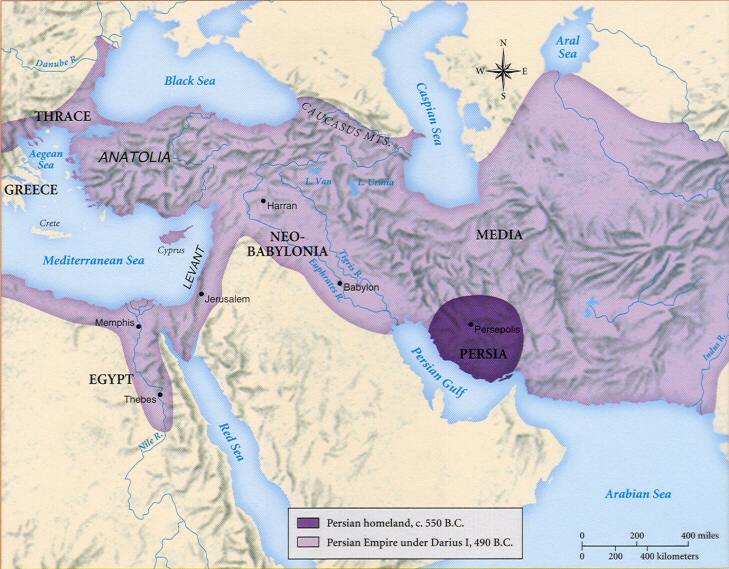
In it, Herodotus analyzed the Persian invasion of Greece – the defining event of his time. To understand how Greece, a much smaller power, achieved a major victory over Persia, Herodotus explored the nature of effective leadership, which he saw as a critical factor in the conflict’s outcome.

A shocking upset

Persia was already a vast empire when it invaded Greece, a tiny country made up of independent city-states. The Persians expected a quick and easy victory.

Instead, the Greco-Persian Wars lasted over a decade, from 490 to 479 B.C.E. They ended with Greece defeating the Persians – a shocking upset. Consequently, Persia abandoned its westward expansion, while various Greek city-states formed a tenuous alliance that lasted nearly 50 years.

To explain this unexpected outcome, Herodotus described how Persian and Greek societies developed before this crucial conflict. In his view, the fact that many Greek city-states had representative governments enabled the Greek victory.

These systems allowed individuals to participate in discussing strategies and resulted in the Greeks uniting to fight for freedom. For example, when the Persian fleet was headed toward mainland Greece, the Athenian general Miltiades says, “Never before have we been in such extreme danger. If we give in to the Persians, we will suffer greatly under the tyrant Hippias.”

Herodotus tended to put his political philosophies into the mouths of historical figures such as Miltiades. He condensed his thoughts about government into what historians call the “Constitutional Debate,” a fictional conversation among three real characters: Persian noblemen named Otanes, Megabazus and Darius.

Persia’s ascent

For centuries prior to invading Greece, Persia had been a small region inhabited by various ancient Iranian peoples and controlled by the neighboring kingdom of Media. Then, in 550 B.C.E., King Cyrus II of Persia overthrew the Medes and expanded Persian territory into what became the Achaemenid Empire.

Thanks to his effective leadership and tolerance for the customs of cultures he conquered, historians call him “Cyrus the Great.”

His son and successor, Cambyses, was less successful. He added Egypt to the Persian empire, but according to Herodotus, Cambyses acted erratically and cruelly. He desecrated the pharaoh’s tomb, mocked the Egyptians’ gods, and killed their sacred Apis bull. He also demanded that Persian judges change the laws so that he could marry his own sisters.

After Cambyses died childless, various factions vied for the Persian throne. Herodotus set his discussion about alternative political systems in this unstable period.

The case for democracy

Otanes, the first speaker in the Constitutional Debate, says “the time has passed for any one man among us to have absolute power.” He recommends that the Persian people themselves handle state affairs.

“How can monarchy continue to be our norm, when a monarch can do whatever he wants, with no accountability whatsoever?” Otanes asks. Even worse, a monarch “disrupts the laws,” as Cambyses did.

Otanes favors rule by the many, which he calls “isonomia,” meaning “equality under the law.” In this system, he explains, politicians are elected and held responsible for their behavior and make decisions transparently.

Today, unlike Otanes, Republican members of Congress appear reluctant to hold Trump responsible for anything or ensure transparency within the administration. Prominent Democrats, including U.S. Rep. Jamie Raskin and House Minority Leader Hakeem Jeffries, are challenging Trump administration actions that they view as lawless, such as freezing of funds authorized by Congress.

Do oligarchs know better?

Otanes’ fellow nobleman, Megabazus, agrees that the Persians should abolish monarchy, but he raises concerns about rule by the people.

“The masses are useless – there’s nothing more witless and violent than a crowd,” Megabazus asserts. He believes “commoners” don’t understand the intricacies of policymaking.

Instead, Megabazus suggests oligarchy, or “rule by a few.” Choose the best men in Persia and let them rule everyone else, he urges, because they “will naturally come up with the best ideas.”

But Megabazus doesn’t explain who would qualify as “the best men” or who would select them.

The U.S. has occasionally resembled an oligarchy, with small, elite groups holding most political power. For example, Article 1, Section 3 of the original Constitution provided for election of senators by state legislators, not directly by the people. Senators were not elected by popular vote until the 17th Amendment passed in 1913.

More recently, Trump has received millions of dollars in support from billionaire tech industry leaders such as Elon Musk, Mark Zuckerberg and Jeff Bezos, who hope to influence antitrust policy and deregulation. The Department of Government Efficiency, headed by Musk before he stepped down in May 2025, is now run by young men with virtually no government experience. DOGE’s cuts to programs such as humanitarian aid are wreaking havoc across the globe.

What about monarchy?

The third speaker, Darius, sees democracy and oligarchy as equally flawed. He points out that even well-intentioned oligarchs fight among themselves because “each wants his own opinion to prevail.” This leads to hatred and worse, much like the Trump-Musk relationship gone sour.

Rather, Darius asserts, “using good judgment, a monarch will be a flawless guardian of the people.” He argues that since Persia was freed by one man, King Cyrus II, Persians should maintain their traditional monarchy.

Darius doesn’t explain how to ensure a monarch’s good judgment. But his argument wins out. It had to, since in reality Darius became Persia’s next king. Kings, or shahs, ruled Persia – it became known as Iran in 1935 – until the Iranian Revolution of 1979 eliminated the monarchy and established the Islamic Republic of Iran.

Trump is not technically a monarch, but some believe he acts like one. He and his administration have ignored court orders, preempted the powers of Congress and sought to silence his critics by attacking protected free speech.

Lessons from Herodotus

Herodotus himself was largely pro-democracy, but his Constitutional Debate doesn’t endorse one form of government. Instead, it highlights principles of good leadership. These include accountability, moderation and respect for “nomos,” a Greek term encompassing the concepts of custom and law.

Herodotus emphasizes: “Formerly great cities have become small, while small cities have become great.” Human fortune changes constantly, and Persia’s failure to conquer Greece is just one example.

History has seen the rise and fall of many world powers. Is the United States next? Herodotus viewed the Persian monarchy, whose kings believed their own authority was paramount, as the weakness that led to their astounding defeat in 479 B.C.E.

READ ORIGINAL STORY HERE

Elon Musk’s Plans For A New Political Party Will Likely Be Derailed By A US Political System Hostile To New Voices

Elon Musk announced in July 2025 that he is launching a new political party. Jim Watson/AFP via Getty Images

BY THOM REILLY
PROFESSOR AND CO-DIRECTOR OF THE 
CENTER FOR INDEPENDENT AND
SUSTAINABLE DEMOCRACY,
ARIZONA STATE UNIVERSITY

As dissatisfaction with the two-party system grows in the United States, the idea of an alternative, however unlikely, gains traction. Elon Musk’s recent call for an America Party may be unserious, but it speaks to something real.

Surveys consistently show that millions of American voters feel they lack real choices. They believe the two major parties don’t reflect their values, and they are exhausted by the constant polarization.

The bigger question isn’t whether Musk succeeds. As a public policy scholar, I think it’s why the U.S. political system is so hostile to new voices and ideas in the first place.

Why third parties rarely succeed

If he follows through on his idea, can Musk’s America Party actually take off? Probably not. History isn’t on his side.

That’s because the U.S. political system is structurally rigged against third parties, with deeply entrenched legal and procedural barriers that make it nearly impossible for new parties to gain traction.

In most states, getting a new party on the ballot is a formidable task. It involves gathering thousands of signatures, meeting stringent deadlines and complying with obscure filing requirements.

Even if a party gets on the ballot in one state, replicating that effort nationally is extremely hard. Each state has different laws, deadlines, signature requirements and legal demands.

Ballot access, campaign finance, media coverage and election rules overwhelmingly favor the existing Republican and Democratic parties. Even the Federal Election Commission is designed for partisan deadlock with an even number of members from each of the two major parties.

In a 2025 article on election administration in America, my colleagues and I analyzed all 50 state election codes. We found widespread legal and administrative barriers that systematically exclude independents and minor parties.

In 45 states, only major party members can serve on election boards, local or state bodies responsible for overseeing the administration of elections. In 27 states, judges must be registered with a major party. Campaign finance laws, access to voter data and registration rules also tilt the field to the major parties.

These structural barriers exist in both red and blue states. We found no statistical correlation between partisan leanings and these restrictions. That’s telling. It suggests that both parties, regardless of their ideological differences, are united in protecting their duopoly.

The founders’ warning

This entrenched two-party control runs contrary to the vision of the U.S. Constitution’s framers, who intentionally excluded political parties from the founding document.

This was no accident. The founders viewed parties as “factions” that had no legitimate place in the republic.

George Washington in 1796 warned that parties would inflame animosity and that the nation could not do enough to protect itself from this. John Adams worried that “a division of the republic into two great parties … is to be dreaded as the great political evil.” Likewise, Alexander Hamilton feared parties as “the most fatal disease” of government and hoped America could dispense of such groups.

An appetite for alternatives

Enter Elon Musk. His suggestion to create the America Party taps directly into a growing national frustration with the two-party entrenchment.

Public trust in major political parties is at historic lows, particularly among young voters and independents, who do not identify with any major party and may register as “no party preference,” “unaffiliated” or “independent” depending on state laws.

Despite Musk being widely unpopular, prone to conspiracy theories and exhibiting erratic and unpredictable politics, his proposal resonates with many Americans. An October 2024 poll found that 58% of U.S. adults say a third party is needed.

Additionally, the number of American voters identifying as politically independent continues to exceed each of the major political parties.

What do Americans really want?

Even if Musk never follows through, the idea of a new party highlights how undemocratic U.S. elections have become. It opens the door to conversations about reforms that give independents and third parties a fair shot and reflects the growing demand for alternatives to the two-party system.

Voters are frustrated by limited choices that fail to capture their full range of political views.

There are models to learn from. Most democracies use a nonpartisan election administration and don’t let political parties control the rules.

In the U.S., partisans referee contests in which members of their party directly compete. That conflict of interest would be unacceptable in business or sports. So why is it tolerated in elections?

Structural reforms and designs have been implemented to varying degrees in the U.S. with a goal of making democracy more responsive, fair, transparent and representative.

Reforms such as open primaries, which allow voters of any party affiliation to participate in any party’s primary election, proportional representation in places such as Cambridge, Massachusetts, and Portland, Oregon, where political parties gain seats in proportion to the number of votes they receive, and independent redistricting commissions have helped create more competitive electoral districts by reducing partisan gerrymandering.

So, too, have ranked-choice voting and fusion voting. In ranked-choice voting, voters rank candidates by preference. If no one gets a majority, the lowest-ranked candidates are eliminated and votes are redistributed until someone wins. In fusion voting, multiple political parties can endorse the same candidate, who then appears on the ballot under each endorsing party’s line.

However, implementation of such reforms has been limited. Opposition to these reforms by the Democratic and Republican parties has, in many cases, been fierce.

It’s the system

The two-party system has insulated itself from competition.

The consequence is that today America has an impenetrable two-party system, the very scenario the framers and reformers feared most. Rather than focusing solely on Musk’s ambitions, the more pressing question is how to build an electoral system that reflects a modern, diverse democracy.

If Americans want more choices, and polling suggests they do, then they may want to examine the legal and procedural barriers that lock in the current system, which fails to address and accommodate their political preferences.

READ ORIGINAL STORY HERE

Wednesday, August 06, 2025

Survivors’ Voices 80 Years After Hiroshima And Nagasaki Sound A Warning And A Call To Action

The Hiroshima Peace Memorial stands as it has since 1945, partially destroyed by the atomic bomb blast and serving as a reminder of the 140,000 people who died in the attack and its aftermath. Masako Toki, CC BY-ND

BY MASAKO TOKI
SENIOR EDUCATION PROJECT MANAGER
AND RESEARCH ASSOCIATE, NONPROLIFERATION
EDUCATION PROGRAM, MIDDLEBURY

Eighty years ago, in August 1945, the cities of Hiroshima and Nagasaki were incinerated by the first and only use of nuclear weapons in war. By the end of that year, approximately 140,000 people had died in Hiroshima and 74,000 in Nagasaki.

Those who survived – known as Hibakusha – have carried their suffering as living testimony to the catastrophic humanitarian consequences of nuclear war, with one key wish: that no one else will suffer as they have.

Now, in 2025, as the world marks 80 years of remembrance since those bombings, the voices of the Hibakusha offer not only memory, but also moral clarity in an age of growing peril.

As someone who focuses on nuclear disarmament and has heard Hibakusha testimonies in my native Japanese language, I have been enthusiastically promoting disarmament education grounded in their voices and experience. I believe their message is more vital than ever at a time of rising nuclear risk. Nuclear threats have reemerged in global discourse, breaking long-standing taboos against even talking about their use. From Russia and Europe to the Middle East and East Asia, the possibility of nuclear escalation is no longer unthinkable.

Japan’s deepening reliance on deterrence

Ironically, increasing nuclear threats are contributing to further reliance on nuclear deterrence, the strategy of preventing attack by threatening nuclear retaliation, rather than renewed efforts toward nuclear disarmament, which seeks to eliminate nuclear weapons entirely.

Nowhere is this contradiction more visible than in Japan. While the Hibakusha have long stood as global advocates for nuclear abolition, Japan’s approach to national security has placed growing emphasis on the role of nuclear deterrence.

In the face of regional threats, the Japanese government has strengthened its dependence on U.S. nuclear protection – even as the survivors of Hiroshima and Nagasaki warn not only of the dangers of relying on nuclear weapons for security, but also of the profound moral failure such reliance represents.

Listen to Hibakusha voices

For eight decades, the Hibakusha have shared their stories to prevent future tragedy – not to assign blame, but to awaken conscience and spark action.

Masako Wada, assistant secretary general of Nihon Hidankyo, a nationwide organization of atomic bomb survivors working for the abolition of nuclear weapons, was just under 2 years old when the atomic bomb was dropped on Nagasaki. Her home, 1.8 miles from the blast center, was shielded by surrounding mountains, sparing her from burns or injury. Though too young to remember the bombing herself, she grew up hearing about it from her mother and grandfather, who witnessed the devastation firsthand.

In July 2025 at a nuclear risk reduction conference in Chicago, Wada told the attendees:

“The risk of using nuclear weapons has never been higher than it is now. … Nuclear deterrence, which intimidates other countries by possessing nuclear weapons, cannot save humanity.”

In a piece she wrote for Arms Control Today that same month, she further implored:

The Hibakusha are the ones who know the humanitarian consequences of the use of nuclear weapons. We will continue to convey that reality. Please listen to us, please empathize with us. Find out what you can do and take action together with us. Nuclear weapons cannot coexist with human beings. They were created by humans; let us assume the responsibility to abolish them with the wisdom of public conscience.”

This plea – rooted in lived experience and moral responsibility – was recognized globally when the 2024 Nobel Peace Prize was awarded to Nihon Hidankyo. The award honored not only the survivors’ suffering, but their decades-long commitment to preventing future use of nuclear weapons through education, activism and testimony.

A dwindling number

But time is running out. Most Hibakusha were children or young adults in 1945. Today, their average age is over 86. In March 2025, the number of officially recognized Hibakusha fell below 100,000, according to Japan’s Ministry of Health.

As Terumi Tanaka, a Hiroshima survivor and longtime leader of Nihon Hidankyo, said at the Nobel Peace Prize ceremony:

“Ten years from now, there may only be a handful of us able to give testimony as firsthand survivors. From now on, I hope that the next generation will find ways to build on our efforts and develop the movement even further.”

The role of empathy in disarmament education

Empathy is not a luxury in disarmament education – it is a necessity. Without it, nuclear weapons remain abstract. With it, they become personal, real and morally unacceptable.

That’s why disarmament education begins with human stories. The Hibakusha testimonies illuminate not only the physical destruction caused by nuclear weapons, but also the long-term trauma, discrimination and intergenerational pain that follow. They remind us that nuclear policy is not just a matter of strategy – it is a question of human survival. Nuclear weapons are the only weapons ever created with the power to annihilate all of humanity – and that makes disarmament not just a political issue, but a moral imperative.

Yet opportunities for young people to learn about nuclear risks, or hear from the Hibakusha directly, are extremely limited. In most countries, these issues are absent from school and university classrooms. This lack of education feeds ignorance and, in turn, complacency – allowing the flawed logic of deterrence to remain unchallenged.

Disarmament education that puts empathy and ethics at its center, along with survivors’ voices, can empower the next generation not only with knowledge, but with moral strength to choose their path.

From remembrance to responsibility

Commemorating 80 years since the atomic bombings of Hiroshima and Nagasaki is not about history alone. It is about the future. It is about what people choose to remember – and what people choose to do with that memory.

The Hibakusha have never sought revenge. Their message is clear: This can happen again. But it doesn’t have to.

The Hibakusha’s journey shows that human beings are not destined to remain divided, nor are they doomed to repeat cycles of destruction. In the face of unimaginable loss, many Hibakusha chose not to dwell on anger or seek retribution, but instead to speak out for the good of all humanity. Their activism has been marked not by bitterness, but by an unwavering commitment to peace, empathy and the prevention of future suffering. Rather than directing their pain toward blame, they have transformed it into a powerful appeal to conscience and global solidarity. Their concern has never been only for Japan – but for the future of the entire human race.

That moral clarity, grounded in lived experience, remains profoundly instructive. In a world increasingly filled with conflict and fear, I believe there is much to learn from the Hibakusha. Their testimony is not just a warning – it is a guide.

I try to listen, and urge others, as well, to truly listen to what they have to say. I seek the company of people who also refuse complacency, question the legitimacy of nuclear deterrence, and work for a future where human dignity, not mutual destruction, defines human security.

READ ORIGINAL STORY HERE

Nigeria’s Federal Police Force Has Failed, But What Does History Say About Local Forces?

The Dogarai police system was reformed in 1907 to become the Native Authority Police Force. Wikimedia Commons BY SAHEED BALOGUN AMUSA PROFES...