Tuesday, April 03, 2012

BNW FACE-2-FACE: OHANEZE ON THE "HOT SEAT" - PART I


On June 19, 2002, the Honorable Emmanuel Okocha, Publicity Secretary for Ohaneze Nd'Igbo, took the BiafraNigeriaWorld "hot seat" and spoke at length on issues including the 2003 presidential elections, MASSOB, the Biafra movement, and efforts to mobilize Nd'Igbo for 2003 and beyond. Hon. Okocha took the opportunity to respond to Ohaneze's critics, while shedding light on the candidacy of John Nwodo. He also talked about his own bid for the governorship of Delta State under the APP platform, and much more. Hon. Okocha is the author of the book, Blood on the Niger, and publisher of the USA Africa magazine.

BiafraNigeriaWorld: BiafraNigerians would like you to introduce yourself, give us a little background, tell us a bit about yourself and let's start there.

Hon. Okocha: I am Honorable Emma Okocha. I am orphaned. I was orphaned during the civil war. My parents suffered. They were victims of the genocide that was carried out by federal troops when they entered into Asaba on October 7, 1967. Asaba suffered the greatest casualty figures amongst civilian victims during the Nigerian Civil War. Following the recapture of the former mid-western states from the Biafran soldiers by the federal troops. After the civil war I was able to finish my school, secondary, high school, university by scholarship which was offered to us by the then mid-western government under Sammuel Ogbemudia and since then I've had this passion to ask the questions "why should my people be killed?" And it is with the same passion we're able to go into politics, free journalism, engage in sports. As I was telling you I used to play soccer for Nigeria. I was also a tennis player -- involved myself in satellite tournaments -- Jamaica, Europe, New England States and occasionally in the Washington area where I lived some ten years back. Since then I've been in Nigeria and been into government, now I'm going to run for an office.

BiafraNigeriaWorld: Which office?

Hon. Okocha: I hope EI will run for the big one. Directly we don't know yet because in our coalition we believe the people determine what the candidate will run for. I started as a councilor in local government; been a delegate representative in the constitutional assembly. So I've run elections since I returned from the United States. I've been running elections and winning. I haven't bee demanding any money or giving anybody money and this time I want to try my luck among the big constituents.

BiafraNigeriaWorld: So by the "big one" you mean the presidency?

Hon. Okocha: No. The big one in Delta State. I stopped at that.

BiafraNigeriaWorld: What's the big one in Delta State?

Hon. Okocha: There's the governorship, gubernatorial elections; there's the Senate especially being a western Igbo we have seen a lot of regret. Those who have gone into the national assembly have squandered the years. This is the end of the Senate tenure. Our representative, our own Senator has not even moved one single bill and our people are suffering under the hegemony of other nationalities who ultimately were part of the people that won the civil war. The western Igbo in Delta State is considered a non-citizen. It is like South Africa during the apartheid -- the western Igbo is not considered a core Deltan. The western Igbo cannot easily be assimilated in the civil service, or democratic institution of Delta State. We don't have permanent secretaries and this is the area we used to prosper when we were in the Nigerian Federation in the old mid-western region. The western Igbos produced a lot of top civil servants. P.C. Asiodu, C.C. Mordi, etc. So this time we're not there. We're not in the bureaucracy, we're not in the political top echelons, we're not in the sports, yet we produce the Keshis, the Victor Oduas. Seventy-five percent of those J.J. Okochas, those are the western Igbos. Yet in the offices we're not there.

BiafraNigeriaWorld: So what's the obstacle? Why aren't you there? What do you see as the stumbling block?

Hon. Okocha: There is the standing state policy that once you're Igbo, whether you are western Igbo you must be degraded as second-class citizens. So what is happening to Igbos in general in Nigeria is being accentuated in Delta

BiafraNigeriaWorld: So what's going to be the impetus for change?

Hon. Okocha: That's why we think this is the time. The time is now because we think people are so disenchanted with the present situation that anybody that raises the issues -- like I know I know the issues. I don't care about how much money you have but I know I can talk more on the issues than any other candidate, any other human being of my generation in that part of the world.

BiafraNigeriaWorld: From what I understand, your goal is to get an Igbo into the presidency. Is that correct?

Hon. Okocha: My goal is not necessarily to get an Igbo, but as you premise this discussion on the theory that guarantees safe federations all over the world like Signapore, Malasia, Switzerland, United States of America, every federation according to the expert analysis of professor J. C. Way. Every federation must cooperate, coexist, co-exert and coordinate. If these four indices of a federation are lacking the federation will not function. The Nigerian federation does not have room for parity of forces as a super position of powers. And then we don't coexist, we don't cooperate. The Igbos are left to play crumbling rolls and at this point in time there is just a lack of good leadership. They don't have those types of characters that used to co-exert, people like Nnamdi Azikiwe, M.I. Okpara, Akanu Ibiam. These are our forefathers. How come that the present generation are only after blue chip jobs? The best jobs are in the United States. Because these Igbos are brilliant, they go to the United Nations, the top most lady among the African division at the World Bank is Dr. Iwuala, she is an Igbo leader. The same thing in the United Nations, all over the world, Igbos prosper. But in their politics suddenly there is a lack. We have around us charlatans. So these are our challenges, to take over, see what we can do. So that these federations that must depend on these co-exerting factors, coexisting factors like I told you as Switzerland, if the canons of Switzerland cannot cooperate, the Swiss federation will collapse. In Nigeria, it is in the interest of Nigerians that they should allow certain roles for Igbos to play, not only in the East but in the Western part of the nation.

BiafraNigeriaWorld: So what if you can't do that? What then is the solution for the Igbo if you cannot achieve this goal?

Hon. Okocha: There is nothing from the history that guided the Nigerian Federation as played by the Igbos. Igbos from history because during the independence war they were at the forefront, they performed. Once they get mobilized, once somebody breaks the issues down to them to see, Igbos will join forces. That's what we are doing. We are now interested. Like you asked me 'what do you want to be'? That is not the immediate question. We are now in the period of mobilizing, getting the issues aggregated, getting our interests defined. For the first time we have been able to define the Igbo interest.

BiafraNigeriaWorld: Isn't it usually better to have a goal in mind then you plot your course carefully so you can achieve that goal. You have to have an ultimate goal in mind. You can't just define issues in a vacuum without having a direction. So I just want to know what is the destination?

Hon. Okocha: You know you're very right. But in politics what you call goals I call political interests. The core goals in psychology or career setting or agenda whatever is different but in political practice, goals are defined as interests. What is your interest? Morgenthau, on the Politics among Nations. America defines their interests in the Middle East ...

BiafraNigeriaWorld: But whatever you call it, isn't it still the same thing?

Hon. Okocha: That is what I'm saying. Those goals are what EThis is the first time since the civil war, since before the civil war, the Igbo man's goal was the Nigerian goal. Get something from Nigeria, make Nigeria good. We have invested in Lagos, we have invested all over the country. The other groups, the Yoruba groups, they were not interested in Nigeria, they were interested in their Western enclave. The Northerners were interested in spreading the Sharia, getting Nigeria to be a Muslim country. But we are managing, trying to manage these forces to get a Nigerian ideal, but now it has failed. There are groups that don't even want to see Nigeria anymore. Those are the Biafran resurgimento groups. But those of us in Ohaneze said, we agree. Nigeria has been a major disappointment, in spite of its resources. But can you change Nigeria? We started to have oasis of hope. That's why we said why not define for the first time, the Igbo interest, the Igbo goals your own words? Once you get it defined the leadership will emerge. But when you come and say I want to be governor, I want to be president, there is no mobilization, there is no socialization of the people, there is no followership. It is going to be difficult. But now we are mobilized courting our group, defining our interests like now the major interest of the Igbo man is to check the erosion explosion in Igboland. If that erosion is not checked, we may not see an Igboland in the next ten years. I don’t know where it comes from but I know in every village, every second it's collapsing before my eyes. It's modern, the states, the local government, take a look at the Nigerian nation, where an Igbo man becomes the president, is from that platform, will solve those problems.

Second interest, if you like, getting the Igbo language as the number one form of communication for the Igbos all over the world because they are speaking very great English, but it is not Eyou know this is a culture among Igbos, they speak good English, good Spanish, good French. The Yoruba man doesn't care, they speak their language.

BiafraNigeriaWorld: You know that's a really interesting point. There's a recent article published at BiafraNigeriaWorld on that very topic. If you have time, please take a look at it. But I'm curious, what was your trip here about? What are you doing in the United States?

Hon. Okocha: I will answer to give our discussion direction. I was talking about mobilization, to identify those interests so that those leaders after the mobilization they will then I came here as part of a mobilization exercise. We have our people with different groups not talking to themselves. We've been able to within this trip get those groups talking to themselves. We cannot totally unify people once they have their different platforms, once they have their different methodologies and their goals. Even in your own family, I don't think you have the same unity of purpose. You know we don't believe in that utopia. All we have done now is to admit that we cannot be the same unified train but we can identify similar interests, similar goals so that those of them who are on the other side can as much as possible merge with other groups who are thinking alike. My visit here is to identify those groups who are thinking like us. Can we produce for the benefit of assuaging those interest of an Igbo president using the resources we have in America. We've done that in Houston because we have identified Houston as having the greatest number of Igbos. Been to Texas, been to New Orleans, been to Kansas. We went to Kansas to speak to the Anioma Igbos, those are the western Igbos some never believed they were Igbos. So after talking with them in Kansas I was very pleased and for the first time they decided to join their kith and kin in the Eastern flank. And as I am talking to you, Ohaneze for the first time is to have their monthly meeting in Asaba the capital of Delta State, which has never happened before. So my visit here is to identify those groups, get them together, and the seek the resources because we believe, profession by profession, especially the new profession, when you are talking about the new profession, we are talking about medical scientists, those transplant liver surgeons, we're talking about the insurance, the computer technology group, the banking finance group, those are what we consider the new professions, as opposed to just lawyers and education group. We have the majority of them in Nigeria. So these are where we thought the Igbos have a lot of professionals in America no longer coming home. Or I've graduated I'm going to come home, no more. They are here. They're going to remain here and they've become very serious opinion molders on the American side. So if America decides that the next Nigerian presidency could go to the East, we have made it. Because it was America that got a prisoner Olusegun Obasanjo through the Baptist mission as proposed by Baptist faithfuls like Jimmy Carter, Jesse Jackson, Andrew Young from Atlanta. Those are the protagonists of the idea that Obasanjo, then a prisoner, should be made the president of Nigeria, despite the fact that he lost his deposit in his local government. So where can we use our own resources, the Igbo resources that could measure, could be even more awesome than any India, Chinese or European resources here. What are they doing for us to convince the American opinion makers and get us the presidency as they did during Obansanjo's Ekwueme contest.

BiafraNigeriaWorld: Have you identified anyone within the American government that could be approachable?

Hon. Okocha: That is the job of these resources. That is their job.

BiafraNigeriaWorld: Even coming from Africa you should still have an idea of whom you need to bring into the fold?

Hon. Okocha: Yes, we tend to leave that job to our brothers who are more Ewho deal more directly with them. They are in the NASA, some of our brothers are lobbyists in the Congress, one is a Mayor in Cleveland, he is an Igbo man. I can tell you I've identified but I know they will do a better job because they are here. We’ve given them that function.

BiafraNigeriaWorld: So you mentioned bankers and IT professionals, what do you do for a living?

Hon. Okocha: I'm a journalist, at present I'm the executive editor of Post Express the first Nigerian newspaper in the Internet and I'm a sports promoter. I intend to bring the William sisters to Nigeria to tour West Africa. I'm talking to the EI was in the Nigerian government. Before now, I was a Commissioner, and then right now I'm back to journalism.

BiafraNigeriaWorld: Post Express seems to be offline. What happened?

Hon. Okocha: We are going to restore it. What happened is that there is a change in management. We are going to reorganize the place.

BiafraNigeriaWorld: Let's get back to Ohaneze the organization. How did it come about?

Hon. Okocha: Ohaneze was founded by seven gentlemen, K.O. Mbadiwe, Akanu Ibiam. These were former Igbo leaders who were prominent in the struggle for Nigeria's independence. After the Nigerian Civil War with the total isolation of the Igbo interest away from the Nigerian Federation Ohaneze was formed as a lobby to bring Igbos back to the mainstream. These gentlemen are K.O. Mbadiwe, he was a former minister under Belewa, Akanu Ibiam, former governor of Eastern Nigeria, when Western Cameroon was part of us, D.V. Osadebay, my uncle. All these people are late. He was the former premier, the first and last premier of mid-western Nigeria. The former sponsor of Ohaneze then was this man from Umunze, , the Balitete of Umunze, Chief Ugochukwu, owner of Ugochukwu tires, Dr. Pius Okigbo, a reverred Nigerian economist and then special advisor to the federal government. Those are the people who founded Ohaneze.

BiafraNigeriaWorld: When did they found the organization?

Hon. Okocha: It was founded during the first election after the civil war. I don't know the exact date -- around late '70's. So it was founded to take care of these Igbo interests. Midway, it was involved in partisan politics. That time Igbos had a party they called NPP, Ohaneze was used. Most of the Ohaneze people were in NPN. Ohaneze was used to fight NPP and it was a losing battle. So Ohaneze was given a knock out punch because NPP took over Igboland. So after the deaths of all these men, because at that time they were septuagenarians, Ohaneze was resuscitated in this era, especially during the Oputa panel, during the killings in the North, Kaduna riots, during the institution of Sharia as a religious mission in the North, so Ohaneze came out to play certain roles. We challenged the Sharia. Ohaneze wrote a petition, organized witnesses to appear in the area, both in Enugu and Abuja. Ohaneze since then has been regarded as the Pan-Igbo cultural leader. And now, two years ago in Enugu, at the Enugu presidential address, Ohaneze rose from a meeting in January 2000, made a declaration that no more would an Igbo man play second fiddle, we would never accept the vice presidency anymore. The Igbos will contest the presidency, 2003. So that is the situation right now.

BiafraNigeriaWorld: How is the organization structured in terms of its leadership? How do you as the Publicity Secretary fit into the organization? How did you become the Publicity Secretary?

Hon. Okocha: I became the publicity secretary after playing a role as the chairman of publicity during the Igbo Day celebrations and the incumbent publicity secretary was voted out of office so and then I belonged to a think tank, what they call Nkpuke. What you talk in Nkpuke you don't say it out at the open assembly. So we enter into Nkpuke and I'm the smallest boy there. People were 70, 60, 50, they are probably former justices, ministers, there you present papers and because of my book and coming from Delta, this is the area, what they call federal character. That's why I'm a member of Nkpuke and I lead the Young Turks because most of the time people criticize Ohaneze of being too conservative. So we want to change how we react. We were the first group that admitted the MASSOB, admitted the Bakassi, people like our Secretary General, Nwabueze is a constitutional lawyer, a Nigerian expert in constitutional law, he teaches the constitution, he is a graduate of the London School of Economics. He was teaching there. He wouldn’t like anything unconstitutional. So we damned that. We said we need to control our own area. Without Bakassi and MASSOB, we cannot control the East so we had to admit them. It took a lot of lobbying and a lot of talking for them to accept that. So, they are now part of us.

BiafraNigeriaWorld: MASSOB was forcibly excluded from your last "Igbo day" celebrations in Enugu. Why?

Hon. Okocha: What happened was that before the last one, in 2001, we had to bring them in, and Uwazuruike really pulled the crowd. Ohaneze does not discriminate. Once you are an Igbo man you are a member of Ohaneze. The Ohaneze we are talking about is just the executive cabinet. But once you are Igbo you are an Ohaneze child. So for MASSOB to say they were excluded or not excluded is not the issue. The issue was that certain Esome leaders of Ohaneze would not like to relate with MASSOB. And then those of us, Ohaneze's younger members, told them that things had to change. We need this group, just like we need groups like Aka-Ikenga, World Igbo Congress Group, whether they're of conservative bent or radical movement, once they are Igbo, they are Igbo. So nobody would say MASSOB or Bakassi is not accepted. Nobody. What happened was that they should come in there, part of the program and in the 1 million march, we are going to organize in Aba. MASSOB will be represented and we don't discriminate. It is not anything official except there are some leaders like I told you who are either afraid or because of Abuja relationship, they would not like to be related.

The details of the march, the symbolism of the march is to teach, that Igbos are now together. This is an election year. If anybody says he is against the Igbo interest, let him be excused from the march, but I know that most probably everybody, including those who were in the Obasanjo camp, they will all run to Aba to get some media attention. Because if we are really going to really have a 1 million march, not only the men this time. Remember the historic position of Aba in Nigerian history. In 1929 Aba women went on riot. They were the first Bostonians. Boston went to riot because of federal taxation. The Aba women are savvy, in 1929. They broke and had their first strike against tax. So we're going to reincarnate that effort. They are moving the women. We are looking for the best world. We are looking at an Igbo language to produce for us what should be the theme of that march. Women and men, oshimili umu nwanyi na umu nwoke, something like that to give it impact.

BiafraNigeriaWorld: Earlier you mentioned the Ohaneze cabinet. Could you describe the Ohaneze cabinet?

Hon. Okocha: The Ohaneze cabinet has a chairman, an executive chairman, a retired chief justice, Ozo Ozobu, it has a secretary general, as I told you a constitutional expert, the best in West Africa, his name is Dr. Ben Nwabueze, it has a treasurer from Abia. Nwabueze is from Anambra, justice, the chairman is from Enugu state, the treasurer is from Abia, the deputy secretary, Dr. Nwogu, is from Imo. I myself am from Asaba, that's Delta, the publicity secretary. I'm the last. So you see they made these appointments to satisfy the different states that make up the Igbo nation.

BiafraNigeriaWorld: So you did that to make sure that all the people are really represented within Ohaneze?

Hon. Okocha: Right.

BiafraNigeriaWorld: So are these people elected, selected or appointed? How did you and the others in the cabinet attain your positions? Or how did you make your selections?

Hon. Okocha: These were positions that were there before I came in. I don't think they were really elected. They were appointed based on their achievements because Igbo rules accept achievement because it’s a functional rule that operates on meritocracy. When I talk about constitutional expertise in Nigeria, Professor Nwabueze is number one, that's why they appointed him secretary general to make sure we don't enter into constitutional faux pas. He's a conservative. There are others who are chairmen of committees, chairman of political committee, chairman of strategic and planning committee, like comrade Uche Chukwumerije and a member of the planning committee also. But the executive is not elected, there is a proposal to make sure that future elections are carried out to usher in new members. The proposals are there because a constitutional amendment has to take place for that to happen, its on the ground.

BiafraNigeriaWorld: So there is a constitution?

Hon. Okocha: Yes.

BiafraNigeriaWorld: What does the constitution say right now about how these officials are to be picked?

Hon. Okocha: When it started, it started as a small thing? But because of the issues that it has treated, it has exploded into something very big. Now that people want to come in and they're asking for constitutional amendments, so that next time around when these elderly fellows leave office, there will be elections. I think its on the ground right now, we're looking forward to it.

BiafraNigeriaWorld: You also said that one of the goals of Ohaneze was to bring the Igbos into the mainstream of Nigeria and then you also mentioned that there were some members of the cabinet who are conservative and are not as radical as for instance some members of MASSOB, so there is a bit of conflict---

Hon. Okocha: Standoff!

BiafraNigeriaWorld: Okay, standoff between them. Why did you choose to call the group Ohaneze? Why not Oha Nd'Igbo?

Hon. Okocha: Ohaneze means the whole people plus the chiefs. What we did on a daily basis with the chiefs, for us to control the crucial constituents, that's our people's towns, the chiefs must be there, the traditional chiefs. That's why we say Oha. Oha takes care of the Ndigbo. Na eze, do you understand? So for every meeting to take place there must be a chief that must chair. Every time we are in Enugu, there must be an Enugu chief. Last time I went to Abia, an umuahia chief was the chairman. Ohaneze cabinet, none of the members could chair the sessions, there must be a traditional chief. That is how it works out.

BiafraNigeriaWorld: One thing that needed to come out of that was that was the question, why not "Oha Nd'Igbo" since Igbo regard themselves as Republicans and it is agreed generally that "Igbo enwe Eze"? Most of the younger generation tend to see Ohaneze as an insular and feudal group of "Ezes". If Igbo enwe Eze, why did you name this thing that is supposed to bring all Igbo together "Ohaneze" when eze suggests that there is now a hierarchy? Igbo base things on achievements, so that no one who has not achieved can rise above another. How does the name Ohaneze highlight that reality about Nd'Igbo?

Hon. Okocha: Igbo enwe Eze is a historical fallacy because inasmuch as we say Igbos enwe Eze, remember Onyemeneke who had empires, remember the Aros. The eze in the Igbo traditional set-up is not a dictator, it is not like the Oba of Benin, or the Ashanti head of the Ashantis. Igbos enwe Eze means the eze had its limitations. In the republican set-up, you still had to depend, you still had to debate with the igwes, the lesser obis. The age groups had rules. The Igbos throughout their history, they had their own type of chiefs. But when those chiefs got out of hand they got the boot. So the Igbos have always had their chiefs. So the people who formed this, they didn't go to every village asking for their opinion. On their own they decided to call it Ohaneze. That's how it started. It was not very popular at that point. But I told you at a certain stage, the popular party NPP (ebe esere madu) beat them to it. Remember, it was later when they had nothing to look forward to, the military governed the whole place, Ohaneze started resurging, it was a resurgimento and that is why Ohaneze stuck. You might as well say why is it not called Igbo nile whatever. We had all sorts of names but Ohaneze was how they started it those founders of the Ohaneze group. As far as we are concerned, there are chiefs, traditional chiefs in Igboland who have certain powers except that they were being controlled by their constituents.

If I may add, those cabinet members who are the top echelons of the Ohaneze cabinet inasmuch as by training or by profession they were conservatives, they still believed in the dream of the Igbo, that Igbo should be free from the tentacles of second-class citizens. Those are the MASSOB group. But where they differ from us is that they have different modalities according to their identity. MASSOB wants to secede, they don't want to hear anything about Nigeria. It's all over. Some members of Ohaneze believe that Nigeria is El Dorado, that there is paradise in Nigeria. After all, they created Nigeria. It was through the sweat of the Igbo that Nigeria became what it is, so why run away? At the same time, they (Ohaneze members) don't want to see Igbo being cheated anymore.

BiafraNigeriaWorld: Yet, it is widely believed that a good portion of the Ohaneze are only interested in protecting their properties and investment in Nigeria. What is your take?

Hon. Okocha: You are correct. That is why I say that they may be conservative, but at the same time, those of us who are in Ohaneze who believe that it is probably not in the best interest of Igbo to secede now. Why can't we get the presidency for the first time? Let us try and get this thing and see whether there could be changes. We do not believe in being conservative about it we are out in the open talking about it. But I don't think we are ready to determine the map of Biafra from Agbor to Warri. I think that is Utopia because even though they are saying they are Biafrans, they don't even believe they are Igbo. I'm talking about Agbor from Ndokwa down to Borny, which is the riverine area. They don't believe they are Igbo even though they speak Igbo in Borny. So for now I believe that if we can use those resources, that Nigeria could be salvaged. If Igbo take over the presidency and bring back work. Because people are not working in Nigeria. The president is traveling as I'm speaking to you. Obasanjo is somewhere in Romania, going to Italy. He has visited the Pope fifty times, has gone to London until the British Prime minister is tired of receiving him at the airport, so now it’s a council member receiving him.

We believe that a working Igbo president that can log in sixteen hours a day. There is no work in Nigeria now. People just go to pillage the treasury. So I think Igbo should not run away, they should play the parity game, they should belong to the federation they worked so hard to bring about. That is our platform and that is why we are seeking the Igbo presidency 2003.

BiafraNigeriaWorld: Some in your group are said to be nursing presidential ambitions as Igbo and appear to be enjoying the support of Ohaneze. It is a matter of public record that some of these men took up arms against their own blood during the civil war. Why does Ohaneze feel comfortable in parading such men as Igbo "leaders" when the minimum of a public apology and acceptance has NOT been tendered before OHA for the abomination committed by those men? Are the Igbo that cheap and forgetful?

Hon. Okocha: Okay I would like to have the test on that question. Who were the Ohaneze who took up arms? One of the greatest members of Ohaneze is Ojukwu, the leader of Biafra, Iwuanyanwu was a soldier in Biafra, Dr. Okigbo was an administrator in Awka province. I want to know those who fought against Biafra that are Ohaneze members.

BiafraNigeriaWorld: I understand what you have to say about Ojukwu, Iwuanyanwu, Okigbo and perhaps yourself. But what about the other members of Ohaneze who actually fought against their own people during the war?

Hon. Okocha: Those in Ohaneze, the visible ones in Ohaneze, may differ, and the modalities of achieving that Igbo goal, Igbo interest Eso if you can give me one or two names that you feel betrayed the Biafran trust, that is in the top echelon of Ohaneze I'll be able to take that question.

BiafraNigeriaWorld: If you knew that somebody fought the war, for example, for the other side, would that disqualify him for leadership, in Ohaneze? Should that disqualify him from leadership of Nd'Igbo?

Hon. Okocha: If we knew that he fought on the other side, it’s a major negative on the backs of whomever that will come to seek an Igbo vote. Knowing that at the crucial time that Igbo needed sympathy and solidarity he went to the other side.

BiafraNigeriaWorld: We know, for example, that Ike Nwachukwu fought the war on the Nigerian side. He bore arms against his own people, against Biafra, and we don't have him on record apologizing for that.

Hon. Okocha: Is Ohaneze proposing Ike Nwachukwu?


BiafraNigeriaWorld: It is just an example, although his name has been bandied about as a possible candidate.


Hon. Okocha: Before now, Ohaneze had been taunted, you don't have a candidate, you made a declaration. Suddenly we are approaching zero hour, and suddenly we have about five candidates, credible candidates.


BiafraNigeriaWorld: Who are they?

Okocha answers question in Part 2
A BIAFRA_NIGERIA_WORLD EXLUSIVE INTERVIEW

Friday, March 30, 2012

Goodluck Jonathan Listed On Time's 100 Most Influential People On Earth


TIME MAGAZINE

The twin imperatives of trying to end a bloody northern Nigeria Islamist rebellion led by Boko Haram and dismantle the fuel subsidies that are one of the country's main sources of corruption (but are also, awkwardly, generally popular for keeping gas prices low) requires bold leadership of Jonathan, who is finishing his first year in office. Whether Nigeria descends into civil unrest, civil war or splits, or whether it reforms and Africa's sleeping giant finally awakens, depends foremost on him.

THE FULL LIST: THE 2012 TIME 100 POLL

Tuesday, March 27, 2012

The Ambrose Ehirim-Apollos Nwauwa Q & A Interview


Dr Apollos Nwauwa's teaching and research focus on modern Africa, especially colonial and post-colonial, intellectual and diaspora history. His published works include Imperialism, Academe, and Nationalism: Britain and University Education for Africans, 1860-1960 (London: Frank Cass, 1997), several book chapters, and numerous peer-reviewed scholarly articles featured in international journals including Anthropos (Germany); Cahiérs D'Études Africaines (France); Africa Quarterly( India); Journal of Asian and African Studies (Israel); History in Africa (USA); Canadian Journal of African Historical Studies (Canada); Ife Journal of History (Nigeria); Ufahamu (USA); and International Journal of African Studies (USA). Dr. Nwauwa serves on the editorial board of many journals and was Guest-Editor of special issue of the International Journal of African Studies in 2007. He is the President of Igbo Studies Association and recently coedited Against All Odds: The Igbo Experience in Post-Colonial Nigeria (Goldline & Jacobs Publishing, 2011). Dr Nwauwa is the Editor, Ofo: Journal of Transatlantic Studies.

Excerpts:

You and Ebere Onwudiwe worked on an important book, "Between Tradition and Change: Sociopolitical and Economic Transformation Among the Igbo of Nigeria." What inspired the project?

The publication of this book was inspired by the enduring commitment of contributors and co-editors to the growth and dissemination of serious scholarship on the Igbo. Between Tradition and Change was not initially begun as a book project per se; rather, it was the result of a scholarly dialogue by Igbo intellectuals about the historical, political, economic, social and cultural elements of the Igbo question. In 2005, Professor Ebere Onwudiwe, then Director of the National Resource Center for African Studies at Central State University, Wilberforce, Ohio, invited prominent Igbo scholars for a conference on the Igbo ethno-political history with a view to understanding the place of the Igbo in the Nigerian political dispensation. The political situation in Nigeria at that time necessitated this conference. It was a time when the Igbo were debating the best way to fight what they saw as their systemic marginalization by successive regimes of the Nigerian state. It was the period when chatter on the Igbo role in national affairs (The Igbo Question) was hot, leading to a political environment ripe for the growth of the Movement for the Actualization of the Sovereign State of Biafra (MASSOB), and the predictable hostile response of federal forces. At this point too, the role of Igbo intellectuals in national affairs came increasingly into question as they said or did very little on the Igbo question. The decline in national political influence mainly due to the civil war (1967-1970) undermined even the local authority of elders and traditional establishment in Igboland. Thus, the lack of national voice was gradually spilling over into an attenuation of the socio-political cohesion in Igbo land. Although the papers from this conference were published in a special issue of the International Journal of African Studies in 2007 for which I was guest editor, we felt that these quality papers deserved wider circulation and readership. Thus, Between Tradition and Change came about; it provides a detailed and insightful account of the transformation of Igbo society, politics and economy since the period of European contact. The Igbo experience demonstrates how internal and global factors gave rise to new dynamics of change as African societies engaged with the Western world and developments in the new global arena

How do you perceive the Igbo of today and the Igbo of yesteryears. What changed dramatically by way of cultural heritage?

To some extent, the Igbo have remained true to their roots; however, what has changed is the way they have responded to the vagaries and challenges of the modern Nigerian state. Just as cultural heritage of any society can be enduring, it can also be lost if not properly harnessed and preserved. Like other societies, the Igbo have adopted and adapted to new forces of change while striving to retain important elements of their indigenous society. They pride themselves as being the most de-tribalized Nigerians. This mindset has its own pros and cons. On the one hand, it is the only way migrant Igbo can fit into their host communities. De-tribalization has not really helped the Igbo in the Nigerian context. It did not help the political future of Dr Nnamdi Azikiwe very much nor is it helping the current Igbo leadership in Igboland and in Abuja. Instead, it diminishes Igbo cultural heritage since the Igbo concentrates on how to fit into everyone else’s but their own culture. Thus, relations between the Igbo nation, other ethnic nationalities and the Nigerian state in the postcolonial period have been marked by intense conflicts and contestation for political and economic control. This tension, culminating in the Nigeria-Biafra war, introduced new significant currents that shape Igbo society today and her relationship to Nigeria and the global community. Yet, despite some strains and shifts in their traditional institutions, the Igbo remain well-equipped to address issues facing them as a nation within contemporary Nigerian society. The key to a meaningful progress centers around a visionary leadership in the spirit of the dictum: Show the Light and the People Will Follow.

What is the Igbo Diaspora not doing right in terms of influencing decisions back home to effect change, using its background of living in a thorough system and an organized society?

Contrary to what many think, the Igbo Diaspora is not really a homogeneous, coherent group. Like other ethnic nationalities in the USA, the Igbo Diaspora consists of peoples from all walks of life separated by everything and only united by the fact that they are all Igbo. Serious social class disparity exists between them; therefore, presenting a united front in influencing or engineering actions at home continues to be a challenge. Just as it is at home in reaching consensus, so it is, if not worse, in the Diaspora. Indeed, it is in the Diaspora that the Igbo maxim: Igbo-Enwe-Eze manifests strongly and often in a negative and counterproductive fashion. Worsening this dictum is the callous application of the American principles of American freedom of expression and choice. The World Igbo Congress effort in providing a common forum has often been bedeviled with challenges crisis within the organization itself, making difficult for any meaningful collective ideas and actions that will influence affairs at home. Thus, what can safely be said is that whatever influences, real or imagined, that the Igbo in Diaspora are making center on individual rather than a collective action. The Igbo Studies Association, though a scholarly/professional organization, is already in the process of forming an action committee that will liaise with colleagues at home in moving the Igbo forward in political, economic, and social-cultural spheres. Yet, the difficult part is to define the meeting points and boundaries between politics and scholarship.

On Igbo women in politics, it seems to be a level playing ground coupled with a changing world. Are the women becoming relative to the cultural and political culture in Igbo land? And what's your take on that?

Women’s participation in politics, like in other callings, is now a global phenomenon, and the Igbo have not been left out. Despite that British colonialism scuttle the progress that women made in pre-colonial Igbo society, the post-independence era has increasingly witnessed the steady progress in women empowerment in Nigerian politics. It has become the rule now rather than exception that list of commissioners and major political appointments must include women. Although there is still a long way to go, the Igbo has not done too badly compared with other ethnicities. Although the Igbo have produced female federal lawmakers in both Senate and House of Representatives, and state lawmakers and deputy governors, no woman has yet been elected as chief executive of any of the five states in Igboland. Igbo women are doing much better in appointive spots compared with elective positions. I do believe that with time, this anomaly will be rectified through more education, awareness, and recognition of the boundless leadership skills of Igbo women.

In 1997, you published a scholarly text " Imperialism, Academe and Nationalism: Britain and University Education for Africans 1860-1960.” You did research on 100 years of British Empire and education in Africa. Analysis on British Empire is almost everywhere and had been written in many forms. What was the need for the book?

Debate on the nature of British rule in Africa, especially their colonial education policy, is one that will never go away. Different scholars approach the issue from varying perspective based on new research and vantage points. Initially, we were misled into almost believing hook and sinker that British colonial education policy was instituted for the benefit of Africans. As new research became available, much of the conclusions that glorified colonial education as benevolent have been challenged. My work on Britain and university education falls under this revisionist history. It demonstrated that western education was the most seductive form of British“cultural imperialism” especially Africans realized that university education opened up prospects for economic advancement, individual dignity, and would ultimately provide the keys to political power and self-government.

From 1860s, African demand for a university in West Africa was frustrated by the British until 1948 when they created four universities – in Uganda, Sierra Leone, Nigeria and the Gold Coast. My research was geared towards providing answers as to why the British rejected the university idea at first through the 1930 only to move swiftly in favor of it in the post-World War II period. Initially, the British worried about the place which the highly education African would occupy under colonial rule that depended on collaboration with traditional rulers under the indirect rule system and the fact that the highly education African elite would be difficult to assuage and control. In the meantime, Africans returning from America with higher education were proving to be too radicalized based on their racial experiences in the USA, and Britain was getting apprehensive about more Africans going to America for university education. London now felt that a British-run university education system in Africa would make it easier to mold the African character. Furthermore, the post-war circumstances ushered in a new era of fervent nationalist movements in Africa to which Britain could not forestall. Seeing the handwriting on the wall, it is my conclusion in this book that British effort to “manage nationalism” by producing a core of African elite imbued with British tradition and values that the British took on the expensive project of creating four universities in Africa in 1948 with mostly British taxpayers’ money. Existing studies on university education in colonial Africa did not engage in this aspect of my analysis and that's what makes my book unique.

Based on the text, and compared to now, what are the significant changes in independent Africa today with a fallen-in-standard educational system?

In the period following independence, there were no significant changes to the colonial education system that African countries inherited from their former European colonial powers. In those African countries that were formerly under French rule such as Senegal and Cote D’Ivoire, the French education system was retained downright. The same scenario was replicated in former British colonies such as Nigeria, Ghana, Uganda, etc. While the curriculum in terms of subject areas may have been altered a bit to reflect the new era of independence, much of the pedagogical approaches remained essentially the same. However, the standard of education in each country has been proportional to the level of economic condition and political stability of the respective countries. In corruption-ridden economies with rogue leadership such as Nigeria, the standard of education had fallen proportionately. When Ghana’s economy came to its knees in the 1970s followed by political failures, Ghanaian standard of education collapsed proportionately. That is exactly where Nigeria finds itself today. Therefore, any solution to falling standard of education must first begin with stabilizing the economy and ending political corruption in government and the educational system.

What had caused the failure of the school systems in Africa today?

As stated earlier, falling standard of education has little to do with the system itself but has everything to do with the level of socio-economic and political situation in a country. When a country is faced with high level of unemployment for university graduates, poor pay for university teachers, lack of financial resources on the part of parents, and government neglect of education, the attendant consequence will be falling standard and system failure. The lack of accountability on the part of government officials infects educational institutions, administrators and teachers and thereby leaving the students and their parents more vulnerable. I do not believe that any country with such chaotic political and epileptic economy as Nigeria can realistically sustain high standard of education at any level.

Studying at Bendel State University, Ekpoma, one would expect you'd settle in Nigeria and provide your services for the country. What compelled you to leave for services elsewhere?

After completing my NYSC in Kaduna State in 1987, I was recalled and employed by my alma mater, Bendel State University, Ekpoma, as graduate assistant. I taught there for one year before leaving the country for further studies in Canada. After completing my doctorate in 1993 and getting ready to return back to Ekpoma, I noticed that even some of my lecturers and colleagues there were leaving for overseas in droves. The Nigerian economy had entered into a downward spiral and the political leadership had also entered into a major carnival of corruption that friends and family members persuaded not to return immediately until things get better. Thus instead of returning to Nigeria, I accepted an offer from the USA as an assistant professor in African history in one of their universities. At first, I thought this stay would be very brief but I was proved wrong when the political saga of the Babangida-Shonekan-Abacha triad pushed Nigeria deeper into political and economic uncertainties. Soon, I began to take my stay in the USA one year at a time. Twenty years and I am still counting. What a shame! That I am still in the USA today is an indication that Nigeria has yet to get the country in order.

There is the Nigerian Association of Greater Toledo. Tell me about it.

The simplest cure for nostalgia for many immigrants in foreign lands is to seek to replicate the socio-cultural practices at home in their new place of abode. The Nigerian Association of Greater Toledo was founded to fulfill this need. I served as the vice president of this Association for four years, and president for another two years. Formed in 2003, the Nigerian Association of Greater Toledo (NAGT) is a socio-cultural organization dedicated to the progress and vitality of the Nigerian community in the Greater Toledo area of Ohio. As the number of Nigerians in the community increased especially in the last few years, it became necessary to have an enrichment forum where issues of importance to members and their community will be received, considered and acted upon collectively. It was against this backdrop that NAGT was formed. Highlights of our mission include: To work cooperatively with public and private agencies, businesses, industries and community organizations on issues beneficial to members and the larger community; to foster unity and good relationship between and among Nigerians and members of other communities and citizens of Greater Toledo; to promote social, educational, cultural and economic interests of Nigerians both here and in Nigeria; and to educate and share with our children and the Greater Toledo community on the beauty and riches of the Nigerian tapestry of cultures and languages.

What would you say the organization has accomplished from the time it was established?

The success of every organization is measured against its stated goals and objectives. Despites its relative young age, the Association has already made its marks in Toledo and its environs through its socio-cultural, community and diversity activities as it continues to fulfill the goals for which it was constituted. The Association has united Nigerians in the Greater Toledo area into a vibrant community that caters for the welfare of its members while contributing to the socio-cultural and economic development of Toledo and its neighboring communities. Plans are underway for scholarship fund launching to help those in need.

I read about the Nigerian Cultural Heritage House. Is the structure in place now? If not, what's going on?

No, the Nigerian Heritage House has not yet become a reality although the idea lives on. The number of Nigerians living in the Toledo area is quite small compared to other larger cities in Ohio such as Columbus, Cleveland and Cincinnati. Therefore, to raise the funds that can help to procure and sustain the Heritage House remains quite a challenge. But given the progress we have made in terms of fund-raising so far, it is only a matter of time in no distant future for us to realize our Heritage project. The worse thing an organization such as ours can do is to hastily commit to a major real estate project without proper planning and readiness in terms of resources.

Let's talk about the current situation in Nigeria. It has the same resemblance of the past. What's your take on that?

Undoubtedly, history seems to be repeating itself in Nigeria. It is like déjà vu all over again!Just like the 1960s crises that culminated in the civil war, the national polity is at the brinks again denoted by ethnic and sectarian tension and violence; mayhem and wanton killing of innocent people, especially the Igbo, fleeing the north for safety; government inability to stop the violence and bring perpetrators to justice; segments of the country feel that it is their birthright to rule Nigeria in perpetuity; and the call for sovereign national conference. Government officials have once again engaged in a carnival of corruption while the masses wallow in economic despair; power-sharing is detested and equal economic and political opportunities for all has become an aberration. All these social and political vices were the same scenarios that resulted in the crises of the 1960s. Observers fear that Nigeria may be heading toward total disintegration. While some would quip that we have been there before and Nigeria is still standing, others would argue that circumstances have changed as the country seems to be in more precarious situation with several cracks at its unity than the 1960 era.

What's your thought on the country's future?

Stability in Nigeria can only be assured if Nigerians themselves agree on the basic elements of national unity and the need to be united as one country. Forced and false unity does not always work. This seems to have been the case with Nigeria. Nigeria as a country was patchwork cobbled together by the British imperial governor, Lord Frederick Lugard, in 1914. From then on, successive British colonial governors of Nigeria instituted several constitutional revisions towards creating what they hoped would become a perfect union. This did not materialize before nationalist movement forced them to quickly retreat and transferred power to Nigerians. Since then, the ghost of the Lugardian patchwork has continued to haunt Nigeria and its successive leadership.

For Nigeria to resolve this lingering existential impasse, the inauguration of the sovereign national conference has become an absolute necessity. This conference will bring all the various ethnic nationalities in the country to a bargaining table to: 1. resolve to be a part of the union called Nigerian; 2. agree to the unity and inviolability of the union; 3. agree on ethnic or regional economic and political power-sharing principles; 4. agree on a federal system of government in which states have more power to legislate provided it did not negate the powers of the union; 5. resolve and recognize the separation of religion and state; 6. resolve the oil derivation and revenue sharing formula; and other matters. Part of this will be an understanding that these resolutions are only subject to alteration after 50 years. It is during this discussion that any group that does not want to be a part of Nigeria should have the opportunity to opt out or be persuaded to stay. This may seem like a recipe for disintegration but one cannot underestimate the power of negotiation. Once these agreements are reached and signed into law, a violation of any part of the contract by any constituent groups will be a crime against the Nigerian state.

Your thoughts on Nd'Igbo cultural and political future?

Unlike other ethnic groups in Nigeria, the Igbo are a people that have done less to promote their culture and nurture their political influence. Language is a major feature of a people’s culture. Out of the three major ethnicities in Nigeria, the Igbo come up the rear when it comes to nurturing their language. A typical Igbo person takes pride in his/her ability to speak other languages other than Igbo. Challenge and education Igbo in the Igbo language, and you see the extent of the problem. In this sense, Igbo cultural future is in danger of extinction just as the Igbo language is in trouble.

Politically, the Igbo political influence in Nigeria has not fully recovered since the outbreak of the Nigeria civil war. In some quarters, it was partly the fear of Igbo domination that led to the mass killing of the Igbo in 1966 resulting in the Nigerian civil war. Since the war ended, although there was the much-talked about “no victor, no vanquished”, it was clear that all hands were on deck in many parts of Nigeria to ensure that the Igbo never rose in political influence again. It has been a struggle ever since; that partly explained why the most respected and influential national politician in the name of Nnamdi Azikiwe lost the 1979 presidential election to the little known Shehu Shagari. It is now 42 years since the end of the civil war and no Igbo person has ruled Nigeria as an executive president. While the Igbo are aware of this problem, they should begin to strategize on how to be relevant again. But unless the current Igbo leadership abandon internal bickering, selfishness and “pull him down” syndrome, and present a united front, the political future of the Igbo will continue to be in disarray.

Nd'Igbo are not writing enough about their history and I'm afraid Igbo history will one day disappear as a result. What should be done?

Just as the Igbo language is under the threat of extinction so is the Igbo history/studies. Both require urgent attention. Currently, enough studies and writings are not being carried out on Igbo history, culture and tradition for a number of major reasons: First, the Igbo no longer have enough historians; secondly, the available historians would rather focus on other fields/areas of study such as international relations where they hope to work as diplomat or secure a UN job that will do nothing about Igbo studies; and thirdly, the Igbo themselves neither pay attention nor support efforts for keeping the study of Igbo history and culture alive. It was more than a decade ago when Professor J. F. Ade Ajayi called upon Nigerians to cultivate a sense of history and to rediscover the value of history to nation-building and for the socio-political and economic development of the country. Ndi-Igbo have yet to heed to that call despite that it was the Igbo iconic historian, the late Professor K.O. Dike, who popularized the study of history not only in Nigeria but also in Africa as a whole. Other first class historians of Igbo extraction included J.C. Anene, Chieka Ifemesia, Adiele Afigbo and others. It is sad that the number of specialists in Igbo history have continued to shrink since the past ten years. Unless the Igbo begin to value their own history, recognize and patronize the works of their few existing historians, and encourage their children to value and read history in schools and universities, Igbo history will gradually disappear. As part of the effort to rekindle interest, southeastern governments should institute a commission on Igbo history, establish scholarships and essay contests on Igbo history at all levels of education in the states.

Tell me about Igbo Studies Association.

The Igbo Studies Association (ISA) was founded at the African Studies Association (ASA) Conference in Philadelphia, Pennsylvania, on November 8, 1999. The mission of the Association is to promote and encourage scholarship on IGBO history, culture and society in African studies; to forge intellectual links and network with scholars, policy makers, and activists inside and outside NIGERIA; to participate actively and collaboratively in continental and global debates with interested organizations in Nigeria, the U.S. and other countries on issues specifically relevant correlated to Igbo studies; to work actively for the promotion of Igbo language with interested organizations and/or institutions in diverse regions of the world. ISA holds an annual conference at Howard University in Washington, DC featuring numerous seasoned and young scholars working on topics relating to the Igbo. Participants come from Nigeria, USA, Canada and other parts of the world. So far, it is one of the strongest Associations dedicated to Igbo scholarship.

As President of Igbo Studies Association, what vital roles do you think should be played under your leadership to educate future Igbo leaders and role models?

Although it is true that the Igbo Studies Association, which I head as president, is not necessarily a political but a scholarly organization, I expect the Association to play a very prominent role in educating the political leadership in Ala-Igbo. Ideas generated by scholars on the political, social, economic and cultural life of the Igbo, if properly harnessed, will serve as reference points for Igbo leaders. Our hope is that with time, it will become absurd for anyone to present himself or herself for a leadership position in Igboland without an appreciable knowledge of aspects of the Igbo culture, history, and society. In recent times, the Igbo have abandoned education for quick money from dubious businesses and from political corruption. This sort of lifestyle contributes nothing meaningful to the general welfare of the people. Instead, it creates more avarice and crime. Life and property have become so unsafe in Igboland that prominent Igbo would rather stay in Hausaland and Yorubaland than visit their home towns and villages. But a well-educated person is an asset to the people, always finding ways to give back to society than to wreak havoc. The more education the Igbo are about their heritage and the need for genuine progress and development, the less likely they would turn to crime and avariciousness.

You and Chima Korieh wrote “Against All Odds: The Igbo Experience In Post-Colonial Nigeria.” Speaking of the ‘horrors of ethnic politics, civil war and the Igbo example of perseverance,’ the question here is, based on that perspective, did Igbo actually learn anything, looking at what had erupted over the months in Northern Nigeria?

Against All Odds is a scholarly book which explores the experiences of the Igbo in postcolonial Nigeria and evinces both the grim side of postcolonial politics in Nigeria, particularly the horrors of ethnic politics, civil war, and the Igbo example of perseverance and human potential to overcome dreadful conditions of such magnitude. The study illuminates the tension emanating from the enduring colonial legacies and their influences on Nigerian peoples and public life; it links socio-economic, cultural, and political events in Nigeria since the 1960s and the peculiar circumstances faced by the Igbo ethnic group with the continuing attempts to forge a more perfect nation state in which every constituent group is treated with fairness and equity. Yet, it has become increasingly more glaring that the Igbo did not gain or learn much from the horrors of the 1960s which resulted to the civil war. An important gain would have been the recognition of the Igbo as equal partners within the Nigerian political and economic contexts. But this has been quite elusive. It has been a little over 41 years since the end of the war and the phony declaration of “no victor, no vanquished,” yet no Igbo has ruled the country ever since. As at the moment, that possibility remained in the distant future. While it is true that the Igbo are partly to blame for their lack of organization and strategic coordination to attain this goal, there is no question that other ethnic groups, especially the bigger two, have some lingering reservations against an Igbo leadership of the country. It was only just recently that an army general of Igbo extraction was ever appointed as the chief of army staff since the end of the civil war. Yet, one wonders whether the Igbo have learned anything from the civil war. Although they are aware of the enduring animosity against them and the fact that they have not been fully accepted back into Nigeria, the Igbo assumed otherwise. Thus, they returned back to the North in droves only to become targets and victims of wanton killings again and again anytime their host communities got upset over often flimsy and mundane issues. Time and time again since the end of the war, the Igbo run back to the East only to return to run yet again. Who said the Igbo have learned from the civil war. Naively they still believe that hatred and animosity against them would disappear at dawn only to be disappointed at sunset.

Your teaching and research focuses on modern Africa. Is Africa developed by way of technology compared to the West and a fast-paced growing Asia? And if not, what seem to have been the problem?

When I use the term “modern Africa,” in my teaching and research, I focus on the period from 1800 to the present, and this encompasses the colonial and the post-colonial eras. Africa’s post-colonial condition is linked to its colonial past, and this colonial past laid the foundation for the development of Africa’s underdevelopment. There are a variety of indices of measuring a country’s or continent’s development and the lack of it. If development is defined as improvement in human welfare, quality of life and social wellbeing especially as they relate to technology, it can be argued that Africa is still a developing continent – the best way to state that the level of this development is low just as its pace is slow in comparison to the West and Asia. Technologically, Africa still remains a consumer rather than producer of technology. There is almost no type of technology you see in the West and Asia that you cannot find in Africa; the difference, however, is who produces the technology. Of course, it is the producers rather than the consumers that profit from it! Here lies the problem – colonial legacy, which created and continues to sustain unparalleled dependency syndrome in Africa. For example, Africa is one of the largest cell phone consumers today but how many of those phones are made or patented in Africa. None! It is also the low level of technology in Africa that compels Africans to ship their raw cocoa to the West only to turn around to buy chocolate that have been processed elsewhere with improved technology. Unfortunately, there is now no end to this economic pattern since under globalization, no continent or country can successfully close its door as Japan did in the eighteenth and nineteen centuries. Such isolationism in today’s world can only spell doom for a country since economic, social, and technological processes are intertwined in a complicated fashion with serious political consequences.

Saturday, March 24, 2012

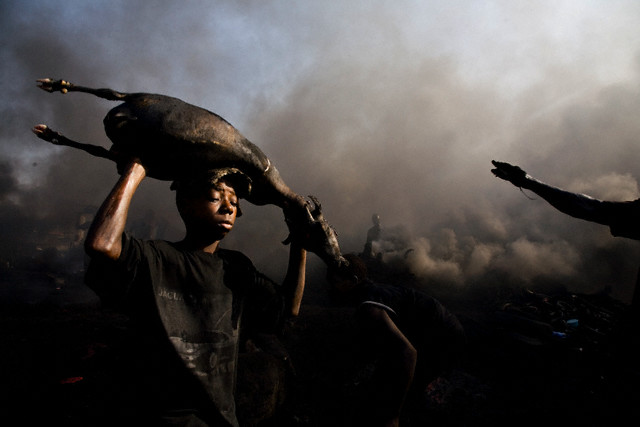
Nigerian Jungle Blues: Trans Amadi Slaughter House

A young man carries an animal carcass through the Trans-Amadi Slaughter, the main abbatoir of Port Harcourt.


A butcher cuts up a cow carcass amidst a pool of blood and guts, at the Trans-Amadi Slaughter, the main abbatoir of Port Harcourt. At the slaughter, animals are killed in the open, their blood spilt into the waterways below and their skin is burned by the flames of old tires, which creates thick clouds of black smoke over the city. Fish had been the traditional source of protein in the Niger Delta, but as fish stocks have dwindled due to pollution from the oil industry and over fishing, meat is becoming more common. Date: June 20, 2006. Location: Port Harcourt. Image: Ed Kashi


Amidst the bones and smoke, a young girl sells drinks to the workers at the Trans-Amadi Slaughter, the main abbatoir of Port Harcourt. At the slaughter, animals are killed in the open, their blood spilt into the waterways below and their skin is burned by the flames of old tires, which creates thick clouds of black smoke over the city. Fish had been the traditional source of protein in the Niger Delta, but as fish stocks have dwindled due to pollution from the oil industry and over fishing, meat is becoming more common. Date: June 20, 2006. Location: Port Harcourt. Image: Ed Kashi

Wednesday, March 21, 2012

The Ambrose Ehirim - Queenkay Amamgbo Q & A Interview


QueenKay is a mother of two young boys, Chika and Lota, a multi-faceted entrepreneur, writer, enthusiast, and optimist. She moved to the United States from Nigeria when she was 18-years-old. After living in the Washington, DC area for a few years, she relocated to Los Angeles, California. Her desire to realize her creative passions led her to Hollywood. Nevertheless, she soon found herself taking a detour, to follow her heart's pathway. After falling in love and getting married, QueenKay's true-life, fairytale romance ended tragically. Ironically, the ending of her romance was the beginning of her Reconstruction and Transformation and the very catalyst of this book, The Reconstruction and Transformation of QueenKay.

Excerpts:

Let’s talk about you. Can you tell us a little bit about yourself, your upbringing and things like that?

Well a bit about me. I am what you call a very down to earth girl. I don't have any hang ups and I am very easy going. I grew up in a middle class family while enduring a lot of family drama.

What were your early influences?

My early influences were seeing my mum as a strong force to be reckoned with. Although pushed down many times, got up many more times to claim what was rightfully hers and raise her children the best way she knew how. I also from an early age fell in love with movies, music and the human experience. We get to tell our stories through so many mediums.

You have written a book. In what environment did you start putting “The Reconstruction & Transformation of Queenkay,” together?

I started writing my book shortly after I lost my husband. I couldn't stay focused on writing because the pain was too raw. It took me three and a half years to finish the book.

And how did you arrive to conclusion it should be put into a book?

I knew when Charles died that our story had to be told. I knew that it would be first as a book and evolve into a feature length film. I was certain of that.

What were your doubts at the time of penning and putting your emotions, Charles’ death and coping with the tragedy, together?


I had a lot to deal with, his death, surviving, raising my boys and struggling to save my business and my home where amongst the setbacks that made writing the book difficult. I didn't really doubt that I would finish the book, I just knew I had to.

You said “The Reconstruction & Transformation of Queenkay” would make one “laugh, cry, think, love, lose it and believe again.” Could you explain what that means?

I mean it would take you through my life and in many instances you would relate to the words and events as though it were happening to you. Ultimately, you would feel HOPE and the courage to carry on no matter what life throws at you.

What would you have done differently assuming you did not complete the book?

I don't think it would have been easy for me to complete any meaningful and fulfilling projects had I not completed the book. It felt like a heavy burden that needed to be let down. I would still be busy building my business and myself up but I am glad I completed the book. I feel freer, lighter and ready to take on the world.

I read somewhere that Hollywood had been on your “radar” from your inception of the American Dream until you met your sweetheart. What inspired the Hollywood dream?

I was very artistically inclined while growing up. It wasn't the dream of simply being famous for the sake of it, it was the desire to fulfill my creative passions that made me want to be part of a dream building opportunity.

If given the opportunity now, would you consider giving Hollywood a shot this time around?

It would have to be on the terms of a creative person behind the scenes. I am now a mother and my priorities have changed, but I would still love to tell moving stories and give people like myself a voice.

In your opinion, what is the Nollywood film industry not doing right to meet up with the challenges in terms of quality production and by way of scholarship compared to Hollywood?

I am not sure what they are doing specifically. I know that the quality of films in recent years has improved dramatically. The American film industry has been around for years and has been improving every since. There are organizations set in place to maintain the integrity of the projects that come around. There are museums and archives of pioneers who have paved the way. I really do not have any way of knowing just where we are in terms of getting to this level. I do know we have some very talented writers, actors and producers. We have come a long way and I pray that the best is soon to come.

You are a one of a kind mother of two boys, a magnificent entrepreneur, author and as the list goes on, where does the energy come from in all these combined?

I do not know where the energy comes from. I get inspired daily to push myself to new heights of creativity. I do not want to settle for less than excellent. I think God just gave that doze of "extra" and I will keep riding high until I get called to glory.

How is ‘Man Must Wak' doing? I love African dishes especially ofe olugbo. What are the delicacies and what should I expect assuming I stop by to make a purchase?

My store is doing great. It has survived the economic downturn and is getting ready to ride the upswing. Do you mean ofe onugbu (bitter leaf soup)? It is a specialty where I come from and we sell the ingredients in my store. If you were to stop by my store, you will find ingredients for making all kinds of soups ranging from okro soup to egusi soup and the list is endless.

Let’s talk about your boy, Chika. I watched him at the book release party video. He was awesome and I could not imagine such a kid with that powerful, moving rendition:

You can't do it alone
we can't do it alone
we have to work together
to keep going
It’s all in one community
that we have to;
work together

Wow! I was personally moved. How was all that rehearsed in preparation to the event? Coupled with the reaction of the audience, what was the discussion when you all got home?


Thank you so very much on the complement regarding my son Chika's speech. You know, that boy is just a God sent. We never rehearsed any speeches. I knew I had to say thank you. I never knew he would want to say something. For a child who was 9 at the time to have the courage to speak in front of a room full of people and say such a courageous thing, moved me also. He's my son and I simply can not get enough of how he seems to be so captivating when he speaks. He reminds me a lot about his father. The audience was moved too and it was just a wonderful day in totality. We didn't speak much about it when we got home, it was just a perfect day and we were grateful it turned out well.

How was your days at the University of San Francisco?

My days at USF were memorable and I am glad I had the opportunity to attend such a prestigious school

What’s your next project now besides a hand-full of family and entrepreneurship?

I just finished co-authoring a book with 23 female authors from all over the world. The book is entitled, "The Unstoppable Woman's Guide to Emotional Well-Being" The book project is such a blessing and their are many more to come from it. The forward to book was written by Oprah's Marketing Manager with Harpo Studios, Maya Watson. I am very excited about this year. The website for that book is http://www.theunstoppablelibrary.com Besides this new book, I have a slew of interviews slated for the next few months and I am simply amazed at what the future holds for me.

What’s your leisure time like?

If I have any leisure time in between my crazy schedule, I sleep. I tell people it's one my hobbies and they laugh, but the truth is, I do everything on full speed, so to me when I lay down, that's a luxury. I do like to read, watch movies, and travel. Thank you so much for the opportunity to connect with you and the readers. I do hope that my book blesses those who read it and is a life changing experience for as many as would allow it.

Wednesday, March 14, 2012

Conversations With Filmmaker Tim Greene


We talked about this interview earlier than I had the chance to meet Philly native and independent filmmaker, Tim Greene. The 20th Anniversary of the Pan African Film and Arts Festival had just begun at the Baldwin Hills Crenshaw Plaza in Los Angeles and filmmakers were in touch for the anniversary when I had checked out the base camp of the festival’s related events. Tim sat quietly on the front porch while we exchanged greetings and informing him of my futile attempts to locate him over the months. Soft spoken and humble, Tim had told me about his overwhelming tour dates all across the United States which he wrapped up arriving Los Angeles.

Tim wants to get on his programs differently when he outlined the ideals behind the “Lil Homeez” project when he was back to Charlotte, North Carolina to edit his documentary, “From Tragedy To Triumph,” a story about a community that took an abandoned empty supermarket in their crime infested neighborhood and turned it into a productive community center to better their community from around which kids in the community in a sudden 180-degrees turn started improving in their grades from D’s to straight As.

Tim who has starred in movies along side Jamie Fox, Terrence Howard, Chris Rock, Tom Cruise, Oprah Winfrey and several others, wants to provide the opportunities for kids and inner city youths who have been less privileged in creating some kind of impacts, but talented in a variety of discipline, had started Hop For A Better World Motion Pictures- Hollywood to help these kids develop their talents and work towards a better future; and recently he joined “Engineering the World,” flying in from Los Angeles for a film-making workshop in a conference for minority students held at the CNN Studios. In that endeavor, over 200 students from the 6th to 12th grade toured the CNN Studios at Time Warner Center as the National Society of Black Engineers (Alumni Extension/New York and Central Jersey Chapter) and the Black Professionals at Turner put together the “Engineering the Worlds” conference. The all day conference was totally free for any minority student from around the country to attend in an effort to build the foundation to impact, revitalize and empower the youths and future leaders of tomorrow. Participants toured the CNN Studios and did a simulated show production with an opportunity for the students to get behind the cameras on a real CNN set learning a variety of skills including camera operator, lighting, graphics, editing and audio with the CNN staffers who donated their time for the conference. The students also learned how they could prepare themselves for a career in engineering and broadcasting.

In his outreach program to kids and why he had chosen to motivate kids and be better assets in the future when his “Discover Your Greatness 20 City Tour” rewarded kids in underprivileged areas with great grades in school with free workshops, prizes and CDs that will teach kids and parents how to be more focused in being future business owners and entrepreneurs. Asked about the ideology, Tim said:

“I also have a new generation of very young kids pledge to use the new “B-word” when they address females. That new “B-Word” is Beautiful.” When I have the males use the word every females face in the house lit up with happiness. I also have “Make it rain with Greatness parties for the exceptional young ladies at the events. Instead of thinking about making it rain on a female in the club for dancing, grandma and the whole family makes it rain when their daughter brings home good grades from school. Then after I leave each city, it is up to each community to keep the “Make it Rain With Greatness Parties” going on every report card period. I have capacity crowds so far in every city and I make sure that I stay and talk to every single person who comes out to meet me even if it takes until one in the morning as most events have been thus far.”

Asked about filmmaking and the impact he would like to create in the industry, Tim said:

“I knew my next step in film-making was in distribution and building a library of films like any other film studio. There are thousands of independent films that get made every year and only about five percent or less land a distribution deal after screenings on the film festival circuit. I will release the films that I know my target audience will love to see. I will release documentaries, Gospel, drama, action and other types of films, not just Hip Hop. With Will Smith being the number one box office draw in the world and Tyler Perry opening up his own film and television studio, it shows me that the whole universe is open to me and I have to create my own destiny and not just sit around waiting for the phone to ring.”

On the “Lil Homeez” kids movie, a G-rated coupled with Hip Hop products for kids, Tim notes:

“In order to be a little homie you have to stay in school, no cursing, no guns or drugs and you must get good grades. We will have a clothing line, story books, video games and much more for the “Lil Homeez” brand. With rap music lyrics being in the headlines lately kids worldwide needs something positive that they can still relate to and still be considered hip. And being a two time Billboard Top Ten Songwriter, I will put out mind enhancing soundtracks for kids 5-9 years old with hip hop beats.”

Thursday, March 08, 2012

Nigeria: Briton And Italian Die In Hostage Rescue Bid

Mr. McManus was captured by gunmen during a raid on his apartment in May last year.

The men were killed in Birnin-Kebbi in the north of the country

Chris McManus and Franco Lamolinara in the video made by the hostage takers.

SKY NEWS

Two hostages - a Briton and an Italian - have been killed by terrorists in northern Nigeria in an attempted rescue operation.

The effort to free Chris McManus, from the North West of England, and his colleague Franco Lamolinara was launched by British special forces and the Nigerian army.
Sky sources say there were no fatalities on the British and Nigerian forces' side but there were several fatalities among the hostage-takers.

Prime Minister David Cameron said the pair appeared to have died at the hands of their captors, either before or during the course of the rescue bid.

Sky sources say it is believed there was a fight and during the assault the UK and Nigerian forces could not get to Mr McManus and Mr Lamolinara in time.

"It strongly appears that the hostage-takers shot the hostages," the sources said.

The rescue bid was launched after the UK received credible information about their whereabouts and that their lives were under increasing threat.

Speaking in Downing Street, Mr Cameron said Mr McManus and Mr Lamolinara were "taken hostage by terrorists" in northern Nigeria May last year.

He said: "Since then, we have been working closely with the Nigerian authorities to try to find Chris and Franco, and to secure their release.

"The terrorists holding the two hostages made very clear threats to take their lives, including in a video that was posted on the internet.

"After months of not knowing where they were being held, we received credible information about their location. A window of opportunity arose to secure their release.

"We also had reason to believe that their lives were under imminent and growing danger.

"Preparations were made to mount an operation to attempt to rescue Chris and Franco.

"Together with the Nigerian Government, today I authorised it to go ahead, with UK support.

"It is with great regret that I have to say that both Chris and Franco have lost their lives.

"We are still awaiting confirmation of the details, but the early indications are clear that both men were murdered by their captors, before they could be rescued."

He added: "Our immediate thoughts must be with Chris and Franco's families, and we offer them our sincerest condolences."

Mr McManus and Mr Lamolinara, contract workers for the construction company B Stabilini, were kidnapped by gunmen who stormed the apartment they shared in Birnin-Kebbi.

The two men were in the city building a bank.

In a statement, Mr McManus' family said: "As a family, we are of course devastated by the news of Chris' death which we received earlier today.

"During this ordeal we have relied heavily on the support of our family and friends which has never waned and has enabled us to get through the most difficult of times.

"We are also aware of the many people who were working to try and have Chris returned to our family, and his girlfriend. We would like to thank all of them for their efforts.

"We knew Chris was in an extremely dangerous situation. However we knew that everything that could be done was being done."

There have been a number of foreigners kidnapped while working in Nigeria in recent years.

In September 2008, two Britons were held by the Movement for the Emancipation of Niger Delta.

A Scottish oil worker was abducted and his guard killed in April 2009, in the Rivers State capital Port Harcourt.

Three Britons and a Colombian were kidnapped in January 2010 and in November of the same year, four men from the US, Canada and France were taken 7.5 miles offshore on the Okoro field.

Tuesday, February 21, 2012

The Ambrose Ehirim-Chidi Achebe Q & A Interview


Dr. Chidi Achebe, son of the literary icon, Professor Chinua Achebe, is a United States-based physician and was recently awarded the Martin Luther King Jr. Social Justice Award by Dartmouth College. In this interview he talks about his medical practice, his service to others, healthcare intervention, education, his mentor, his dad and lots more.

Excerpts:


Tell me a bit about yourself

I completed undergraduate studies in natural sciences, history and philosophy at Bard College; received an MPH from the Harvard School of Public Health, and an MD at Dartmouth Medical School and an MBA degree at Yale University's School of Management.

I also completed residency in both Internal Medicine and Pediatrics at the Texas Medical Center in Houston, TX. For a brief period, I served as Medical Director of the Whittier Street Health Center (13 months); and then served as Assistant Professor at Tufts University School of Medicine, Medical Director of Harvard Street Health Center before my appointment as the President and CEO of the Harvard Street Health Center.

Recently, you were awarded the Martin Luther King Social Justice Award from Dartmouth College. Tell me a bit more about your work that brought about this recognition.

I think the press release from our health center makes the point better than I could ever do: “After several years of work at various Boston health centers, Dr. Achebe now sees "the struggle against inequalities in health and health care for all vulnerable, underserved Americans, as the next stage of the Civil Rights movement;" and has dedicated his life's work to helping to solve the conundrum of health care inequity in America's health care system.

Dr. Achebe makes church calls, and speaks at youth summits, conventions, conferences, schools, barber shops - focal gathering areas where he can reach underserved patients - reminding the community of the value of health, preventive care, and the quality of service readily available at Harvard Street.

While expanding his unique implementation of “medicine without borders,” Achebe works as a passionate advocate for the global community through his writings that call attention to worldwide health concerns such as the HIV/AIDs pandemic and Prostate Cancer. His efforts have earned him a featured TV appearance on Basic Black; profile in the Boston Globe and AOL Black Voices, an interview on WUMB-FM's Commonwealth Journal (interviewed by the legendary Barbara Neely); and feature length articles in several international periodicals, journals, and newspapers.

Through his years of work, Dr. Achebe has become a leader in the battle for healthcare equality and serves on several boards and committees where he continues his passion to be at the vanguard of the quest to bridge disparities that exist in the health care system.”

Of all the things that you have done, which one stands out in your mind?

Service to others. My overall thrust in life is to be what my Dad; Professor Chinua Achebe calls a “servant leader.” Another great influence has been Robert K. Greenleaf whose classic work The Servant as Leader, an essay that he first published in 1970 is monumental in its influence on me. In that essay, he said:

"The servant-leader is servant first… It begins with the natural feeling that one wants to serve, to serve first. Then conscious choice brings one to aspire to lead. That person is sharply different from one who is leader first; perhaps because of the need to assuage an unusual power drive or to acquire material possessions…The leader-first and the servant-first are two extreme types. Between them there are shadings and blends that are part of the infinite variety of human nature."

So what aspect do you generally feel your services have done much in the community?

I feel that our work is ongoing. Our overall dream is community transformation that means that health care intervention has to work in concert with other strategies. Historically, most of the effective political, social and civil rights movements have required a myriad of interventions to be successful. Health Care should be seen as the nexus for not only bridging the disparities that exist within the society, but eliminating the long standing social pathologies such as low educational attainment and violence. Community Health Centers like Harvard Street Health Center can bring about this multi-purpose revolution with talent from different backgrounds that can play a critical role to this end. They can serve as vehicles for assessing and accurately communicating community perspectives and needs on the issue of health care disparities; as a clearinghouse for data and recognized authority on the issue; as a vehicle for educating and mobilizing large numbers of individuals and organizations to give leverage to initiatives relative to health care disparities; as a catalyst for community, business, and government involvement in the resolution of social pathologies such as community violence and crime, teenage pregnancy, etc. In addition health care centers can serve as magnets for adequate funding targeted at reducing health care disparities; and the establishment of a broad-based, statewide coalition of key stakeholders to monitor the implementation and impact of any Comprehensive Health Care Education and Violence prevention plans.

You are trained as an internist. And now you hold position as President and CEO of Harvard Street Health Center. Do you find it compatible with the administrative and technical aspect of your profession?

The fact that I hold business and public health degrees in addition to my medical degree is no accident. I was fortunate enough to be appointed a Medical Director very early on in my career – I was in my early thirties. I remember it made international headlines at the time! During my tenure, I realized that my financial/business knowledge was weak, so I decided to go back to school this time to get an MBA. I am not unique, at least in Boston, which you know is the pinnacle of Medical Science and Health Care in the United States- indeed in the world.

My mentor Dr. Gary Gottlieb – one of the most admired physician/business leaders in the country, and under whom I had the utmost privilege to study for a year during Business School – also holds both Medical and Business degrees; as do some others in Massachusetts and across the country. Dr. Gottlieb is the President and CEO of Partners Health Care (a Harvard university affiliated health system in Massachusetts that includes world class hospitals Brigham and Women’s hospital and Mass General Hospital, both in Boston). It should also be mentioned that several business Schools – Yale my alma mater, Duke and now Harvard business school have started a major focus on the health care segment of the American economy that makes up 16.9% of the GDP; in other words one of every six dollars spent in the US economy is toward health care related services, goods or products.

So my training is designed for my role and is consistent with what many experts think is a much needed ingredient to fix the ailing health care system and the US economy at large – medically trained individuals who also have a business background and are then prepared to bring to bear these myriad skills to the problems that plague the health system

Can you give me a rundown of day-to-day activities of those areas?

I do all the administrative work required of any Chief Executive – make sure the organization lives up to its mission and vision statements, help set company priorities and strategy, work and meet with the board, senior management, committees and serve as the face of the organization. I also help with fund raising and organizational as well as community development initiatives. In addition, my role requires that I make sure that the day to day activities of the organization run smoothly.

Which of those two aspects of your profession do you think consumes more of your time?

I am still in clinic 20 hours a week (which is equivalent to a half- time physician). On top of that I have the full time President and CEO position. So my week is usually a 60 hour week.

How is the Chinua Achebe Colloquium/Interview Series doing? Is it still vibrant doing what it is supposed to do?

It is going very well. A former United States ambassador to Nigeria described the annual gathering as “the best intellectual gathering focusing on Africa in the world.” The annual colloquium brings together an international group of scholars, officials from African governments, the United Nations, the United States, the European Union, and other organizations for two days of intense deliberation and exchange of ideas on the importance of strengthening democracy and peace on the African continent. The next installment later this year will be the fourth in the series.

On Nd'Igbo and the upcoming generation, what's your opinion about an evolving concept of the Igbo nation?

The role of Nd'Igbo has been monumental from the birth of Nigeria. The greatest of Nigeria’s founding fathers, in my opinion, were mainly those from the East – the great Zik being the most significant of the lot. The war destroyed a lot of what we had. I was born three days before the war was declared - at the very beginnings of the war- and so cannot pretend to know what transpired during those horrendous two and a half years. I, like millions of other Nd'Igbo, Nigerians, Africans, admirers of Professor Achebe’s work around the world, can’t wait to lay my hands on his new book on Biafra- There was a country: A personal history of Biafra due out this Fall, 2012.

The war led to a scattering of the Igbos across the world – much like to tribes of Israel. A new generation of Igbo leaders can be found now across the world, working diligently in every known intellectual, business, and political endeavor. The challenge is to de-emphasize mammon worship and bring about an intellectual renaissance that will permanently restore Igbo land, Nigeria? and hence Africa on a path to permanent, sustainable development.

On a Nigerian national state, what are your thoughts on what had erupted over the years, especially the series of civil unrests, the Islamic militants and things like that since the Fourth Republic?

What has befallen us is the destruction of the culture of excellence and meritocracy that Zik’s generation put in place. It has been replaced by what Dad has termed the cult of mediocrity. We are playing with our “tenth eleven instead of our first eleven”- if I may be permitted to utilize a soccer allegory. Nigerians have some of the best and brightest people on the planet. The West knows this because Nigerians have been given plum jobs in Western establishments. The culture of mediocrity has been encouraged because competing ethnic groups believe they will benefit in such an arrangement. No country has EVER made it under such a chaotic system – where incompetence and corruption rule and the lust of money pervades every activity. The very destruction of Nigeria – nothing works – is a result of this “slumming down” of standards – perfected by the military – and continued by their really unprepared, inept civilian cohorts. Everyone knows that terrorists can only strive in chaotic environments – look at Afghanistan, Iraq, Yemen, Somalia etc. Unless Nigeria puts things right by placing into every conceivable position, the best and brightest Nigerians that can be found, it is doomed

Is the country heading toward the right direction and if not, what should be done?

Clearly not. Let me be clear about this: Nigeria must reestablish the culture of meritocracy that had an early death following independence. Nigerians must search, find and place the very best people in every conceivable public and private position as well as every level of government – local government, state, federal - or it will NEVER make it.

With a handful of business-related responsibilities, how do you account for your leisure time? What do you do?

I am grateful to GOD for my many blessing. I am blessed with a beautiful spouse and family- three wonderful boys. There is no greater blessing than the love of family… coming home after a long day’s work and hearing a greeting from your spouse and your boys running towards you yelling: “Daddy, Daddy.” That is enough to bring your blood pressure down. Thank God for our blessings.

Thank you.

Tuesday, February 07, 2012

OKOTO THE MESSENGER @ The 20TH ANNIVERSARY, PAN AFRICAN FILM & ARTS FESTIVAL


OKOTO THE MESSENGER @ THE 20TH ANNIVERSARY, THE PAN AFRICAN FILM & ARTS FESTIVAL, BALDWIN HILLS CRENSHAW PLAZA, 3650 WEST MARTIN LUTER KING BLVD., LOS ANGELES, CA 90008. SUNDAY FEBRUARY 12, 2012 @ 7:50PM, SCREEN #8 & FRIDAY FBRUARY 18, 2012 @ 1:00PM, Screen #15

"Okoto the Messenger tells the story of Okoto Igwe (Pascal Atuma) and his girlfriend Angelina(JJ Bunny),both whom were born and raised ...in Africa, but live in America and are entrenched within the principle “To not forget their roots” thereby operating within the African community in America. Boyfriend and girlfriend, they are a proverbial match made in heaven. They both love to have fun, that is at the expense of “telling it as it is” to their fellow Africans."

Wednesday, February 01, 2012

Portrait: Carla Bruni Sarkozy Nude By Pamela Hanson

Nude of Carla Bruni Sarkozy to be auctioned in Berlin
A staff member of auction house Villa Grisebach holds a nude of French first lady Carla Bruni Sarkozy in Berlin, Germany, 02 June 2009. The photography titled 'Carla Bruni in Bed' (1994) by Pamela Hanson will be auctioned in Berlin on 04 June, a bid of 2,500 to 3,500 euro is expected.

The Ambrose Ehirim-Tana Lopez Q & A Interview


Tana Lopez is a nationally exhibited and nationally published international documentary and fine-art photographer living in the Washington, D.C. and Baltimore area. She is also an official member of the Jazz Journalist Association.In the summers of 2010 and 2011 she traveled to Ghana, West Africa as the official photographer for a non-profit organization that builds schools and health clinics in the mud-hut villages that surround the city of Accra. Her photos from Ghana benefited the organization’s fund raising efforts significantly and in August, 2011 were also exhibited at the prestigious Eubie Blake National Jazz Institute and Cultural Center in Baltimore, MD. Tana is absolutely passionate about taking pictures that will bring about awareness of important issues because she feels that the best way to motivate people to change the world is to show them what needs to be changed. She has many more exhibits planned in the near future.

You had the Tana Lopez Photography Public Exhibition at the Eubie Blake National Jazz and Cultural Center in downtown Baltimore in 2011. How did this come about?

A lady by the name of Cheryl Goodman referred me to the Director of the center (Troy Burton). They asked me if I would like to do an exhibit of my live jazz photos and I said yes!! Eventually I decided I would rather show my photos from my work in Ghana because I felt that the poverty that existed there was an issue that was important and that people needed to know about.

Photography is art. When and how did you start the work of photography?

In 2008, I had come to a time in my life where my children were all in school and didn't need my constant care and attention anymore. I had a college degree but when I started applying for jobs, I realized that after having stayed home with my children for so long, very few people were willing to hire me or to pay me what I was worth. I decided not to take a low-paying job, that I would rather find something I was passionate about. After trying many different things, photography was the one form of art that really stuck, once I started I just couldn't stop.


What are your favorite moments in photography?

By far the best and most meaningful part of my photographic career has been my work in the mud-hut villages of Ghana.

You traveled to Ghana in 2010 as photographer to cover events for the Ghanaian Mothers Hope, Inc. How did you get the assignment?

I came across their facebook page in May of 2010 and eventually landed on their website. I read about how they were building schools and health clinics in the mud-hut villages that surround the city of Accra. This was something that I had always dreamed of doing, going to a third world country and helping the people. I knew immediately that I wanted to do something like this, so I emailed the director and asked if I could join them. A few weeks later, she called me and told me yes!! I went to Ghana in 2010 for a month and then I went back with the same organization in 2011 for three weeks.

Was that trip your first to any African country?

Yes, this was my first trip to the continent of Africa

What was the trip about?

For me this trip was a huge lesson in taking something I was good at doing and adding meaning to it in a way I had never even imagined. Up until my trip to Ghana, being a photographer was fun and exciting. Going to a third world country took my life to a whole new level, I have now decided that all my future work will be about documenting important issues such as poverty.

Entering your website, first on spot is the music of David Dyson. Who is David Dyson?

David Dyson is a phenomenal jazz bass guitarist and a great friend. He was the musical director of New Kids on the Block and since then has performed with many amazing artists such as Phil Perry, Pieces of a Dream, Walter Beasley, Marcus Johnson, and so many more.

It’s obvious jazz music is one of your favorites. Who is your favorite jazz performer?

It's hard to have a favorite jazz performer, there is just so much talent out there. But I have to say that the jazz artists in the DMV area hold a special place in my heart.

You quoted Hakim Sanai recently in one of your lines on Face-book: “I choose love above all else. As for wealth, if that comes, or goes, so be it. Wealth and love in nhabit separate worlds.” Who is Hakim Sanai and what was the quote all about?

Hakim Sanai is one of the earlier Sufi poets and lived during the 11th century, he is just one of many poets whose work I admire. I love reading poetry!! As far as that quote, to me it just means that love and wealth really are two different concepts that have nothing to do with each other. Too often in our society we confuse the two, or we make one dependent on the other, but I don't agree with that idea. I think love is far more important than anything else in life.


You are a lover of people. How did you generate that?

It is just who I am at the deepest level, I have always loved people and had a special affinity toward people who are less fortunate than others. I have always felt that poverty in our world should not exist and have always felt a special pull toward the poor.

What are you working on now?

I am absolutely passionate about taking pictures that will bring about awareness and change. I believe that the best way to facilitate change in this world is by showing the world what needs to be changed. After having researched different social issues in our country and abroad, I have decided that I absolutely must explore the current issues of today’s Native Americans. I want to depict their beauty and their struggle so that I can show this to the world by way of multiple national and international photo exhibits and eventually the publication of a book. When people see and can truly feel the pain and the struggle that the American Indians are going through they will want to make a difference. For this reason, I will work closely with several different non-profit organizations so that when people feel motivated to donate money, they will immediately know where they can send their money.

In 2013 I am planning a three month trip to work in an orphanage in India. I plan to have exhibits and publish a book with the photos that I take in India as well. I will continue to venture to places and to take pictures of the people I feel the world needs to see.

Thank you so much, Ambrose, for showing interest in my work and for writing this article. You are helping me bring about awareness of important issues and I appreciate that so much!!

Nigeria’s Federal Police Force Has Failed, But What Does History Say About Local Forces?

The Dogarai police system was reformed in 1907 to become the Native Authority Police Force. Wikimedia Commons BY SAHEED BALOGUN AMUSA PROFES...